Spirals
Lesson
30
of
49

Lesson by
Suellio Almeida
Lesson by
Suellio Almeida
Mark as Finished
In this lesson, we will explore opening spirals (which occur during acceleration), closing spirals, the effect of downforce on the racing line, and the crucial differences between U-shape versus V-shape lines. Understanding these concepts is essential for mastering proper racing lines.
Opening Spirals
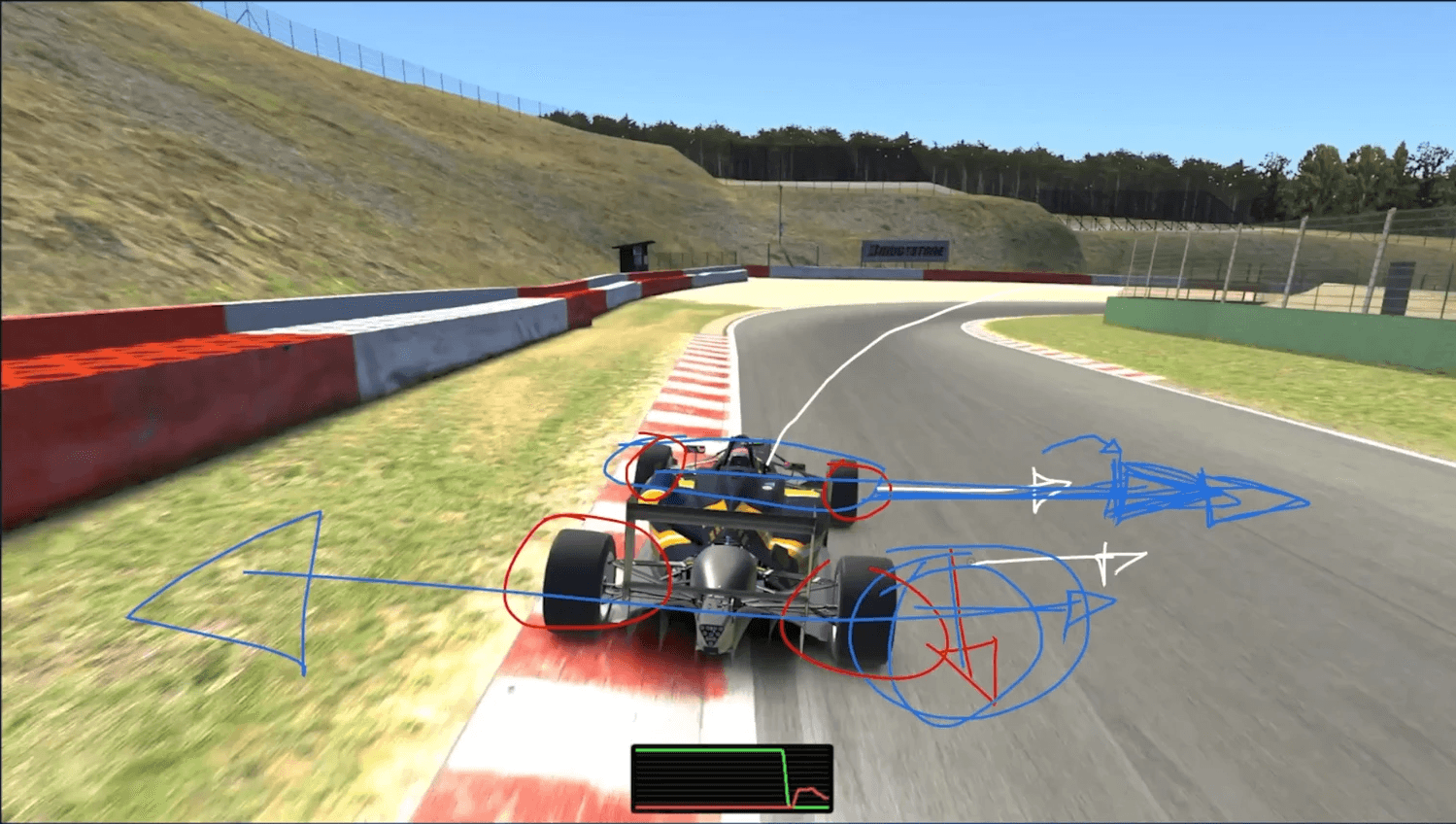
Opening spirals demonstrate how a car's cornering capabilities decrease as it gains speed. If you're accelerating and turning at the limit of the front tires and the car is gaining speed, it's going to be able to rotate less and less, creating an opening spiral. This means that every time the speed goes up, the rotation will go down from zero kilometers per hour to top speed. This effect remains consistent regardless of the speed range.
Closing Spirals
A closing spiral appears when you start decelerating. As soon as you start decelerating while continuing to turn, as the car loses speed, it's going to gain more and more rotation, creating a spiral shape until it stops. The slower the speed, the higher the rotation, from top speed all the way until minimum speed.
Every car will have a different spiral, depending on numerous factors including the setup, tires, suspension, weight, power of the engine, and especially the downforce.
The Effect of Downforce on Spirals
Low Downforce Cars
Let's start with a car with absolutely no downforce. As it gains speed, it creates an opening spiral. The more speed the car has, the less it can rotate, and this effect is very aggressive. You would have to really slow down to be able to rotate.
High Downforce Cars
Now let's take that same car and add downforce to it by adding wings and inlets, allowing the car to use the wind to push itself down at higher speeds. It would start with a very similar performance at lower speeds, but then slowly as the car gains speed, it would be able to continue rotating much more. Because as the speed goes up, the wind is helping push the car down and giving it more and more traction against the track.
At higher speeds, you can see a big difference in cornering performance, but not so much at lower speeds. For example, at 200 kilometers per hour, you have a very big performance difference while cornering compared to a low downforce version of that same car. This applies to braking as well. If you're decelerating, you're going to do a spiral where you're capable of rotating way more at lower speeds, but on a high downforce car, you can already rotate very well even when the speeds are still a little bit higher.
U-Shape Versus V-Shape Lines
V-Shape Lines (Low Downforce)
On a low downforce car, you have to decelerate to be able to rotate, but you still want to brake as late as possible. By blending the braking into the cornering, turning in a little bit earlier allows you to at least benefit from that initial rotation while still being able to decelerate well. That's why the line turns in a little bit earlier and has a little bit less angle, but then that angle exponentially increases as you get to the lower speed. When you accelerate, you also have a very aggressive opening spiral.
U-Shape Lines (High Downforce)
With a high downforce car, when starting to turn into the corner, you realize that at that entry speed, you already can actually rotate quite well. So you don't have to do such an aggressive V-shape line. You can do a more U-shape line by turning in a little bit later, because now you can benefit from that extra speed to help with the cornering. This allows you to carry more speed into the corner to benefit from that downforce and have a lot more rotation at the extremes of the corner, but not so much of a difference at the minimum speed, because the minimum speed is where the cornering performance difference between a high downforce car and a low downforce car is the smallest.
This is the core concept behind U-shape versus V-shape lines. A V-shape line is never going to be actually braking on a straight line towards the apex. It's just that it looks more like an ellipse and less like a circle. A U-shape line is a lot more round, because you can benefit already from that speed and you don't have to decelerate so progressively as you turn into the corner. You want to keep that speed a little bit higher on corner entry to still benefit from the downforce on turn in.
Impact on Racing Lines
This affects every corner, because every corner will have a corner entry speed and a minimum speed. The corner entry speed is most of the time, especially for trail braking into the corner, going to be way higher. So with high downforce, that produces a different line. That is why with a high downforce car, almost all lines in all corners are going to be different compared to a low downforce car.
Real-World Examples: Eau Rouge at Spa
High Downforce Example (McLaren F1)
Looking at Eau Rouge at Spa with the McLaren F1:
Start braking later
Start turning in, getting off the curb just before a specific reference point
Hit the apex deep into the corner, almost at the middle
Nearly single apexing, almost riding the curb on the inside on a constant radius
The steering goes up very linearly
Apply power and open up, using the outside of the track
The turn-in point is later, getting to the apex and hugging it slightly with a double apex feel
Low Downforce Example (Porsche Cup)
Comparing the same corner with the Porsche Cup:
Start braking earlier
Already turning and getting off the curb way earlier
The turning point is a few car lengths before the Formula One
This is a V-shape line approach
Touch the inside curb much earlier (early apex)
Actually doing a double apex in this car
Continue braking pretty hard, using the brakes to rotate the car as much as possible
The car goes more to the middle, then turn even more and aggressively use the second apex
Brake and Steering Trace Differences
Brake Traces
U-shape line traces (high downforce) look like a sharp triangle with a small area on the right side. There's a lot more braking on a straight line at the very beginning of turning, and a lot less braking while turning. This is because you don't need that much trail braking with a more U-shape line.
V-shape line traces (low downforce) show similar surface area to the right compared to the left. You're turning less at entry and then more later, which constitutes a V-shape line. You're breaking a lot more while cornering because you're loading the car early and getting that lateral load, but you have to turn in very slowly and really wait for the cornering capability to show up as the speed goes down.
Steering Traces
The steering trace on a U-shape versus a V-shape is also different:
U-shape line: The steering is a lot more linear. You don't increase the steering rate more; it's like the same rate of steering back, very linear and straight
V-shape line: The steering is way more exponential. You start turning very slowly, not a lot initially, and then ramp up more quickly later because the car is capable of taking it
In the end, the line on an F1 car is still an ellipse with more rotation at the lower speed; it's just that the eccentricity of that radius is not so big. The difference in radius at the beginning of the corner and at the middle of the corner is less than in a low-downforce car. A low-downforce car has a very eccentric change and then very eccentric opening, but on an F1, it's very subtle. You still increase the steering progressively to the minimum speed and then still have to open up more and more as you get back on power.
Additional Examples: Hungaroring
Modern F1
At Hungaroring with a modern F1:
Late brake, quick turn in, one apex
Apply power, use all the track on exit
Trail-braking trace is very progressive and sharp, not a lot of brakes mid-corner
Really trusting the downforce
Very linear steering throughout
Porsche Cup
The same corner in a Porsche Cup:
Already turning at a much earlier point compared to the F1
This is a V-shape approach versus the F1's U-shape approach
First apex is earlier
The corner becomes a double apex: first apex, then out, then second apex
Much more aggressive line choice
Sacrificing the exit of the corner to carry more speed into the subsequent corner
Super early turn-in, progressive steering, ramping up the steering significantly
The brake trace shows still carrying brakes very progressively, releasing gradually, and then going straight from a higher brake percentage to power with absolutely no coasting. In the F1 example, you brake more on entry and even coast a little bit before actually accelerating. The brake density difference in a U-shape line versus a V-shape line is significant.
Driving the Car Approach
It's essential to drive the line that matches the car. Imagine someone showed you a lap in an F1 and now you're trying to do the F1 line on a Porsche Cup—it really would not work at all. That's why it's so important to match driving the car with driving the line so that you can already have an idea of what you want to do, understand in detail what the car can do in terms of spirals, and then trace your lines and decide which corners will be single apexes or double apexes.
Always remember the principle: You want to maximize grip, maximize acceleration, maximize cornering, and maximize the blend in between while keeping the car at 100% of the grip and respecting the line that it wants to trace at each speed, maximizing that line and then fitting that line on the corner.
In this lesson, we will explore opening spirals (which occur during acceleration), closing spirals, the effect of downforce on the racing line, and the crucial differences between U-shape versus V-shape lines. Understanding these concepts is essential for mastering proper racing lines.
Opening Spirals
Opening spirals demonstrate how a car's cornering capabilities decrease as it gains speed. If you're accelerating and turning at the limit of the front tires and the car is gaining speed, it's going to be able to rotate less and less, creating an opening spiral. This means that every time the speed goes up, the rotation will go down from zero kilometers per hour to top speed. This effect remains consistent regardless of the speed range.
Closing Spirals
A closing spiral appears when you start decelerating. As soon as you start decelerating while continuing to turn, as the car loses speed, it's going to gain more and more rotation, creating a spiral shape until it stops. The slower the speed, the higher the rotation, from top speed all the way until minimum speed.
Every car will have a different spiral, depending on numerous factors including the setup, tires, suspension, weight, power of the engine, and especially the downforce.
The Effect of Downforce on Spirals
Low Downforce Cars
Let's start with a car with absolutely no downforce. As it gains speed, it creates an opening spiral. The more speed the car has, the less it can rotate, and this effect is very aggressive. You would have to really slow down to be able to rotate.
High Downforce Cars
Now let's take that same car and add downforce to it by adding wings and inlets, allowing the car to use the wind to push itself down at higher speeds. It would start with a very similar performance at lower speeds, but then slowly as the car gains speed, it would be able to continue rotating much more. Because as the speed goes up, the wind is helping push the car down and giving it more and more traction against the track.
At higher speeds, you can see a big difference in cornering performance, but not so much at lower speeds. For example, at 200 kilometers per hour, you have a very big performance difference while cornering compared to a low downforce version of that same car. This applies to braking as well. If you're decelerating, you're going to do a spiral where you're capable of rotating way more at lower speeds, but on a high downforce car, you can already rotate very well even when the speeds are still a little bit higher.
U-Shape Versus V-Shape Lines
V-Shape Lines (Low Downforce)
On a low downforce car, you have to decelerate to be able to rotate, but you still want to brake as late as possible. By blending the braking into the cornering, turning in a little bit earlier allows you to at least benefit from that initial rotation while still being able to decelerate well. That's why the line turns in a little bit earlier and has a little bit less angle, but then that angle exponentially increases as you get to the lower speed. When you accelerate, you also have a very aggressive opening spiral.
U-Shape Lines (High Downforce)
With a high downforce car, when starting to turn into the corner, you realize that at that entry speed, you already can actually rotate quite well. So you don't have to do such an aggressive V-shape line. You can do a more U-shape line by turning in a little bit later, because now you can benefit from that extra speed to help with the cornering. This allows you to carry more speed into the corner to benefit from that downforce and have a lot more rotation at the extremes of the corner, but not so much of a difference at the minimum speed, because the minimum speed is where the cornering performance difference between a high downforce car and a low downforce car is the smallest.
This is the core concept behind U-shape versus V-shape lines. A V-shape line is never going to be actually braking on a straight line towards the apex. It's just that it looks more like an ellipse and less like a circle. A U-shape line is a lot more round, because you can benefit already from that speed and you don't have to decelerate so progressively as you turn into the corner. You want to keep that speed a little bit higher on corner entry to still benefit from the downforce on turn in.
Impact on Racing Lines
This affects every corner, because every corner will have a corner entry speed and a minimum speed. The corner entry speed is most of the time, especially for trail braking into the corner, going to be way higher. So with high downforce, that produces a different line. That is why with a high downforce car, almost all lines in all corners are going to be different compared to a low downforce car.
Real-World Examples: Eau Rouge at Spa
High Downforce Example (McLaren F1)
Looking at Eau Rouge at Spa with the McLaren F1:
Start braking later
Start turning in, getting off the curb just before a specific reference point
Hit the apex deep into the corner, almost at the middle
Nearly single apexing, almost riding the curb on the inside on a constant radius
The steering goes up very linearly
Apply power and open up, using the outside of the track
The turn-in point is later, getting to the apex and hugging it slightly with a double apex feel
Low Downforce Example (Porsche Cup)
Comparing the same corner with the Porsche Cup:
Start braking earlier
Already turning and getting off the curb way earlier
The turning point is a few car lengths before the Formula One
This is a V-shape line approach
Touch the inside curb much earlier (early apex)
Actually doing a double apex in this car
Continue braking pretty hard, using the brakes to rotate the car as much as possible
The car goes more to the middle, then turn even more and aggressively use the second apex
Brake and Steering Trace Differences
Brake Traces
U-shape line traces (high downforce) look like a sharp triangle with a small area on the right side. There's a lot more braking on a straight line at the very beginning of turning, and a lot less braking while turning. This is because you don't need that much trail braking with a more U-shape line.
V-shape line traces (low downforce) show similar surface area to the right compared to the left. You're turning less at entry and then more later, which constitutes a V-shape line. You're breaking a lot more while cornering because you're loading the car early and getting that lateral load, but you have to turn in very slowly and really wait for the cornering capability to show up as the speed goes down.
Steering Traces
The steering trace on a U-shape versus a V-shape is also different:
U-shape line: The steering is a lot more linear. You don't increase the steering rate more; it's like the same rate of steering back, very linear and straight
V-shape line: The steering is way more exponential. You start turning very slowly, not a lot initially, and then ramp up more quickly later because the car is capable of taking it
In the end, the line on an F1 car is still an ellipse with more rotation at the lower speed; it's just that the eccentricity of that radius is not so big. The difference in radius at the beginning of the corner and at the middle of the corner is less than in a low-downforce car. A low-downforce car has a very eccentric change and then very eccentric opening, but on an F1, it's very subtle. You still increase the steering progressively to the minimum speed and then still have to open up more and more as you get back on power.
Additional Examples: Hungaroring
Modern F1
At Hungaroring with a modern F1:
Late brake, quick turn in, one apex
Apply power, use all the track on exit
Trail-braking trace is very progressive and sharp, not a lot of brakes mid-corner
Really trusting the downforce
Very linear steering throughout
Porsche Cup
The same corner in a Porsche Cup:
Already turning at a much earlier point compared to the F1
This is a V-shape approach versus the F1's U-shape approach
First apex is earlier
The corner becomes a double apex: first apex, then out, then second apex
Much more aggressive line choice
Sacrificing the exit of the corner to carry more speed into the subsequent corner
Super early turn-in, progressive steering, ramping up the steering significantly
The brake trace shows still carrying brakes very progressively, releasing gradually, and then going straight from a higher brake percentage to power with absolutely no coasting. In the F1 example, you brake more on entry and even coast a little bit before actually accelerating. The brake density difference in a U-shape line versus a V-shape line is significant.
Driving the Car Approach
It's essential to drive the line that matches the car. Imagine someone showed you a lap in an F1 and now you're trying to do the F1 line on a Porsche Cup—it really would not work at all. That's why it's so important to match driving the car with driving the line so that you can already have an idea of what you want to do, understand in detail what the car can do in terms of spirals, and then trace your lines and decide which corners will be single apexes or double apexes.
Always remember the principle: You want to maximize grip, maximize acceleration, maximize cornering, and maximize the blend in between while keeping the car at 100% of the grip and respecting the line that it wants to trace at each speed, maximizing that line and then fitting that line on the corner.
In this lesson, we will explore opening spirals (which occur during acceleration), closing spirals, the effect of downforce on the racing line, and the crucial differences between U-shape versus V-shape lines. Understanding these concepts is essential for mastering proper racing lines.
Opening Spirals
Opening spirals demonstrate how a car's cornering capabilities decrease as it gains speed. If you're accelerating and turning at the limit of the front tires and the car is gaining speed, it's going to be able to rotate less and less, creating an opening spiral. This means that every time the speed goes up, the rotation will go down from zero kilometers per hour to top speed. This effect remains consistent regardless of the speed range.
Closing Spirals
A closing spiral appears when you start decelerating. As soon as you start decelerating while continuing to turn, as the car loses speed, it's going to gain more and more rotation, creating a spiral shape until it stops. The slower the speed, the higher the rotation, from top speed all the way until minimum speed.
Every car will have a different spiral, depending on numerous factors including the setup, tires, suspension, weight, power of the engine, and especially the downforce.
The Effect of Downforce on Spirals
Low Downforce Cars
Let's start with a car with absolutely no downforce. As it gains speed, it creates an opening spiral. The more speed the car has, the less it can rotate, and this effect is very aggressive. You would have to really slow down to be able to rotate.
High Downforce Cars
Now let's take that same car and add downforce to it by adding wings and inlets, allowing the car to use the wind to push itself down at higher speeds. It would start with a very similar performance at lower speeds, but then slowly as the car gains speed, it would be able to continue rotating much more. Because as the speed goes up, the wind is helping push the car down and giving it more and more traction against the track.
At higher speeds, you can see a big difference in cornering performance, but not so much at lower speeds. For example, at 200 kilometers per hour, you have a very big performance difference while cornering compared to a low downforce version of that same car. This applies to braking as well. If you're decelerating, you're going to do a spiral where you're capable of rotating way more at lower speeds, but on a high downforce car, you can already rotate very well even when the speeds are still a little bit higher.
U-Shape Versus V-Shape Lines
V-Shape Lines (Low Downforce)
On a low downforce car, you have to decelerate to be able to rotate, but you still want to brake as late as possible. By blending the braking into the cornering, turning in a little bit earlier allows you to at least benefit from that initial rotation while still being able to decelerate well. That's why the line turns in a little bit earlier and has a little bit less angle, but then that angle exponentially increases as you get to the lower speed. When you accelerate, you also have a very aggressive opening spiral.
U-Shape Lines (High Downforce)
With a high downforce car, when starting to turn into the corner, you realize that at that entry speed, you already can actually rotate quite well. So you don't have to do such an aggressive V-shape line. You can do a more U-shape line by turning in a little bit later, because now you can benefit from that extra speed to help with the cornering. This allows you to carry more speed into the corner to benefit from that downforce and have a lot more rotation at the extremes of the corner, but not so much of a difference at the minimum speed, because the minimum speed is where the cornering performance difference between a high downforce car and a low downforce car is the smallest.
This is the core concept behind U-shape versus V-shape lines. A V-shape line is never going to be actually braking on a straight line towards the apex. It's just that it looks more like an ellipse and less like a circle. A U-shape line is a lot more round, because you can benefit already from that speed and you don't have to decelerate so progressively as you turn into the corner. You want to keep that speed a little bit higher on corner entry to still benefit from the downforce on turn in.
Impact on Racing Lines
This affects every corner, because every corner will have a corner entry speed and a minimum speed. The corner entry speed is most of the time, especially for trail braking into the corner, going to be way higher. So with high downforce, that produces a different line. That is why with a high downforce car, almost all lines in all corners are going to be different compared to a low downforce car.
Real-World Examples: Eau Rouge at Spa
High Downforce Example (McLaren F1)
Looking at Eau Rouge at Spa with the McLaren F1:
Start braking later
Start turning in, getting off the curb just before a specific reference point
Hit the apex deep into the corner, almost at the middle
Nearly single apexing, almost riding the curb on the inside on a constant radius
The steering goes up very linearly
Apply power and open up, using the outside of the track
The turn-in point is later, getting to the apex and hugging it slightly with a double apex feel
Low Downforce Example (Porsche Cup)
Comparing the same corner with the Porsche Cup:
Start braking earlier
Already turning and getting off the curb way earlier
The turning point is a few car lengths before the Formula One
This is a V-shape line approach
Touch the inside curb much earlier (early apex)
Actually doing a double apex in this car
Continue braking pretty hard, using the brakes to rotate the car as much as possible
The car goes more to the middle, then turn even more and aggressively use the second apex
Brake and Steering Trace Differences
Brake Traces
U-shape line traces (high downforce) look like a sharp triangle with a small area on the right side. There's a lot more braking on a straight line at the very beginning of turning, and a lot less braking while turning. This is because you don't need that much trail braking with a more U-shape line.
V-shape line traces (low downforce) show similar surface area to the right compared to the left. You're turning less at entry and then more later, which constitutes a V-shape line. You're breaking a lot more while cornering because you're loading the car early and getting that lateral load, but you have to turn in very slowly and really wait for the cornering capability to show up as the speed goes down.
Steering Traces
The steering trace on a U-shape versus a V-shape is also different:
U-shape line: The steering is a lot more linear. You don't increase the steering rate more; it's like the same rate of steering back, very linear and straight
V-shape line: The steering is way more exponential. You start turning very slowly, not a lot initially, and then ramp up more quickly later because the car is capable of taking it
In the end, the line on an F1 car is still an ellipse with more rotation at the lower speed; it's just that the eccentricity of that radius is not so big. The difference in radius at the beginning of the corner and at the middle of the corner is less than in a low-downforce car. A low-downforce car has a very eccentric change and then very eccentric opening, but on an F1, it's very subtle. You still increase the steering progressively to the minimum speed and then still have to open up more and more as you get back on power.
Additional Examples: Hungaroring
Modern F1
At Hungaroring with a modern F1:
Late brake, quick turn in, one apex
Apply power, use all the track on exit
Trail-braking trace is very progressive and sharp, not a lot of brakes mid-corner
Really trusting the downforce
Very linear steering throughout
Porsche Cup
The same corner in a Porsche Cup:
Already turning at a much earlier point compared to the F1
This is a V-shape approach versus the F1's U-shape approach
First apex is earlier
The corner becomes a double apex: first apex, then out, then second apex
Much more aggressive line choice
Sacrificing the exit of the corner to carry more speed into the subsequent corner
Super early turn-in, progressive steering, ramping up the steering significantly
The brake trace shows still carrying brakes very progressively, releasing gradually, and then going straight from a higher brake percentage to power with absolutely no coasting. In the F1 example, you brake more on entry and even coast a little bit before actually accelerating. The brake density difference in a U-shape line versus a V-shape line is significant.
Driving the Car Approach
It's essential to drive the line that matches the car. Imagine someone showed you a lap in an F1 and now you're trying to do the F1 line on a Porsche Cup—it really would not work at all. That's why it's so important to match driving the car with driving the line so that you can already have an idea of what you want to do, understand in detail what the car can do in terms of spirals, and then trace your lines and decide which corners will be single apexes or double apexes.
Always remember the principle: You want to maximize grip, maximize acceleration, maximize cornering, and maximize the blend in between while keeping the car at 100% of the grip and respecting the line that it wants to trace at each speed, maximizing that line and then fitting that line on the corner.
Consistency & Confidence
Balance & Speed
Mastery
Other Lessons