Maximum Rotation Point
Lesson
31
of
49

Lesson by
Suellio Almeida
Lesson by
Suellio Almeida
Mark as Finished
Maximum Rotation Point Fundamentals
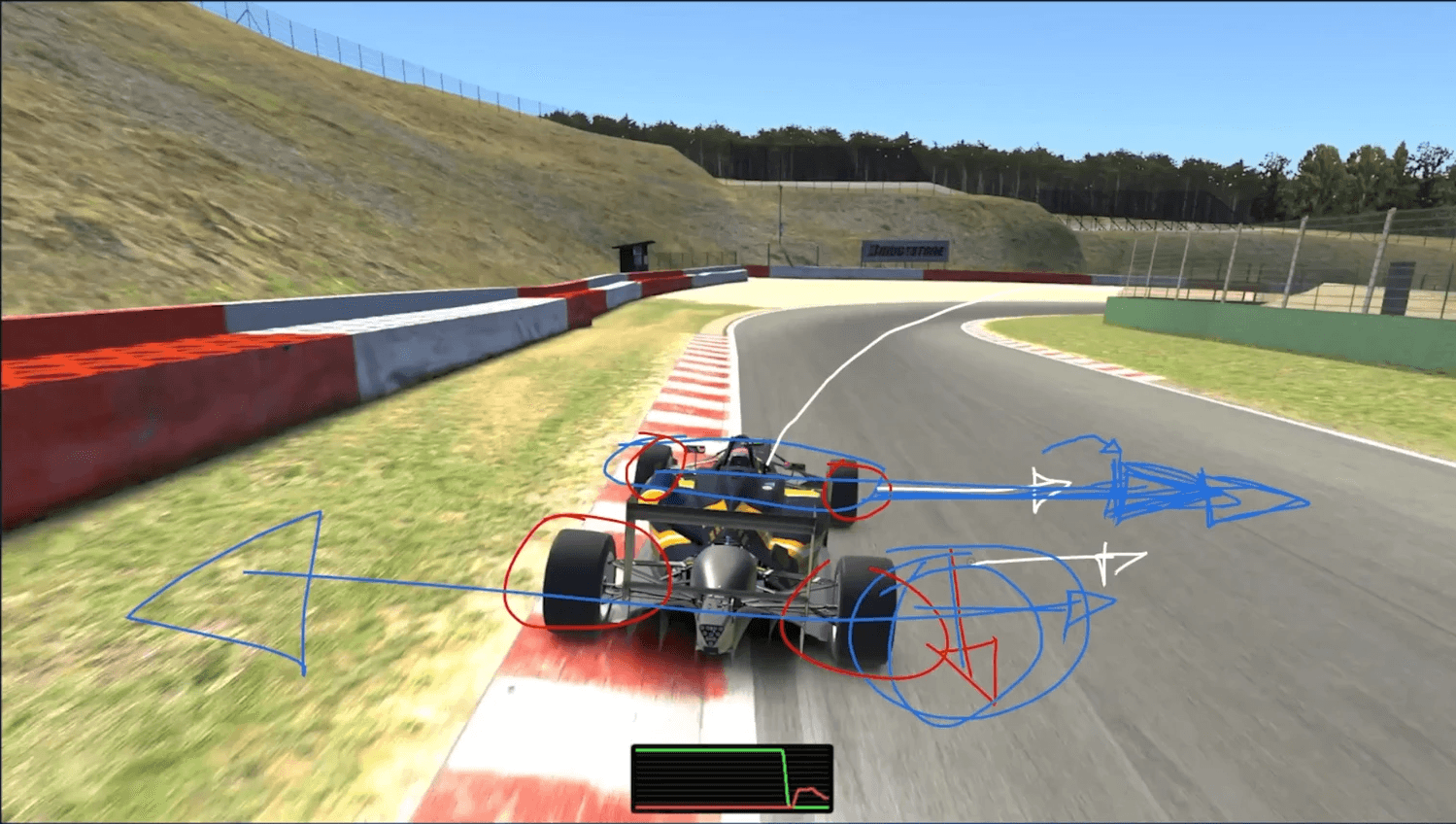
The maximum rotation point (MRP) is a direct result of the inverse relation between speed and rotation. We will reach our maximum rotation at the minimum speed. This is very important to know because we tend to underuse the tires at the minimum speed in many situations, especially after having sketchy or slightly corner entries.
Why the MRP Exists
The maximum rotation point only exists because the radius of the corner is different depending on where you are. At the minimum speed, which is more or less where we start accelerating, is where we reach the minimum speed, therefore the maximum rotation, therefore the smallest radius.
Even the car with the most downforce available will not follow a perfect circle. The racing line will always have some sort of elliptical nature. When you overlay a perfect circle on the racing line, you can see that we rotate a little bit less at the extremities and a little bit more at the minimum speeds. A Formula One car, or anything with less downforce than a Formula One car, will have an even more aggressive elliptical shape in its racing line compared to the perfect circle.
The geometric line is not very realistic, and if we have a geometric line we don't have a maximum rotation point - we rotate exactly the same at every spot. When we do have an elliptical line, that means we have a closing spiral, then an opening spiral, and the intersection between the closing and opening spirals constitutes an MRP. This is the best way for us to structure the corner and divide the corner into entry and exit.
Defining Apex vs. Maximum Rotation Point
It's important to understand that every time we talk about the apex, we are talking about the physical limits of the corner on the inside. That's pretty much it. A lot of people will say there's a car's apex and there's the corner's apex. For us, the car's apex is going to be the maximum rotation point. We have:
The apex: the inside limit of the corner
The maximum rotation point: the place at which the car rotates the most
Distance Between MRP and Apex
A very good baseline is to actually place both the MRP and apex at the same spot. You will most of the time have your maximum rotation point so close to the apex that you can get away with always trying to place your MRP at the apex and still be very fast. The difference when you use a later apex approach is going to be very subtle, but there is a difference in terms of efficiency and lap time.
Early vs. Late Apex Strategy
Because cars are actually more efficient at decelerating rather than accelerating, it's going to be a little bit faster if you try to concentrate a little bit more of the rotation at the first half of the corner. You will get a little bit more rotation and try to get a little bit better, straighter line for the exit. When you try to get a little bit more rotation and try to get a little bit better straighter line for the exit, you're actually touching the inside a little bit later, although you're getting back on power a little bit earlier.
The distance between the maximum rotation point (which is when you accelerate) and the apex is bigger in a later apex approach. Late apex means early maximum rotation point - lots of rotation on entry and early acceleration to allow you to really carry that speed on the exit.
Aggressive Late Apex Example
A very aggressive late apex is actually realistically possible if you're driving a very low speed hairpin in a high powered car. You want to get back on power early and you want to actually straighten your exit because it's going to be very easy to get traction control or wheelspin. In this case, you brake late, you turn late, but then you accelerate earlier and you prepare that exit to get the best exit speed possible.
Early Apex Example
An early apex is where you actually accelerate very close to, or pretty much at the same time you reach the apex. In a symmetrical corner, you consider the apex to be the exact middle where we reach the closest spot to the center of the corner.
When you're driving and actually trying to do this, we're talking about maybe getting back on power 0.2 or 0.3 seconds before the actual apex. Although this looks a little bit aggressive on the top down shot, when you're actually driving it's not that much of a difference.
Identifying the MRP in Telemetry
The maximum rotation point can be identified in telemetry by looking at the yaw rate graphs. The yaw rate is pretty much how many degrees per second the car is turning or rotating. If the car is rotating 360 degrees per second, that means the car is doing a full circle every second.
Key Telemetry Indicators at the MRP
At the maximum rotation point, you can see several things happening simultaneously:
Minimum speed area
Highest yaw rate
Peak steering angle
End of braking
Beginning of throttle
Everything happens at the same time. The maximum rotation point is the culmination, the climax of the corner where you then divide it into an organized plan to organize what you want to do. It makes everything way easier.
Telemetry Patterns
The patterns visible in telemetry are very clear:
Speed goes down until the MRP and then it goes up
Gearing also goes down and then up
Yaw rate reaches its peak and then goes down
Steering reaches its peak and then goes down
This is when we stop braking and start accelerating
Practical Application: Cornering Process
The cornering process is very simple because you divide the corner into two halves: do the first half, do the second half, and that's it.
Entry to MRP (Closing Spiral)
On corner entry:
Start braking
Add steering progressively
Speed is going down
Steering is increasing
Rotation is increasing
Still trail braking as you add more steering
MRP to Exit (Opening Spiral)
After reaching the MRP:
Apply throttle at the peak steering point
Steering goes back (unwinding)
Not gaining rotation - the car is on the limit
Less steering, more throttle
The car is rotating less and less while gaining speed
Important Concept: Rotation in Power
It's very important to understand that if you gain rotation and speed at the same time, you're going to lose the car - either spin or just understeer and go off. This is a very common misconception that you have to rotate the car in power. You should just maintain the rotation that you had before and then the rotation should go down. So: power, less steering, and then the car is rotating less and less and less while gaining speed.
Maximizing the MRP Opportunity
Your opportunity to rotate the most is at the minimum speed, so you really need to maximize this moment. If you hesitate and don't get that rotation, instead of getting a nice line that uses all the track, you end up deviating the line a little bit and can end up going to the gravel and having big issues.
Full Lap Integration
The MRP concept applies to every corner on a lap. The pattern remains consistent:
Closing spiral: more steering, more steering, more steering, still trail braking
MRP: peak rotation, minimum speed, begin acceleration
Opening spiral: unwind steering, less steering, less steering, car loses rotation naturally
This is how you divide all corners. The MRP is a fundamental way to organize the corner and to explain more complex concepts. It provides a clear structure for understanding both the entry and exit phases of every corner.
Maximum Rotation Point Fundamentals
The maximum rotation point (MRP) is a direct result of the inverse relation between speed and rotation. We will reach our maximum rotation at the minimum speed. This is very important to know because we tend to underuse the tires at the minimum speed in many situations, especially after having sketchy or slightly corner entries.
Why the MRP Exists
The maximum rotation point only exists because the radius of the corner is different depending on where you are. At the minimum speed, which is more or less where we start accelerating, is where we reach the minimum speed, therefore the maximum rotation, therefore the smallest radius.
Even the car with the most downforce available will not follow a perfect circle. The racing line will always have some sort of elliptical nature. When you overlay a perfect circle on the racing line, you can see that we rotate a little bit less at the extremities and a little bit more at the minimum speeds. A Formula One car, or anything with less downforce than a Formula One car, will have an even more aggressive elliptical shape in its racing line compared to the perfect circle.
The geometric line is not very realistic, and if we have a geometric line we don't have a maximum rotation point - we rotate exactly the same at every spot. When we do have an elliptical line, that means we have a closing spiral, then an opening spiral, and the intersection between the closing and opening spirals constitutes an MRP. This is the best way for us to structure the corner and divide the corner into entry and exit.
Defining Apex vs. Maximum Rotation Point
It's important to understand that every time we talk about the apex, we are talking about the physical limits of the corner on the inside. That's pretty much it. A lot of people will say there's a car's apex and there's the corner's apex. For us, the car's apex is going to be the maximum rotation point. We have:
The apex: the inside limit of the corner
The maximum rotation point: the place at which the car rotates the most
Distance Between MRP and Apex
A very good baseline is to actually place both the MRP and apex at the same spot. You will most of the time have your maximum rotation point so close to the apex that you can get away with always trying to place your MRP at the apex and still be very fast. The difference when you use a later apex approach is going to be very subtle, but there is a difference in terms of efficiency and lap time.
Early vs. Late Apex Strategy
Because cars are actually more efficient at decelerating rather than accelerating, it's going to be a little bit faster if you try to concentrate a little bit more of the rotation at the first half of the corner. You will get a little bit more rotation and try to get a little bit better, straighter line for the exit. When you try to get a little bit more rotation and try to get a little bit better straighter line for the exit, you're actually touching the inside a little bit later, although you're getting back on power a little bit earlier.
The distance between the maximum rotation point (which is when you accelerate) and the apex is bigger in a later apex approach. Late apex means early maximum rotation point - lots of rotation on entry and early acceleration to allow you to really carry that speed on the exit.
Aggressive Late Apex Example
A very aggressive late apex is actually realistically possible if you're driving a very low speed hairpin in a high powered car. You want to get back on power early and you want to actually straighten your exit because it's going to be very easy to get traction control or wheelspin. In this case, you brake late, you turn late, but then you accelerate earlier and you prepare that exit to get the best exit speed possible.
Early Apex Example
An early apex is where you actually accelerate very close to, or pretty much at the same time you reach the apex. In a symmetrical corner, you consider the apex to be the exact middle where we reach the closest spot to the center of the corner.
When you're driving and actually trying to do this, we're talking about maybe getting back on power 0.2 or 0.3 seconds before the actual apex. Although this looks a little bit aggressive on the top down shot, when you're actually driving it's not that much of a difference.
Identifying the MRP in Telemetry
The maximum rotation point can be identified in telemetry by looking at the yaw rate graphs. The yaw rate is pretty much how many degrees per second the car is turning or rotating. If the car is rotating 360 degrees per second, that means the car is doing a full circle every second.
Key Telemetry Indicators at the MRP
At the maximum rotation point, you can see several things happening simultaneously:
Minimum speed area
Highest yaw rate
Peak steering angle
End of braking
Beginning of throttle
Everything happens at the same time. The maximum rotation point is the culmination, the climax of the corner where you then divide it into an organized plan to organize what you want to do. It makes everything way easier.
Telemetry Patterns
The patterns visible in telemetry are very clear:
Speed goes down until the MRP and then it goes up
Gearing also goes down and then up
Yaw rate reaches its peak and then goes down
Steering reaches its peak and then goes down
This is when we stop braking and start accelerating
Practical Application: Cornering Process
The cornering process is very simple because you divide the corner into two halves: do the first half, do the second half, and that's it.
Entry to MRP (Closing Spiral)
On corner entry:
Start braking
Add steering progressively
Speed is going down
Steering is increasing
Rotation is increasing
Still trail braking as you add more steering
MRP to Exit (Opening Spiral)
After reaching the MRP:
Apply throttle at the peak steering point
Steering goes back (unwinding)
Not gaining rotation - the car is on the limit
Less steering, more throttle
The car is rotating less and less while gaining speed
Important Concept: Rotation in Power
It's very important to understand that if you gain rotation and speed at the same time, you're going to lose the car - either spin or just understeer and go off. This is a very common misconception that you have to rotate the car in power. You should just maintain the rotation that you had before and then the rotation should go down. So: power, less steering, and then the car is rotating less and less and less while gaining speed.
Maximizing the MRP Opportunity
Your opportunity to rotate the most is at the minimum speed, so you really need to maximize this moment. If you hesitate and don't get that rotation, instead of getting a nice line that uses all the track, you end up deviating the line a little bit and can end up going to the gravel and having big issues.
Full Lap Integration
The MRP concept applies to every corner on a lap. The pattern remains consistent:
Closing spiral: more steering, more steering, more steering, still trail braking
MRP: peak rotation, minimum speed, begin acceleration
Opening spiral: unwind steering, less steering, less steering, car loses rotation naturally
This is how you divide all corners. The MRP is a fundamental way to organize the corner and to explain more complex concepts. It provides a clear structure for understanding both the entry and exit phases of every corner.
Maximum Rotation Point Fundamentals
The maximum rotation point (MRP) is a direct result of the inverse relation between speed and rotation. We will reach our maximum rotation at the minimum speed. This is very important to know because we tend to underuse the tires at the minimum speed in many situations, especially after having sketchy or slightly corner entries.
Why the MRP Exists
The maximum rotation point only exists because the radius of the corner is different depending on where you are. At the minimum speed, which is more or less where we start accelerating, is where we reach the minimum speed, therefore the maximum rotation, therefore the smallest radius.
Even the car with the most downforce available will not follow a perfect circle. The racing line will always have some sort of elliptical nature. When you overlay a perfect circle on the racing line, you can see that we rotate a little bit less at the extremities and a little bit more at the minimum speeds. A Formula One car, or anything with less downforce than a Formula One car, will have an even more aggressive elliptical shape in its racing line compared to the perfect circle.
The geometric line is not very realistic, and if we have a geometric line we don't have a maximum rotation point - we rotate exactly the same at every spot. When we do have an elliptical line, that means we have a closing spiral, then an opening spiral, and the intersection between the closing and opening spirals constitutes an MRP. This is the best way for us to structure the corner and divide the corner into entry and exit.
Defining Apex vs. Maximum Rotation Point
It's important to understand that every time we talk about the apex, we are talking about the physical limits of the corner on the inside. That's pretty much it. A lot of people will say there's a car's apex and there's the corner's apex. For us, the car's apex is going to be the maximum rotation point. We have:
The apex: the inside limit of the corner
The maximum rotation point: the place at which the car rotates the most
Distance Between MRP and Apex
A very good baseline is to actually place both the MRP and apex at the same spot. You will most of the time have your maximum rotation point so close to the apex that you can get away with always trying to place your MRP at the apex and still be very fast. The difference when you use a later apex approach is going to be very subtle, but there is a difference in terms of efficiency and lap time.
Early vs. Late Apex Strategy
Because cars are actually more efficient at decelerating rather than accelerating, it's going to be a little bit faster if you try to concentrate a little bit more of the rotation at the first half of the corner. You will get a little bit more rotation and try to get a little bit better, straighter line for the exit. When you try to get a little bit more rotation and try to get a little bit better straighter line for the exit, you're actually touching the inside a little bit later, although you're getting back on power a little bit earlier.
The distance between the maximum rotation point (which is when you accelerate) and the apex is bigger in a later apex approach. Late apex means early maximum rotation point - lots of rotation on entry and early acceleration to allow you to really carry that speed on the exit.
Aggressive Late Apex Example
A very aggressive late apex is actually realistically possible if you're driving a very low speed hairpin in a high powered car. You want to get back on power early and you want to actually straighten your exit because it's going to be very easy to get traction control or wheelspin. In this case, you brake late, you turn late, but then you accelerate earlier and you prepare that exit to get the best exit speed possible.
Early Apex Example
An early apex is where you actually accelerate very close to, or pretty much at the same time you reach the apex. In a symmetrical corner, you consider the apex to be the exact middle where we reach the closest spot to the center of the corner.
When you're driving and actually trying to do this, we're talking about maybe getting back on power 0.2 or 0.3 seconds before the actual apex. Although this looks a little bit aggressive on the top down shot, when you're actually driving it's not that much of a difference.
Identifying the MRP in Telemetry
The maximum rotation point can be identified in telemetry by looking at the yaw rate graphs. The yaw rate is pretty much how many degrees per second the car is turning or rotating. If the car is rotating 360 degrees per second, that means the car is doing a full circle every second.
Key Telemetry Indicators at the MRP
At the maximum rotation point, you can see several things happening simultaneously:
Minimum speed area
Highest yaw rate
Peak steering angle
End of braking
Beginning of throttle
Everything happens at the same time. The maximum rotation point is the culmination, the climax of the corner where you then divide it into an organized plan to organize what you want to do. It makes everything way easier.
Telemetry Patterns
The patterns visible in telemetry are very clear:
Speed goes down until the MRP and then it goes up
Gearing also goes down and then up
Yaw rate reaches its peak and then goes down
Steering reaches its peak and then goes down
This is when we stop braking and start accelerating
Practical Application: Cornering Process
The cornering process is very simple because you divide the corner into two halves: do the first half, do the second half, and that's it.
Entry to MRP (Closing Spiral)
On corner entry:
Start braking
Add steering progressively
Speed is going down
Steering is increasing
Rotation is increasing
Still trail braking as you add more steering
MRP to Exit (Opening Spiral)
After reaching the MRP:
Apply throttle at the peak steering point
Steering goes back (unwinding)
Not gaining rotation - the car is on the limit
Less steering, more throttle
The car is rotating less and less while gaining speed
Important Concept: Rotation in Power
It's very important to understand that if you gain rotation and speed at the same time, you're going to lose the car - either spin or just understeer and go off. This is a very common misconception that you have to rotate the car in power. You should just maintain the rotation that you had before and then the rotation should go down. So: power, less steering, and then the car is rotating less and less and less while gaining speed.
Maximizing the MRP Opportunity
Your opportunity to rotate the most is at the minimum speed, so you really need to maximize this moment. If you hesitate and don't get that rotation, instead of getting a nice line that uses all the track, you end up deviating the line a little bit and can end up going to the gravel and having big issues.
Full Lap Integration
The MRP concept applies to every corner on a lap. The pattern remains consistent:
Closing spiral: more steering, more steering, more steering, still trail braking
MRP: peak rotation, minimum speed, begin acceleration
Opening spiral: unwind steering, less steering, less steering, car loses rotation naturally
This is how you divide all corners. The MRP is a fundamental way to organize the corner and to explain more complex concepts. It provides a clear structure for understanding both the entry and exit phases of every corner.
Consistency & Confidence
Balance & Speed
Mastery
Other Lessons