Double Apexes
Lesson
35
of
49

Lesson by
Suellio Almeida
Lesson by
Suellio Almeida
Mark as Finished
Understanding Double Apex Corners
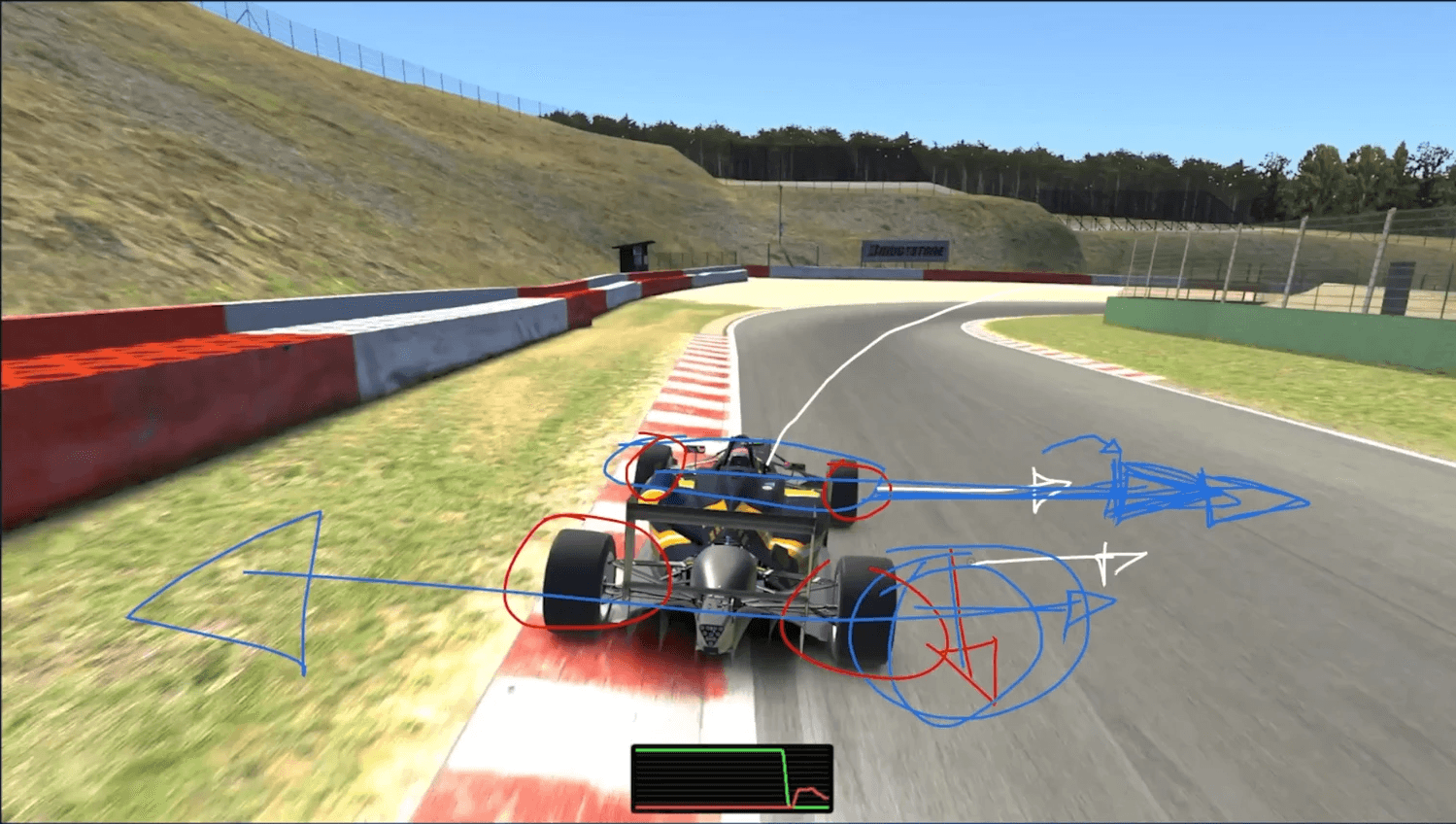
The most basic definition of a double apex is a corner where you touch the inside, then you go a little bit wide, and then you touch the inside on a second moment before you exit that corner. A double apex can be a very obvious one, if the corners are quite square, and then the line already kind of throws you to the middle, and then you can just get back to the second corner because there are two separate corners that are very close to each other. Or it's just one consistent corner that is so long and so big radius that the faster line because of the closing spiral behavior of a car that's accelerating becomes one where you touch the inside and you let the car run off and then you touch the inside again.
Of course, the second one is less obvious, and that's where most people make the most mistakes of getting stuck inside over slowing into the corner and just losing a lot of time. The magic of double apexing long corners like that is that there's a double benefit. There's a benefit of breaking later and carrying more speed on entry and accelerating more aggressively and having a better line to carry more speed on the exit.
Single Apex Approach vs. Double Apex Approach
If you try to take a single apex approach in a corner like this, for example, you have to turn in a little bit later, and then by the time you start turning in, you realize that the car is at some point here going to be under the limit. Because the corner is so consistent that if you're turning from here and you're planning to take this line, the speed of the car will decrease and the car is actually going to be able to do more rotation than necessary. Remember, the closing spiral. In order to stay on the limit, what you want to do is actually carry more speed.
So you carry more speed, but let's say that we start turning in the same place. If you carry more speed and you turn in the same place, then you will miss the corner a little bit too much. And then here, you're going to be a little bit too slow too early and you will want to accelerate. By the time you accelerate, you hit the inside too early and it just doesn't work if you use the same turning point.
The Double Apex Technique
So in a double apex approach, what we want to do is turn in earlier. So instead of touching the inside here, we're going to turn in way earlier like this. Then let's say we touch the apex right here. Now, at this point in time, comparing these two lines, the outside line, that is single apex approach and the inside line, the inside line, you're carrying a lot more speed because you're carrying more speed and here's a secret. Don't ignore this. The car will want to go wider because you are faster. The car is not capable of sticking to the inside here. So it will run off on its own. You have no choice. If the speed is right, the car is going to take itself wide after you hit the first apex.
And then when you point back, you start accelerating and here's the second benefit. When you start accelerating, the line that you can take here is much straighter and you can carry a lot more speed if your car is placed here compared to being placed here. So you see, you gain time on entry because you're carrying a lot more speed here. You're carrying more speed on this inside line. But then, because of this extra speed, the inertia will take you wide. But that's fine because you have the space to do it. The corner is long. And then by the time you get here, you already gain speed, but your car is a little bit wider, which allows you to do a wider arc here. And then by the time you get back on power, you can do it more aggressively and you can carry a lot more speed. So you gain time here and you gain time here.
This is why we double apex in long corners because the nature of the line when the cars on the limit will be elliptical will not be circular.
Downforce Effects on Double Apex Corners
Low Downforce Characteristics
Now, here's what you really need to know about double apex depending on how much downforce the car has. So this is what would look like in a very low downforce car, like a Porsche Cup or a GT car with low downforce settings. What happens is the car is not able to rotate at the higher speeds yet. So it needs to turn in very early. And then in low downforce, we hit the apex pretty early. So the first apex is very early. We carry a lot of speed. We're still accelerating. We're still accelerating. And then the car wants to go wide. Again, the natural behavior of the car is to go wide all the way here. Then we get back on power right here. And then the second time we hit the apex is actually very late. So in a low downforce scenario, the distance between the two apexes is very big.
Higher Downforce Characteristics
Now, in a different scenario where the car has a little bit more downforce, here's what happens. Let's add downforce very slowly. So as you can see, the V shape line is becoming a more U shape line because now in this configuration here, the car is able to rotate a lot more on higher speeds on entry. This is the extreme scenario of like a former one car that has a lot of turning capability on entry already. So the turning point actually moved forward a lot. Again, compare the turning point here to the turning point of a former car. So this is the turning point of a high downforce car right here. And this is the turning point of a low downforce car here. So you can see the distance here. It's like four, maybe five, six car lengths. It's pretty big.
On the high downforce car, it's possible that if the car has enough downforce, it can transform what would be a double apex in other cars into a single apex because the line is so U shaped, it's actually capable while being on the limit, hit the inside only once and then accelerate and start going wide and have the grip to do that while being on the limit.
Summary of Downforce Effects
So to recap, low downforce car, early turn in, early apex, big distance between the two apexes and the car goes very wide in between at the MRP. The MRP will always be in between the two apexes in a slightly higher downforce scenario. What we have, we turn in a little bit later. The distance between the apexes is much smaller now compared to here when it was on the low downforce. The distance actually closed then a little bit and the car still goes wide but a lot less. It went to this point instead of this point on the super low downforce.
So it's a progression. You see, we have less downforce, huge distance right here between the car and the inside in between the apexes and then the more downforce we have the closer it gets, the closer it gets, the closer it gets. All the way to the point where if you have enough downforce, that actually becomes a single apex.
Key Characteristics to Observe
And although it seems very clear in my illustrations, as always, the differences in real life are actually pretty subtle. So as an exercise for you here, just try to notice the subtle differences between these characteristics. High downforce on the left, low downforce on the right and identify whatever we discussed in this lesson in these videos. I'm not going to show anything. I just want you to pay attention and train your eyes for those subtle differences.
Notice the difference in turning points in V shape versus U shape line, how far apart are the apexes and how far from the inside the car is by the time we start getting back on power.
Understanding Double Apex Corners
The most basic definition of a double apex is a corner where you touch the inside, then you go a little bit wide, and then you touch the inside on a second moment before you exit that corner. A double apex can be a very obvious one, if the corners are quite square, and then the line already kind of throws you to the middle, and then you can just get back to the second corner because there are two separate corners that are very close to each other. Or it's just one consistent corner that is so long and so big radius that the faster line because of the closing spiral behavior of a car that's accelerating becomes one where you touch the inside and you let the car run off and then you touch the inside again.
Of course, the second one is less obvious, and that's where most people make the most mistakes of getting stuck inside over slowing into the corner and just losing a lot of time. The magic of double apexing long corners like that is that there's a double benefit. There's a benefit of breaking later and carrying more speed on entry and accelerating more aggressively and having a better line to carry more speed on the exit.
Single Apex Approach vs. Double Apex Approach
If you try to take a single apex approach in a corner like this, for example, you have to turn in a little bit later, and then by the time you start turning in, you realize that the car is at some point here going to be under the limit. Because the corner is so consistent that if you're turning from here and you're planning to take this line, the speed of the car will decrease and the car is actually going to be able to do more rotation than necessary. Remember, the closing spiral. In order to stay on the limit, what you want to do is actually carry more speed.
So you carry more speed, but let's say that we start turning in the same place. If you carry more speed and you turn in the same place, then you will miss the corner a little bit too much. And then here, you're going to be a little bit too slow too early and you will want to accelerate. By the time you accelerate, you hit the inside too early and it just doesn't work if you use the same turning point.
The Double Apex Technique
So in a double apex approach, what we want to do is turn in earlier. So instead of touching the inside here, we're going to turn in way earlier like this. Then let's say we touch the apex right here. Now, at this point in time, comparing these two lines, the outside line, that is single apex approach and the inside line, the inside line, you're carrying a lot more speed because you're carrying more speed and here's a secret. Don't ignore this. The car will want to go wider because you are faster. The car is not capable of sticking to the inside here. So it will run off on its own. You have no choice. If the speed is right, the car is going to take itself wide after you hit the first apex.
And then when you point back, you start accelerating and here's the second benefit. When you start accelerating, the line that you can take here is much straighter and you can carry a lot more speed if your car is placed here compared to being placed here. So you see, you gain time on entry because you're carrying a lot more speed here. You're carrying more speed on this inside line. But then, because of this extra speed, the inertia will take you wide. But that's fine because you have the space to do it. The corner is long. And then by the time you get here, you already gain speed, but your car is a little bit wider, which allows you to do a wider arc here. And then by the time you get back on power, you can do it more aggressively and you can carry a lot more speed. So you gain time here and you gain time here.
This is why we double apex in long corners because the nature of the line when the cars on the limit will be elliptical will not be circular.
Downforce Effects on Double Apex Corners
Low Downforce Characteristics
Now, here's what you really need to know about double apex depending on how much downforce the car has. So this is what would look like in a very low downforce car, like a Porsche Cup or a GT car with low downforce settings. What happens is the car is not able to rotate at the higher speeds yet. So it needs to turn in very early. And then in low downforce, we hit the apex pretty early. So the first apex is very early. We carry a lot of speed. We're still accelerating. We're still accelerating. And then the car wants to go wide. Again, the natural behavior of the car is to go wide all the way here. Then we get back on power right here. And then the second time we hit the apex is actually very late. So in a low downforce scenario, the distance between the two apexes is very big.
Higher Downforce Characteristics
Now, in a different scenario where the car has a little bit more downforce, here's what happens. Let's add downforce very slowly. So as you can see, the V shape line is becoming a more U shape line because now in this configuration here, the car is able to rotate a lot more on higher speeds on entry. This is the extreme scenario of like a former one car that has a lot of turning capability on entry already. So the turning point actually moved forward a lot. Again, compare the turning point here to the turning point of a former car. So this is the turning point of a high downforce car right here. And this is the turning point of a low downforce car here. So you can see the distance here. It's like four, maybe five, six car lengths. It's pretty big.
On the high downforce car, it's possible that if the car has enough downforce, it can transform what would be a double apex in other cars into a single apex because the line is so U shaped, it's actually capable while being on the limit, hit the inside only once and then accelerate and start going wide and have the grip to do that while being on the limit.
Summary of Downforce Effects
So to recap, low downforce car, early turn in, early apex, big distance between the two apexes and the car goes very wide in between at the MRP. The MRP will always be in between the two apexes in a slightly higher downforce scenario. What we have, we turn in a little bit later. The distance between the apexes is much smaller now compared to here when it was on the low downforce. The distance actually closed then a little bit and the car still goes wide but a lot less. It went to this point instead of this point on the super low downforce.
So it's a progression. You see, we have less downforce, huge distance right here between the car and the inside in between the apexes and then the more downforce we have the closer it gets, the closer it gets, the closer it gets. All the way to the point where if you have enough downforce, that actually becomes a single apex.
Key Characteristics to Observe
And although it seems very clear in my illustrations, as always, the differences in real life are actually pretty subtle. So as an exercise for you here, just try to notice the subtle differences between these characteristics. High downforce on the left, low downforce on the right and identify whatever we discussed in this lesson in these videos. I'm not going to show anything. I just want you to pay attention and train your eyes for those subtle differences.
Notice the difference in turning points in V shape versus U shape line, how far apart are the apexes and how far from the inside the car is by the time we start getting back on power.
Understanding Double Apex Corners
The most basic definition of a double apex is a corner where you touch the inside, then you go a little bit wide, and then you touch the inside on a second moment before you exit that corner. A double apex can be a very obvious one, if the corners are quite square, and then the line already kind of throws you to the middle, and then you can just get back to the second corner because there are two separate corners that are very close to each other. Or it's just one consistent corner that is so long and so big radius that the faster line because of the closing spiral behavior of a car that's accelerating becomes one where you touch the inside and you let the car run off and then you touch the inside again.
Of course, the second one is less obvious, and that's where most people make the most mistakes of getting stuck inside over slowing into the corner and just losing a lot of time. The magic of double apexing long corners like that is that there's a double benefit. There's a benefit of breaking later and carrying more speed on entry and accelerating more aggressively and having a better line to carry more speed on the exit.
Single Apex Approach vs. Double Apex Approach
If you try to take a single apex approach in a corner like this, for example, you have to turn in a little bit later, and then by the time you start turning in, you realize that the car is at some point here going to be under the limit. Because the corner is so consistent that if you're turning from here and you're planning to take this line, the speed of the car will decrease and the car is actually going to be able to do more rotation than necessary. Remember, the closing spiral. In order to stay on the limit, what you want to do is actually carry more speed.
So you carry more speed, but let's say that we start turning in the same place. If you carry more speed and you turn in the same place, then you will miss the corner a little bit too much. And then here, you're going to be a little bit too slow too early and you will want to accelerate. By the time you accelerate, you hit the inside too early and it just doesn't work if you use the same turning point.
The Double Apex Technique
So in a double apex approach, what we want to do is turn in earlier. So instead of touching the inside here, we're going to turn in way earlier like this. Then let's say we touch the apex right here. Now, at this point in time, comparing these two lines, the outside line, that is single apex approach and the inside line, the inside line, you're carrying a lot more speed because you're carrying more speed and here's a secret. Don't ignore this. The car will want to go wider because you are faster. The car is not capable of sticking to the inside here. So it will run off on its own. You have no choice. If the speed is right, the car is going to take itself wide after you hit the first apex.
And then when you point back, you start accelerating and here's the second benefit. When you start accelerating, the line that you can take here is much straighter and you can carry a lot more speed if your car is placed here compared to being placed here. So you see, you gain time on entry because you're carrying a lot more speed here. You're carrying more speed on this inside line. But then, because of this extra speed, the inertia will take you wide. But that's fine because you have the space to do it. The corner is long. And then by the time you get here, you already gain speed, but your car is a little bit wider, which allows you to do a wider arc here. And then by the time you get back on power, you can do it more aggressively and you can carry a lot more speed. So you gain time here and you gain time here.
This is why we double apex in long corners because the nature of the line when the cars on the limit will be elliptical will not be circular.
Downforce Effects on Double Apex Corners
Low Downforce Characteristics
Now, here's what you really need to know about double apex depending on how much downforce the car has. So this is what would look like in a very low downforce car, like a Porsche Cup or a GT car with low downforce settings. What happens is the car is not able to rotate at the higher speeds yet. So it needs to turn in very early. And then in low downforce, we hit the apex pretty early. So the first apex is very early. We carry a lot of speed. We're still accelerating. We're still accelerating. And then the car wants to go wide. Again, the natural behavior of the car is to go wide all the way here. Then we get back on power right here. And then the second time we hit the apex is actually very late. So in a low downforce scenario, the distance between the two apexes is very big.
Higher Downforce Characteristics
Now, in a different scenario where the car has a little bit more downforce, here's what happens. Let's add downforce very slowly. So as you can see, the V shape line is becoming a more U shape line because now in this configuration here, the car is able to rotate a lot more on higher speeds on entry. This is the extreme scenario of like a former one car that has a lot of turning capability on entry already. So the turning point actually moved forward a lot. Again, compare the turning point here to the turning point of a former car. So this is the turning point of a high downforce car right here. And this is the turning point of a low downforce car here. So you can see the distance here. It's like four, maybe five, six car lengths. It's pretty big.
On the high downforce car, it's possible that if the car has enough downforce, it can transform what would be a double apex in other cars into a single apex because the line is so U shaped, it's actually capable while being on the limit, hit the inside only once and then accelerate and start going wide and have the grip to do that while being on the limit.
Summary of Downforce Effects
So to recap, low downforce car, early turn in, early apex, big distance between the two apexes and the car goes very wide in between at the MRP. The MRP will always be in between the two apexes in a slightly higher downforce scenario. What we have, we turn in a little bit later. The distance between the apexes is much smaller now compared to here when it was on the low downforce. The distance actually closed then a little bit and the car still goes wide but a lot less. It went to this point instead of this point on the super low downforce.
So it's a progression. You see, we have less downforce, huge distance right here between the car and the inside in between the apexes and then the more downforce we have the closer it gets, the closer it gets, the closer it gets. All the way to the point where if you have enough downforce, that actually becomes a single apex.
Key Characteristics to Observe
And although it seems very clear in my illustrations, as always, the differences in real life are actually pretty subtle. So as an exercise for you here, just try to notice the subtle differences between these characteristics. High downforce on the left, low downforce on the right and identify whatever we discussed in this lesson in these videos. I'm not going to show anything. I just want you to pay attention and train your eyes for those subtle differences.
Notice the difference in turning points in V shape versus U shape line, how far apart are the apexes and how far from the inside the car is by the time we start getting back on power.
Consistency & Confidence
Balance & Speed
Mastery
Other Lessons