Advanced Stages of a Corner
Lesson
32
of
49

Lesson by
Suellio Almeida
Lesson by
Suellio Almeida
Mark as Finished
Understanding the Stages of a Corner
The stages of a corner consist of hard breaking, early entry, late entry, early exit, and late exit. Not all corners will have all these stages, and there are various examples and variations depending on the corner type.
Order of Importance
The order of importance is very well defined. If you mess up the early entry, the rest is going to be bad. If you mess up the hard breaking, you will also mess up everything else. It's very important that you get the first steps right so that you can maximize everything else.
By getting the breaking right, you have the opportunity of nailing the early entry. By getting the early entry right, you get the opportunity to do the next one right and then so on. It's very important that you maximize the beginnings because they depend on each other. Without that, there's no chance you're going to have a very good corner.
Telemetry Overview of the Stages
In terms of telemetry, this is what we will see at the stages:
Hard breaking: Full straight line, absolutely no steering
Early entry: As soon as we get the first degree of steering, we are officially getting into early entry phase, where we still don't have a lot of turning, but we're starting to get the car to bend and starting to already create some neutral steer, starting to get some oversteer maybe with the minimal steering, lots of trail breaking, lots of engine breaking
Late entry: The final phase as the speeds are getting closer to the minimum
Early exit: We are going to accelerate into the early exit. Very important to get this right, because the late exit obviously depends on the previous one
Late exit: When we are essentially just going along for the ride. If we did everything right, we can just enjoy the exit
Hard Breaking Phase
Hard breaking is essentially straight line breaking. You just need to maximize the acceleration. Nothing else. You need to get the reference right, you need to really stay on the limit without hitting too much ABS and without locking, but also without being under the limit or without having a consistent breaking.
When Hard Breaking is Necessary
Some corners won't have the hard breaking phase. When do we need to do hard breaking?
When there's a big difference in approaching speed versus corner speed, to a point where it's really worth it slowing down on a straight line to maximize longitudinal grip
If you're reaching top speed and you're getting to a corner that is like medium speed or low speed and you need to really slow down a lot to get into the corner
Normally before low speed corners
Most cars nowadays are very grippy, so it's not like we're driving a load of 49 where we need to break in a straight line to pretty much every corner. Focus on maximum acceleration, fully straight line. Make sure you get that threshold breaking perfect, get the downshifts right, don't under break, and find the limit. The objective here is to always bring exactly the same approaching speed into the early entry phase.
Early Entry Phase
Early entry is the most difficult to nail because it requires a lot of precision. That initial phase where you turn one to three degrees and you release one to three percent of the brakes, and the car starts bending and you start loading the car into the corner, that phase can be very fast in some cars, can be a little bit longer and low down force heavy cars where you really need to wait for the car to load.
It is the most difficult one because it's very easy to get it wrong. Instead of getting a nice rotation, you might just lock the front tire and end up going straight, and then from there there's nothing you can do. You lose the opportunity to do a good late entry, and so on. This one needs a lot of practice, and you need to understand the downforce levels of the car to master the early entry.
Downforce Level Considerations
If you're driving a hide-on-force car, you're going to have a car that's a little bit more agile at the early entry. The brake release will be a little bit quicker, and you're going to get into that lateral load a little bit more quickly, and you're going to do a more open entry, U-shape line.
If you have a low downforce car, the early entry will be still pretty much very straight. You're turning almost nothing, and you're really preparing to actually load the car the most at the late entry.
Key Techniques for Early Entry
Beginning of serial angle
Light hands - front still are very loaded, so you have to really turn in with light hands to feel the feedback
With that feedback you can even adjust your trail braking
If the steering gets a little bit too heavy and you feel that the car starts locking, you can hear the sound of the tires and you can see the visuals
You can adjust both the steering and the release of the brakes, but light hands will help you with that
It is the beginning of the closing spiral, so the spiral is still not aggressive, but that's where it begins to close
Obviously will dictate the performance of the next phases
Important note: This only applies to entries under braking. There's no need to turn the steering slowly if you're not braking. The distinction between braking early entry, late entry, and then power only applies to corners where you have braking. If you're doing a corner where you're already on power, we're gonna go straight to early exit or late exit from the turning.
Late Entry Phase
The final build up to the maximum rotation point. We are still closing spiral, and that's the most important part to actually get the car to rotate the most without understeering too much.
Managing Understeer at Late Entry
Why is understeer management so important? Because it's very easy to understeer at the late entry phase. Most cars, even most over steer cars, tend to oversteer way more on an early entry because of the weight on the front tires, but they tend to understeer a lot more closer to the minimum speed.
It's very important that you manage that understeer. You don't abuse the front tires, and you're still trail braking. Do not coast as much. Make sure you combine the brakes and the steering all the way into the maximum rotation point to prevent understeer.
Learning Grip Limits
Late entry is also the safest place to force and test the car. This is the best phase to actually do turn if you want to get understeer on purpose for the sake of learning the grip. That's the safest place to do it, because it is easier to do it, and that's why there's risk of understeer.
At an intermediate and advanced level, you don't want that, but as a beginner, it's a good thing because:
You're going to learn about understeer
You're going to learn about the grip limit of the car
You're going to learn about how much speed you can carry in each corner when you're learning your track
Obviously, this phase dictates the performance of the early and late phases. This is where some of the times the understeer snap oversteer starts. Understeer snap oversteer is a big problem that gets a lot of people.
Early Exit Phase
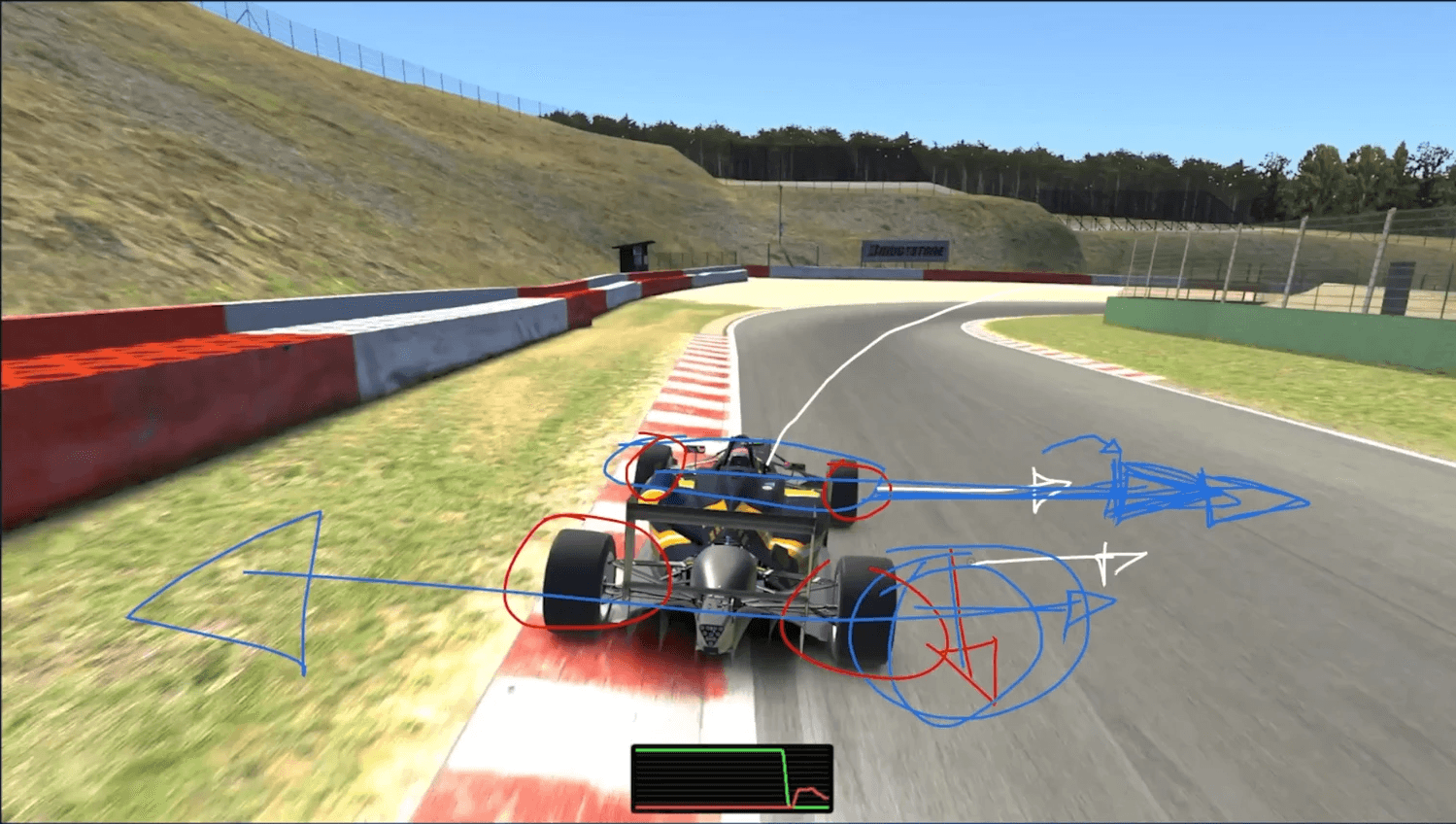
Early exit is the very middle of the corner when we start to get on power, and we have reached the peak steering. It is the beginning also of the opening spiral, because from that point we're gaining speed, therefore we shall lose rotation.
You have no choice. If you gain rotation at this phase, you are most likely getting into oversteer.
Steering Technique at Early Exit
It is still important to force the steering a little bit. You will decrease it from there, but you won't actively open the steering. You will still force and let the force sit back and wind it for you as you progressively relax your hands. This is still not the place to be fully relaxed with your hands.
You should still be forcing a little bit. You get on power, and then you feel the car wanting to correct for you. You listen to what the car is telling you. It will want to open up a little bit, and you respect it, and you start dancing with it as the car starts to get into that micro oversteer ideally.
It's also a little bit difficult to get oversteer here. Still it's easier to get oversteer on the late exit, but it's very important to get it here, it's very important to get a lot of rotation here, because that rotation will dictate the safety of the late exit. If you get rotation here, you don't need to rotate as much at the late exit when the car is already going way faster.
Throttle Application
The throttle application depends on engine power obviously:
If the car has a lot of power, you're going to accelerate a little bit more progressively, and then modulate from there
If the car is on MX-5, depends on the balance. Not necessarily all the time you're going to 100% on a low powered car
Even if it's low powered, if it's oversteering, you're still gonna have to go on power progressively to induce some understeer to correct that oversteer and manage the balance from there
Most likely you will get to 100% way earlier than a phone on the car
Late Exit Phase
Late exit is mostly consequence of previous phases. You don't have a lot of control here. There is a risk of power oversteer, especially if you get understeer on the early exit. If you didn't get enough rotation, you're going wide, you look at the exit curve, you're like oh my god, I need to turn more, and then you add steering while being already on 100% throttle, you will most likely induce oversteer and have a lot of trouble.
This is very dangerous especially in real life. People are afraid of rotating the car on early exit, and then they deal with the consequence during late exits.
Opening Spiral Characteristics
It is the final stage of the opening spiral, so this is where the car is straighter and straighter and straighter and straighter. It does not want to rotate any more. It does actually want to rotate less and less and less. Even trying to stay at the same rotation level gives you the risk of power oversteer.
The car will 1 5 4 3 2 1 rotation. It does not accept 5 4 4 4, you spent, it doesn't work.
Key Principles for Late Exit
No more added steering
Light hands
Field steering feedback
The car is gaining speed, and you can be the car at that point
Just let the force it back, tell you what it wants you to do and respect it
At this point, it's a consequence. If you did something wrong, you are going to have to lose a lot of time, unless you're going to crash
Throttle Position
100% throttle, not necessarily for all cars. If you're driving a Formula 1 car or a GTP car, you might get into late exit, and even I already go straight, exiting for example the bus stop at Spa, and you're still not at 100% throttle. But those are exceptions. Most of the time, you will already be 100% throttle, and just seeing, feeling the car wanting to go straighter and straighter and straighter.
Understanding Understeer Snap Oversteer
Understeer's nap oversteer is a very common effect, because people end up being afraid of rotating, or they just fail to rotate the car, because they don't handle the understeer. When this happens, you have to compensate for the missing rotation by trying to get even more rotation, although you are already going quicker and quicker, on the late exit phase.
When It Occurs
Every time you get understeer's nap over steer, it will happen at late entry and early exit, at the lower speeds, through the understeer, and the consequence, the snap oversteer will happen at late exit.
The Solution
Make sure you know how to really get good rotation mid-corner. To get good rotation mid-corner, you have to respect the early entry, so that on late entry you still get good grip on the front tires. Then finally, you can use that nice rotation on late entry early exit, and then late exit, you just relax and let the car do its thing.
Corner Types and Phase Combinations
Now let's go through some important examples, because there are different types of corners in terms of how the structure of the telemetry will show up in reality.
Complete Five-Phase Corner
First we have the actual complete one, so you have a phase on a straight line, just exactly like the graph, and then we get back on power. In this case we have all five phases: the breaking, early entry, late entry, early exit, and late exit.
Corners Without Hard Breaking
Sometimes we will ditch the hard breaking. We will not use that part because it's not necessary. We will start already with some semi-hard breaking that does not stay there, that goes straight down. Depending on how much you have to break, you're going to start there. Sometimes you might even have to start with less breaks, if it's a shorter corner, and so on.
Our break trace can have a few forms depending on how fast the corner is and how much you need to accelerate. You might have a straight line phase, but you will also have many corners where we don't need to break on the beginning. In this case, these corners, we are already starting the process at early entry, without having the hard breaking phase. We still need light hands on entry, we still need to really make sure that the beginning is right, so that we can then work our weight transfer back to the rear, but there will be no straight line.
Corners Without Any Braking
If there is no breaking at all necessary, we will go straight to early exit. It's going to feel a little bit weird, because you will turn in on the entry on the first half of the corner, but the car will behave, and we will apply all the rules, in terms of understeer, oversteer, steering, and throttle, of the early exit and late exit phases.
For example, if your steering is straight, but then you go straight to a corner where you don't have to break, you don't need the build-up phase. You can actually go straight to the peak steering at that speed, and then as your speed goes up, because you're going flat, you're going to have a trace that looks different. This is actually the early exit phase at the entry of the corner. Just remember this is a driving characteristic of a traditional corner, but you're doing that on the entry of a corner, because you're not breaking.
Three Types of Corner Starts
Very useful to think like that, so essentially you can have three types of corners:
You can have a corner that starts at the heartbreaking phase
You can have a corner that starts at the early interface
You can have a corner that starts at the early exit phase
It's pretty much like you're starting some corners in the middle of the process already. Remember, if you're cornering on power, you are actually opening your spiral, you're actually doing an opening spiral. That's why we call it early exit, because you know that early exit, you're gaining speed and you're losing rotation, even if you do that at turn end. The physics will apply just the same.
Understanding the Stages of a Corner
The stages of a corner consist of hard breaking, early entry, late entry, early exit, and late exit. Not all corners will have all these stages, and there are various examples and variations depending on the corner type.
Order of Importance
The order of importance is very well defined. If you mess up the early entry, the rest is going to be bad. If you mess up the hard breaking, you will also mess up everything else. It's very important that you get the first steps right so that you can maximize everything else.
By getting the breaking right, you have the opportunity of nailing the early entry. By getting the early entry right, you get the opportunity to do the next one right and then so on. It's very important that you maximize the beginnings because they depend on each other. Without that, there's no chance you're going to have a very good corner.
Telemetry Overview of the Stages
In terms of telemetry, this is what we will see at the stages:
Hard breaking: Full straight line, absolutely no steering
Early entry: As soon as we get the first degree of steering, we are officially getting into early entry phase, where we still don't have a lot of turning, but we're starting to get the car to bend and starting to already create some neutral steer, starting to get some oversteer maybe with the minimal steering, lots of trail breaking, lots of engine breaking
Late entry: The final phase as the speeds are getting closer to the minimum
Early exit: We are going to accelerate into the early exit. Very important to get this right, because the late exit obviously depends on the previous one
Late exit: When we are essentially just going along for the ride. If we did everything right, we can just enjoy the exit
Hard Breaking Phase
Hard breaking is essentially straight line breaking. You just need to maximize the acceleration. Nothing else. You need to get the reference right, you need to really stay on the limit without hitting too much ABS and without locking, but also without being under the limit or without having a consistent breaking.
When Hard Breaking is Necessary
Some corners won't have the hard breaking phase. When do we need to do hard breaking?
When there's a big difference in approaching speed versus corner speed, to a point where it's really worth it slowing down on a straight line to maximize longitudinal grip
If you're reaching top speed and you're getting to a corner that is like medium speed or low speed and you need to really slow down a lot to get into the corner
Normally before low speed corners
Most cars nowadays are very grippy, so it's not like we're driving a load of 49 where we need to break in a straight line to pretty much every corner. Focus on maximum acceleration, fully straight line. Make sure you get that threshold breaking perfect, get the downshifts right, don't under break, and find the limit. The objective here is to always bring exactly the same approaching speed into the early entry phase.
Early Entry Phase
Early entry is the most difficult to nail because it requires a lot of precision. That initial phase where you turn one to three degrees and you release one to three percent of the brakes, and the car starts bending and you start loading the car into the corner, that phase can be very fast in some cars, can be a little bit longer and low down force heavy cars where you really need to wait for the car to load.
It is the most difficult one because it's very easy to get it wrong. Instead of getting a nice rotation, you might just lock the front tire and end up going straight, and then from there there's nothing you can do. You lose the opportunity to do a good late entry, and so on. This one needs a lot of practice, and you need to understand the downforce levels of the car to master the early entry.
Downforce Level Considerations
If you're driving a hide-on-force car, you're going to have a car that's a little bit more agile at the early entry. The brake release will be a little bit quicker, and you're going to get into that lateral load a little bit more quickly, and you're going to do a more open entry, U-shape line.
If you have a low downforce car, the early entry will be still pretty much very straight. You're turning almost nothing, and you're really preparing to actually load the car the most at the late entry.
Key Techniques for Early Entry
Beginning of serial angle
Light hands - front still are very loaded, so you have to really turn in with light hands to feel the feedback
With that feedback you can even adjust your trail braking
If the steering gets a little bit too heavy and you feel that the car starts locking, you can hear the sound of the tires and you can see the visuals
You can adjust both the steering and the release of the brakes, but light hands will help you with that
It is the beginning of the closing spiral, so the spiral is still not aggressive, but that's where it begins to close
Obviously will dictate the performance of the next phases
Important note: This only applies to entries under braking. There's no need to turn the steering slowly if you're not braking. The distinction between braking early entry, late entry, and then power only applies to corners where you have braking. If you're doing a corner where you're already on power, we're gonna go straight to early exit or late exit from the turning.
Late Entry Phase
The final build up to the maximum rotation point. We are still closing spiral, and that's the most important part to actually get the car to rotate the most without understeering too much.
Managing Understeer at Late Entry
Why is understeer management so important? Because it's very easy to understeer at the late entry phase. Most cars, even most over steer cars, tend to oversteer way more on an early entry because of the weight on the front tires, but they tend to understeer a lot more closer to the minimum speed.
It's very important that you manage that understeer. You don't abuse the front tires, and you're still trail braking. Do not coast as much. Make sure you combine the brakes and the steering all the way into the maximum rotation point to prevent understeer.
Learning Grip Limits
Late entry is also the safest place to force and test the car. This is the best phase to actually do turn if you want to get understeer on purpose for the sake of learning the grip. That's the safest place to do it, because it is easier to do it, and that's why there's risk of understeer.
At an intermediate and advanced level, you don't want that, but as a beginner, it's a good thing because:
You're going to learn about understeer
You're going to learn about the grip limit of the car
You're going to learn about how much speed you can carry in each corner when you're learning your track
Obviously, this phase dictates the performance of the early and late phases. This is where some of the times the understeer snap oversteer starts. Understeer snap oversteer is a big problem that gets a lot of people.
Early Exit Phase
Early exit is the very middle of the corner when we start to get on power, and we have reached the peak steering. It is the beginning also of the opening spiral, because from that point we're gaining speed, therefore we shall lose rotation.
You have no choice. If you gain rotation at this phase, you are most likely getting into oversteer.
Steering Technique at Early Exit
It is still important to force the steering a little bit. You will decrease it from there, but you won't actively open the steering. You will still force and let the force sit back and wind it for you as you progressively relax your hands. This is still not the place to be fully relaxed with your hands.
You should still be forcing a little bit. You get on power, and then you feel the car wanting to correct for you. You listen to what the car is telling you. It will want to open up a little bit, and you respect it, and you start dancing with it as the car starts to get into that micro oversteer ideally.
It's also a little bit difficult to get oversteer here. Still it's easier to get oversteer on the late exit, but it's very important to get it here, it's very important to get a lot of rotation here, because that rotation will dictate the safety of the late exit. If you get rotation here, you don't need to rotate as much at the late exit when the car is already going way faster.
Throttle Application
The throttle application depends on engine power obviously:
If the car has a lot of power, you're going to accelerate a little bit more progressively, and then modulate from there
If the car is on MX-5, depends on the balance. Not necessarily all the time you're going to 100% on a low powered car
Even if it's low powered, if it's oversteering, you're still gonna have to go on power progressively to induce some understeer to correct that oversteer and manage the balance from there
Most likely you will get to 100% way earlier than a phone on the car
Late Exit Phase
Late exit is mostly consequence of previous phases. You don't have a lot of control here. There is a risk of power oversteer, especially if you get understeer on the early exit. If you didn't get enough rotation, you're going wide, you look at the exit curve, you're like oh my god, I need to turn more, and then you add steering while being already on 100% throttle, you will most likely induce oversteer and have a lot of trouble.
This is very dangerous especially in real life. People are afraid of rotating the car on early exit, and then they deal with the consequence during late exits.
Opening Spiral Characteristics
It is the final stage of the opening spiral, so this is where the car is straighter and straighter and straighter and straighter. It does not want to rotate any more. It does actually want to rotate less and less and less. Even trying to stay at the same rotation level gives you the risk of power oversteer.
The car will 1 5 4 3 2 1 rotation. It does not accept 5 4 4 4, you spent, it doesn't work.
Key Principles for Late Exit
No more added steering
Light hands
Field steering feedback
The car is gaining speed, and you can be the car at that point
Just let the force it back, tell you what it wants you to do and respect it
At this point, it's a consequence. If you did something wrong, you are going to have to lose a lot of time, unless you're going to crash
Throttle Position
100% throttle, not necessarily for all cars. If you're driving a Formula 1 car or a GTP car, you might get into late exit, and even I already go straight, exiting for example the bus stop at Spa, and you're still not at 100% throttle. But those are exceptions. Most of the time, you will already be 100% throttle, and just seeing, feeling the car wanting to go straighter and straighter and straighter.
Understanding Understeer Snap Oversteer
Understeer's nap oversteer is a very common effect, because people end up being afraid of rotating, or they just fail to rotate the car, because they don't handle the understeer. When this happens, you have to compensate for the missing rotation by trying to get even more rotation, although you are already going quicker and quicker, on the late exit phase.
When It Occurs
Every time you get understeer's nap over steer, it will happen at late entry and early exit, at the lower speeds, through the understeer, and the consequence, the snap oversteer will happen at late exit.
The Solution
Make sure you know how to really get good rotation mid-corner. To get good rotation mid-corner, you have to respect the early entry, so that on late entry you still get good grip on the front tires. Then finally, you can use that nice rotation on late entry early exit, and then late exit, you just relax and let the car do its thing.
Corner Types and Phase Combinations
Now let's go through some important examples, because there are different types of corners in terms of how the structure of the telemetry will show up in reality.
Complete Five-Phase Corner
First we have the actual complete one, so you have a phase on a straight line, just exactly like the graph, and then we get back on power. In this case we have all five phases: the breaking, early entry, late entry, early exit, and late exit.
Corners Without Hard Breaking
Sometimes we will ditch the hard breaking. We will not use that part because it's not necessary. We will start already with some semi-hard breaking that does not stay there, that goes straight down. Depending on how much you have to break, you're going to start there. Sometimes you might even have to start with less breaks, if it's a shorter corner, and so on.
Our break trace can have a few forms depending on how fast the corner is and how much you need to accelerate. You might have a straight line phase, but you will also have many corners where we don't need to break on the beginning. In this case, these corners, we are already starting the process at early entry, without having the hard breaking phase. We still need light hands on entry, we still need to really make sure that the beginning is right, so that we can then work our weight transfer back to the rear, but there will be no straight line.
Corners Without Any Braking
If there is no breaking at all necessary, we will go straight to early exit. It's going to feel a little bit weird, because you will turn in on the entry on the first half of the corner, but the car will behave, and we will apply all the rules, in terms of understeer, oversteer, steering, and throttle, of the early exit and late exit phases.
For example, if your steering is straight, but then you go straight to a corner where you don't have to break, you don't need the build-up phase. You can actually go straight to the peak steering at that speed, and then as your speed goes up, because you're going flat, you're going to have a trace that looks different. This is actually the early exit phase at the entry of the corner. Just remember this is a driving characteristic of a traditional corner, but you're doing that on the entry of a corner, because you're not breaking.
Three Types of Corner Starts
Very useful to think like that, so essentially you can have three types of corners:
You can have a corner that starts at the heartbreaking phase
You can have a corner that starts at the early interface
You can have a corner that starts at the early exit phase
It's pretty much like you're starting some corners in the middle of the process already. Remember, if you're cornering on power, you are actually opening your spiral, you're actually doing an opening spiral. That's why we call it early exit, because you know that early exit, you're gaining speed and you're losing rotation, even if you do that at turn end. The physics will apply just the same.
Understanding the Stages of a Corner
The stages of a corner consist of hard breaking, early entry, late entry, early exit, and late exit. Not all corners will have all these stages, and there are various examples and variations depending on the corner type.
Order of Importance
The order of importance is very well defined. If you mess up the early entry, the rest is going to be bad. If you mess up the hard breaking, you will also mess up everything else. It's very important that you get the first steps right so that you can maximize everything else.
By getting the breaking right, you have the opportunity of nailing the early entry. By getting the early entry right, you get the opportunity to do the next one right and then so on. It's very important that you maximize the beginnings because they depend on each other. Without that, there's no chance you're going to have a very good corner.
Telemetry Overview of the Stages
In terms of telemetry, this is what we will see at the stages:
Hard breaking: Full straight line, absolutely no steering
Early entry: As soon as we get the first degree of steering, we are officially getting into early entry phase, where we still don't have a lot of turning, but we're starting to get the car to bend and starting to already create some neutral steer, starting to get some oversteer maybe with the minimal steering, lots of trail breaking, lots of engine breaking
Late entry: The final phase as the speeds are getting closer to the minimum
Early exit: We are going to accelerate into the early exit. Very important to get this right, because the late exit obviously depends on the previous one
Late exit: When we are essentially just going along for the ride. If we did everything right, we can just enjoy the exit
Hard Breaking Phase
Hard breaking is essentially straight line breaking. You just need to maximize the acceleration. Nothing else. You need to get the reference right, you need to really stay on the limit without hitting too much ABS and without locking, but also without being under the limit or without having a consistent breaking.
When Hard Breaking is Necessary
Some corners won't have the hard breaking phase. When do we need to do hard breaking?
When there's a big difference in approaching speed versus corner speed, to a point where it's really worth it slowing down on a straight line to maximize longitudinal grip
If you're reaching top speed and you're getting to a corner that is like medium speed or low speed and you need to really slow down a lot to get into the corner
Normally before low speed corners
Most cars nowadays are very grippy, so it's not like we're driving a load of 49 where we need to break in a straight line to pretty much every corner. Focus on maximum acceleration, fully straight line. Make sure you get that threshold breaking perfect, get the downshifts right, don't under break, and find the limit. The objective here is to always bring exactly the same approaching speed into the early entry phase.
Early Entry Phase
Early entry is the most difficult to nail because it requires a lot of precision. That initial phase where you turn one to three degrees and you release one to three percent of the brakes, and the car starts bending and you start loading the car into the corner, that phase can be very fast in some cars, can be a little bit longer and low down force heavy cars where you really need to wait for the car to load.
It is the most difficult one because it's very easy to get it wrong. Instead of getting a nice rotation, you might just lock the front tire and end up going straight, and then from there there's nothing you can do. You lose the opportunity to do a good late entry, and so on. This one needs a lot of practice, and you need to understand the downforce levels of the car to master the early entry.
Downforce Level Considerations
If you're driving a hide-on-force car, you're going to have a car that's a little bit more agile at the early entry. The brake release will be a little bit quicker, and you're going to get into that lateral load a little bit more quickly, and you're going to do a more open entry, U-shape line.
If you have a low downforce car, the early entry will be still pretty much very straight. You're turning almost nothing, and you're really preparing to actually load the car the most at the late entry.
Key Techniques for Early Entry
Beginning of serial angle
Light hands - front still are very loaded, so you have to really turn in with light hands to feel the feedback
With that feedback you can even adjust your trail braking
If the steering gets a little bit too heavy and you feel that the car starts locking, you can hear the sound of the tires and you can see the visuals
You can adjust both the steering and the release of the brakes, but light hands will help you with that
It is the beginning of the closing spiral, so the spiral is still not aggressive, but that's where it begins to close
Obviously will dictate the performance of the next phases
Important note: This only applies to entries under braking. There's no need to turn the steering slowly if you're not braking. The distinction between braking early entry, late entry, and then power only applies to corners where you have braking. If you're doing a corner where you're already on power, we're gonna go straight to early exit or late exit from the turning.
Late Entry Phase
The final build up to the maximum rotation point. We are still closing spiral, and that's the most important part to actually get the car to rotate the most without understeering too much.
Managing Understeer at Late Entry
Why is understeer management so important? Because it's very easy to understeer at the late entry phase. Most cars, even most over steer cars, tend to oversteer way more on an early entry because of the weight on the front tires, but they tend to understeer a lot more closer to the minimum speed.
It's very important that you manage that understeer. You don't abuse the front tires, and you're still trail braking. Do not coast as much. Make sure you combine the brakes and the steering all the way into the maximum rotation point to prevent understeer.
Learning Grip Limits
Late entry is also the safest place to force and test the car. This is the best phase to actually do turn if you want to get understeer on purpose for the sake of learning the grip. That's the safest place to do it, because it is easier to do it, and that's why there's risk of understeer.
At an intermediate and advanced level, you don't want that, but as a beginner, it's a good thing because:
You're going to learn about understeer
You're going to learn about the grip limit of the car
You're going to learn about how much speed you can carry in each corner when you're learning your track
Obviously, this phase dictates the performance of the early and late phases. This is where some of the times the understeer snap oversteer starts. Understeer snap oversteer is a big problem that gets a lot of people.
Early Exit Phase
Early exit is the very middle of the corner when we start to get on power, and we have reached the peak steering. It is the beginning also of the opening spiral, because from that point we're gaining speed, therefore we shall lose rotation.
You have no choice. If you gain rotation at this phase, you are most likely getting into oversteer.
Steering Technique at Early Exit
It is still important to force the steering a little bit. You will decrease it from there, but you won't actively open the steering. You will still force and let the force sit back and wind it for you as you progressively relax your hands. This is still not the place to be fully relaxed with your hands.
You should still be forcing a little bit. You get on power, and then you feel the car wanting to correct for you. You listen to what the car is telling you. It will want to open up a little bit, and you respect it, and you start dancing with it as the car starts to get into that micro oversteer ideally.
It's also a little bit difficult to get oversteer here. Still it's easier to get oversteer on the late exit, but it's very important to get it here, it's very important to get a lot of rotation here, because that rotation will dictate the safety of the late exit. If you get rotation here, you don't need to rotate as much at the late exit when the car is already going way faster.
Throttle Application
The throttle application depends on engine power obviously:
If the car has a lot of power, you're going to accelerate a little bit more progressively, and then modulate from there
If the car is on MX-5, depends on the balance. Not necessarily all the time you're going to 100% on a low powered car
Even if it's low powered, if it's oversteering, you're still gonna have to go on power progressively to induce some understeer to correct that oversteer and manage the balance from there
Most likely you will get to 100% way earlier than a phone on the car
Late Exit Phase
Late exit is mostly consequence of previous phases. You don't have a lot of control here. There is a risk of power oversteer, especially if you get understeer on the early exit. If you didn't get enough rotation, you're going wide, you look at the exit curve, you're like oh my god, I need to turn more, and then you add steering while being already on 100% throttle, you will most likely induce oversteer and have a lot of trouble.
This is very dangerous especially in real life. People are afraid of rotating the car on early exit, and then they deal with the consequence during late exits.
Opening Spiral Characteristics
It is the final stage of the opening spiral, so this is where the car is straighter and straighter and straighter and straighter. It does not want to rotate any more. It does actually want to rotate less and less and less. Even trying to stay at the same rotation level gives you the risk of power oversteer.
The car will 1 5 4 3 2 1 rotation. It does not accept 5 4 4 4, you spent, it doesn't work.
Key Principles for Late Exit
No more added steering
Light hands
Field steering feedback
The car is gaining speed, and you can be the car at that point
Just let the force it back, tell you what it wants you to do and respect it
At this point, it's a consequence. If you did something wrong, you are going to have to lose a lot of time, unless you're going to crash
Throttle Position
100% throttle, not necessarily for all cars. If you're driving a Formula 1 car or a GTP car, you might get into late exit, and even I already go straight, exiting for example the bus stop at Spa, and you're still not at 100% throttle. But those are exceptions. Most of the time, you will already be 100% throttle, and just seeing, feeling the car wanting to go straighter and straighter and straighter.
Understanding Understeer Snap Oversteer
Understeer's nap oversteer is a very common effect, because people end up being afraid of rotating, or they just fail to rotate the car, because they don't handle the understeer. When this happens, you have to compensate for the missing rotation by trying to get even more rotation, although you are already going quicker and quicker, on the late exit phase.
When It Occurs
Every time you get understeer's nap over steer, it will happen at late entry and early exit, at the lower speeds, through the understeer, and the consequence, the snap oversteer will happen at late exit.
The Solution
Make sure you know how to really get good rotation mid-corner. To get good rotation mid-corner, you have to respect the early entry, so that on late entry you still get good grip on the front tires. Then finally, you can use that nice rotation on late entry early exit, and then late exit, you just relax and let the car do its thing.
Corner Types and Phase Combinations
Now let's go through some important examples, because there are different types of corners in terms of how the structure of the telemetry will show up in reality.
Complete Five-Phase Corner
First we have the actual complete one, so you have a phase on a straight line, just exactly like the graph, and then we get back on power. In this case we have all five phases: the breaking, early entry, late entry, early exit, and late exit.
Corners Without Hard Breaking
Sometimes we will ditch the hard breaking. We will not use that part because it's not necessary. We will start already with some semi-hard breaking that does not stay there, that goes straight down. Depending on how much you have to break, you're going to start there. Sometimes you might even have to start with less breaks, if it's a shorter corner, and so on.
Our break trace can have a few forms depending on how fast the corner is and how much you need to accelerate. You might have a straight line phase, but you will also have many corners where we don't need to break on the beginning. In this case, these corners, we are already starting the process at early entry, without having the hard breaking phase. We still need light hands on entry, we still need to really make sure that the beginning is right, so that we can then work our weight transfer back to the rear, but there will be no straight line.
Corners Without Any Braking
If there is no breaking at all necessary, we will go straight to early exit. It's going to feel a little bit weird, because you will turn in on the entry on the first half of the corner, but the car will behave, and we will apply all the rules, in terms of understeer, oversteer, steering, and throttle, of the early exit and late exit phases.
For example, if your steering is straight, but then you go straight to a corner where you don't have to break, you don't need the build-up phase. You can actually go straight to the peak steering at that speed, and then as your speed goes up, because you're going flat, you're going to have a trace that looks different. This is actually the early exit phase at the entry of the corner. Just remember this is a driving characteristic of a traditional corner, but you're doing that on the entry of a corner, because you're not breaking.
Three Types of Corner Starts
Very useful to think like that, so essentially you can have three types of corners:
You can have a corner that starts at the heartbreaking phase
You can have a corner that starts at the early interface
You can have a corner that starts at the early exit phase
It's pretty much like you're starting some corners in the middle of the process already. Remember, if you're cornering on power, you are actually opening your spiral, you're actually doing an opening spiral. That's why we call it early exit, because you know that early exit, you're gaining speed and you're losing rotation, even if you do that at turn end. The physics will apply just the same.
Consistency & Confidence
Balance & Speed
Mastery
Other Lessons