Compound Corners
Lesson
36
of
49

Lesson by
Suellio Almeida
Lesson by
Suellio Almeida
Mark as Finished
Let's examine what defines a compound corner. Consider a scenario where you have a single corner that leads into another corner. If the line you take on the first corner is the fastest possible, and you have time to prepare for the next corner, these are not compound corners. In this case, you can satisfy the ideal line for both corners separately, using all the track and achieving the fastest arc for each corner independently.
However, when tracing the fastest line for the first corner makes it impossible to properly set up for the second corner, you must sacrifice one corner or the other, or find a compromise between both. This is a compound corner. The exit of the second corner depends heavily on the entire first corner, not just its exit. Remember that an exit depends on what you do at the entry.
The Fundamental Rule of Compound Corners
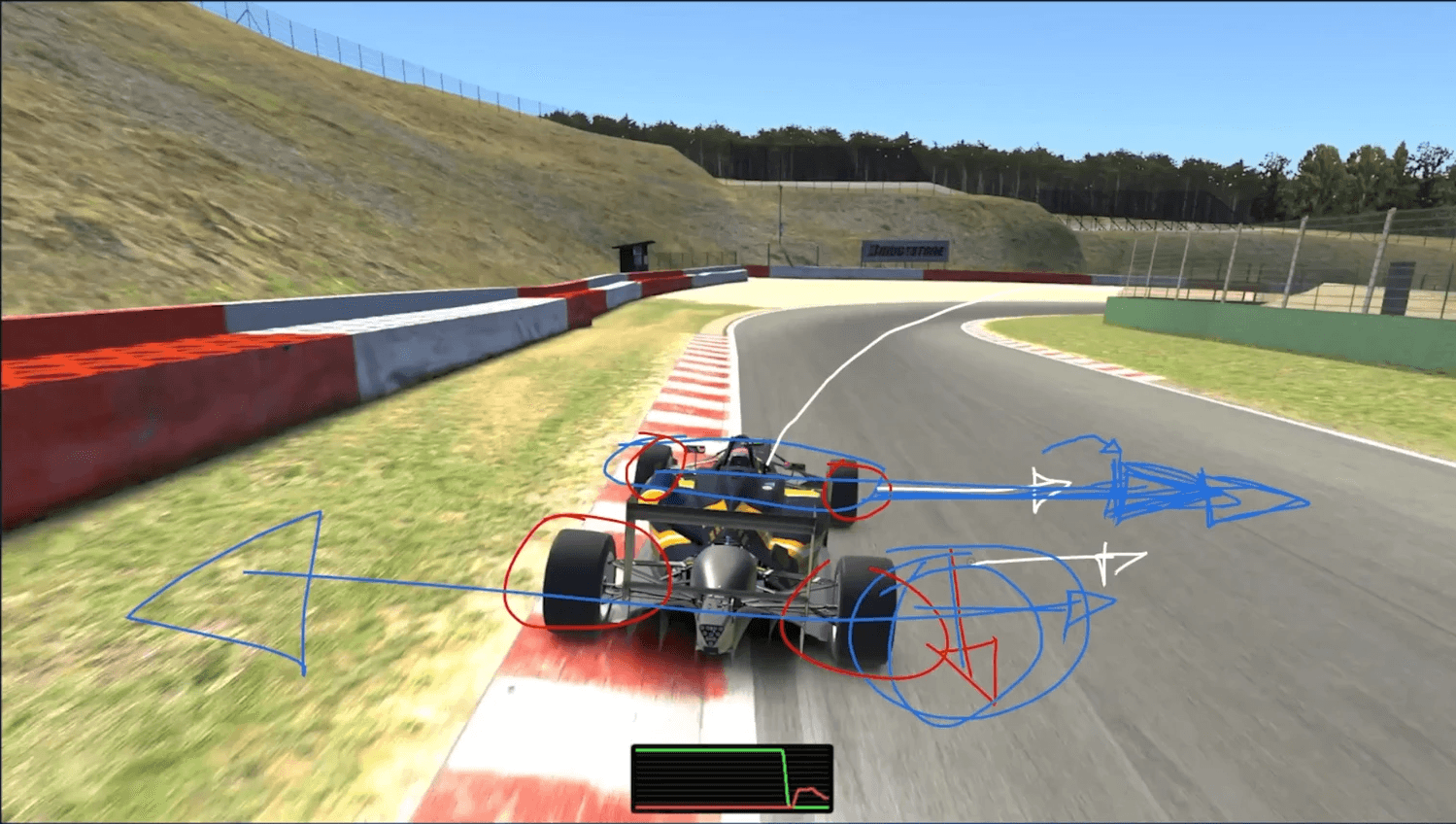
The most important rule for compound corners is to never be under the limit in between them. You don't have time to relax. You must stay on the limit, bringing the car as much as possible and creating as much force as possible in the direction of the first corner. Then, as soon as you change direction, immediately start creating as much force as possible toward the second corner.
This means you should never trace a straight line in between compound corners. If you're going straight at any point between these corners, you're too slow. No matter how you approach it, going straight indicates you're not using all available grip.
Common Mistakes in Compound Corners
Here's an example of a typical mistake: using all the track on the first corner, hitting the apex, getting back on power, and using almost all the track on exit. However, if the next corner is very close and requires using all the track, you might think you're correctly sacrificing the first corner to benefit from the second. The problem occurs when you go straight for an extended period between the corners.
If you're going straight, that means you could have probably used more of the first corner to gain time, then used all the time in between to keep bringing the car over for the second corner. This creates a double mistake:
Not using all the track on the first corner exit
Going straight instead of continuously positioning the car
Wrong angle before turning in to the second corner
Not using all available track width
This type of mistake can cost over a tenth of a second simply because you relaxed between the corners. Instead, you should bring the car as much as possible and use the white line, being parallel to it before starting to turn in. If you're trail braking into the second corner, even with just one percent brake pressure, this indicates that corner is challenging. Using more of the track before it will gain easy time just by planning in advance.
The correct approach involves using more of the track and not relaxing. Keep bringing the car over continuously, then change direction. By the time you start turning in, you should be perfectly using all the track before the next corner. This small change can be worth over a tenth in just the transition between two corners.
Over-Preparation Problems
Another common issue occurs when drivers over-prepare for the second corner. A student might try to open up as much as possible to set up the best exit for a corner leading onto a long straight. The problem is that by over-preparing the second corner, they don't use all the track on the first corner and end up having remaining grip that goes unused. Between the first and second corners, they're actually under the limit for a few fractions of a second, which can cost around two tenths.
The better approach, even in a car with less downforce, is to use more of the exit on the first corner, stay on the limit while bringing the car over, then quickly change direction and start trail braking into the second corner. Leave absolutely no fraction of a second left over—use the grip throughout the entire compound sector.
Visual Examples from Racing
When observing slow drivers, you can see them turning into a corner and then going straight at some point. This demonstrates not using the grip, resulting in time loss both on exit and on the following corner—a double problem. In comparison, drivers at the front of the grid don't go straight. They're constantly turning in one direction, then immediately changing to the other direction.
The Line of Consequence
Understanding how to adjust your line to prepare perfectly for the second corner is crucial. Remember that entry is cause and exit is consequence. Whatever you do on entry will determine your line of consequence—the path your car takes that affects the entry of the next corner.
This line of consequence already depends on what you do at the initial turn-in. No matter how hard you try to bring the car over, if you carry too much speed, you will go wide, scrub speed, lose the car, destroy the tires, and experience understeer or oversteer. You won't be able to bring the car back if you enter too fast.
Early Decision Making
Your decision at the first turn-in point determines everything. You might choose between:
A late apex, hitting the later part of the curb, accelerating earlier, but not using all the track on exit
Carrying more speed, hitting the inside earlier, carrying more speed on exit, and positioning for the next corner
These two lines are consequences of your initial decision. It's a very common mistake for drivers to do whatever they want on the first corner, then realize upon getting back on power that they want to bring the car over. This won't happen because the car is too fast, forcing you to lift or make other time-losing corrections.
The consequence depends on the entry. You must make your entry decision while thinking about where you want to put the car for the next corner. A very practical way to think about this is to adjust your MRP (Minimum Radius Point). The MRP has positioning, angle, and longitudinal positioning (how late your apex is).
If you want to sacrifice the first corner more, simply do a later apex. You can even brake in the same place—just turn in a little later, hit the inside later, get back on power, and the car will be on the perfect line of consequence that takes you to the entry of the next corner. Adjust your MRP and your line of consequence will be adjusted accordingly.
The Cascade Effect
Think about the relationship between these areas: you're dealing with two corners, but the second already depends on the first, which also depends on its entry, which depends on its braking point. If you are on the limits of both corners, the first entry determines everything. You have to nail the first bit in order to nail all subsequent bits. You must think ahead.
This is the actual vision technique—not only visual vision, but visualization in your head and mind of what lines you're going to trace. We're discussing two corners here, but imagine three, four, or five corners. Think about the Suzuka S's where all corners depend on the previous one in a snowball effect.
Two Types of Drivers
There are generally two types of drivers making mistakes in compound corners:
Over-preparing drivers: They go too slow on the first corner, get back on power, then have a space of being under the limit where they go straight and do nothing, before finally getting back on the limit thinking about the exit and the long straight ahead
Over-forcing drivers: They want to go fast, so they push hard on the first corner but then force the car too much in the transition, ending up destroying their tires and being frustrated because the car won't go where they want
Remember: you don't make the decision in the transition—you make it at the entry of the first corner.
Choosing How Much to Sacrifice
You have a spectrum of choices, from completely sacrificing the second corner to completely sacrificing the first corner. Where should you be on this spectrum?
The 50/50 Baseline
The best baseline is literally 50/50. Use a 50/50 approach to bring the car more or less to the middle after the first corner, then adjust from there. This approach provides a good starting baseline to understand how much time you gain or lose, and then you can start adjusting.
After establishing this baseline, generally sacrificing more of the first corner and bringing the car to benefit the second corner is better. This is because it's very important to carry more speed on exit, since cars are less efficient in acceleration than deceleration. However, this also depends on how long you're going to benefit from that exit speed.
Factors to Consider
If there's a very long straight after the compound corners, you definitely want to sacrifice more of the first corner. Bring the car over as much as possible—always on the limit, remembering not to go straight anywhere—then have the best exit possible to carry speed throughout the long straight.
One key factor is: how long is the straight after the compound corner? If you have a long distance to continue benefiting from exit speed, sacrifice a little more of the first corner. However, we're initially considering two identical corners, which rarely happens. Generally, compound corners have different radii, so we need to analyze examples with varying situations.
Practical Examples
Short Radius to Long Radius Corner
Consider a right-hander that leads into a longer left-hander. You're approaching the first corner at particularly high speed. Although we generally want to sacrifice a little more of the first corner to get a better exit on the second, there are two factors that make us sacrifice none of the first corner in this case:
There isn't a long straight after the second corner
The first corner is a much shorter radius and the second corner is much longer
You have to decelerate significantly for the first corner already. Because the next corner is long, you can take a double apex approach. The best way is to not sacrifice the first corner at all, get back on power early, go all the way to the outside, and then at the lower speed, start trail braking into the second corner with a double apex approach—using all the curb, going slightly wide, then back slightly before running wide on the final exit.
The reason you don't sacrifice the first corner is that it has such a shorter radius. If you were to sacrifice it to benefit from the second, the amount of time you lose on the smaller corner won't be worth it. You won't get that time back on the second corner because it's much longer. Whenever you have a short corner leading into a longer corner that can be double apexed, try not to sacrifice the first one. Gain as much time as possible on the first, then do a double apex approach on the second.
If you sacrifice the first corner too much, you'll have to slow down excessively, and by the time you turn into the next corner, you'll be way under the limit. The car will be able to turn more than necessary, and you'll bounce off the apex.
Interlagos Turns One, Two, and Three
This example involves three connected corners. After turn two, turn three is going to be flat with a long straight following. The amount of speed you carry over turn three and onto the straight is invaluable. You must sacrifice turn one as much as possible to prepare for turn two, because turn two can kill your speed if you don't sacrifice turn one correctly.
Make sure you bring the car as much as possible to the left on turn one, doing a very late MRP. By the time you change direction into turn two, you have a very big radius allowing you to carry more speed. You can maintain that speed on turn three because it's an easier corner with a much bigger radius, and you can carry that extra speed for a long time afterward.
It's a very common mistake to see drivers bringing the car way too much to the right because they want to go fast on turn one. Turn one is quite long with a somewhat closing radius, which makes you want to accelerate earlier, but this ends up requiring too much sacrifice for turn two. Instead, be patient, place your MRP pretty late, bring the car a little more to the left, and then when you change direction you can really carry speed on turn two and benefit from all that speed from turn three all the way to the straight before turn four.
Silverstone Brooklands
Here we have another compound corner where the second one is much longer. By the time you get there, you're at lower speed and can double apex that corner. The ideal line involves not sacrificing the first corner at all and going all the way to the outside after the left-hander. Because you're now at lower speed, you can hit the first apex very early, let the car go wide, then bring it back to hit the second apex.
If you were to sacrifice the first corner, you would enter the second corner at lower speed. That corner has a big radius, so you wouldn't be able to benefit from the lower speed in a wider arc because the car would be under the limit very easily. This would require you to accelerate too early, but then the car would start spiraling up because of the acceleration, and you'd have to brake again. The best way is to carry as much speed as possible so you already carry that speed in, giving you time on the second corner to bring that speed down as you do the closing spiral in the first half of that double apex.
Three-Corner Sequence with Long Straight
Consider a sequence where an exit leads into a very long straight. This exit depends on where you apex, but that line depends not just on that corner but on the previous corner—a kink to the left. That kink depends on where you apex on the right-hander before it.
If you do reverse engineering all the way from the corner leading onto the straight back to the initial entry, you realize that the moment you apex at the beginning determines everything. A small change at the first apex affects the line on the middle corner, which affects the line on the entry of the final corner—a snowball effect. It's just three corners long in this example, but there are examples with even more.
The secret is to plan the apex on the first corner. Plan where your MRP is going to be and when you're going to hit the inside, then just be on the limit for as long as you can, going all the way over, quickly changing direction, opening up as much as you can, then benefiting from the final corner. If you want to make any adjustment, adjust the MRP on the first corner—the other corners will be consequences.
Yes, you may want to do a tiny lift when bringing the car over in the middle section to get a little more rotation, but even with that adjustment you still need a very good line. If you carry way too much speed on the first corner and get to the middle section too early, you get pushed too far over afterward, and your entry for the third corner is terrible, preventing you from carrying any speed onto the long straight.
For compound corners like this, adjust the first MRP and the first line—whether late apex or early apex—and stay on the limit on the other corners. That's already going to give you so much information that you'll be ahead compared to almost everyone.
Circuit of the Americas Complex
Let's count how many corners are connected by the same line with absolutely no time under the limit between them: one corner, two, three, four, then another right-hander (five) leads into a left-hander (six), then a closing radius right-hander (seven), and finally a fast, tricky left-hander (eight).
These corners are always on the limit. There's absolutely no moment where you're not on the limit. The traps and problems in this section are all about the snowball effect.
The first corner looks easy because you can take it flat, but the next corner is to the right, so you have to be as far left as possible on the first one. Even though the corner is flat, you shouldn't relax. Don't turn in early and end up in the middle of the track afterward, because then you'll compromise the entry for the actual corner where you're over the limit and have to slow down. Instead, turn in a bit later—it's flat, but choose the right line—and try to be as far left as possible after this first apex so that by the time you change direction, you're using the left side of the track.
You're on the limit, so still try to bring the car as far right as possible and change direction more or less in the middle of the track for the next corner. But here's the thing: the next corner is a double apex and it's long, so you don't need to sacrifice the previous left-hander. You can go as fast as possible and let the car run wide, because the next corner is long enough for a double apex. Turn in early, let the car run wide, and the corner's length gives you space to bring it back to the second apex without slowing down too much, then hit the second apex.
Still on the limit, you won't have enough time to bring the car all the way to the curb on the right, so bring it as much as possible without relaxing or going straight, then immediately change direction for the next corner. Hit the apex, get back on power, bring the car as far left as possible, then immediately change direction again and start braking for the next corner—a closing radius. Be patient, stay on the limit, then quickly change direction again.
You see: absolutely no time to go straight, absolutely no time to relax. You have to plan your line. All these lines depend on what you do on the first corner, which is the easy one. The easy corner is the trap itself, because if you don't use all the track there, you create a terrible snowball effect. You go wide on the next corner, then way too wide on the following one, and you can't carry as much speed as possible on the double apex.
From that point you can recover from the snowball effect and do the remaining corners as fast as possible, but by the time you recover, you've already lost way too much time on the S's. The answer: think ahead, reverse engineer where you want to be on each corner, then try to satisfy the line requirements on the corners before so you have the chance of nailing the next corners.
Car-Dependent Lines
You must also know that the same compound corner can have drastically different lines depending on the car you're driving. For example, consider a very long left-hander that leads into a very fast right-hander kink. What would be the ideal line? That actually depends on how you can take that kink afterward, which depends on how much grip the car has.
A Formula One car with lots of downforce can take that right-hander flat even without sacrificing the left-hander before it. But if you're driving a car with low downforce or a heavy car, that right-hander becomes a bottleneck for your speed. You really need to prepare that right-hander to carry as much speed as possible on that corner and on the short straight after.
The fastest line in a formula car involves absolutely no sacrificing, whereas the fastest line in a GT car involves double apexing aggressively on the left-hander and sacrificing its exit so you can have good positioning and angle for the right-hander after. These are the two extremes, so pretty much every other car will be somewhere in between those two extreme lines.
The fastest way to identify the correct line is by trying to stay on the limit for as long as possible and see how much speed you can carry on the second corner. If you can't carry speed on the second corner and have to slow down way too much, then sacrifice a little more of the exit on the first corner. Always test the limit, always try to never go straight, never relax in between these corners. Try to keep the car loaded and see where it ends up depending on your approach on the first corner.
Remember: always adjust the first corner and test the second corner.
Let's examine what defines a compound corner. Consider a scenario where you have a single corner that leads into another corner. If the line you take on the first corner is the fastest possible, and you have time to prepare for the next corner, these are not compound corners. In this case, you can satisfy the ideal line for both corners separately, using all the track and achieving the fastest arc for each corner independently.
However, when tracing the fastest line for the first corner makes it impossible to properly set up for the second corner, you must sacrifice one corner or the other, or find a compromise between both. This is a compound corner. The exit of the second corner depends heavily on the entire first corner, not just its exit. Remember that an exit depends on what you do at the entry.
The Fundamental Rule of Compound Corners
The most important rule for compound corners is to never be under the limit in between them. You don't have time to relax. You must stay on the limit, bringing the car as much as possible and creating as much force as possible in the direction of the first corner. Then, as soon as you change direction, immediately start creating as much force as possible toward the second corner.
This means you should never trace a straight line in between compound corners. If you're going straight at any point between these corners, you're too slow. No matter how you approach it, going straight indicates you're not using all available grip.
Common Mistakes in Compound Corners
Here's an example of a typical mistake: using all the track on the first corner, hitting the apex, getting back on power, and using almost all the track on exit. However, if the next corner is very close and requires using all the track, you might think you're correctly sacrificing the first corner to benefit from the second. The problem occurs when you go straight for an extended period between the corners.
If you're going straight, that means you could have probably used more of the first corner to gain time, then used all the time in between to keep bringing the car over for the second corner. This creates a double mistake:
Not using all the track on the first corner exit
Going straight instead of continuously positioning the car
Wrong angle before turning in to the second corner
Not using all available track width
This type of mistake can cost over a tenth of a second simply because you relaxed between the corners. Instead, you should bring the car as much as possible and use the white line, being parallel to it before starting to turn in. If you're trail braking into the second corner, even with just one percent brake pressure, this indicates that corner is challenging. Using more of the track before it will gain easy time just by planning in advance.
The correct approach involves using more of the track and not relaxing. Keep bringing the car over continuously, then change direction. By the time you start turning in, you should be perfectly using all the track before the next corner. This small change can be worth over a tenth in just the transition between two corners.
Over-Preparation Problems
Another common issue occurs when drivers over-prepare for the second corner. A student might try to open up as much as possible to set up the best exit for a corner leading onto a long straight. The problem is that by over-preparing the second corner, they don't use all the track on the first corner and end up having remaining grip that goes unused. Between the first and second corners, they're actually under the limit for a few fractions of a second, which can cost around two tenths.
The better approach, even in a car with less downforce, is to use more of the exit on the first corner, stay on the limit while bringing the car over, then quickly change direction and start trail braking into the second corner. Leave absolutely no fraction of a second left over—use the grip throughout the entire compound sector.
Visual Examples from Racing
When observing slow drivers, you can see them turning into a corner and then going straight at some point. This demonstrates not using the grip, resulting in time loss both on exit and on the following corner—a double problem. In comparison, drivers at the front of the grid don't go straight. They're constantly turning in one direction, then immediately changing to the other direction.
The Line of Consequence
Understanding how to adjust your line to prepare perfectly for the second corner is crucial. Remember that entry is cause and exit is consequence. Whatever you do on entry will determine your line of consequence—the path your car takes that affects the entry of the next corner.
This line of consequence already depends on what you do at the initial turn-in. No matter how hard you try to bring the car over, if you carry too much speed, you will go wide, scrub speed, lose the car, destroy the tires, and experience understeer or oversteer. You won't be able to bring the car back if you enter too fast.
Early Decision Making
Your decision at the first turn-in point determines everything. You might choose between:
A late apex, hitting the later part of the curb, accelerating earlier, but not using all the track on exit
Carrying more speed, hitting the inside earlier, carrying more speed on exit, and positioning for the next corner
These two lines are consequences of your initial decision. It's a very common mistake for drivers to do whatever they want on the first corner, then realize upon getting back on power that they want to bring the car over. This won't happen because the car is too fast, forcing you to lift or make other time-losing corrections.
The consequence depends on the entry. You must make your entry decision while thinking about where you want to put the car for the next corner. A very practical way to think about this is to adjust your MRP (Minimum Radius Point). The MRP has positioning, angle, and longitudinal positioning (how late your apex is).
If you want to sacrifice the first corner more, simply do a later apex. You can even brake in the same place—just turn in a little later, hit the inside later, get back on power, and the car will be on the perfect line of consequence that takes you to the entry of the next corner. Adjust your MRP and your line of consequence will be adjusted accordingly.
The Cascade Effect
Think about the relationship between these areas: you're dealing with two corners, but the second already depends on the first, which also depends on its entry, which depends on its braking point. If you are on the limits of both corners, the first entry determines everything. You have to nail the first bit in order to nail all subsequent bits. You must think ahead.
This is the actual vision technique—not only visual vision, but visualization in your head and mind of what lines you're going to trace. We're discussing two corners here, but imagine three, four, or five corners. Think about the Suzuka S's where all corners depend on the previous one in a snowball effect.
Two Types of Drivers
There are generally two types of drivers making mistakes in compound corners:
Over-preparing drivers: They go too slow on the first corner, get back on power, then have a space of being under the limit where they go straight and do nothing, before finally getting back on the limit thinking about the exit and the long straight ahead
Over-forcing drivers: They want to go fast, so they push hard on the first corner but then force the car too much in the transition, ending up destroying their tires and being frustrated because the car won't go where they want
Remember: you don't make the decision in the transition—you make it at the entry of the first corner.
Choosing How Much to Sacrifice
You have a spectrum of choices, from completely sacrificing the second corner to completely sacrificing the first corner. Where should you be on this spectrum?
The 50/50 Baseline
The best baseline is literally 50/50. Use a 50/50 approach to bring the car more or less to the middle after the first corner, then adjust from there. This approach provides a good starting baseline to understand how much time you gain or lose, and then you can start adjusting.
After establishing this baseline, generally sacrificing more of the first corner and bringing the car to benefit the second corner is better. This is because it's very important to carry more speed on exit, since cars are less efficient in acceleration than deceleration. However, this also depends on how long you're going to benefit from that exit speed.
Factors to Consider
If there's a very long straight after the compound corners, you definitely want to sacrifice more of the first corner. Bring the car over as much as possible—always on the limit, remembering not to go straight anywhere—then have the best exit possible to carry speed throughout the long straight.
One key factor is: how long is the straight after the compound corner? If you have a long distance to continue benefiting from exit speed, sacrifice a little more of the first corner. However, we're initially considering two identical corners, which rarely happens. Generally, compound corners have different radii, so we need to analyze examples with varying situations.
Practical Examples
Short Radius to Long Radius Corner
Consider a right-hander that leads into a longer left-hander. You're approaching the first corner at particularly high speed. Although we generally want to sacrifice a little more of the first corner to get a better exit on the second, there are two factors that make us sacrifice none of the first corner in this case:
There isn't a long straight after the second corner
The first corner is a much shorter radius and the second corner is much longer
You have to decelerate significantly for the first corner already. Because the next corner is long, you can take a double apex approach. The best way is to not sacrifice the first corner at all, get back on power early, go all the way to the outside, and then at the lower speed, start trail braking into the second corner with a double apex approach—using all the curb, going slightly wide, then back slightly before running wide on the final exit.
The reason you don't sacrifice the first corner is that it has such a shorter radius. If you were to sacrifice it to benefit from the second, the amount of time you lose on the smaller corner won't be worth it. You won't get that time back on the second corner because it's much longer. Whenever you have a short corner leading into a longer corner that can be double apexed, try not to sacrifice the first one. Gain as much time as possible on the first, then do a double apex approach on the second.
If you sacrifice the first corner too much, you'll have to slow down excessively, and by the time you turn into the next corner, you'll be way under the limit. The car will be able to turn more than necessary, and you'll bounce off the apex.
Interlagos Turns One, Two, and Three
This example involves three connected corners. After turn two, turn three is going to be flat with a long straight following. The amount of speed you carry over turn three and onto the straight is invaluable. You must sacrifice turn one as much as possible to prepare for turn two, because turn two can kill your speed if you don't sacrifice turn one correctly.
Make sure you bring the car as much as possible to the left on turn one, doing a very late MRP. By the time you change direction into turn two, you have a very big radius allowing you to carry more speed. You can maintain that speed on turn three because it's an easier corner with a much bigger radius, and you can carry that extra speed for a long time afterward.
It's a very common mistake to see drivers bringing the car way too much to the right because they want to go fast on turn one. Turn one is quite long with a somewhat closing radius, which makes you want to accelerate earlier, but this ends up requiring too much sacrifice for turn two. Instead, be patient, place your MRP pretty late, bring the car a little more to the left, and then when you change direction you can really carry speed on turn two and benefit from all that speed from turn three all the way to the straight before turn four.
Silverstone Brooklands
Here we have another compound corner where the second one is much longer. By the time you get there, you're at lower speed and can double apex that corner. The ideal line involves not sacrificing the first corner at all and going all the way to the outside after the left-hander. Because you're now at lower speed, you can hit the first apex very early, let the car go wide, then bring it back to hit the second apex.
If you were to sacrifice the first corner, you would enter the second corner at lower speed. That corner has a big radius, so you wouldn't be able to benefit from the lower speed in a wider arc because the car would be under the limit very easily. This would require you to accelerate too early, but then the car would start spiraling up because of the acceleration, and you'd have to brake again. The best way is to carry as much speed as possible so you already carry that speed in, giving you time on the second corner to bring that speed down as you do the closing spiral in the first half of that double apex.
Three-Corner Sequence with Long Straight
Consider a sequence where an exit leads into a very long straight. This exit depends on where you apex, but that line depends not just on that corner but on the previous corner—a kink to the left. That kink depends on where you apex on the right-hander before it.
If you do reverse engineering all the way from the corner leading onto the straight back to the initial entry, you realize that the moment you apex at the beginning determines everything. A small change at the first apex affects the line on the middle corner, which affects the line on the entry of the final corner—a snowball effect. It's just three corners long in this example, but there are examples with even more.
The secret is to plan the apex on the first corner. Plan where your MRP is going to be and when you're going to hit the inside, then just be on the limit for as long as you can, going all the way over, quickly changing direction, opening up as much as you can, then benefiting from the final corner. If you want to make any adjustment, adjust the MRP on the first corner—the other corners will be consequences.
Yes, you may want to do a tiny lift when bringing the car over in the middle section to get a little more rotation, but even with that adjustment you still need a very good line. If you carry way too much speed on the first corner and get to the middle section too early, you get pushed too far over afterward, and your entry for the third corner is terrible, preventing you from carrying any speed onto the long straight.
For compound corners like this, adjust the first MRP and the first line—whether late apex or early apex—and stay on the limit on the other corners. That's already going to give you so much information that you'll be ahead compared to almost everyone.
Circuit of the Americas Complex
Let's count how many corners are connected by the same line with absolutely no time under the limit between them: one corner, two, three, four, then another right-hander (five) leads into a left-hander (six), then a closing radius right-hander (seven), and finally a fast, tricky left-hander (eight).
These corners are always on the limit. There's absolutely no moment where you're not on the limit. The traps and problems in this section are all about the snowball effect.
The first corner looks easy because you can take it flat, but the next corner is to the right, so you have to be as far left as possible on the first one. Even though the corner is flat, you shouldn't relax. Don't turn in early and end up in the middle of the track afterward, because then you'll compromise the entry for the actual corner where you're over the limit and have to slow down. Instead, turn in a bit later—it's flat, but choose the right line—and try to be as far left as possible after this first apex so that by the time you change direction, you're using the left side of the track.
You're on the limit, so still try to bring the car as far right as possible and change direction more or less in the middle of the track for the next corner. But here's the thing: the next corner is a double apex and it's long, so you don't need to sacrifice the previous left-hander. You can go as fast as possible and let the car run wide, because the next corner is long enough for a double apex. Turn in early, let the car run wide, and the corner's length gives you space to bring it back to the second apex without slowing down too much, then hit the second apex.
Still on the limit, you won't have enough time to bring the car all the way to the curb on the right, so bring it as much as possible without relaxing or going straight, then immediately change direction for the next corner. Hit the apex, get back on power, bring the car as far left as possible, then immediately change direction again and start braking for the next corner—a closing radius. Be patient, stay on the limit, then quickly change direction again.
You see: absolutely no time to go straight, absolutely no time to relax. You have to plan your line. All these lines depend on what you do on the first corner, which is the easy one. The easy corner is the trap itself, because if you don't use all the track there, you create a terrible snowball effect. You go wide on the next corner, then way too wide on the following one, and you can't carry as much speed as possible on the double apex.
From that point you can recover from the snowball effect and do the remaining corners as fast as possible, but by the time you recover, you've already lost way too much time on the S's. The answer: think ahead, reverse engineer where you want to be on each corner, then try to satisfy the line requirements on the corners before so you have the chance of nailing the next corners.
Car-Dependent Lines
You must also know that the same compound corner can have drastically different lines depending on the car you're driving. For example, consider a very long left-hander that leads into a very fast right-hander kink. What would be the ideal line? That actually depends on how you can take that kink afterward, which depends on how much grip the car has.
A Formula One car with lots of downforce can take that right-hander flat even without sacrificing the left-hander before it. But if you're driving a car with low downforce or a heavy car, that right-hander becomes a bottleneck for your speed. You really need to prepare that right-hander to carry as much speed as possible on that corner and on the short straight after.
The fastest line in a formula car involves absolutely no sacrificing, whereas the fastest line in a GT car involves double apexing aggressively on the left-hander and sacrificing its exit so you can have good positioning and angle for the right-hander after. These are the two extremes, so pretty much every other car will be somewhere in between those two extreme lines.
The fastest way to identify the correct line is by trying to stay on the limit for as long as possible and see how much speed you can carry on the second corner. If you can't carry speed on the second corner and have to slow down way too much, then sacrifice a little more of the exit on the first corner. Always test the limit, always try to never go straight, never relax in between these corners. Try to keep the car loaded and see where it ends up depending on your approach on the first corner.
Remember: always adjust the first corner and test the second corner.
Let's examine what defines a compound corner. Consider a scenario where you have a single corner that leads into another corner. If the line you take on the first corner is the fastest possible, and you have time to prepare for the next corner, these are not compound corners. In this case, you can satisfy the ideal line for both corners separately, using all the track and achieving the fastest arc for each corner independently.
However, when tracing the fastest line for the first corner makes it impossible to properly set up for the second corner, you must sacrifice one corner or the other, or find a compromise between both. This is a compound corner. The exit of the second corner depends heavily on the entire first corner, not just its exit. Remember that an exit depends on what you do at the entry.
The Fundamental Rule of Compound Corners
The most important rule for compound corners is to never be under the limit in between them. You don't have time to relax. You must stay on the limit, bringing the car as much as possible and creating as much force as possible in the direction of the first corner. Then, as soon as you change direction, immediately start creating as much force as possible toward the second corner.
This means you should never trace a straight line in between compound corners. If you're going straight at any point between these corners, you're too slow. No matter how you approach it, going straight indicates you're not using all available grip.
Common Mistakes in Compound Corners
Here's an example of a typical mistake: using all the track on the first corner, hitting the apex, getting back on power, and using almost all the track on exit. However, if the next corner is very close and requires using all the track, you might think you're correctly sacrificing the first corner to benefit from the second. The problem occurs when you go straight for an extended period between the corners.
If you're going straight, that means you could have probably used more of the first corner to gain time, then used all the time in between to keep bringing the car over for the second corner. This creates a double mistake:
Not using all the track on the first corner exit
Going straight instead of continuously positioning the car
Wrong angle before turning in to the second corner
Not using all available track width
This type of mistake can cost over a tenth of a second simply because you relaxed between the corners. Instead, you should bring the car as much as possible and use the white line, being parallel to it before starting to turn in. If you're trail braking into the second corner, even with just one percent brake pressure, this indicates that corner is challenging. Using more of the track before it will gain easy time just by planning in advance.
The correct approach involves using more of the track and not relaxing. Keep bringing the car over continuously, then change direction. By the time you start turning in, you should be perfectly using all the track before the next corner. This small change can be worth over a tenth in just the transition between two corners.
Over-Preparation Problems
Another common issue occurs when drivers over-prepare for the second corner. A student might try to open up as much as possible to set up the best exit for a corner leading onto a long straight. The problem is that by over-preparing the second corner, they don't use all the track on the first corner and end up having remaining grip that goes unused. Between the first and second corners, they're actually under the limit for a few fractions of a second, which can cost around two tenths.
The better approach, even in a car with less downforce, is to use more of the exit on the first corner, stay on the limit while bringing the car over, then quickly change direction and start trail braking into the second corner. Leave absolutely no fraction of a second left over—use the grip throughout the entire compound sector.
Visual Examples from Racing
When observing slow drivers, you can see them turning into a corner and then going straight at some point. This demonstrates not using the grip, resulting in time loss both on exit and on the following corner—a double problem. In comparison, drivers at the front of the grid don't go straight. They're constantly turning in one direction, then immediately changing to the other direction.
The Line of Consequence
Understanding how to adjust your line to prepare perfectly for the second corner is crucial. Remember that entry is cause and exit is consequence. Whatever you do on entry will determine your line of consequence—the path your car takes that affects the entry of the next corner.
This line of consequence already depends on what you do at the initial turn-in. No matter how hard you try to bring the car over, if you carry too much speed, you will go wide, scrub speed, lose the car, destroy the tires, and experience understeer or oversteer. You won't be able to bring the car back if you enter too fast.
Early Decision Making
Your decision at the first turn-in point determines everything. You might choose between:
A late apex, hitting the later part of the curb, accelerating earlier, but not using all the track on exit
Carrying more speed, hitting the inside earlier, carrying more speed on exit, and positioning for the next corner
These two lines are consequences of your initial decision. It's a very common mistake for drivers to do whatever they want on the first corner, then realize upon getting back on power that they want to bring the car over. This won't happen because the car is too fast, forcing you to lift or make other time-losing corrections.
The consequence depends on the entry. You must make your entry decision while thinking about where you want to put the car for the next corner. A very practical way to think about this is to adjust your MRP (Minimum Radius Point). The MRP has positioning, angle, and longitudinal positioning (how late your apex is).
If you want to sacrifice the first corner more, simply do a later apex. You can even brake in the same place—just turn in a little later, hit the inside later, get back on power, and the car will be on the perfect line of consequence that takes you to the entry of the next corner. Adjust your MRP and your line of consequence will be adjusted accordingly.
The Cascade Effect
Think about the relationship between these areas: you're dealing with two corners, but the second already depends on the first, which also depends on its entry, which depends on its braking point. If you are on the limits of both corners, the first entry determines everything. You have to nail the first bit in order to nail all subsequent bits. You must think ahead.
This is the actual vision technique—not only visual vision, but visualization in your head and mind of what lines you're going to trace. We're discussing two corners here, but imagine three, four, or five corners. Think about the Suzuka S's where all corners depend on the previous one in a snowball effect.
Two Types of Drivers
There are generally two types of drivers making mistakes in compound corners:
Over-preparing drivers: They go too slow on the first corner, get back on power, then have a space of being under the limit where they go straight and do nothing, before finally getting back on the limit thinking about the exit and the long straight ahead
Over-forcing drivers: They want to go fast, so they push hard on the first corner but then force the car too much in the transition, ending up destroying their tires and being frustrated because the car won't go where they want
Remember: you don't make the decision in the transition—you make it at the entry of the first corner.
Choosing How Much to Sacrifice
You have a spectrum of choices, from completely sacrificing the second corner to completely sacrificing the first corner. Where should you be on this spectrum?
The 50/50 Baseline
The best baseline is literally 50/50. Use a 50/50 approach to bring the car more or less to the middle after the first corner, then adjust from there. This approach provides a good starting baseline to understand how much time you gain or lose, and then you can start adjusting.
After establishing this baseline, generally sacrificing more of the first corner and bringing the car to benefit the second corner is better. This is because it's very important to carry more speed on exit, since cars are less efficient in acceleration than deceleration. However, this also depends on how long you're going to benefit from that exit speed.
Factors to Consider
If there's a very long straight after the compound corners, you definitely want to sacrifice more of the first corner. Bring the car over as much as possible—always on the limit, remembering not to go straight anywhere—then have the best exit possible to carry speed throughout the long straight.
One key factor is: how long is the straight after the compound corner? If you have a long distance to continue benefiting from exit speed, sacrifice a little more of the first corner. However, we're initially considering two identical corners, which rarely happens. Generally, compound corners have different radii, so we need to analyze examples with varying situations.
Practical Examples
Short Radius to Long Radius Corner
Consider a right-hander that leads into a longer left-hander. You're approaching the first corner at particularly high speed. Although we generally want to sacrifice a little more of the first corner to get a better exit on the second, there are two factors that make us sacrifice none of the first corner in this case:
There isn't a long straight after the second corner
The first corner is a much shorter radius and the second corner is much longer
You have to decelerate significantly for the first corner already. Because the next corner is long, you can take a double apex approach. The best way is to not sacrifice the first corner at all, get back on power early, go all the way to the outside, and then at the lower speed, start trail braking into the second corner with a double apex approach—using all the curb, going slightly wide, then back slightly before running wide on the final exit.
The reason you don't sacrifice the first corner is that it has such a shorter radius. If you were to sacrifice it to benefit from the second, the amount of time you lose on the smaller corner won't be worth it. You won't get that time back on the second corner because it's much longer. Whenever you have a short corner leading into a longer corner that can be double apexed, try not to sacrifice the first one. Gain as much time as possible on the first, then do a double apex approach on the second.
If you sacrifice the first corner too much, you'll have to slow down excessively, and by the time you turn into the next corner, you'll be way under the limit. The car will be able to turn more than necessary, and you'll bounce off the apex.
Interlagos Turns One, Two, and Three
This example involves three connected corners. After turn two, turn three is going to be flat with a long straight following. The amount of speed you carry over turn three and onto the straight is invaluable. You must sacrifice turn one as much as possible to prepare for turn two, because turn two can kill your speed if you don't sacrifice turn one correctly.
Make sure you bring the car as much as possible to the left on turn one, doing a very late MRP. By the time you change direction into turn two, you have a very big radius allowing you to carry more speed. You can maintain that speed on turn three because it's an easier corner with a much bigger radius, and you can carry that extra speed for a long time afterward.
It's a very common mistake to see drivers bringing the car way too much to the right because they want to go fast on turn one. Turn one is quite long with a somewhat closing radius, which makes you want to accelerate earlier, but this ends up requiring too much sacrifice for turn two. Instead, be patient, place your MRP pretty late, bring the car a little more to the left, and then when you change direction you can really carry speed on turn two and benefit from all that speed from turn three all the way to the straight before turn four.
Silverstone Brooklands
Here we have another compound corner where the second one is much longer. By the time you get there, you're at lower speed and can double apex that corner. The ideal line involves not sacrificing the first corner at all and going all the way to the outside after the left-hander. Because you're now at lower speed, you can hit the first apex very early, let the car go wide, then bring it back to hit the second apex.
If you were to sacrifice the first corner, you would enter the second corner at lower speed. That corner has a big radius, so you wouldn't be able to benefit from the lower speed in a wider arc because the car would be under the limit very easily. This would require you to accelerate too early, but then the car would start spiraling up because of the acceleration, and you'd have to brake again. The best way is to carry as much speed as possible so you already carry that speed in, giving you time on the second corner to bring that speed down as you do the closing spiral in the first half of that double apex.
Three-Corner Sequence with Long Straight
Consider a sequence where an exit leads into a very long straight. This exit depends on where you apex, but that line depends not just on that corner but on the previous corner—a kink to the left. That kink depends on where you apex on the right-hander before it.
If you do reverse engineering all the way from the corner leading onto the straight back to the initial entry, you realize that the moment you apex at the beginning determines everything. A small change at the first apex affects the line on the middle corner, which affects the line on the entry of the final corner—a snowball effect. It's just three corners long in this example, but there are examples with even more.
The secret is to plan the apex on the first corner. Plan where your MRP is going to be and when you're going to hit the inside, then just be on the limit for as long as you can, going all the way over, quickly changing direction, opening up as much as you can, then benefiting from the final corner. If you want to make any adjustment, adjust the MRP on the first corner—the other corners will be consequences.
Yes, you may want to do a tiny lift when bringing the car over in the middle section to get a little more rotation, but even with that adjustment you still need a very good line. If you carry way too much speed on the first corner and get to the middle section too early, you get pushed too far over afterward, and your entry for the third corner is terrible, preventing you from carrying any speed onto the long straight.
For compound corners like this, adjust the first MRP and the first line—whether late apex or early apex—and stay on the limit on the other corners. That's already going to give you so much information that you'll be ahead compared to almost everyone.
Circuit of the Americas Complex
Let's count how many corners are connected by the same line with absolutely no time under the limit between them: one corner, two, three, four, then another right-hander (five) leads into a left-hander (six), then a closing radius right-hander (seven), and finally a fast, tricky left-hander (eight).
These corners are always on the limit. There's absolutely no moment where you're not on the limit. The traps and problems in this section are all about the snowball effect.
The first corner looks easy because you can take it flat, but the next corner is to the right, so you have to be as far left as possible on the first one. Even though the corner is flat, you shouldn't relax. Don't turn in early and end up in the middle of the track afterward, because then you'll compromise the entry for the actual corner where you're over the limit and have to slow down. Instead, turn in a bit later—it's flat, but choose the right line—and try to be as far left as possible after this first apex so that by the time you change direction, you're using the left side of the track.
You're on the limit, so still try to bring the car as far right as possible and change direction more or less in the middle of the track for the next corner. But here's the thing: the next corner is a double apex and it's long, so you don't need to sacrifice the previous left-hander. You can go as fast as possible and let the car run wide, because the next corner is long enough for a double apex. Turn in early, let the car run wide, and the corner's length gives you space to bring it back to the second apex without slowing down too much, then hit the second apex.
Still on the limit, you won't have enough time to bring the car all the way to the curb on the right, so bring it as much as possible without relaxing or going straight, then immediately change direction for the next corner. Hit the apex, get back on power, bring the car as far left as possible, then immediately change direction again and start braking for the next corner—a closing radius. Be patient, stay on the limit, then quickly change direction again.
You see: absolutely no time to go straight, absolutely no time to relax. You have to plan your line. All these lines depend on what you do on the first corner, which is the easy one. The easy corner is the trap itself, because if you don't use all the track there, you create a terrible snowball effect. You go wide on the next corner, then way too wide on the following one, and you can't carry as much speed as possible on the double apex.
From that point you can recover from the snowball effect and do the remaining corners as fast as possible, but by the time you recover, you've already lost way too much time on the S's. The answer: think ahead, reverse engineer where you want to be on each corner, then try to satisfy the line requirements on the corners before so you have the chance of nailing the next corners.
Car-Dependent Lines
You must also know that the same compound corner can have drastically different lines depending on the car you're driving. For example, consider a very long left-hander that leads into a very fast right-hander kink. What would be the ideal line? That actually depends on how you can take that kink afterward, which depends on how much grip the car has.
A Formula One car with lots of downforce can take that right-hander flat even without sacrificing the left-hander before it. But if you're driving a car with low downforce or a heavy car, that right-hander becomes a bottleneck for your speed. You really need to prepare that right-hander to carry as much speed as possible on that corner and on the short straight after.
The fastest line in a formula car involves absolutely no sacrificing, whereas the fastest line in a GT car involves double apexing aggressively on the left-hander and sacrificing its exit so you can have good positioning and angle for the right-hander after. These are the two extremes, so pretty much every other car will be somewhere in between those two extreme lines.
The fastest way to identify the correct line is by trying to stay on the limit for as long as possible and see how much speed you can carry on the second corner. If you can't carry speed on the second corner and have to slow down way too much, then sacrifice a little more of the exit on the first corner. Always test the limit, always try to never go straight, never relax in between these corners. Try to keep the car loaded and see where it ends up depending on your approach on the first corner.
Remember: always adjust the first corner and test the second corner.
Consistency & Confidence
Balance & Speed
Mastery
Other Lessons