Advanced MRP Tips
Lesson
33
of
49

Lesson by
Suellio Almeida
Lesson by
Suellio Almeida
Mark as Finished
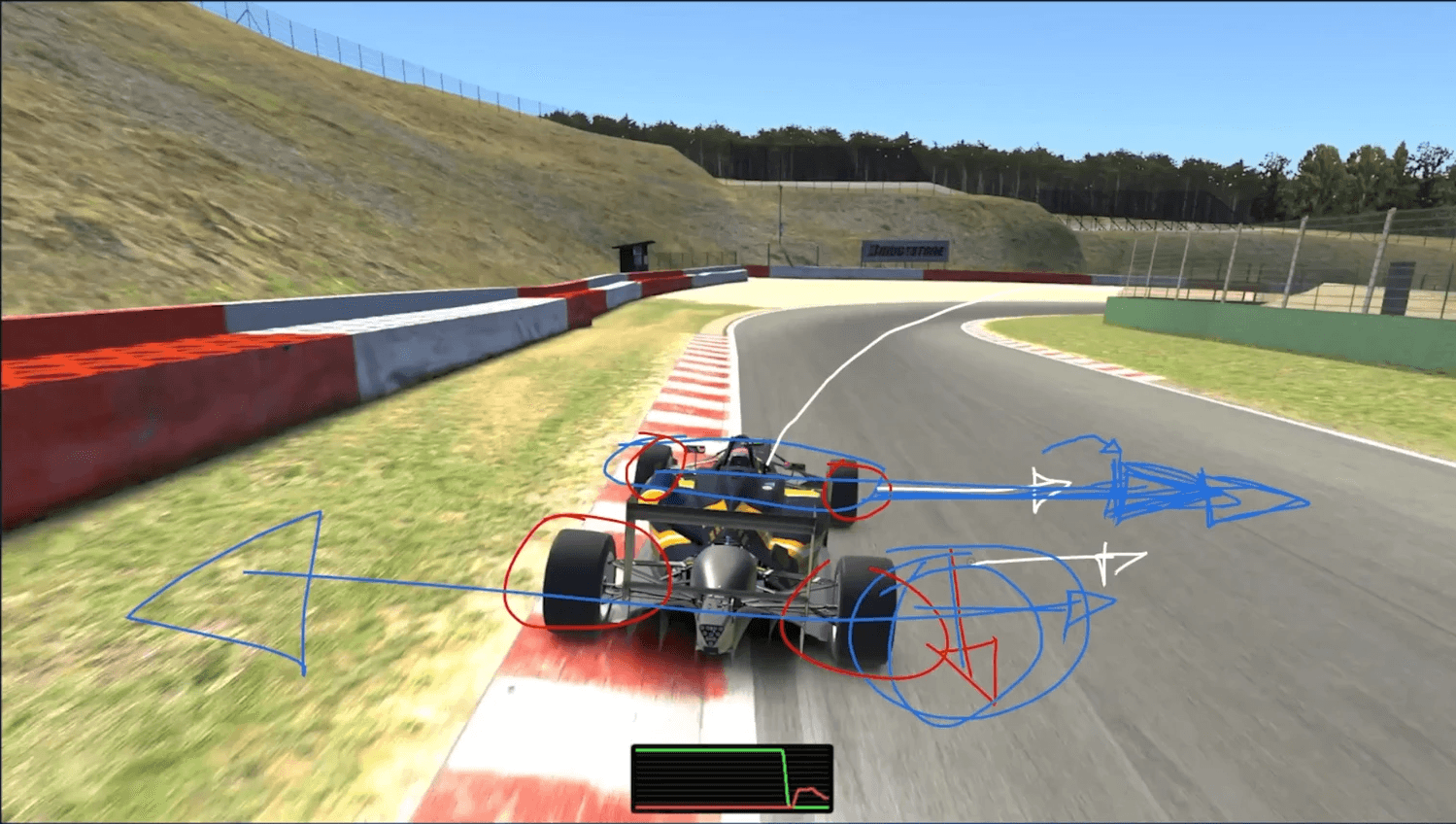
Essentially, we're going to make a hairpin, so we're going to brake, turn and accelerate. First of all, we are going to come at top speed and we're going to brake on a straight line. At this point we are creating only forces to this direction, which actually matches the eventual direction that we want on the exit. So all the forces are now matching our final direction, which is good.
Understanding Force Combination Through the Corner
Now we will start turning. First we'll turn a little bit more slowly and then we'll turn a little bit more quickly as the speed goes down, right, all the way to our MRP. Now at this point here we are turning a little bit, right, so we're creating a little bit of a force here, because that's a rotational force. But we're still braking, so we are still creating a force to this direction. We're trail braking. Now if we combine those two forces, we will get this, which is the same direction of our exit. The combined forces, the resultant force direction, is the same.
Now let's go a little bit deeper into the corner. At this point here we are really turning a lot, right, peak rotation. So we're creating a lot of forces in the car to this direction and at this point pretty much braking almost nothing, so a little bit of a force here. And if we combine those two forces, again we still get the resultant force matching that.
Transitioning to Acceleration
Now at this point we will start accelerating. So let's start accelerating a little bit. At this point we are already creating a force forward a little bit, not so much yet, right, we're starting to accelerate. And we are still turning a lot, so we're creating a force to this direction. And if we combine the forces, still matches. See, ideally here we're optimizing and combining the longitudinal and lateral forces, so that the resultant force matches the direction of the exit of the corner.
And then we accelerate even more. We get to this point where we are now accelerating way more and turning a little bit less, right, opening spiral. The resultant force is the same. And then we keep going until we get to the point where we're fully straight and we're only creating this force in an alternative.
This is a very interesting way of seeing how we can blend from longitudinal deceleration to peak rotation to longitudinal acceleration all while maintaining that combination, that proportion in a way that the resultant forces always match the direction of the corner we want to go. This is extremely, extremely useful.
Common Mistakes With Force Direction
And you'll see that if we, for example, accelerate a little bit here, that wouldn't be good because now it would be creating a force to that direction, but then turning to this direction. And the resultant force goes up. It doesn't really match the direction that we want. And that is why when you're trying that approach, you will probably go to a different direction and you won't be able to get a very good exit.
At the same time, if we were here and we started braking, we would be creating a force to this direction while cornering to this direction. And our resultant is also not matching the direction that we want. This is why we don't brake on the exit and this is why we don't accelerate at the entry.
Special Case: Flat Corners
This is a very obvious scenario because we're talking about a symmetrical corner. But this only applies if we have to decelerate. If you're doing a corner where you're already flat, let's say you're doing a corner like this and you're at low speed, you don't need to necessarily brake here because you can do the corner flat. In this case, that will not apply. You will do an opening spiral from the turning point. And because the car already has enough grip to rotate, you don't have to rebalance the forces. You have plenty of forces laterally already available to use 100%. So there is no need to rebalance the forces.
Application to Double Apex Corners
This is very helpful in double apex corners where you see this curve and you see this curve and you're like a little bit confused. You might even think that these are two separate corners where you're going to brake and then accelerate and then brake and then accelerate like this. It's not going to help if you don't understand that you can actually combine these. There's going to be a lesson only on double apexes. So I'm going to explain when to double apex when to not double apex.
But in this case, we can see exactly everything that we talked about right now. We have this force fully, right? Then right here, we're trail braking. So we're creating this force and this force and the resultant is this, which matches right here. And then as we keep going, we're going to accelerate where? Right here at the throttle application point, look at the car. It's pretty much 50/50, right? The car is pointing that way. It's finally crossing that horizon. Now it's starting to turn a lot more and it's going from having a tiny bit of brakes to having a tiny bit of throttle. And then from here, right here, we get a lot more power and still a little bit of turning. And then right here, tiny bit of turning, more acceleration and the car is drifting itself all the way to the outside.
So you can see how the forces were always matching downwards in this symmetrical 180 degrees corner. I emphasize that this is going to look exactly like this. Super nice and beautiful. When the corner is 180 degrees and symmetrical, if the corner is 45 degrees or 90 degrees, then the forces are not going to align 100 percent. But the idea is exactly the same. You're just combining the forces so that the arrows match very well the direction that you want to go on the exit.
Developing Feel and Instinct
This is also something you can feel while driving. When you brake and you're starting to transition, you want to kind of like feel that force and then you're doing your best to direct those forces to where you want to go while going as fast as possible and while being on the limit of cornering. This is super useful because it's kind of like a principle, you know, a feeling, an instinct that you can carry to every corner and that allows you to be on the limit and have something to follow rather than just following braking zones and turning points and stuff like that. Feel it. Internalize this idea as a physical feeling and then you can start doing those things in any corner without having to think about it. Just naturally doing it.
Example: Long Beach 90-Degree Corner
Let's go through an example that I like a lot. We are with the Ferrari GT3 at Long Beach in a 90-degree corner. Let's talk about this one because I found it very difficult when I started learning and I see a lot of people struggling with it. Here's a top-down shot. Actually, before I show you this, let's think a little bit about where should be our acceleration point.
First glance, we look at the apex and I told you, hey, accelerate at the apex as a baseline, 50% right, 50% on the rotation. The thing though is that if you look at the width of the track right here and the width of the track right here, ooh, there's something interesting here. This is not a symmetrical corner. The entry is wider. We have way more room from here to here than from here to here.
Finding the True Apex
So where should our maximum rotation point be? Where is the place where a traditional apex would be? Well, take the corner. The corner is 90 degrees right from here to here and cross a line on the middle. Boom. That's the point right here. It's not here. This is the physical inside, which I said, hey, the apex is the physical inside of the corner, but in some places there's kind of like a hidden ghost apex where your maximum rotation point should be around. Again, not necessarily here, depending on if it's an effective late apex, then your maximum rotation point would be around here. This apex or the middle of the corner for this specific scenario would be just 50% of the rotation. So where is 50% of the rotation? If you look at the actual arc here, if you try to place an arc, you will see that the middle is around here.
So let's run the video and see where I started accelerating. Right here. You see? So this is still kind of an early apex. I'm not accelerating so early, but you can see that there's this distance here between the throttle point and the actual physical inside of the corner. If we touched the middle, middle of the wall, then we would be actually crashing here in the wall. See? This is the line that most people do beginners, but this is the actual line is actually turning in later than you would think so that you can have this nice exit. And this is mostly because there's a difference in width here that most people don't take into account.
So this is still an early apex approach, but I'm accelerating before the wall. Just to compensate for the difference in the tracks width on exit compared to entry. But you see that the baseline is still the same. I want to accelerate when I rotate 50%, and if I wanted an even later apex approach, I will accelerate probably a little bit before that. But actually never here. This would be too late, and you would just not get a good exit compared to what's optimally possible.
So as you can see, right here, accelerating already at 50% throttle right here. And then by the time we get to the actual apex, we already traveled some good time on power. So very important, divide the corner into two halves and see where is that middle. Place your MRP at that middle and then make adjustments from there. You can put your MRP here or here or here. This is more or less the area. Remember early apex around this area, late apex around this area. No later than that, no earlier than that.
Forces in Non-180 Degree Corners
One more example, this time just a regular corner. And I want to explain a little bit more about the forces when the corner is not 180 degrees. All right, great. The thing here is we have two forces, right? We have the force slowing down the car. We have the force turning the car. In this case, we are combining the forces, but they're not as easy to comprehend compared to a 180 degree corner.
So the explanation here, just to make it very, very clear, is that without the braking, if you were just trying to turn with that much speed, the tires would not have the grip to create those forces. The effective force would be something like this and you would go off. So in the case of braking a little bit, instead of braking all the way, because when you're braking here, you're not actually creating a force that is in the same direction of the exit. That doesn't match, right?
Using Braking to Enable Rotation
But there's a reason for the brakes here is that so that we can enable the rotational forces to even exist because without the deceleration, the car is too fast and this arrow doesn't get as big as this one and the car is not capable of rotating. So in this case, we are using a little bit of this to be able to get a bigger blue arrow and that is why we have to decelerate in this way and that is why the directions of forces are not so easy to comprehend when the corner is not 180 degrees.
So remember, we use a little bit of the brakes to add rotation. And by the way, we do that in two ways. One, we simply decelerate the car so the car can naturally get extra rotation. And two, we actually shift some weight to the front tires so the front tires have even more grip and they can get even more rotation to the direction you want. And remember, of course, if you do that too much, then the rear tires start to struggle. They cannot hold that rotation and the car ends up sliding to this side. So this front goes to the right, the rear goes to the left and you end up spinning the car. This is obviously oversteer.
This way of understanding the forces is really, really helpful when you really, truly understand at an instinctive level because you can just do it without thinking in the future. And I will repeat that because in the end, I wanted to forget about my course. I wanted to forget about everything. I just wanted to drive fast.
Choosing Between Late Apex and Early Apex
Now that we have a better idea of what late apex versus early apex is, we can talk about how to choose which one to do. Let's put a little corner here, very basic. And let's say this is our baseline. In this corner, we can do both, right? We can do an early apex or we can do a later apex. I'm going to exaggerate a little bit here. Which one do we choose? How do you know? Well, it depends on the context of the corner.
Late Apex: Benefits and When to Use
So let's say that this approach, the late apex gives you a better exit, right? By here, you gain 0.1 seconds on exit because you're carrying more speed. And here you lose one tenth. And the other approach, the opposite, you gain 1/10th on entry here on this approach. But you lose 1/10th by the time you get here. Early apex makes you a little bit slower on the exit. But the thing is, this is by this line. It's by the time you reach this line. Let's say there's a little sector here. This is where the time is going to count. But let's say this is before a long straight like this. In this case, by the time you get to this part of the straight, the early apex will have lost 0.2 and the late apex approach would gain 2/10th here. Now, if you compare these two, the late apex approach is better because you lose 1/10th on entry, but you gain 2/10th on exit.
So we will generally choose late apex approach when there is a lot of straight or a lot of track on power. Even if there's like fast corners here, but you're not really lifting, then the late apex approach right here is going to matter a lot.
Early Apex: Benefits and When to Use
In a different scenario where we have actually a right-hander, a corner right here, then it's different, right? Now you don't really want to do a late apex here because you will have to start braking here. So you don't even have time to regain this 1/10th. You'll probably only have regained 0.7 or 0.6, something like that. And then you already have to brake a little bit for the next corner. So in this case, when there's another corner right away, you don't really have enough time to benefit from a faster exit right here. So it's way better to do the early apex approach because this one, you gain this tenth, you don't have enough time to lose a tenth on the exit because you're already turning in for another corner. So the context of the corner makes the total difference.
Corner Speed Considerations
Another thing that you should take into account is actually just how low speed the corner is. If you have a very low speed corner with a very high speed approach where you have to decelerate a lot, then generally a slightly later apex is better. If you have a fast corner instead, then an earlier apex is going to be better because that speed is not going to be that different. And remember what I said about the efficiency, right? The cars are way more efficient in decelerating than accelerating. In the case of decelerating a lot and then trying your best to get the best exit possible because you're going to benefit for this long straight, especially on a low speed corner, the late apex is going to be the best approach.
But in the case of a faster corner where you're not braking that much, then that difference is not that big, you can actually do an early apex. So in this case, the corner would be a lot more traditional early apex 50/50. So the lower the speed, the later the apex, the higher the speed, the closer to a traditional early apex 50/50 you would do. So in the end, you have to balance those two factors. The context of the corner, whether you have a lot of exit straight to benefit from the exit and the speed of the corner itself, the lower the speed, the later the apex, the longer the straight after the later the apex.
Reading MRP Data and Telemetry
I'm going to show you some more examples of MRP. This time, I'm going to plug a portion of the video from the motor racing checklist 2.0 because it was very good, no need to change anything. And then after that, we're going to go through some mistakes.
The reason we talk about MRP is to remember that whenever the speeds are going down, the rotation should be going up. This is how a well-defined MRP looks like. The rotation keeps increasing all the way into the minimum speed point with the peak yaw matching the peak steering and the minimum speed point before it starts going down as the speed increases.
And here's one more very good example of a very very clear MRP dividing the corner by two, one where you spiral down into more rotation and the second where you spiral up away from the rotation, never ever gaining rotation on exit. This is a very good example because although I am oversteering, even doing a countersteer on exit, I'm actually not gaining rotation at any time. You can see my yaw rate is still going down, but because the yaw rate was not going down fast enough for the amount of speed I was gaining, the car could not handle it and the rear tire started breaking grip.
Understanding Oversteer on Entry
This is how it looks like when you lose the rear on entry. The graph was supposed to look like this, but because it got more rotation than it was capable of handling at that speed, the rears broke grip. And that's why I had to do the countersteer before quickly bringing the car back to the limit and pointing to the right direction.
Just so we make it clear how you should read these graphs, the steering goes right when it's negative and it goes left when it's positive. The speed is pretty straightforward, we have more speed here and less speed here and the yaw rate is the same as the steering. We're seeing the graph going down because the car is yawing to the right and left when the car is turning left. So I had there in that example was the speed going down and then a little bit less slowly down here because we're trail braking so we're slowing down a little bit less during the corner compared to while we're braking a straight line and then it goes up like that.
Steering vs Yaw Relationship
And then we have the steering where we turn a tiny bit more or less here, but then as soon as we turn this bit, the yaw actually went a lot more than we expected to direct to the cars now over steering because we have less steering and a lot more yaw. The relationship between steering and yaw is always what's going to tell you if you have oversteer or understeer. Basically, if you have a little bit of steering but the car is yawing a lot, that's oversteer. If you have a lot of steering but the car is not yawing, that's understeer.
So if we have a graph that looks like this, that's oversteer. If we have a graph that looks like this and then the yaw is going less than the steering, that's understeer. Of course, it's very difficult to actually measure this because you don't know exactly what are the proportions of the graph. It's just so you can have some extra information. This is not necessarily how you're going to judge if you have understeer or oversteer. It's just a fun fact.
Anyways, so here we had a little bit of steering and we had a lot of yaw more than necessary. So I had to do a quick correction with the steering to bring that yaw back and then quickly getting back to where I wanted to be to not lose time. So I adjusted the correction and then I brought the car to building that nice rotation until I reached the actual peak that I wanted and then all the way back. This is how it looked in the graph and this is the oversteer moment right here. As you can see here, we have two peaks of rotation. One with the correct speed, which is exactly what I wanted. But this one here is a peak of rotation at a higher speed and the car is not capable of dealing with it.
Correcting Oversteer: GT Car Example
One more example, this time with a GT car. As you can see again, I got oversteer on entry. This time, the way I corrected was not with too much countersteer. I of course had to hold a little bit on my steering but without actually pointing to the other side because my way to solving this oversteer was to drop the brakes a little bit more quickly. So I shifted more weight to the rear tires more quickly and then I corrected the balance. As you can see, this was a less aggressive oversteer compared to the Formula 3 example. But you can definitely see that the yaw rate had an aggressive start there and I had to tame it and control it a little bit before bringing it up again towards mid-corner.
Pattern Recognition Across Corners
Then we have turn 6 and 7 and guess what? Exactly the same thing. Minimum speed, maximum rotation, place to accelerate, peak steering. We start seeing that pattern emerge in most corners. Closing spiral under braking, opening spiral on power. Closing spiral under braking, opening spiral on power. In all these examples so far, the maximum rotation point or the MRP is very close to the apex where the intersection between these closing and opening spirals are. But is it always like this? Let's watch this example.
MRP in Acceleration Corners
So far, in all the previous examples the peak steering was very close to the apex or very close to the inside of the corner. This time on the first apex that is still true, we still have the peak steering at the minimum speed which is very very close to the apex. We get back on power a little bit before the apex. But then on the second corner, the MRP is not very close to the right apex anymore. This time as soon as we change direction, we jump straight to the actual MRP. So if you look at the graph, we actually jump straight to the peak steering way, way before the actual second apex.
And the reason we're doing that is because we are not braking towards the second corner. We are accelerating. So if we're accelerating, we're gaining speed. So we have an opening spiral. Yes, we have an opening spiral very early into that corner because if we're gaining speed, we should be losing rotation. And this is such a common mistake on this corner. 90% of all the drivers and the planet will increase the steering towards the apex because so many corners are like that that we are wired in our brains to add more steering when we see that we're getting closer to an apex. But you have to add steering if you're decreasing your speed. If you're on power, you should be opening up your steering, which means if you're doing an entire corner on power and gaining speed, the peak steering is at the very beginning of it.
MRP Distance from Apex
What we have then is an MRP very close to the apex here because we are doing a closing spiral. So that's fine. Get back on power right here. That means we're opening spiral a little bit here. But as we change direction, we're building an opening spiral from here already. So that means the first MRP is right here. But the second one is right here. As you can see here, the distance between the MRP and the first apex is very close, regular, traditional, but the second one happens here. And the apex is not only until here. So that means we have a huge distance between the MRP and the apex.
In a situation like that, we definitely get a lot more rotation on the first half because we are at the lower speed right here and a much higher speed here. That means we have to turn in a little bit later than we think and turn in more aggressively to get the car to really point at the first half. And then the second half the car is going to be quicker and going on a straighter arc.
Lime Rock Example: Flat Corner Following Acceleration
Here's another very good example. Lime Rock. We're doing this left-hander corner and this is a acceleration part. So we're adding, adding, adding, adding steering until we accelerate. Now we decrease a little bit the steering, right? Because we're gaining speed, but then we're changing direction to the right and the next corner is flat. So that means we should already reach the peak steering as soon as we change direction. There we go. I change right away and then I'm getting less and less.
Common Mistake: Adding Steering Toward the Apex
But like all the other corners, a lot of people tends to add steering here because they see this curb and they think, "Oh, okay, that's a curb. That's the apex that increases steering on the way to that apex." And that's not correct. This is how we should not do it. You see, this is exactly what I talked about. At this point, he's steering this much. Right here, he has more speed than before, but also more steering. He is definitely going to be over the limit at this point and destroying the front tires if he was on the limit right here. And you can hear the tires just suffering and struggling and understeering and scrubbing and crying because he is asking for way too much from the car by expecting more rotation with more speed.
And the reason he's doing that, he's not even noticing it. It's just seeing the apex on the right. He's seeing the curb. And again, like I said, we are wired to add more steering when we see an apex. When we go from the outside on entry towards the inside mid-corner, we are doing more steering in 95% of the corners. And that's why we don't realize that there are moments where this is wrong.
Looking Ahead
Many of the next lessons are going to be about specific types of corners. We're going to talk about compound corners, double apexes, double left, double right, blind corners, deceiving corners, and more.
Essentially, we're going to make a hairpin, so we're going to brake, turn and accelerate. First of all, we are going to come at top speed and we're going to brake on a straight line. At this point we are creating only forces to this direction, which actually matches the eventual direction that we want on the exit. So all the forces are now matching our final direction, which is good.
Understanding Force Combination Through the Corner
Now we will start turning. First we'll turn a little bit more slowly and then we'll turn a little bit more quickly as the speed goes down, right, all the way to our MRP. Now at this point here we are turning a little bit, right, so we're creating a little bit of a force here, because that's a rotational force. But we're still braking, so we are still creating a force to this direction. We're trail braking. Now if we combine those two forces, we will get this, which is the same direction of our exit. The combined forces, the resultant force direction, is the same.
Now let's go a little bit deeper into the corner. At this point here we are really turning a lot, right, peak rotation. So we're creating a lot of forces in the car to this direction and at this point pretty much braking almost nothing, so a little bit of a force here. And if we combine those two forces, again we still get the resultant force matching that.
Transitioning to Acceleration
Now at this point we will start accelerating. So let's start accelerating a little bit. At this point we are already creating a force forward a little bit, not so much yet, right, we're starting to accelerate. And we are still turning a lot, so we're creating a force to this direction. And if we combine the forces, still matches. See, ideally here we're optimizing and combining the longitudinal and lateral forces, so that the resultant force matches the direction of the exit of the corner.
And then we accelerate even more. We get to this point where we are now accelerating way more and turning a little bit less, right, opening spiral. The resultant force is the same. And then we keep going until we get to the point where we're fully straight and we're only creating this force in an alternative.
This is a very interesting way of seeing how we can blend from longitudinal deceleration to peak rotation to longitudinal acceleration all while maintaining that combination, that proportion in a way that the resultant forces always match the direction of the corner we want to go. This is extremely, extremely useful.
Common Mistakes With Force Direction
And you'll see that if we, for example, accelerate a little bit here, that wouldn't be good because now it would be creating a force to that direction, but then turning to this direction. And the resultant force goes up. It doesn't really match the direction that we want. And that is why when you're trying that approach, you will probably go to a different direction and you won't be able to get a very good exit.
At the same time, if we were here and we started braking, we would be creating a force to this direction while cornering to this direction. And our resultant is also not matching the direction that we want. This is why we don't brake on the exit and this is why we don't accelerate at the entry.
Special Case: Flat Corners
This is a very obvious scenario because we're talking about a symmetrical corner. But this only applies if we have to decelerate. If you're doing a corner where you're already flat, let's say you're doing a corner like this and you're at low speed, you don't need to necessarily brake here because you can do the corner flat. In this case, that will not apply. You will do an opening spiral from the turning point. And because the car already has enough grip to rotate, you don't have to rebalance the forces. You have plenty of forces laterally already available to use 100%. So there is no need to rebalance the forces.
Application to Double Apex Corners
This is very helpful in double apex corners where you see this curve and you see this curve and you're like a little bit confused. You might even think that these are two separate corners where you're going to brake and then accelerate and then brake and then accelerate like this. It's not going to help if you don't understand that you can actually combine these. There's going to be a lesson only on double apexes. So I'm going to explain when to double apex when to not double apex.
But in this case, we can see exactly everything that we talked about right now. We have this force fully, right? Then right here, we're trail braking. So we're creating this force and this force and the resultant is this, which matches right here. And then as we keep going, we're going to accelerate where? Right here at the throttle application point, look at the car. It's pretty much 50/50, right? The car is pointing that way. It's finally crossing that horizon. Now it's starting to turn a lot more and it's going from having a tiny bit of brakes to having a tiny bit of throttle. And then from here, right here, we get a lot more power and still a little bit of turning. And then right here, tiny bit of turning, more acceleration and the car is drifting itself all the way to the outside.
So you can see how the forces were always matching downwards in this symmetrical 180 degrees corner. I emphasize that this is going to look exactly like this. Super nice and beautiful. When the corner is 180 degrees and symmetrical, if the corner is 45 degrees or 90 degrees, then the forces are not going to align 100 percent. But the idea is exactly the same. You're just combining the forces so that the arrows match very well the direction that you want to go on the exit.
Developing Feel and Instinct
This is also something you can feel while driving. When you brake and you're starting to transition, you want to kind of like feel that force and then you're doing your best to direct those forces to where you want to go while going as fast as possible and while being on the limit of cornering. This is super useful because it's kind of like a principle, you know, a feeling, an instinct that you can carry to every corner and that allows you to be on the limit and have something to follow rather than just following braking zones and turning points and stuff like that. Feel it. Internalize this idea as a physical feeling and then you can start doing those things in any corner without having to think about it. Just naturally doing it.
Example: Long Beach 90-Degree Corner
Let's go through an example that I like a lot. We are with the Ferrari GT3 at Long Beach in a 90-degree corner. Let's talk about this one because I found it very difficult when I started learning and I see a lot of people struggling with it. Here's a top-down shot. Actually, before I show you this, let's think a little bit about where should be our acceleration point.
First glance, we look at the apex and I told you, hey, accelerate at the apex as a baseline, 50% right, 50% on the rotation. The thing though is that if you look at the width of the track right here and the width of the track right here, ooh, there's something interesting here. This is not a symmetrical corner. The entry is wider. We have way more room from here to here than from here to here.
Finding the True Apex
So where should our maximum rotation point be? Where is the place where a traditional apex would be? Well, take the corner. The corner is 90 degrees right from here to here and cross a line on the middle. Boom. That's the point right here. It's not here. This is the physical inside, which I said, hey, the apex is the physical inside of the corner, but in some places there's kind of like a hidden ghost apex where your maximum rotation point should be around. Again, not necessarily here, depending on if it's an effective late apex, then your maximum rotation point would be around here. This apex or the middle of the corner for this specific scenario would be just 50% of the rotation. So where is 50% of the rotation? If you look at the actual arc here, if you try to place an arc, you will see that the middle is around here.
So let's run the video and see where I started accelerating. Right here. You see? So this is still kind of an early apex. I'm not accelerating so early, but you can see that there's this distance here between the throttle point and the actual physical inside of the corner. If we touched the middle, middle of the wall, then we would be actually crashing here in the wall. See? This is the line that most people do beginners, but this is the actual line is actually turning in later than you would think so that you can have this nice exit. And this is mostly because there's a difference in width here that most people don't take into account.
So this is still an early apex approach, but I'm accelerating before the wall. Just to compensate for the difference in the tracks width on exit compared to entry. But you see that the baseline is still the same. I want to accelerate when I rotate 50%, and if I wanted an even later apex approach, I will accelerate probably a little bit before that. But actually never here. This would be too late, and you would just not get a good exit compared to what's optimally possible.
So as you can see, right here, accelerating already at 50% throttle right here. And then by the time we get to the actual apex, we already traveled some good time on power. So very important, divide the corner into two halves and see where is that middle. Place your MRP at that middle and then make adjustments from there. You can put your MRP here or here or here. This is more or less the area. Remember early apex around this area, late apex around this area. No later than that, no earlier than that.
Forces in Non-180 Degree Corners
One more example, this time just a regular corner. And I want to explain a little bit more about the forces when the corner is not 180 degrees. All right, great. The thing here is we have two forces, right? We have the force slowing down the car. We have the force turning the car. In this case, we are combining the forces, but they're not as easy to comprehend compared to a 180 degree corner.
So the explanation here, just to make it very, very clear, is that without the braking, if you were just trying to turn with that much speed, the tires would not have the grip to create those forces. The effective force would be something like this and you would go off. So in the case of braking a little bit, instead of braking all the way, because when you're braking here, you're not actually creating a force that is in the same direction of the exit. That doesn't match, right?
Using Braking to Enable Rotation
But there's a reason for the brakes here is that so that we can enable the rotational forces to even exist because without the deceleration, the car is too fast and this arrow doesn't get as big as this one and the car is not capable of rotating. So in this case, we are using a little bit of this to be able to get a bigger blue arrow and that is why we have to decelerate in this way and that is why the directions of forces are not so easy to comprehend when the corner is not 180 degrees.
So remember, we use a little bit of the brakes to add rotation. And by the way, we do that in two ways. One, we simply decelerate the car so the car can naturally get extra rotation. And two, we actually shift some weight to the front tires so the front tires have even more grip and they can get even more rotation to the direction you want. And remember, of course, if you do that too much, then the rear tires start to struggle. They cannot hold that rotation and the car ends up sliding to this side. So this front goes to the right, the rear goes to the left and you end up spinning the car. This is obviously oversteer.
This way of understanding the forces is really, really helpful when you really, truly understand at an instinctive level because you can just do it without thinking in the future. And I will repeat that because in the end, I wanted to forget about my course. I wanted to forget about everything. I just wanted to drive fast.
Choosing Between Late Apex and Early Apex
Now that we have a better idea of what late apex versus early apex is, we can talk about how to choose which one to do. Let's put a little corner here, very basic. And let's say this is our baseline. In this corner, we can do both, right? We can do an early apex or we can do a later apex. I'm going to exaggerate a little bit here. Which one do we choose? How do you know? Well, it depends on the context of the corner.
Late Apex: Benefits and When to Use
So let's say that this approach, the late apex gives you a better exit, right? By here, you gain 0.1 seconds on exit because you're carrying more speed. And here you lose one tenth. And the other approach, the opposite, you gain 1/10th on entry here on this approach. But you lose 1/10th by the time you get here. Early apex makes you a little bit slower on the exit. But the thing is, this is by this line. It's by the time you reach this line. Let's say there's a little sector here. This is where the time is going to count. But let's say this is before a long straight like this. In this case, by the time you get to this part of the straight, the early apex will have lost 0.2 and the late apex approach would gain 2/10th here. Now, if you compare these two, the late apex approach is better because you lose 1/10th on entry, but you gain 2/10th on exit.
So we will generally choose late apex approach when there is a lot of straight or a lot of track on power. Even if there's like fast corners here, but you're not really lifting, then the late apex approach right here is going to matter a lot.
Early Apex: Benefits and When to Use
In a different scenario where we have actually a right-hander, a corner right here, then it's different, right? Now you don't really want to do a late apex here because you will have to start braking here. So you don't even have time to regain this 1/10th. You'll probably only have regained 0.7 or 0.6, something like that. And then you already have to brake a little bit for the next corner. So in this case, when there's another corner right away, you don't really have enough time to benefit from a faster exit right here. So it's way better to do the early apex approach because this one, you gain this tenth, you don't have enough time to lose a tenth on the exit because you're already turning in for another corner. So the context of the corner makes the total difference.
Corner Speed Considerations
Another thing that you should take into account is actually just how low speed the corner is. If you have a very low speed corner with a very high speed approach where you have to decelerate a lot, then generally a slightly later apex is better. If you have a fast corner instead, then an earlier apex is going to be better because that speed is not going to be that different. And remember what I said about the efficiency, right? The cars are way more efficient in decelerating than accelerating. In the case of decelerating a lot and then trying your best to get the best exit possible because you're going to benefit for this long straight, especially on a low speed corner, the late apex is going to be the best approach.
But in the case of a faster corner where you're not braking that much, then that difference is not that big, you can actually do an early apex. So in this case, the corner would be a lot more traditional early apex 50/50. So the lower the speed, the later the apex, the higher the speed, the closer to a traditional early apex 50/50 you would do. So in the end, you have to balance those two factors. The context of the corner, whether you have a lot of exit straight to benefit from the exit and the speed of the corner itself, the lower the speed, the later the apex, the longer the straight after the later the apex.
Reading MRP Data and Telemetry
I'm going to show you some more examples of MRP. This time, I'm going to plug a portion of the video from the motor racing checklist 2.0 because it was very good, no need to change anything. And then after that, we're going to go through some mistakes.
The reason we talk about MRP is to remember that whenever the speeds are going down, the rotation should be going up. This is how a well-defined MRP looks like. The rotation keeps increasing all the way into the minimum speed point with the peak yaw matching the peak steering and the minimum speed point before it starts going down as the speed increases.
And here's one more very good example of a very very clear MRP dividing the corner by two, one where you spiral down into more rotation and the second where you spiral up away from the rotation, never ever gaining rotation on exit. This is a very good example because although I am oversteering, even doing a countersteer on exit, I'm actually not gaining rotation at any time. You can see my yaw rate is still going down, but because the yaw rate was not going down fast enough for the amount of speed I was gaining, the car could not handle it and the rear tire started breaking grip.
Understanding Oversteer on Entry
This is how it looks like when you lose the rear on entry. The graph was supposed to look like this, but because it got more rotation than it was capable of handling at that speed, the rears broke grip. And that's why I had to do the countersteer before quickly bringing the car back to the limit and pointing to the right direction.
Just so we make it clear how you should read these graphs, the steering goes right when it's negative and it goes left when it's positive. The speed is pretty straightforward, we have more speed here and less speed here and the yaw rate is the same as the steering. We're seeing the graph going down because the car is yawing to the right and left when the car is turning left. So I had there in that example was the speed going down and then a little bit less slowly down here because we're trail braking so we're slowing down a little bit less during the corner compared to while we're braking a straight line and then it goes up like that.
Steering vs Yaw Relationship
And then we have the steering where we turn a tiny bit more or less here, but then as soon as we turn this bit, the yaw actually went a lot more than we expected to direct to the cars now over steering because we have less steering and a lot more yaw. The relationship between steering and yaw is always what's going to tell you if you have oversteer or understeer. Basically, if you have a little bit of steering but the car is yawing a lot, that's oversteer. If you have a lot of steering but the car is not yawing, that's understeer.
So if we have a graph that looks like this, that's oversteer. If we have a graph that looks like this and then the yaw is going less than the steering, that's understeer. Of course, it's very difficult to actually measure this because you don't know exactly what are the proportions of the graph. It's just so you can have some extra information. This is not necessarily how you're going to judge if you have understeer or oversteer. It's just a fun fact.
Anyways, so here we had a little bit of steering and we had a lot of yaw more than necessary. So I had to do a quick correction with the steering to bring that yaw back and then quickly getting back to where I wanted to be to not lose time. So I adjusted the correction and then I brought the car to building that nice rotation until I reached the actual peak that I wanted and then all the way back. This is how it looked in the graph and this is the oversteer moment right here. As you can see here, we have two peaks of rotation. One with the correct speed, which is exactly what I wanted. But this one here is a peak of rotation at a higher speed and the car is not capable of dealing with it.
Correcting Oversteer: GT Car Example
One more example, this time with a GT car. As you can see again, I got oversteer on entry. This time, the way I corrected was not with too much countersteer. I of course had to hold a little bit on my steering but without actually pointing to the other side because my way to solving this oversteer was to drop the brakes a little bit more quickly. So I shifted more weight to the rear tires more quickly and then I corrected the balance. As you can see, this was a less aggressive oversteer compared to the Formula 3 example. But you can definitely see that the yaw rate had an aggressive start there and I had to tame it and control it a little bit before bringing it up again towards mid-corner.
Pattern Recognition Across Corners
Then we have turn 6 and 7 and guess what? Exactly the same thing. Minimum speed, maximum rotation, place to accelerate, peak steering. We start seeing that pattern emerge in most corners. Closing spiral under braking, opening spiral on power. Closing spiral under braking, opening spiral on power. In all these examples so far, the maximum rotation point or the MRP is very close to the apex where the intersection between these closing and opening spirals are. But is it always like this? Let's watch this example.
MRP in Acceleration Corners
So far, in all the previous examples the peak steering was very close to the apex or very close to the inside of the corner. This time on the first apex that is still true, we still have the peak steering at the minimum speed which is very very close to the apex. We get back on power a little bit before the apex. But then on the second corner, the MRP is not very close to the right apex anymore. This time as soon as we change direction, we jump straight to the actual MRP. So if you look at the graph, we actually jump straight to the peak steering way, way before the actual second apex.
And the reason we're doing that is because we are not braking towards the second corner. We are accelerating. So if we're accelerating, we're gaining speed. So we have an opening spiral. Yes, we have an opening spiral very early into that corner because if we're gaining speed, we should be losing rotation. And this is such a common mistake on this corner. 90% of all the drivers and the planet will increase the steering towards the apex because so many corners are like that that we are wired in our brains to add more steering when we see that we're getting closer to an apex. But you have to add steering if you're decreasing your speed. If you're on power, you should be opening up your steering, which means if you're doing an entire corner on power and gaining speed, the peak steering is at the very beginning of it.
MRP Distance from Apex
What we have then is an MRP very close to the apex here because we are doing a closing spiral. So that's fine. Get back on power right here. That means we're opening spiral a little bit here. But as we change direction, we're building an opening spiral from here already. So that means the first MRP is right here. But the second one is right here. As you can see here, the distance between the MRP and the first apex is very close, regular, traditional, but the second one happens here. And the apex is not only until here. So that means we have a huge distance between the MRP and the apex.
In a situation like that, we definitely get a lot more rotation on the first half because we are at the lower speed right here and a much higher speed here. That means we have to turn in a little bit later than we think and turn in more aggressively to get the car to really point at the first half. And then the second half the car is going to be quicker and going on a straighter arc.
Lime Rock Example: Flat Corner Following Acceleration
Here's another very good example. Lime Rock. We're doing this left-hander corner and this is a acceleration part. So we're adding, adding, adding, adding steering until we accelerate. Now we decrease a little bit the steering, right? Because we're gaining speed, but then we're changing direction to the right and the next corner is flat. So that means we should already reach the peak steering as soon as we change direction. There we go. I change right away and then I'm getting less and less.
Common Mistake: Adding Steering Toward the Apex
But like all the other corners, a lot of people tends to add steering here because they see this curb and they think, "Oh, okay, that's a curb. That's the apex that increases steering on the way to that apex." And that's not correct. This is how we should not do it. You see, this is exactly what I talked about. At this point, he's steering this much. Right here, he has more speed than before, but also more steering. He is definitely going to be over the limit at this point and destroying the front tires if he was on the limit right here. And you can hear the tires just suffering and struggling and understeering and scrubbing and crying because he is asking for way too much from the car by expecting more rotation with more speed.
And the reason he's doing that, he's not even noticing it. It's just seeing the apex on the right. He's seeing the curb. And again, like I said, we are wired to add more steering when we see an apex. When we go from the outside on entry towards the inside mid-corner, we are doing more steering in 95% of the corners. And that's why we don't realize that there are moments where this is wrong.
Looking Ahead
Many of the next lessons are going to be about specific types of corners. We're going to talk about compound corners, double apexes, double left, double right, blind corners, deceiving corners, and more.
Essentially, we're going to make a hairpin, so we're going to brake, turn and accelerate. First of all, we are going to come at top speed and we're going to brake on a straight line. At this point we are creating only forces to this direction, which actually matches the eventual direction that we want on the exit. So all the forces are now matching our final direction, which is good.
Understanding Force Combination Through the Corner
Now we will start turning. First we'll turn a little bit more slowly and then we'll turn a little bit more quickly as the speed goes down, right, all the way to our MRP. Now at this point here we are turning a little bit, right, so we're creating a little bit of a force here, because that's a rotational force. But we're still braking, so we are still creating a force to this direction. We're trail braking. Now if we combine those two forces, we will get this, which is the same direction of our exit. The combined forces, the resultant force direction, is the same.
Now let's go a little bit deeper into the corner. At this point here we are really turning a lot, right, peak rotation. So we're creating a lot of forces in the car to this direction and at this point pretty much braking almost nothing, so a little bit of a force here. And if we combine those two forces, again we still get the resultant force matching that.
Transitioning to Acceleration
Now at this point we will start accelerating. So let's start accelerating a little bit. At this point we are already creating a force forward a little bit, not so much yet, right, we're starting to accelerate. And we are still turning a lot, so we're creating a force to this direction. And if we combine the forces, still matches. See, ideally here we're optimizing and combining the longitudinal and lateral forces, so that the resultant force matches the direction of the exit of the corner.
And then we accelerate even more. We get to this point where we are now accelerating way more and turning a little bit less, right, opening spiral. The resultant force is the same. And then we keep going until we get to the point where we're fully straight and we're only creating this force in an alternative.
This is a very interesting way of seeing how we can blend from longitudinal deceleration to peak rotation to longitudinal acceleration all while maintaining that combination, that proportion in a way that the resultant forces always match the direction of the corner we want to go. This is extremely, extremely useful.
Common Mistakes With Force Direction
And you'll see that if we, for example, accelerate a little bit here, that wouldn't be good because now it would be creating a force to that direction, but then turning to this direction. And the resultant force goes up. It doesn't really match the direction that we want. And that is why when you're trying that approach, you will probably go to a different direction and you won't be able to get a very good exit.
At the same time, if we were here and we started braking, we would be creating a force to this direction while cornering to this direction. And our resultant is also not matching the direction that we want. This is why we don't brake on the exit and this is why we don't accelerate at the entry.
Special Case: Flat Corners
This is a very obvious scenario because we're talking about a symmetrical corner. But this only applies if we have to decelerate. If you're doing a corner where you're already flat, let's say you're doing a corner like this and you're at low speed, you don't need to necessarily brake here because you can do the corner flat. In this case, that will not apply. You will do an opening spiral from the turning point. And because the car already has enough grip to rotate, you don't have to rebalance the forces. You have plenty of forces laterally already available to use 100%. So there is no need to rebalance the forces.
Application to Double Apex Corners
This is very helpful in double apex corners where you see this curve and you see this curve and you're like a little bit confused. You might even think that these are two separate corners where you're going to brake and then accelerate and then brake and then accelerate like this. It's not going to help if you don't understand that you can actually combine these. There's going to be a lesson only on double apexes. So I'm going to explain when to double apex when to not double apex.
But in this case, we can see exactly everything that we talked about right now. We have this force fully, right? Then right here, we're trail braking. So we're creating this force and this force and the resultant is this, which matches right here. And then as we keep going, we're going to accelerate where? Right here at the throttle application point, look at the car. It's pretty much 50/50, right? The car is pointing that way. It's finally crossing that horizon. Now it's starting to turn a lot more and it's going from having a tiny bit of brakes to having a tiny bit of throttle. And then from here, right here, we get a lot more power and still a little bit of turning. And then right here, tiny bit of turning, more acceleration and the car is drifting itself all the way to the outside.
So you can see how the forces were always matching downwards in this symmetrical 180 degrees corner. I emphasize that this is going to look exactly like this. Super nice and beautiful. When the corner is 180 degrees and symmetrical, if the corner is 45 degrees or 90 degrees, then the forces are not going to align 100 percent. But the idea is exactly the same. You're just combining the forces so that the arrows match very well the direction that you want to go on the exit.
Developing Feel and Instinct
This is also something you can feel while driving. When you brake and you're starting to transition, you want to kind of like feel that force and then you're doing your best to direct those forces to where you want to go while going as fast as possible and while being on the limit of cornering. This is super useful because it's kind of like a principle, you know, a feeling, an instinct that you can carry to every corner and that allows you to be on the limit and have something to follow rather than just following braking zones and turning points and stuff like that. Feel it. Internalize this idea as a physical feeling and then you can start doing those things in any corner without having to think about it. Just naturally doing it.
Example: Long Beach 90-Degree Corner
Let's go through an example that I like a lot. We are with the Ferrari GT3 at Long Beach in a 90-degree corner. Let's talk about this one because I found it very difficult when I started learning and I see a lot of people struggling with it. Here's a top-down shot. Actually, before I show you this, let's think a little bit about where should be our acceleration point.
First glance, we look at the apex and I told you, hey, accelerate at the apex as a baseline, 50% right, 50% on the rotation. The thing though is that if you look at the width of the track right here and the width of the track right here, ooh, there's something interesting here. This is not a symmetrical corner. The entry is wider. We have way more room from here to here than from here to here.
Finding the True Apex
So where should our maximum rotation point be? Where is the place where a traditional apex would be? Well, take the corner. The corner is 90 degrees right from here to here and cross a line on the middle. Boom. That's the point right here. It's not here. This is the physical inside, which I said, hey, the apex is the physical inside of the corner, but in some places there's kind of like a hidden ghost apex where your maximum rotation point should be around. Again, not necessarily here, depending on if it's an effective late apex, then your maximum rotation point would be around here. This apex or the middle of the corner for this specific scenario would be just 50% of the rotation. So where is 50% of the rotation? If you look at the actual arc here, if you try to place an arc, you will see that the middle is around here.
So let's run the video and see where I started accelerating. Right here. You see? So this is still kind of an early apex. I'm not accelerating so early, but you can see that there's this distance here between the throttle point and the actual physical inside of the corner. If we touched the middle, middle of the wall, then we would be actually crashing here in the wall. See? This is the line that most people do beginners, but this is the actual line is actually turning in later than you would think so that you can have this nice exit. And this is mostly because there's a difference in width here that most people don't take into account.
So this is still an early apex approach, but I'm accelerating before the wall. Just to compensate for the difference in the tracks width on exit compared to entry. But you see that the baseline is still the same. I want to accelerate when I rotate 50%, and if I wanted an even later apex approach, I will accelerate probably a little bit before that. But actually never here. This would be too late, and you would just not get a good exit compared to what's optimally possible.
So as you can see, right here, accelerating already at 50% throttle right here. And then by the time we get to the actual apex, we already traveled some good time on power. So very important, divide the corner into two halves and see where is that middle. Place your MRP at that middle and then make adjustments from there. You can put your MRP here or here or here. This is more or less the area. Remember early apex around this area, late apex around this area. No later than that, no earlier than that.
Forces in Non-180 Degree Corners
One more example, this time just a regular corner. And I want to explain a little bit more about the forces when the corner is not 180 degrees. All right, great. The thing here is we have two forces, right? We have the force slowing down the car. We have the force turning the car. In this case, we are combining the forces, but they're not as easy to comprehend compared to a 180 degree corner.
So the explanation here, just to make it very, very clear, is that without the braking, if you were just trying to turn with that much speed, the tires would not have the grip to create those forces. The effective force would be something like this and you would go off. So in the case of braking a little bit, instead of braking all the way, because when you're braking here, you're not actually creating a force that is in the same direction of the exit. That doesn't match, right?
Using Braking to Enable Rotation
But there's a reason for the brakes here is that so that we can enable the rotational forces to even exist because without the deceleration, the car is too fast and this arrow doesn't get as big as this one and the car is not capable of rotating. So in this case, we are using a little bit of this to be able to get a bigger blue arrow and that is why we have to decelerate in this way and that is why the directions of forces are not so easy to comprehend when the corner is not 180 degrees.
So remember, we use a little bit of the brakes to add rotation. And by the way, we do that in two ways. One, we simply decelerate the car so the car can naturally get extra rotation. And two, we actually shift some weight to the front tires so the front tires have even more grip and they can get even more rotation to the direction you want. And remember, of course, if you do that too much, then the rear tires start to struggle. They cannot hold that rotation and the car ends up sliding to this side. So this front goes to the right, the rear goes to the left and you end up spinning the car. This is obviously oversteer.
This way of understanding the forces is really, really helpful when you really, truly understand at an instinctive level because you can just do it without thinking in the future. And I will repeat that because in the end, I wanted to forget about my course. I wanted to forget about everything. I just wanted to drive fast.
Choosing Between Late Apex and Early Apex
Now that we have a better idea of what late apex versus early apex is, we can talk about how to choose which one to do. Let's put a little corner here, very basic. And let's say this is our baseline. In this corner, we can do both, right? We can do an early apex or we can do a later apex. I'm going to exaggerate a little bit here. Which one do we choose? How do you know? Well, it depends on the context of the corner.
Late Apex: Benefits and When to Use
So let's say that this approach, the late apex gives you a better exit, right? By here, you gain 0.1 seconds on exit because you're carrying more speed. And here you lose one tenth. And the other approach, the opposite, you gain 1/10th on entry here on this approach. But you lose 1/10th by the time you get here. Early apex makes you a little bit slower on the exit. But the thing is, this is by this line. It's by the time you reach this line. Let's say there's a little sector here. This is where the time is going to count. But let's say this is before a long straight like this. In this case, by the time you get to this part of the straight, the early apex will have lost 0.2 and the late apex approach would gain 2/10th here. Now, if you compare these two, the late apex approach is better because you lose 1/10th on entry, but you gain 2/10th on exit.
So we will generally choose late apex approach when there is a lot of straight or a lot of track on power. Even if there's like fast corners here, but you're not really lifting, then the late apex approach right here is going to matter a lot.
Early Apex: Benefits and When to Use
In a different scenario where we have actually a right-hander, a corner right here, then it's different, right? Now you don't really want to do a late apex here because you will have to start braking here. So you don't even have time to regain this 1/10th. You'll probably only have regained 0.7 or 0.6, something like that. And then you already have to brake a little bit for the next corner. So in this case, when there's another corner right away, you don't really have enough time to benefit from a faster exit right here. So it's way better to do the early apex approach because this one, you gain this tenth, you don't have enough time to lose a tenth on the exit because you're already turning in for another corner. So the context of the corner makes the total difference.
Corner Speed Considerations
Another thing that you should take into account is actually just how low speed the corner is. If you have a very low speed corner with a very high speed approach where you have to decelerate a lot, then generally a slightly later apex is better. If you have a fast corner instead, then an earlier apex is going to be better because that speed is not going to be that different. And remember what I said about the efficiency, right? The cars are way more efficient in decelerating than accelerating. In the case of decelerating a lot and then trying your best to get the best exit possible because you're going to benefit for this long straight, especially on a low speed corner, the late apex is going to be the best approach.
But in the case of a faster corner where you're not braking that much, then that difference is not that big, you can actually do an early apex. So in this case, the corner would be a lot more traditional early apex 50/50. So the lower the speed, the later the apex, the higher the speed, the closer to a traditional early apex 50/50 you would do. So in the end, you have to balance those two factors. The context of the corner, whether you have a lot of exit straight to benefit from the exit and the speed of the corner itself, the lower the speed, the later the apex, the longer the straight after the later the apex.
Reading MRP Data and Telemetry
I'm going to show you some more examples of MRP. This time, I'm going to plug a portion of the video from the motor racing checklist 2.0 because it was very good, no need to change anything. And then after that, we're going to go through some mistakes.
The reason we talk about MRP is to remember that whenever the speeds are going down, the rotation should be going up. This is how a well-defined MRP looks like. The rotation keeps increasing all the way into the minimum speed point with the peak yaw matching the peak steering and the minimum speed point before it starts going down as the speed increases.
And here's one more very good example of a very very clear MRP dividing the corner by two, one where you spiral down into more rotation and the second where you spiral up away from the rotation, never ever gaining rotation on exit. This is a very good example because although I am oversteering, even doing a countersteer on exit, I'm actually not gaining rotation at any time. You can see my yaw rate is still going down, but because the yaw rate was not going down fast enough for the amount of speed I was gaining, the car could not handle it and the rear tire started breaking grip.
Understanding Oversteer on Entry
This is how it looks like when you lose the rear on entry. The graph was supposed to look like this, but because it got more rotation than it was capable of handling at that speed, the rears broke grip. And that's why I had to do the countersteer before quickly bringing the car back to the limit and pointing to the right direction.
Just so we make it clear how you should read these graphs, the steering goes right when it's negative and it goes left when it's positive. The speed is pretty straightforward, we have more speed here and less speed here and the yaw rate is the same as the steering. We're seeing the graph going down because the car is yawing to the right and left when the car is turning left. So I had there in that example was the speed going down and then a little bit less slowly down here because we're trail braking so we're slowing down a little bit less during the corner compared to while we're braking a straight line and then it goes up like that.
Steering vs Yaw Relationship
And then we have the steering where we turn a tiny bit more or less here, but then as soon as we turn this bit, the yaw actually went a lot more than we expected to direct to the cars now over steering because we have less steering and a lot more yaw. The relationship between steering and yaw is always what's going to tell you if you have oversteer or understeer. Basically, if you have a little bit of steering but the car is yawing a lot, that's oversteer. If you have a lot of steering but the car is not yawing, that's understeer.
So if we have a graph that looks like this, that's oversteer. If we have a graph that looks like this and then the yaw is going less than the steering, that's understeer. Of course, it's very difficult to actually measure this because you don't know exactly what are the proportions of the graph. It's just so you can have some extra information. This is not necessarily how you're going to judge if you have understeer or oversteer. It's just a fun fact.
Anyways, so here we had a little bit of steering and we had a lot of yaw more than necessary. So I had to do a quick correction with the steering to bring that yaw back and then quickly getting back to where I wanted to be to not lose time. So I adjusted the correction and then I brought the car to building that nice rotation until I reached the actual peak that I wanted and then all the way back. This is how it looked in the graph and this is the oversteer moment right here. As you can see here, we have two peaks of rotation. One with the correct speed, which is exactly what I wanted. But this one here is a peak of rotation at a higher speed and the car is not capable of dealing with it.
Correcting Oversteer: GT Car Example
One more example, this time with a GT car. As you can see again, I got oversteer on entry. This time, the way I corrected was not with too much countersteer. I of course had to hold a little bit on my steering but without actually pointing to the other side because my way to solving this oversteer was to drop the brakes a little bit more quickly. So I shifted more weight to the rear tires more quickly and then I corrected the balance. As you can see, this was a less aggressive oversteer compared to the Formula 3 example. But you can definitely see that the yaw rate had an aggressive start there and I had to tame it and control it a little bit before bringing it up again towards mid-corner.
Pattern Recognition Across Corners
Then we have turn 6 and 7 and guess what? Exactly the same thing. Minimum speed, maximum rotation, place to accelerate, peak steering. We start seeing that pattern emerge in most corners. Closing spiral under braking, opening spiral on power. Closing spiral under braking, opening spiral on power. In all these examples so far, the maximum rotation point or the MRP is very close to the apex where the intersection between these closing and opening spirals are. But is it always like this? Let's watch this example.
MRP in Acceleration Corners
So far, in all the previous examples the peak steering was very close to the apex or very close to the inside of the corner. This time on the first apex that is still true, we still have the peak steering at the minimum speed which is very very close to the apex. We get back on power a little bit before the apex. But then on the second corner, the MRP is not very close to the right apex anymore. This time as soon as we change direction, we jump straight to the actual MRP. So if you look at the graph, we actually jump straight to the peak steering way, way before the actual second apex.
And the reason we're doing that is because we are not braking towards the second corner. We are accelerating. So if we're accelerating, we're gaining speed. So we have an opening spiral. Yes, we have an opening spiral very early into that corner because if we're gaining speed, we should be losing rotation. And this is such a common mistake on this corner. 90% of all the drivers and the planet will increase the steering towards the apex because so many corners are like that that we are wired in our brains to add more steering when we see that we're getting closer to an apex. But you have to add steering if you're decreasing your speed. If you're on power, you should be opening up your steering, which means if you're doing an entire corner on power and gaining speed, the peak steering is at the very beginning of it.
MRP Distance from Apex
What we have then is an MRP very close to the apex here because we are doing a closing spiral. So that's fine. Get back on power right here. That means we're opening spiral a little bit here. But as we change direction, we're building an opening spiral from here already. So that means the first MRP is right here. But the second one is right here. As you can see here, the distance between the MRP and the first apex is very close, regular, traditional, but the second one happens here. And the apex is not only until here. So that means we have a huge distance between the MRP and the apex.
In a situation like that, we definitely get a lot more rotation on the first half because we are at the lower speed right here and a much higher speed here. That means we have to turn in a little bit later than we think and turn in more aggressively to get the car to really point at the first half. And then the second half the car is going to be quicker and going on a straighter arc.
Lime Rock Example: Flat Corner Following Acceleration
Here's another very good example. Lime Rock. We're doing this left-hander corner and this is a acceleration part. So we're adding, adding, adding, adding steering until we accelerate. Now we decrease a little bit the steering, right? Because we're gaining speed, but then we're changing direction to the right and the next corner is flat. So that means we should already reach the peak steering as soon as we change direction. There we go. I change right away and then I'm getting less and less.
Common Mistake: Adding Steering Toward the Apex
But like all the other corners, a lot of people tends to add steering here because they see this curb and they think, "Oh, okay, that's a curb. That's the apex that increases steering on the way to that apex." And that's not correct. This is how we should not do it. You see, this is exactly what I talked about. At this point, he's steering this much. Right here, he has more speed than before, but also more steering. He is definitely going to be over the limit at this point and destroying the front tires if he was on the limit right here. And you can hear the tires just suffering and struggling and understeering and scrubbing and crying because he is asking for way too much from the car by expecting more rotation with more speed.
And the reason he's doing that, he's not even noticing it. It's just seeing the apex on the right. He's seeing the curb. And again, like I said, we are wired to add more steering when we see an apex. When we go from the outside on entry towards the inside mid-corner, we are doing more steering in 95% of the corners. And that's why we don't realize that there are moments where this is wrong.
Looking Ahead
Many of the next lessons are going to be about specific types of corners. We're going to talk about compound corners, double apexes, double left, double right, blind corners, deceiving corners, and more.
Consistency & Confidence
Balance & Speed
Mastery
Other Lessons