Consistency Challenge 2
Lesson
13
of
49

Did you complete the challenge? Share on Discord!
This consistency challenge uses a car equipped with ABS traction control and significant torque at medium RPM. The objective is to complete 10 consecutive laps under 1:03.5 seconds. To begin, select the M2CS (a free car) and choose Lime Rock Park chicane's layout. Remember to reset your weather conditions. You can use any setup, but the fixed setup is recommended.
Turn One: Braking and Initial Approach
Turn one provides clear reference points with multiple brake markers available. Begin braking around the four marker, reaching peak pressure just after the four. For consistency, avoid abusing the ABS system. When ABS activates in this car, rotation vanishes and understeer becomes a significant problem. Minimize understeer by avoiding simultaneous hard braking and turning.
The target lap time for consistency should be in the 1:03 to high 1:02 range. Achieving this requires limiting ABS use and avoiding excessive braking force. The grass at this section is extremely unforgiving—once ABS engages, it becomes very easy to touch the grass with either both tires or just the rear, resulting in an immediate spin.
Double Apex Section: First Apex
Apply trail braking very lightly as you approach this long double apex corner. Clip the first apex curb quite early, as this corner requires a specific approach. There is a brief moment to touch the throttle between the two apexes—just enough time to re-accelerate slightly before trailing again. Position the car almost all the way to the left while preparing for the second apex.
Double Apex Section: Second Apex
The second apex is particularly tricky due to its closing radius characteristic. While the corner initially appears less tight, it becomes progressively tighter toward the exit. Avoid hitting the curb purely; instead, aim to hit the curb on the second half of it, positioning closest to the inside during the second half of the corner.
At the exit, the car will naturally drift with a bit of oversteer, requiring minor steering corrections. Don't position the car too far to the right—just slightly right—then turn in quite early. Pay attention to throttle application: progression is critical here because this car produces substantial torque in third gear with significant power to the wheels. Exercise patience and caution to avoid excessive slide. While traction control is present, it won't prevent oversteer and only activates when you're already in serious trouble.
Next Corner: Late Apex Strategy
Apply very light braking at this section. Be patient with steering input as the car becomes slightly loose here. Avoid getting to the inside too early—you need to see the curb, but the actual maximum rotation point occurs quite late. Continue turning progressively more and more until finally reaching the curb toward the end of the corner. Aim to almost clip the grass here.
This late apex strategy is deliberate: it positions you on the left for the next corner, which is crucial for lap times due to the semi-long straight that follows. Maximizing speed through this next corner is essential, which is why we sacrifice optimal speed in the left-hander before it.
Quick Direction Change and Compression
Execute a quick change in direction. Due to the high torque, full throttle may not be possible here as the car will dance considerably. Change direction with a little lift, then gradually apply more and more power.
As you enter a compression with slight camber, be aware that the track falls on the outside. This transition from banking to flat surface results in reduced grip. The track appears to get visually thinner in this area, indicating the falling characteristic. Around this zone, the car will feel like it wants to snap. The sensation can be deceptive—you may feel fine initially, then realize the car is nearly at the outside edge. Mistakes are easy here; clipping the damaged grass can result in a spin or direction control issues, costing anywhere from three to ten seconds.
Braking Zone with Skid Mark Reference
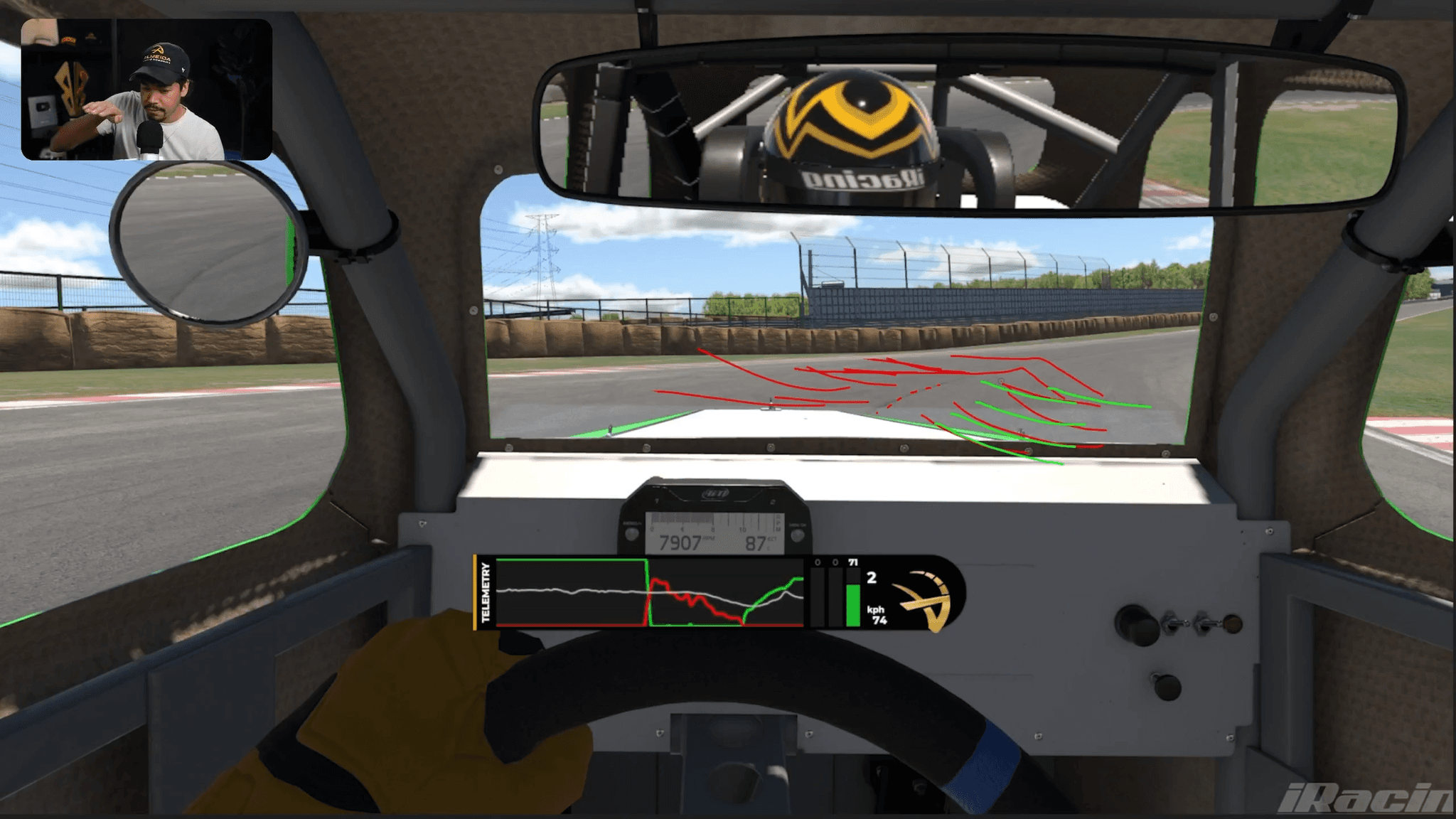
This braking zone offers limited reference points, but the skid mark provides an excellent guide. Skid marks can be useful references, and this particular one is ideal for this specific environment. Since it's printed in the track texture rather than being a dynamic skid mark, it remains constant and reliable. A second skid mark forms an X pattern, further enhancing the braking reference.
As braking begins, relax your hands. The wheel will vibrate and shake slightly—this is normal, simply the force feedback returning to its natural state. Turn ever so slightly to the left while braking, though this contradicts the general rule of not braking and turning simultaneously. The minimal one-degree turn allows you to drift slightly over the curb and maximize your radius.
Gear Selection: Third vs. Second
This very tight corner can be taken in either third or second gear—try both to determine your preference. Second gear provides more torque but requires a rapid upshift to third, and this car exhibits poor upshift characteristics. Despite being launched in 2024-2025, the car remains problematic during upshifts. When upshifting from second to third, the car kicks, making it very easy to lose the rear during the upshift itself.
Staying in third gear proves more consistent. Additionally, third gear at very low RPM still produces substantial torque, so minimal time is lost by remaining in third. Testing both options allows you to feel the difference: second gear offers slightly more torque, but the upshift to third (which occurs around a specific point in the corner) produces severe oversteer.
Trail Braking and Crest Navigation
Apply trail braking, then power through. Allow the car to drift at the crest, where visibility is limited. The car becomes very light and falls toward the outside, so let it run toward the curb. Attempting to run away from the curb will induce oversteer to the right, resulting in significant time loss due to traction control intervention or potential loss of control.
For braking reference, use the track line and the layout change mark visible on the track surface. Turn in semi-late. What appears to be an apex is not—ignore it. The actual apex is further along. Position the car to cross the track from left to right as much as possible to achieve a better change of direction afterward. Continue closing, closing, closing, then open up more to reach the proper position. This provides a better line to the right, allowing maximum speed carry through the following left-hander.
Line Optimization and Direction Change
Turning in too early—as the track seems to invite—will push you wide at the exit, resulting in a terrible line for the subsequent corner. The preferred line involves crossing the track fully, enabling a fast direction change. Execute the direction change quickly, then position half the car in the grass. Be careful not to use too much grass, as this will trigger a slowdown and off-track penalty.
Upshifting to third gear at this point consistently causes oversteer due to the quick shift characteristic. This car exhibits particularly poor behavior regarding oversteer during upshifts. The phenomenon is notable and unusual—just a simple upshift produces significant oversteer that demands immediate correction.
Compression Turn-In
Execute a very aggressive turn-in here to capitalize on the compression. The car effectively doubles its weight as it hits this compression before turning into the corner. Maximize this grip by turning aggressively on the compression. In real life, you would feel your entire body being pushed down. The area features some camber initially, but the track falls from a certain point onward.
Up to a specific point, grip is abundant. However, from there the track tilts off-camber. This creates a deceptive sensation—it feels like you'll make the corner well, but the car wants to run all the way to the grass. Be careful with this exit. A quick lift followed by slow, gradual acceleration proves most effective for maintaining consistency.
Looking Ahead: Future Course Content
The focus here is on consistency rather than absolute lap time. Faster lap times in the 1:01 range will be addressed in levels two, three, and four of this course. The next series will cover balance and speed, teaching you to drive like a top 5% driver. Topics will include:
Breaking precision and breaking exercises
Weight transfers
Lip angle
True limits
Neutral steer
Precision exercises
Trail breaking
String theory and advanced string theory variations
Advanced steering concepts
Light hand technique
Active versus passive counter steer
More advanced steering tips and exercises
These topics will be covered before progressing to level three, where instruction focuses on reaching the top 2% of drivers.
Consistency & Confidence
Balance & Speed
Cornering Precision
Mastery