The Basics
Lesson
5
of
49

In this lesson, we'll talk about why braking is the most important part of racing, the functions of braking, and pro tips for entry speed consistency. This is part one, braking of a series of three lessons on consistency.
Why Braking is the Most Important Technique in Racing
Entry is cause, exit is consequence. That's pretty much the single most important reason why braking is so important, because if you don't understand and feel how much your car can slow down, then how do you know when to brake, how much to brake, or even if you will make the corner? You can't know, you need to slow down and get the speed to what you can actually carry during the corner itself. Consistent laps will come from consistent braking. This is like the most important thing. 90% of your consistency comes from having the car always slow down the same way.
The Two Functions of Braking
Braking has two functions. First, obviously, deceleration, which is what we're going to use the most as beginners. And second is rotation, which we will start using as we become intermediate and advanced drivers. But I want to create this separation here, because you actually don't get to choose. Sometimes you try to decelerate, and you get the rotation. Sometimes you try to rotate, and you get the deceleration. You will always get both together, depending on whether you're turning the steering or not. And that is why so many beginners end up spinning so easily, because they're not ready for the amount of rotation that you might get if you try to brake and turn at the same time.
Now, these functions, they actually flow from one side to the other, depending on how much you're braking, how much you're turning. If you're braking 100% and not turning at all, you might get peak deceleration. But if you start turning into the corner and you start to slowly release the brakes, you can really see that transition with the speed goes down more slowly, but you're getting way more rotation. And this transition can be controlled, which is what we call trail braking.
Understanding Trail Braking
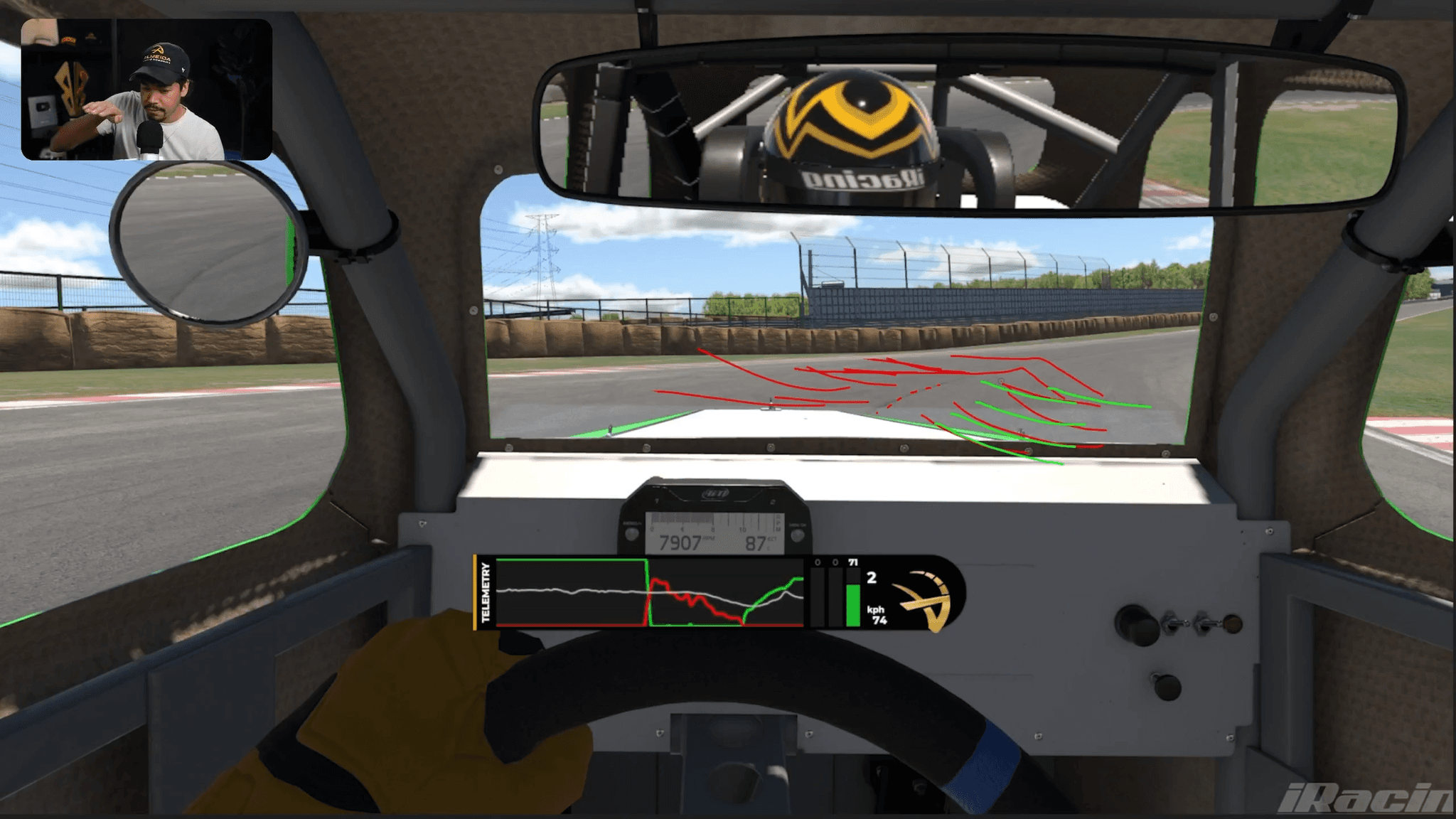
Trail braking is when you start transitioning the grip usage of the tires from deceleration to rotation, you start releasing the brakes as you add the steering. At first, we brake pretty hard to get the car to slow down predictably, and then we start releasing the brakes as the car turns more and more and more. And this, all of this is the actual trail braking.
Let me talk about something here. A lot of people will think that trail braking is only this ending part, not the transition. And honestly, this is just an agreement thing. If you want to call this phase trail braking, but not this phase, it's totally fine. Some different coaches will do. For me, as a coach and Connor and Kane, the other coaches from the Almeida Racing Academy will agree that trail braking is the whole process, all the way from the initial brake release when you have some sort of steering to the peak when you really release the brakes completely to 0% either to, you know, let the car roll with no inputs or to get back to the acceleration zone. So trail braking will be the whole process for us in this series.
And I'm saying this because, for example, if I say, hey, you're not trail braking a lot, that probably is what I'm telling you, instead of you doing something like this, you see this for me and for you, hopefully, will be a lot more trail braking on this line on top compared to this line down here. And I'm just telling you this here so that it's clear in every other lesson, what I mean by trail braking, more or trail braking less.
Essential Tips for Consistent Braking
Now let's talk about some very, very important. This is the best part, the most important part of this lesson. If you forget everything, I don't care. Just don't forget this bit here because this is the biggest thing for consistency.
Number One: You Need a Braking Reference
You will always have to need a braking reference. It can be the three board or the two board or the one board or the change from grass to track on the outside or a cone or a person or a Marshall post, whatever, you need a braking reference because you're going to use that beginning to change lap after lap using that as a reference. Very important to never brake somewhere around there or I don't really remember, I just like felt, you know, where I was braking no, choose a spot and brake at that spot. It's going to help you become more consistent over time.
Fast Application
Very, very, very important. Your initial brake application has to be pretty aggressive. You want to really get as quickly as possible to the peak deceleration. Obviously, if you are on a straight line before the corner, you want to brake pretty, pretty aggressively because this is how you're going to predictably slow the car down. Very, very important. I will show you why in a second.
Target Pressure Percentage
You brake very fast initially. That's a very good tip for consistency. But you also want to know to what pressure do you want to brake? Is it the top 100%? Does the car have good ABS? Then okay, maybe it may be at 100%. What if the car doesn't have ABS, if 100% locks or something, then you're going to have to brake, you know, 75 or 65 or something. Always be aware of how much you're actually braking because that is going to give you a lot more predictability, lap after lap on how much the car is going to slow down.
Maintained Pressure
Very important. I see a lot of beginners doing some sort of braking where they brake very hard and then they release too much. The car is not stopping, bro. Like you're in actual danger. If you brake, but then you're afraid of locking and you drop too much, the car is not going to stop. And then you brake again, but that's too late now because you're actually trying to turn. And then you lock up and then you go straight. Be careful with the pressure going up and down a lot and try to be a lot more consistent with the maintained pressure.
Obviously, if you are braking on a very straight line from top speed to a hairpin, for example, you have to brake and stay there, stay very close to the limit. You have to look for that limit. So again, we want to brake very fast to a specific pressure and we want to kind of maintain it. We don't want to drop it. When I really maintain, you can even think about it going fully straight like this and then only start trail braking as you start turning into the corner. But this initial phase is super important and this initial phase is super important. These two phases are going to give you a very consistent entry speed by the time you start turning into the corner.
Why Fast Application Matters
That's very, very, very important. If you brake differently from lap to lap, let's say you brake a little bit more slowly here. Ooh, look at this. By the time the car traveled a lot, you lost this much deceleration. Now, by the time you get here on the same spot, your car is going to be 10 kilometers faster and you might not even be able to do the corner. And you don't know why because, you know, oh, let's say you use this reference, but your brake application speed was different. So that's why it's so important to brake pretty sharply at first because that beginning is going to give you a predictable target entry speed point when you start turning into the corner.
Be on a Completely Straight Line
You have to be on a completely straight line. We're talking obviously about the hard braking zones that you can be on a straight line. If you're braking to the limit limit limit, you have to relax your hands. You don't want to be gripping the steering and moving around or trying to adjust your line a little bit. No, no, no. Before braking, you set up the line, you start braking your relax your hands and you let the steering go super straight because this is the only way that the tires are going to be balanced, literally 50, 50%. And you will get the maximum grip.
As soon as you grip your steering a little bit too hard and you start shaking it to one side or the other, you will get here 45 on one side and 55 on the other. And the car is not going to stop because this side here is going to be abused. It's not going to have enough traction. You might lock up one side and this side here is going to be under the limit. The car might even start turning a little bit. It's really, really bad. If you're trying to reach peak deceleration on a straight line braking zone, but you're not relaxing your hands and the car is not going perfectly straight.
Rotation Tips
Now let's talk about rotation tips. Also very, very important, slightly less important than the deceleration. So if you're a very, very early beginner, focus on that and try to really feel that before focusing on the rotation tips. But if you're more advanced, these are going to help you.
1% Feeling
First thing, 1% feeling. You have to know how to brake 1% in your pedal. Literally 1%. You can really look at the meter in iracing or whatever simulator you are. Try to just get to that 1% where you can barely see the bar that is going to be very useful. Because if you're only braking 100 and 0, 100 and 0 and sometimes someone tells you to trailbreak, you might end up braking 50, thinking that you're braking a lot less because you don't have the precision on your foot yet.
That brings back to what I told you on the few lessons ago. Muscle memory training comes from getting the right feeling and then repeating with reference, with patience, with time. So right now, I wanted to be able to stay on 1%. You can go 1, down, 1, down. You can stay 1 and get that feeling because eventually what you can do is you're turning into a corner and you combine the steering with that 1%. It's going to give you more rotation. It's going to be very, very useful, especially if the car is understeer and you want to be able to turn a little bit more so you can carry more speed and literally gain lap times.
Risk of Oversteer and Spin
Then we have the risk of oversteer and spin. This is where when you do that 1% and you turn, you might get an overwhelming amount of rotation and the car might even point too much and snap the rear towards the outside. So this will require you to be a little bit more precise because the oversteer requires a much quicker correction and reaction than understeer. And that is why you need to relax your hands.
Light Hands Technique
And we're going to talk about this in a lot of detail on the more advanced levels of the series of courses. But it's called light hands technique. The very basis of it is that you have to feel the force feedback. You have to relax your hands and sense the variance in forces that the force feedback is giving you. As soon as you get a little bit of oversteer, the steering is going to get heavier. As soon as you let's say you're turning here, you're turning this much and you're like, oh my God, the car is like understeering. I wanted to rotate more. If you just relax your hands and you start braking at this point, at this point, immediately the steering is actually going to get a little bit heavier. It's going to go down a little bit if you relax your hands because you're going to get so much more rotation that you get more grip on the front tires and more grip means more self-centering force being transferred to the steering and you feel it, you can feel the steering getting heavier immediately after you touch the pedals.
That's very, very, very useful and that is going to give you the precision. Because if you did it, if you ignored that, let's say you ignored this, right, you start braking, this looks like 5%. And then you stay here. That might be too much and you might spin and then you want to do a crazy correction here, but you're already spun. So that is why relaxing your hands whenever you try the 1% thing is very important for you to gain the precision to deal with the oversteer that might happen when you do the 1% trail braking thing.
Trail Braking as an Ongoing Process
Also remember that this 1% thing we're talking about is an ongoing process. So let's go back and say we're turning the steering constantly. This is what you're feeling. You're applying a specific amount of force and you're quite relaxed, right? So let's say you start trail braking a little bit here. The steering is actually going to force against you. You're going to feel that. And as soon as you release the brakes, the steering goes back up because it's going to resist less. Obviously here, we're assuming that the speed is not going down. It doesn't make a lot of sense. So the steering should actually start going up a little bit. But I'm ignoring this. I'm just telling you how the steering feels and how it reacts when you start trail braking.
And it's very important that this is an ongoing process. Why am I saying that this is an ongoing process? Because sometimes I see people, you know, just touching the brakes like this and then turning the steering, assuming that this is trail braking or this is going to turn the car. This is not going to turn the car. It's just going to do this and then the car is going to go back to understeer. What you really want is an ongoing process. It's going to feel and act and react to your inputs as long as the trail braking is there. That is why it's so important to have that 1% and feel the ongoing effect of it as your pedal is still pressed 1%, very, very important that this is an ongoing process.
And all of this is just for the 1% feeling. Like all these things, I'm talking about the 1% feeling. I'm not even talking about the whole no transition between peak deceleration and 1% feeling. All this transition here, we are going to talk about in the over 10 advanced lessons that we have on the next few courses. Remember that I told you that 95% of motorsports is actually braking, right? So yeah, we have a lot to talk about. There's a world of information here and so on. This is where you really find a perfect lap time.
More specifically about braking techniques, we will talk about a lot of stuff right at the very beginning of the level 2 course balance and speed. I'm going to teach you how to gain precision with the pedals. I'm going to talk about all stages of braking and how it differs from car to car, from low downforce to high downforce. I'm going to talk about braking elevation changes. I'm going to give you some actual exercise to try and improve your braking precision and way more stuff and trail braking and so on. But for now, focus on getting that consistency, focus on feeling the peak deceleration and feeling the 1% because feeling the gap after is going to be way easier as you're already more consistent.
Pro Tips for Entry Speed Consistency
Now, let me tell you some pro tips for entry speed consistency. Also, very, very important. It's actually the whole point of what you want to do with the brakes is so that you can have a better entry speed consistency.
Finding Your Target Entry Speed
What is the entry speed that you want to carry right here? We don't know, right? So you're going to find a place to brake. We have three, two, one cones here. So I'm going to draw here three, two, one. At the beginning, we are going to brake at way before the three. We don't know, right? We're testing. Eventually, it might be between the two and the one, but I don't know. So I'm going to brake right before the three. Boom, we start braking here. Perfect. That's our braking. We will actually be quite slow very early, and we start turning into the corner. We start getting some understeer exercises. You know, we try to understeer a little bit here. You still don't know how, but I'm going to teach you very soon. And then we get a feeling of how much speed we can carry here.
Next up, we try to brake a little bit later. We try the three, and then we start doing the same process. We start feeling that we're getting a little bit close to what is going to be the ideal speed here. That's great. And then we keep doing this process more and more and more until we start really braking a little bit later. Eventually, you're going to know exactly how much speed you want to carry here that gives you a nice understeer and that gets the car on the limit of cornering. And now all you need to do is brake as late as possible in a way that consistently brings you to that X speed every time you get to that point. This is your target, right? So you need to start braking here, thinking about at what speed you want to be at the turn in phase. The turn in phase speed is again the objective. You start braking so that you find yourself in the right speed to turn into the corner.
Reliable Braking Pressure Equals Reliable Entry Speed
What you need to know here is that as long as your braking pressure is very consistent, your speed deceleration will always be also reliable and very consistent. So let's say you start braking very hard to what you know is the limit very close to locking but not locking. And then you stay, stay, stay, stay and then you start trail braking to the corner or just dropping the brakes depending on the level. Your speed when you do a fast application and you keep it pretty consistent here, let's even again imagine this is a straight line, depending on the car is totally fine. Your actual speed will go down very, very consistently. It will be almost like a straight line until you start releasing the brakes and then it will be a little bit less sharp here. And then as soon as you get back on power, it starts going up again.
But this straight line here will really depend on your precision with the brakes. So if your brakes are a little bit inconsistent and you end up doing this, you end up doing a big drop for some reason, your speed at this point here would actually go down a little bit less. And then when you reapply the brakes, now your speed is going down at the same rate. But hey, now you're too fast, now you're too fast, now you're too fast. And by the time you get into the actual turning phase, you might be, you know, five to 10 kilometers per hour too fast. And you might have a big issue if you were braking very late. So that is why it's so important, especially when you have a reference of how much speed you want to be at the turning point that you find a braking reference and maximize your braking throughout the whole braking phase, which might be half a second or a second or a second and a half depending on the car, depending on the length of the braking zone, and so on.
So again, your corner entry speed is very reliable. If your braking pressures are reliable, if your braking application is reliable, and if your maintained pressure is reliable and consistent and your steering is pretty straight, the car will always carry exactly the same speed by turning.
Using Gears as Speed References
Now, how do we always carry exactly the same speed? How do we get a reference of how much speed we are carrying into a corner? Because as a beginner, when you have very different corners, some corners will be faster, some corners will be a little bit slower, some corners will be vastly slower. So the number one tip for beginners is to actually choose gears. If you just choose gears for each corner that already gives you a nice window of speed that you might carry into the corner, which will give you way more consistency. If you're a little bit confused with the downshifting and sometimes you even forget to downshift and all those things, then it's way more difficult to be consistent with your target speed at turn in.
And if you're a little bit more advanced, you can choose the gears, but also the RPMs. So you can be third gear in a corner, high RPM, but in a different corner, it's also third gear, but low RPM. That gives you an even more precise idea of speed that you're going to carry in different corners that are not so different, that might be a little bit tricky depending on the car.
When you sort this out, and you can always bring the same speed to every corner entry, and you can always brake consistently and really understand the braking capability of the car and choose good references, then we can start improving your line consistency, which is exactly what we're going to talk about in the next lesson.
Consistency & Confidence
Balance & Speed
Cornering Precision
Mastery