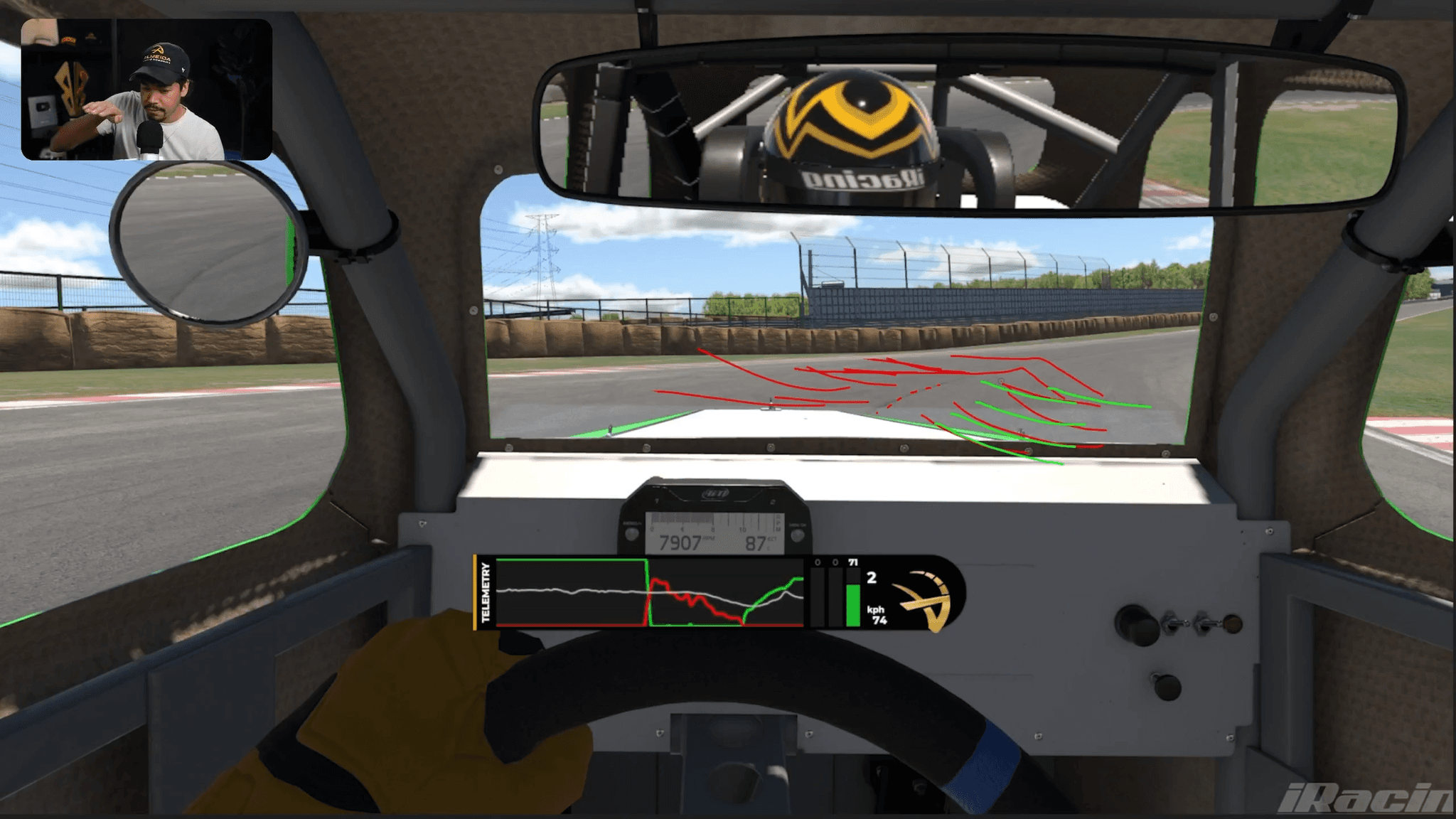
Consistency Challenge 1
Lesson
12
of
49

Did you complete the challenge? Share on Discord!
The objective of this challenge is to hit ten lap times in a row under one minute and five seconds. This is not too difficult to hit, but it's going to force you to not overdrive the car in places that can punish you a lot. This is a very important skill before moving on to level two balance and speed.
Setting Up the Session
To open this test drive, go to test drive anti-racing and open this session with the Legends Ford at Tsukuba 2000 layout. Then go to weather conditions and click reset to default. It's going to have a fixed time so the track and air temperature are going to stay consistent. You can stay in the session for many hours and the track conditions are going to stay the same.
Managing Risk and Avoiding Overdriving
The objective is managing your own risk before guessing braking a little bit too late or overdriving the car. This car punishes you a lot if you overdrive it on power or even under braking.
Turn One: Establishing Braking References
For turn one, there are several reference points available. There is an access road that can be used as a reference. It's important to use references that are close to the car - it's way more reliable to use something that's directly in front of you versus something that's a little bit on the side.
Another useful reference is the end of the open fence at the beginning of the closed fence. This gives a better idea of where to brake. However, this depends on your FOV (field of view). If you have a different field of view settings, then by the time this disappears or crosses the pillar of the car, you might be in a different place compared to someone else who has a different field of view.
It's helpful to draw an imaginary line and establish that your braking reference is going to be somewhere between the end of the little access road and this imaginary line. It can be even after. You can also use the end of the darker patch as a reference. There's also damaged grass that can serve as a reference point. Pick as many reference points as possible so you can familiarize yourself with the braking zone.
Understanding Crests and Elevation Changes
You can see the corner from the braking point. If you can't see the corner, that's a crest. If it's a crest, that means there's less grip on turn and you have to brake a little bit more gently. When you trail brake, the car is going to punish you if you force it. There's going to be a whole lesson on elevation changes on level three, but it's important to know that when you can't see the track, there's going to be less grip.
Turn One Technique
When braking, don't brake too hard. You can probably brake a little bit harder, but the aim is for consistency - to show a lap that can be done a hundred times without spinning. Use a little bit of steering, almost nothing, kind of doing a v-shaped line. V-shaped lines will be explained in level three and four.
Apply a little bit more steering, then a little bit more steering, then a lot more steering mid-corner. Mid-corner, as soon as you go on power with a tiny bit of power, you can actually force the steering a little bit more. If you force the steering on brakes, the car would not like that and you might get into a lot of oversteer. So use a little bit of understeer - a little bit of steering and a little bit of throttle.
As soon as you start adding more power, the car will want to do an opening spiral. It will want to go out because it's gaining speed. Get back on power with a little correction, and then probably tiny micro corrections all over the exit as you're ramping the throttle more and more and more. Use more steering until a certain point, and then less steering as you add more throttle.
The S-Curves: Thinking Ahead
The S-curves lead to a very important braking zone. It's very important to think ahead here. You don't want to position yourself in the middle. Instead, go around, go left, and then a lot right so that you can have a better line and a better preparation for the braking zone before the hairpin. Think ahead and look forward.
Late apex the S-curve rather than taking a different line. This positions the car a little bit more towards the center so you can brake kind of diagonally to the inside. The braking zone is so short that you can even try to bring the car a little bit more to the right, but you're going to see that the car is not going to like when you turn in, mostly because there's no downforce in this car. It will actually save a little bit of time by braking more towards the middle of the track.
The Hairpin: Relaxed Braking Technique
As soon as you start braking, be very relaxed. This is very important. You can see the steering kind of locks in on a straight line as soon as braking starts. Turn a little bit, and then as soon as braking begins, the steering should be straight, straight, straight. It might even be wiggling or vibrating a little bit - that's not driver input, that's just force feedback. Relax your hands and let it do that.
Now start trail braking and turning into the corner. As soon as you climb on the curb, go a little bit on power. If it's too much, you'll get too much understeer, so go back a little bit. Then start ramping up on the exit.
Off-Camber Exit Awareness
You might not notice at first if you're a beginner, but the grip here disappears because the track is actually falling on the outside. It's difficult to see at first, but you can see the track kind of going down from a certain point. That's where the grip is going to disappear. The track will fall right here, so it may not look dramatic when driving conservatively, but if you force the car, it's very easy to spin right here. That's why they have a row of soft wall that will absorb your impact - because a lot of people spin here and go to the left.
The Light Braking Zone
Bring the car to the left, and then apply very, very, very light braking. This is a very good opportunity to practice braking what feels like 1%. Then get back on power. The car also loses a little bit of grip here, just a tiny bit, and then you can see the car sliding a tiny bit there.
The Fast Direction Change
This corner is interesting. Look at how fast the steering turns left - that flick is the peak steering. That's it. Now only steer less. Why is that? Because that change of direction was on power and the car is gaining speed, so you should always lose rotation.
It's very easy for beginners here to think they're going to turn left and then turn more left at the apex. No - you're going to turn more at the beginning and now you're turning less and less and less, just managing the car. The car is really sliding, sliding, sliding all the way to the outside here. You should manage that by getting more rotation at first and then just letting it drift outside as it gains speed and asks you to go all the way to the right because that's how much the grip is going to be able to hold.
The Long Hairpin: Semi-Double Apex Technique
Brake on a straight line again, kind of towards the middle here. This is a very long hairpin so you can semi-double apex it. You don't want to be too tight because as soon as you turn, you're going to find yourself bouncing off the apex. You're going to be too slow and you're not going to be able to get any rotation, because the rotation that you will get would be enough for you to go to the inside grass.
You don't want that. You want to carry enough speed so that you're limited by the rotation. That means you're carrying as much speed as the car can take on the minimum speed. Remember, the minimum speed is safe to force the car - safe to actually turn a little bit more and feel it. You just want to be careful on corner entries to set up a good line, and then the car will accept you forcing a little bit with the steering.
Use very light hands, and then turn a little bit more. You can see that there may even be a little correction there - that's good. Corrections early on the exit allow you to feel the grip of the car without putting yourself in such a dangerous situation. You don't want to do a lot of corrections on the exit because it's easier to spin, but doing corrections mid-corner before the exit is a good opportunity for you to try the grip of the car.
The Track Crown Effect
You can see that the car loses grip again on the second apex. There's a reason for that. There's a little dot that's actually dividing the track in two so that they can drain the water when it rains. This makes the track look like a crown, which means at one point there's a lot of grip because it's camber, but then there's going to be zero grip because it's off-camber. As soon as the car falls, crosses that crown, and falls on the off-camber section, you're going to feel the grip disappear immediately. Keep that in mind. As soon as it falls, you can feel the car just giving up on the grip that you thought you had mid-corner.
The Final Corner: Long and Fast
For the last corner, that's a very, very fast but long corner. Don't brake on a straight line. Brake a tiny bit and turn. Now trail brake, trail brake, trail brake, trail brake, trail brake, trail brake, trail brake, trail brake, then power.
The corner gets a little bit tighter here, so you want to kind of late apex this curb. If you look back a little bit, you can see that it's open radius. Now the green section is visible, which is a good reference for how deep into the corner you are. It's a long corner - you need references. There's the beginning of the curb, and then there's the tighter part. The tightest part of the corner is the end of the curb, so that's where you want to clip more or less.
From here, just let the car run wide, wide, wide, controlling, controlling, controlling on power. You can see how progressive the power is. Just let the oversteer guide you all the way to the outside of the track. As you can see, you can use all the track available. It's only enough track - if you touch the grass, even a little bit of the dirt here should be fine.
Challenge Requirements
Your objective is to do under 1:05 ten times in a row. Then you should be qualified to do challenge number two. If you beat challenge number two, you should be qualified to go to level two course balance and speed.
Consistency & Confidence
Balance & Speed
Cornering Precision
Mastery