Corner Exits
Lesson
8
of
49

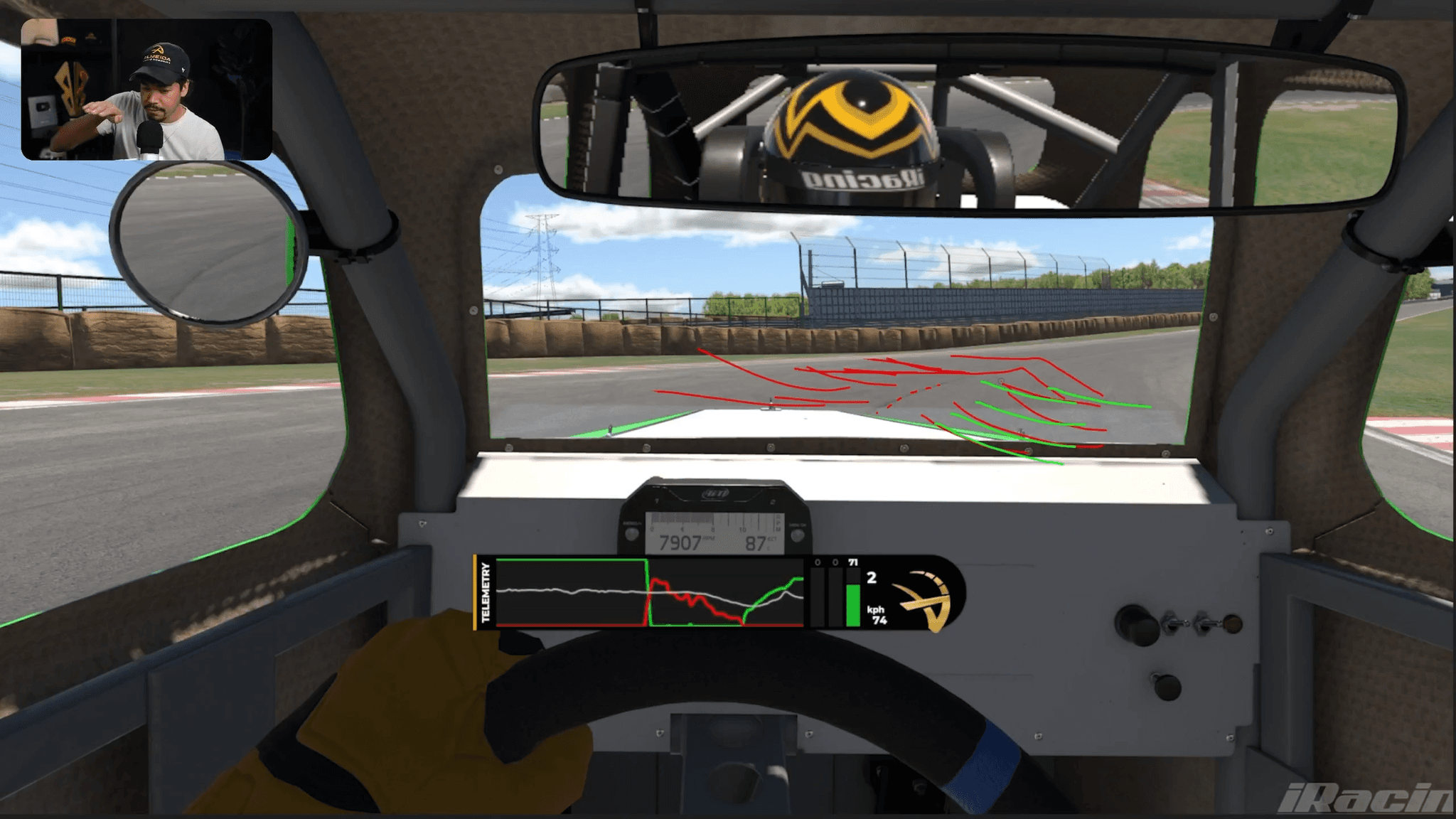
The main objective in corner exits is to have no choice but to use all the track on the outside. Let's focus on the no choice. If you get back on power and you're so fast that inertia throws you all the way to the outside and that's your only choice, meaning if you wanted to exit on the middle of the track, you wouldn't be able to because your car is so fast that you have to go all the way to the outside. That means you're pretty much at least at some sort of limit, maybe oversteer, maybe understeer, maybe ideally both. You want to get the car carry itself to the outside as you're on the throttle really gaining and carrying that energy and have no choice but to use all the track on the exit.
This is not that easy on the beginning but what is important to avoid is that you artificially go to the outside. You're very slow, you're not really on the limit but then you're unwinding the steering and letting the car go all the way to the outside without being on the limit. That is a problem because if you do that and you don't realize, then you're never going to fix it without awareness, you don't know it's a problem, without knowing it's a problem, you never even try to fix it.
For most single corners, you do want to carry the energy all the way to the outside by accelerating early, by carrying good speed and having no choice but to use the track on the outside. Obviously if it's a compound corner and you're sacrificing the exit, that's a different scenario.
Using All the Track: Understanding the Concept
Use all the track is one of the most common tips out there, but the problem is that every faster driver or even coaches will simply tell you that, use all the track, but they don't really explain exactly how this is going to benefit you and what exactly you have to do to gain lap time while doing it.
By using all the track, all the way on the outside on entry, all the way on the inside on the apex and all the way on the outside on exit, you will mathematically have the biggest arc you can trace on the corner, which means you will turn less and you can carry more speed. If we don't use all the track, we will have to turn the car more and we will have to slow down more to be able to do that line.
But here's the problem. This mathematical rule only applies to cars that are actually on the limit of the tires, meaning only if the car is extracting as much lateral force as possible. And to get to this limit, you have to rotate the car as much as you can at the highest speed the car is capable to do that rotation.
Driving the Car Versus Driving the Line
Imagine two different drivers:
Driver 1: Driving the Line
One focuses on keeping the car on the ideal line as much as possible. They use every angle to track on entry, apex and exit. Driving the line is the most comfortable driving approach. You can be under the limit and do the perfect line all day. But here's a problem with it. It invites you to stay in your comfort zone. It might even trick you into thinking that you are on the limit and that you are carrying the right speed on that corner.
Driver 2: Driving the Car
The second driver focuses on feeling the grip limit of the tires, rotating the car as much as possible, even if they're not using all the track. Driving the car is always trying to reach the cornering grip limit. It's reaching out to that point where you know the car is on the verge of sliding too much. It's asking for as much as the car can offer in terms of braking, turning and accelerating.
The perfect scenario is obviously when you combine both styles together. When you drive the car to its limit on top of the ideal mathematical line.
Key Insight About Speed and Rotation
If the car is on the limit, then the rotation of the car will depend on its speed, meaning the car will rotate more if the speed is slower and rotate less if the speed is higher. With this in mind, we can conclude that it's actually possible to do the first approach, driving the line at whatever speed you want, as long as it's equal or under the speed limit at which the car can do that line.
This tells us that you can be driving the perfect line and be very much under the limit and worse than that without noticing it. But with the driving the car approach, trying to turn as much as possible, if the speed is low, you will obviously rotate way more than necessary. And more than that, you will quickly feel that you are under the limit on that corner and that you can carry way more speed on the next lap.
With the driving the car approach, the rotation of the car is linked to the speed you are carrying into the corner. And this is actually great because it gives you real-time information about what the car can do in terms of rotation, depending on how much speed you decide to carry into the corner.
If you are someone that drives the car more than driving the line, you can actually get up to speed and find lap times more quickly than other drivers who may even have beautiful lines but are not noticing that they are still under the limit.
How to Know If You're On the Limit
Let's say you're using all the track but you don't know exactly if you're on the limit or not. How do you know that? The answer is simple but a little bit curious. Try to not use all the track using your steering. Try to turn more. As soon as you get on power, try to turn a little bit more. Obviously trying to take care of the balance of the car and then see if the car will leave some track space by the time you reach the exit.
If you notice that the car is actually accepting your extra steering wheel and turning more than necessary and you're not using all the track, bingo. You can carry more speed on the next lap. Again, remember, when you're on the limit of rotation, the line the car traces is linked to how much speed you're carrying.
Critical Point to Remember
If you are on the right speed on the perfect speed, you won't need to take the car to the outside on the perfect line. The car will take you to the outside on the perfect line. You will have no choice but to become a passenger of inertia, drifting wide to the outside and using every inch of the track because of physics. Not because someone told you to.
Don't try to artificially use all the track just because someone told you to use all the track. Try to feel and use the grip limit of the car and then find the right speed in line that the car will take you there.
Three Things That Can Happen When Turning More
The car just turns more: If you're not on the limit, the car is just gonna turn more. This helps you realize how much more grip you were actually not using on corner entry.
The car understeers: That is definitely going to depend on your pedal inputs. So the way you balance the car, the way you transfer the weight, is going to affect that.
The car oversteers: If you get back on power a little bit too aggressively and you get into oversteer, you are going to have to correct anyways, which naturally pushes the car outwards and you're gonna have to use all the track or even go off if it's too much oversteer.
So it doesn't really matter what kind of limit you are reaching. As soon as you reach that limit, your rotation will be limited and the car will try to go a little bit wider. So you see the trick here. You're adding kinetic energy earlier to the car and that energy is gonna push the car wider and that's how you gain that time. And that's how you actually use more of the track.
The Line of Consequence
You're gonna time your throttle application in your corner entry lines and that exit line is going to be a consequence, which is what is called the line of consequence. So you're not unwinding the steering on purpose. You're creating that extra kinetic energy that is gonna take you where you wanted to take you.
Turn-In Timing Examples
Turn in too early: Even if you carry exactly the same minimum speed, you are going to go off because your angle is off.
Turn in too late: You're over preparing, you're having to slow down a lot and doing a lot of the rotation on entry. And then your exit is too easy.
When to Accelerate
What is early? Well, it's actually just not too late. You're not gonna accelerate way before the apex. Ideally, you want to carry speed so that you brake all the way into the apex so that you trail brake a little bit that 1% feeling just to get the car to rotate a little bit. If you're inducing understeer, just to test the grip, then that's a different scenario. You're going to actually have throttle a little bit early, and then you're going to roll up to 100% towards the exit.
But normally, let's say you're really trying to be consistent. You're not inducing a lot of understeer. You're just already being quite consistent. Your throttle will be at the apex. Don't think too much about, oh, I want to accelerate before because this is a late apex leading to a long straight. You don't have to think about any of that yet because it doesn't really matter for your lap times.
Right now, think about throttle at the apex. That's pretty much it. Until you get to like 1.5 off the actual perfect lap times, you shouldn't be spending your mental energy thinking about when to accelerate. You should mostly just accelerate at the apex. That's going to help you. That's going to work. And you're going to be pretty fast if you're having decent entries, because the difference between accelerate at the apex or a little bit before are very subtle.
When people think about accelerating early, they end up, especially beginners, they end up doing too much of a difference. And you end up actually losing more time than gaining time, even if there's a long straight after. So don't think about it for now, gain precision, gain consistency, accelerate at the apex. You will see it works. It works very well.
In the future, when you gain enough precision and you want to accelerate a little bit before the apex, we're talking about two tenths of a second, three tenths of a second before the actual apex. It's not that much of a difference.
Why Corner Exits Are Simpler
There's not a lot of stuff to talk about when it comes to corner exits, because 95% of motor sports is actually entry braking, entry or braking into the corner and choosing the line. It all happens on the first half. The second half is mostly consequence. So there's not a lot to talk about, except for some advanced stuff that will be covered in level four course mastery.
Consistency & Confidence
Balance & Speed
Cornering Precision
Mastery