Inducing Oversteer
Lesson
10
of
49

Inducing oversteer is a more advanced technique that requires practice to gain proficiency. While it may seem tricky at first, mastering this skill will significantly improve your racing abilities. Understanding how to intentionally create oversteer provides crucial benefits for overall car control and speed.
Why Learn to Induce Oversteer
Oversteer is the opposite side of understeer and represents the missing key to fully understanding tire dynamics. By mastering both understeer and oversteer, you can eventually reach the middle point: neutral steer. At neutral steer, you achieve peak lateral forces from both the front tires and the rear tires, allowing the car to corner as fast as mathematically and physically possible.
If you only know how to understeer but are afraid of oversteer, you will never reach that optimal point. When you encounter oversteer without proper understanding, the car becomes unpredictable and intimidating. Through the Almeida method, you will learn predictability by mastering oversteer, understanding how fast you need to react, and predicting how it happens by causing it on purpose. This allows you to react proactively and maintain that state at a very subtle level, which gives you the fastest cornering speed possible.
The Physics Behind Oversteer
Oversteer is a reaction to the front tires. The rear tires will always react to what you ask the front tires to do. In the case of oversteer, the front tires get a lot of rotation towards the inside, and the rear tires can't follow that path because they're not grabbing onto the tracks strongly enough. They slide forwards compared to how much the front tires go in, and they go outwards while they slide, causing the car to rotate too much and get into a slide.
How to Induce Oversteer
The technique for inducing oversteer on purpose involves several specific steps:
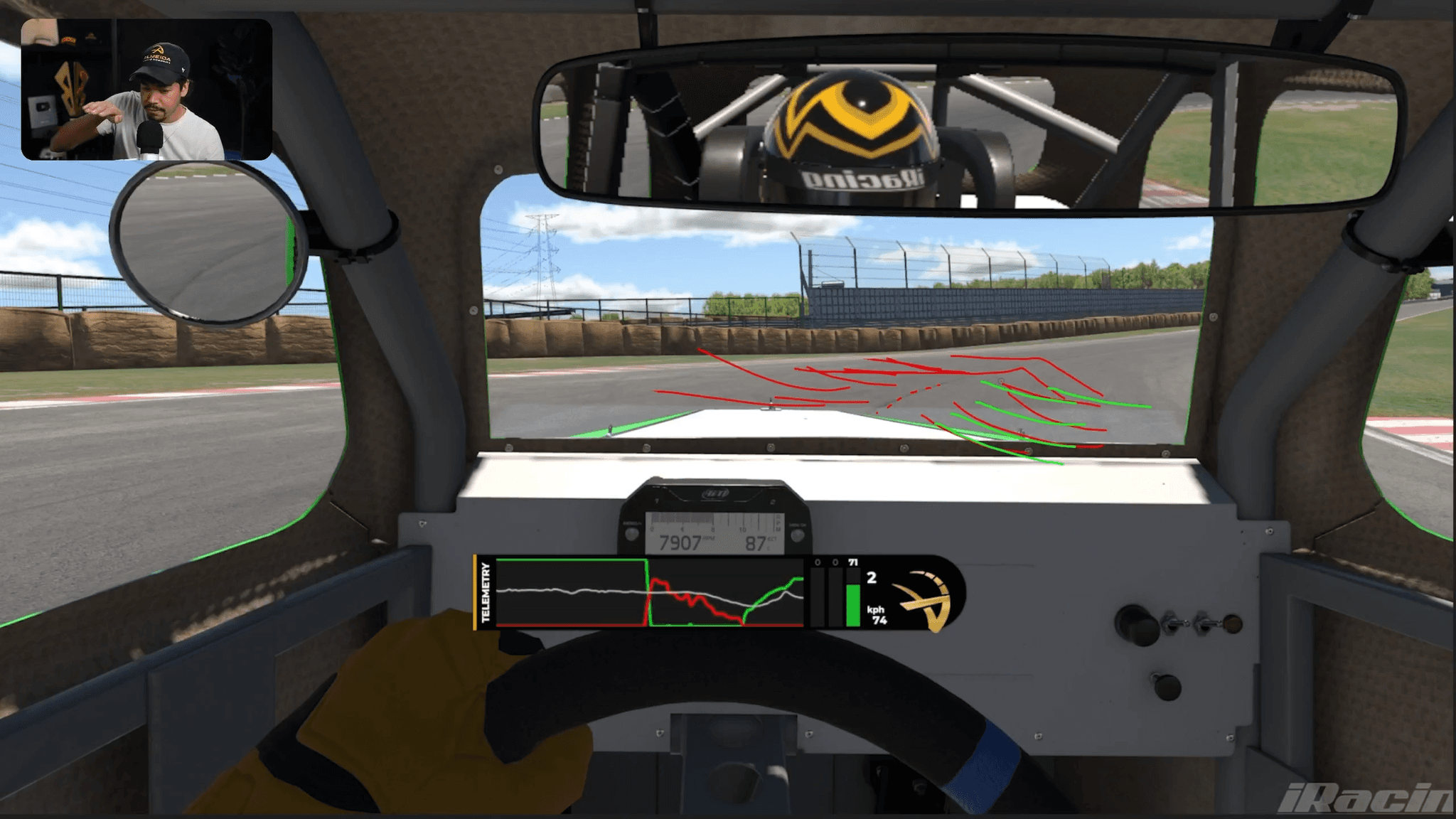
Be at the right corner entry speed - you need to be a little bit faster than what you would need to get understeer
Add approximately 25% brakes
Steer normally into the corner - do not flick the steering
Apply the brakes as soon as you start turning
It's crucial not to flick the steering into the corner. If you do that, you will get understeer instead of oversteer because you will abuse the front tires, causing them to die first. If the front tires die first, the rear tires have nothing to react to. You must turn normally into the corner.
What really makes the car oversteer are the brakes and the extra weight on the front tires. The sequence works like this: break early, release the brakes to reach the right speed while the car is rolling, then as you enter the corner and start turning, add a little bit of brakes at the same time. This should be enough to generate some oversteer, though the exact amount will depend on the car and setup.
Breaking the Rule: Brakes and Steering Together
In previous lessons, you learned that you should never add brakes and steering at the same time. However, in this case, we're doing this mistake on purpose to induce a slide. The goal is to feel what happens and understand the dynamics involved.
Common Mistake: Too Much Brake Pressure
If you apply too much brake pressure while inducing oversteer, the results change dramatically. When the car starts rotating and begins to oversteer, but you keep adding more and more brakes, eventually you'll reach a point where the car is already oversteering at perhaps 30 degrees. However, because you're breaking too hard, you'll lock the front tires and the rear tires as well.
When this happens, the car slides forwards at an angle. The rotation stops and becomes frozen in place, with the car just sliding straight at that locked angle. The four tires lock and the rotation gets frozen, rather than continuing the rotational slide. This is why inducing oversteer requires less pedal input than you might expect.
Entry Speed Considerations
Inducing oversteer requires more entry speed than necessary to induce understeer because it is easier to induce wall turning with the brakes. This exercise is going to be way easier on entry and on brakes.
Note that oversteer through throttle application is not going to be very useful for this training. It requires you to smash the throttle or needs a lot of power, which is not useful for your technique development. When inducing understeer, you use it on entry but carry that understeer to the exit with the throttle. In the case of oversteer, it's really mostly only on entry.
Purpose and Progression
This is an introduction to develop your understanding of oversteer and understeer, and to build understanding of how quickly you might need to correct the car when it comes to oversteer. All this is necessary for the advanced trail braking lesson on level two balance and speed.
The main objective of this exercise specifically is to:
Improve your reaction times and precision while driving through the Almeida method
Learn how to extract peak lateral forces and use all four tires on the limit
Combine all these exercises and implement them into your complete driving style
Practice Approach
Inducing oversteer is an exercise. Do it in an extreme way first - spin, do weird stuff, and play with the car in a way that allows you to know it more and more. Only then should you do smaller amounts of it until you can dance with the car at a more subtle level in a way that you would actually see very fast drivers doing.
Dancing with the car at a microscopic level, where you can see the car bending and correcting here and there, is a result of first understanding oversteer in a more general and exaggerated way. This progression from exaggerated movements to subtle corrections is essential for developing true mastery.
Consistency & Confidence
Balance & Speed
Cornering Precision
Mastery