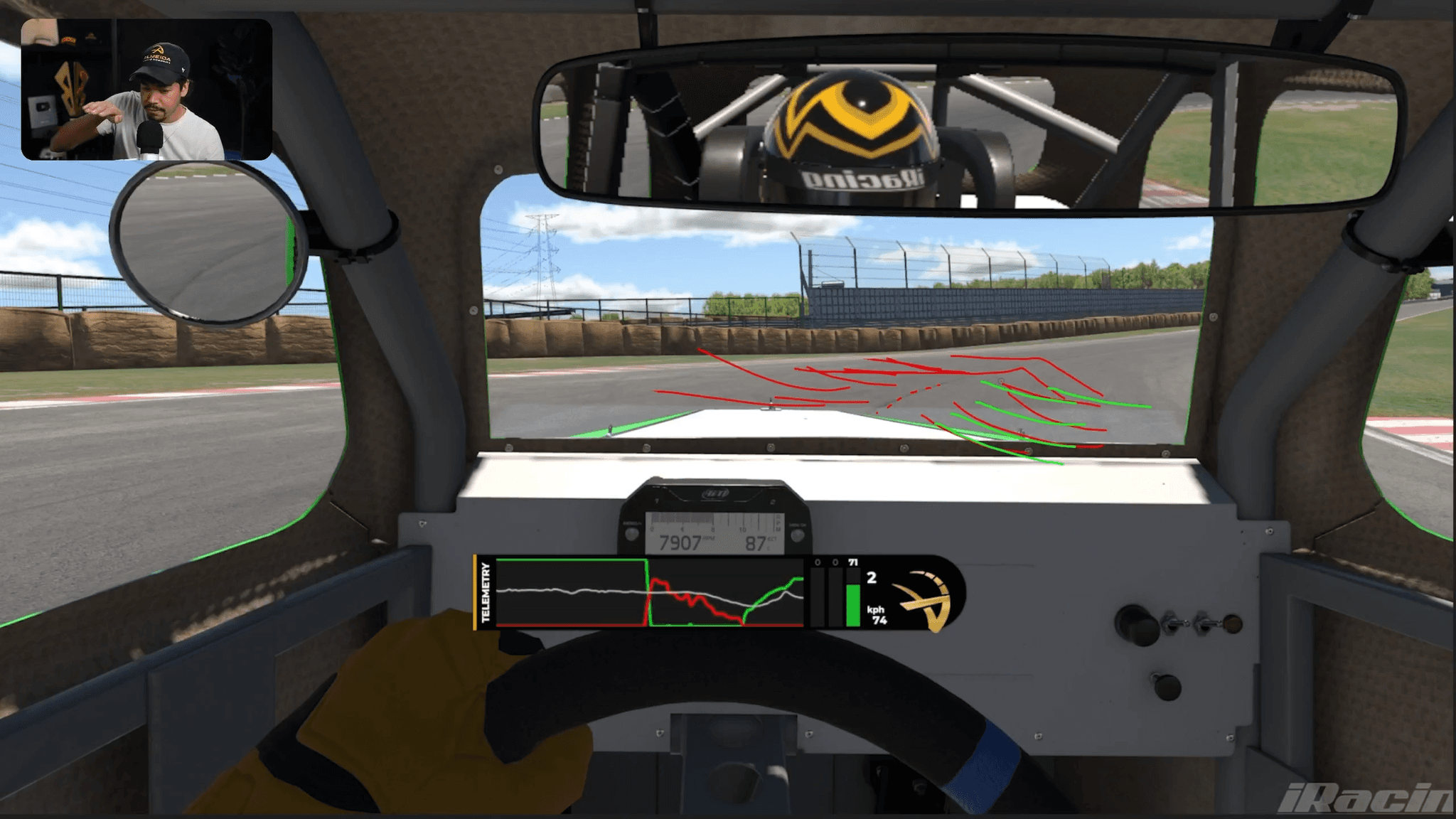
Understanding Grip Limits
Lesson
4
of
49

Understanding the Limit
The concept of the limit in racing is often misunderstood and lacks a universal definition. In everyday language, drivers might say "I reached the limit" or "I was driving on the limit," but these statements can be highly subjective. One driver claiming to be "on the limit" might be two seconds off the pace, while another driver who is two seconds faster might say they were not on the limit at all. This ambiguity creates confusion that must be resolved through a precise, scientific definition.
Definition of the Limit
For the purposes of this course, the limit is defined as follows: The limit a single tire can achieve is the maximum force it can create to change the direction or speed of the car. This definition allows us to be very specific about what we mean by "the limit." You can be on the limit of the front tires (which produces understeer), on the limit of the rear tires (which produces oversteer), or on the limit of braking (which causes tire lock or ABS activation). This precise definition eliminates confusion and provides a consistent framework for understanding vehicle dynamics.
Types of Limits
Limit of Acceleration
The limit of acceleration occurs when you attempt to accelerate the car, particularly at low speeds. The tire tries to move the body forward, but if there is too much power and too much rotation on the tires, they don't have enough force to grab the track and slip backwards. Instead of the car accelerating faster, it starts slowly accelerating while the tire is burning, slipping, and spinning against the track. This phenomenon is known as wheel spin, and it is definitely one form of limit.
If the car has traction control, the system will automatically cut the torque so that the tire doesn't slip as much. This saves the tire and prevents you from getting too much wheel spin, which could cause you to lose the rear of the car and spin.
Limit of Deceleration
The limit of deceleration is the opposite of acceleration and represents another longitudinal limit. The tire is already rolling over the track, and the brakes try to make it stop rolling. If the tire doesn't have enough grab, it will slide over the track, causing a tire lockup.
The limit of deceleration is the point at which the tire stops being effective at slowing the car down. Once this limit is exceeded, the tire gives up very quickly, locks, and starts sliding on the track. As soon as the tire locks and starts sliding, the actual forces it creates to slow the car down actually decrease. This means the car stops less quickly and keeps moving further if you lock up the tire.
If you have ABS, the system will prevent the tire from completely locking up and dragging against the track. A locked tire creates excessive wear, creates a flat spot, can literally make your tire square, and produces vibrations you can hear. After a long lockup, the tire becomes useless, in addition to potentially not stopping in time and crashing. The ABS limits the amount of braking force and, as soon as it feels that the tire is starting to lock, decreases the braking force slightly to let the tires still roll a little bit. The system is controlling the pressure electronically because you are braking too hard, allowing just enough pressure so that the tire doesn't lock up, which makes the car slow down way more than if you were simply locking up the tire.
Limit of Cornering
The limit of cornering occurs when you try to turn the car at too much speed and ask for an amount of rotation that the tires cannot handle. This is essentially the same concept as the longitudinal limit, but applied to getting the car to be sideways. If the car is sideways, the contact patch of the tire is sliding against the track.
When you try to turn, inertia wants you to go straight, but you're trying to turn in a different direction. This creates forces against the track, opposing the direction of that mass. The mass wants to go straight, but the tires are forcing the car to turn. If you force too much to the point where the tiny contact patch is not capable of creating enough forces—not capable of resisting that direction and making the car change direction—the tire will give up and start sliding forwards instead of going in the direction you intended.
Understeer: If you're trying to rotate the car significantly and the rear tires are too grippy and are resisting that rotation, then the front tires give up first. Instead of creating forces, they start sliding, and as they continue sliding, they create fewer forces. The car will go straighter than you expected.
Oversteer: In this case, the rear tires are not capable of resisting the rotation. The front tires point in a direction, and the rear tires try to resist, but if they give up or if you're causing too much force, the rear tires start sliding first. The rear of the car will go straighter than the front, which creates rotation because the front tires are pointing in one direction while the rear tires are being thrown forwards, unable to grab the track and follow the direction the front tires are going.
It's crucial to remember that the rear tires always react to whatever the front tires do. The front tires ask for a task, and the rear tires respond to that task.
Driver Input and Vehicle Balance
It's very important to know that understeer or oversteer will not depend only on the car, but also on your driving inputs. What you do with the inputs, with the pedals and the steering, will make the car oversteer or understeer—probably even more than the setup, if the setup is decent.
You have to stop blaming the car for understeer or oversteer. You have to stop saying that it's too pointy and you can't drive it. Obviously, at a level of detail where you're looking for a tenth or two, the setup is going to make more sense. But before making that complaint, remember that a good driver knows how to make an understeer car oversteer and also how to make an oversteer car understeer. Through the driving inputs, you're able to induce more of a behavior even though the car already has a natural tendency towards one of the behaviors in the first place. We will talk about this in the active versus passive driving section in level 4 mastery in way more detail.
Combined Limits
Combined limits are very, very important. The same tires used for acceleration and deceleration must also be used for rotation. This means that if you abuse the rear tires, for example, by getting a lot of wheelspin while at the same time asking the car to turn, you're now abusing the tires that were busy with the rotation and they will have grip for nothing. This is why when you get wheelspin, you will just lose the car—you are overwhelming the tire and it gives up on everything you ask it to do.
The same principle applies to the front tires under braking. If you're braking into a corner and you start turning too much without releasing the brakes, you're asking the tire to do a lot of work under braking and to do a lot of work on turning. That tire is going to give up because that combination of requests overwhelms 100% of the grip available. It will either just understeer or actually lock up fully, and the car will go straight, essentially saying, "I will not do that because you're asking too much from me."
It's also possible to lock the rear tires when you're turning into the corner, which will cause an immediate oversteer. As soon as the tire blocks, the car will not be able to continuously turn in the direction you're going—the rear tires will go straight. If the rear tires are going straight and the fronts are turning, this creates a spinning motion and the car will immediately spin.
Performance Beyond the Limit
It's very important to know that over the limit means less grip and less force. You might think, "I have ABS, I have traction control. Shouldn't I just be aggressive and let the electronic aids help me?" The answer is no, because even when you get into actual ABS activation while trying to rotate the car, you will have less grip.
There is an optimal place just under over driving, which is actually at the very limit, where you will get the most forces from the car. If you abuse that, you can even get away with it, but you're going to notice that you're carrying a little bit less speed, generating a little bit less rotation, or maybe too much rotation. Then you're scrubbing the tires and don't have exit speed. Over driving will generally lead to less performance. There are very, very rare exceptions to that, but you also don't want to be under the limit too much.
By "under the limit," we mean never dealing with understeer or oversteer, always having the car respond to all your inputs because you're not on the limit of the speed and therefore not on the limit of lateral grip or longitudinal grip. This is not ideal, and the reasons why will become clear.
Over Driving vs. Under Driving for Learning
In some racing contexts, over driving in a controlled way is more productive than under driving for learning purposes. Let's examine this concept by quantifying an imaginary limit.
The Under Driver
An under driver has a specific issue: it's very easy to carry very different speeds as long as you're under the limit. There won't be oversteer, understeer, or any big risk. You can easily be quite inconsistent, and as soon as you go over the limit, you're probably going to go over by a lot and be severely punished. When you're never on the limit, when it does happen, you're not prepared for it. This is very, very important.
Under driving allows you, without much punishment or penalties, to be very, very inconsistent with your driving. Eventually, you will make a very big mistake because you haven't developed the skills to manage the limit.
The Over Driver
In contrast, if you're an over driver—someone who's always above the line—you're actually controlling and experiencing the limit much more because you're constantly being punished by it. You're constantly dealing with understeer, oversteer, and tire lock. You can see it happening and are always learning from that experience.
Over driving actually allows you, in the long term, to be way more consistent compared to under driving. Over driving forces you to learn every corner through constant feedback and correction.
Controlled Over Driving
This doesn't mean you should simply be an over driver without purpose. You want to be a scientific over driver. You want to induce understeer on purpose, induce oversteer on purpose, as part of a controlled over driving method. You want to do some controlled over driving for the sake of experimenting with the tires, experiencing how it feels, and developing your precision.
You don't want to just go all in without really learning anything. You want to try things systematically:
"Let me try actually inducing a little bit of understeer here. Oh, okay, it feels like this."
"Let me try dancing with the car a little bit."
"Let me throw the car into the corner here and see what happens."
If you're doing that while being super aware and with the objective of learning, that is controlled over driving, and it is strongly recommended.
Developing Proficiency with the Limit
Your proficiency with the limit will improve over time through a natural progression:
Beginner Level
As a beginner, you're going to be able to say, "I actually did understeer in this corner." You can easily identify that you understeered. Then on the next lap, you might say, "I oversteered this time." You can identify one state per corner.
Intermediate Level
Over time, as you gain proficiency, you're going to be able to identify different states in the same corner. Instead of just oversteering in a corner, you might say, "Actually, I had understeer on entry and then I had oversteer on exit." Now you can perceive two different states in the same corner—your "refresh rate" is two states per corner. This represents how much you can perceive with your level of experience.
Advanced Level
As you become even more experienced, you can identify more granular states: a little bit of oversteer on entry, then understeer on mid corner, then oversteer on exit. Now you're able to identify three different states in the same corner, which means your reaction times and your proficiency with the inputs and the response of the car are getting better.
You want to break this down to a point where you really, really understand what is happening to the car at every fraction of a second. The more time you drive, the easier this is going to get.
How to Approach the Limit Safely
What is the safest and best way to learn all these limits? There is a specific, methodical approach that should be followed:
Step 1: Find Peak Deceleration Capability
The first thing you need to know about a race car, in real life or in sim racing, is what the peak deceleration capability is. You need to know how much the car can slow down because if you're going flat out on a straight before a hairpin, you can't guess where you're going to brake. You don't want to guess.
You want to brake hard and get a feeling for the G's. You're going to experience how much the car can slow down and use that as a very important factor when you determine your braking reference in the future.
For example, in real life, approaching a hairpin at 260 kilometers per hour, you shouldn't choose a braking reference found in the sim or suggested by someone else ("brake at the three board"). Instead, brake earlier at the five board and feel the deceleration. Gather that longitudinal information. Then on the next lap, brake at the four board and feel it. Then on the next lap, brake at the three board. You're always trying to feel the peak deceleration before anything else because it's the most important thing for safety and for consistency. You don't want to guess how late you're going to brake anywhere, ever.
Step 2: Find Minimum Speed Understeer
Next, find minimum speed understeer. This is great because it's going to help you understand how much speed you will eventually be able to carry in that specific corner. Induce a little bit of understeer, which is very predictable and very safe. You're only using the front tire, so you're not going as fast as possible, but you're getting information about how close you are to the speed that you will eventually carry when you're not understeering too much.
Eventually, you'll be carrying good rotation, really trying to trailbrake into the corner. Minimum speed understeer is another very, very safe way to find the limit.
The progression for this step is:
First, do this on very low speed corners
Then do it on medium speed corners
Then try it on high speed corners (which sometimes depends more on the setup than the low speed corners)
Step 3: Start Dealing with Oversteer
Only after completing the first two steps should you start dealing with oversteer. At this point, you have a good braking reference and know how much the car can stop. You know how much speed you will eventually carry in each corner because you experienced some understeer to feel the limit of the fronts.
Now you can start using both the fronts and the rears, getting the car to rotate and being a little bit more aggressive in the corner so that you can reach the actual top minimum speed you could carry in that corner.
Looking Ahead
In upcoming lessons within this course, you will learn how to induce understeer and oversteer. Additionally, at the level two course Balance and Speed, there is a very advanced lesson on weight transfer that will help you understand completely how weight transfer works and how you can use it to find lap times.
Consistency & Confidence
Balance & Speed
Cornering Precision
Mastery