Quickly Learn a New Track
Lesson
11
of
49

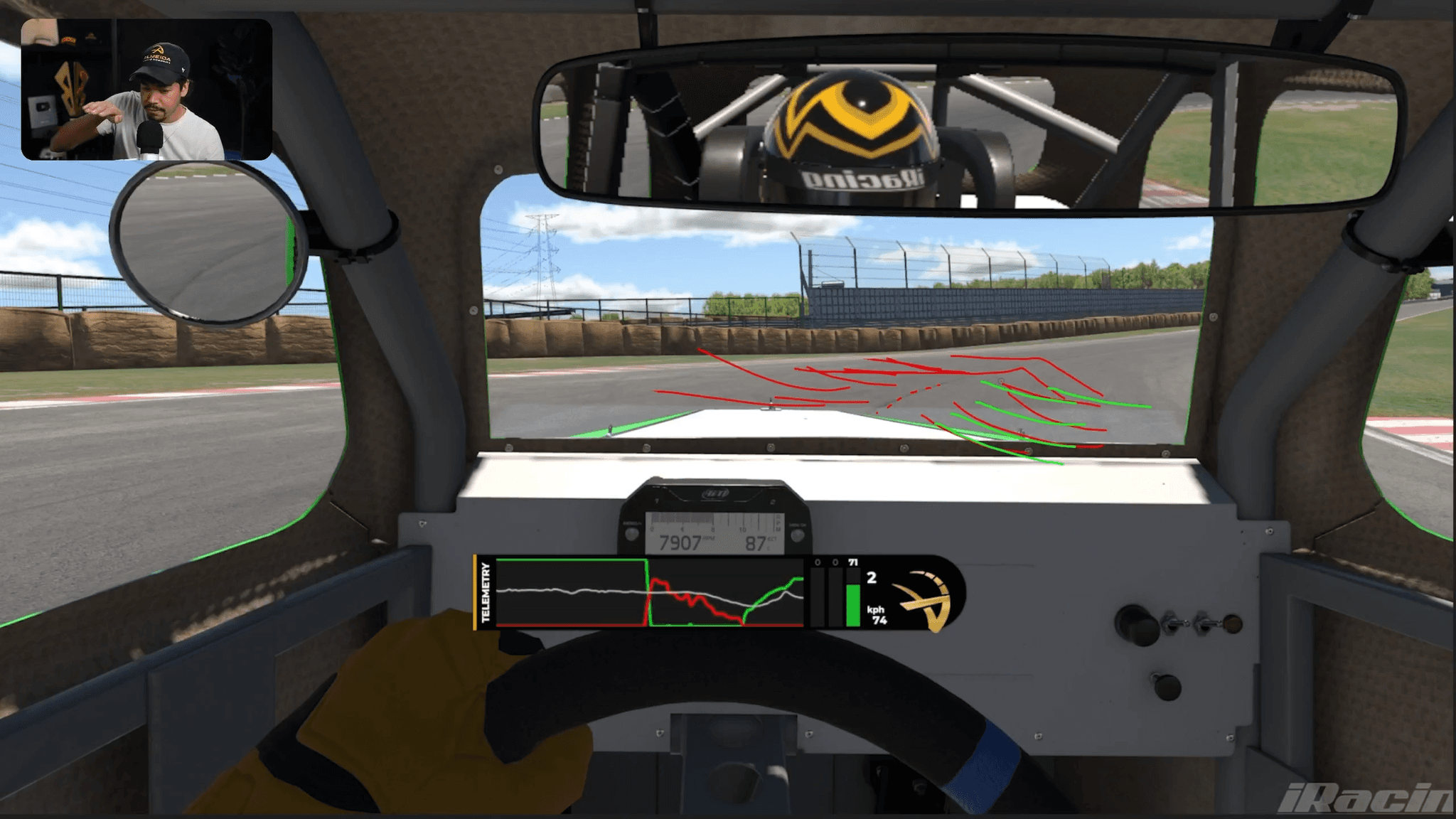
Let's learn how to learn a track using a systematic approach. For this lesson, we'll be using the Legends Coupe Car at Tsukuba Full Circuit 2000. The objective is to understand a completely new car and track combination through methodical testing and gradual progression.
Initial Assessment: Testing the Car
When approaching an unfamiliar car and track, begin with basic testing to understand the vehicle's characteristics. Start by testing laterally with half throttle to feel how the car responds. This particular car has a lot of power, so initial inputs should be conservative.
During the first exploration lap, focus on these key tests:
Half throttle with steering input to assess oversteer tendency
Braking at 50% pressure to understand stopping capability without locking
Progressive steering inputs to feel the grip level
Remember that tires are still cold during initial laps
Understanding Braking Limits
Test the braking system progressively. Start with moderate brake pressure to avoid locking the wheels while you're still learning. When you find a corner where you can safely test, brake harder to discover the car's maximum stopping power. Eventually, try braking at 100% to find where the tires lock, establishing the absolute limit.
Learning Track Layout and References
As you complete your first laps, simultaneously memorize the track layout and establish braking references. Look ahead to understand what corners are coming. For example, identify whether an upcoming corner is a fast left, a hairpin, or a closing radius turn.
Establishing Braking References
Start conservatively with braking references. If you try an access road as a braking point and it feels too early, you know you can brake later next time. Build your reference points gradually:
Identify visual markers like access roads, guardrails, or track features
Start with early braking references
Progressively brake later as you gain confidence
Adjust brake pressure or braking point based on your entry speed
For each corner, find a specific braking reference. This might be the end of a guardrail, halfway along an access road, or the end of a curve on the track edge. The key is to avoid guessing and keep your eyes active—your vision is everything.
Testing Oversteer and Understeer Characteristics
Once you understand basic braking and turning, begin exploring the car's balance characteristics. This Legends Coupe is very sensitive to throttle and steering inputs.
Oversteer Characteristics
This car easily transitions to oversteer in several situations:
Half throttle with significant steering input induces oversteer readily
Adding throttle while increasing steering angle creates oversteer very easily
Trail braking can quickly lead to oversteer
Power-on oversteer occurs easily even with moderate throttle in second gear
The car has lots of torque that can spin the wheels and rotate the car
Understeer to Oversteer Transition
A critical characteristic of this car is how easily understeer becomes oversteer. When you try to induce understeer, the car is very sensitive and transitions to oversteer quickly. Adding more steering while on throttle, even when the car is initially understeering, can flip the balance to oversteer.
At full throttle, the car can understeer and oversteer simultaneously, creating a sliding behavior that requires careful management.
Progressive Skill Development
The Testing Phase
Continue asking the car what it can do and how much it can handle. Push the limits gradually:
Test how much steering input the car accepts at half throttle
Explore the slip angle of the front tires
Learn how much oversteer the car can handle
Understand when understeer transitions to oversteer
Throttle Management
Throttle control is crucial in this car. Half throttle on second gear is already enough to spin the wheels and induce oversteer. Be very progressive with throttle application, especially at corner exit. The car has a lot of torque even when the engine RPM sounds low.
Use light hands technique, especially on corner exit. As you ramp up the throttle, the car wants to rotate more. Very progressive throttle application combined with relaxed hands allows the steering to correct itself.
Corner-Specific Techniques
Fast Corners
For high-speed corners, test whether they can be taken flat out. Some corners may technically be flat, but require significant oversteer correction, making them difficult and inconsistent. For the consistency challenge, it's better to take these corners at 60-70% throttle consistently rather than attempting 100% throttle with unpredictable results.
Hairpins and Tight Corners
Approach tight corners with:
Relaxed hands
Proper downshifting (often to second gear)
Trail braking to help rotation
Cautious throttle application—not a lot of steering and not a lot of throttle at the beginning of mid-corner
Progressive throttle increase as you unwind steering
Closing Radius Corners
Some corners tighten at the exit (closing radius). These require early turn-in because the corner opens up less than expected. The tightening pushes you wide, so plan your line accordingly.
Building a Corner Plan
For every corner, create a structured plan that includes:
Specific braking reference point
Brake pressure required
Appropriate gear
Turn-in point
Apex location
Throttle application strategy
This plan should be informed by your testing. Understand what the car is capable of doing before finalizing your approach to each corner.
Forcing the Car Safely
There's a difference between forcing the car and overdriving it. You should be cautious without being afraid.
Where to Force the Car
Force the car at lower speeds within each corner. After braking conservatively, you can explore the grip limits and test different lines at a manageable speed. This allows you to:
Understand what lines the car can trace at that speed
Stay within track limits
Avoid going off track
Have fun inducing oversteer in controlled situations
Avoiding Overdriving
Don't force the car by guessing braking points too late. Braking extremely late puts you in deep trouble—you might miss the apex, run wide, lose significant time, and feel frustrated. Even if you occasionally get away with it, it's inconsistent and often leads to offs or spins.
Brake a little earlier than you think necessary, then force the grip of the car and explore the line within the track limits. This approach allows you to be aggressive and have fun while staying on track.
The Consistency Challenge Approach
The objective is to be consistent with a car that is semi-difficult to drive. Your goal is to:
Complete 10 laps in a row
Hit the target lap time on all 10 laps
No spins
No off-tracks
This isn't about setting the absolute fastest lap time. It's about controllably forcing the car at safe spots, taking care of it in dangerous parts, and hitting the lap time consistently.
Key Principles for Consistency
Be cautious by not overdriving into corners, but play with the car within the limits of your entry speed. Test and force the car to understand how much grip it has. Keep your eyes active to find proper braking references—don't guess.
Structure every corner with a proper plan. Before creating this plan, test the grip of the car and see what it's capable of doing. This creates a very informed plan that you can execute consistently.
The worst outcome is crashing all the time. By following this systematic approach—test, test, test, force, force, force, correct, correct—you'll progressively feel the car more and more, allowing you to have fun and drive on track without constant incidents.
Consistency & Confidence
Balance & Speed
Cornering Precision
Mastery