Master Brake Precision
Lesson
15
of
49

Lesson by
Suellio Almeida
Lesson by
Suellio Almeida
Mark as Finished
We are going to get very advanced in every lesson from now on to help you become the best driver you can be. From now on, 95% of driving is in the braking, and we are going to make sure that you can do the things we will need you to do in order to find lap times.
Training Muscle Memory for Precise Braking
In this lesson we are going to talk about how to train your muscle memory for precise braking, some pro brake modulation tips and exercises, and variations of trail braking. To get the graph the same way shown here, use race lab, a software that allows you to get real time input telemetry. Then go to iRacing, open the test session, and leave the car sitting down turned off at the garage so that it can show you the live telemetry data.
You have to try these exercises if you can be at the simulator. Put the video on the side and try to mimic what is being demonstrated. If you find any issue with it, just stick with it and try again and again and again until you develop your precision, and then move to the next exercise. Take your time - this is going to be a big difference from now on in your driving. If you can't do it, that means you were not being able to do it when it mattered, and this is the time for you to develop that precision.
Body Position and Relaxation
First of all, try all of these with upper body and hands relaxed. Anything you do with your left foot right now will be with your upper body relaxed. Remember that anytime we add more brakes we have to relax our hands. If you're turning and you try to add more brakes, you have to immediately relax everything. A fun thing is that actually the body goes up a tiny bit when we brake. Take that as a signal, as a trigger that the more you break, the more everything else on top from the center of your body up has to be more relaxed - the more breaking pressure you add.
Understanding Your Pedal Calibration: 1% and 99%
First of all, you have to know where 1% and 99% are in your braking traces. This is very important because sometimes we are breaking way higher than 200-300% and the simulator doesn't read that. The simulator thinks you're breaking only 100%. So right now you might be breaking 400%, and your line would be all the way up there, but it only shows 100%.
What's the problem with that? If you start releasing from 400% to say 300%, well the graph is still showing 100%, the car still thinks you're breaking as hard as possible, and nothing is going to be read and your trail braking is not going to work. That's why it's very important to know where the 100% is by breaking just 1% under. Anything over 100% you can see, but 1% before 100% you can see very clearly.
Exercise 1: Finding 99% Brake Pressure
Our first exercise is actually to break all the way to 99%. Stay on that range between 95% or 90% and 100%. Get very close to 99% and get a feeling. This is just so you can calibrate your body to what is the calibration of the pedal. You should be able to easily stay right there and do your car adjustments on that five top percent.
Practice sequence:
Go to 99% and get the feeling - this is your max. Anything more than what you're pressing right now is not going to be read, it's going to be ignored by the software
Go back to zero
Go pretty slowly to 99%
Go back to zero
Go a little bit more quickly to 99%
Go very quickly to 99%
This is very useful for you to practice your explosion. You just want to make sure that even when you break pretty hard, you're going to that area and not too hard over 100%. This is very important - do not underestimate this. It doesn't matter what level you are, you might have issues with this in the future, especially if you think you don't have it. So just make sure you're checking that right now.
Exercise 2: Finding 1% Brake Pressure
The next thing we want to know is the bottom range. Try to break 1%. Get this feeling of how much is 1%. Now try 10%. Practice going back and forth:
Break to 1%
Break to 10%
Back to 1%
Back to 10%
Then try messing with the steering with your hands. Turn a little bit and see how that 1% feels while you are turning the steering, because those two signals in your brain are going to be always together. So it's good to mess a little bit with the steering while you're trying this exercise.
Exercise 3: Alternating Between Extremes
Now that you have 99% and 1%, practice alternating between them:
Go to 99%
Turn and go to 1%
Back up to 99%
Back down to 1%
Just get the feeling of how much that bottom range feels, because it's going to be very important. If you're driving a formula four or a formula 1600 or any GT3 car with a lot of downforce with a loose setup, you are going to need to know what 1% is. Because on these cars with a very advanced setup, 1% is just enough to get the car to rotate. 5% will make you oversteer. Very important to know that very 1%, very very very subtle 1% feeling, because it's gonna be extremely useful.
If you think this is too precise, great - you're just a beginner starting to understand how precise motor sports is and how much more you need to learn to actually get good.
Again, just make sure you're super comfortable with this alternation between very low range - top 5% and bottom 5% - 99%, 1%, 99%, 1%.
Understanding Brake Trace Shapes
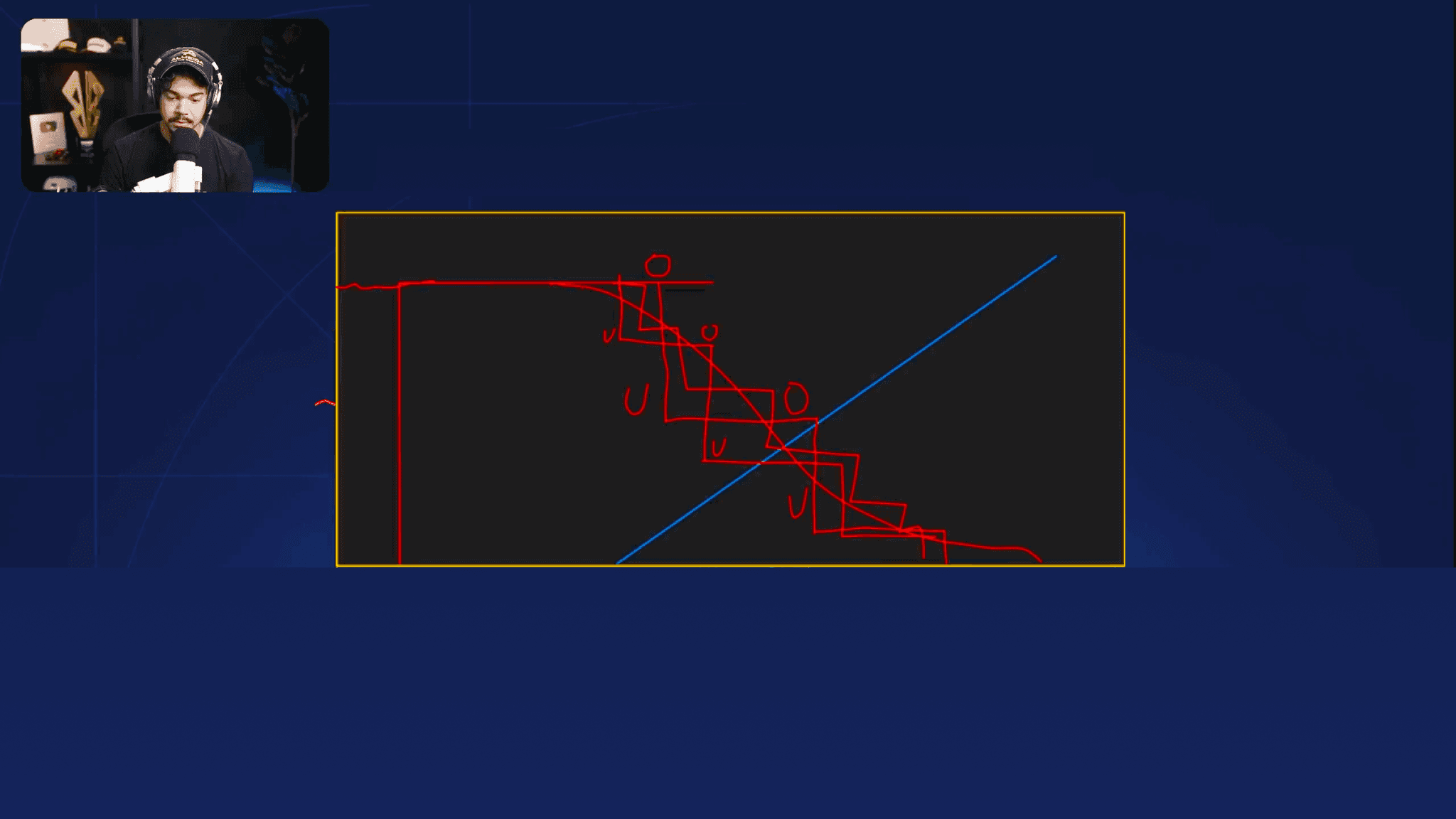
After you get super comfortable with the previous exercises, we're gonna start moving around these ranges with different speeds. The traditional braking trace should look like this: you brake hard and then you start releasing a little bit, and then you start releasing more quickly as you trail brake into the corner.
Different Downforce Levels
This is pretty much like a traditional medium downforce pressure. If it's a low downforce trace, a car that actually doesn't have any downforce, then it's gonna look like this: you're gonna keep it pretty much at the same pressure and then you start releasing slowly as you're trail braking to the corner. So there's no two stages.
In a formula one car, it's like you explode to 100%, you release very slowly, and then you release more quickly as you start turning to the corner. That's a formula one trace right there: you break pretty hard to 100% and you have two steepness in the release. The first steepness is on a straight line just due to the downforce loss, and the second steepness is as you actually start turning to the corner.
Fast Application and Slow Release
The most common way we are going to break, especially if we're coming from a straight line, is a fast application and a slow release. Sometimes the fast application doesn't have to stay at threshold. If we're breaking in a straight line, yes we will keep at the threshold, and only when we start turning we start releasing the brakes. But sometimes we are in a corner where we don't have to break in a straight line - we just need to trail brake straight into the corner.
So the trace is not going to look like a plateau and then a release - it's actually always going to look more like a triangle. Let's say we're on a semi-fast corner but you still need to trail brake - the trace is going to look like a triangle. Now an even faster corner, and then an even faster corner, and even faster. So the trace is still the same - fast up and slow release - but the pressure, the target pressure at the beginning of the application is what's going to change.
So a very fast corner, we just touch the brakes a little bit. A slower corner, we do a little bit more. An even slower corner, we actually break on a straight line and then start releasing the brakes. You can see that the shape on the release is very similar. The application is also fast - it's just that threshold that depends whether we are breaking in a straight line or not.
Brake Modulation Exercise Combinations
In terms of precision, you need to be able to do four things:
1. Apply Slowly, Release Slowly
Very, very smooth, very patient.
2. Apply Fast, Release Slowly
This is the most common brake trace you will use.
3. Apply Slowly, Release Quickly
We will rarely use this. We will almost never use this trace. But you need to be able to do it because we're teaching you the possibilities in brake traces.
4. Apply Quickly, Release Quickly
Kind of doing like a semi-square, a very squared trace. Also very rare, but it's a very common thing a lot of people do. A lot of beginners break like this: drop straight to zero and then turn into the corner. That's not very good long-term when you start getting more and more speed.
Practice in Different Ranges
Try those exercises in different ranges. You can practice around 50-60%, but you can do the same thing in other areas. Try the same thing for very high pressures - 100% and then slowly up (also very rare - sometimes we will apply slowly depending on the corners). Try fast release as well.
Try these things. Try to do this very, very progressively as well. You go up more and more and more and then even more, even more, until you get super comfortable with every range, every speed of application, and every speed of release.
Sometimes for fun you can try to draw patterns with your brake trace. It's kind of useless, but it shows that you can control your break trace and it shows that you can understand the telemetry. By the way, this is the input telemetry software being used - race lab - but you can use any software that gives you this overlay. It's super useful to help you understand what kinds of traces you are using and what kinds of pressures you are doing in a real-time telemetry kind of format.
Summary
This is pretty much it. Make sure you can do these things before you move on to the next lessons. If you have any question, send us a message in discord. Next up we are going to talk about the stages of breaking.
We are going to get very advanced in every lesson from now on to help you become the best driver you can be. From now on, 95% of driving is in the braking, and we are going to make sure that you can do the things we will need you to do in order to find lap times.
Training Muscle Memory for Precise Braking
In this lesson we are going to talk about how to train your muscle memory for precise braking, some pro brake modulation tips and exercises, and variations of trail braking. To get the graph the same way shown here, use race lab, a software that allows you to get real time input telemetry. Then go to iRacing, open the test session, and leave the car sitting down turned off at the garage so that it can show you the live telemetry data.
You have to try these exercises if you can be at the simulator. Put the video on the side and try to mimic what is being demonstrated. If you find any issue with it, just stick with it and try again and again and again until you develop your precision, and then move to the next exercise. Take your time - this is going to be a big difference from now on in your driving. If you can't do it, that means you were not being able to do it when it mattered, and this is the time for you to develop that precision.
Body Position and Relaxation
First of all, try all of these with upper body and hands relaxed. Anything you do with your left foot right now will be with your upper body relaxed. Remember that anytime we add more brakes we have to relax our hands. If you're turning and you try to add more brakes, you have to immediately relax everything. A fun thing is that actually the body goes up a tiny bit when we brake. Take that as a signal, as a trigger that the more you break, the more everything else on top from the center of your body up has to be more relaxed - the more breaking pressure you add.
Understanding Your Pedal Calibration: 1% and 99%
First of all, you have to know where 1% and 99% are in your braking traces. This is very important because sometimes we are breaking way higher than 200-300% and the simulator doesn't read that. The simulator thinks you're breaking only 100%. So right now you might be breaking 400%, and your line would be all the way up there, but it only shows 100%.
What's the problem with that? If you start releasing from 400% to say 300%, well the graph is still showing 100%, the car still thinks you're breaking as hard as possible, and nothing is going to be read and your trail braking is not going to work. That's why it's very important to know where the 100% is by breaking just 1% under. Anything over 100% you can see, but 1% before 100% you can see very clearly.
Exercise 1: Finding 99% Brake Pressure
Our first exercise is actually to break all the way to 99%. Stay on that range between 95% or 90% and 100%. Get very close to 99% and get a feeling. This is just so you can calibrate your body to what is the calibration of the pedal. You should be able to easily stay right there and do your car adjustments on that five top percent.
Practice sequence:
Go to 99% and get the feeling - this is your max. Anything more than what you're pressing right now is not going to be read, it's going to be ignored by the software
Go back to zero
Go pretty slowly to 99%
Go back to zero
Go a little bit more quickly to 99%
Go very quickly to 99%
This is very useful for you to practice your explosion. You just want to make sure that even when you break pretty hard, you're going to that area and not too hard over 100%. This is very important - do not underestimate this. It doesn't matter what level you are, you might have issues with this in the future, especially if you think you don't have it. So just make sure you're checking that right now.
Exercise 2: Finding 1% Brake Pressure
The next thing we want to know is the bottom range. Try to break 1%. Get this feeling of how much is 1%. Now try 10%. Practice going back and forth:
Break to 1%
Break to 10%
Back to 1%
Back to 10%
Then try messing with the steering with your hands. Turn a little bit and see how that 1% feels while you are turning the steering, because those two signals in your brain are going to be always together. So it's good to mess a little bit with the steering while you're trying this exercise.
Exercise 3: Alternating Between Extremes
Now that you have 99% and 1%, practice alternating between them:
Go to 99%
Turn and go to 1%
Back up to 99%
Back down to 1%
Just get the feeling of how much that bottom range feels, because it's going to be very important. If you're driving a formula four or a formula 1600 or any GT3 car with a lot of downforce with a loose setup, you are going to need to know what 1% is. Because on these cars with a very advanced setup, 1% is just enough to get the car to rotate. 5% will make you oversteer. Very important to know that very 1%, very very very subtle 1% feeling, because it's gonna be extremely useful.
If you think this is too precise, great - you're just a beginner starting to understand how precise motor sports is and how much more you need to learn to actually get good.
Again, just make sure you're super comfortable with this alternation between very low range - top 5% and bottom 5% - 99%, 1%, 99%, 1%.
Understanding Brake Trace Shapes
After you get super comfortable with the previous exercises, we're gonna start moving around these ranges with different speeds. The traditional braking trace should look like this: you brake hard and then you start releasing a little bit, and then you start releasing more quickly as you trail brake into the corner.
Different Downforce Levels
This is pretty much like a traditional medium downforce pressure. If it's a low downforce trace, a car that actually doesn't have any downforce, then it's gonna look like this: you're gonna keep it pretty much at the same pressure and then you start releasing slowly as you're trail braking to the corner. So there's no two stages.
In a formula one car, it's like you explode to 100%, you release very slowly, and then you release more quickly as you start turning to the corner. That's a formula one trace right there: you break pretty hard to 100% and you have two steepness in the release. The first steepness is on a straight line just due to the downforce loss, and the second steepness is as you actually start turning to the corner.
Fast Application and Slow Release
The most common way we are going to break, especially if we're coming from a straight line, is a fast application and a slow release. Sometimes the fast application doesn't have to stay at threshold. If we're breaking in a straight line, yes we will keep at the threshold, and only when we start turning we start releasing the brakes. But sometimes we are in a corner where we don't have to break in a straight line - we just need to trail brake straight into the corner.
So the trace is not going to look like a plateau and then a release - it's actually always going to look more like a triangle. Let's say we're on a semi-fast corner but you still need to trail brake - the trace is going to look like a triangle. Now an even faster corner, and then an even faster corner, and even faster. So the trace is still the same - fast up and slow release - but the pressure, the target pressure at the beginning of the application is what's going to change.
So a very fast corner, we just touch the brakes a little bit. A slower corner, we do a little bit more. An even slower corner, we actually break on a straight line and then start releasing the brakes. You can see that the shape on the release is very similar. The application is also fast - it's just that threshold that depends whether we are breaking in a straight line or not.
Brake Modulation Exercise Combinations
In terms of precision, you need to be able to do four things:
1. Apply Slowly, Release Slowly
Very, very smooth, very patient.
2. Apply Fast, Release Slowly
This is the most common brake trace you will use.
3. Apply Slowly, Release Quickly
We will rarely use this. We will almost never use this trace. But you need to be able to do it because we're teaching you the possibilities in brake traces.
4. Apply Quickly, Release Quickly
Kind of doing like a semi-square, a very squared trace. Also very rare, but it's a very common thing a lot of people do. A lot of beginners break like this: drop straight to zero and then turn into the corner. That's not very good long-term when you start getting more and more speed.
Practice in Different Ranges
Try those exercises in different ranges. You can practice around 50-60%, but you can do the same thing in other areas. Try the same thing for very high pressures - 100% and then slowly up (also very rare - sometimes we will apply slowly depending on the corners). Try fast release as well.
Try these things. Try to do this very, very progressively as well. You go up more and more and more and then even more, even more, until you get super comfortable with every range, every speed of application, and every speed of release.
Sometimes for fun you can try to draw patterns with your brake trace. It's kind of useless, but it shows that you can control your break trace and it shows that you can understand the telemetry. By the way, this is the input telemetry software being used - race lab - but you can use any software that gives you this overlay. It's super useful to help you understand what kinds of traces you are using and what kinds of pressures you are doing in a real-time telemetry kind of format.
Summary
This is pretty much it. Make sure you can do these things before you move on to the next lessons. If you have any question, send us a message in discord. Next up we are going to talk about the stages of breaking.
We are going to get very advanced in every lesson from now on to help you become the best driver you can be. From now on, 95% of driving is in the braking, and we are going to make sure that you can do the things we will need you to do in order to find lap times.
Training Muscle Memory for Precise Braking
In this lesson we are going to talk about how to train your muscle memory for precise braking, some pro brake modulation tips and exercises, and variations of trail braking. To get the graph the same way shown here, use race lab, a software that allows you to get real time input telemetry. Then go to iRacing, open the test session, and leave the car sitting down turned off at the garage so that it can show you the live telemetry data.
You have to try these exercises if you can be at the simulator. Put the video on the side and try to mimic what is being demonstrated. If you find any issue with it, just stick with it and try again and again and again until you develop your precision, and then move to the next exercise. Take your time - this is going to be a big difference from now on in your driving. If you can't do it, that means you were not being able to do it when it mattered, and this is the time for you to develop that precision.
Body Position and Relaxation
First of all, try all of these with upper body and hands relaxed. Anything you do with your left foot right now will be with your upper body relaxed. Remember that anytime we add more brakes we have to relax our hands. If you're turning and you try to add more brakes, you have to immediately relax everything. A fun thing is that actually the body goes up a tiny bit when we brake. Take that as a signal, as a trigger that the more you break, the more everything else on top from the center of your body up has to be more relaxed - the more breaking pressure you add.
Understanding Your Pedal Calibration: 1% and 99%
First of all, you have to know where 1% and 99% are in your braking traces. This is very important because sometimes we are breaking way higher than 200-300% and the simulator doesn't read that. The simulator thinks you're breaking only 100%. So right now you might be breaking 400%, and your line would be all the way up there, but it only shows 100%.
What's the problem with that? If you start releasing from 400% to say 300%, well the graph is still showing 100%, the car still thinks you're breaking as hard as possible, and nothing is going to be read and your trail braking is not going to work. That's why it's very important to know where the 100% is by breaking just 1% under. Anything over 100% you can see, but 1% before 100% you can see very clearly.
Exercise 1: Finding 99% Brake Pressure
Our first exercise is actually to break all the way to 99%. Stay on that range between 95% or 90% and 100%. Get very close to 99% and get a feeling. This is just so you can calibrate your body to what is the calibration of the pedal. You should be able to easily stay right there and do your car adjustments on that five top percent.
Practice sequence:
Go to 99% and get the feeling - this is your max. Anything more than what you're pressing right now is not going to be read, it's going to be ignored by the software
Go back to zero
Go pretty slowly to 99%
Go back to zero
Go a little bit more quickly to 99%
Go very quickly to 99%
This is very useful for you to practice your explosion. You just want to make sure that even when you break pretty hard, you're going to that area and not too hard over 100%. This is very important - do not underestimate this. It doesn't matter what level you are, you might have issues with this in the future, especially if you think you don't have it. So just make sure you're checking that right now.
Exercise 2: Finding 1% Brake Pressure
The next thing we want to know is the bottom range. Try to break 1%. Get this feeling of how much is 1%. Now try 10%. Practice going back and forth:
Break to 1%
Break to 10%
Back to 1%
Back to 10%
Then try messing with the steering with your hands. Turn a little bit and see how that 1% feels while you are turning the steering, because those two signals in your brain are going to be always together. So it's good to mess a little bit with the steering while you're trying this exercise.
Exercise 3: Alternating Between Extremes
Now that you have 99% and 1%, practice alternating between them:
Go to 99%
Turn and go to 1%
Back up to 99%
Back down to 1%
Just get the feeling of how much that bottom range feels, because it's going to be very important. If you're driving a formula four or a formula 1600 or any GT3 car with a lot of downforce with a loose setup, you are going to need to know what 1% is. Because on these cars with a very advanced setup, 1% is just enough to get the car to rotate. 5% will make you oversteer. Very important to know that very 1%, very very very subtle 1% feeling, because it's gonna be extremely useful.
If you think this is too precise, great - you're just a beginner starting to understand how precise motor sports is and how much more you need to learn to actually get good.
Again, just make sure you're super comfortable with this alternation between very low range - top 5% and bottom 5% - 99%, 1%, 99%, 1%.
Understanding Brake Trace Shapes
After you get super comfortable with the previous exercises, we're gonna start moving around these ranges with different speeds. The traditional braking trace should look like this: you brake hard and then you start releasing a little bit, and then you start releasing more quickly as you trail brake into the corner.
Different Downforce Levels
This is pretty much like a traditional medium downforce pressure. If it's a low downforce trace, a car that actually doesn't have any downforce, then it's gonna look like this: you're gonna keep it pretty much at the same pressure and then you start releasing slowly as you're trail braking to the corner. So there's no two stages.
In a formula one car, it's like you explode to 100%, you release very slowly, and then you release more quickly as you start turning to the corner. That's a formula one trace right there: you break pretty hard to 100% and you have two steepness in the release. The first steepness is on a straight line just due to the downforce loss, and the second steepness is as you actually start turning to the corner.
Fast Application and Slow Release
The most common way we are going to break, especially if we're coming from a straight line, is a fast application and a slow release. Sometimes the fast application doesn't have to stay at threshold. If we're breaking in a straight line, yes we will keep at the threshold, and only when we start turning we start releasing the brakes. But sometimes we are in a corner where we don't have to break in a straight line - we just need to trail brake straight into the corner.
So the trace is not going to look like a plateau and then a release - it's actually always going to look more like a triangle. Let's say we're on a semi-fast corner but you still need to trail brake - the trace is going to look like a triangle. Now an even faster corner, and then an even faster corner, and even faster. So the trace is still the same - fast up and slow release - but the pressure, the target pressure at the beginning of the application is what's going to change.
So a very fast corner, we just touch the brakes a little bit. A slower corner, we do a little bit more. An even slower corner, we actually break on a straight line and then start releasing the brakes. You can see that the shape on the release is very similar. The application is also fast - it's just that threshold that depends whether we are breaking in a straight line or not.
Brake Modulation Exercise Combinations
In terms of precision, you need to be able to do four things:
1. Apply Slowly, Release Slowly
Very, very smooth, very patient.
2. Apply Fast, Release Slowly
This is the most common brake trace you will use.
3. Apply Slowly, Release Quickly
We will rarely use this. We will almost never use this trace. But you need to be able to do it because we're teaching you the possibilities in brake traces.
4. Apply Quickly, Release Quickly
Kind of doing like a semi-square, a very squared trace. Also very rare, but it's a very common thing a lot of people do. A lot of beginners break like this: drop straight to zero and then turn into the corner. That's not very good long-term when you start getting more and more speed.
Practice in Different Ranges
Try those exercises in different ranges. You can practice around 50-60%, but you can do the same thing in other areas. Try the same thing for very high pressures - 100% and then slowly up (also very rare - sometimes we will apply slowly depending on the corners). Try fast release as well.
Try these things. Try to do this very, very progressively as well. You go up more and more and more and then even more, even more, until you get super comfortable with every range, every speed of application, and every speed of release.
Sometimes for fun you can try to draw patterns with your brake trace. It's kind of useless, but it shows that you can control your break trace and it shows that you can understand the telemetry. By the way, this is the input telemetry software being used - race lab - but you can use any software that gives you this overlay. It's super useful to help you understand what kinds of traces you are using and what kinds of pressures you are doing in a real-time telemetry kind of format.
Summary
This is pretty much it. Make sure you can do these things before you move on to the next lessons. If you have any question, send us a message in discord. Next up we are going to talk about the stages of breaking.
Consistency & Confidence
Balance & Speed
Cornering Precision
Mastery
Other Lessons