Trail Braking
Lesson
20
of
49

Lesson by
Suellio Almeida
Lesson by
Suellio Almeida
Mark as Finished
Trail braking is very simple. We are simply creating a blend, a transition between the brakes and the steering for the sake of maximizing grip usage on the four tires during the transition. This allows us to stay at 100% grip usage of the tires in that transition from longitudinal grip to lateral grip. We will do it every time we want to brake a little bit later and we will do it every time we want to get a little bit more rotation out of the car, especially if it's understeering.
Understanding Coasting
Coasting is a gap between the last bit of braking and the throttle application. We will do that only in rare events where mid-corner, especially in a little bit longer corners, trail braking doesn't help. Trail braking might not help because of a few reasons:
Maybe the car is not very well balanced and any sort of braking makes the car lock the front tire. It's very easy, especially when you're turning into a corner and the front tire is lifting a little bit, to lock the tire and actually destroy it. So in that scenario, you will break the least possible and sometimes that includes coasting.
When the car already rotates too much and mid-corner, especially when the corner is a little bit longer, you can just let it do its thing without having to use the brakes to make it turn. This includes any car with a lot of rotation, be it because it's a very light car with a very over-series setup or because it's a car with a lot of front downforce that allows the car to rotate already.
Remember that trail braking adds weight to the front tires. But if there is already a lot of weight into the front tires because of the front wing pushing the car down, in that case, we will actually not trail brake that much mid-corner. Remember that coasting is mostly useful mid-corner, you are still going to trail brake.
Why Trail Braking Is So Difficult
When you are releasing the brakes and adding steering, there is still a lot of weight on the front tires and this area makes the car extremely sensitive to mistakes. If you trail brake a little bit too much, you lock the front tires or you get ABS and you can understeer or oversteer depending on whether you're locking your ears on the front. If you brake too little, now you're not slowing the car enough, you might not get enough rotation and you might be a little bit too fast and end up going wide mid-corner.
Trail braking is difficult because it requires a lot of precision to get right. It will punish you for doing too much of it and it will punish you for doing too little of it. So you have to really understand that perfect combination between the brakes and the steering and that combination is also a moving target. That is why it is so difficult.
Remember that you are releasing the brakes while keeping the weight on the front tires so it's very easy to create this misconception that you should add more weight to get the car turn if you're understeering but be careful that you should never actually reapply brakes while applying steering at the same time because that will just make you abuse the front tire or the rear tire and the car is not going to like that because it does not have that much grip to offer.
Finding the Right Line for Each Car
It's also difficult to trail brake because you have to find the right line for each specific car. A car with a lot of downforce and with a very stiff suspension will require a different line, will require a lot less trail braking, a lot less pressure mid-corner and a U-shaped line. A car with a low downforce, a very heavy car with soft suspension and low downforce, will require a way more aggressive V-shaped line and a way more aggressive transition between the brakes and the steering with a heavy trail braking surface area as well as a very exponential and progressive steering.
A lot of these things have to match correctly for the trail braking to feel right and that is why it can take even months and years for you to really master it.
Understanding Trail Braking Precision Through Building Blocks
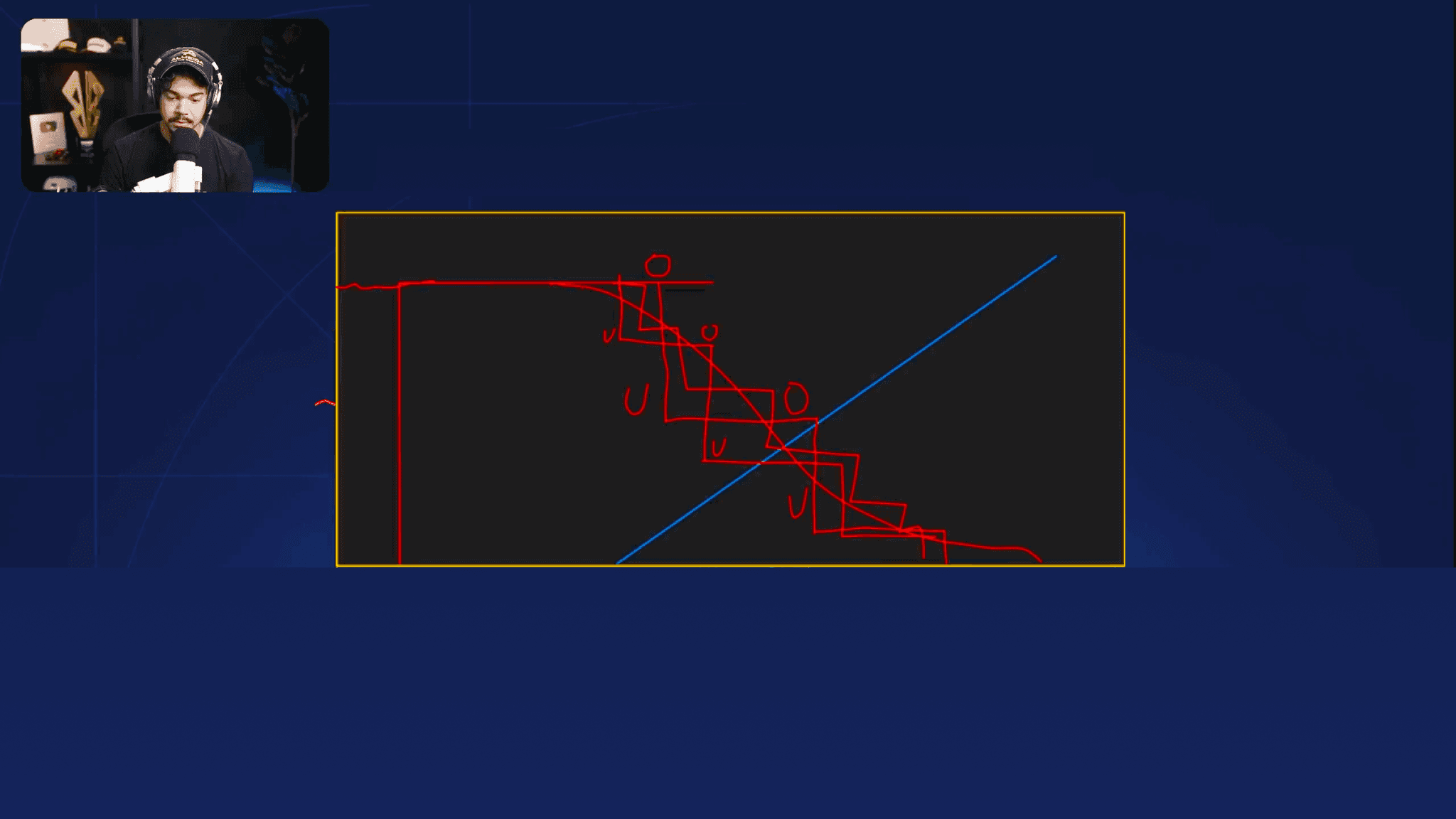
Let's say we brake on a straight line. If we add a very normal linear steering, what would happen when we start adding steering and staying on the brakes? At this point as soon as we start adding this steering and let's say this is ABS, this is really the limit, the car will be over the limit. Let's call it oversteer. Let's say this car oversteers when you add too much brake and too much steering.
The solution for that is actually to release a little bit the brakes but if we release too much, now we're actually under the limit so we stay a little bit more on the brakes but now here we get into over the limit again and then we release again, we get under the limit again and this is a very choppy trail braking trace which is what a lot of beginners do. We don't have that precision at first. We're trying to trail brake but it's kind of difficult and this is how it looks.
When you get a little bit more advanced you can already kind of predict what's going to happen. So you release a little bit earlier but then again you get a little bit under the limit and then you try to stay a little bit more, you get a little bit over the limit and then you go down, you get under and then you start making these adjustments. The more precise you get, the smaller the steps become and then we end up building eventually the actual trail braking trace that matches being on the limit and building that nice transition from the brakes to the steering. So these are the building blocks.
If you stay too much over, you abuse the tires and it will punish you. If you get a lot under then you're going to be a little bit too fast, you're not going to get the rotation and you might not be able to get the apex or you might just go wide because you didn't get enough rotation.
How to Master Trail Braking Precision
Light Hands
You need to feel how the brakes affect the steering effectiveness as you turn into a corner by feeling that as soon as you start turning a tiny bit and start releasing the brakes a tiny bit from the top, the car already wants to point where you have to feel the effect of the car really going almost for you with the least amount of steering. That's the first step.
As soon as that happens, you're able to start releasing a little bit more the brakes and turning a bit more the steering to try to keep that sensation that the car almost goes for you and you're just giving it the right inputs to allow that rotation to feel the easiest rotation possible. And that's the magic here. When you get it right, it actually feels extremely easy to rotate the car and it also actually feels very easy to spin the car if you want.
Spinning the car on purpose is a very easy thing to do as soon as you understand it. But whenever I try to ask most of my students to spin on purpose, they struggle a lot and they try very hard and the funny thing is that the harder they try, the less they spend because they just start steering a lot and actually getting into understeer. Remember, you will spend the car when you master the trail braking so that you turn it the most with the least steering.
Constant Adjustment and Practice
You want to constantly adjust the pressure in the steering to try to find that neutral steer, to try to find that magic combination. At first, if you're struggling to do that in a corner, try that at the centripetal circuit. But ideally, you should be able to kind of throw the car a little bit too late, let's say a little bit too late into the corner and throw it into a nice oversteer and then dance with it.
Try to do that with the MX-5 or with the Formula 1600 because these cars allow a lot of correction. So if you can throw it a little bit and then correct, just so that you can learn that throw in catching motion, you will master your trail braking precision a lot more.
Trail Braking in Different Cars
The main difference is going to be whether they are already capable of rotating very well with not a lot of support from the trail braking during the corner.
High Downforce Cars
A car with high downforce will already be able to rotate very well at higher speeds and that is why we're able to do a more U-shaped, more closer to a circle line. For example, at Bruce Shells at Spa, a Formula 1 can trace this purple line. Because of that, the braking trace looks a little bit thinner mid-corner because you don't have to carry that much trail braking deep into the corner because you can rely on the downforce.
Low Downforce Cars
The red line would be, say, a Porsche Cup where you actually have to turn in a little bit earlier because you still need to slow down the car a lot more on this phase because the car at this speed is still not capable of rotating. There's no downforce to help it so it needs to slow down a lot more and actually, in this case, the car even transforms this single apex into a double apex because you need to carry energy into the corner and to continue braking while turning way less here and then turning way more when the speeds go down.
The main difference between high and low downforce is that high downforce has some extra rotation on high speeds to compensate for the speed difference. In a high downforce car, there's not that much difference in rotation points between the corner entry and mid corner whereas in the low downforce car, you're able to get way more rotation at the lower speed but way less rotation at the extremes of the corner because there's no downforce to help the car rotate more at the higher speeds when you're turning in.
Because of that, you still need to trail brake a lot to get the car to slow down and then finally get that rotation rather than turning in super late and carrying that speed into the corner like it would do on a high downforce car. This affects the trail braking so that you carry a lot more trail braking into the corner because you need still to decelerate a lot more as you're building the V-shaped line.
Comparing Braking Pressure
Remember because of the graph compression, the absolute amount of braking in a Formula One car is actually way higher. So even though it looks like you're braking a lot less compared to the Porsche Cup, if you were to actually compare it in absolute terms, the amount of actual braking pressure felt by the tires is similar but still the point is the same. There's way more area under the curve on the beginning and way less mid-corner compared to the distribution of braking between entry and mid-corner in a low downforce car which is way closer if you compare it to a Formula One car.
Trail Braking Mistakes
Mistake 1: Releasing Brakes Slowly Without Steering Connection
You release the brakes slowly just because someone told you to and when you just think in an isolated way of releasing the brakes slowly but you don't create any connection with the steering then this trail braking is ineffective. A lot of people do these mistakes where for example they can brake and release very slowly for the sake of releasing very slowly but they start steering much later. In this case already from that point all the way until steering begins you are abusing the tires.
The opposite sometimes is another actually very common mistake where a student releases the brakes very slowly and then starts adding steering later. In this area you're under the limit all the way until that point you are not on the limit because you are releasing the brakes before you even add the steering. So the number one mistake is making the trail braking graph look great, look beautiful but without creating a connection between that trace and the steering itself.
Mistake 2: Reapplying Brakes While Steering
Another very common trail braking mistake is to release the brakes very quickly and then add a little bit more because you want to gain rotation. Be careful with that because again if you're adding brakes and steering at the same time the car is not going to like it you're going quickly from being very under the limit to being absolutely over the limit and abusing the tires.
Remember that you'd never add trail braking. Yes, we always say you need to add weight to the front tires but the weight is already there when you start braking hard you already have all the weight you just need to have a little bit less weight while keeping the right amount of weight on the front tires and then releasing that.
The Solution to Correction Mistakes
Anytime you release the brakes and realize that the car is not stopping, naturally you will want to add brakes and then release again with the steering still going up. That's a very common mistake. What's the solution then if you can't add brakes and the steering at the same time? The solution is actually anytime you want to add brakes just make sure you also decrease the steering for that time and then add again.
In a panic correction situation, add steering until that point then go straight as you're adding more brakes. The car will actually stop way more than if you just kept steering because if you keep steering you're gonna get into ABS the car is gonna go straight and it's not gonna stop it's gonna be over the limit and if it doesn't have ABS it's gonna lock. But if you straighten the steering for a little bit get that correction and then add again you'll still miss the apex but at least you're gonna stop the car and stay on track.
Remember this connection has to always be there. Every time you add brakes you release the steering. Every time you release brakes you can add steering. This should be always there even when you're making corrections for mistakes this relation has to be ingrained in your brain so that it always happens. There is absolutely no situation where it will work or be better to add brakes and steering at the same time. This will never ever work.
Trail Braking Mistake Examples
Example 1: Releasing Brakes Too Fast
In this example, we see a very sharp replication and then a little bit of steering but then the brakes go down so fast. They go way too fast all the way down without the steering following that motion. The steering actually kind of stops and the brakes are going down continuously. Then the brakes stop and then a lot of steering with the brakes actually going up a little bit again. In this case you're not gonna go crazy over the limit because the quick drop was the big problem actually.
This driver is under the limit by a lot and not getting the rotation that he needs. He can actually still do the corner but you can see that he is struggling a lot with understeer. The car really doesn't want to turn and if he's still capable of doing the corner like this it's because he is braking too early. So he can gain a lot of time by braking a little bit later but that would force him to get the right trail braking release because otherwise with this specific trace that would not work.
Example 2: Adding Brakes and Steering Simultaneously
In this example, we see a lot of steering and adding brakes at the same time. You can see the brakes going up with the steering going up and the car immediately understeers gets into front ABS and goes straight. At the very moment he adds these brakes and the steering that's where it gets worse and the car really goes straight. It literally loses rotation. It's not only staying at a fixed limited rotation it's actually getting less. It's actually going straighter because of him adding brakes and steering at the same time. The car pretty much almost stops to be able to do the corner.
Example 3: Inducing Oversteer
In this example, there's a big slide. Adding brakes and steering at the same time. More brakes, more steering. More brakes, more steering. And now that's already too much even though he is releasing the brakes that's too late. Now the car is really already sliding and he's having to do a big correction. You see that the car really does not like when you add both at the same time.
If you have to add both at the same time because you're getting into a corner that is so fast that it's just a tiny bit, that's fine. But it's never going to be this amount of steering with this amount of brakes. Ideally he should have added the brakes and then transitioned to that amount of steering with like 5 to 10% brakes. But he went straight to 35% brakes with 45 degrees of steering. At the same time, that's pretty much how you induce an oversteer.
Example 4: Too Much Braking Mid-Corner in a Formula Car
In this example with a Formula car with lots of downforce, lots of rotation, and a loose setup, 20% brakes mid-corner is the problem. That's a little bit too much mid-corner for a formula car. So the car starts oversteering. But the driver stays on those 20 to 15% brakes and that's too much you end up losing the car. The solution here would have been to as soon as you realize that the rotation is already good, you drop a little bit more quickly and that would have solved it.
It's not a big difference. But when you're driving at the limit, a little bit like 10-15% of brakes, it's between the perfect lap and a big spin that's going to ruin your race. This is the kind of precision that we want to work on.
Trail Braking Exercises
Exercise 1: Feeling Steering Weight
Stay on a line and then add the brakes. Your objective is to feel the steering getting heavier. When you add the same steering force, the steering gets heavier and heavier and heavier. If you break a lot, you're a little bit too slow. If you break a lot, you actually have to force with a pretty strong force at the back. You can do that with as much as 400m you should already be able to feel that.
Exercise 2: Slowing to a Stop with Trail Braking
Try to slow the car down until stop with the trail braking and just making corrections and feeling the trail braking actually helping the car rotate. Touch the brakes just a little bit. The smaller the speed, the more steering you need to add to feel that same steering resistance. If you just start braking, steering gets heavier, but then it doesn't feel heavy if you don't fight it. But if you keep fighting it, then you can feel that you're chasing that resistance and the car stays on the neutral steer while gaining rotation.
It's actually effectively doing a closing spiral. You're trail braking properly if you chase the resistance. So you don't only chase the resistance on the initial turn end, you actually keep forcing more. It's almost spinning, almost spinning, but not spinning. It's really neutral steering all the way on a closing spiral.
If you add a little bit too much force and too much brakes at first, you immediately lose the car. Just a little bit of steering and adding a little bit of excessive force by the time you initiate. So by the time you get on the brakes, your hands have to relax a little bit. And then you add more, and then you add more, and then you add more, and the car can take it. The car will take it. The lower the speed, the more you can force the steering. Initially, the higher the speed, the more sensitive it will be for any initial steering.
Exercise 3: Hard Braking Transitioning to Trail Braking
Start braking on a straight line and then transition. So super high speed, start braking, and then do it. That's some sort of hard braking transitioning into trail braking. That's a good practice. You brake on a straight line, and then you start trail braking. Feel that without spinning. Maybe you want to spin on purpose. Brake on a straight line, and then spin on purpose.
It doesn't even look that different in the telemetry, but it's just that you added a little bit too much steering too fast without releasing the brakes as fast. If you do the opposite, if you just brake very hard, but drop the brakes too fast, and then turn, you get understeer. It doesn't want to turn at all. But if you start adding steering, and then kind of feeling the brake release, then you can see how easy it is to slide.
Practice at the Centripetal Circuit
That's why it's so important for you to go and try. Get to the centripetal circuit, get this car, and then make little corrections mid-corner where you can turn a lot of steering. That is a very useful thing for you to do to feel the trail braking, because in any corner, we're going to do the same thing. We brake hard, trail brake, trail brake, correct, trail brake, correct, power, exit. That's pretty much the way you're going to do most of the corners.
You can also try all the mistakes, adding brakes and steering at the same time. Too much locks the front. If it's not too much, you spin. But adding brakes and steering at the same time will punish you in some sort of way.
Relaxing Your Hands
That's why it's so important to every time, even if you're turning, if you want to get back on brakes, you just need to relax your hands. If you drop the hands, as soon as you start braking, the car fixes itself. That's why relaxing your hands is so useful, because it allows the force feedback to find the ideal amount of steering for each braking pressure. And then you end up becoming capable of doing whatever you want with the car.
Conclusion
You probably already noticed that a lot of concepts are repeated, but that's because many concepts are expressed in similar inputs in motorsports. Everything happens at the same time. So we will still repeat it, but with different explanations or explanations coming from different perspectives or from different concepts. And we are going to explain some extra concepts to fill in the gaps of understanding in every exercise that we have done so far up to this point.
Trail braking is very simple. We are simply creating a blend, a transition between the brakes and the steering for the sake of maximizing grip usage on the four tires during the transition. This allows us to stay at 100% grip usage of the tires in that transition from longitudinal grip to lateral grip. We will do it every time we want to brake a little bit later and we will do it every time we want to get a little bit more rotation out of the car, especially if it's understeering.
Understanding Coasting
Coasting is a gap between the last bit of braking and the throttle application. We will do that only in rare events where mid-corner, especially in a little bit longer corners, trail braking doesn't help. Trail braking might not help because of a few reasons:
Maybe the car is not very well balanced and any sort of braking makes the car lock the front tire. It's very easy, especially when you're turning into a corner and the front tire is lifting a little bit, to lock the tire and actually destroy it. So in that scenario, you will break the least possible and sometimes that includes coasting.
When the car already rotates too much and mid-corner, especially when the corner is a little bit longer, you can just let it do its thing without having to use the brakes to make it turn. This includes any car with a lot of rotation, be it because it's a very light car with a very over-series setup or because it's a car with a lot of front downforce that allows the car to rotate already.
Remember that trail braking adds weight to the front tires. But if there is already a lot of weight into the front tires because of the front wing pushing the car down, in that case, we will actually not trail brake that much mid-corner. Remember that coasting is mostly useful mid-corner, you are still going to trail brake.
Why Trail Braking Is So Difficult
When you are releasing the brakes and adding steering, there is still a lot of weight on the front tires and this area makes the car extremely sensitive to mistakes. If you trail brake a little bit too much, you lock the front tires or you get ABS and you can understeer or oversteer depending on whether you're locking your ears on the front. If you brake too little, now you're not slowing the car enough, you might not get enough rotation and you might be a little bit too fast and end up going wide mid-corner.
Trail braking is difficult because it requires a lot of precision to get right. It will punish you for doing too much of it and it will punish you for doing too little of it. So you have to really understand that perfect combination between the brakes and the steering and that combination is also a moving target. That is why it is so difficult.
Remember that you are releasing the brakes while keeping the weight on the front tires so it's very easy to create this misconception that you should add more weight to get the car turn if you're understeering but be careful that you should never actually reapply brakes while applying steering at the same time because that will just make you abuse the front tire or the rear tire and the car is not going to like that because it does not have that much grip to offer.
Finding the Right Line for Each Car
It's also difficult to trail brake because you have to find the right line for each specific car. A car with a lot of downforce and with a very stiff suspension will require a different line, will require a lot less trail braking, a lot less pressure mid-corner and a U-shaped line. A car with a low downforce, a very heavy car with soft suspension and low downforce, will require a way more aggressive V-shaped line and a way more aggressive transition between the brakes and the steering with a heavy trail braking surface area as well as a very exponential and progressive steering.
A lot of these things have to match correctly for the trail braking to feel right and that is why it can take even months and years for you to really master it.
Understanding Trail Braking Precision Through Building Blocks
Let's say we brake on a straight line. If we add a very normal linear steering, what would happen when we start adding steering and staying on the brakes? At this point as soon as we start adding this steering and let's say this is ABS, this is really the limit, the car will be over the limit. Let's call it oversteer. Let's say this car oversteers when you add too much brake and too much steering.
The solution for that is actually to release a little bit the brakes but if we release too much, now we're actually under the limit so we stay a little bit more on the brakes but now here we get into over the limit again and then we release again, we get under the limit again and this is a very choppy trail braking trace which is what a lot of beginners do. We don't have that precision at first. We're trying to trail brake but it's kind of difficult and this is how it looks.
When you get a little bit more advanced you can already kind of predict what's going to happen. So you release a little bit earlier but then again you get a little bit under the limit and then you try to stay a little bit more, you get a little bit over the limit and then you go down, you get under and then you start making these adjustments. The more precise you get, the smaller the steps become and then we end up building eventually the actual trail braking trace that matches being on the limit and building that nice transition from the brakes to the steering. So these are the building blocks.
If you stay too much over, you abuse the tires and it will punish you. If you get a lot under then you're going to be a little bit too fast, you're not going to get the rotation and you might not be able to get the apex or you might just go wide because you didn't get enough rotation.
How to Master Trail Braking Precision
Light Hands
You need to feel how the brakes affect the steering effectiveness as you turn into a corner by feeling that as soon as you start turning a tiny bit and start releasing the brakes a tiny bit from the top, the car already wants to point where you have to feel the effect of the car really going almost for you with the least amount of steering. That's the first step.
As soon as that happens, you're able to start releasing a little bit more the brakes and turning a bit more the steering to try to keep that sensation that the car almost goes for you and you're just giving it the right inputs to allow that rotation to feel the easiest rotation possible. And that's the magic here. When you get it right, it actually feels extremely easy to rotate the car and it also actually feels very easy to spin the car if you want.
Spinning the car on purpose is a very easy thing to do as soon as you understand it. But whenever I try to ask most of my students to spin on purpose, they struggle a lot and they try very hard and the funny thing is that the harder they try, the less they spend because they just start steering a lot and actually getting into understeer. Remember, you will spend the car when you master the trail braking so that you turn it the most with the least steering.
Constant Adjustment and Practice
You want to constantly adjust the pressure in the steering to try to find that neutral steer, to try to find that magic combination. At first, if you're struggling to do that in a corner, try that at the centripetal circuit. But ideally, you should be able to kind of throw the car a little bit too late, let's say a little bit too late into the corner and throw it into a nice oversteer and then dance with it.
Try to do that with the MX-5 or with the Formula 1600 because these cars allow a lot of correction. So if you can throw it a little bit and then correct, just so that you can learn that throw in catching motion, you will master your trail braking precision a lot more.
Trail Braking in Different Cars
The main difference is going to be whether they are already capable of rotating very well with not a lot of support from the trail braking during the corner.
High Downforce Cars
A car with high downforce will already be able to rotate very well at higher speeds and that is why we're able to do a more U-shaped, more closer to a circle line. For example, at Bruce Shells at Spa, a Formula 1 can trace this purple line. Because of that, the braking trace looks a little bit thinner mid-corner because you don't have to carry that much trail braking deep into the corner because you can rely on the downforce.
Low Downforce Cars
The red line would be, say, a Porsche Cup where you actually have to turn in a little bit earlier because you still need to slow down the car a lot more on this phase because the car at this speed is still not capable of rotating. There's no downforce to help it so it needs to slow down a lot more and actually, in this case, the car even transforms this single apex into a double apex because you need to carry energy into the corner and to continue braking while turning way less here and then turning way more when the speeds go down.
The main difference between high and low downforce is that high downforce has some extra rotation on high speeds to compensate for the speed difference. In a high downforce car, there's not that much difference in rotation points between the corner entry and mid corner whereas in the low downforce car, you're able to get way more rotation at the lower speed but way less rotation at the extremes of the corner because there's no downforce to help the car rotate more at the higher speeds when you're turning in.
Because of that, you still need to trail brake a lot to get the car to slow down and then finally get that rotation rather than turning in super late and carrying that speed into the corner like it would do on a high downforce car. This affects the trail braking so that you carry a lot more trail braking into the corner because you need still to decelerate a lot more as you're building the V-shaped line.
Comparing Braking Pressure
Remember because of the graph compression, the absolute amount of braking in a Formula One car is actually way higher. So even though it looks like you're braking a lot less compared to the Porsche Cup, if you were to actually compare it in absolute terms, the amount of actual braking pressure felt by the tires is similar but still the point is the same. There's way more area under the curve on the beginning and way less mid-corner compared to the distribution of braking between entry and mid-corner in a low downforce car which is way closer if you compare it to a Formula One car.
Trail Braking Mistakes
Mistake 1: Releasing Brakes Slowly Without Steering Connection
You release the brakes slowly just because someone told you to and when you just think in an isolated way of releasing the brakes slowly but you don't create any connection with the steering then this trail braking is ineffective. A lot of people do these mistakes where for example they can brake and release very slowly for the sake of releasing very slowly but they start steering much later. In this case already from that point all the way until steering begins you are abusing the tires.
The opposite sometimes is another actually very common mistake where a student releases the brakes very slowly and then starts adding steering later. In this area you're under the limit all the way until that point you are not on the limit because you are releasing the brakes before you even add the steering. So the number one mistake is making the trail braking graph look great, look beautiful but without creating a connection between that trace and the steering itself.
Mistake 2: Reapplying Brakes While Steering
Another very common trail braking mistake is to release the brakes very quickly and then add a little bit more because you want to gain rotation. Be careful with that because again if you're adding brakes and steering at the same time the car is not going to like it you're going quickly from being very under the limit to being absolutely over the limit and abusing the tires.
Remember that you'd never add trail braking. Yes, we always say you need to add weight to the front tires but the weight is already there when you start braking hard you already have all the weight you just need to have a little bit less weight while keeping the right amount of weight on the front tires and then releasing that.
The Solution to Correction Mistakes
Anytime you release the brakes and realize that the car is not stopping, naturally you will want to add brakes and then release again with the steering still going up. That's a very common mistake. What's the solution then if you can't add brakes and the steering at the same time? The solution is actually anytime you want to add brakes just make sure you also decrease the steering for that time and then add again.
In a panic correction situation, add steering until that point then go straight as you're adding more brakes. The car will actually stop way more than if you just kept steering because if you keep steering you're gonna get into ABS the car is gonna go straight and it's not gonna stop it's gonna be over the limit and if it doesn't have ABS it's gonna lock. But if you straighten the steering for a little bit get that correction and then add again you'll still miss the apex but at least you're gonna stop the car and stay on track.
Remember this connection has to always be there. Every time you add brakes you release the steering. Every time you release brakes you can add steering. This should be always there even when you're making corrections for mistakes this relation has to be ingrained in your brain so that it always happens. There is absolutely no situation where it will work or be better to add brakes and steering at the same time. This will never ever work.
Trail Braking Mistake Examples
Example 1: Releasing Brakes Too Fast
In this example, we see a very sharp replication and then a little bit of steering but then the brakes go down so fast. They go way too fast all the way down without the steering following that motion. The steering actually kind of stops and the brakes are going down continuously. Then the brakes stop and then a lot of steering with the brakes actually going up a little bit again. In this case you're not gonna go crazy over the limit because the quick drop was the big problem actually.
This driver is under the limit by a lot and not getting the rotation that he needs. He can actually still do the corner but you can see that he is struggling a lot with understeer. The car really doesn't want to turn and if he's still capable of doing the corner like this it's because he is braking too early. So he can gain a lot of time by braking a little bit later but that would force him to get the right trail braking release because otherwise with this specific trace that would not work.
Example 2: Adding Brakes and Steering Simultaneously
In this example, we see a lot of steering and adding brakes at the same time. You can see the brakes going up with the steering going up and the car immediately understeers gets into front ABS and goes straight. At the very moment he adds these brakes and the steering that's where it gets worse and the car really goes straight. It literally loses rotation. It's not only staying at a fixed limited rotation it's actually getting less. It's actually going straighter because of him adding brakes and steering at the same time. The car pretty much almost stops to be able to do the corner.
Example 3: Inducing Oversteer
In this example, there's a big slide. Adding brakes and steering at the same time. More brakes, more steering. More brakes, more steering. And now that's already too much even though he is releasing the brakes that's too late. Now the car is really already sliding and he's having to do a big correction. You see that the car really does not like when you add both at the same time.
If you have to add both at the same time because you're getting into a corner that is so fast that it's just a tiny bit, that's fine. But it's never going to be this amount of steering with this amount of brakes. Ideally he should have added the brakes and then transitioned to that amount of steering with like 5 to 10% brakes. But he went straight to 35% brakes with 45 degrees of steering. At the same time, that's pretty much how you induce an oversteer.
Example 4: Too Much Braking Mid-Corner in a Formula Car
In this example with a Formula car with lots of downforce, lots of rotation, and a loose setup, 20% brakes mid-corner is the problem. That's a little bit too much mid-corner for a formula car. So the car starts oversteering. But the driver stays on those 20 to 15% brakes and that's too much you end up losing the car. The solution here would have been to as soon as you realize that the rotation is already good, you drop a little bit more quickly and that would have solved it.
It's not a big difference. But when you're driving at the limit, a little bit like 10-15% of brakes, it's between the perfect lap and a big spin that's going to ruin your race. This is the kind of precision that we want to work on.
Trail Braking Exercises
Exercise 1: Feeling Steering Weight
Stay on a line and then add the brakes. Your objective is to feel the steering getting heavier. When you add the same steering force, the steering gets heavier and heavier and heavier. If you break a lot, you're a little bit too slow. If you break a lot, you actually have to force with a pretty strong force at the back. You can do that with as much as 400m you should already be able to feel that.
Exercise 2: Slowing to a Stop with Trail Braking
Try to slow the car down until stop with the trail braking and just making corrections and feeling the trail braking actually helping the car rotate. Touch the brakes just a little bit. The smaller the speed, the more steering you need to add to feel that same steering resistance. If you just start braking, steering gets heavier, but then it doesn't feel heavy if you don't fight it. But if you keep fighting it, then you can feel that you're chasing that resistance and the car stays on the neutral steer while gaining rotation.
It's actually effectively doing a closing spiral. You're trail braking properly if you chase the resistance. So you don't only chase the resistance on the initial turn end, you actually keep forcing more. It's almost spinning, almost spinning, but not spinning. It's really neutral steering all the way on a closing spiral.
If you add a little bit too much force and too much brakes at first, you immediately lose the car. Just a little bit of steering and adding a little bit of excessive force by the time you initiate. So by the time you get on the brakes, your hands have to relax a little bit. And then you add more, and then you add more, and then you add more, and the car can take it. The car will take it. The lower the speed, the more you can force the steering. Initially, the higher the speed, the more sensitive it will be for any initial steering.
Exercise 3: Hard Braking Transitioning to Trail Braking
Start braking on a straight line and then transition. So super high speed, start braking, and then do it. That's some sort of hard braking transitioning into trail braking. That's a good practice. You brake on a straight line, and then you start trail braking. Feel that without spinning. Maybe you want to spin on purpose. Brake on a straight line, and then spin on purpose.
It doesn't even look that different in the telemetry, but it's just that you added a little bit too much steering too fast without releasing the brakes as fast. If you do the opposite, if you just brake very hard, but drop the brakes too fast, and then turn, you get understeer. It doesn't want to turn at all. But if you start adding steering, and then kind of feeling the brake release, then you can see how easy it is to slide.
Practice at the Centripetal Circuit
That's why it's so important for you to go and try. Get to the centripetal circuit, get this car, and then make little corrections mid-corner where you can turn a lot of steering. That is a very useful thing for you to do to feel the trail braking, because in any corner, we're going to do the same thing. We brake hard, trail brake, trail brake, correct, trail brake, correct, power, exit. That's pretty much the way you're going to do most of the corners.
You can also try all the mistakes, adding brakes and steering at the same time. Too much locks the front. If it's not too much, you spin. But adding brakes and steering at the same time will punish you in some sort of way.
Relaxing Your Hands
That's why it's so important to every time, even if you're turning, if you want to get back on brakes, you just need to relax your hands. If you drop the hands, as soon as you start braking, the car fixes itself. That's why relaxing your hands is so useful, because it allows the force feedback to find the ideal amount of steering for each braking pressure. And then you end up becoming capable of doing whatever you want with the car.
Conclusion
You probably already noticed that a lot of concepts are repeated, but that's because many concepts are expressed in similar inputs in motorsports. Everything happens at the same time. So we will still repeat it, but with different explanations or explanations coming from different perspectives or from different concepts. And we are going to explain some extra concepts to fill in the gaps of understanding in every exercise that we have done so far up to this point.
Trail braking is very simple. We are simply creating a blend, a transition between the brakes and the steering for the sake of maximizing grip usage on the four tires during the transition. This allows us to stay at 100% grip usage of the tires in that transition from longitudinal grip to lateral grip. We will do it every time we want to brake a little bit later and we will do it every time we want to get a little bit more rotation out of the car, especially if it's understeering.
Understanding Coasting
Coasting is a gap between the last bit of braking and the throttle application. We will do that only in rare events where mid-corner, especially in a little bit longer corners, trail braking doesn't help. Trail braking might not help because of a few reasons:
Maybe the car is not very well balanced and any sort of braking makes the car lock the front tire. It's very easy, especially when you're turning into a corner and the front tire is lifting a little bit, to lock the tire and actually destroy it. So in that scenario, you will break the least possible and sometimes that includes coasting.
When the car already rotates too much and mid-corner, especially when the corner is a little bit longer, you can just let it do its thing without having to use the brakes to make it turn. This includes any car with a lot of rotation, be it because it's a very light car with a very over-series setup or because it's a car with a lot of front downforce that allows the car to rotate already.
Remember that trail braking adds weight to the front tires. But if there is already a lot of weight into the front tires because of the front wing pushing the car down, in that case, we will actually not trail brake that much mid-corner. Remember that coasting is mostly useful mid-corner, you are still going to trail brake.
Why Trail Braking Is So Difficult
When you are releasing the brakes and adding steering, there is still a lot of weight on the front tires and this area makes the car extremely sensitive to mistakes. If you trail brake a little bit too much, you lock the front tires or you get ABS and you can understeer or oversteer depending on whether you're locking your ears on the front. If you brake too little, now you're not slowing the car enough, you might not get enough rotation and you might be a little bit too fast and end up going wide mid-corner.
Trail braking is difficult because it requires a lot of precision to get right. It will punish you for doing too much of it and it will punish you for doing too little of it. So you have to really understand that perfect combination between the brakes and the steering and that combination is also a moving target. That is why it is so difficult.
Remember that you are releasing the brakes while keeping the weight on the front tires so it's very easy to create this misconception that you should add more weight to get the car turn if you're understeering but be careful that you should never actually reapply brakes while applying steering at the same time because that will just make you abuse the front tire or the rear tire and the car is not going to like that because it does not have that much grip to offer.
Finding the Right Line for Each Car
It's also difficult to trail brake because you have to find the right line for each specific car. A car with a lot of downforce and with a very stiff suspension will require a different line, will require a lot less trail braking, a lot less pressure mid-corner and a U-shaped line. A car with a low downforce, a very heavy car with soft suspension and low downforce, will require a way more aggressive V-shaped line and a way more aggressive transition between the brakes and the steering with a heavy trail braking surface area as well as a very exponential and progressive steering.
A lot of these things have to match correctly for the trail braking to feel right and that is why it can take even months and years for you to really master it.
Understanding Trail Braking Precision Through Building Blocks
Let's say we brake on a straight line. If we add a very normal linear steering, what would happen when we start adding steering and staying on the brakes? At this point as soon as we start adding this steering and let's say this is ABS, this is really the limit, the car will be over the limit. Let's call it oversteer. Let's say this car oversteers when you add too much brake and too much steering.
The solution for that is actually to release a little bit the brakes but if we release too much, now we're actually under the limit so we stay a little bit more on the brakes but now here we get into over the limit again and then we release again, we get under the limit again and this is a very choppy trail braking trace which is what a lot of beginners do. We don't have that precision at first. We're trying to trail brake but it's kind of difficult and this is how it looks.
When you get a little bit more advanced you can already kind of predict what's going to happen. So you release a little bit earlier but then again you get a little bit under the limit and then you try to stay a little bit more, you get a little bit over the limit and then you go down, you get under and then you start making these adjustments. The more precise you get, the smaller the steps become and then we end up building eventually the actual trail braking trace that matches being on the limit and building that nice transition from the brakes to the steering. So these are the building blocks.
If you stay too much over, you abuse the tires and it will punish you. If you get a lot under then you're going to be a little bit too fast, you're not going to get the rotation and you might not be able to get the apex or you might just go wide because you didn't get enough rotation.
How to Master Trail Braking Precision
Light Hands
You need to feel how the brakes affect the steering effectiveness as you turn into a corner by feeling that as soon as you start turning a tiny bit and start releasing the brakes a tiny bit from the top, the car already wants to point where you have to feel the effect of the car really going almost for you with the least amount of steering. That's the first step.
As soon as that happens, you're able to start releasing a little bit more the brakes and turning a bit more the steering to try to keep that sensation that the car almost goes for you and you're just giving it the right inputs to allow that rotation to feel the easiest rotation possible. And that's the magic here. When you get it right, it actually feels extremely easy to rotate the car and it also actually feels very easy to spin the car if you want.
Spinning the car on purpose is a very easy thing to do as soon as you understand it. But whenever I try to ask most of my students to spin on purpose, they struggle a lot and they try very hard and the funny thing is that the harder they try, the less they spend because they just start steering a lot and actually getting into understeer. Remember, you will spend the car when you master the trail braking so that you turn it the most with the least steering.
Constant Adjustment and Practice
You want to constantly adjust the pressure in the steering to try to find that neutral steer, to try to find that magic combination. At first, if you're struggling to do that in a corner, try that at the centripetal circuit. But ideally, you should be able to kind of throw the car a little bit too late, let's say a little bit too late into the corner and throw it into a nice oversteer and then dance with it.
Try to do that with the MX-5 or with the Formula 1600 because these cars allow a lot of correction. So if you can throw it a little bit and then correct, just so that you can learn that throw in catching motion, you will master your trail braking precision a lot more.
Trail Braking in Different Cars
The main difference is going to be whether they are already capable of rotating very well with not a lot of support from the trail braking during the corner.
High Downforce Cars
A car with high downforce will already be able to rotate very well at higher speeds and that is why we're able to do a more U-shaped, more closer to a circle line. For example, at Bruce Shells at Spa, a Formula 1 can trace this purple line. Because of that, the braking trace looks a little bit thinner mid-corner because you don't have to carry that much trail braking deep into the corner because you can rely on the downforce.
Low Downforce Cars
The red line would be, say, a Porsche Cup where you actually have to turn in a little bit earlier because you still need to slow down the car a lot more on this phase because the car at this speed is still not capable of rotating. There's no downforce to help it so it needs to slow down a lot more and actually, in this case, the car even transforms this single apex into a double apex because you need to carry energy into the corner and to continue braking while turning way less here and then turning way more when the speeds go down.
The main difference between high and low downforce is that high downforce has some extra rotation on high speeds to compensate for the speed difference. In a high downforce car, there's not that much difference in rotation points between the corner entry and mid corner whereas in the low downforce car, you're able to get way more rotation at the lower speed but way less rotation at the extremes of the corner because there's no downforce to help the car rotate more at the higher speeds when you're turning in.
Because of that, you still need to trail brake a lot to get the car to slow down and then finally get that rotation rather than turning in super late and carrying that speed into the corner like it would do on a high downforce car. This affects the trail braking so that you carry a lot more trail braking into the corner because you need still to decelerate a lot more as you're building the V-shaped line.
Comparing Braking Pressure
Remember because of the graph compression, the absolute amount of braking in a Formula One car is actually way higher. So even though it looks like you're braking a lot less compared to the Porsche Cup, if you were to actually compare it in absolute terms, the amount of actual braking pressure felt by the tires is similar but still the point is the same. There's way more area under the curve on the beginning and way less mid-corner compared to the distribution of braking between entry and mid-corner in a low downforce car which is way closer if you compare it to a Formula One car.
Trail Braking Mistakes
Mistake 1: Releasing Brakes Slowly Without Steering Connection
You release the brakes slowly just because someone told you to and when you just think in an isolated way of releasing the brakes slowly but you don't create any connection with the steering then this trail braking is ineffective. A lot of people do these mistakes where for example they can brake and release very slowly for the sake of releasing very slowly but they start steering much later. In this case already from that point all the way until steering begins you are abusing the tires.
The opposite sometimes is another actually very common mistake where a student releases the brakes very slowly and then starts adding steering later. In this area you're under the limit all the way until that point you are not on the limit because you are releasing the brakes before you even add the steering. So the number one mistake is making the trail braking graph look great, look beautiful but without creating a connection between that trace and the steering itself.
Mistake 2: Reapplying Brakes While Steering
Another very common trail braking mistake is to release the brakes very quickly and then add a little bit more because you want to gain rotation. Be careful with that because again if you're adding brakes and steering at the same time the car is not going to like it you're going quickly from being very under the limit to being absolutely over the limit and abusing the tires.
Remember that you'd never add trail braking. Yes, we always say you need to add weight to the front tires but the weight is already there when you start braking hard you already have all the weight you just need to have a little bit less weight while keeping the right amount of weight on the front tires and then releasing that.
The Solution to Correction Mistakes
Anytime you release the brakes and realize that the car is not stopping, naturally you will want to add brakes and then release again with the steering still going up. That's a very common mistake. What's the solution then if you can't add brakes and the steering at the same time? The solution is actually anytime you want to add brakes just make sure you also decrease the steering for that time and then add again.
In a panic correction situation, add steering until that point then go straight as you're adding more brakes. The car will actually stop way more than if you just kept steering because if you keep steering you're gonna get into ABS the car is gonna go straight and it's not gonna stop it's gonna be over the limit and if it doesn't have ABS it's gonna lock. But if you straighten the steering for a little bit get that correction and then add again you'll still miss the apex but at least you're gonna stop the car and stay on track.
Remember this connection has to always be there. Every time you add brakes you release the steering. Every time you release brakes you can add steering. This should be always there even when you're making corrections for mistakes this relation has to be ingrained in your brain so that it always happens. There is absolutely no situation where it will work or be better to add brakes and steering at the same time. This will never ever work.
Trail Braking Mistake Examples
Example 1: Releasing Brakes Too Fast
In this example, we see a very sharp replication and then a little bit of steering but then the brakes go down so fast. They go way too fast all the way down without the steering following that motion. The steering actually kind of stops and the brakes are going down continuously. Then the brakes stop and then a lot of steering with the brakes actually going up a little bit again. In this case you're not gonna go crazy over the limit because the quick drop was the big problem actually.
This driver is under the limit by a lot and not getting the rotation that he needs. He can actually still do the corner but you can see that he is struggling a lot with understeer. The car really doesn't want to turn and if he's still capable of doing the corner like this it's because he is braking too early. So he can gain a lot of time by braking a little bit later but that would force him to get the right trail braking release because otherwise with this specific trace that would not work.
Example 2: Adding Brakes and Steering Simultaneously
In this example, we see a lot of steering and adding brakes at the same time. You can see the brakes going up with the steering going up and the car immediately understeers gets into front ABS and goes straight. At the very moment he adds these brakes and the steering that's where it gets worse and the car really goes straight. It literally loses rotation. It's not only staying at a fixed limited rotation it's actually getting less. It's actually going straighter because of him adding brakes and steering at the same time. The car pretty much almost stops to be able to do the corner.
Example 3: Inducing Oversteer
In this example, there's a big slide. Adding brakes and steering at the same time. More brakes, more steering. More brakes, more steering. And now that's already too much even though he is releasing the brakes that's too late. Now the car is really already sliding and he's having to do a big correction. You see that the car really does not like when you add both at the same time.
If you have to add both at the same time because you're getting into a corner that is so fast that it's just a tiny bit, that's fine. But it's never going to be this amount of steering with this amount of brakes. Ideally he should have added the brakes and then transitioned to that amount of steering with like 5 to 10% brakes. But he went straight to 35% brakes with 45 degrees of steering. At the same time, that's pretty much how you induce an oversteer.
Example 4: Too Much Braking Mid-Corner in a Formula Car
In this example with a Formula car with lots of downforce, lots of rotation, and a loose setup, 20% brakes mid-corner is the problem. That's a little bit too much mid-corner for a formula car. So the car starts oversteering. But the driver stays on those 20 to 15% brakes and that's too much you end up losing the car. The solution here would have been to as soon as you realize that the rotation is already good, you drop a little bit more quickly and that would have solved it.
It's not a big difference. But when you're driving at the limit, a little bit like 10-15% of brakes, it's between the perfect lap and a big spin that's going to ruin your race. This is the kind of precision that we want to work on.
Trail Braking Exercises
Exercise 1: Feeling Steering Weight
Stay on a line and then add the brakes. Your objective is to feel the steering getting heavier. When you add the same steering force, the steering gets heavier and heavier and heavier. If you break a lot, you're a little bit too slow. If you break a lot, you actually have to force with a pretty strong force at the back. You can do that with as much as 400m you should already be able to feel that.
Exercise 2: Slowing to a Stop with Trail Braking
Try to slow the car down until stop with the trail braking and just making corrections and feeling the trail braking actually helping the car rotate. Touch the brakes just a little bit. The smaller the speed, the more steering you need to add to feel that same steering resistance. If you just start braking, steering gets heavier, but then it doesn't feel heavy if you don't fight it. But if you keep fighting it, then you can feel that you're chasing that resistance and the car stays on the neutral steer while gaining rotation.
It's actually effectively doing a closing spiral. You're trail braking properly if you chase the resistance. So you don't only chase the resistance on the initial turn end, you actually keep forcing more. It's almost spinning, almost spinning, but not spinning. It's really neutral steering all the way on a closing spiral.
If you add a little bit too much force and too much brakes at first, you immediately lose the car. Just a little bit of steering and adding a little bit of excessive force by the time you initiate. So by the time you get on the brakes, your hands have to relax a little bit. And then you add more, and then you add more, and then you add more, and the car can take it. The car will take it. The lower the speed, the more you can force the steering. Initially, the higher the speed, the more sensitive it will be for any initial steering.
Exercise 3: Hard Braking Transitioning to Trail Braking
Start braking on a straight line and then transition. So super high speed, start braking, and then do it. That's some sort of hard braking transitioning into trail braking. That's a good practice. You brake on a straight line, and then you start trail braking. Feel that without spinning. Maybe you want to spin on purpose. Brake on a straight line, and then spin on purpose.
It doesn't even look that different in the telemetry, but it's just that you added a little bit too much steering too fast without releasing the brakes as fast. If you do the opposite, if you just brake very hard, but drop the brakes too fast, and then turn, you get understeer. It doesn't want to turn at all. But if you start adding steering, and then kind of feeling the brake release, then you can see how easy it is to slide.
Practice at the Centripetal Circuit
That's why it's so important for you to go and try. Get to the centripetal circuit, get this car, and then make little corrections mid-corner where you can turn a lot of steering. That is a very useful thing for you to do to feel the trail braking, because in any corner, we're going to do the same thing. We brake hard, trail brake, trail brake, correct, trail brake, correct, power, exit. That's pretty much the way you're going to do most of the corners.
You can also try all the mistakes, adding brakes and steering at the same time. Too much locks the front. If it's not too much, you spin. But adding brakes and steering at the same time will punish you in some sort of way.
Relaxing Your Hands
That's why it's so important to every time, even if you're turning, if you want to get back on brakes, you just need to relax your hands. If you drop the hands, as soon as you start braking, the car fixes itself. That's why relaxing your hands is so useful, because it allows the force feedback to find the ideal amount of steering for each braking pressure. And then you end up becoming capable of doing whatever you want with the car.
Conclusion
You probably already noticed that a lot of concepts are repeated, but that's because many concepts are expressed in similar inputs in motorsports. Everything happens at the same time. So we will still repeat it, but with different explanations or explanations coming from different perspectives or from different concepts. And we are going to explain some extra concepts to fill in the gaps of understanding in every exercise that we have done so far up to this point.
Consistency & Confidence
Balance & Speed
Cornering Precision
Mastery
Other Lessons