Tire Surface Temperatures
Lesson
48
of
49

Lesson by
Suellio Almeida
Lesson by
Suellio Almeida
Mark as Finished
Let's talk about tire surface temperature and how it's affected by the brake bias and the engine braking, and how all these three work together. This is a higher level lesson. If you are at or approaching the top 1% level in iRacing (that's around 5000 iRating), this should help you a lot to find some good lap time. We're talking about potentially half a second to a second a lap just by managing these things.
Understanding Tire Surface Temperature Analysis
We're going to zoom in to one corner and examine how tire surface temperature affects just one corner. We're going to have three ways of analyzing it:
Short term: What happens in the same corner
Mid term: What happens on the same sector (if you're doing Suzuka where you have a lot of S's, or if you have a double left or a double right, or corners that are very close to each other)
Long term: What happens over a stint and how we can control the temperature and manage the tires in the most efficient way possible
Short Term Effects: What Happens in the Same Corner
Let's start with the short term, which is what happens in the same corner. When we start braking on a straight line, we already start adding temperature to the surface of the tire. Depending on the tire compound and the tire physics, that surface temperature might increase the grip or decrease the grip. In iRacing and in most tires, you're going to have less grip when you start heating out the surface.
Here's what happens: You start braking on a straight line, you start generating temperature on the surface of the tire, and that actually decreases grip. The more temperature you get in, the less grip you're going to have. You start turning and then we get even more temperature and even less grip, continuing through the apex. We're still using all the grip, we're still on the limit, we're still overheating the tires. Then we finally exit and we stop. We're not on the limit anymore. Then we start cooling down the surface of the tires because we're going on the straight and the hot surface is in contact with the colder track. The temperature is transferring towards the inside of the tire and towards the track because of air and everything. So whenever you are on a straight line, the surface temperature is going down.
The Importance of Lock-Ups
Why is this important? Because let's say you lock up the tires. You start braking but then you really lock up. When this happens, you gain a lot of temperature because you are overheating the tire. Because of that, at this point with more temperature, you have less grip. Because you have less grip, you kind of abuse the tires because you are now a little bit too fast and the car is not capable, so you start scrubbing more. You're getting into a snowball effect where it gets worse and worse: more temperature, less grip, more scrubbing, more temperature, less grip, more scrubbing until you really overheat the tires. By the time you get on the apex, the car is really sliding all over the place. Finally, you get on the exit and then the temperature starts going down again.
This is very important to know: if you do lock up the tire on entry, even if you unlock the tire, it will still have less grip. If you overheat the tire at any stage of the corner, there's no going back. The car is going to have less grip overall. A tiny lock here generates less cornering grip throughout the entire corner, and that is important because something that happens on a straight line affects what happens during the corner.
Brake Bias and Temperature Balance
I'm using the locking example, but this works even when you're not over the limit. Let's say you have a braking bias that is abusing the front tires. You are heating up the front more, and by the time you get to turn in, the fronts are hotter than the rears. By the time you start turning in, the fronts are hotter than the rears. There's less grip and the car is going to understeer. Because it understeers, you turn more and then you get into a snowball effect and it gets worse and worse and worse, and you're understeering all the way to the exit.
In this case, the solution would be to change the brake bias a little bit, so the temperature becomes more balanced: a little bit less temperature on the front tires and a little bit more temperature on the rear tires. If the rears become a little bit hotter, the temperature remains pretty stable. However, if you get a little bit too much oversteer, the opposite happens. Because you got oversteer, now the rears are too hot and there's a bigger tendency of another oversteer situation to happen because now the rear tires are hotter.
This is very important: Remember this—what happens at the beginning of the corner will affect the rest of the corner until you exit and cool down the tires. Whatever you do on entry will affect the rest of the corner.
Managing ABS and Braking Pressure
This is why it's so important to not brake too hard and get into too much ABS in a car that has ABS, or to do microlocking or locking in a car that does not have ABS. When you use ABS, you start braking and then you get into ABS and you keep there. You can stay at 100%. What happens with the temperature overall is it goes up more quickly than you need it to in order to stop as efficiently as possible. Then by the time you start turning in to the corner, there's less grip.
Now, if you brake just a little bit less, you're right on the edge, the car is going to stop in a similar manner. It's going to stop a tiny bit less, but because the temperature is going to be lower by the time you turn into the corner, there's literally more cornering grip. That is super important: to not abuse the tires during braking so that you conserve the surface temperature of the tires so that you use them very well during the corner.
In this situation, if you abuse the braking and you overheat the tires, you're always going to be slower. You're not going to understand why your rivals are able to carry so much speed mid-corner. Well, because they are taking care of the temperature of the tires on entry—they're not abusing the braking. I'm talking about a very small difference here, maybe just avoiding ABS or not locking that much.
Mid-Term Effects: Impact on Sequential Corners
The problem is that when you overheat the tire in one corner, there are short term effects, but not only. You also have mid-term effects. The mid-term effects are going to happen when you have another corner that is very close to the other corner. Instead of just one apex, imagine two apexes close together.
Let's say we abuse and lock up before the first corner. Then we're overheating the tires throughout that entire corner. On exit, the tires go down and cool down a tiny bit, but then there's another corner already, so we already have to turn in. That's the apex and we're still overheating a little bit. Remember, the higher the temperature, the less grip we have. This second corner will suffer the consequences of the first lock-up. It's that important.
What you want to do is take care of the temperatures through the first corner, then exit and let the temperature go down a little bit before the next corner. In the example where we locked up, we had less grip throughout the entirety of this compound corner. As a full sector, we might be talking about losing two, three, four, or five tenths because of a micro lock-up that overheated the tires.
Practical Examples of Front Lock-Ups
Here's a practical example of how locking up the fronts a tiny bit makes you understeer for the rest of the corner because of how you overheated the fronts. When you lock up a tiny bit and then realize it, you release the brakes and restart your process. You try to get as much rotation as possible, downshift to second, get on the right speed and the right braking, and try to make the car rotate as much as possible. But it just understeers. There's absolutely no rotation—it just does not want to turn at all, just because of this micro lock-up that happened a few seconds before.
This is how important it is. Of course, this is an extreme example, but it is exactly the way it works on a subtle level. If you do a micro lock on the fronts, even if it's not fully locking, just micro locking a little bit, it's already going to make the car understeer more by the time you start turning in, just because you overheated the surface of the tires.
In a more aggressive lock-up, when you try to reset and brake again, you actually overheat the front so much that it's even locking up more easily. Even trying your best to turn into the corner, you're just locking repeatedly because the inside front tire is completely overheated. Even though you may have locked up only one tire more than the other, that surface temperature on that tire alone is enough to completely kill the performance of that corner.
Rear Tire Lock-Ups
Now let's try the opposite—locking the rear tires and seeing what happens. When you bring the brake bias way down (like five or six percent) just to lock the rear tires, even a little bit of locking in the rear is significant. You can't do a full lock because you would spin. If you listen carefully, you can hear the engine shutting off. If you hear the engine sound going down very aggressively, that's because you're locking the end that is driven by the engine. In a rear-wheel drive car, the engine puts the power on the rear tires, so if the rear tires lock up, then the engine also turns off and you can hear it. When you unlock, the RPM goes up again because now the rear tires are back and running.
When you lock up the rears for a fraction of a second and then try to do the corner normally, the results are dramatic. The brake bias is a little bit different, which also affects it, but the bigger factor is the fact that you locked up the rear tires. You overheated the rear tires, and now they have a lot less grip when you turn in.
Mid-Term Temperature Effects Between Corners
The same thing applies for mid-term temperature effects and also applies to the very next corner if the corner is close enough. If you start understeering on purpose in one corner, you're actually painting the track with excessive front tire usage. Then after that, you get back on power and there's another corner four seconds after. As soon as you try to do this corner, even if you try to brake a little bit more to make the car turn, because you did understeer and overheat the front on the corner before, this one is also going to understeer. Whatever you try, this car is not going to oversteer unless you really abuse or try something to compensate for the temperature imbalance that you already have.
The same thing happens in the opposite way. If you're deliberately overheating the rear tires by trying to get a little bit of entry oversteer (not a big one, but a little bit—enough to overheat the rear tires more than the front), and you get back on power a little bit aggressively, you're painting the track with the rears. Then the car has more temperature on the surface of the rear tires than the front. When you start turning in a little bit on the next corner, immediately you can see how you're already losing the car easily. Even with one downshift, the car is really wanting to oversteer. You're doing corrections and even coasting for a while. When you just get back on power a tiny bit, you can see how the rears are dead and the car just goes.
That's how easily you can affect the balance of the car depending on whether you abuse the front tires or abuse the rear tires in the moments before.
Long-Term Effects: Managing Temperature Over a Stint
Then we have the long-term effects, which is pretty much what happens over a whole stint. You start the stint doing lots of laps and you're overheating until you get to a point where you are just maintaining that temperature and doing lap after lap after lap, and the temperatures are stable. This is how it looks long-term, but if you were to overlay the short-term temperatures, it would actually look like corner after corner after corner. You overheat and then it cools down on the straight.
If you had a long straight, it would show clear cycles. For example, if you had four corners and a straight, it would always look like this: one corner, two corners, three corners, four corners, then go down a little bit. Then one corner, two corners, three corners, four corners, go down. It continues like that as you still heat up the carcass. The temperature will never go down that much if you're really on the limit over a full stint.
Basically, what you do in the short-term effects affects the mid-term effects and affects the long-term effects in a snowball effect.
Real-World Application: Coaching Example
Here's a coaching example with a very fast driver called Alberto Nasca, who is a YouTuber and a very famous professional driver in real life. We were doing a session in iRacing and he was abusing the front tires because he was braking too hard. He was always overheating the front and getting a little bit more tire wear. We were trying to figure out what we could do to fix that.
He was doing three laps and by the end of his first session, three laps, he had 91% left on the front left, 92% left on the front right, and then 94% on both rears. This was before we started investigating what he was doing. Then I realized that he was understeering too much and suggested that maybe we don't need to change the setup—we can only change the way he's driving to manage the temperatures a little bit better, get the car to already want to rotate a little bit more so he abuses the front less.
The first attempt of trying whatever we worked on in the session (a one-hour session) resulted in 93% and 94% on the fronts, 93% on one rear and still 94% on the other. He was actually going faster, he was abusing the front tires less, and he was not using the rears more (well, a little bit more but in a much more balanced way) where he was actually using up all four tires in a much more consistent and balanced way.
Three laps—we're talking about three laps here. Imagine if you're doing a one-hour-and-a-half double stint on an endurance race. This 2% change in two or three laps could mean 10%, 15%, or 20% difference in tire wear because you adjusted your driving a tiny bit. But that tiny bit in one corner snowballs into a totally different behavior during the entire stint. That can mean seconds per lap at the very end of the stint if you take care of the tires and understand how to manage the temperatures, and how we can affect our braking pressures, our brake bias, and our engine braking thinking about tire surface temperature.
Controlling Temperature Through Braking and Downshifting
I'm going to show two situations here. In one situation, we're braking a lot—very, very hard braking—and then a little bit of threshold braking, then we start trail braking into the corner. In this example A, we are downshifting a little bit late, so we're doing three downshifts and then turning into the corner.
Let's say in this situation, the car is understeering. What we can do to control in a very, very subtle way the tire surface temperature balance between the front tires and the rear tires is to maybe brake a little bit less instead. We're going to brake a tiny bit less, like 5% less or something, and then just stay a little bit under and try to brake normally, kind of keeping the same pressure as well. But now, instead of downshifting late, I'm going to move the downshifting earlier.
So we have:
Situation A: Braking pretty hard and downshifting late
Situation B: Braking less and downshifting earlier
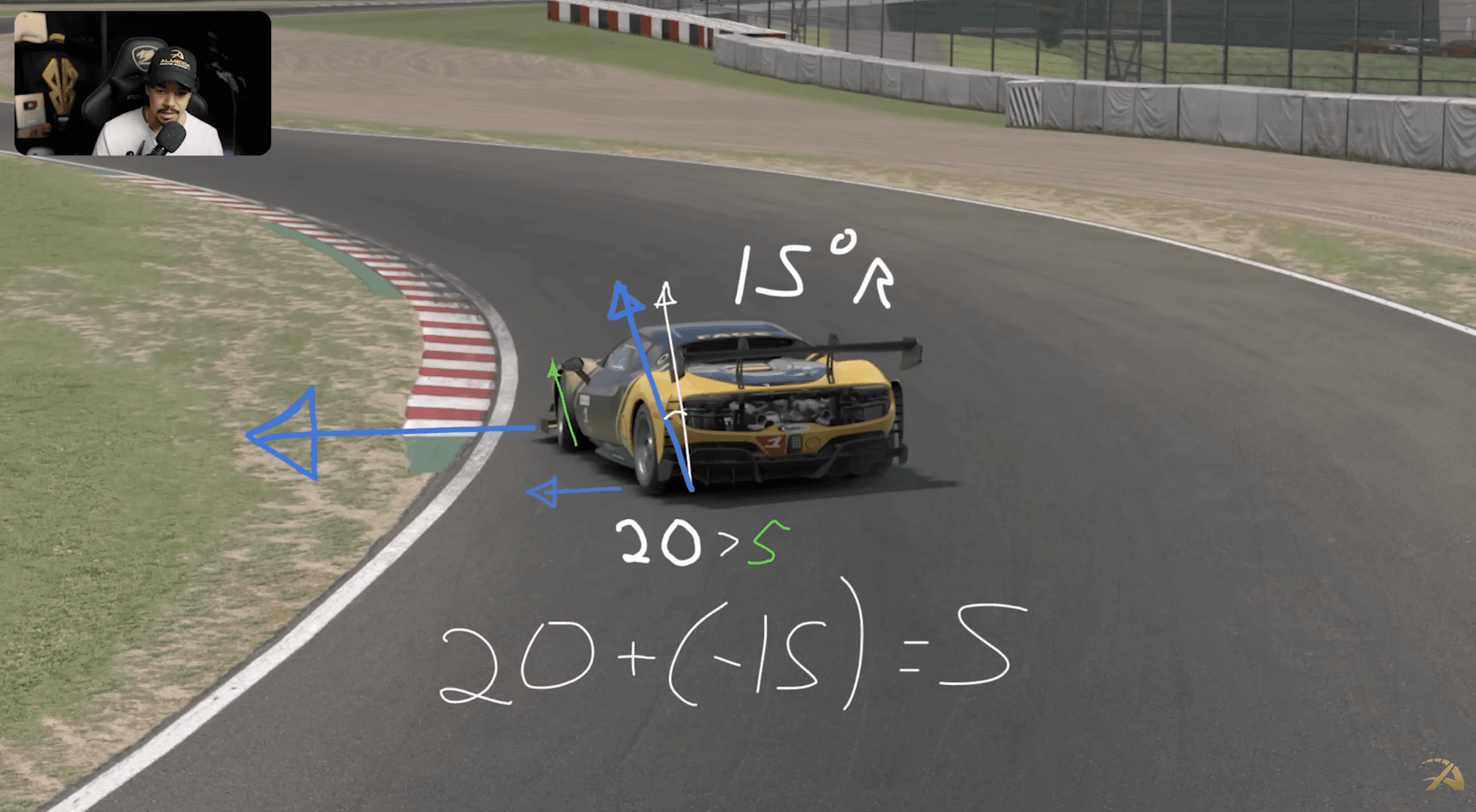
In situation B, because we're downshifting earlier, we're adding more dynamic brake bias to the rear tires because the engine braking is higher. That is heating up more the rear tires, but we are braking a little bit less, so we are also heating up less the fronts. In this situation B, when we start turning into the corner, we have more front grip and the car literally rotates more, just because we brake a tiny bit less and we downshifted a little bit earlier.
Just these tiny adjustments make the car go from total understeer to even spinning without changing anything in the setup, and in this situation without even changing the brake bias. Because we can also change the brake bias to affect the tire surface temperature, but I'm showing you that here, just the pressure of braking and the timing of the downshifts can make a car get into a corner with the fronts overheated or the rear overheated.
Application in Endurance Racing
This is incredibly useful if you're driving with someone else in an endurance race. Let's say driver A heats up the front tires a lot more, driver B heats up the rear tires, and you never get to have a setup because you're like, "Oh no, but my car, I'm always destroying the front, you're always destroying the rear," and "my setup I think is better this way, your setup is this way," so you kind of get into a conflict.
It's super useful to understand how you can adjust your driving to adjust the tire wear and the tire temperature so that your driving adapts to different setups. Of course, at this point, you can say, "No, you should adapt," or "You should adapt." No, talk about it. Try to check telemetry, try to understand who is having too much understeer. Someone might be braking a little bit too hard and downshifting too late. The other one might be braking a little bit too soft and downshifting too early. You have to see exactly what are the combinations that generate the temperature more towards the fronts or the rear so you can solve the problem and have a setup that satisfies everyone.
Special Cases and Tire Behavior
Now, here's the thing about this tire surface temperature phenomenon. Most tires will have less grip with more temperature on the surface. Some tires will behave in a very consistent way—you don't feel too much the difference—and other tires might even gain cornering grip when you get temperature on the surface. This is very rare, but it happens. I've seen it happen in real life.
There's the famous example of Fernando Alonso, I think it was 2008, where he was turning a lot on turn-in, and he was really overheating the front tires because that would actually give more grip to the car mid-corner. Basically, he would turn in on entry, overheat the tires a lot on turn-in, and then as he got into the corner deeper into the corner, the tires would gain grip and the car would point more because of that generated surface temperature that he was doing on purpose.
Of course, this is a very rare example in iRacing, and in most compounds in real life, you're going to have less grip with more surface temperature.
Practical Demonstration: Downshift Timing vs. Braking Pressure
Now, here's one obvious clear example of how adjusting the relationship between how early you downshift versus how hard you brake affects the balance of the car. This car has ABS, so if you brake too hard, you're just going to get that ABS more aggressively, generally more on the front tires first, and that's going to affect the way the car is going to behave heavily because of the tire temperature.
Example 1: Less Braking, Aggressive Downshifting
First example: not a lot of braking, but a very aggressive downshift timing, so there's more rear temperature and less front temperature, so the car is expected to have more rotation. Just for reference, by the time you cross a certain point, you might be at around 128 km/h, and you might lose the rear.
Example 2: More Braking, Late Downshifting
Now, let's go to the next example. This time, brake more, so you get more ABS on the front tires and more temperature on the front tires. Of course, if you change the brake bias, it's going to also affect things, so make sure you're thinking about all these small factors. But also, not only braking more, downshift later. You might actually be carrying more speed this time, and still, the result is heavy understeer—heavy, heavy, heavy, heavy understeer—just because you adjusted these small factors. You adjusted the way the temperature was being generated on entry, and that temperature will decrease the grip on the end that has more heat, and that will completely affect the balance of the car into the corner.
Again, these are very aggressive examples so you feel the extremes, and then the more you get used to these extremes, the more you can go for the subtle differences.
Let's talk about tire surface temperature and how it's affected by the brake bias and the engine braking, and how all these three work together. This is a higher level lesson. If you are at or approaching the top 1% level in iRacing (that's around 5000 iRating), this should help you a lot to find some good lap time. We're talking about potentially half a second to a second a lap just by managing these things.
Understanding Tire Surface Temperature Analysis
We're going to zoom in to one corner and examine how tire surface temperature affects just one corner. We're going to have three ways of analyzing it:
Short term: What happens in the same corner
Mid term: What happens on the same sector (if you're doing Suzuka where you have a lot of S's, or if you have a double left or a double right, or corners that are very close to each other)
Long term: What happens over a stint and how we can control the temperature and manage the tires in the most efficient way possible
Short Term Effects: What Happens in the Same Corner
Let's start with the short term, which is what happens in the same corner. When we start braking on a straight line, we already start adding temperature to the surface of the tire. Depending on the tire compound and the tire physics, that surface temperature might increase the grip or decrease the grip. In iRacing and in most tires, you're going to have less grip when you start heating out the surface.
Here's what happens: You start braking on a straight line, you start generating temperature on the surface of the tire, and that actually decreases grip. The more temperature you get in, the less grip you're going to have. You start turning and then we get even more temperature and even less grip, continuing through the apex. We're still using all the grip, we're still on the limit, we're still overheating the tires. Then we finally exit and we stop. We're not on the limit anymore. Then we start cooling down the surface of the tires because we're going on the straight and the hot surface is in contact with the colder track. The temperature is transferring towards the inside of the tire and towards the track because of air and everything. So whenever you are on a straight line, the surface temperature is going down.
The Importance of Lock-Ups
Why is this important? Because let's say you lock up the tires. You start braking but then you really lock up. When this happens, you gain a lot of temperature because you are overheating the tire. Because of that, at this point with more temperature, you have less grip. Because you have less grip, you kind of abuse the tires because you are now a little bit too fast and the car is not capable, so you start scrubbing more. You're getting into a snowball effect where it gets worse and worse: more temperature, less grip, more scrubbing, more temperature, less grip, more scrubbing until you really overheat the tires. By the time you get on the apex, the car is really sliding all over the place. Finally, you get on the exit and then the temperature starts going down again.
This is very important to know: if you do lock up the tire on entry, even if you unlock the tire, it will still have less grip. If you overheat the tire at any stage of the corner, there's no going back. The car is going to have less grip overall. A tiny lock here generates less cornering grip throughout the entire corner, and that is important because something that happens on a straight line affects what happens during the corner.
Brake Bias and Temperature Balance
I'm using the locking example, but this works even when you're not over the limit. Let's say you have a braking bias that is abusing the front tires. You are heating up the front more, and by the time you get to turn in, the fronts are hotter than the rears. By the time you start turning in, the fronts are hotter than the rears. There's less grip and the car is going to understeer. Because it understeers, you turn more and then you get into a snowball effect and it gets worse and worse and worse, and you're understeering all the way to the exit.
In this case, the solution would be to change the brake bias a little bit, so the temperature becomes more balanced: a little bit less temperature on the front tires and a little bit more temperature on the rear tires. If the rears become a little bit hotter, the temperature remains pretty stable. However, if you get a little bit too much oversteer, the opposite happens. Because you got oversteer, now the rears are too hot and there's a bigger tendency of another oversteer situation to happen because now the rear tires are hotter.
This is very important: Remember this—what happens at the beginning of the corner will affect the rest of the corner until you exit and cool down the tires. Whatever you do on entry will affect the rest of the corner.
Managing ABS and Braking Pressure
This is why it's so important to not brake too hard and get into too much ABS in a car that has ABS, or to do microlocking or locking in a car that does not have ABS. When you use ABS, you start braking and then you get into ABS and you keep there. You can stay at 100%. What happens with the temperature overall is it goes up more quickly than you need it to in order to stop as efficiently as possible. Then by the time you start turning in to the corner, there's less grip.
Now, if you brake just a little bit less, you're right on the edge, the car is going to stop in a similar manner. It's going to stop a tiny bit less, but because the temperature is going to be lower by the time you turn into the corner, there's literally more cornering grip. That is super important: to not abuse the tires during braking so that you conserve the surface temperature of the tires so that you use them very well during the corner.
In this situation, if you abuse the braking and you overheat the tires, you're always going to be slower. You're not going to understand why your rivals are able to carry so much speed mid-corner. Well, because they are taking care of the temperature of the tires on entry—they're not abusing the braking. I'm talking about a very small difference here, maybe just avoiding ABS or not locking that much.
Mid-Term Effects: Impact on Sequential Corners
The problem is that when you overheat the tire in one corner, there are short term effects, but not only. You also have mid-term effects. The mid-term effects are going to happen when you have another corner that is very close to the other corner. Instead of just one apex, imagine two apexes close together.
Let's say we abuse and lock up before the first corner. Then we're overheating the tires throughout that entire corner. On exit, the tires go down and cool down a tiny bit, but then there's another corner already, so we already have to turn in. That's the apex and we're still overheating a little bit. Remember, the higher the temperature, the less grip we have. This second corner will suffer the consequences of the first lock-up. It's that important.
What you want to do is take care of the temperatures through the first corner, then exit and let the temperature go down a little bit before the next corner. In the example where we locked up, we had less grip throughout the entirety of this compound corner. As a full sector, we might be talking about losing two, three, four, or five tenths because of a micro lock-up that overheated the tires.
Practical Examples of Front Lock-Ups
Here's a practical example of how locking up the fronts a tiny bit makes you understeer for the rest of the corner because of how you overheated the fronts. When you lock up a tiny bit and then realize it, you release the brakes and restart your process. You try to get as much rotation as possible, downshift to second, get on the right speed and the right braking, and try to make the car rotate as much as possible. But it just understeers. There's absolutely no rotation—it just does not want to turn at all, just because of this micro lock-up that happened a few seconds before.
This is how important it is. Of course, this is an extreme example, but it is exactly the way it works on a subtle level. If you do a micro lock on the fronts, even if it's not fully locking, just micro locking a little bit, it's already going to make the car understeer more by the time you start turning in, just because you overheated the surface of the tires.
In a more aggressive lock-up, when you try to reset and brake again, you actually overheat the front so much that it's even locking up more easily. Even trying your best to turn into the corner, you're just locking repeatedly because the inside front tire is completely overheated. Even though you may have locked up only one tire more than the other, that surface temperature on that tire alone is enough to completely kill the performance of that corner.
Rear Tire Lock-Ups
Now let's try the opposite—locking the rear tires and seeing what happens. When you bring the brake bias way down (like five or six percent) just to lock the rear tires, even a little bit of locking in the rear is significant. You can't do a full lock because you would spin. If you listen carefully, you can hear the engine shutting off. If you hear the engine sound going down very aggressively, that's because you're locking the end that is driven by the engine. In a rear-wheel drive car, the engine puts the power on the rear tires, so if the rear tires lock up, then the engine also turns off and you can hear it. When you unlock, the RPM goes up again because now the rear tires are back and running.
When you lock up the rears for a fraction of a second and then try to do the corner normally, the results are dramatic. The brake bias is a little bit different, which also affects it, but the bigger factor is the fact that you locked up the rear tires. You overheated the rear tires, and now they have a lot less grip when you turn in.
Mid-Term Temperature Effects Between Corners
The same thing applies for mid-term temperature effects and also applies to the very next corner if the corner is close enough. If you start understeering on purpose in one corner, you're actually painting the track with excessive front tire usage. Then after that, you get back on power and there's another corner four seconds after. As soon as you try to do this corner, even if you try to brake a little bit more to make the car turn, because you did understeer and overheat the front on the corner before, this one is also going to understeer. Whatever you try, this car is not going to oversteer unless you really abuse or try something to compensate for the temperature imbalance that you already have.
The same thing happens in the opposite way. If you're deliberately overheating the rear tires by trying to get a little bit of entry oversteer (not a big one, but a little bit—enough to overheat the rear tires more than the front), and you get back on power a little bit aggressively, you're painting the track with the rears. Then the car has more temperature on the surface of the rear tires than the front. When you start turning in a little bit on the next corner, immediately you can see how you're already losing the car easily. Even with one downshift, the car is really wanting to oversteer. You're doing corrections and even coasting for a while. When you just get back on power a tiny bit, you can see how the rears are dead and the car just goes.
That's how easily you can affect the balance of the car depending on whether you abuse the front tires or abuse the rear tires in the moments before.
Long-Term Effects: Managing Temperature Over a Stint
Then we have the long-term effects, which is pretty much what happens over a whole stint. You start the stint doing lots of laps and you're overheating until you get to a point where you are just maintaining that temperature and doing lap after lap after lap, and the temperatures are stable. This is how it looks long-term, but if you were to overlay the short-term temperatures, it would actually look like corner after corner after corner. You overheat and then it cools down on the straight.
If you had a long straight, it would show clear cycles. For example, if you had four corners and a straight, it would always look like this: one corner, two corners, three corners, four corners, then go down a little bit. Then one corner, two corners, three corners, four corners, go down. It continues like that as you still heat up the carcass. The temperature will never go down that much if you're really on the limit over a full stint.
Basically, what you do in the short-term effects affects the mid-term effects and affects the long-term effects in a snowball effect.
Real-World Application: Coaching Example
Here's a coaching example with a very fast driver called Alberto Nasca, who is a YouTuber and a very famous professional driver in real life. We were doing a session in iRacing and he was abusing the front tires because he was braking too hard. He was always overheating the front and getting a little bit more tire wear. We were trying to figure out what we could do to fix that.
He was doing three laps and by the end of his first session, three laps, he had 91% left on the front left, 92% left on the front right, and then 94% on both rears. This was before we started investigating what he was doing. Then I realized that he was understeering too much and suggested that maybe we don't need to change the setup—we can only change the way he's driving to manage the temperatures a little bit better, get the car to already want to rotate a little bit more so he abuses the front less.
The first attempt of trying whatever we worked on in the session (a one-hour session) resulted in 93% and 94% on the fronts, 93% on one rear and still 94% on the other. He was actually going faster, he was abusing the front tires less, and he was not using the rears more (well, a little bit more but in a much more balanced way) where he was actually using up all four tires in a much more consistent and balanced way.
Three laps—we're talking about three laps here. Imagine if you're doing a one-hour-and-a-half double stint on an endurance race. This 2% change in two or three laps could mean 10%, 15%, or 20% difference in tire wear because you adjusted your driving a tiny bit. But that tiny bit in one corner snowballs into a totally different behavior during the entire stint. That can mean seconds per lap at the very end of the stint if you take care of the tires and understand how to manage the temperatures, and how we can affect our braking pressures, our brake bias, and our engine braking thinking about tire surface temperature.
Controlling Temperature Through Braking and Downshifting
I'm going to show two situations here. In one situation, we're braking a lot—very, very hard braking—and then a little bit of threshold braking, then we start trail braking into the corner. In this example A, we are downshifting a little bit late, so we're doing three downshifts and then turning into the corner.
Let's say in this situation, the car is understeering. What we can do to control in a very, very subtle way the tire surface temperature balance between the front tires and the rear tires is to maybe brake a little bit less instead. We're going to brake a tiny bit less, like 5% less or something, and then just stay a little bit under and try to brake normally, kind of keeping the same pressure as well. But now, instead of downshifting late, I'm going to move the downshifting earlier.
So we have:
Situation A: Braking pretty hard and downshifting late
Situation B: Braking less and downshifting earlier
In situation B, because we're downshifting earlier, we're adding more dynamic brake bias to the rear tires because the engine braking is higher. That is heating up more the rear tires, but we are braking a little bit less, so we are also heating up less the fronts. In this situation B, when we start turning into the corner, we have more front grip and the car literally rotates more, just because we brake a tiny bit less and we downshifted a little bit earlier.
Just these tiny adjustments make the car go from total understeer to even spinning without changing anything in the setup, and in this situation without even changing the brake bias. Because we can also change the brake bias to affect the tire surface temperature, but I'm showing you that here, just the pressure of braking and the timing of the downshifts can make a car get into a corner with the fronts overheated or the rear overheated.
Application in Endurance Racing
This is incredibly useful if you're driving with someone else in an endurance race. Let's say driver A heats up the front tires a lot more, driver B heats up the rear tires, and you never get to have a setup because you're like, "Oh no, but my car, I'm always destroying the front, you're always destroying the rear," and "my setup I think is better this way, your setup is this way," so you kind of get into a conflict.
It's super useful to understand how you can adjust your driving to adjust the tire wear and the tire temperature so that your driving adapts to different setups. Of course, at this point, you can say, "No, you should adapt," or "You should adapt." No, talk about it. Try to check telemetry, try to understand who is having too much understeer. Someone might be braking a little bit too hard and downshifting too late. The other one might be braking a little bit too soft and downshifting too early. You have to see exactly what are the combinations that generate the temperature more towards the fronts or the rear so you can solve the problem and have a setup that satisfies everyone.
Special Cases and Tire Behavior
Now, here's the thing about this tire surface temperature phenomenon. Most tires will have less grip with more temperature on the surface. Some tires will behave in a very consistent way—you don't feel too much the difference—and other tires might even gain cornering grip when you get temperature on the surface. This is very rare, but it happens. I've seen it happen in real life.
There's the famous example of Fernando Alonso, I think it was 2008, where he was turning a lot on turn-in, and he was really overheating the front tires because that would actually give more grip to the car mid-corner. Basically, he would turn in on entry, overheat the tires a lot on turn-in, and then as he got into the corner deeper into the corner, the tires would gain grip and the car would point more because of that generated surface temperature that he was doing on purpose.
Of course, this is a very rare example in iRacing, and in most compounds in real life, you're going to have less grip with more surface temperature.
Practical Demonstration: Downshift Timing vs. Braking Pressure
Now, here's one obvious clear example of how adjusting the relationship between how early you downshift versus how hard you brake affects the balance of the car. This car has ABS, so if you brake too hard, you're just going to get that ABS more aggressively, generally more on the front tires first, and that's going to affect the way the car is going to behave heavily because of the tire temperature.
Example 1: Less Braking, Aggressive Downshifting
First example: not a lot of braking, but a very aggressive downshift timing, so there's more rear temperature and less front temperature, so the car is expected to have more rotation. Just for reference, by the time you cross a certain point, you might be at around 128 km/h, and you might lose the rear.
Example 2: More Braking, Late Downshifting
Now, let's go to the next example. This time, brake more, so you get more ABS on the front tires and more temperature on the front tires. Of course, if you change the brake bias, it's going to also affect things, so make sure you're thinking about all these small factors. But also, not only braking more, downshift later. You might actually be carrying more speed this time, and still, the result is heavy understeer—heavy, heavy, heavy, heavy understeer—just because you adjusted these small factors. You adjusted the way the temperature was being generated on entry, and that temperature will decrease the grip on the end that has more heat, and that will completely affect the balance of the car into the corner.
Again, these are very aggressive examples so you feel the extremes, and then the more you get used to these extremes, the more you can go for the subtle differences.
Let's talk about tire surface temperature and how it's affected by the brake bias and the engine braking, and how all these three work together. This is a higher level lesson. If you are at or approaching the top 1% level in iRacing (that's around 5000 iRating), this should help you a lot to find some good lap time. We're talking about potentially half a second to a second a lap just by managing these things.
Understanding Tire Surface Temperature Analysis
We're going to zoom in to one corner and examine how tire surface temperature affects just one corner. We're going to have three ways of analyzing it:
Short term: What happens in the same corner
Mid term: What happens on the same sector (if you're doing Suzuka where you have a lot of S's, or if you have a double left or a double right, or corners that are very close to each other)
Long term: What happens over a stint and how we can control the temperature and manage the tires in the most efficient way possible
Short Term Effects: What Happens in the Same Corner
Let's start with the short term, which is what happens in the same corner. When we start braking on a straight line, we already start adding temperature to the surface of the tire. Depending on the tire compound and the tire physics, that surface temperature might increase the grip or decrease the grip. In iRacing and in most tires, you're going to have less grip when you start heating out the surface.
Here's what happens: You start braking on a straight line, you start generating temperature on the surface of the tire, and that actually decreases grip. The more temperature you get in, the less grip you're going to have. You start turning and then we get even more temperature and even less grip, continuing through the apex. We're still using all the grip, we're still on the limit, we're still overheating the tires. Then we finally exit and we stop. We're not on the limit anymore. Then we start cooling down the surface of the tires because we're going on the straight and the hot surface is in contact with the colder track. The temperature is transferring towards the inside of the tire and towards the track because of air and everything. So whenever you are on a straight line, the surface temperature is going down.
The Importance of Lock-Ups
Why is this important? Because let's say you lock up the tires. You start braking but then you really lock up. When this happens, you gain a lot of temperature because you are overheating the tire. Because of that, at this point with more temperature, you have less grip. Because you have less grip, you kind of abuse the tires because you are now a little bit too fast and the car is not capable, so you start scrubbing more. You're getting into a snowball effect where it gets worse and worse: more temperature, less grip, more scrubbing, more temperature, less grip, more scrubbing until you really overheat the tires. By the time you get on the apex, the car is really sliding all over the place. Finally, you get on the exit and then the temperature starts going down again.
This is very important to know: if you do lock up the tire on entry, even if you unlock the tire, it will still have less grip. If you overheat the tire at any stage of the corner, there's no going back. The car is going to have less grip overall. A tiny lock here generates less cornering grip throughout the entire corner, and that is important because something that happens on a straight line affects what happens during the corner.
Brake Bias and Temperature Balance
I'm using the locking example, but this works even when you're not over the limit. Let's say you have a braking bias that is abusing the front tires. You are heating up the front more, and by the time you get to turn in, the fronts are hotter than the rears. By the time you start turning in, the fronts are hotter than the rears. There's less grip and the car is going to understeer. Because it understeers, you turn more and then you get into a snowball effect and it gets worse and worse and worse, and you're understeering all the way to the exit.
In this case, the solution would be to change the brake bias a little bit, so the temperature becomes more balanced: a little bit less temperature on the front tires and a little bit more temperature on the rear tires. If the rears become a little bit hotter, the temperature remains pretty stable. However, if you get a little bit too much oversteer, the opposite happens. Because you got oversteer, now the rears are too hot and there's a bigger tendency of another oversteer situation to happen because now the rear tires are hotter.
This is very important: Remember this—what happens at the beginning of the corner will affect the rest of the corner until you exit and cool down the tires. Whatever you do on entry will affect the rest of the corner.
Managing ABS and Braking Pressure
This is why it's so important to not brake too hard and get into too much ABS in a car that has ABS, or to do microlocking or locking in a car that does not have ABS. When you use ABS, you start braking and then you get into ABS and you keep there. You can stay at 100%. What happens with the temperature overall is it goes up more quickly than you need it to in order to stop as efficiently as possible. Then by the time you start turning in to the corner, there's less grip.
Now, if you brake just a little bit less, you're right on the edge, the car is going to stop in a similar manner. It's going to stop a tiny bit less, but because the temperature is going to be lower by the time you turn into the corner, there's literally more cornering grip. That is super important: to not abuse the tires during braking so that you conserve the surface temperature of the tires so that you use them very well during the corner.
In this situation, if you abuse the braking and you overheat the tires, you're always going to be slower. You're not going to understand why your rivals are able to carry so much speed mid-corner. Well, because they are taking care of the temperature of the tires on entry—they're not abusing the braking. I'm talking about a very small difference here, maybe just avoiding ABS or not locking that much.
Mid-Term Effects: Impact on Sequential Corners
The problem is that when you overheat the tire in one corner, there are short term effects, but not only. You also have mid-term effects. The mid-term effects are going to happen when you have another corner that is very close to the other corner. Instead of just one apex, imagine two apexes close together.
Let's say we abuse and lock up before the first corner. Then we're overheating the tires throughout that entire corner. On exit, the tires go down and cool down a tiny bit, but then there's another corner already, so we already have to turn in. That's the apex and we're still overheating a little bit. Remember, the higher the temperature, the less grip we have. This second corner will suffer the consequences of the first lock-up. It's that important.
What you want to do is take care of the temperatures through the first corner, then exit and let the temperature go down a little bit before the next corner. In the example where we locked up, we had less grip throughout the entirety of this compound corner. As a full sector, we might be talking about losing two, three, four, or five tenths because of a micro lock-up that overheated the tires.
Practical Examples of Front Lock-Ups
Here's a practical example of how locking up the fronts a tiny bit makes you understeer for the rest of the corner because of how you overheated the fronts. When you lock up a tiny bit and then realize it, you release the brakes and restart your process. You try to get as much rotation as possible, downshift to second, get on the right speed and the right braking, and try to make the car rotate as much as possible. But it just understeers. There's absolutely no rotation—it just does not want to turn at all, just because of this micro lock-up that happened a few seconds before.
This is how important it is. Of course, this is an extreme example, but it is exactly the way it works on a subtle level. If you do a micro lock on the fronts, even if it's not fully locking, just micro locking a little bit, it's already going to make the car understeer more by the time you start turning in, just because you overheated the surface of the tires.
In a more aggressive lock-up, when you try to reset and brake again, you actually overheat the front so much that it's even locking up more easily. Even trying your best to turn into the corner, you're just locking repeatedly because the inside front tire is completely overheated. Even though you may have locked up only one tire more than the other, that surface temperature on that tire alone is enough to completely kill the performance of that corner.
Rear Tire Lock-Ups
Now let's try the opposite—locking the rear tires and seeing what happens. When you bring the brake bias way down (like five or six percent) just to lock the rear tires, even a little bit of locking in the rear is significant. You can't do a full lock because you would spin. If you listen carefully, you can hear the engine shutting off. If you hear the engine sound going down very aggressively, that's because you're locking the end that is driven by the engine. In a rear-wheel drive car, the engine puts the power on the rear tires, so if the rear tires lock up, then the engine also turns off and you can hear it. When you unlock, the RPM goes up again because now the rear tires are back and running.
When you lock up the rears for a fraction of a second and then try to do the corner normally, the results are dramatic. The brake bias is a little bit different, which also affects it, but the bigger factor is the fact that you locked up the rear tires. You overheated the rear tires, and now they have a lot less grip when you turn in.
Mid-Term Temperature Effects Between Corners
The same thing applies for mid-term temperature effects and also applies to the very next corner if the corner is close enough. If you start understeering on purpose in one corner, you're actually painting the track with excessive front tire usage. Then after that, you get back on power and there's another corner four seconds after. As soon as you try to do this corner, even if you try to brake a little bit more to make the car turn, because you did understeer and overheat the front on the corner before, this one is also going to understeer. Whatever you try, this car is not going to oversteer unless you really abuse or try something to compensate for the temperature imbalance that you already have.
The same thing happens in the opposite way. If you're deliberately overheating the rear tires by trying to get a little bit of entry oversteer (not a big one, but a little bit—enough to overheat the rear tires more than the front), and you get back on power a little bit aggressively, you're painting the track with the rears. Then the car has more temperature on the surface of the rear tires than the front. When you start turning in a little bit on the next corner, immediately you can see how you're already losing the car easily. Even with one downshift, the car is really wanting to oversteer. You're doing corrections and even coasting for a while. When you just get back on power a tiny bit, you can see how the rears are dead and the car just goes.
That's how easily you can affect the balance of the car depending on whether you abuse the front tires or abuse the rear tires in the moments before.
Long-Term Effects: Managing Temperature Over a Stint
Then we have the long-term effects, which is pretty much what happens over a whole stint. You start the stint doing lots of laps and you're overheating until you get to a point where you are just maintaining that temperature and doing lap after lap after lap, and the temperatures are stable. This is how it looks long-term, but if you were to overlay the short-term temperatures, it would actually look like corner after corner after corner. You overheat and then it cools down on the straight.
If you had a long straight, it would show clear cycles. For example, if you had four corners and a straight, it would always look like this: one corner, two corners, three corners, four corners, then go down a little bit. Then one corner, two corners, three corners, four corners, go down. It continues like that as you still heat up the carcass. The temperature will never go down that much if you're really on the limit over a full stint.
Basically, what you do in the short-term effects affects the mid-term effects and affects the long-term effects in a snowball effect.
Real-World Application: Coaching Example
Here's a coaching example with a very fast driver called Alberto Nasca, who is a YouTuber and a very famous professional driver in real life. We were doing a session in iRacing and he was abusing the front tires because he was braking too hard. He was always overheating the front and getting a little bit more tire wear. We were trying to figure out what we could do to fix that.
He was doing three laps and by the end of his first session, three laps, he had 91% left on the front left, 92% left on the front right, and then 94% on both rears. This was before we started investigating what he was doing. Then I realized that he was understeering too much and suggested that maybe we don't need to change the setup—we can only change the way he's driving to manage the temperatures a little bit better, get the car to already want to rotate a little bit more so he abuses the front less.
The first attempt of trying whatever we worked on in the session (a one-hour session) resulted in 93% and 94% on the fronts, 93% on one rear and still 94% on the other. He was actually going faster, he was abusing the front tires less, and he was not using the rears more (well, a little bit more but in a much more balanced way) where he was actually using up all four tires in a much more consistent and balanced way.
Three laps—we're talking about three laps here. Imagine if you're doing a one-hour-and-a-half double stint on an endurance race. This 2% change in two or three laps could mean 10%, 15%, or 20% difference in tire wear because you adjusted your driving a tiny bit. But that tiny bit in one corner snowballs into a totally different behavior during the entire stint. That can mean seconds per lap at the very end of the stint if you take care of the tires and understand how to manage the temperatures, and how we can affect our braking pressures, our brake bias, and our engine braking thinking about tire surface temperature.
Controlling Temperature Through Braking and Downshifting
I'm going to show two situations here. In one situation, we're braking a lot—very, very hard braking—and then a little bit of threshold braking, then we start trail braking into the corner. In this example A, we are downshifting a little bit late, so we're doing three downshifts and then turning into the corner.
Let's say in this situation, the car is understeering. What we can do to control in a very, very subtle way the tire surface temperature balance between the front tires and the rear tires is to maybe brake a little bit less instead. We're going to brake a tiny bit less, like 5% less or something, and then just stay a little bit under and try to brake normally, kind of keeping the same pressure as well. But now, instead of downshifting late, I'm going to move the downshifting earlier.
So we have:
Situation A: Braking pretty hard and downshifting late
Situation B: Braking less and downshifting earlier
In situation B, because we're downshifting earlier, we're adding more dynamic brake bias to the rear tires because the engine braking is higher. That is heating up more the rear tires, but we are braking a little bit less, so we are also heating up less the fronts. In this situation B, when we start turning into the corner, we have more front grip and the car literally rotates more, just because we brake a tiny bit less and we downshifted a little bit earlier.
Just these tiny adjustments make the car go from total understeer to even spinning without changing anything in the setup, and in this situation without even changing the brake bias. Because we can also change the brake bias to affect the tire surface temperature, but I'm showing you that here, just the pressure of braking and the timing of the downshifts can make a car get into a corner with the fronts overheated or the rear overheated.
Application in Endurance Racing
This is incredibly useful if you're driving with someone else in an endurance race. Let's say driver A heats up the front tires a lot more, driver B heats up the rear tires, and you never get to have a setup because you're like, "Oh no, but my car, I'm always destroying the front, you're always destroying the rear," and "my setup I think is better this way, your setup is this way," so you kind of get into a conflict.
It's super useful to understand how you can adjust your driving to adjust the tire wear and the tire temperature so that your driving adapts to different setups. Of course, at this point, you can say, "No, you should adapt," or "You should adapt." No, talk about it. Try to check telemetry, try to understand who is having too much understeer. Someone might be braking a little bit too hard and downshifting too late. The other one might be braking a little bit too soft and downshifting too early. You have to see exactly what are the combinations that generate the temperature more towards the fronts or the rear so you can solve the problem and have a setup that satisfies everyone.
Special Cases and Tire Behavior
Now, here's the thing about this tire surface temperature phenomenon. Most tires will have less grip with more temperature on the surface. Some tires will behave in a very consistent way—you don't feel too much the difference—and other tires might even gain cornering grip when you get temperature on the surface. This is very rare, but it happens. I've seen it happen in real life.
There's the famous example of Fernando Alonso, I think it was 2008, where he was turning a lot on turn-in, and he was really overheating the front tires because that would actually give more grip to the car mid-corner. Basically, he would turn in on entry, overheat the tires a lot on turn-in, and then as he got into the corner deeper into the corner, the tires would gain grip and the car would point more because of that generated surface temperature that he was doing on purpose.
Of course, this is a very rare example in iRacing, and in most compounds in real life, you're going to have less grip with more surface temperature.
Practical Demonstration: Downshift Timing vs. Braking Pressure
Now, here's one obvious clear example of how adjusting the relationship between how early you downshift versus how hard you brake affects the balance of the car. This car has ABS, so if you brake too hard, you're just going to get that ABS more aggressively, generally more on the front tires first, and that's going to affect the way the car is going to behave heavily because of the tire temperature.
Example 1: Less Braking, Aggressive Downshifting
First example: not a lot of braking, but a very aggressive downshift timing, so there's more rear temperature and less front temperature, so the car is expected to have more rotation. Just for reference, by the time you cross a certain point, you might be at around 128 km/h, and you might lose the rear.
Example 2: More Braking, Late Downshifting
Now, let's go to the next example. This time, brake more, so you get more ABS on the front tires and more temperature on the front tires. Of course, if you change the brake bias, it's going to also affect things, so make sure you're thinking about all these small factors. But also, not only braking more, downshift later. You might actually be carrying more speed this time, and still, the result is heavy understeer—heavy, heavy, heavy, heavy understeer—just because you adjusted these small factors. You adjusted the way the temperature was being generated on entry, and that temperature will decrease the grip on the end that has more heat, and that will completely affect the balance of the car into the corner.
Again, these are very aggressive examples so you feel the extremes, and then the more you get used to these extremes, the more you can go for the subtle differences.
Consistency & Confidence
Balance & Speed
Cornering Precision
Other Lessons