Three tools of rotation
Lesson
43
of
49

Lesson by
Suellio Almeida
Lesson by
Suellio Almeida
Mark as Finished
Many students have found significant time improvements and better consistency by understanding the three tools for rotation. If most people were asked to spin a car on purpose, they would likely struggle. They might try turning the steering wheel aggressively, attempting to throw the car around, but instead encounter understeer. The car simply refuses to spin, no matter how hard they try to turn left or right.
This raises an interesting question: why is it that when you try to spin on purpose, you fail, but when you're trying to drive the corner normally, the car spins unexpectedly? Understanding this paradox is the key to mastering corner entry rotation.
The Three Tools for Rotation on Entry
The secret lies in understanding that there are three distinct tools for controlling rotation on entry. The common misconception is that steering alone controls how much the car rotates. Many people who try to spin a car simply turn the steering wheel more, but this approach fails because turning too much immediately abuses the front tires, and the car simply does not respond.
The three tools for rotation on entry are:
Steering
Trail braking
Engine braking
In a rear-wheel drive car, if you downshift more quickly, the high RPM creates more engine braking, which makes the car rotate more. Note that in a front-wheel drive car, you get the opposite effect. The magic of spinning a car easily comes from combining all three tools together, not relying on steering alone.
Using Steering Correctly
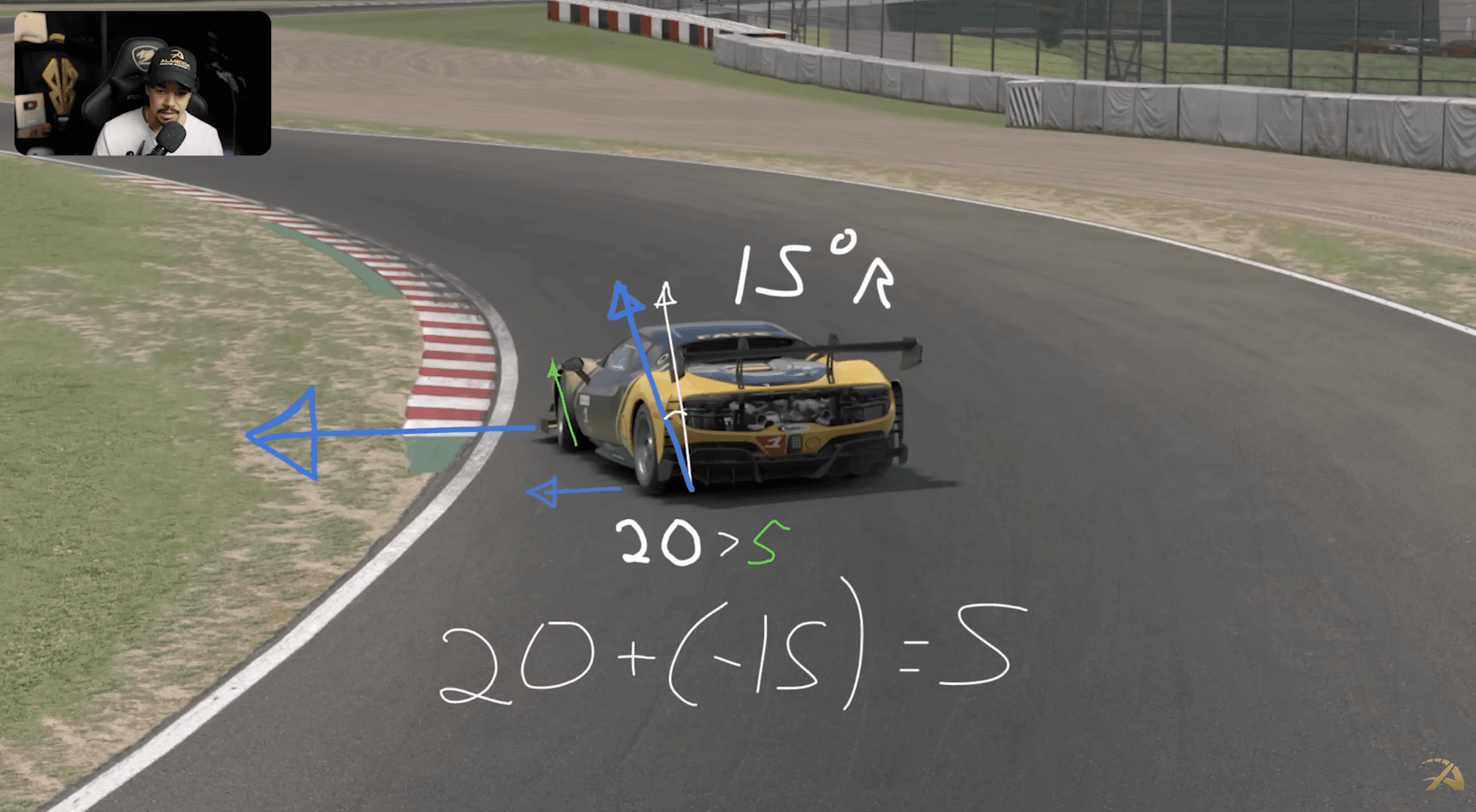
When using steering, you actually need a little bit of steering input. This doesn't mean you're under the limit—you're turning right on the limit, at the optimum slip angle of the front tires. Even though the speed might be high, you don't need to turn a lot to reach the limit of the front tires. A little bit of steering is already enough to reach that optimal slip angle of the front. Then you use trail braking and engine braking to amplify the rotation.
If you try to use steering alone, it's not going to be enough. You have to combine steering plus trail braking plus engine braking to achieve proper rotation.
The Limits of Each Tool
However, it's not that simple. If you try to use too much trail braking, you'll find that the car behaves similarly to over-steering. You abuse the front tires. Even if you use the steering perfectly and the engine braking perfectly, but you abuse the ABS or use excessive braking, it's not going to work.
In order to get the car to properly point, you have to be on the limit of all three tools, not over the limit. Here's a critical concept to remember: oversteer means less steering. In order to achieve oversteer, you have to steer less. If you steer less—just enough—you can get the car to oversteer significantly. But if you steer too much, the car is going to understeer. Turning too much steering will actually prevent the car from turning at all.
Understanding Car-Specific Tendencies
While we have these three tools that we can use, and we need to maximize all three to get optimal rotation, determining which ones to use and in what proportion depends on the specific tendencies of each car. All cars will have a different personality. Some cars will have more engine braking, some will have less. Some cars will be very pointy under trail braking situations, while others will be very lazy under trail braking situations. You have to understand at each stage of the corner what the car wants to do.
Engine Braking in Rear-Wheel Drive Cars
Here's a common pattern for most rear-wheel drive cars: entry on high RPM is going to make the car rotate more. If you downshift a lot early in the corner, the car might lose stability very early on high RPM in second gear because the RPMs are high.
This creates a common pattern: the RPM is high initially, around 25% into the corner. This is where cars tend to lose stability because the RPMs are very high. The engine braking starts very high and then diminishes as you get deeper into the corner, unless you downshift again. If you downshift again mid-corner, you get a new peak of engine braking that will make the car rotate a little bit more.
Ideally, you don't want to downshift too much into corners. While some corners require it—particularly long corners—generally downshifting into the corner is not the best approach. If you can downshift before you start turning in and get high RPM on entry, that's generally faster, especially in high-level racing. You can adjust the speed of downshifting to affect how much the car will want or not to rotate.
The RPM Effect Through the Corner
When you downshift to second gear and reach peak RPM, the car will be most prone to losing stability at that point. If the car starts to lose it, the rear tires begin to overheat, creating a snowball effect that can lead to a spin.
However, if you try to induce oversteer mid-corner instead, the car will likely understeer. Why? Because by the time you try it mid-corner with more trail braking and more steering, the engine braking is already lower. Since the combination requires all three tools—steering, trail braking, and engine braking—and the engine braking is low, the other two are not enough to make the car point.
This demonstrates a crucial principle: because engine braking always decreases as RPMs go down, there's always a bigger tendency to lose the car on entry if you don't shift very early. It's much easier to lose the car on entry because of the higher RPMs and high engine braking. The car tends to oversteer on entry, but as the RPMs go down, you lose that tendency to oversteer and the car becomes progressively more prone to understeer toward mid-corner, toward the maximum rotation point, toward the minimum speed point.
Steering Strategy Based on Engine Braking
This principle has important implications for your steering technique. You should be a little bit more careful on your initial turn-in because the car will tend to lose stability very easily if you turn in very fast. You want to turn in a little bit more slowly, and then as the RPMs go down, you're safer to start steering more. These concepts will be explored further in lessons on exponential steering and the light hands technique.
The Integration of All Three Tools
The main idea is that there are three tools to rotate the car, and they will always work together. You cannot ignore any of them:
If you ignore the steering, you lose control of the car and won't know exactly how to make the car oversteer or understeer
If you don't know how to trail brake, it won't work—you'll either get way too much rotation, way too little rotation, or brake too hard and trigger ABS
If you don't understand the rate of your downshifts, that will kill your consistency because sometimes you'll downshift fast and get lots of rotation, and other times you'll downshift slowly without being aware of it and the car will understeer
All three should work together in harmony.
Proportional Contribution Through the Corner
Here's a useful way to understand how much each of these tools is contributing to rotation depending on the stage of the corner. Consider a corner where you start braking in a straight line, then reach your turning point. By the time you start turning in, you're using just a little bit of steering. Ideally, you want to downshift early, so you complete your last downshift right at or before turn-in. This means the RPMs are at their peak—peak RPM equals peak engine braking.
At the initial turn-in point, you have:
Steering: a little bit
Trail braking: pretty heavy, though starting to release, so brake pressure is high
Engine braking: lots of rotation coming from high RPMs
If we were to visualize the actual proportions of each tool's contribution as a pie chart at this early stage, we would see that steering contributes a small portion, while trail braking and engine braking provide the majority of the rotation. The main source of rotation comes from trail braking and engine braking, not from steering.
As you get deeper into the corner, the proportions shift significantly:
The RPMs go down, so there is already less engine braking
The trail braking is also decreasing because you're gaining more lateral grip
The steering input increases proportionally
At this deeper point in the corner, the proportions have changed dramatically. Now you have much more steering, much less engine braking, and still a little bit of trail braking, but the main source of rotation has shifted to steering. Early in the corner, you have barely any steering and the car rotates significantly because of trail braking and engine braking. Later in the corner, you have a totally different proportion.
The Progressive Transition
These proportions actually shift very progressively—it's a gradual transition from one state to the other. In every corner, as soon as you start braking, you have a car that wants to oversteer much more. Then as you progress through the corner, you have a car that wants to rotate less and less.
This is a general example. It is possible to have a car that's a little bit more lazy on entry and a little bit more responsive mid-corner—it's rare, but it can happen. The goal is to become autonomous and develop the sensitivity to notice these behaviors in different stages of the corner, from car to car, and from tool to tool.
Many students have found significant time improvements and better consistency by understanding the three tools for rotation. If most people were asked to spin a car on purpose, they would likely struggle. They might try turning the steering wheel aggressively, attempting to throw the car around, but instead encounter understeer. The car simply refuses to spin, no matter how hard they try to turn left or right.
This raises an interesting question: why is it that when you try to spin on purpose, you fail, but when you're trying to drive the corner normally, the car spins unexpectedly? Understanding this paradox is the key to mastering corner entry rotation.
The Three Tools for Rotation on Entry
The secret lies in understanding that there are three distinct tools for controlling rotation on entry. The common misconception is that steering alone controls how much the car rotates. Many people who try to spin a car simply turn the steering wheel more, but this approach fails because turning too much immediately abuses the front tires, and the car simply does not respond.
The three tools for rotation on entry are:
Steering
Trail braking
Engine braking
In a rear-wheel drive car, if you downshift more quickly, the high RPM creates more engine braking, which makes the car rotate more. Note that in a front-wheel drive car, you get the opposite effect. The magic of spinning a car easily comes from combining all three tools together, not relying on steering alone.
Using Steering Correctly
When using steering, you actually need a little bit of steering input. This doesn't mean you're under the limit—you're turning right on the limit, at the optimum slip angle of the front tires. Even though the speed might be high, you don't need to turn a lot to reach the limit of the front tires. A little bit of steering is already enough to reach that optimal slip angle of the front. Then you use trail braking and engine braking to amplify the rotation.
If you try to use steering alone, it's not going to be enough. You have to combine steering plus trail braking plus engine braking to achieve proper rotation.
The Limits of Each Tool
However, it's not that simple. If you try to use too much trail braking, you'll find that the car behaves similarly to over-steering. You abuse the front tires. Even if you use the steering perfectly and the engine braking perfectly, but you abuse the ABS or use excessive braking, it's not going to work.
In order to get the car to properly point, you have to be on the limit of all three tools, not over the limit. Here's a critical concept to remember: oversteer means less steering. In order to achieve oversteer, you have to steer less. If you steer less—just enough—you can get the car to oversteer significantly. But if you steer too much, the car is going to understeer. Turning too much steering will actually prevent the car from turning at all.
Understanding Car-Specific Tendencies
While we have these three tools that we can use, and we need to maximize all three to get optimal rotation, determining which ones to use and in what proportion depends on the specific tendencies of each car. All cars will have a different personality. Some cars will have more engine braking, some will have less. Some cars will be very pointy under trail braking situations, while others will be very lazy under trail braking situations. You have to understand at each stage of the corner what the car wants to do.
Engine Braking in Rear-Wheel Drive Cars
Here's a common pattern for most rear-wheel drive cars: entry on high RPM is going to make the car rotate more. If you downshift a lot early in the corner, the car might lose stability very early on high RPM in second gear because the RPMs are high.
This creates a common pattern: the RPM is high initially, around 25% into the corner. This is where cars tend to lose stability because the RPMs are very high. The engine braking starts very high and then diminishes as you get deeper into the corner, unless you downshift again. If you downshift again mid-corner, you get a new peak of engine braking that will make the car rotate a little bit more.
Ideally, you don't want to downshift too much into corners. While some corners require it—particularly long corners—generally downshifting into the corner is not the best approach. If you can downshift before you start turning in and get high RPM on entry, that's generally faster, especially in high-level racing. You can adjust the speed of downshifting to affect how much the car will want or not to rotate.
The RPM Effect Through the Corner
When you downshift to second gear and reach peak RPM, the car will be most prone to losing stability at that point. If the car starts to lose it, the rear tires begin to overheat, creating a snowball effect that can lead to a spin.
However, if you try to induce oversteer mid-corner instead, the car will likely understeer. Why? Because by the time you try it mid-corner with more trail braking and more steering, the engine braking is already lower. Since the combination requires all three tools—steering, trail braking, and engine braking—and the engine braking is low, the other two are not enough to make the car point.
This demonstrates a crucial principle: because engine braking always decreases as RPMs go down, there's always a bigger tendency to lose the car on entry if you don't shift very early. It's much easier to lose the car on entry because of the higher RPMs and high engine braking. The car tends to oversteer on entry, but as the RPMs go down, you lose that tendency to oversteer and the car becomes progressively more prone to understeer toward mid-corner, toward the maximum rotation point, toward the minimum speed point.
Steering Strategy Based on Engine Braking
This principle has important implications for your steering technique. You should be a little bit more careful on your initial turn-in because the car will tend to lose stability very easily if you turn in very fast. You want to turn in a little bit more slowly, and then as the RPMs go down, you're safer to start steering more. These concepts will be explored further in lessons on exponential steering and the light hands technique.
The Integration of All Three Tools
The main idea is that there are three tools to rotate the car, and they will always work together. You cannot ignore any of them:
If you ignore the steering, you lose control of the car and won't know exactly how to make the car oversteer or understeer
If you don't know how to trail brake, it won't work—you'll either get way too much rotation, way too little rotation, or brake too hard and trigger ABS
If you don't understand the rate of your downshifts, that will kill your consistency because sometimes you'll downshift fast and get lots of rotation, and other times you'll downshift slowly without being aware of it and the car will understeer
All three should work together in harmony.
Proportional Contribution Through the Corner
Here's a useful way to understand how much each of these tools is contributing to rotation depending on the stage of the corner. Consider a corner where you start braking in a straight line, then reach your turning point. By the time you start turning in, you're using just a little bit of steering. Ideally, you want to downshift early, so you complete your last downshift right at or before turn-in. This means the RPMs are at their peak—peak RPM equals peak engine braking.
At the initial turn-in point, you have:
Steering: a little bit
Trail braking: pretty heavy, though starting to release, so brake pressure is high
Engine braking: lots of rotation coming from high RPMs
If we were to visualize the actual proportions of each tool's contribution as a pie chart at this early stage, we would see that steering contributes a small portion, while trail braking and engine braking provide the majority of the rotation. The main source of rotation comes from trail braking and engine braking, not from steering.
As you get deeper into the corner, the proportions shift significantly:
The RPMs go down, so there is already less engine braking
The trail braking is also decreasing because you're gaining more lateral grip
The steering input increases proportionally
At this deeper point in the corner, the proportions have changed dramatically. Now you have much more steering, much less engine braking, and still a little bit of trail braking, but the main source of rotation has shifted to steering. Early in the corner, you have barely any steering and the car rotates significantly because of trail braking and engine braking. Later in the corner, you have a totally different proportion.
The Progressive Transition
These proportions actually shift very progressively—it's a gradual transition from one state to the other. In every corner, as soon as you start braking, you have a car that wants to oversteer much more. Then as you progress through the corner, you have a car that wants to rotate less and less.
This is a general example. It is possible to have a car that's a little bit more lazy on entry and a little bit more responsive mid-corner—it's rare, but it can happen. The goal is to become autonomous and develop the sensitivity to notice these behaviors in different stages of the corner, from car to car, and from tool to tool.
Many students have found significant time improvements and better consistency by understanding the three tools for rotation. If most people were asked to spin a car on purpose, they would likely struggle. They might try turning the steering wheel aggressively, attempting to throw the car around, but instead encounter understeer. The car simply refuses to spin, no matter how hard they try to turn left or right.
This raises an interesting question: why is it that when you try to spin on purpose, you fail, but when you're trying to drive the corner normally, the car spins unexpectedly? Understanding this paradox is the key to mastering corner entry rotation.
The Three Tools for Rotation on Entry
The secret lies in understanding that there are three distinct tools for controlling rotation on entry. The common misconception is that steering alone controls how much the car rotates. Many people who try to spin a car simply turn the steering wheel more, but this approach fails because turning too much immediately abuses the front tires, and the car simply does not respond.
The three tools for rotation on entry are:
Steering
Trail braking
Engine braking
In a rear-wheel drive car, if you downshift more quickly, the high RPM creates more engine braking, which makes the car rotate more. Note that in a front-wheel drive car, you get the opposite effect. The magic of spinning a car easily comes from combining all three tools together, not relying on steering alone.
Using Steering Correctly
When using steering, you actually need a little bit of steering input. This doesn't mean you're under the limit—you're turning right on the limit, at the optimum slip angle of the front tires. Even though the speed might be high, you don't need to turn a lot to reach the limit of the front tires. A little bit of steering is already enough to reach that optimal slip angle of the front. Then you use trail braking and engine braking to amplify the rotation.
If you try to use steering alone, it's not going to be enough. You have to combine steering plus trail braking plus engine braking to achieve proper rotation.
The Limits of Each Tool
However, it's not that simple. If you try to use too much trail braking, you'll find that the car behaves similarly to over-steering. You abuse the front tires. Even if you use the steering perfectly and the engine braking perfectly, but you abuse the ABS or use excessive braking, it's not going to work.
In order to get the car to properly point, you have to be on the limit of all three tools, not over the limit. Here's a critical concept to remember: oversteer means less steering. In order to achieve oversteer, you have to steer less. If you steer less—just enough—you can get the car to oversteer significantly. But if you steer too much, the car is going to understeer. Turning too much steering will actually prevent the car from turning at all.
Understanding Car-Specific Tendencies
While we have these three tools that we can use, and we need to maximize all three to get optimal rotation, determining which ones to use and in what proportion depends on the specific tendencies of each car. All cars will have a different personality. Some cars will have more engine braking, some will have less. Some cars will be very pointy under trail braking situations, while others will be very lazy under trail braking situations. You have to understand at each stage of the corner what the car wants to do.
Engine Braking in Rear-Wheel Drive Cars
Here's a common pattern for most rear-wheel drive cars: entry on high RPM is going to make the car rotate more. If you downshift a lot early in the corner, the car might lose stability very early on high RPM in second gear because the RPMs are high.
This creates a common pattern: the RPM is high initially, around 25% into the corner. This is where cars tend to lose stability because the RPMs are very high. The engine braking starts very high and then diminishes as you get deeper into the corner, unless you downshift again. If you downshift again mid-corner, you get a new peak of engine braking that will make the car rotate a little bit more.
Ideally, you don't want to downshift too much into corners. While some corners require it—particularly long corners—generally downshifting into the corner is not the best approach. If you can downshift before you start turning in and get high RPM on entry, that's generally faster, especially in high-level racing. You can adjust the speed of downshifting to affect how much the car will want or not to rotate.
The RPM Effect Through the Corner
When you downshift to second gear and reach peak RPM, the car will be most prone to losing stability at that point. If the car starts to lose it, the rear tires begin to overheat, creating a snowball effect that can lead to a spin.
However, if you try to induce oversteer mid-corner instead, the car will likely understeer. Why? Because by the time you try it mid-corner with more trail braking and more steering, the engine braking is already lower. Since the combination requires all three tools—steering, trail braking, and engine braking—and the engine braking is low, the other two are not enough to make the car point.
This demonstrates a crucial principle: because engine braking always decreases as RPMs go down, there's always a bigger tendency to lose the car on entry if you don't shift very early. It's much easier to lose the car on entry because of the higher RPMs and high engine braking. The car tends to oversteer on entry, but as the RPMs go down, you lose that tendency to oversteer and the car becomes progressively more prone to understeer toward mid-corner, toward the maximum rotation point, toward the minimum speed point.
Steering Strategy Based on Engine Braking
This principle has important implications for your steering technique. You should be a little bit more careful on your initial turn-in because the car will tend to lose stability very easily if you turn in very fast. You want to turn in a little bit more slowly, and then as the RPMs go down, you're safer to start steering more. These concepts will be explored further in lessons on exponential steering and the light hands technique.
The Integration of All Three Tools
The main idea is that there are three tools to rotate the car, and they will always work together. You cannot ignore any of them:
If you ignore the steering, you lose control of the car and won't know exactly how to make the car oversteer or understeer
If you don't know how to trail brake, it won't work—you'll either get way too much rotation, way too little rotation, or brake too hard and trigger ABS
If you don't understand the rate of your downshifts, that will kill your consistency because sometimes you'll downshift fast and get lots of rotation, and other times you'll downshift slowly without being aware of it and the car will understeer
All three should work together in harmony.
Proportional Contribution Through the Corner
Here's a useful way to understand how much each of these tools is contributing to rotation depending on the stage of the corner. Consider a corner where you start braking in a straight line, then reach your turning point. By the time you start turning in, you're using just a little bit of steering. Ideally, you want to downshift early, so you complete your last downshift right at or before turn-in. This means the RPMs are at their peak—peak RPM equals peak engine braking.
At the initial turn-in point, you have:
Steering: a little bit
Trail braking: pretty heavy, though starting to release, so brake pressure is high
Engine braking: lots of rotation coming from high RPMs
If we were to visualize the actual proportions of each tool's contribution as a pie chart at this early stage, we would see that steering contributes a small portion, while trail braking and engine braking provide the majority of the rotation. The main source of rotation comes from trail braking and engine braking, not from steering.
As you get deeper into the corner, the proportions shift significantly:
The RPMs go down, so there is already less engine braking
The trail braking is also decreasing because you're gaining more lateral grip
The steering input increases proportionally
At this deeper point in the corner, the proportions have changed dramatically. Now you have much more steering, much less engine braking, and still a little bit of trail braking, but the main source of rotation has shifted to steering. Early in the corner, you have barely any steering and the car rotates significantly because of trail braking and engine braking. Later in the corner, you have a totally different proportion.
The Progressive Transition
These proportions actually shift very progressively—it's a gradual transition from one state to the other. In every corner, as soon as you start braking, you have a car that wants to oversteer much more. Then as you progress through the corner, you have a car that wants to rotate less and less.
This is a general example. It is possible to have a car that's a little bit more lazy on entry and a little bit more responsive mid-corner—it's rare, but it can happen. The goal is to become autonomous and develop the sensitivity to notice these behaviors in different stages of the corner, from car to car, and from tool to tool.
Consistency & Confidence
Balance & Speed
Cornering Precision
Other Lessons