Smooth is Fast - Input Speeds
Lesson
42
of
49

Lesson by
Suellio Almeida
Lesson by
Suellio Almeida
Mark as Finished
Smooth is fast, is it? Really? Let's talk about inputs speeds. This is a traditional telemetry, nice braking, great, very, very smooth transition, and also quite smooth transition on the exit. There are places where you will have to be smooth, that's obvious, because again, we're following that rule, right? Speed goes down, rotation goes up, and you're always adjusting that.
Understanding Optimal Input Speeds
So there are optimal scenarios where movements between your inputs will be pretty smooth, but that's the optimal ideal theoretical input speed for some corners. There will be imperfections, there will be corrections, and you will have to do them as quickly as possible to be able to get back to where you want to be smoothly.
So let's say, for example, that we get a little bit of an oversteer here. It's very common for beginners to do a little bit of a slow correction before getting back to where the car wants to be in terms of limit, right? So over correcting here, big, big, big issue, you don't want these corrections to be slow.
Braking Application Speed
Here, for example, just in this example, we have the initial braking, obviously not so smooth. We want to go pretty quickly to the limit. Again, even if we're talking about a slightly slower application, in some cases in iRacing, this can be very useful for tire surface temperatures. We will talk about that as well. There's a lesson about tire surface temperatures that's still pretty fast, right?
You're not doing smooth braking, because again, a lot of beginners suffer with trying to be too smooth in everything, but they end up losing a lot of precision. So I don't want you to lose precision by trying to be gentle with the car. Ideally, I want it to be actually aggressive to learn these things, and then eventually shaving off those imperfections and getting back into an ideal driving scenario that will have, in some parts, smooth driving.
Throttle Application
Another thing that we can see right here is this quite vertical application here. We will also have a specific lesson about throttle application, and we'll explain why, but a hint here is that you don't want to accelerate too slowly if the car doesn't have a lot of power, or even if it does, but it's at a higher speed, where this would actually generate a lot of understeer.
So sometimes you just applying a very small amount of throttle and trying to be smooth and going super slowly like this is only going to load the rear tires and make the front tires die and make you lose rotation. And then you might have a big issue here, right? Understeer snaps oversteer. The oversteer would happen right here, and you don't want that.
So the throttle application here in some places will have to be fast enough so that you can get to very close the traction limit, which is if you go a little bit too much, you get wheelspin. If you go a little bit too little, you get understeer. So there's an area in the throttle application where you already want to jump to so that you continue not increase very important so that you continue the rotation that you generated all the way to mid corner. Very, very important. We're going to talk about that as well.
Light Braking Scenarios
There's also some more scenarios. First of all, if you're braking very, very lightly at first already, your steering doesn't have to be very progressive because there's nothing to transition from. You just want these brakes to kind of help the car rotate a little bit. So your steering can be a little bit more aggressive at first.
And then, and that's the cool part, then you go smooth, right? So initially, you want to get to that limit of rotation and limit of steering according to how much your speed is. And then from there, you go smoothly because now you're on the ideal magic combination between steering brakes. And as your speed goes down, you can increase the steering more slowly. But the beginning part, especially if you're going straight to 1% brakes, is a little bit faster.
I wanted to try that. I wanted to try in some of these corners where you're not braking super hard, brake and already kind of load a little bit more quickly to find that that initial speed is always going to be a little bit difficult at first, but you're going to develop the feeling so that you don't go super slowly right away from the beginning. Do your own experiments and try to find that speed for each corner.
Obviously, if we had a harder braking here, that would be completely different. In that case, then yes, the initial application would be a little bit different. So you see, it really depends on whether you're transitioning or not. And in that case, yeah, it's going to be smooth.
Correcting Oversteer
Okay, now let's say even in the situation where you're doing this and your trail braking, and we start turning very smoothly, but we get an oversteer. What should you do? You have a few options, right? You can kind of like, correct a little bit and then go back at it. But I already told you, Hey, this correction here, it's only to fix the excessive angle, right?
So you don't want to do this, you want to do this. You want to do a very small correction, quick correction, small and quick, because that should be enough, unless it's a very, very big slide. In that case, of course, you have to do a longer correction until the car catches back. But most of the time, these corrections are just small enough so that you can get it back to neutral steer, be careful not to overcorrect, because if you overcorrect, you go from oversteer to nothing, right? If you don't have any limit, all this time you're just losing time.
So sometimes you just need to correct a little bit to get back to some oversteer or some neutral steer. And then you keep going with a neutral steer as long as you can staying on the red line.
Brake Release as a Correction Tool
And remember that you can also release the brakes a little bit. So that's, let's say you're starting to turn, you get a little bit of oversteer. What you can do is, it depends a lot on the corner, but you can also do a little bit of a brake correction while staying on the steering or by at least turning a little bit less, but not so much. And then you go from there.
In that case, you have to choose, it depends from a car to car, it depends from situation to situation. Sometimes if you're over driving, obviously, then you're going to have to stay a little bit on the brakes. And then the correction will have to be done more on the steering. In this case, if you're staying on the brakes, you're going to have to stay a little bit more on the center rather than doing a big correction like this, and then back to where you were before.
So lots of little corrections, we're going to have, again, another lesson just on how we do these corrections. But most of these things happen fast. That's the thing about this lesson. I want you to remember that you're steering. It can actually look like this with no issue. It can be if it's especially if it's a very, very oversteer car, it can look like that with no problem. And you can still be very fast. What it can't not look like is one slow big correction, because in this case, you're losing a lot of lap time.
Changes of Direction
Another thing without talking about corrections is actually changes of direction. So if you're just trail braking, but you're changing your direction here, remember that you can do a fast correction, obviously in the telemetry, it's going to look like this, because there is some time. And if the car is a little bit too soft, yes, the change of direction will be a little bit slower than a formula car. But it's still in that very small range that where you look the steering, it's actually doing a quite a fast flick.
And then from there, again, if you're still trail braking, then you're adding more. And if there's a third change of direction, you're going to change like that, and then have to trail brake a little bit more, and then release as you get empowered. So changes of directions are fast, corrections of oversteer are fast, and brake release also in correction of oversteer can be a little bit fast like this.
And in the case of throttle application, it depends a lot on the power of the car. If the car is very under steer, be careful not to do this. It really causes a lot of understeer. You want to accelerate a little bit more aggressively. But again, I will have a lesson only about this.
Real-World Example Analysis
All right, let's take a look at this example. It's a pretty fast correction. There's a lot of things happening here. So I want to dissect this video for you. All right, let's go through it again. A lot of things happen. Actually, I think let's say just three things to talk about here that happened in that tiny, tiny amount of time.
Breaking Down the Three-Step Process
First of all, let's go frame by frame here. I start turning in with light hands, right? So I break, I start turning in with light hands. And ideally here, my geometry trace should look like something like this. But as soon as I got right here, this happened here. So I want to divide this in one, two, three. The three is the big one in blue.
That's step one, light hands entering the corner, aiming to do this, right? Aiming to do a build up like this. I turned in a little bit too aggressively, just a little bit too fast and just a little bit too much steering. I think I should have added a little bit less steering here, like a few degrees less, right? I'm really on the limit.
Passive Countersteer
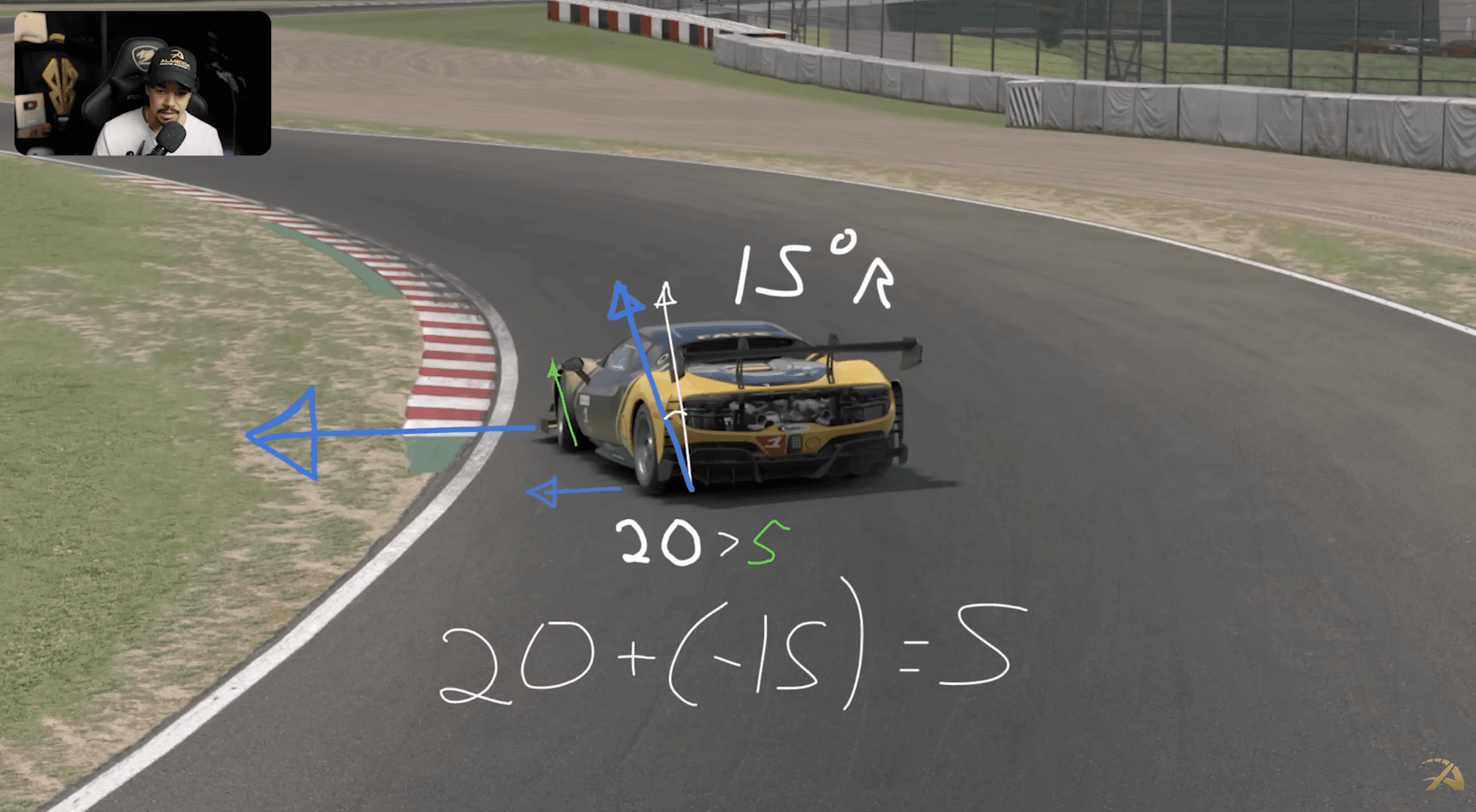
Then what happens is that the green line is a correction that is passive. So this is passive countersteer right now. This moment, that's passive countersteer. That's the steering getting heavier, right? So I've turned in with light hands. The steering gets heavy, passive countersteer. I'm still forcing a little bit. I'm still creating a little bit of that force, right? Like I'm fighting it a little bit. It's light, but it's still trying. But the thing is that as soon as I realized that that's too much, and if I keep forcing, I'm going to spin, now I have to resort to active countersteer.
Active Countersteer
So in blue, we have light hands turn in. In green, we have passive countersteer kind of warning me, hey, you're doing a little bit too much here. And in red is my attempt to save the entry and to correct for the oversteer without having to lose a lot of time or without spinning. The active countersteer in red was very fast. Why? Because I want to only correct the oversteer as quickly as possible and then get back to my plan. I still can correct it and still get a good line and still get a good exit. But I have to be very fast.
So all those three events right here probably happened in 0.4, 0.5 second light hands, passive countersteer, emergency active countersteer, very fast. So that's one thing I think that we could say is that the active countersteer, when it happens, it has to be fast. So that you can get back to trying to use all your four tires as quickly as possible. Yeah, that's really cool. Boom, boom, boom. And you see how fast it was.
Early Detection is Key
Obviously it depends on the level of the oversteer and it also depends on how early you catch it, right? How early you realize that the car is oversteering? If you get it on the very beginning of it, then yeah, you fix it. But if you still didn't have like some, let's say for example, if you didn't have light hands and if you were really forcing the car, you would have to feel visually the oversteer. But that's going to take a while for you to process the information. And by the time you have to correct, the cars are already sliding too much. And then you have to do a big correction.
In my case, I had everything I could, right? I had the light hands. So when the steering got heavy, I already got a warning. So I'm already processing that I am a little bit over the limit. And then I'm ready already to do the quick correction. So I caught the oversteer early and I was able to fix it early as well. That's why it's so important to be very, very sharp with these active corrections.
Brake Release During Correction
And you can also see my brake release. So I generally trail brake until the end here. This is actually very good too. So my trail braking is supposed to kind of like stay a little bit like this. But because I got a little bit of rotation, I also used a quicker release to countersteer and to make the correction. And you can see that I actually get back on it after I solve the problem, right?
I get back on the trail braking to prevent leftover understeer mid-corner before power. You correct the oversteer and then back to the plan, back to getting the car to the MRP, back to getting the car to rotate, you know, it's going to be very, very fast. And obviously it takes practice. But being an active driver and trying to drive the car will help you get there.
In the next lesson, we will talk about the three tools for rotation. We're getting into a very interesting territory right now.
Smooth is fast, is it? Really? Let's talk about inputs speeds. This is a traditional telemetry, nice braking, great, very, very smooth transition, and also quite smooth transition on the exit. There are places where you will have to be smooth, that's obvious, because again, we're following that rule, right? Speed goes down, rotation goes up, and you're always adjusting that.
Understanding Optimal Input Speeds
So there are optimal scenarios where movements between your inputs will be pretty smooth, but that's the optimal ideal theoretical input speed for some corners. There will be imperfections, there will be corrections, and you will have to do them as quickly as possible to be able to get back to where you want to be smoothly.
So let's say, for example, that we get a little bit of an oversteer here. It's very common for beginners to do a little bit of a slow correction before getting back to where the car wants to be in terms of limit, right? So over correcting here, big, big, big issue, you don't want these corrections to be slow.
Braking Application Speed
Here, for example, just in this example, we have the initial braking, obviously not so smooth. We want to go pretty quickly to the limit. Again, even if we're talking about a slightly slower application, in some cases in iRacing, this can be very useful for tire surface temperatures. We will talk about that as well. There's a lesson about tire surface temperatures that's still pretty fast, right?
You're not doing smooth braking, because again, a lot of beginners suffer with trying to be too smooth in everything, but they end up losing a lot of precision. So I don't want you to lose precision by trying to be gentle with the car. Ideally, I want it to be actually aggressive to learn these things, and then eventually shaving off those imperfections and getting back into an ideal driving scenario that will have, in some parts, smooth driving.
Throttle Application
Another thing that we can see right here is this quite vertical application here. We will also have a specific lesson about throttle application, and we'll explain why, but a hint here is that you don't want to accelerate too slowly if the car doesn't have a lot of power, or even if it does, but it's at a higher speed, where this would actually generate a lot of understeer.
So sometimes you just applying a very small amount of throttle and trying to be smooth and going super slowly like this is only going to load the rear tires and make the front tires die and make you lose rotation. And then you might have a big issue here, right? Understeer snaps oversteer. The oversteer would happen right here, and you don't want that.
So the throttle application here in some places will have to be fast enough so that you can get to very close the traction limit, which is if you go a little bit too much, you get wheelspin. If you go a little bit too little, you get understeer. So there's an area in the throttle application where you already want to jump to so that you continue not increase very important so that you continue the rotation that you generated all the way to mid corner. Very, very important. We're going to talk about that as well.
Light Braking Scenarios
There's also some more scenarios. First of all, if you're braking very, very lightly at first already, your steering doesn't have to be very progressive because there's nothing to transition from. You just want these brakes to kind of help the car rotate a little bit. So your steering can be a little bit more aggressive at first.
And then, and that's the cool part, then you go smooth, right? So initially, you want to get to that limit of rotation and limit of steering according to how much your speed is. And then from there, you go smoothly because now you're on the ideal magic combination between steering brakes. And as your speed goes down, you can increase the steering more slowly. But the beginning part, especially if you're going straight to 1% brakes, is a little bit faster.
I wanted to try that. I wanted to try in some of these corners where you're not braking super hard, brake and already kind of load a little bit more quickly to find that that initial speed is always going to be a little bit difficult at first, but you're going to develop the feeling so that you don't go super slowly right away from the beginning. Do your own experiments and try to find that speed for each corner.
Obviously, if we had a harder braking here, that would be completely different. In that case, then yes, the initial application would be a little bit different. So you see, it really depends on whether you're transitioning or not. And in that case, yeah, it's going to be smooth.
Correcting Oversteer
Okay, now let's say even in the situation where you're doing this and your trail braking, and we start turning very smoothly, but we get an oversteer. What should you do? You have a few options, right? You can kind of like, correct a little bit and then go back at it. But I already told you, Hey, this correction here, it's only to fix the excessive angle, right?
So you don't want to do this, you want to do this. You want to do a very small correction, quick correction, small and quick, because that should be enough, unless it's a very, very big slide. In that case, of course, you have to do a longer correction until the car catches back. But most of the time, these corrections are just small enough so that you can get it back to neutral steer, be careful not to overcorrect, because if you overcorrect, you go from oversteer to nothing, right? If you don't have any limit, all this time you're just losing time.
So sometimes you just need to correct a little bit to get back to some oversteer or some neutral steer. And then you keep going with a neutral steer as long as you can staying on the red line.
Brake Release as a Correction Tool
And remember that you can also release the brakes a little bit. So that's, let's say you're starting to turn, you get a little bit of oversteer. What you can do is, it depends a lot on the corner, but you can also do a little bit of a brake correction while staying on the steering or by at least turning a little bit less, but not so much. And then you go from there.
In that case, you have to choose, it depends from a car to car, it depends from situation to situation. Sometimes if you're over driving, obviously, then you're going to have to stay a little bit on the brakes. And then the correction will have to be done more on the steering. In this case, if you're staying on the brakes, you're going to have to stay a little bit more on the center rather than doing a big correction like this, and then back to where you were before.
So lots of little corrections, we're going to have, again, another lesson just on how we do these corrections. But most of these things happen fast. That's the thing about this lesson. I want you to remember that you're steering. It can actually look like this with no issue. It can be if it's especially if it's a very, very oversteer car, it can look like that with no problem. And you can still be very fast. What it can't not look like is one slow big correction, because in this case, you're losing a lot of lap time.
Changes of Direction
Another thing without talking about corrections is actually changes of direction. So if you're just trail braking, but you're changing your direction here, remember that you can do a fast correction, obviously in the telemetry, it's going to look like this, because there is some time. And if the car is a little bit too soft, yes, the change of direction will be a little bit slower than a formula car. But it's still in that very small range that where you look the steering, it's actually doing a quite a fast flick.
And then from there, again, if you're still trail braking, then you're adding more. And if there's a third change of direction, you're going to change like that, and then have to trail brake a little bit more, and then release as you get empowered. So changes of directions are fast, corrections of oversteer are fast, and brake release also in correction of oversteer can be a little bit fast like this.
And in the case of throttle application, it depends a lot on the power of the car. If the car is very under steer, be careful not to do this. It really causes a lot of understeer. You want to accelerate a little bit more aggressively. But again, I will have a lesson only about this.
Real-World Example Analysis
All right, let's take a look at this example. It's a pretty fast correction. There's a lot of things happening here. So I want to dissect this video for you. All right, let's go through it again. A lot of things happen. Actually, I think let's say just three things to talk about here that happened in that tiny, tiny amount of time.
Breaking Down the Three-Step Process
First of all, let's go frame by frame here. I start turning in with light hands, right? So I break, I start turning in with light hands. And ideally here, my geometry trace should look like something like this. But as soon as I got right here, this happened here. So I want to divide this in one, two, three. The three is the big one in blue.
That's step one, light hands entering the corner, aiming to do this, right? Aiming to do a build up like this. I turned in a little bit too aggressively, just a little bit too fast and just a little bit too much steering. I think I should have added a little bit less steering here, like a few degrees less, right? I'm really on the limit.
Passive Countersteer
Then what happens is that the green line is a correction that is passive. So this is passive countersteer right now. This moment, that's passive countersteer. That's the steering getting heavier, right? So I've turned in with light hands. The steering gets heavy, passive countersteer. I'm still forcing a little bit. I'm still creating a little bit of that force, right? Like I'm fighting it a little bit. It's light, but it's still trying. But the thing is that as soon as I realized that that's too much, and if I keep forcing, I'm going to spin, now I have to resort to active countersteer.
Active Countersteer
So in blue, we have light hands turn in. In green, we have passive countersteer kind of warning me, hey, you're doing a little bit too much here. And in red is my attempt to save the entry and to correct for the oversteer without having to lose a lot of time or without spinning. The active countersteer in red was very fast. Why? Because I want to only correct the oversteer as quickly as possible and then get back to my plan. I still can correct it and still get a good line and still get a good exit. But I have to be very fast.
So all those three events right here probably happened in 0.4, 0.5 second light hands, passive countersteer, emergency active countersteer, very fast. So that's one thing I think that we could say is that the active countersteer, when it happens, it has to be fast. So that you can get back to trying to use all your four tires as quickly as possible. Yeah, that's really cool. Boom, boom, boom. And you see how fast it was.
Early Detection is Key
Obviously it depends on the level of the oversteer and it also depends on how early you catch it, right? How early you realize that the car is oversteering? If you get it on the very beginning of it, then yeah, you fix it. But if you still didn't have like some, let's say for example, if you didn't have light hands and if you were really forcing the car, you would have to feel visually the oversteer. But that's going to take a while for you to process the information. And by the time you have to correct, the cars are already sliding too much. And then you have to do a big correction.
In my case, I had everything I could, right? I had the light hands. So when the steering got heavy, I already got a warning. So I'm already processing that I am a little bit over the limit. And then I'm ready already to do the quick correction. So I caught the oversteer early and I was able to fix it early as well. That's why it's so important to be very, very sharp with these active corrections.
Brake Release During Correction
And you can also see my brake release. So I generally trail brake until the end here. This is actually very good too. So my trail braking is supposed to kind of like stay a little bit like this. But because I got a little bit of rotation, I also used a quicker release to countersteer and to make the correction. And you can see that I actually get back on it after I solve the problem, right?
I get back on the trail braking to prevent leftover understeer mid-corner before power. You correct the oversteer and then back to the plan, back to getting the car to the MRP, back to getting the car to rotate, you know, it's going to be very, very fast. And obviously it takes practice. But being an active driver and trying to drive the car will help you get there.
In the next lesson, we will talk about the three tools for rotation. We're getting into a very interesting territory right now.
Smooth is fast, is it? Really? Let's talk about inputs speeds. This is a traditional telemetry, nice braking, great, very, very smooth transition, and also quite smooth transition on the exit. There are places where you will have to be smooth, that's obvious, because again, we're following that rule, right? Speed goes down, rotation goes up, and you're always adjusting that.
Understanding Optimal Input Speeds
So there are optimal scenarios where movements between your inputs will be pretty smooth, but that's the optimal ideal theoretical input speed for some corners. There will be imperfections, there will be corrections, and you will have to do them as quickly as possible to be able to get back to where you want to be smoothly.
So let's say, for example, that we get a little bit of an oversteer here. It's very common for beginners to do a little bit of a slow correction before getting back to where the car wants to be in terms of limit, right? So over correcting here, big, big, big issue, you don't want these corrections to be slow.
Braking Application Speed
Here, for example, just in this example, we have the initial braking, obviously not so smooth. We want to go pretty quickly to the limit. Again, even if we're talking about a slightly slower application, in some cases in iRacing, this can be very useful for tire surface temperatures. We will talk about that as well. There's a lesson about tire surface temperatures that's still pretty fast, right?
You're not doing smooth braking, because again, a lot of beginners suffer with trying to be too smooth in everything, but they end up losing a lot of precision. So I don't want you to lose precision by trying to be gentle with the car. Ideally, I want it to be actually aggressive to learn these things, and then eventually shaving off those imperfections and getting back into an ideal driving scenario that will have, in some parts, smooth driving.
Throttle Application
Another thing that we can see right here is this quite vertical application here. We will also have a specific lesson about throttle application, and we'll explain why, but a hint here is that you don't want to accelerate too slowly if the car doesn't have a lot of power, or even if it does, but it's at a higher speed, where this would actually generate a lot of understeer.
So sometimes you just applying a very small amount of throttle and trying to be smooth and going super slowly like this is only going to load the rear tires and make the front tires die and make you lose rotation. And then you might have a big issue here, right? Understeer snaps oversteer. The oversteer would happen right here, and you don't want that.
So the throttle application here in some places will have to be fast enough so that you can get to very close the traction limit, which is if you go a little bit too much, you get wheelspin. If you go a little bit too little, you get understeer. So there's an area in the throttle application where you already want to jump to so that you continue not increase very important so that you continue the rotation that you generated all the way to mid corner. Very, very important. We're going to talk about that as well.
Light Braking Scenarios
There's also some more scenarios. First of all, if you're braking very, very lightly at first already, your steering doesn't have to be very progressive because there's nothing to transition from. You just want these brakes to kind of help the car rotate a little bit. So your steering can be a little bit more aggressive at first.
And then, and that's the cool part, then you go smooth, right? So initially, you want to get to that limit of rotation and limit of steering according to how much your speed is. And then from there, you go smoothly because now you're on the ideal magic combination between steering brakes. And as your speed goes down, you can increase the steering more slowly. But the beginning part, especially if you're going straight to 1% brakes, is a little bit faster.
I wanted to try that. I wanted to try in some of these corners where you're not braking super hard, brake and already kind of load a little bit more quickly to find that that initial speed is always going to be a little bit difficult at first, but you're going to develop the feeling so that you don't go super slowly right away from the beginning. Do your own experiments and try to find that speed for each corner.
Obviously, if we had a harder braking here, that would be completely different. In that case, then yes, the initial application would be a little bit different. So you see, it really depends on whether you're transitioning or not. And in that case, yeah, it's going to be smooth.
Correcting Oversteer
Okay, now let's say even in the situation where you're doing this and your trail braking, and we start turning very smoothly, but we get an oversteer. What should you do? You have a few options, right? You can kind of like, correct a little bit and then go back at it. But I already told you, Hey, this correction here, it's only to fix the excessive angle, right?
So you don't want to do this, you want to do this. You want to do a very small correction, quick correction, small and quick, because that should be enough, unless it's a very, very big slide. In that case, of course, you have to do a longer correction until the car catches back. But most of the time, these corrections are just small enough so that you can get it back to neutral steer, be careful not to overcorrect, because if you overcorrect, you go from oversteer to nothing, right? If you don't have any limit, all this time you're just losing time.
So sometimes you just need to correct a little bit to get back to some oversteer or some neutral steer. And then you keep going with a neutral steer as long as you can staying on the red line.
Brake Release as a Correction Tool
And remember that you can also release the brakes a little bit. So that's, let's say you're starting to turn, you get a little bit of oversteer. What you can do is, it depends a lot on the corner, but you can also do a little bit of a brake correction while staying on the steering or by at least turning a little bit less, but not so much. And then you go from there.
In that case, you have to choose, it depends from a car to car, it depends from situation to situation. Sometimes if you're over driving, obviously, then you're going to have to stay a little bit on the brakes. And then the correction will have to be done more on the steering. In this case, if you're staying on the brakes, you're going to have to stay a little bit more on the center rather than doing a big correction like this, and then back to where you were before.
So lots of little corrections, we're going to have, again, another lesson just on how we do these corrections. But most of these things happen fast. That's the thing about this lesson. I want you to remember that you're steering. It can actually look like this with no issue. It can be if it's especially if it's a very, very oversteer car, it can look like that with no problem. And you can still be very fast. What it can't not look like is one slow big correction, because in this case, you're losing a lot of lap time.
Changes of Direction
Another thing without talking about corrections is actually changes of direction. So if you're just trail braking, but you're changing your direction here, remember that you can do a fast correction, obviously in the telemetry, it's going to look like this, because there is some time. And if the car is a little bit too soft, yes, the change of direction will be a little bit slower than a formula car. But it's still in that very small range that where you look the steering, it's actually doing a quite a fast flick.
And then from there, again, if you're still trail braking, then you're adding more. And if there's a third change of direction, you're going to change like that, and then have to trail brake a little bit more, and then release as you get empowered. So changes of directions are fast, corrections of oversteer are fast, and brake release also in correction of oversteer can be a little bit fast like this.
And in the case of throttle application, it depends a lot on the power of the car. If the car is very under steer, be careful not to do this. It really causes a lot of understeer. You want to accelerate a little bit more aggressively. But again, I will have a lesson only about this.
Real-World Example Analysis
All right, let's take a look at this example. It's a pretty fast correction. There's a lot of things happening here. So I want to dissect this video for you. All right, let's go through it again. A lot of things happen. Actually, I think let's say just three things to talk about here that happened in that tiny, tiny amount of time.
Breaking Down the Three-Step Process
First of all, let's go frame by frame here. I start turning in with light hands, right? So I break, I start turning in with light hands. And ideally here, my geometry trace should look like something like this. But as soon as I got right here, this happened here. So I want to divide this in one, two, three. The three is the big one in blue.
That's step one, light hands entering the corner, aiming to do this, right? Aiming to do a build up like this. I turned in a little bit too aggressively, just a little bit too fast and just a little bit too much steering. I think I should have added a little bit less steering here, like a few degrees less, right? I'm really on the limit.
Passive Countersteer
Then what happens is that the green line is a correction that is passive. So this is passive countersteer right now. This moment, that's passive countersteer. That's the steering getting heavier, right? So I've turned in with light hands. The steering gets heavy, passive countersteer. I'm still forcing a little bit. I'm still creating a little bit of that force, right? Like I'm fighting it a little bit. It's light, but it's still trying. But the thing is that as soon as I realized that that's too much, and if I keep forcing, I'm going to spin, now I have to resort to active countersteer.
Active Countersteer
So in blue, we have light hands turn in. In green, we have passive countersteer kind of warning me, hey, you're doing a little bit too much here. And in red is my attempt to save the entry and to correct for the oversteer without having to lose a lot of time or without spinning. The active countersteer in red was very fast. Why? Because I want to only correct the oversteer as quickly as possible and then get back to my plan. I still can correct it and still get a good line and still get a good exit. But I have to be very fast.
So all those three events right here probably happened in 0.4, 0.5 second light hands, passive countersteer, emergency active countersteer, very fast. So that's one thing I think that we could say is that the active countersteer, when it happens, it has to be fast. So that you can get back to trying to use all your four tires as quickly as possible. Yeah, that's really cool. Boom, boom, boom. And you see how fast it was.
Early Detection is Key
Obviously it depends on the level of the oversteer and it also depends on how early you catch it, right? How early you realize that the car is oversteering? If you get it on the very beginning of it, then yeah, you fix it. But if you still didn't have like some, let's say for example, if you didn't have light hands and if you were really forcing the car, you would have to feel visually the oversteer. But that's going to take a while for you to process the information. And by the time you have to correct, the cars are already sliding too much. And then you have to do a big correction.
In my case, I had everything I could, right? I had the light hands. So when the steering got heavy, I already got a warning. So I'm already processing that I am a little bit over the limit. And then I'm ready already to do the quick correction. So I caught the oversteer early and I was able to fix it early as well. That's why it's so important to be very, very sharp with these active corrections.
Brake Release During Correction
And you can also see my brake release. So I generally trail brake until the end here. This is actually very good too. So my trail braking is supposed to kind of like stay a little bit like this. But because I got a little bit of rotation, I also used a quicker release to countersteer and to make the correction. And you can see that I actually get back on it after I solve the problem, right?
I get back on the trail braking to prevent leftover understeer mid-corner before power. You correct the oversteer and then back to the plan, back to getting the car to the MRP, back to getting the car to rotate, you know, it's going to be very, very fast. And obviously it takes practice. But being an active driver and trying to drive the car will help you get there.
In the next lesson, we will talk about the three tools for rotation. We're getting into a very interesting territory right now.
Consistency & Confidence
Balance & Speed
Cornering Precision
Other Lessons