Brake Bias
Lesson
44
of
49

Lesson by
Suellio Almeida
Lesson by
Suellio Almeida
Mark as Finished
Understanding Brake Bias
Brake bias is the distribution in force in braking pressure between the front tires and the rear tires. A common misconception is that when you add brake bias to the front you actually add front grip, but this is not true. It's actually the opposite.
When you add more braking force to the front tires, you're actually stressing the tires more and you're using up their available grip for longitudinal deceleration, leaving them less available grip for rotation. With more brake bias on the front, it's easier to reach the tire limits, and when that happens the tire will completely lock and start sliding through the track because it will have reached its limit in friction and now it will have a lot less deceleration force and absolutely zero rotation—it will go straight.
This is also true even if you're not fully locking the tire. When you're approaching locking you will already be losing front grip. For example, if you have a lot of front bias even without locking, you will already have a car that will tend to rotate less because it's not only an on-off thing. Yes, for sure when you do lock it feels abrupt, but even before you're locking you're already having an effect in the rotation that the car can get. Again, you're consuming that lateral grip availability so that you can have a little bit more longitudinal grip usage.
Setting Brake Bias as a Starting Point
As a starting point, and very important that this is only a starting point, we want to set the brake bias so that we lock all four tires almost at the same time, if not possibly at the same time, on a straight line without turning a single degree of steering. This is important for deceleration performance because if you get too much brake pressure on the front, for example, by the time the fronts lock you were not really on the limit of deceleration from the rear tires and the car will actually stop less before it reaches that locking point.
However, we have to think very seriously about what the brake bias is doing to our rotation. Especially at a higher level, it can actually be more important to focus your brake bias to optimize your rotation rather than only full deceleration performance.
How Brake Bias Affects Corner Performance
Less Brake Bias (Lower Percentage)
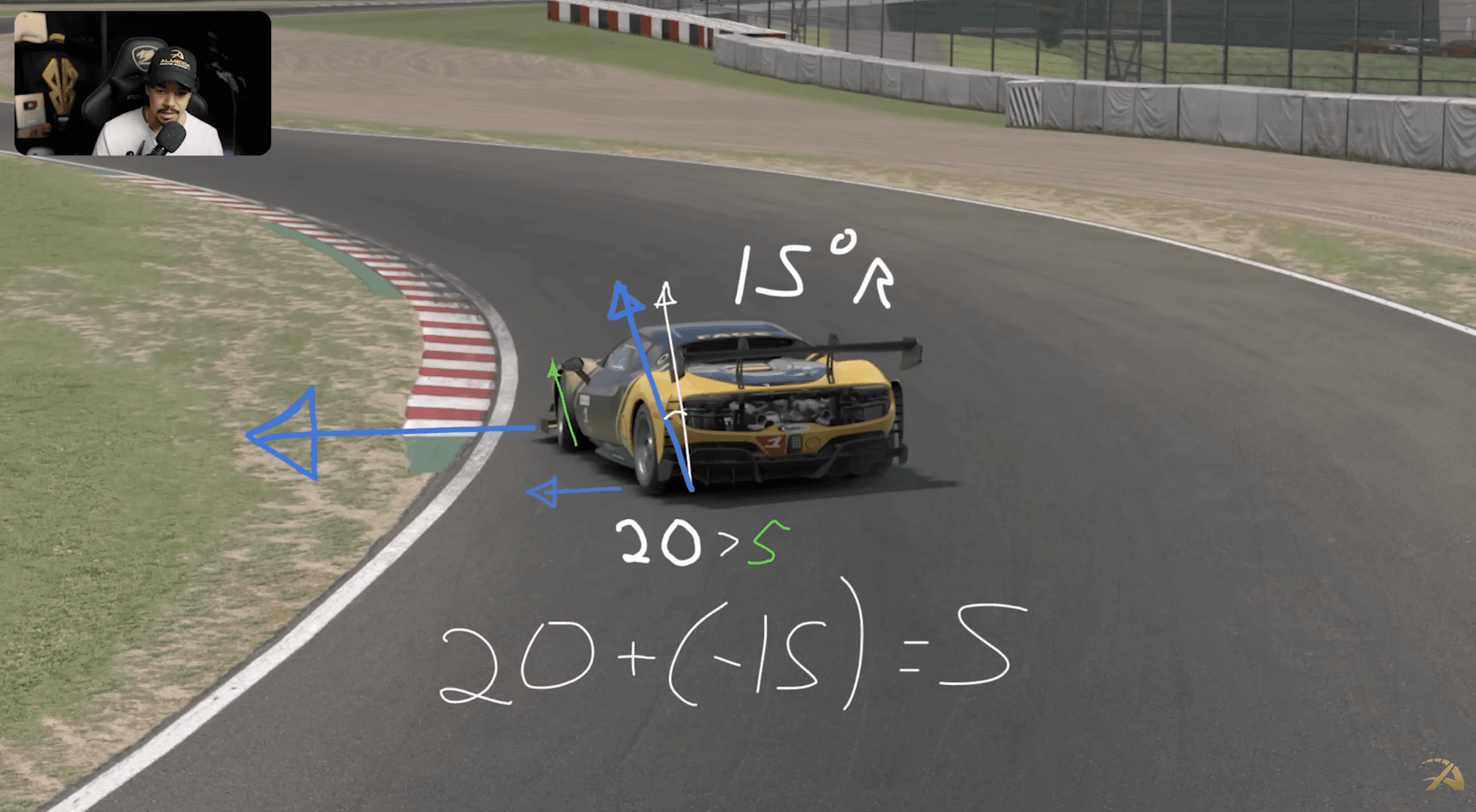
When you have less brake bias or less brake bias percentage, you have more brake pressure to the rear compared to the front and you will get more rotation. That's because more pressure on the rear means the rear tires are very busy and very stressed with the longitudinal grip, and they end up not having as much lateral grip remaining to try and hold the car to the direction the front tires are pointing. While the front tires are able to breathe more because they're not being so overwhelmed by the longitudinal stress, and they can point the car more.
More Brake Bias (Higher Percentage)
When you have more brake bias to the front or more brake bias percentage, the opposite is happening. You have a lot more pressure on the front tires and that will overwhelm the front tires a lot more, leaving them less available grip to turn the car while the rear tires are less stressed and they have more lateral grip, so they can resist that rotation more easily.
Working with Default Setups
Generally the default setups, fixed setups, and iRacing in any simulator honestly, will have a pretty safe brake bias that's gonna be not too sketchy to drive. But a lot of these setups are way faster when you actually move the brake bias a little bit. The problem with this is that the car becomes a little bit more precise and responsive on the corner entry, which makes it more difficult for beginners, but it is ultimately going to be faster.
Normally the setups have a brake bias that locks the fronts more easily. But for some cars 60% might be actually very low and what you might actually lock the rear tires. It really depends on so many factors like setup, tires, etc., etc., etc. Because when you start braking a lot of weight goes to the front tires, then it's normal that some cars have a lot more brake bias on the front to prevent rear locking because the rear lifts and has a lot less grip. So for some cars 55% is actually very low and you're gonna spin right away if you start braking too hard with that.
Balancing Setup Compromises
An under-series setup where the car does not want to turn at all, we end up needing a much lower brake bias to make it turn well corner. But that will cause the longitudinal grip to be a bit off, causing the car to lock the rears first on a straight line if you go over the limit. In this case, it would have to maybe even lose a little bit of braking performance to benefit the cornering and find the best compromise. If you cannot change the setup, trial and error is the only way to go until you find the best compromise.
Different Balance for Different Corner Speeds
Depending on car and setup, the balance can be different while cornering between low speed and high speed corners. There's a crazy example of me driving a Formula 3 at Spa on an event at a fixed setup. The car was extremely oversteer on low speed corners so it rotated a lot, but it was super understeer on high speed corners because of the wing setup. So what I ended up doing was using 55% brake bias on the low speed stuff, but then I would have to move the brake bias all the way down to 45% so that I could go fast on the high speed stuff.
Inside Front Locking: A Key Secret
Now here's a very good secret that people told me not to tell anyone. The brake bias will affect whether you lock the inside front as you turn into the corner. Right, so let's say you have a car that is easily locking the inside front. Well, sometimes it's just because the front suspension is too stiff. Cars with stiff suspension will generally lock the inside front as you turn into the corner, and they can even lift a little bit the inside tire to a point where the tire is actually flying, so 1% brakes are already going to make obviously the car lock the inside tire. That can even happen with GT cars as well.
In this case sometimes just adjusting the front roll bar making it softer or making the front suspension springs softer will fix the inside front locking issue without having to change the brake bias. But don't tell anyone.
Obviously here we're talking about proper steering technique, right? So if you have a low brake bias and you still steer a lot you are going to lock the fronts anyways.
Practice and Development
For now I strongly recommend that you start playing with the brake bias and trying to feel the difference at very subtle ways. At first you can change the bias aggressively just to feel the difference—I'm talking about 10%—and even if it locks too much on the straight line, at least try to feel the difference mid-corner. And then you start to close more and more the gap so that you can gain that precision. And then eventually you're going to start feeling the difference of half a percent, maybe you know one click, and that should be very very useful when you start to get really consistent close to the perfect lap.
Understanding Brake Bias
Brake bias is the distribution in force in braking pressure between the front tires and the rear tires. A common misconception is that when you add brake bias to the front you actually add front grip, but this is not true. It's actually the opposite.
When you add more braking force to the front tires, you're actually stressing the tires more and you're using up their available grip for longitudinal deceleration, leaving them less available grip for rotation. With more brake bias on the front, it's easier to reach the tire limits, and when that happens the tire will completely lock and start sliding through the track because it will have reached its limit in friction and now it will have a lot less deceleration force and absolutely zero rotation—it will go straight.
This is also true even if you're not fully locking the tire. When you're approaching locking you will already be losing front grip. For example, if you have a lot of front bias even without locking, you will already have a car that will tend to rotate less because it's not only an on-off thing. Yes, for sure when you do lock it feels abrupt, but even before you're locking you're already having an effect in the rotation that the car can get. Again, you're consuming that lateral grip availability so that you can have a little bit more longitudinal grip usage.
Setting Brake Bias as a Starting Point
As a starting point, and very important that this is only a starting point, we want to set the brake bias so that we lock all four tires almost at the same time, if not possibly at the same time, on a straight line without turning a single degree of steering. This is important for deceleration performance because if you get too much brake pressure on the front, for example, by the time the fronts lock you were not really on the limit of deceleration from the rear tires and the car will actually stop less before it reaches that locking point.
However, we have to think very seriously about what the brake bias is doing to our rotation. Especially at a higher level, it can actually be more important to focus your brake bias to optimize your rotation rather than only full deceleration performance.
How Brake Bias Affects Corner Performance
Less Brake Bias (Lower Percentage)
When you have less brake bias or less brake bias percentage, you have more brake pressure to the rear compared to the front and you will get more rotation. That's because more pressure on the rear means the rear tires are very busy and very stressed with the longitudinal grip, and they end up not having as much lateral grip remaining to try and hold the car to the direction the front tires are pointing. While the front tires are able to breathe more because they're not being so overwhelmed by the longitudinal stress, and they can point the car more.
More Brake Bias (Higher Percentage)
When you have more brake bias to the front or more brake bias percentage, the opposite is happening. You have a lot more pressure on the front tires and that will overwhelm the front tires a lot more, leaving them less available grip to turn the car while the rear tires are less stressed and they have more lateral grip, so they can resist that rotation more easily.
Working with Default Setups
Generally the default setups, fixed setups, and iRacing in any simulator honestly, will have a pretty safe brake bias that's gonna be not too sketchy to drive. But a lot of these setups are way faster when you actually move the brake bias a little bit. The problem with this is that the car becomes a little bit more precise and responsive on the corner entry, which makes it more difficult for beginners, but it is ultimately going to be faster.
Normally the setups have a brake bias that locks the fronts more easily. But for some cars 60% might be actually very low and what you might actually lock the rear tires. It really depends on so many factors like setup, tires, etc., etc., etc. Because when you start braking a lot of weight goes to the front tires, then it's normal that some cars have a lot more brake bias on the front to prevent rear locking because the rear lifts and has a lot less grip. So for some cars 55% is actually very low and you're gonna spin right away if you start braking too hard with that.
Balancing Setup Compromises
An under-series setup where the car does not want to turn at all, we end up needing a much lower brake bias to make it turn well corner. But that will cause the longitudinal grip to be a bit off, causing the car to lock the rears first on a straight line if you go over the limit. In this case, it would have to maybe even lose a little bit of braking performance to benefit the cornering and find the best compromise. If you cannot change the setup, trial and error is the only way to go until you find the best compromise.
Different Balance for Different Corner Speeds
Depending on car and setup, the balance can be different while cornering between low speed and high speed corners. There's a crazy example of me driving a Formula 3 at Spa on an event at a fixed setup. The car was extremely oversteer on low speed corners so it rotated a lot, but it was super understeer on high speed corners because of the wing setup. So what I ended up doing was using 55% brake bias on the low speed stuff, but then I would have to move the brake bias all the way down to 45% so that I could go fast on the high speed stuff.
Inside Front Locking: A Key Secret
Now here's a very good secret that people told me not to tell anyone. The brake bias will affect whether you lock the inside front as you turn into the corner. Right, so let's say you have a car that is easily locking the inside front. Well, sometimes it's just because the front suspension is too stiff. Cars with stiff suspension will generally lock the inside front as you turn into the corner, and they can even lift a little bit the inside tire to a point where the tire is actually flying, so 1% brakes are already going to make obviously the car lock the inside tire. That can even happen with GT cars as well.
In this case sometimes just adjusting the front roll bar making it softer or making the front suspension springs softer will fix the inside front locking issue without having to change the brake bias. But don't tell anyone.
Obviously here we're talking about proper steering technique, right? So if you have a low brake bias and you still steer a lot you are going to lock the fronts anyways.
Practice and Development
For now I strongly recommend that you start playing with the brake bias and trying to feel the difference at very subtle ways. At first you can change the bias aggressively just to feel the difference—I'm talking about 10%—and even if it locks too much on the straight line, at least try to feel the difference mid-corner. And then you start to close more and more the gap so that you can gain that precision. And then eventually you're going to start feeling the difference of half a percent, maybe you know one click, and that should be very very useful when you start to get really consistent close to the perfect lap.
Understanding Brake Bias
Brake bias is the distribution in force in braking pressure between the front tires and the rear tires. A common misconception is that when you add brake bias to the front you actually add front grip, but this is not true. It's actually the opposite.
When you add more braking force to the front tires, you're actually stressing the tires more and you're using up their available grip for longitudinal deceleration, leaving them less available grip for rotation. With more brake bias on the front, it's easier to reach the tire limits, and when that happens the tire will completely lock and start sliding through the track because it will have reached its limit in friction and now it will have a lot less deceleration force and absolutely zero rotation—it will go straight.
This is also true even if you're not fully locking the tire. When you're approaching locking you will already be losing front grip. For example, if you have a lot of front bias even without locking, you will already have a car that will tend to rotate less because it's not only an on-off thing. Yes, for sure when you do lock it feels abrupt, but even before you're locking you're already having an effect in the rotation that the car can get. Again, you're consuming that lateral grip availability so that you can have a little bit more longitudinal grip usage.
Setting Brake Bias as a Starting Point
As a starting point, and very important that this is only a starting point, we want to set the brake bias so that we lock all four tires almost at the same time, if not possibly at the same time, on a straight line without turning a single degree of steering. This is important for deceleration performance because if you get too much brake pressure on the front, for example, by the time the fronts lock you were not really on the limit of deceleration from the rear tires and the car will actually stop less before it reaches that locking point.
However, we have to think very seriously about what the brake bias is doing to our rotation. Especially at a higher level, it can actually be more important to focus your brake bias to optimize your rotation rather than only full deceleration performance.
How Brake Bias Affects Corner Performance
Less Brake Bias (Lower Percentage)
When you have less brake bias or less brake bias percentage, you have more brake pressure to the rear compared to the front and you will get more rotation. That's because more pressure on the rear means the rear tires are very busy and very stressed with the longitudinal grip, and they end up not having as much lateral grip remaining to try and hold the car to the direction the front tires are pointing. While the front tires are able to breathe more because they're not being so overwhelmed by the longitudinal stress, and they can point the car more.
More Brake Bias (Higher Percentage)
When you have more brake bias to the front or more brake bias percentage, the opposite is happening. You have a lot more pressure on the front tires and that will overwhelm the front tires a lot more, leaving them less available grip to turn the car while the rear tires are less stressed and they have more lateral grip, so they can resist that rotation more easily.
Working with Default Setups
Generally the default setups, fixed setups, and iRacing in any simulator honestly, will have a pretty safe brake bias that's gonna be not too sketchy to drive. But a lot of these setups are way faster when you actually move the brake bias a little bit. The problem with this is that the car becomes a little bit more precise and responsive on the corner entry, which makes it more difficult for beginners, but it is ultimately going to be faster.
Normally the setups have a brake bias that locks the fronts more easily. But for some cars 60% might be actually very low and what you might actually lock the rear tires. It really depends on so many factors like setup, tires, etc., etc., etc. Because when you start braking a lot of weight goes to the front tires, then it's normal that some cars have a lot more brake bias on the front to prevent rear locking because the rear lifts and has a lot less grip. So for some cars 55% is actually very low and you're gonna spin right away if you start braking too hard with that.
Balancing Setup Compromises
An under-series setup where the car does not want to turn at all, we end up needing a much lower brake bias to make it turn well corner. But that will cause the longitudinal grip to be a bit off, causing the car to lock the rears first on a straight line if you go over the limit. In this case, it would have to maybe even lose a little bit of braking performance to benefit the cornering and find the best compromise. If you cannot change the setup, trial and error is the only way to go until you find the best compromise.
Different Balance for Different Corner Speeds
Depending on car and setup, the balance can be different while cornering between low speed and high speed corners. There's a crazy example of me driving a Formula 3 at Spa on an event at a fixed setup. The car was extremely oversteer on low speed corners so it rotated a lot, but it was super understeer on high speed corners because of the wing setup. So what I ended up doing was using 55% brake bias on the low speed stuff, but then I would have to move the brake bias all the way down to 45% so that I could go fast on the high speed stuff.
Inside Front Locking: A Key Secret
Now here's a very good secret that people told me not to tell anyone. The brake bias will affect whether you lock the inside front as you turn into the corner. Right, so let's say you have a car that is easily locking the inside front. Well, sometimes it's just because the front suspension is too stiff. Cars with stiff suspension will generally lock the inside front as you turn into the corner, and they can even lift a little bit the inside tire to a point where the tire is actually flying, so 1% brakes are already going to make obviously the car lock the inside tire. That can even happen with GT cars as well.
In this case sometimes just adjusting the front roll bar making it softer or making the front suspension springs softer will fix the inside front locking issue without having to change the brake bias. But don't tell anyone.
Obviously here we're talking about proper steering technique, right? So if you have a low brake bias and you still steer a lot you are going to lock the fronts anyways.
Practice and Development
For now I strongly recommend that you start playing with the brake bias and trying to feel the difference at very subtle ways. At first you can change the bias aggressively just to feel the difference—I'm talking about 10%—and even if it locks too much on the straight line, at least try to feel the difference mid-corner. And then you start to close more and more the gap so that you can gain that precision. And then eventually you're going to start feeling the difference of half a percent, maybe you know one click, and that should be very very useful when you start to get really consistent close to the perfect lap.
Consistency & Confidence
Balance & Speed
Cornering Precision
Other Lessons