Throttle Applications
Lesson
47
of
49

Lesson by
Suellio Almeida
Lesson by
Suellio Almeida
Mark as Finished
Let's talk about throttle application techniques. We are going to talk about balance throttle, no man's land throttle, exit throttle, and we're going to talk about correction and lifting techniques.
Balance Throttle
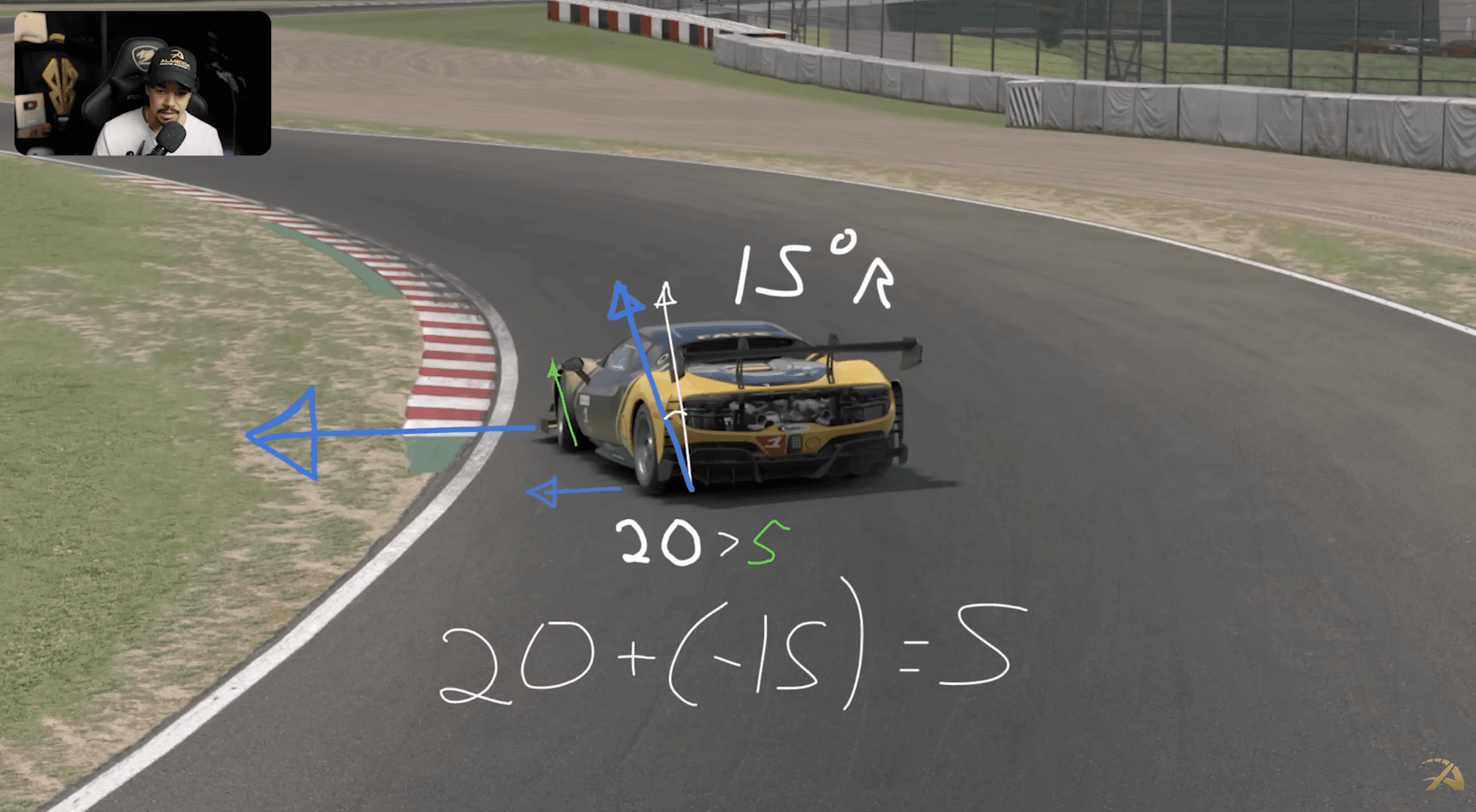
This is the earliest part. So let's say we have a line here, we start braking, we release the brakes, and we get right here. On the very beginning of your throttle application, there can be a few things. The balance throttle is basically a little bit of a smoother application depending on the balance of the car before. So if the car is oversteering right here, it might be a little bit too risky to go up aggressively on the throttle because that might make the oversteer worse. This smaller application here that can range in different speeds depending on the car's power and depending on the setup as well is going to help kind of settle a little bit their rear before you start going up again.
Now there is a second part of this which is as soon as the balance is fixed depending on the car, you might actually go a little bit more quickly. So if the car doesn't have a lot of power and you fixed the balance on that first application, then you can go up to 100% because now you're really thinking only about the exit.
When to Use Balance Throttle
You will most likely use balance throttle only if the car is already oversteering a little bit. If the car is understeering though and you do this or this or this, any of these will make the car understeer even more. So be careful with the slow application if the car is understeering because you don't want to lose the rotation.
Remember that our rotation is going to look like this, right? We gain yaw rate, we reach our peak and then we start decreasing the yaw rate. At the end, when you apply the throttle, you don't want your rotation to go down like this. If you get on power a little bit too soft, this will happen. You will lose too much rotation. If you get on power a little bit too aggressively, then you might end up getting a little bit too much rotation which makes you oversteer. In this case here, this is more yaw rate than the rear tires that are capable of holding. In this case, you would get oversteer and you might become an actual spin.
So again, it really depends on how much yaw you have, how much oversteer you have and remember that the oversteer is how much rotation you're getting with the amount of steering. So if you're steering normally but the yaw is way higher than you expected, let's say you expected this amount of rotation but you're getting this amount of rotation and you're starting to oversteer, you will need a little balance throttle before you go to exit.
Balance Throttle in Different Cars
You're not only going to have to use balance throttle in high powered cars. Sometimes an MX-5 will need this kind of acceleration. Here's an example. In this case, you can see that there was a lot of engine braking on entry. So that engine braking really caused a lot of rotation and I had to make a slightly more aggressive correction. I needed to hold the rear a little bit and then when the balance was fixed, you can see me going way more quickly to 100%.
This one is different. You can see how I am really going more quickly to 50% and then a bit more slowly. The reason here is that I did not have engine braking when I turned in. So I was already at a low, medium to low RPM. So when I turned in, there was not a lot of over steer mid-corner. So I got back in power more quickly to that area around 50%. And then from there, I was causing some oversteer with the throttle and managing it. So that's the difference. That's why I was carrying that oversteer a little bit more gentle oversteer throughout the whole exit.
And this exit here of this second right-hander hairpin is a crest. So the car is falling a little bit. There's a little bit less grip than the left-hander the first hairpin. So that's why the shape is also different. There's always many different reasons that combine into you having a totally different shape on the throttle even though it's the same car.
Example Analysis
Lots of thinking braking on the first one needed to do the correction. Let's watch that again. Lots of thinking braking. Boom, boom. Car super loose. I turn it super loose here. If I go on power aggressively to 50% or more, I'm gonna get a spin. I can feel the car is super, super loose. It may be a little bit more difficult to see the video. Over to force it back and with the triple screens, I can really feel that the car is about to spend. So I correct and then power.
And then in this case, I'm on first gear, medium RPM. The car is not so fast. I turn in. There's a little bit of oversteer still. I'm trail braking. But it's definitely a little bit less than the first hairpin. And in this case, I'm really using a little bit more different tires. The tires are a little bit hotter at this point. So you will have a little bit less grip on the right-hander than the left-hander because the surface temperature of the tires was a little bit higher already on the second corner, especially on the front tires.
So here, I'm actually turning a little bit more, I'm being a little bit more aggressive with the front tires and maybe getting even a little bit of both understeer and oversteer, right? So it's semi neutral steer. That's why this shape of the throttle is completely different. Obviously, I'm not really thinking too much about these things. I'm just feeling the car and balancing the rotation of the car with the throttle. I'm showing you I'm breaking it down technically why I'm doing those things. But that's not what I think when I do it. You just need to drive, drive, drive. And then eventually you will get to that. But knowing the balanced throttle as a technique is extremely useful because you can do it on purpose until it becomes automatic in driving.
Understanding the Traction Limit
In the case of balanced throttle, we are actually not on the limit of traction in terms of acceleration and wheel span. But because the tires right here are already so used by the lateral grip, then we don't have any more grip available for acceleration. If the car is not rotating that much, you can accelerate more aggressively. In the same lap, you're going to see me accelerating like this in the next five, or you will see me accelerating pretty much straight to 100%.
It really depends on the context in my high speed corner with low RPM and a car with low power, you might not need to do this balanced throttle. But if I'm really hanging into oversteer on a hairpin and the X5 like I showed you, then it will be very progressively initially depending on how much rotation I need to manage.
No Man's Land Throttle
Now the no man's length throttle. What is this? This is actually a throttle that is fixing too much the oversteer to the point of getting you into understeer. So let's say you enter a corner, you're getting a little bit of oversteer, you want to fix it. But instead of like doing a little bit of balanced throttle and then accelerating, you go like this. You accelerate somewhere in between where you're correcting a little bit too much the oversteer and you're getting into understeer. And then when the car is ready to accelerate, you're still not going there. So you're not giving the car power and you're not giving the car good rotation here because you're causing too much understeer.
So this is the no man's length. You have to be careful with this middle phase here, because depending on the power of the car and the grip levels of the corner, you will want to avoid this. You want to kind of go either straight to here, or you want to do this, and then you can go a little bit more aggressively. The no man's length is a place where you just get too much understeer, but not enough power to the car.
Exit Throttle
Now what about exit throttle? Exit throttle is essentially after you have fixed a little bit of this, you want to go to the traction limit of the car. The traction limit of the car generally looks like a range, something like this. Somewhere in a range that will obviously change depending on how much power you have.
Exit Throttle in Different Power Levels
If you have a car with pretty much no power, then you can go like this.
If your car has some power, but not so much, like the Porsche Cup, it's going to be something like this.
But if the car is a Formula One, then it's going to look like this. It's going to be very progressive because there's way too much torque, sometimes even on a straight line, you're still having to modulate the throttle to prevent wheel spins.
So this is not balanced related at this point. It is still a little bit for most cars, but for some cars, it becomes just a wheel spin thing, a launch to no grip, even on a straight line. It's not enough to hold the crazy amount of power that some cars have.
Multiple Techniques in the Same Car
And remember that you can still do all these three things in the same car, depending on the corner. You can actually still do this trace on a Formula One, if you are already at a fast speed, if you are already really loaded by the downforce and you're just doing a little bit of trail braking and then going straight on power, there will be events where you will have the grip to do that. And then in medium corners, you're going to do something like this. And then in low speed corners, you're going to do something like this.
Porsche Cup Example
And the same thing for a Porsche, for example, you might want to go straight here. Let's say you don't have any issues with the balance, right? So you go straight to the traction limit pretty aggressively to this area. And then from there, we will modulate depends on what's happening with the balance. And you will going to do something like this. Why do we go straight to this? Because it's a very heavy car that likes to understeer your trail braking a lot. And you don't want to lose that rotation. If you do a little bit of balance throttle on the Porsche Cup, you're going to waste your rotation and understeer too much.
So what we do is we find this area that we are going to call the traction limit area. And then we're going to ride that. So if it's too much, then you get oversteer. So a little bit too much, you're going to get wheel spin and the car is going to start sliding and you're going to overheat the rear tires. And it's going to be a really bad exit. If it's too little, then you're not getting enough power to the car to compensate for that potential understeer. So you're just shifting weight to the car without giving it enough power. This is no man's land for the Porsche Cup.
And then if you go straight here, that's let's say the perfect spot to pick up the rotation that you generated. So you're going to go up with the rotation and then you're going to pick that rotation up and then you're going to decrease it. The decrease of this rotation here should happen pretty naturally because of the throttle and it should just relax your hands. So like hands technique and allow the car to lose its rotation as it wants to. And you're going to make it want to lose that rotation with the way you apply the throttle. So you're going to apply the throttle to the traction limit. You're going to ride that up and the rotation of the car will naturally go down.
If you apply the throttle only here though, then the rotation will drop a little bit too fast and you're going to get a lot of understeer, which will prevent you from actually exiting the corner nicely. And you will have to wait and wait and wait and you're going to lose a lot of time and rotation at the same time. But the same posh a cup on a fast corner can still do some pretty aggressive throttle application. It really depends on the speed of the corner because if the car is already very fast, the engine doesn't have that much power to give that much torque, right? It's already really on the limit and there's a lot of wind preventing the car from going super fast.
Elevation Changes and Grip Levels
And on top of that, the corner might have a lot of grip, for example, and you might be able to accelerate very aggressively, which is another thing that we have to talk about especially on power. The elevation changes of the corner.
If the corner has a big compression on the exit, you're probably going to be able to accelerate way more.
If the corner is flat, but at the same speed, you would do something like this.
And if the corner is a crest on the exit very, very loose, then you might have to be a little bit more cautious with the throttle application.
I'm talking about the same car at the same speed in a corner with the same radius, just with different levels of grip. Compression, flat, and crest.
Lifting Techniques
Now let's talk about some lifting techniques here. So let's say we are only lifting on a corner that's flat, right? You can do a few things. You can do something like this. So it's low lift, slow application, but you can also do some different things. And I'm not telling you which one is right here because each car will have a different ideal way of doing it.
Different Lifting Approaches
Some cars will prefer that you lift a little bit more quickly and reapply or slowly.
Some cars will prefer that you lift slowly, but get back on power quickly.
Some cars will want you to lift quickly and accelerate quickly.
Some cars will prefer that you lift quickly, but short and full.
And some cars will prefer that you lift less, but for longer.
It really, really depends on the differential of the car, on the setup of the car, on the grip of the corner, on the amount of steering. This really is something that I cannot teach you the right way because every way is possible, depending on the situation.
Mid-Corner Corrections
Now in terms of corner exit, let's say we get back on power a little bit too early, a little bit too early, the car is going wide. One thing that you can do, ideally, if you pick it up very early, is to just ride a little bit longer the modulation and then go back up. And they should be enough. But be careful that you might get a little bit too much understeer.
If you get too much understeer, then a better way might be to actually do a quicker lift and then a faster application straight to 100. So what's going to happen here? If you do a quicker lift, you're shifting weight a little bit back to the front tires, first of all. So you're getting a little bit more rotation. And then when you accelerate more quickly, you're adding a little bit of stress to the rear tires. You're just doing a little bit of a kick to kind of regain the rotation, which again, I always say do not ever gain rotation with the throttle. This is not ideal. This is a correction. This is damage limitation.
In this case, you can do that. I do a lot of aggressive corrections depending on the car. For example, you're going to see me doing a lot of this, especially if it's a very quick one. I can do boom, boom, very, very, very fast lift and application. I generally will do that on high speed corners. If I do this on low speed corners, obviously I'm going to spin or just not going to be worth it.
Correction Example Analysis
Here's one example. Alright, so let's look at the mistakes here and the reason I did that correction. First of all, I turn in, I start releasing the brakes a little bit too fast. And you can see that I'm actually not increasing the steering at the very same rate. I drop the brakes, my steering is kind of stable, and then here I increase a lot more. And you can see this right here. You can see me dropping a lot, but the steering is doing kind of like this weird turn. I do this and then I do this. So I'm turning more after I have released the brakes.
So my string theory here is bad, pretty bad. And the reason is that I turned them too early. So I could not steer more, because when I started turning into the corner, turning a little bit too early. So now if I turn more, I'm going to hit the grass. And because of that, I had to do a little correction. Wait, wait, wait, then when I turned more, well, I had already released the brakes. That's too late, and now I'm not amplifying the rotation of the car with the steering. So I missed the apex a little bit and I early apex as well. And now because of that, the car is under steering a little bit.
There is more grip here, though, so I am used at this spot. My application, my throttle application point is really aggressive. It's high speed, high don't force car, high grip corner, high, high everything, right? So I can pretty much explode the throttle like that. And that's normal. That's the right way of doing it here in this corner in this car. But I'm going wide. I've done some mistakes here. I didn't get enough rotation, maximum rotation point was not in the right spot. Now I have to get a little bit more rotation.
So what I do is I do a quick drop on the throttle to just get a little bit more weight on the front and pull the car more in and then I explode the throttle again to try to get the rear to rotate a little bit more. Again, this is just a very, very fast damaged limitation correction, not ideal, but I'm used to doing those things very quickly just for some corrections. Feel free to try that rather than just, you know, being a little bit lazy with your corrections and end up going off or stuff like that. So be aggressive, be aggressive just for the sake of training. You're in a simulator.
And then here you can see just absolutely no grip. The trail brake here is actually correct in this case just because this car is very, very easy to lock this tire, the front right. So I really have to rely on the engine braking here to get the car to turn and turn the steering a lot more and trail brake a lot less. And then I get back on power. You can see that I have this application a little bit slow just to not get the car too much interaction control. And then I get up as soon as the balance is fine.
I actually am on the wrong gear here on first gear, my throttle application is a little bit under because first gear you have more RPM. So it looks a little bit more like this. But on second gear, as soon as I realized that nothing was happening because I wasn't the wrong gear, I ended up having to go quickly to 80% and then go to 100.
Maintenance Throttle
There's another thing that you can do to that is very, very discussed. But I don't really recommend or teach that much, which is a little bit of maintenance throttle. Maintenance throttle is when you combine brakes and throttle at the same time to limit a little bit of the rotation from the car. We do not teach this. It's very rare that we need to do it. I discussed what Kane and Connor, they do not do it. I don't remember doing it. So it's very rare.
It's a possible technique where if the car has, say, an open differential and you still want to use the front tires, you can kind of ride the throttle a little bit on entry to compensate for the tires being completely disconnected and the car being a little bit to lose. But what we tend to do even in this cars is just deal with the rotation with light hands and it ends up working very well. And we do very fast lap times. So we do not teach it. We do not do it. I don't really remember using it anywhere. And again, probably not recommended, just use the light hands technique and it's going to be fine.
Additional Examples and Analysis
Let's look at some more examples. I'm going to show a bunch of videos and go through the thought process in the throttle application in different corners in different situations.
Example 1: Quick Application to 50%
All right, this one can see quick applications straight from trail braking into pretty much 50%. And then little adjustment here. And then all the way up. So essentially, it looked like this. As you can see, I wasn't oversteering too much. I wanted to keep the rotation going. I went quickly to 50%. And then I modulated up to 100%.
Example 2: Balance Throttle with Oversteer
All right, here we have some action. This is a little bit oversteering on this corner. So I turned in trail braking the car turns a lot. And I touched 20% throttle. So we have some balance throttle. And then I go up to 100%. This car doesn't have a lot of power. So after the throttle is corrected, I'm okay to go to 100%. But then I got a little bit of understeers. So I had to do a quick lift and a quick application. Same thing, shift weight to the front and then stress the rear as much as you can with a higher boosa engine to get the car to rotate a tiny bit more. So this is a trace that we got in this example. Let's look at it again. There you go.
Example 3: Fast Lift, Slow Application
Even faster corner. So okay, this one was a fast lift into a very slow re-application. That's what I felt worked better in the radical. So you can see not like this and also not like slow lift and quick application. I did a fast lift and a slow application. Let's look at that again. There you go.
Example 4: High Grip Compression Corner
Fast, very, very grippy left-hander compression. Lots of grip. All right. Lots of hesitation there. I don't know if it's hesitation or if it's correction right away here. A little bit hesitant kind of like kicking the throttle a little bit too early. The car was not really rotating that much. Then I went again, then again, then 100%. This part was very, very rubbery and this rubber here was not interacting very well with my tires. So this is rubber from the Indy cars and we didn't really deal very well. I think they had like Firestone tires and we had Purelli or Michelin tires. So the rubber interacting was not that grippy.
So you can see here, essentially, boom, boom. Okay. Okay. So lots of attempts there with a little bit of understeer. I did have a tiny bit more room here, but this is very bumpy. So I just didn't want to try too much. So that's a lot of factors in real life that forced me to make some of these corrections. Not ideal, but these are corrections and this lesson is about corrections. So here we are.
Example 5: Single Progressive Application
All right. Interesting one, very clean this one, trail brake, very, very loose car here. And then very progressive on the throttle. You can see the throttle is I did a little bit of trail brake and then the throttle is pretty much like this. So this is almost like a combination between balanced throttle and full throttle where I just do one big squeeze on the throttle pedal. That's really because I'm already at such a high speed that in order to actually feel some weight being shifted to the back, I need a little bit more power. So I already wanted to do that single transition to not upset the car. And at the same time, in a way, blend the two effects. I'm shifting the weight back to the rear and I'm slowly pushing the car forward to get a better exit. So that's why we had this single application, especially because it's a super high speed corner. There you go. It wasn't so slow, you know, it wasn't so slow, but it was definitely a cautious approach to keep the balance very intact.
Example 6: Third Gear Low Torque
All right, pretty aggressive acceleration here straight to 80%. So we can even say it was like this. Most of the reasons I think it's mostly because I was on third gear and the RPM it was slow. So with a low RPM, you don't have a lot of torque anyways. In this corner, we were always deciding between second and third gear. With the third gear, because you don't have a lot of torque, you can be pretty aggressive with the throttle. So that's why I did this. Boom, quite aggressive to 100%, almost immediately to 100% because of the torque of third gear.
Example 7: High Speed Corner with Crest
And this one here, also similar to the left hander kink, super high speed corner. I want to make the balance pretty stable. It can't understeer and it can oversteer this corner because of this this crest here, right? The track is falling before we get a lot of grip and the banked part on the inside. We're actually falling towards the inside and the car gets very loose here. And by loose, I mean both the front and the rear, it just has zero grip, right? I was getting back on power on this area with the least grip to make sure I'm controlling the balance of the car. And then by the time you get deeper into the corner here, I'm already 100%.
Example 8: LMP3 Second Gear
And second gear, pretty aggressive to 100% because the RPM was pretty low. That's the simplest reason here. I pretty much went straight to 100 if you look at it. Not kicking it, but you know, pretty fast, really fast to 100%. This is LMP3 at Nurburgring GP.
Example 9: LMP3 First Gear High Torque
All right, this one is special. It's mostly because this car has so much torque and I'm on the first gear. So if you drive the LMP3, this is the LMP3, and I race and you're going to see that it gets into traction control very easily on first gear. So the first gear is insane. It's a beast, right? So there's so much torque in the whole pedal range that you only need to accelerate like this and then really ramp up to prevent getting to traction control and losing time. So as you can see, I really, really ramp up the throttle. Very progressive here. I did exactly that. I went to this and then, although up to 100%, low speed, first gear, high torque, high everything.
Example 10: Off-Camber Corner
Ah, interesting. Okay, so this one is good to talk about because this whole corner is off camber. This whole corner is kind of like this, right? You're falling. And because it's off camber, you can see how, first of all, when I turn in, I lift. No, I lift pretty fast. Okay, that's fine. When I get back on power, look at how progressively I'm getting on power. First, this is balance throw, right? So I do this right here. Cars very loose. Then I go up to exit throttle, but I'm not going to 100% because this corner doesn't have grip. So I'm like, and then 100%. So we can see the three stages here. Balance throttle. Now I start to accelerate more. Light hands. Cars still lose, still lose. And then as it starts to create an opening spiral, you can see me going fully to 100% and finally claiming the exit.
Same thing. This one, because I was already on second gear, you can see me jumping from 50 to 100, and the track is pretty flat here. So there is more grip. But on the left hander, you can see very, very, very progressive on power because I really want to stay to the left here and prepare a better exit from the right hander after. So I'm very, very cautious here, obviously trying my best to not get too much understeer, which I struggled with. I was trying to get the car more to the left, but this little thing here was really making my car understeer a lot. I remember doing that last year.
Example 11: Track with Compression
All right, this one. Very progressive here because there's no grip. Track is falling here, but then it becomes a compression right here. So you can see how I get back on power here, very, very, very cautiously. This is balanced throttle. And then as soon as we're about to get into the compression now, where we're going to have a lot of grip, you can see me increasing the throttle more and more, still not so much, but then finally 100%. Now we're getting to high speed territory.
Example 12: Modulating to Traction Limit
Same thing, very progressive on throttle. And this one here, it's a little bit difficult to see, but I'm not really using balanced throttle on this one. I'm not doing this and then this, I'm actually going kind of quickly to the traction limit and then modulating up. So essentially, what I'm trying to tell you is that I'm doing this. It's just a little bit difficult to see in the graph because I was driving a little bit too smoothly. That's colder like that. You can hear from the engine how I was already activating the torque and keeping the rotation there. Yep.
Example 13: Low Speed Corner with Traction Control
Now you go to a very low speed corner. First gear, very cautious with the traction control. As soon as the car goes straight, I go a little bit more. I could have been more aggressive here. I could have been a little bit more aggressive. I was just, you know, this was my first time ever driving an LMP3 in real life. So I was taking it easy, but you can see really on the first gear how aggressive the torque is and how cautious you have to be with the initial throttle. A little bit of oversteer there on the exit.
Example 14: Power Band Application
All right. So this one, a little bit of balance, but not so much. You can hear the engine, right? So I'm not really doing this only for the balance. I'm kind of going already to the power band of the engine that really, you know, gets the car forward and then modulating riding the throttle up from there. Little, little correction, little correction right here because of the oversteer. So a little correction on the throttle like hands. Yep.
Porsche Cup iRacing Examples
Now this is some push-a-cup in iRacing.
Traditional Porsche Cup Approach
All right. Very traditional. This car is under steering. So no need to use maintenance throttle. It would make things way worse in this car. So you can see how I'm really trail breaking pretty heavily, getting the car to rotate as much as possible, and then jumping straight to TL, traction limit, and getting the car to keep turning, whatever rotation I was able to generate on the trail brake.
Oh, pretty aggressive. So you can see, boom. And then all the way up. Same thing, same pattern. In the push-a-cup you're going to see that most times we accelerate are very similar. Boom. Same thing. Again, you see that I really explode to 50% because I noticed that if I accelerate a little bit too smoothly in the push-a-cup, I just got so much understeer. It's useless. So I want to kick it. Even if I have to correct a little bit after, like I did here, instead of going diagonally, I had to wait a little bit. That might be hesitation. That might be because I was actually going a little bit wide and didn't want to push the car even wider.
But I still prefer to do this than this. Way more because this is a lot of understeer. So I like this little kick to prevent understeer, not necessarily gain your rotation, just preventing the understeer. And then from here up, you're now making adjustments, but the car is already rotating very well. So that's pretty healthy. There we go. Same thing. Boom. Adjust. 100%. And the same thing. Exactly the same thing. Quick kick. And then ride
Let's talk about throttle application techniques. We are going to talk about balance throttle, no man's land throttle, exit throttle, and we're going to talk about correction and lifting techniques.
Balance Throttle
This is the earliest part. So let's say we have a line here, we start braking, we release the brakes, and we get right here. On the very beginning of your throttle application, there can be a few things. The balance throttle is basically a little bit of a smoother application depending on the balance of the car before. So if the car is oversteering right here, it might be a little bit too risky to go up aggressively on the throttle because that might make the oversteer worse. This smaller application here that can range in different speeds depending on the car's power and depending on the setup as well is going to help kind of settle a little bit their rear before you start going up again.
Now there is a second part of this which is as soon as the balance is fixed depending on the car, you might actually go a little bit more quickly. So if the car doesn't have a lot of power and you fixed the balance on that first application, then you can go up to 100% because now you're really thinking only about the exit.
When to Use Balance Throttle
You will most likely use balance throttle only if the car is already oversteering a little bit. If the car is understeering though and you do this or this or this, any of these will make the car understeer even more. So be careful with the slow application if the car is understeering because you don't want to lose the rotation.
Remember that our rotation is going to look like this, right? We gain yaw rate, we reach our peak and then we start decreasing the yaw rate. At the end, when you apply the throttle, you don't want your rotation to go down like this. If you get on power a little bit too soft, this will happen. You will lose too much rotation. If you get on power a little bit too aggressively, then you might end up getting a little bit too much rotation which makes you oversteer. In this case here, this is more yaw rate than the rear tires that are capable of holding. In this case, you would get oversteer and you might become an actual spin.
So again, it really depends on how much yaw you have, how much oversteer you have and remember that the oversteer is how much rotation you're getting with the amount of steering. So if you're steering normally but the yaw is way higher than you expected, let's say you expected this amount of rotation but you're getting this amount of rotation and you're starting to oversteer, you will need a little balance throttle before you go to exit.
Balance Throttle in Different Cars
You're not only going to have to use balance throttle in high powered cars. Sometimes an MX-5 will need this kind of acceleration. Here's an example. In this case, you can see that there was a lot of engine braking on entry. So that engine braking really caused a lot of rotation and I had to make a slightly more aggressive correction. I needed to hold the rear a little bit and then when the balance was fixed, you can see me going way more quickly to 100%.
This one is different. You can see how I am really going more quickly to 50% and then a bit more slowly. The reason here is that I did not have engine braking when I turned in. So I was already at a low, medium to low RPM. So when I turned in, there was not a lot of over steer mid-corner. So I got back in power more quickly to that area around 50%. And then from there, I was causing some oversteer with the throttle and managing it. So that's the difference. That's why I was carrying that oversteer a little bit more gentle oversteer throughout the whole exit.
And this exit here of this second right-hander hairpin is a crest. So the car is falling a little bit. There's a little bit less grip than the left-hander the first hairpin. So that's why the shape is also different. There's always many different reasons that combine into you having a totally different shape on the throttle even though it's the same car.
Example Analysis
Lots of thinking braking on the first one needed to do the correction. Let's watch that again. Lots of thinking braking. Boom, boom. Car super loose. I turn it super loose here. If I go on power aggressively to 50% or more, I'm gonna get a spin. I can feel the car is super, super loose. It may be a little bit more difficult to see the video. Over to force it back and with the triple screens, I can really feel that the car is about to spend. So I correct and then power.
And then in this case, I'm on first gear, medium RPM. The car is not so fast. I turn in. There's a little bit of oversteer still. I'm trail braking. But it's definitely a little bit less than the first hairpin. And in this case, I'm really using a little bit more different tires. The tires are a little bit hotter at this point. So you will have a little bit less grip on the right-hander than the left-hander because the surface temperature of the tires was a little bit higher already on the second corner, especially on the front tires.
So here, I'm actually turning a little bit more, I'm being a little bit more aggressive with the front tires and maybe getting even a little bit of both understeer and oversteer, right? So it's semi neutral steer. That's why this shape of the throttle is completely different. Obviously, I'm not really thinking too much about these things. I'm just feeling the car and balancing the rotation of the car with the throttle. I'm showing you I'm breaking it down technically why I'm doing those things. But that's not what I think when I do it. You just need to drive, drive, drive. And then eventually you will get to that. But knowing the balanced throttle as a technique is extremely useful because you can do it on purpose until it becomes automatic in driving.
Understanding the Traction Limit
In the case of balanced throttle, we are actually not on the limit of traction in terms of acceleration and wheel span. But because the tires right here are already so used by the lateral grip, then we don't have any more grip available for acceleration. If the car is not rotating that much, you can accelerate more aggressively. In the same lap, you're going to see me accelerating like this in the next five, or you will see me accelerating pretty much straight to 100%.
It really depends on the context in my high speed corner with low RPM and a car with low power, you might not need to do this balanced throttle. But if I'm really hanging into oversteer on a hairpin and the X5 like I showed you, then it will be very progressively initially depending on how much rotation I need to manage.
No Man's Land Throttle
Now the no man's length throttle. What is this? This is actually a throttle that is fixing too much the oversteer to the point of getting you into understeer. So let's say you enter a corner, you're getting a little bit of oversteer, you want to fix it. But instead of like doing a little bit of balanced throttle and then accelerating, you go like this. You accelerate somewhere in between where you're correcting a little bit too much the oversteer and you're getting into understeer. And then when the car is ready to accelerate, you're still not going there. So you're not giving the car power and you're not giving the car good rotation here because you're causing too much understeer.
So this is the no man's length. You have to be careful with this middle phase here, because depending on the power of the car and the grip levels of the corner, you will want to avoid this. You want to kind of go either straight to here, or you want to do this, and then you can go a little bit more aggressively. The no man's length is a place where you just get too much understeer, but not enough power to the car.
Exit Throttle
Now what about exit throttle? Exit throttle is essentially after you have fixed a little bit of this, you want to go to the traction limit of the car. The traction limit of the car generally looks like a range, something like this. Somewhere in a range that will obviously change depending on how much power you have.
Exit Throttle in Different Power Levels
If you have a car with pretty much no power, then you can go like this.
If your car has some power, but not so much, like the Porsche Cup, it's going to be something like this.
But if the car is a Formula One, then it's going to look like this. It's going to be very progressive because there's way too much torque, sometimes even on a straight line, you're still having to modulate the throttle to prevent wheel spins.
So this is not balanced related at this point. It is still a little bit for most cars, but for some cars, it becomes just a wheel spin thing, a launch to no grip, even on a straight line. It's not enough to hold the crazy amount of power that some cars have.
Multiple Techniques in the Same Car
And remember that you can still do all these three things in the same car, depending on the corner. You can actually still do this trace on a Formula One, if you are already at a fast speed, if you are already really loaded by the downforce and you're just doing a little bit of trail braking and then going straight on power, there will be events where you will have the grip to do that. And then in medium corners, you're going to do something like this. And then in low speed corners, you're going to do something like this.
Porsche Cup Example
And the same thing for a Porsche, for example, you might want to go straight here. Let's say you don't have any issues with the balance, right? So you go straight to the traction limit pretty aggressively to this area. And then from there, we will modulate depends on what's happening with the balance. And you will going to do something like this. Why do we go straight to this? Because it's a very heavy car that likes to understeer your trail braking a lot. And you don't want to lose that rotation. If you do a little bit of balance throttle on the Porsche Cup, you're going to waste your rotation and understeer too much.
So what we do is we find this area that we are going to call the traction limit area. And then we're going to ride that. So if it's too much, then you get oversteer. So a little bit too much, you're going to get wheel spin and the car is going to start sliding and you're going to overheat the rear tires. And it's going to be a really bad exit. If it's too little, then you're not getting enough power to the car to compensate for that potential understeer. So you're just shifting weight to the car without giving it enough power. This is no man's land for the Porsche Cup.
And then if you go straight here, that's let's say the perfect spot to pick up the rotation that you generated. So you're going to go up with the rotation and then you're going to pick that rotation up and then you're going to decrease it. The decrease of this rotation here should happen pretty naturally because of the throttle and it should just relax your hands. So like hands technique and allow the car to lose its rotation as it wants to. And you're going to make it want to lose that rotation with the way you apply the throttle. So you're going to apply the throttle to the traction limit. You're going to ride that up and the rotation of the car will naturally go down.
If you apply the throttle only here though, then the rotation will drop a little bit too fast and you're going to get a lot of understeer, which will prevent you from actually exiting the corner nicely. And you will have to wait and wait and wait and you're going to lose a lot of time and rotation at the same time. But the same posh a cup on a fast corner can still do some pretty aggressive throttle application. It really depends on the speed of the corner because if the car is already very fast, the engine doesn't have that much power to give that much torque, right? It's already really on the limit and there's a lot of wind preventing the car from going super fast.
Elevation Changes and Grip Levels
And on top of that, the corner might have a lot of grip, for example, and you might be able to accelerate very aggressively, which is another thing that we have to talk about especially on power. The elevation changes of the corner.
If the corner has a big compression on the exit, you're probably going to be able to accelerate way more.
If the corner is flat, but at the same speed, you would do something like this.
And if the corner is a crest on the exit very, very loose, then you might have to be a little bit more cautious with the throttle application.
I'm talking about the same car at the same speed in a corner with the same radius, just with different levels of grip. Compression, flat, and crest.
Lifting Techniques
Now let's talk about some lifting techniques here. So let's say we are only lifting on a corner that's flat, right? You can do a few things. You can do something like this. So it's low lift, slow application, but you can also do some different things. And I'm not telling you which one is right here because each car will have a different ideal way of doing it.
Different Lifting Approaches
Some cars will prefer that you lift a little bit more quickly and reapply or slowly.
Some cars will prefer that you lift slowly, but get back on power quickly.
Some cars will want you to lift quickly and accelerate quickly.
Some cars will prefer that you lift quickly, but short and full.
And some cars will prefer that you lift less, but for longer.
It really, really depends on the differential of the car, on the setup of the car, on the grip of the corner, on the amount of steering. This really is something that I cannot teach you the right way because every way is possible, depending on the situation.
Mid-Corner Corrections
Now in terms of corner exit, let's say we get back on power a little bit too early, a little bit too early, the car is going wide. One thing that you can do, ideally, if you pick it up very early, is to just ride a little bit longer the modulation and then go back up. And they should be enough. But be careful that you might get a little bit too much understeer.
If you get too much understeer, then a better way might be to actually do a quicker lift and then a faster application straight to 100. So what's going to happen here? If you do a quicker lift, you're shifting weight a little bit back to the front tires, first of all. So you're getting a little bit more rotation. And then when you accelerate more quickly, you're adding a little bit of stress to the rear tires. You're just doing a little bit of a kick to kind of regain the rotation, which again, I always say do not ever gain rotation with the throttle. This is not ideal. This is a correction. This is damage limitation.
In this case, you can do that. I do a lot of aggressive corrections depending on the car. For example, you're going to see me doing a lot of this, especially if it's a very quick one. I can do boom, boom, very, very, very fast lift and application. I generally will do that on high speed corners. If I do this on low speed corners, obviously I'm going to spin or just not going to be worth it.
Correction Example Analysis
Here's one example. Alright, so let's look at the mistakes here and the reason I did that correction. First of all, I turn in, I start releasing the brakes a little bit too fast. And you can see that I'm actually not increasing the steering at the very same rate. I drop the brakes, my steering is kind of stable, and then here I increase a lot more. And you can see this right here. You can see me dropping a lot, but the steering is doing kind of like this weird turn. I do this and then I do this. So I'm turning more after I have released the brakes.
So my string theory here is bad, pretty bad. And the reason is that I turned them too early. So I could not steer more, because when I started turning into the corner, turning a little bit too early. So now if I turn more, I'm going to hit the grass. And because of that, I had to do a little correction. Wait, wait, wait, then when I turned more, well, I had already released the brakes. That's too late, and now I'm not amplifying the rotation of the car with the steering. So I missed the apex a little bit and I early apex as well. And now because of that, the car is under steering a little bit.
There is more grip here, though, so I am used at this spot. My application, my throttle application point is really aggressive. It's high speed, high don't force car, high grip corner, high, high everything, right? So I can pretty much explode the throttle like that. And that's normal. That's the right way of doing it here in this corner in this car. But I'm going wide. I've done some mistakes here. I didn't get enough rotation, maximum rotation point was not in the right spot. Now I have to get a little bit more rotation.
So what I do is I do a quick drop on the throttle to just get a little bit more weight on the front and pull the car more in and then I explode the throttle again to try to get the rear to rotate a little bit more. Again, this is just a very, very fast damaged limitation correction, not ideal, but I'm used to doing those things very quickly just for some corrections. Feel free to try that rather than just, you know, being a little bit lazy with your corrections and end up going off or stuff like that. So be aggressive, be aggressive just for the sake of training. You're in a simulator.
And then here you can see just absolutely no grip. The trail brake here is actually correct in this case just because this car is very, very easy to lock this tire, the front right. So I really have to rely on the engine braking here to get the car to turn and turn the steering a lot more and trail brake a lot less. And then I get back on power. You can see that I have this application a little bit slow just to not get the car too much interaction control. And then I get up as soon as the balance is fine.
I actually am on the wrong gear here on first gear, my throttle application is a little bit under because first gear you have more RPM. So it looks a little bit more like this. But on second gear, as soon as I realized that nothing was happening because I wasn't the wrong gear, I ended up having to go quickly to 80% and then go to 100.
Maintenance Throttle
There's another thing that you can do to that is very, very discussed. But I don't really recommend or teach that much, which is a little bit of maintenance throttle. Maintenance throttle is when you combine brakes and throttle at the same time to limit a little bit of the rotation from the car. We do not teach this. It's very rare that we need to do it. I discussed what Kane and Connor, they do not do it. I don't remember doing it. So it's very rare.
It's a possible technique where if the car has, say, an open differential and you still want to use the front tires, you can kind of ride the throttle a little bit on entry to compensate for the tires being completely disconnected and the car being a little bit to lose. But what we tend to do even in this cars is just deal with the rotation with light hands and it ends up working very well. And we do very fast lap times. So we do not teach it. We do not do it. I don't really remember using it anywhere. And again, probably not recommended, just use the light hands technique and it's going to be fine.
Additional Examples and Analysis
Let's look at some more examples. I'm going to show a bunch of videos and go through the thought process in the throttle application in different corners in different situations.
Example 1: Quick Application to 50%
All right, this one can see quick applications straight from trail braking into pretty much 50%. And then little adjustment here. And then all the way up. So essentially, it looked like this. As you can see, I wasn't oversteering too much. I wanted to keep the rotation going. I went quickly to 50%. And then I modulated up to 100%.
Example 2: Balance Throttle with Oversteer
All right, here we have some action. This is a little bit oversteering on this corner. So I turned in trail braking the car turns a lot. And I touched 20% throttle. So we have some balance throttle. And then I go up to 100%. This car doesn't have a lot of power. So after the throttle is corrected, I'm okay to go to 100%. But then I got a little bit of understeers. So I had to do a quick lift and a quick application. Same thing, shift weight to the front and then stress the rear as much as you can with a higher boosa engine to get the car to rotate a tiny bit more. So this is a trace that we got in this example. Let's look at it again. There you go.
Example 3: Fast Lift, Slow Application
Even faster corner. So okay, this one was a fast lift into a very slow re-application. That's what I felt worked better in the radical. So you can see not like this and also not like slow lift and quick application. I did a fast lift and a slow application. Let's look at that again. There you go.
Example 4: High Grip Compression Corner
Fast, very, very grippy left-hander compression. Lots of grip. All right. Lots of hesitation there. I don't know if it's hesitation or if it's correction right away here. A little bit hesitant kind of like kicking the throttle a little bit too early. The car was not really rotating that much. Then I went again, then again, then 100%. This part was very, very rubbery and this rubber here was not interacting very well with my tires. So this is rubber from the Indy cars and we didn't really deal very well. I think they had like Firestone tires and we had Purelli or Michelin tires. So the rubber interacting was not that grippy.
So you can see here, essentially, boom, boom. Okay. Okay. So lots of attempts there with a little bit of understeer. I did have a tiny bit more room here, but this is very bumpy. So I just didn't want to try too much. So that's a lot of factors in real life that forced me to make some of these corrections. Not ideal, but these are corrections and this lesson is about corrections. So here we are.
Example 5: Single Progressive Application
All right. Interesting one, very clean this one, trail brake, very, very loose car here. And then very progressive on the throttle. You can see the throttle is I did a little bit of trail brake and then the throttle is pretty much like this. So this is almost like a combination between balanced throttle and full throttle where I just do one big squeeze on the throttle pedal. That's really because I'm already at such a high speed that in order to actually feel some weight being shifted to the back, I need a little bit more power. So I already wanted to do that single transition to not upset the car. And at the same time, in a way, blend the two effects. I'm shifting the weight back to the rear and I'm slowly pushing the car forward to get a better exit. So that's why we had this single application, especially because it's a super high speed corner. There you go. It wasn't so slow, you know, it wasn't so slow, but it was definitely a cautious approach to keep the balance very intact.
Example 6: Third Gear Low Torque
All right, pretty aggressive acceleration here straight to 80%. So we can even say it was like this. Most of the reasons I think it's mostly because I was on third gear and the RPM it was slow. So with a low RPM, you don't have a lot of torque anyways. In this corner, we were always deciding between second and third gear. With the third gear, because you don't have a lot of torque, you can be pretty aggressive with the throttle. So that's why I did this. Boom, quite aggressive to 100%, almost immediately to 100% because of the torque of third gear.
Example 7: High Speed Corner with Crest
And this one here, also similar to the left hander kink, super high speed corner. I want to make the balance pretty stable. It can't understeer and it can oversteer this corner because of this this crest here, right? The track is falling before we get a lot of grip and the banked part on the inside. We're actually falling towards the inside and the car gets very loose here. And by loose, I mean both the front and the rear, it just has zero grip, right? I was getting back on power on this area with the least grip to make sure I'm controlling the balance of the car. And then by the time you get deeper into the corner here, I'm already 100%.
Example 8: LMP3 Second Gear
And second gear, pretty aggressive to 100% because the RPM was pretty low. That's the simplest reason here. I pretty much went straight to 100 if you look at it. Not kicking it, but you know, pretty fast, really fast to 100%. This is LMP3 at Nurburgring GP.
Example 9: LMP3 First Gear High Torque
All right, this one is special. It's mostly because this car has so much torque and I'm on the first gear. So if you drive the LMP3, this is the LMP3, and I race and you're going to see that it gets into traction control very easily on first gear. So the first gear is insane. It's a beast, right? So there's so much torque in the whole pedal range that you only need to accelerate like this and then really ramp up to prevent getting to traction control and losing time. So as you can see, I really, really ramp up the throttle. Very progressive here. I did exactly that. I went to this and then, although up to 100%, low speed, first gear, high torque, high everything.
Example 10: Off-Camber Corner
Ah, interesting. Okay, so this one is good to talk about because this whole corner is off camber. This whole corner is kind of like this, right? You're falling. And because it's off camber, you can see how, first of all, when I turn in, I lift. No, I lift pretty fast. Okay, that's fine. When I get back on power, look at how progressively I'm getting on power. First, this is balance throw, right? So I do this right here. Cars very loose. Then I go up to exit throttle, but I'm not going to 100% because this corner doesn't have grip. So I'm like, and then 100%. So we can see the three stages here. Balance throttle. Now I start to accelerate more. Light hands. Cars still lose, still lose. And then as it starts to create an opening spiral, you can see me going fully to 100% and finally claiming the exit.
Same thing. This one, because I was already on second gear, you can see me jumping from 50 to 100, and the track is pretty flat here. So there is more grip. But on the left hander, you can see very, very, very progressive on power because I really want to stay to the left here and prepare a better exit from the right hander after. So I'm very, very cautious here, obviously trying my best to not get too much understeer, which I struggled with. I was trying to get the car more to the left, but this little thing here was really making my car understeer a lot. I remember doing that last year.
Example 11: Track with Compression
All right, this one. Very progressive here because there's no grip. Track is falling here, but then it becomes a compression right here. So you can see how I get back on power here, very, very, very cautiously. This is balanced throttle. And then as soon as we're about to get into the compression now, where we're going to have a lot of grip, you can see me increasing the throttle more and more, still not so much, but then finally 100%. Now we're getting to high speed territory.
Example 12: Modulating to Traction Limit
Same thing, very progressive on throttle. And this one here, it's a little bit difficult to see, but I'm not really using balanced throttle on this one. I'm not doing this and then this, I'm actually going kind of quickly to the traction limit and then modulating up. So essentially, what I'm trying to tell you is that I'm doing this. It's just a little bit difficult to see in the graph because I was driving a little bit too smoothly. That's colder like that. You can hear from the engine how I was already activating the torque and keeping the rotation there. Yep.
Example 13: Low Speed Corner with Traction Control
Now you go to a very low speed corner. First gear, very cautious with the traction control. As soon as the car goes straight, I go a little bit more. I could have been more aggressive here. I could have been a little bit more aggressive. I was just, you know, this was my first time ever driving an LMP3 in real life. So I was taking it easy, but you can see really on the first gear how aggressive the torque is and how cautious you have to be with the initial throttle. A little bit of oversteer there on the exit.
Example 14: Power Band Application
All right. So this one, a little bit of balance, but not so much. You can hear the engine, right? So I'm not really doing this only for the balance. I'm kind of going already to the power band of the engine that really, you know, gets the car forward and then modulating riding the throttle up from there. Little, little correction, little correction right here because of the oversteer. So a little correction on the throttle like hands. Yep.
Porsche Cup iRacing Examples
Now this is some push-a-cup in iRacing.
Traditional Porsche Cup Approach
All right. Very traditional. This car is under steering. So no need to use maintenance throttle. It would make things way worse in this car. So you can see how I'm really trail breaking pretty heavily, getting the car to rotate as much as possible, and then jumping straight to TL, traction limit, and getting the car to keep turning, whatever rotation I was able to generate on the trail brake.
Oh, pretty aggressive. So you can see, boom. And then all the way up. Same thing, same pattern. In the push-a-cup you're going to see that most times we accelerate are very similar. Boom. Same thing. Again, you see that I really explode to 50% because I noticed that if I accelerate a little bit too smoothly in the push-a-cup, I just got so much understeer. It's useless. So I want to kick it. Even if I have to correct a little bit after, like I did here, instead of going diagonally, I had to wait a little bit. That might be hesitation. That might be because I was actually going a little bit wide and didn't want to push the car even wider.
But I still prefer to do this than this. Way more because this is a lot of understeer. So I like this little kick to prevent understeer, not necessarily gain your rotation, just preventing the understeer. And then from here up, you're now making adjustments, but the car is already rotating very well. So that's pretty healthy. There we go. Same thing. Boom. Adjust. 100%. And the same thing. Exactly the same thing. Quick kick. And then ride
Let's talk about throttle application techniques. We are going to talk about balance throttle, no man's land throttle, exit throttle, and we're going to talk about correction and lifting techniques.
Balance Throttle
This is the earliest part. So let's say we have a line here, we start braking, we release the brakes, and we get right here. On the very beginning of your throttle application, there can be a few things. The balance throttle is basically a little bit of a smoother application depending on the balance of the car before. So if the car is oversteering right here, it might be a little bit too risky to go up aggressively on the throttle because that might make the oversteer worse. This smaller application here that can range in different speeds depending on the car's power and depending on the setup as well is going to help kind of settle a little bit their rear before you start going up again.
Now there is a second part of this which is as soon as the balance is fixed depending on the car, you might actually go a little bit more quickly. So if the car doesn't have a lot of power and you fixed the balance on that first application, then you can go up to 100% because now you're really thinking only about the exit.
When to Use Balance Throttle
You will most likely use balance throttle only if the car is already oversteering a little bit. If the car is understeering though and you do this or this or this, any of these will make the car understeer even more. So be careful with the slow application if the car is understeering because you don't want to lose the rotation.
Remember that our rotation is going to look like this, right? We gain yaw rate, we reach our peak and then we start decreasing the yaw rate. At the end, when you apply the throttle, you don't want your rotation to go down like this. If you get on power a little bit too soft, this will happen. You will lose too much rotation. If you get on power a little bit too aggressively, then you might end up getting a little bit too much rotation which makes you oversteer. In this case here, this is more yaw rate than the rear tires that are capable of holding. In this case, you would get oversteer and you might become an actual spin.
So again, it really depends on how much yaw you have, how much oversteer you have and remember that the oversteer is how much rotation you're getting with the amount of steering. So if you're steering normally but the yaw is way higher than you expected, let's say you expected this amount of rotation but you're getting this amount of rotation and you're starting to oversteer, you will need a little balance throttle before you go to exit.
Balance Throttle in Different Cars
You're not only going to have to use balance throttle in high powered cars. Sometimes an MX-5 will need this kind of acceleration. Here's an example. In this case, you can see that there was a lot of engine braking on entry. So that engine braking really caused a lot of rotation and I had to make a slightly more aggressive correction. I needed to hold the rear a little bit and then when the balance was fixed, you can see me going way more quickly to 100%.
This one is different. You can see how I am really going more quickly to 50% and then a bit more slowly. The reason here is that I did not have engine braking when I turned in. So I was already at a low, medium to low RPM. So when I turned in, there was not a lot of over steer mid-corner. So I got back in power more quickly to that area around 50%. And then from there, I was causing some oversteer with the throttle and managing it. So that's the difference. That's why I was carrying that oversteer a little bit more gentle oversteer throughout the whole exit.
And this exit here of this second right-hander hairpin is a crest. So the car is falling a little bit. There's a little bit less grip than the left-hander the first hairpin. So that's why the shape is also different. There's always many different reasons that combine into you having a totally different shape on the throttle even though it's the same car.
Example Analysis
Lots of thinking braking on the first one needed to do the correction. Let's watch that again. Lots of thinking braking. Boom, boom. Car super loose. I turn it super loose here. If I go on power aggressively to 50% or more, I'm gonna get a spin. I can feel the car is super, super loose. It may be a little bit more difficult to see the video. Over to force it back and with the triple screens, I can really feel that the car is about to spend. So I correct and then power.
And then in this case, I'm on first gear, medium RPM. The car is not so fast. I turn in. There's a little bit of oversteer still. I'm trail braking. But it's definitely a little bit less than the first hairpin. And in this case, I'm really using a little bit more different tires. The tires are a little bit hotter at this point. So you will have a little bit less grip on the right-hander than the left-hander because the surface temperature of the tires was a little bit higher already on the second corner, especially on the front tires.
So here, I'm actually turning a little bit more, I'm being a little bit more aggressive with the front tires and maybe getting even a little bit of both understeer and oversteer, right? So it's semi neutral steer. That's why this shape of the throttle is completely different. Obviously, I'm not really thinking too much about these things. I'm just feeling the car and balancing the rotation of the car with the throttle. I'm showing you I'm breaking it down technically why I'm doing those things. But that's not what I think when I do it. You just need to drive, drive, drive. And then eventually you will get to that. But knowing the balanced throttle as a technique is extremely useful because you can do it on purpose until it becomes automatic in driving.
Understanding the Traction Limit
In the case of balanced throttle, we are actually not on the limit of traction in terms of acceleration and wheel span. But because the tires right here are already so used by the lateral grip, then we don't have any more grip available for acceleration. If the car is not rotating that much, you can accelerate more aggressively. In the same lap, you're going to see me accelerating like this in the next five, or you will see me accelerating pretty much straight to 100%.
It really depends on the context in my high speed corner with low RPM and a car with low power, you might not need to do this balanced throttle. But if I'm really hanging into oversteer on a hairpin and the X5 like I showed you, then it will be very progressively initially depending on how much rotation I need to manage.
No Man's Land Throttle
Now the no man's length throttle. What is this? This is actually a throttle that is fixing too much the oversteer to the point of getting you into understeer. So let's say you enter a corner, you're getting a little bit of oversteer, you want to fix it. But instead of like doing a little bit of balanced throttle and then accelerating, you go like this. You accelerate somewhere in between where you're correcting a little bit too much the oversteer and you're getting into understeer. And then when the car is ready to accelerate, you're still not going there. So you're not giving the car power and you're not giving the car good rotation here because you're causing too much understeer.
So this is the no man's length. You have to be careful with this middle phase here, because depending on the power of the car and the grip levels of the corner, you will want to avoid this. You want to kind of go either straight to here, or you want to do this, and then you can go a little bit more aggressively. The no man's length is a place where you just get too much understeer, but not enough power to the car.
Exit Throttle
Now what about exit throttle? Exit throttle is essentially after you have fixed a little bit of this, you want to go to the traction limit of the car. The traction limit of the car generally looks like a range, something like this. Somewhere in a range that will obviously change depending on how much power you have.
Exit Throttle in Different Power Levels
If you have a car with pretty much no power, then you can go like this.
If your car has some power, but not so much, like the Porsche Cup, it's going to be something like this.
But if the car is a Formula One, then it's going to look like this. It's going to be very progressive because there's way too much torque, sometimes even on a straight line, you're still having to modulate the throttle to prevent wheel spins.
So this is not balanced related at this point. It is still a little bit for most cars, but for some cars, it becomes just a wheel spin thing, a launch to no grip, even on a straight line. It's not enough to hold the crazy amount of power that some cars have.
Multiple Techniques in the Same Car
And remember that you can still do all these three things in the same car, depending on the corner. You can actually still do this trace on a Formula One, if you are already at a fast speed, if you are already really loaded by the downforce and you're just doing a little bit of trail braking and then going straight on power, there will be events where you will have the grip to do that. And then in medium corners, you're going to do something like this. And then in low speed corners, you're going to do something like this.
Porsche Cup Example
And the same thing for a Porsche, for example, you might want to go straight here. Let's say you don't have any issues with the balance, right? So you go straight to the traction limit pretty aggressively to this area. And then from there, we will modulate depends on what's happening with the balance. And you will going to do something like this. Why do we go straight to this? Because it's a very heavy car that likes to understeer your trail braking a lot. And you don't want to lose that rotation. If you do a little bit of balance throttle on the Porsche Cup, you're going to waste your rotation and understeer too much.
So what we do is we find this area that we are going to call the traction limit area. And then we're going to ride that. So if it's too much, then you get oversteer. So a little bit too much, you're going to get wheel spin and the car is going to start sliding and you're going to overheat the rear tires. And it's going to be a really bad exit. If it's too little, then you're not getting enough power to the car to compensate for that potential understeer. So you're just shifting weight to the car without giving it enough power. This is no man's land for the Porsche Cup.
And then if you go straight here, that's let's say the perfect spot to pick up the rotation that you generated. So you're going to go up with the rotation and then you're going to pick that rotation up and then you're going to decrease it. The decrease of this rotation here should happen pretty naturally because of the throttle and it should just relax your hands. So like hands technique and allow the car to lose its rotation as it wants to. And you're going to make it want to lose that rotation with the way you apply the throttle. So you're going to apply the throttle to the traction limit. You're going to ride that up and the rotation of the car will naturally go down.
If you apply the throttle only here though, then the rotation will drop a little bit too fast and you're going to get a lot of understeer, which will prevent you from actually exiting the corner nicely. And you will have to wait and wait and wait and you're going to lose a lot of time and rotation at the same time. But the same posh a cup on a fast corner can still do some pretty aggressive throttle application. It really depends on the speed of the corner because if the car is already very fast, the engine doesn't have that much power to give that much torque, right? It's already really on the limit and there's a lot of wind preventing the car from going super fast.
Elevation Changes and Grip Levels
And on top of that, the corner might have a lot of grip, for example, and you might be able to accelerate very aggressively, which is another thing that we have to talk about especially on power. The elevation changes of the corner.
If the corner has a big compression on the exit, you're probably going to be able to accelerate way more.
If the corner is flat, but at the same speed, you would do something like this.
And if the corner is a crest on the exit very, very loose, then you might have to be a little bit more cautious with the throttle application.
I'm talking about the same car at the same speed in a corner with the same radius, just with different levels of grip. Compression, flat, and crest.
Lifting Techniques
Now let's talk about some lifting techniques here. So let's say we are only lifting on a corner that's flat, right? You can do a few things. You can do something like this. So it's low lift, slow application, but you can also do some different things. And I'm not telling you which one is right here because each car will have a different ideal way of doing it.
Different Lifting Approaches
Some cars will prefer that you lift a little bit more quickly and reapply or slowly.
Some cars will prefer that you lift slowly, but get back on power quickly.
Some cars will want you to lift quickly and accelerate quickly.
Some cars will prefer that you lift quickly, but short and full.
And some cars will prefer that you lift less, but for longer.
It really, really depends on the differential of the car, on the setup of the car, on the grip of the corner, on the amount of steering. This really is something that I cannot teach you the right way because every way is possible, depending on the situation.
Mid-Corner Corrections
Now in terms of corner exit, let's say we get back on power a little bit too early, a little bit too early, the car is going wide. One thing that you can do, ideally, if you pick it up very early, is to just ride a little bit longer the modulation and then go back up. And they should be enough. But be careful that you might get a little bit too much understeer.
If you get too much understeer, then a better way might be to actually do a quicker lift and then a faster application straight to 100. So what's going to happen here? If you do a quicker lift, you're shifting weight a little bit back to the front tires, first of all. So you're getting a little bit more rotation. And then when you accelerate more quickly, you're adding a little bit of stress to the rear tires. You're just doing a little bit of a kick to kind of regain the rotation, which again, I always say do not ever gain rotation with the throttle. This is not ideal. This is a correction. This is damage limitation.
In this case, you can do that. I do a lot of aggressive corrections depending on the car. For example, you're going to see me doing a lot of this, especially if it's a very quick one. I can do boom, boom, very, very, very fast lift and application. I generally will do that on high speed corners. If I do this on low speed corners, obviously I'm going to spin or just not going to be worth it.
Correction Example Analysis
Here's one example. Alright, so let's look at the mistakes here and the reason I did that correction. First of all, I turn in, I start releasing the brakes a little bit too fast. And you can see that I'm actually not increasing the steering at the very same rate. I drop the brakes, my steering is kind of stable, and then here I increase a lot more. And you can see this right here. You can see me dropping a lot, but the steering is doing kind of like this weird turn. I do this and then I do this. So I'm turning more after I have released the brakes.
So my string theory here is bad, pretty bad. And the reason is that I turned them too early. So I could not steer more, because when I started turning into the corner, turning a little bit too early. So now if I turn more, I'm going to hit the grass. And because of that, I had to do a little correction. Wait, wait, wait, then when I turned more, well, I had already released the brakes. That's too late, and now I'm not amplifying the rotation of the car with the steering. So I missed the apex a little bit and I early apex as well. And now because of that, the car is under steering a little bit.
There is more grip here, though, so I am used at this spot. My application, my throttle application point is really aggressive. It's high speed, high don't force car, high grip corner, high, high everything, right? So I can pretty much explode the throttle like that. And that's normal. That's the right way of doing it here in this corner in this car. But I'm going wide. I've done some mistakes here. I didn't get enough rotation, maximum rotation point was not in the right spot. Now I have to get a little bit more rotation.
So what I do is I do a quick drop on the throttle to just get a little bit more weight on the front and pull the car more in and then I explode the throttle again to try to get the rear to rotate a little bit more. Again, this is just a very, very fast damaged limitation correction, not ideal, but I'm used to doing those things very quickly just for some corrections. Feel free to try that rather than just, you know, being a little bit lazy with your corrections and end up going off or stuff like that. So be aggressive, be aggressive just for the sake of training. You're in a simulator.
And then here you can see just absolutely no grip. The trail brake here is actually correct in this case just because this car is very, very easy to lock this tire, the front right. So I really have to rely on the engine braking here to get the car to turn and turn the steering a lot more and trail brake a lot less. And then I get back on power. You can see that I have this application a little bit slow just to not get the car too much interaction control. And then I get up as soon as the balance is fine.
I actually am on the wrong gear here on first gear, my throttle application is a little bit under because first gear you have more RPM. So it looks a little bit more like this. But on second gear, as soon as I realized that nothing was happening because I wasn't the wrong gear, I ended up having to go quickly to 80% and then go to 100.
Maintenance Throttle
There's another thing that you can do to that is very, very discussed. But I don't really recommend or teach that much, which is a little bit of maintenance throttle. Maintenance throttle is when you combine brakes and throttle at the same time to limit a little bit of the rotation from the car. We do not teach this. It's very rare that we need to do it. I discussed what Kane and Connor, they do not do it. I don't remember doing it. So it's very rare.
It's a possible technique where if the car has, say, an open differential and you still want to use the front tires, you can kind of ride the throttle a little bit on entry to compensate for the tires being completely disconnected and the car being a little bit to lose. But what we tend to do even in this cars is just deal with the rotation with light hands and it ends up working very well. And we do very fast lap times. So we do not teach it. We do not do it. I don't really remember using it anywhere. And again, probably not recommended, just use the light hands technique and it's going to be fine.
Additional Examples and Analysis
Let's look at some more examples. I'm going to show a bunch of videos and go through the thought process in the throttle application in different corners in different situations.
Example 1: Quick Application to 50%
All right, this one can see quick applications straight from trail braking into pretty much 50%. And then little adjustment here. And then all the way up. So essentially, it looked like this. As you can see, I wasn't oversteering too much. I wanted to keep the rotation going. I went quickly to 50%. And then I modulated up to 100%.
Example 2: Balance Throttle with Oversteer
All right, here we have some action. This is a little bit oversteering on this corner. So I turned in trail braking the car turns a lot. And I touched 20% throttle. So we have some balance throttle. And then I go up to 100%. This car doesn't have a lot of power. So after the throttle is corrected, I'm okay to go to 100%. But then I got a little bit of understeers. So I had to do a quick lift and a quick application. Same thing, shift weight to the front and then stress the rear as much as you can with a higher boosa engine to get the car to rotate a tiny bit more. So this is a trace that we got in this example. Let's look at it again. There you go.
Example 3: Fast Lift, Slow Application
Even faster corner. So okay, this one was a fast lift into a very slow re-application. That's what I felt worked better in the radical. So you can see not like this and also not like slow lift and quick application. I did a fast lift and a slow application. Let's look at that again. There you go.
Example 4: High Grip Compression Corner
Fast, very, very grippy left-hander compression. Lots of grip. All right. Lots of hesitation there. I don't know if it's hesitation or if it's correction right away here. A little bit hesitant kind of like kicking the throttle a little bit too early. The car was not really rotating that much. Then I went again, then again, then 100%. This part was very, very rubbery and this rubber here was not interacting very well with my tires. So this is rubber from the Indy cars and we didn't really deal very well. I think they had like Firestone tires and we had Purelli or Michelin tires. So the rubber interacting was not that grippy.
So you can see here, essentially, boom, boom. Okay. Okay. So lots of attempts there with a little bit of understeer. I did have a tiny bit more room here, but this is very bumpy. So I just didn't want to try too much. So that's a lot of factors in real life that forced me to make some of these corrections. Not ideal, but these are corrections and this lesson is about corrections. So here we are.
Example 5: Single Progressive Application
All right. Interesting one, very clean this one, trail brake, very, very loose car here. And then very progressive on the throttle. You can see the throttle is I did a little bit of trail brake and then the throttle is pretty much like this. So this is almost like a combination between balanced throttle and full throttle where I just do one big squeeze on the throttle pedal. That's really because I'm already at such a high speed that in order to actually feel some weight being shifted to the back, I need a little bit more power. So I already wanted to do that single transition to not upset the car. And at the same time, in a way, blend the two effects. I'm shifting the weight back to the rear and I'm slowly pushing the car forward to get a better exit. So that's why we had this single application, especially because it's a super high speed corner. There you go. It wasn't so slow, you know, it wasn't so slow, but it was definitely a cautious approach to keep the balance very intact.
Example 6: Third Gear Low Torque
All right, pretty aggressive acceleration here straight to 80%. So we can even say it was like this. Most of the reasons I think it's mostly because I was on third gear and the RPM it was slow. So with a low RPM, you don't have a lot of torque anyways. In this corner, we were always deciding between second and third gear. With the third gear, because you don't have a lot of torque, you can be pretty aggressive with the throttle. So that's why I did this. Boom, quite aggressive to 100%, almost immediately to 100% because of the torque of third gear.
Example 7: High Speed Corner with Crest
And this one here, also similar to the left hander kink, super high speed corner. I want to make the balance pretty stable. It can't understeer and it can oversteer this corner because of this this crest here, right? The track is falling before we get a lot of grip and the banked part on the inside. We're actually falling towards the inside and the car gets very loose here. And by loose, I mean both the front and the rear, it just has zero grip, right? I was getting back on power on this area with the least grip to make sure I'm controlling the balance of the car. And then by the time you get deeper into the corner here, I'm already 100%.
Example 8: LMP3 Second Gear
And second gear, pretty aggressive to 100% because the RPM was pretty low. That's the simplest reason here. I pretty much went straight to 100 if you look at it. Not kicking it, but you know, pretty fast, really fast to 100%. This is LMP3 at Nurburgring GP.
Example 9: LMP3 First Gear High Torque
All right, this one is special. It's mostly because this car has so much torque and I'm on the first gear. So if you drive the LMP3, this is the LMP3, and I race and you're going to see that it gets into traction control very easily on first gear. So the first gear is insane. It's a beast, right? So there's so much torque in the whole pedal range that you only need to accelerate like this and then really ramp up to prevent getting to traction control and losing time. So as you can see, I really, really ramp up the throttle. Very progressive here. I did exactly that. I went to this and then, although up to 100%, low speed, first gear, high torque, high everything.
Example 10: Off-Camber Corner
Ah, interesting. Okay, so this one is good to talk about because this whole corner is off camber. This whole corner is kind of like this, right? You're falling. And because it's off camber, you can see how, first of all, when I turn in, I lift. No, I lift pretty fast. Okay, that's fine. When I get back on power, look at how progressively I'm getting on power. First, this is balance throw, right? So I do this right here. Cars very loose. Then I go up to exit throttle, but I'm not going to 100% because this corner doesn't have grip. So I'm like, and then 100%. So we can see the three stages here. Balance throttle. Now I start to accelerate more. Light hands. Cars still lose, still lose. And then as it starts to create an opening spiral, you can see me going fully to 100% and finally claiming the exit.
Same thing. This one, because I was already on second gear, you can see me jumping from 50 to 100, and the track is pretty flat here. So there is more grip. But on the left hander, you can see very, very, very progressive on power because I really want to stay to the left here and prepare a better exit from the right hander after. So I'm very, very cautious here, obviously trying my best to not get too much understeer, which I struggled with. I was trying to get the car more to the left, but this little thing here was really making my car understeer a lot. I remember doing that last year.
Example 11: Track with Compression
All right, this one. Very progressive here because there's no grip. Track is falling here, but then it becomes a compression right here. So you can see how I get back on power here, very, very, very cautiously. This is balanced throttle. And then as soon as we're about to get into the compression now, where we're going to have a lot of grip, you can see me increasing the throttle more and more, still not so much, but then finally 100%. Now we're getting to high speed territory.
Example 12: Modulating to Traction Limit
Same thing, very progressive on throttle. And this one here, it's a little bit difficult to see, but I'm not really using balanced throttle on this one. I'm not doing this and then this, I'm actually going kind of quickly to the traction limit and then modulating up. So essentially, what I'm trying to tell you is that I'm doing this. It's just a little bit difficult to see in the graph because I was driving a little bit too smoothly. That's colder like that. You can hear from the engine how I was already activating the torque and keeping the rotation there. Yep.
Example 13: Low Speed Corner with Traction Control
Now you go to a very low speed corner. First gear, very cautious with the traction control. As soon as the car goes straight, I go a little bit more. I could have been more aggressive here. I could have been a little bit more aggressive. I was just, you know, this was my first time ever driving an LMP3 in real life. So I was taking it easy, but you can see really on the first gear how aggressive the torque is and how cautious you have to be with the initial throttle. A little bit of oversteer there on the exit.
Example 14: Power Band Application
All right. So this one, a little bit of balance, but not so much. You can hear the engine, right? So I'm not really doing this only for the balance. I'm kind of going already to the power band of the engine that really, you know, gets the car forward and then modulating riding the throttle up from there. Little, little correction, little correction right here because of the oversteer. So a little correction on the throttle like hands. Yep.
Porsche Cup iRacing Examples
Now this is some push-a-cup in iRacing.
Traditional Porsche Cup Approach
All right. Very traditional. This car is under steering. So no need to use maintenance throttle. It would make things way worse in this car. So you can see how I'm really trail breaking pretty heavily, getting the car to rotate as much as possible, and then jumping straight to TL, traction limit, and getting the car to keep turning, whatever rotation I was able to generate on the trail brake.
Oh, pretty aggressive. So you can see, boom. And then all the way up. Same thing, same pattern. In the push-a-cup you're going to see that most times we accelerate are very similar. Boom. Same thing. Again, you see that I really explode to 50% because I noticed that if I accelerate a little bit too smoothly in the push-a-cup, I just got so much understeer. It's useless. So I want to kick it. Even if I have to correct a little bit after, like I did here, instead of going diagonally, I had to wait a little bit. That might be hesitation. That might be because I was actually going a little bit wide and didn't want to push the car even wider.
But I still prefer to do this than this. Way more because this is a lot of understeer. So I like this little kick to prevent understeer, not necessarily gain your rotation, just preventing the understeer. And then from here up, you're now making adjustments, but the car is already rotating very well. So that's pretty healthy. There we go. Same thing. Boom. Adjust. 100%. And the same thing. Exactly the same thing. Quick kick. And then ride
Consistency & Confidence
Balance & Speed
Cornering Precision
Other Lessons