Active vs Passive Driving
Lesson
41
of
49

Lesson by
Suellio Almeida
Lesson by
Suellio Almeida
Mark as Finished
Active Versus Passive Driving
Understanding the Passive Driver
A passive driver is one who waits, who will get into a nice predictable rotation and then will kind of wait for the car to turn into the corner. This driver will get on power and will kind of wait for the car to go all the way to the outside and that's it. Generally this is obviously carried through understeer, so if you get into a nice locked rotation where if you turn more the car there's nothing, that's understeer. If you accept that and you take that as your driving style, driving feels pretty easy and you're very consistent even, but that's passive. That means you're not actually getting that extra rotation that would put you a little bit on the edge of oversteer.
Understanding the Active Driver
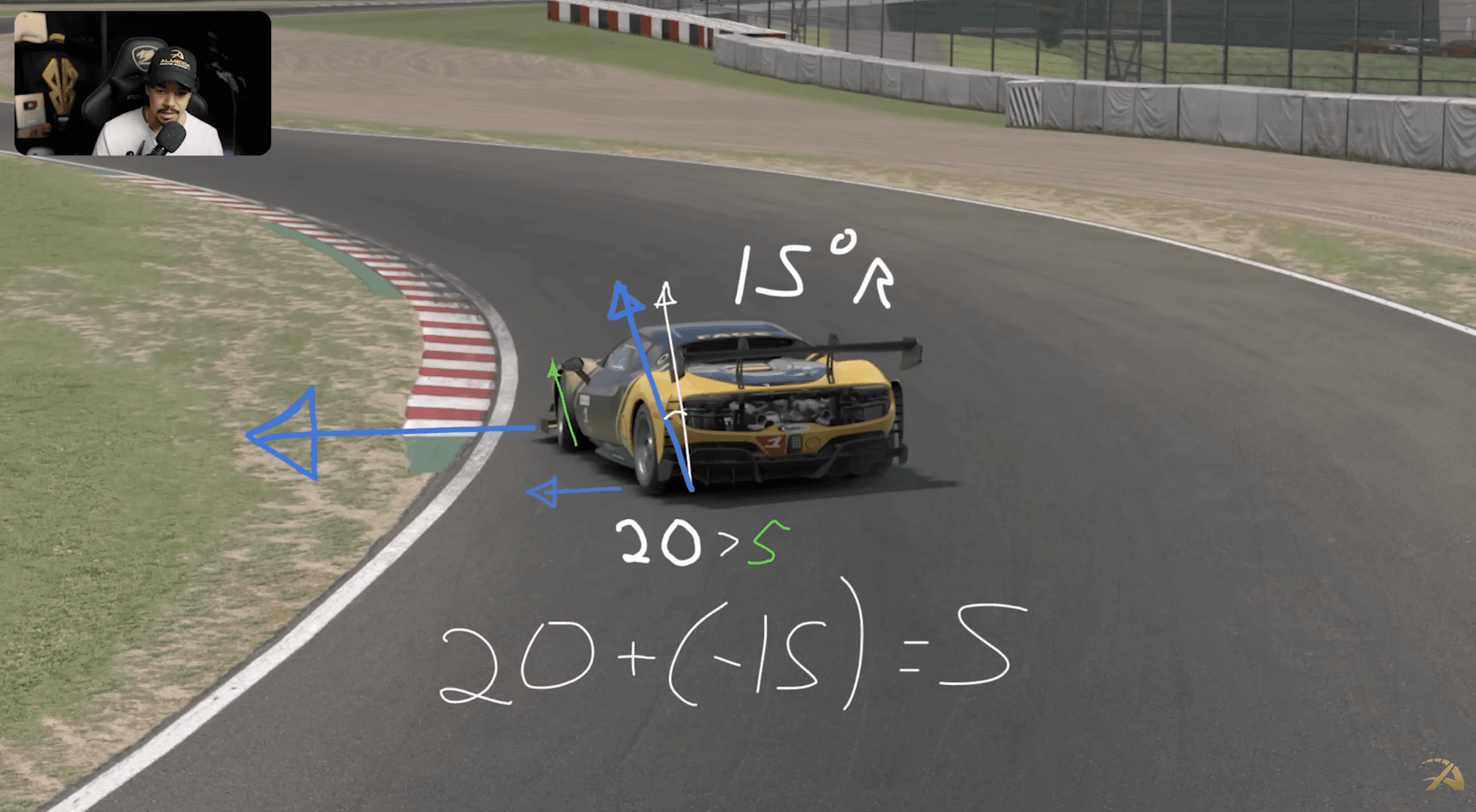
An active driver is a driver that is constantly chasing rotation and then managing it. As mentioned previously, the limit of neutral steer is never self-balancing. It's very difficult to stay on it because it's always running away from you. It's a moving target.
An active driver continuously makes adjustments throughout the corner:
Adjusting your speed of steering
Adjusting the speed of the brake release
Adjusting for balance
Adjusting even the downshift (which affects the balance of the car)
You're constantly doing those adjustments all the way from initial turn in until power application, and even after getting to power, you're also doing adjustments and trying to stay in the neutral steer.
The Active Driver's Mindset
An active driver is one that's never satisfied with that amount of rotation and always wants more until the car starts complaining through that neutral steer almost becoming a little bit too much oversteer. Obviously depending on the tire you don't want to be too aggressive because you might overheat the tires and everything, but you want to have the ability to overdrive the car and do lots of laps over driving and then to back off a little bit from that. So you have to learn how to get on that edge and how to really be always chasing, chasing, chasing rotation non-stop.
Performance Comparison
An active driver will find lap times way more easy even if at first the active driver is a little bit less consistent, but the longer you spend on the limit the longer you learn how to stay on it.
A passive driver is always slightly under the limit and then when the limit happens, oh big problem because the passive driver didn't learn how to deal with that limit and ended up being surprised by it and didn't know how to correct it. So a passive driver is good and consistent until something bad happens, until they overdrive a little bit because they're not trained for it.
An active driver is always looking for that extra rotation and it's always kind of losing the car a little bit, but the active driver is always practicing being on the limit and improving the reaction times, improving the correction, improving everything to stay on that red line, to stay on that limit for as long as possible.
Moving Forward: Learning Corrections and Input Speeds
In order to stay on that nice limit we have to learn how to make corrections and what speeds we need to do them. The next topic will address the question: is smooth really fast? This leads into a discussion about input speeds.
Active Versus Passive Driving
Understanding the Passive Driver
A passive driver is one who waits, who will get into a nice predictable rotation and then will kind of wait for the car to turn into the corner. This driver will get on power and will kind of wait for the car to go all the way to the outside and that's it. Generally this is obviously carried through understeer, so if you get into a nice locked rotation where if you turn more the car there's nothing, that's understeer. If you accept that and you take that as your driving style, driving feels pretty easy and you're very consistent even, but that's passive. That means you're not actually getting that extra rotation that would put you a little bit on the edge of oversteer.
Understanding the Active Driver
An active driver is a driver that is constantly chasing rotation and then managing it. As mentioned previously, the limit of neutral steer is never self-balancing. It's very difficult to stay on it because it's always running away from you. It's a moving target.
An active driver continuously makes adjustments throughout the corner:
Adjusting your speed of steering
Adjusting the speed of the brake release
Adjusting for balance
Adjusting even the downshift (which affects the balance of the car)
You're constantly doing those adjustments all the way from initial turn in until power application, and even after getting to power, you're also doing adjustments and trying to stay in the neutral steer.
The Active Driver's Mindset
An active driver is one that's never satisfied with that amount of rotation and always wants more until the car starts complaining through that neutral steer almost becoming a little bit too much oversteer. Obviously depending on the tire you don't want to be too aggressive because you might overheat the tires and everything, but you want to have the ability to overdrive the car and do lots of laps over driving and then to back off a little bit from that. So you have to learn how to get on that edge and how to really be always chasing, chasing, chasing rotation non-stop.
Performance Comparison
An active driver will find lap times way more easy even if at first the active driver is a little bit less consistent, but the longer you spend on the limit the longer you learn how to stay on it.
A passive driver is always slightly under the limit and then when the limit happens, oh big problem because the passive driver didn't learn how to deal with that limit and ended up being surprised by it and didn't know how to correct it. So a passive driver is good and consistent until something bad happens, until they overdrive a little bit because they're not trained for it.
An active driver is always looking for that extra rotation and it's always kind of losing the car a little bit, but the active driver is always practicing being on the limit and improving the reaction times, improving the correction, improving everything to stay on that red line, to stay on that limit for as long as possible.
Moving Forward: Learning Corrections and Input Speeds
In order to stay on that nice limit we have to learn how to make corrections and what speeds we need to do them. The next topic will address the question: is smooth really fast? This leads into a discussion about input speeds.
Active Versus Passive Driving
Understanding the Passive Driver
A passive driver is one who waits, who will get into a nice predictable rotation and then will kind of wait for the car to turn into the corner. This driver will get on power and will kind of wait for the car to go all the way to the outside and that's it. Generally this is obviously carried through understeer, so if you get into a nice locked rotation where if you turn more the car there's nothing, that's understeer. If you accept that and you take that as your driving style, driving feels pretty easy and you're very consistent even, but that's passive. That means you're not actually getting that extra rotation that would put you a little bit on the edge of oversteer.
Understanding the Active Driver
An active driver is a driver that is constantly chasing rotation and then managing it. As mentioned previously, the limit of neutral steer is never self-balancing. It's very difficult to stay on it because it's always running away from you. It's a moving target.
An active driver continuously makes adjustments throughout the corner:
Adjusting your speed of steering
Adjusting the speed of the brake release
Adjusting for balance
Adjusting even the downshift (which affects the balance of the car)
You're constantly doing those adjustments all the way from initial turn in until power application, and even after getting to power, you're also doing adjustments and trying to stay in the neutral steer.
The Active Driver's Mindset
An active driver is one that's never satisfied with that amount of rotation and always wants more until the car starts complaining through that neutral steer almost becoming a little bit too much oversteer. Obviously depending on the tire you don't want to be too aggressive because you might overheat the tires and everything, but you want to have the ability to overdrive the car and do lots of laps over driving and then to back off a little bit from that. So you have to learn how to get on that edge and how to really be always chasing, chasing, chasing rotation non-stop.
Performance Comparison
An active driver will find lap times way more easy even if at first the active driver is a little bit less consistent, but the longer you spend on the limit the longer you learn how to stay on it.
A passive driver is always slightly under the limit and then when the limit happens, oh big problem because the passive driver didn't learn how to deal with that limit and ended up being surprised by it and didn't know how to correct it. So a passive driver is good and consistent until something bad happens, until they overdrive a little bit because they're not trained for it.
An active driver is always looking for that extra rotation and it's always kind of losing the car a little bit, but the active driver is always practicing being on the limit and improving the reaction times, improving the correction, improving everything to stay on that red line, to stay on that limit for as long as possible.
Moving Forward: Learning Corrections and Input Speeds
In order to stay on that nice limit we have to learn how to make corrections and what speeds we need to do them. The next topic will address the question: is smooth really fast? This leads into a discussion about input speeds.
Consistency & Confidence
Balance & Speed
Cornering Precision
Other Lessons