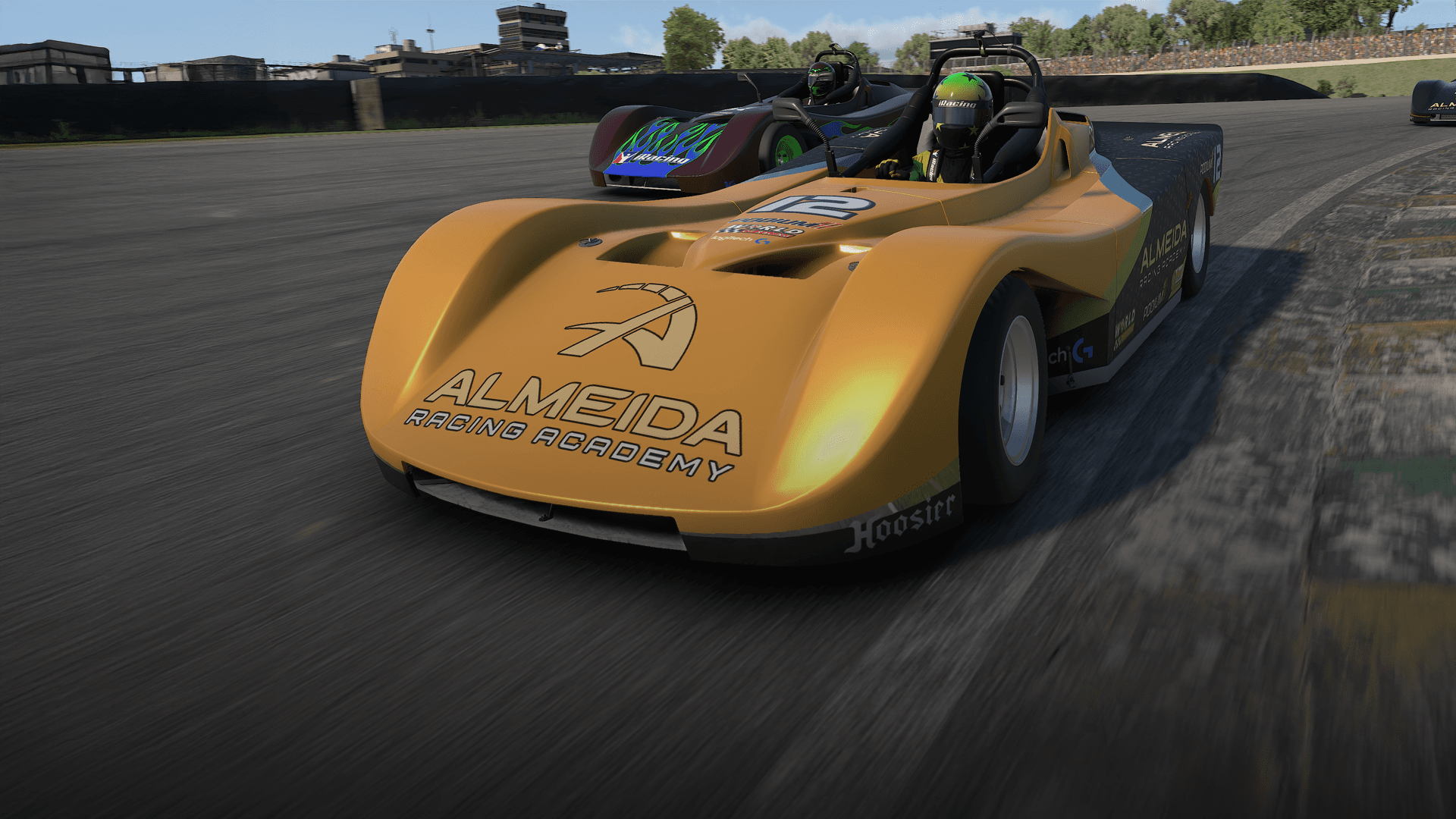
Corner Exits
Lesson
9
of
21

Lesson by
Suellio Almeida
Lesson by
Suellio Almeida
Mark as Finished
In the Maurice checklist I have a lesson where I teach how accelerating and the timing of acceleration determines the line on the exit more than simply unwinding the wheel. That's super important. I always say that the worst thing you can do that will hide your bad habits is to unwind the steering wheel on purpose just to show others that you're using all the track. Instead you want to accelerate earlier and inertia is going to do the job for you to push the car all the way to the outside whether you want it or not. This is the fastest way because the speed that is carrying you is the speed that will give you lap times. In racecraft that is exactly the same thing. You want to accelerate earlier to use all the track. You don't want to unwind the steering wheel to use all the track. If you do that you carry less speed and you know that track position is key.
Carrying Speed vs. Using Track
Everyone says you have to always use as much of the track as possible. I don't like to put it this way. Instead here's how I like to say it: Try to carry as much speed as possible out of the corner so that inertia will take your car all the way outside on exit. Inertia is a keyword here.
Using all the track because of inertia because you're carrying a lot of speed is good. Using all the track because you're just artificially unwinding your steering wheel is bad. If you've been told that you should use all the track, especially as a beginner, you end up doing that before you try to carry more speed. And it definitely does feel a little bit wrong and inefficient, confusing. It just doesn't work when it comes to lap times or position. I mean you can literally drive at one kilometer per hour and still use all the track.
Now I'm telling you to carry more speed. You will carry more speed and consequently use more of the track on exit. Assuming of course that you know how to control the balance of the car while on power, which I talk about in my first line course about car handling, track position is key. And if you want to gain an advantage on the corner exit, you have to time your throttle to carry as much speed as possible. And as a consequence, you will use more track on the exit.
You see, there's a lot of other things that come before you using all the track. You using all the track is going to be a way to measure it, but it should not be the goal. That's just a thought process to make you more efficient in your driving. And this is why this lesson is so important.
Throttle Timing Determines Track Position
The tool that you will use to determine how much space you give to your opponent if you're on the inside is the timing of the throttle. I will say it again with other words: You will determine how wide your car will go on exit by how early or late you accelerate.
So let's go back to that example where you could potentially clear yourself on the exit when fighting for position on the inside. This could only work if you time your throttle perfectly. If you delay your throttle just a little bit, but just unwind the wheel to artificially use all the track on exit, you will just not carry as much speed as possible on exit and you will not have the track position advantage. That means the guy is going to still be there. And if he continues to maintain the overlap by the exit of that corner, you're going to carry that battle again for the next corner and you lose more time.
If you don't apply this lesson perfectly, all the other battles for position techniques and lessons in this course will be just much more difficult because this is the way to finish the move. Because of that, pay attention. And I will say it again: The timing of your throttle should be the biggest factor to determine how wide your car will go on exit.
Of course, remember that you need to generate that healthy rotation before power so that you have a good angle by the time you start accelerating. If you just try to accelerate too early, but you forgot to rotate the car, then you're just going to hit your opponent anyways.
When You're on the Outside
Now, what if you're on the outside? Same thing. You want to use as much of the exit, the physical exit of the track as possible. And to do that effectively, you have to time your throttle application to send the car super wide and gain advantage on track position and exit speed. In this case, being on the outside, your limit is not the car, but just the track limit.
Track Limits
So what about track limits? Remember that different series have different rulings on track limits. And it's even more important to understand how much of these you can exploit. Always push track limits as much as possible. It will only allow you to carry more speed.
In iRacing, for example, there will be places where going off track, in case it's not like grass or a wall, will only give you a 1x incident, like an off track penalty, but not a slow down penalty. In this case, you can literally trade a 1x incident penalty for a position. And if you can take care of your incident points, this is definitely a great trade. A lot of people do that. It's a little bit on the limit of the law. It's actually kind of tricky, but you will see on top splits, a lot of people doing that, a lot of people taking care of their incident points, because they know they can use like 17x, 16x, and they just use them when they're fighting for position.
They go a little bit wide. It's right on the gray zone. They're not really abusing and going all the way to the outside just to gain track position. No, because if you do that, you're going to be protested and people are going to ban you. But it's not that, it's a little bit more. We're talking about a tenth or two tenths more. You go a little bit wide, say, exiting the last corner at Spa. If you get back on power and go a little bit over the green, get an off track, but you're like not so wide. That's how you can exploit that rule. Get an incident point and pass someone on the outside. But you have to be careful, because if you do it in a very obvious way, people are going to protest and you're going to be penalized.
The Mental Factor
One big, big factor in this entire throttle timing thing is actually mental. So I see a lot of drivers being overwhelmed and scared during fights for position and they end up just not accelerating on the ideal time because they're afraid of crashing. You're afraid of making a mistake. And this is why you should practice being aggressive with your applications, while of course doing pit parties. Because during actual races, it's actually very difficult to identify why you accelerated later, so try to be very open to analyze your replays and take notes on your racecraft mistakes in corner exits as well.
Examples
Example 1: Not Ideal Track Position
First example, we have not ideal track position. Then we gain track position right here, but we realize that the car is a little bit too fast and we can't go to this little space that we wanted here. So now, we're a little bit wide. We end up delaying our acceleration. And now we are at a very bad spot here for carrying more speed and gaining track position at this spot. So we know that more or less here now the driver on the inside has a much wider line. He is going to recover some of that track position as he does here. And we find ourselves right now at this spot.
So here that track position is not good enough for you to clear yourself. So what you want to do is time your throttle to give one car space. So you're going to time your throttle and get your car more or less here. You will not want to let the car run wide because if you do, this happens. So as you can see here, this moment is when you realize that the throttle timing has to respect the fact that you will have to leave one car space. Because if you try to just force it with this track position, you are at fault and you will cause a crash and it's going to be your fault.
Example 2: Good Rotation and Track Position
Now a different scenario is when we do get some good rotation here and now we carry some good speed. We change direction and we are now with a lot of track position advantage. So in this situation, we can definitely try to accelerate earlier and clear yourself and let the car run wide all the way to the exit so that you can finish the battle as early as possible. As you can see here, this side to accelerate early is a good decision because you will just finish that move and keep going with your life. If you don't spin, of course.
Example 3: 50/50 Situation
And then we have a situation of 50/50 where it's a very high risk to try to accelerate earlier to use all the track. So you have to be very careful. If it's the last lap, maybe you can try to risk it. But in this situation, we have a 50/50 scenario where the car is a little bit ahead, but not enough to be a safe move to accelerate thinking of just using all the track on the exit. Here, Kane tried it and it barely worked. As you can see, there was a micro-contact there. Actually, it was not a contact. He just scared off the opponent and he had to touch the brakes a little bit. That's why you can see his car pointing more to the right because of the weight transfer.
But that's the kind of thing that when you find yourself in this position, you have to time your throttle to, one, use all the track and finish the move or be a little bit on the safe side, get back on power, not here, but here, and then leave one car space.
Example 4: Early Throttle Application
This is another very good scenario where, first of all, on entry, not leaving too much space, turning in, and then here what happens is that the driver on the outside kind of turned in a little bit earlier than the driver on the inside expected. But then he went a little bit wide here. So now we have a very good situation to accelerate early and try to let the car run as wide as possible. Of course, here, he knew that with this track position, he is not going to be able to accelerate super early and go all the way to the outside. So he accelerated as early as possible while still leaving one car space.
And what's defining that one car space here? Again, it's not the steering. It's the throttle application timing that he used with one car space in mind for the exit. This is a very tricky thing to do. Like, this is actually real high level racecraft here. It's very dangerous to do it. But you become safer and safer as you understand that the timing of your throttle determines the exit usage more, even more than the steering. So you understand that, then you have a lot more control of your exit track usage in very tricky, high risk scenarios like this one.
Example 5: Surprising the Opponent
This is a very interesting one where the reason here to finish the fight early was to accelerate as early as you can hear more than the driver on the outside expected so that you compromise what would be the ideal line here. Right now, the ideal line is being right here. You want to actually not go wide. You don't want to use this. You want to apex very late on this corner before. You want to stay doing this line here. And what this driver did was to completely abort his plan in order to get that artificial track position and just block the driver behind earlier.
So it's a very tricky one to do. Right here, both drivers are expected to do a very tight line here. But then this driver didn't want to be on the outside for this corner. So what he wanted to do is instead of accelerating more or less here, which is where we generally apex in this corner, he got back on power ultra early and surprised this driver. And he went super wide now, cleared himself. And now he has a nice clear run for the exit on this one. And he finished the move.
It's funny because you can even hear that as he is gaining back on power, the driver on the outside, it's still down shifting. So that's to prove how he was really expecting to get back on power around here. So this driver got back on power here. And this driver got back on power here. Of course, because of this large distance between the throttle application points, this driver used inertia to his advantage. Lots of track position, cleared himself. Of course, sacrificed his line here, but he just finished that move early. And this driver behind like was so surprised with that kind of move that he didn't even have time to come back and try something. The move was done.
Example 6: Inverted Situation
And here's the inverted situation where both drivers are taking the, say, expected line of staying a little bit more to the inside here so that they can prepare this corner. But then they are both carrying the fight to the next corner as well. And then in this situation, right now, the driver currently on the inside gets the advantage, gets back on power earlier. Of course, there's a little bit of kind of like brushing here. And because of that, the driver on the outside also loses a little bit his line, as you can see.
I think it's more or less kind of his fault, because why not go here? Why not go to the wide line and try to carry that? He kind of went around here left a little bit too much space. And because of the little contact that there was, he ended up losing right now a little bit of balance here. And now his car is pointing that way while this car is pointing this way. And like I told you, if you get enough early rotation, you can accelerate earlier. And because of that, now the fact that this car is pointing more to the left and this car is pointing more to the right allows the car on the inside to accelerate earlier, because he has already done that good amount of rotation. His car is ready to accelerate, and he gets a lot more track position on the exit and finishes the move.
Example 7: Being Too Cautious
This example, it's kind of a bonus. It's essentially to show you that if you're a little bit too cautious, and you're so fixated on not crashing, so fixated on giving enough space, you end up over slowing. So here a little bit too much space. And then right here, you can't really accelerate because you're forcing the car so much to the right, you're trying to leave that lovely space to the opponent, but you end up sacrificing your line a little bit too much. You don't get the track position.
So right now you're carrying that fight to one more corner, and then you're carrying that fight to one more corner, and you continue losing time for so long, because you ended up panicking a little bit around this corner right here. So a best scenario here is to just not give that much space, try to carry as much speed as possible and clear yourself in one corner by using the throttle timing, by of course preparing a good situation that allows you to use that throttle timing so you can get the track position for good by the time you get to the esses.
In the Maurice checklist I have a lesson where I teach how accelerating and the timing of acceleration determines the line on the exit more than simply unwinding the wheel. That's super important. I always say that the worst thing you can do that will hide your bad habits is to unwind the steering wheel on purpose just to show others that you're using all the track. Instead you want to accelerate earlier and inertia is going to do the job for you to push the car all the way to the outside whether you want it or not. This is the fastest way because the speed that is carrying you is the speed that will give you lap times. In racecraft that is exactly the same thing. You want to accelerate earlier to use all the track. You don't want to unwind the steering wheel to use all the track. If you do that you carry less speed and you know that track position is key.
Carrying Speed vs. Using Track
Everyone says you have to always use as much of the track as possible. I don't like to put it this way. Instead here's how I like to say it: Try to carry as much speed as possible out of the corner so that inertia will take your car all the way outside on exit. Inertia is a keyword here.
Using all the track because of inertia because you're carrying a lot of speed is good. Using all the track because you're just artificially unwinding your steering wheel is bad. If you've been told that you should use all the track, especially as a beginner, you end up doing that before you try to carry more speed. And it definitely does feel a little bit wrong and inefficient, confusing. It just doesn't work when it comes to lap times or position. I mean you can literally drive at one kilometer per hour and still use all the track.
Now I'm telling you to carry more speed. You will carry more speed and consequently use more of the track on exit. Assuming of course that you know how to control the balance of the car while on power, which I talk about in my first line course about car handling, track position is key. And if you want to gain an advantage on the corner exit, you have to time your throttle to carry as much speed as possible. And as a consequence, you will use more track on the exit.
You see, there's a lot of other things that come before you using all the track. You using all the track is going to be a way to measure it, but it should not be the goal. That's just a thought process to make you more efficient in your driving. And this is why this lesson is so important.
Throttle Timing Determines Track Position
The tool that you will use to determine how much space you give to your opponent if you're on the inside is the timing of the throttle. I will say it again with other words: You will determine how wide your car will go on exit by how early or late you accelerate.
So let's go back to that example where you could potentially clear yourself on the exit when fighting for position on the inside. This could only work if you time your throttle perfectly. If you delay your throttle just a little bit, but just unwind the wheel to artificially use all the track on exit, you will just not carry as much speed as possible on exit and you will not have the track position advantage. That means the guy is going to still be there. And if he continues to maintain the overlap by the exit of that corner, you're going to carry that battle again for the next corner and you lose more time.
If you don't apply this lesson perfectly, all the other battles for position techniques and lessons in this course will be just much more difficult because this is the way to finish the move. Because of that, pay attention. And I will say it again: The timing of your throttle should be the biggest factor to determine how wide your car will go on exit.
Of course, remember that you need to generate that healthy rotation before power so that you have a good angle by the time you start accelerating. If you just try to accelerate too early, but you forgot to rotate the car, then you're just going to hit your opponent anyways.
When You're on the Outside
Now, what if you're on the outside? Same thing. You want to use as much of the exit, the physical exit of the track as possible. And to do that effectively, you have to time your throttle application to send the car super wide and gain advantage on track position and exit speed. In this case, being on the outside, your limit is not the car, but just the track limit.
Track Limits
So what about track limits? Remember that different series have different rulings on track limits. And it's even more important to understand how much of these you can exploit. Always push track limits as much as possible. It will only allow you to carry more speed.
In iRacing, for example, there will be places where going off track, in case it's not like grass or a wall, will only give you a 1x incident, like an off track penalty, but not a slow down penalty. In this case, you can literally trade a 1x incident penalty for a position. And if you can take care of your incident points, this is definitely a great trade. A lot of people do that. It's a little bit on the limit of the law. It's actually kind of tricky, but you will see on top splits, a lot of people doing that, a lot of people taking care of their incident points, because they know they can use like 17x, 16x, and they just use them when they're fighting for position.
They go a little bit wide. It's right on the gray zone. They're not really abusing and going all the way to the outside just to gain track position. No, because if you do that, you're going to be protested and people are going to ban you. But it's not that, it's a little bit more. We're talking about a tenth or two tenths more. You go a little bit wide, say, exiting the last corner at Spa. If you get back on power and go a little bit over the green, get an off track, but you're like not so wide. That's how you can exploit that rule. Get an incident point and pass someone on the outside. But you have to be careful, because if you do it in a very obvious way, people are going to protest and you're going to be penalized.
The Mental Factor
One big, big factor in this entire throttle timing thing is actually mental. So I see a lot of drivers being overwhelmed and scared during fights for position and they end up just not accelerating on the ideal time because they're afraid of crashing. You're afraid of making a mistake. And this is why you should practice being aggressive with your applications, while of course doing pit parties. Because during actual races, it's actually very difficult to identify why you accelerated later, so try to be very open to analyze your replays and take notes on your racecraft mistakes in corner exits as well.
Examples
Example 1: Not Ideal Track Position
First example, we have not ideal track position. Then we gain track position right here, but we realize that the car is a little bit too fast and we can't go to this little space that we wanted here. So now, we're a little bit wide. We end up delaying our acceleration. And now we are at a very bad spot here for carrying more speed and gaining track position at this spot. So we know that more or less here now the driver on the inside has a much wider line. He is going to recover some of that track position as he does here. And we find ourselves right now at this spot.
So here that track position is not good enough for you to clear yourself. So what you want to do is time your throttle to give one car space. So you're going to time your throttle and get your car more or less here. You will not want to let the car run wide because if you do, this happens. So as you can see here, this moment is when you realize that the throttle timing has to respect the fact that you will have to leave one car space. Because if you try to just force it with this track position, you are at fault and you will cause a crash and it's going to be your fault.
Example 2: Good Rotation and Track Position
Now a different scenario is when we do get some good rotation here and now we carry some good speed. We change direction and we are now with a lot of track position advantage. So in this situation, we can definitely try to accelerate earlier and clear yourself and let the car run wide all the way to the exit so that you can finish the battle as early as possible. As you can see here, this side to accelerate early is a good decision because you will just finish that move and keep going with your life. If you don't spin, of course.
Example 3: 50/50 Situation
And then we have a situation of 50/50 where it's a very high risk to try to accelerate earlier to use all the track. So you have to be very careful. If it's the last lap, maybe you can try to risk it. But in this situation, we have a 50/50 scenario where the car is a little bit ahead, but not enough to be a safe move to accelerate thinking of just using all the track on the exit. Here, Kane tried it and it barely worked. As you can see, there was a micro-contact there. Actually, it was not a contact. He just scared off the opponent and he had to touch the brakes a little bit. That's why you can see his car pointing more to the right because of the weight transfer.
But that's the kind of thing that when you find yourself in this position, you have to time your throttle to, one, use all the track and finish the move or be a little bit on the safe side, get back on power, not here, but here, and then leave one car space.
Example 4: Early Throttle Application
This is another very good scenario where, first of all, on entry, not leaving too much space, turning in, and then here what happens is that the driver on the outside kind of turned in a little bit earlier than the driver on the inside expected. But then he went a little bit wide here. So now we have a very good situation to accelerate early and try to let the car run as wide as possible. Of course, here, he knew that with this track position, he is not going to be able to accelerate super early and go all the way to the outside. So he accelerated as early as possible while still leaving one car space.
And what's defining that one car space here? Again, it's not the steering. It's the throttle application timing that he used with one car space in mind for the exit. This is a very tricky thing to do. Like, this is actually real high level racecraft here. It's very dangerous to do it. But you become safer and safer as you understand that the timing of your throttle determines the exit usage more, even more than the steering. So you understand that, then you have a lot more control of your exit track usage in very tricky, high risk scenarios like this one.
Example 5: Surprising the Opponent
This is a very interesting one where the reason here to finish the fight early was to accelerate as early as you can hear more than the driver on the outside expected so that you compromise what would be the ideal line here. Right now, the ideal line is being right here. You want to actually not go wide. You don't want to use this. You want to apex very late on this corner before. You want to stay doing this line here. And what this driver did was to completely abort his plan in order to get that artificial track position and just block the driver behind earlier.
So it's a very tricky one to do. Right here, both drivers are expected to do a very tight line here. But then this driver didn't want to be on the outside for this corner. So what he wanted to do is instead of accelerating more or less here, which is where we generally apex in this corner, he got back on power ultra early and surprised this driver. And he went super wide now, cleared himself. And now he has a nice clear run for the exit on this one. And he finished the move.
It's funny because you can even hear that as he is gaining back on power, the driver on the outside, it's still down shifting. So that's to prove how he was really expecting to get back on power around here. So this driver got back on power here. And this driver got back on power here. Of course, because of this large distance between the throttle application points, this driver used inertia to his advantage. Lots of track position, cleared himself. Of course, sacrificed his line here, but he just finished that move early. And this driver behind like was so surprised with that kind of move that he didn't even have time to come back and try something. The move was done.
Example 6: Inverted Situation
And here's the inverted situation where both drivers are taking the, say, expected line of staying a little bit more to the inside here so that they can prepare this corner. But then they are both carrying the fight to the next corner as well. And then in this situation, right now, the driver currently on the inside gets the advantage, gets back on power earlier. Of course, there's a little bit of kind of like brushing here. And because of that, the driver on the outside also loses a little bit his line, as you can see.
I think it's more or less kind of his fault, because why not go here? Why not go to the wide line and try to carry that? He kind of went around here left a little bit too much space. And because of the little contact that there was, he ended up losing right now a little bit of balance here. And now his car is pointing that way while this car is pointing this way. And like I told you, if you get enough early rotation, you can accelerate earlier. And because of that, now the fact that this car is pointing more to the left and this car is pointing more to the right allows the car on the inside to accelerate earlier, because he has already done that good amount of rotation. His car is ready to accelerate, and he gets a lot more track position on the exit and finishes the move.
Example 7: Being Too Cautious
This example, it's kind of a bonus. It's essentially to show you that if you're a little bit too cautious, and you're so fixated on not crashing, so fixated on giving enough space, you end up over slowing. So here a little bit too much space. And then right here, you can't really accelerate because you're forcing the car so much to the right, you're trying to leave that lovely space to the opponent, but you end up sacrificing your line a little bit too much. You don't get the track position.
So right now you're carrying that fight to one more corner, and then you're carrying that fight to one more corner, and you continue losing time for so long, because you ended up panicking a little bit around this corner right here. So a best scenario here is to just not give that much space, try to carry as much speed as possible and clear yourself in one corner by using the throttle timing, by of course preparing a good situation that allows you to use that throttle timing so you can get the track position for good by the time you get to the esses.
In the Maurice checklist I have a lesson where I teach how accelerating and the timing of acceleration determines the line on the exit more than simply unwinding the wheel. That's super important. I always say that the worst thing you can do that will hide your bad habits is to unwind the steering wheel on purpose just to show others that you're using all the track. Instead you want to accelerate earlier and inertia is going to do the job for you to push the car all the way to the outside whether you want it or not. This is the fastest way because the speed that is carrying you is the speed that will give you lap times. In racecraft that is exactly the same thing. You want to accelerate earlier to use all the track. You don't want to unwind the steering wheel to use all the track. If you do that you carry less speed and you know that track position is key.
Carrying Speed vs. Using Track
Everyone says you have to always use as much of the track as possible. I don't like to put it this way. Instead here's how I like to say it: Try to carry as much speed as possible out of the corner so that inertia will take your car all the way outside on exit. Inertia is a keyword here.
Using all the track because of inertia because you're carrying a lot of speed is good. Using all the track because you're just artificially unwinding your steering wheel is bad. If you've been told that you should use all the track, especially as a beginner, you end up doing that before you try to carry more speed. And it definitely does feel a little bit wrong and inefficient, confusing. It just doesn't work when it comes to lap times or position. I mean you can literally drive at one kilometer per hour and still use all the track.
Now I'm telling you to carry more speed. You will carry more speed and consequently use more of the track on exit. Assuming of course that you know how to control the balance of the car while on power, which I talk about in my first line course about car handling, track position is key. And if you want to gain an advantage on the corner exit, you have to time your throttle to carry as much speed as possible. And as a consequence, you will use more track on the exit.
You see, there's a lot of other things that come before you using all the track. You using all the track is going to be a way to measure it, but it should not be the goal. That's just a thought process to make you more efficient in your driving. And this is why this lesson is so important.
Throttle Timing Determines Track Position
The tool that you will use to determine how much space you give to your opponent if you're on the inside is the timing of the throttle. I will say it again with other words: You will determine how wide your car will go on exit by how early or late you accelerate.
So let's go back to that example where you could potentially clear yourself on the exit when fighting for position on the inside. This could only work if you time your throttle perfectly. If you delay your throttle just a little bit, but just unwind the wheel to artificially use all the track on exit, you will just not carry as much speed as possible on exit and you will not have the track position advantage. That means the guy is going to still be there. And if he continues to maintain the overlap by the exit of that corner, you're going to carry that battle again for the next corner and you lose more time.
If you don't apply this lesson perfectly, all the other battles for position techniques and lessons in this course will be just much more difficult because this is the way to finish the move. Because of that, pay attention. And I will say it again: The timing of your throttle should be the biggest factor to determine how wide your car will go on exit.
Of course, remember that you need to generate that healthy rotation before power so that you have a good angle by the time you start accelerating. If you just try to accelerate too early, but you forgot to rotate the car, then you're just going to hit your opponent anyways.
When You're on the Outside
Now, what if you're on the outside? Same thing. You want to use as much of the exit, the physical exit of the track as possible. And to do that effectively, you have to time your throttle application to send the car super wide and gain advantage on track position and exit speed. In this case, being on the outside, your limit is not the car, but just the track limit.
Track Limits
So what about track limits? Remember that different series have different rulings on track limits. And it's even more important to understand how much of these you can exploit. Always push track limits as much as possible. It will only allow you to carry more speed.
In iRacing, for example, there will be places where going off track, in case it's not like grass or a wall, will only give you a 1x incident, like an off track penalty, but not a slow down penalty. In this case, you can literally trade a 1x incident penalty for a position. And if you can take care of your incident points, this is definitely a great trade. A lot of people do that. It's a little bit on the limit of the law. It's actually kind of tricky, but you will see on top splits, a lot of people doing that, a lot of people taking care of their incident points, because they know they can use like 17x, 16x, and they just use them when they're fighting for position.
They go a little bit wide. It's right on the gray zone. They're not really abusing and going all the way to the outside just to gain track position. No, because if you do that, you're going to be protested and people are going to ban you. But it's not that, it's a little bit more. We're talking about a tenth or two tenths more. You go a little bit wide, say, exiting the last corner at Spa. If you get back on power and go a little bit over the green, get an off track, but you're like not so wide. That's how you can exploit that rule. Get an incident point and pass someone on the outside. But you have to be careful, because if you do it in a very obvious way, people are going to protest and you're going to be penalized.
The Mental Factor
One big, big factor in this entire throttle timing thing is actually mental. So I see a lot of drivers being overwhelmed and scared during fights for position and they end up just not accelerating on the ideal time because they're afraid of crashing. You're afraid of making a mistake. And this is why you should practice being aggressive with your applications, while of course doing pit parties. Because during actual races, it's actually very difficult to identify why you accelerated later, so try to be very open to analyze your replays and take notes on your racecraft mistakes in corner exits as well.
Examples
Example 1: Not Ideal Track Position
First example, we have not ideal track position. Then we gain track position right here, but we realize that the car is a little bit too fast and we can't go to this little space that we wanted here. So now, we're a little bit wide. We end up delaying our acceleration. And now we are at a very bad spot here for carrying more speed and gaining track position at this spot. So we know that more or less here now the driver on the inside has a much wider line. He is going to recover some of that track position as he does here. And we find ourselves right now at this spot.
So here that track position is not good enough for you to clear yourself. So what you want to do is time your throttle to give one car space. So you're going to time your throttle and get your car more or less here. You will not want to let the car run wide because if you do, this happens. So as you can see here, this moment is when you realize that the throttle timing has to respect the fact that you will have to leave one car space. Because if you try to just force it with this track position, you are at fault and you will cause a crash and it's going to be your fault.
Example 2: Good Rotation and Track Position
Now a different scenario is when we do get some good rotation here and now we carry some good speed. We change direction and we are now with a lot of track position advantage. So in this situation, we can definitely try to accelerate earlier and clear yourself and let the car run wide all the way to the exit so that you can finish the battle as early as possible. As you can see here, this side to accelerate early is a good decision because you will just finish that move and keep going with your life. If you don't spin, of course.
Example 3: 50/50 Situation
And then we have a situation of 50/50 where it's a very high risk to try to accelerate earlier to use all the track. So you have to be very careful. If it's the last lap, maybe you can try to risk it. But in this situation, we have a 50/50 scenario where the car is a little bit ahead, but not enough to be a safe move to accelerate thinking of just using all the track on the exit. Here, Kane tried it and it barely worked. As you can see, there was a micro-contact there. Actually, it was not a contact. He just scared off the opponent and he had to touch the brakes a little bit. That's why you can see his car pointing more to the right because of the weight transfer.
But that's the kind of thing that when you find yourself in this position, you have to time your throttle to, one, use all the track and finish the move or be a little bit on the safe side, get back on power, not here, but here, and then leave one car space.
Example 4: Early Throttle Application
This is another very good scenario where, first of all, on entry, not leaving too much space, turning in, and then here what happens is that the driver on the outside kind of turned in a little bit earlier than the driver on the inside expected. But then he went a little bit wide here. So now we have a very good situation to accelerate early and try to let the car run as wide as possible. Of course, here, he knew that with this track position, he is not going to be able to accelerate super early and go all the way to the outside. So he accelerated as early as possible while still leaving one car space.
And what's defining that one car space here? Again, it's not the steering. It's the throttle application timing that he used with one car space in mind for the exit. This is a very tricky thing to do. Like, this is actually real high level racecraft here. It's very dangerous to do it. But you become safer and safer as you understand that the timing of your throttle determines the exit usage more, even more than the steering. So you understand that, then you have a lot more control of your exit track usage in very tricky, high risk scenarios like this one.
Example 5: Surprising the Opponent
This is a very interesting one where the reason here to finish the fight early was to accelerate as early as you can hear more than the driver on the outside expected so that you compromise what would be the ideal line here. Right now, the ideal line is being right here. You want to actually not go wide. You don't want to use this. You want to apex very late on this corner before. You want to stay doing this line here. And what this driver did was to completely abort his plan in order to get that artificial track position and just block the driver behind earlier.
So it's a very tricky one to do. Right here, both drivers are expected to do a very tight line here. But then this driver didn't want to be on the outside for this corner. So what he wanted to do is instead of accelerating more or less here, which is where we generally apex in this corner, he got back on power ultra early and surprised this driver. And he went super wide now, cleared himself. And now he has a nice clear run for the exit on this one. And he finished the move.
It's funny because you can even hear that as he is gaining back on power, the driver on the outside, it's still down shifting. So that's to prove how he was really expecting to get back on power around here. So this driver got back on power here. And this driver got back on power here. Of course, because of this large distance between the throttle application points, this driver used inertia to his advantage. Lots of track position, cleared himself. Of course, sacrificed his line here, but he just finished that move early. And this driver behind like was so surprised with that kind of move that he didn't even have time to come back and try something. The move was done.
Example 6: Inverted Situation
And here's the inverted situation where both drivers are taking the, say, expected line of staying a little bit more to the inside here so that they can prepare this corner. But then they are both carrying the fight to the next corner as well. And then in this situation, right now, the driver currently on the inside gets the advantage, gets back on power earlier. Of course, there's a little bit of kind of like brushing here. And because of that, the driver on the outside also loses a little bit his line, as you can see.
I think it's more or less kind of his fault, because why not go here? Why not go to the wide line and try to carry that? He kind of went around here left a little bit too much space. And because of the little contact that there was, he ended up losing right now a little bit of balance here. And now his car is pointing that way while this car is pointing this way. And like I told you, if you get enough early rotation, you can accelerate earlier. And because of that, now the fact that this car is pointing more to the left and this car is pointing more to the right allows the car on the inside to accelerate earlier, because he has already done that good amount of rotation. His car is ready to accelerate, and he gets a lot more track position on the exit and finishes the move.
Example 7: Being Too Cautious
This example, it's kind of a bonus. It's essentially to show you that if you're a little bit too cautious, and you're so fixated on not crashing, so fixated on giving enough space, you end up over slowing. So here a little bit too much space. And then right here, you can't really accelerate because you're forcing the car so much to the right, you're trying to leave that lovely space to the opponent, but you end up sacrificing your line a little bit too much. You don't get the track position.
So right now you're carrying that fight to one more corner, and then you're carrying that fight to one more corner, and you continue losing time for so long, because you ended up panicking a little bit around this corner right here. So a best scenario here is to just not give that much space, try to carry as much speed as possible and clear yourself in one corner by using the throttle timing, by of course preparing a good situation that allows you to use that throttle timing so you can get the track position for good by the time you get to the esses.
Racecraft Foundations
Racing Strategies
Psychology of Racing
Other Lessons