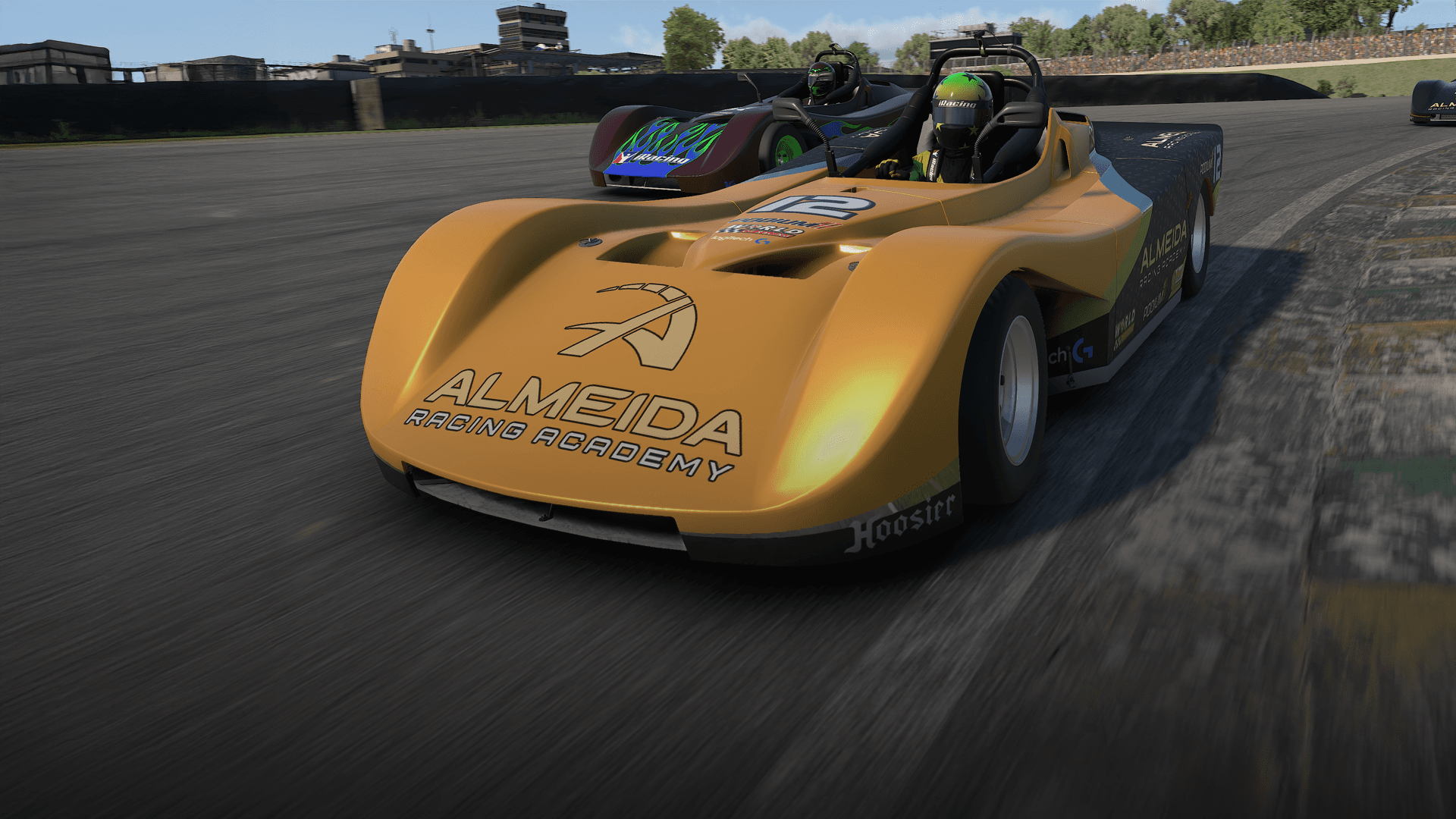
Battle Dynamics
Lesson
5
of
21

Lesson by
Suellio Almeida
Lesson by
Suellio Almeida
Mark as Finished
No matter if you're attacking or defending, just like cornering, anything in motorsports, you need to nail the initial conditions of a move to make it tick. On a battle for position, whatever you do on exit depends on whatever happens at the apex, and whatever happens at the apex depends on what you did on corner entry, which also depends on what you did on the braking, which also depends on what you did before braking, which depends on what you did on the last corner exit. When it comes to racecraft, moves can take several corners until they finally happen.
Track Position: The Foundation of Overtaking
The most important rule for overtaking is this: track position is key. By track position, we mean how far behind or ahead you are to your opponent, and how much overlap you have. This ranges from zero overlap, to some overlap, to a lot of overlap, to 50% overlap, and beyond.
For example, if we say "not enough track position," that means you're too far behind to make the overtake stick safely. The closer you are to the car ahead, and additionally, the more overlap you have by the time you start braking, the better track position you will have at the turning point and apex.
Understanding the Rules for Attacking on the Inside
You only have the right to the apex if you have at least half a car overlap. That's the former one rule. Remember the general rule: if you have a little bit of overlap, and the car on the outside wants to be safe, they will already start thinking about giving you space or not.
If you're the attacking car, you actually want to get as much track position as possible, so you can have a stronger claim to that apex. If you can't get your nose to at least the middle of the car ahead by the apex, there's a big chance the overtake will fail. The more overlap you have, and the earlier you get the overlap, the more chance you have of making the overtake work.
Building Track Position Through Multiple Corners
Track position is key. You want to focus on getting a better exit from the previous corner so that you can get as close as possible to the car ahead. Then you stay behind them as long as possible to benefit from their slipstream as much as you can. This will give you the extra speed that will become incredibly important into the braking zone and before the apex.
In our examples, we will be using a long straight before a braking zone, just so we have more time to think and analyze our moves. Shorter corners and chaining corners will give you a lot less time to think, but we'll get there as long as we understand the basics in this easier scenario first.
Attacking on the Inside
As the attacker, you depend on what line the defender will choose. If they are fully ahead of you on a straight before the next corner, they can move around whenever they want, wherever they want. They can choose to fully go all the way to the inside or to the middle or to the outside. Before you can do anything, you have to analyze what is going to be the decision of the defender.
Three Defensive Strategies
To put it in a very simplistic way, the defender can do three things:
They can stay on their line, essentially leaving the inside open
They can half defend, which is to move a little bit to the inside to try to discourage you from trying to overtake
They can fully defend, which is moving all the way and leaving no car space, so it's impossible for you to claim the inside
Half defending can be effective if the attacker is not super committed to the move or hesitant, but higher level drivers or more aggressive drivers generally don't fall into this trap. If they decide and commit that they want the inside, half defending is not going to work. The defender will have to go all the way to the inside to stand a chance against these drivers.
Executing the Inside Attack
For the next examples, let's say the defender is also beginning in sim racing and they don't know too much what to do, so they just stay on their racing line. In this case, your best choice as the attacker is to stay behind them to benefit from the draft until the last second, and then you pull the car to the inside before braking.
Because of the accordion effect you get from the slipstream, by the time you start braking into the corner, your car will naturally gain a little bit of track position if you brake at exactly the same place. Ideally, you want to already have some track position by the time you turn in, so that the defender sees that they can't just turn in into you.
Track position is key. If you don't have enough overlap, they might not see you and just turn into the apex, which will force you to yield and give up the position or will cause a crash. In this case, you would be at fault, so be careful with that.
If you have significant overlap by the turning point, you're in great position. They will most likely have already seen you and will give you one car space or more if they're beginners. And because you're on the inside line, you will go through a shorter distance and probably gain even more track position by the apex.
Corner Exit Decision Making
Now at this point, at the apex, you have to judge how much overlap you both have and use that as a reference to what you will do on the exit. On corner exit, you have two choices:
Choice One: Leave one car space at the exit of the corner on the outside. If the defender is capable of maintaining their overlap with you, then you both get out of the corner without contact. Although this is the safest option, it's definitely not ideal for you as the attacker, because not using all the track means you will get a slower exit and you will lose a lot of time and track position, and you will potentially have to fight again in the next corner, making you both lose way too much time in a race.
Choice Two: Accelerate early and gain even more track position until you eventually clear yourself. Clearing yourself means being 100% ahead of the defender with no overlap so that you can use all the track on exit without having any contact.
The Risk Scale of Early Acceleration
This move has a sliding scale of risk depending on track position. If you're 100% side by side right before the apex, accelerating early and using all the track guarantees that you will crash or push your opponent off track. If you're 50% ahead, then you're in the risky area where you have to decide fast if you will accelerate early and track out or not.
There's a huge dilemma here with commitment. If you want to track out and use all the track, you have to commit early to this move. You have to commit early to the throttle to get that boost in speed and get even more track position. If you're not sure that you can do it, you can easily pit maneuver yourself and spin or crash both of you. Hesitation is a big problem in this scenario.
Again, track position is key. The better your track position, the safer your move will be and the better the chances that you can get out ahead. That's why setting up the passes is important. If you start with good position relative to your opponent, then you will carry that benefit throughout the entire overtaking process.
Attacking on the Outside
Now let's say your opponent didn't like the idea of you passing them on the inside like that. Now they're improving their racecraft and they want to defend more actively. So let's reset the same overtaking scenario. You got a good exit on the corner before, tuck behind on the draft and wait to get your car sucked up and get more speed in the straight. But now the defender is moving to the inside before the braking zone. They will not let you get the inside line anymore. Now you only have one choice: attack on the outside.
Now instead of leaving a car space on entry and exit like when you were on the inside, you will actually use all the track on the entry outside and on the exit outside, only leaving a car space for them on the apex, which is the inside part of the whole process. It's definitely more tricky to overtake on the outside, but it's still possible and there will be some tricks we can do to make it more doable.
You know that the closer we are to the ideal racing line, the more speed we will be able to carry. So now let's assume two scenarios based on the defender's lateral positioning of the car during their defense.
Scenario One: Defender Stays All the Way Inside
They go all the way to the inside and stay there until the braking zone. It's very normal for beginners. In this situation, which is actually quite common, the defending driver is giving you just too much space on the outside. You have the benefit of doing a much wider radius.
So it's your opportunity to try and carry the most speed possible on the outside, and here's the catch: you can only benefit from the situation if you're able to do the best line for you, which is—in case they're still there on the inside—to give only one car space at the apex. This way, you can carry much more speed than them because their line is going to be super tight and your line is going to be all over the corner, and you can stay ahead at the exit.
By turn end though, it's possible that they brake super ultra duper late and they cannot get the car stopped enough past the apex. If you see this happening, you can't just try to do the one car space at the apex line since they would crash into you. They have no control, they're too fast, they are now carrying that extra speed, they're desperately trying to slow down the car.
Experience will give you the hints on when they won't be able to do the corner if they brake too late. In this case, you will want to delay your turning point a little bit more. You're going to wait and then you will just watch your opponent sliding past the apex and getting a poor exit, and then you turn in and accelerate to get a much better exit speed and easily pass them afterwards.
Scenario Two: Defender Opens Up to Improve Their Line
The second scenario is when the defending driver is tired of having bad lines on the inside and decides to open up slightly to improve their own line before the corner. This means the driver doesn't let you simply use all the track while maintaining a bad line for themselves on the inside.
This is generally the worst situation possible for the attacker because the defender will get easy track position on the inside if they do it right. This is why overtaking on the outside in high level competitions like Formula 1 is seen as an amazing move, because when the defender is literally a Formula 1 driver, this kind of overtaking becomes very difficult.
At this point, the only thing you can really do is try to get the most speed possible while giving one car space. There's not really anything else that you can do at this point.
Advanced Defensive Positioning
Things actually get more complicated than that though. Let's think about the one move rule again. It says that if you move to the inside, you cannot move back. Yes, but if there is space, if there's already overlap, you can actually use this room. This does not breach the one move rule because you can go and optimize your line without creating contact. It will only breach the one move rule if you actually push the driver off.
So you can move a little bit under braking if you're not invading the space of the other driver. Even though the one move rule exists, it's for clear changes of lanes, not for those tiny little adjustments.
The Diagonal Braking Defense
As a defender, the most effective move is to go all the way to the inside to prevent aggressive noses and then brake almost diagonally outwards so you can optimize your line on the inside and have a better run through the corner.
But here's the thing: if the driver on the outside chooses to stay on the middle of the track, the driver on the inside cannot move outwards or they will cause a crash and it's going to be their fault. As the driver on the outside, you can choose to squeeze the driver on the inside for as long as you want and even turn in from there.
This sounds almost aggressive, but it is legal. Of course, this is a very aggressive kind of move that will make everyone involved lose a lot of time, so doing that in a race might have its own side effects.
The Squeeze and Release Technique
Generally, what happens is that the good attacker will squeeze the defender until the last second and then they will move out to open up their line for the corner, leaving no time for the defender to react and also open up more. This way, the driver on the outside will have more chances of making the overtake stick.
As a defender, you can try to predict when the driver on the outside will open up for their line. But if you try to move to the outside and you hit them, it's your fault.
Conclusion: The Complexity of Overtaking
Now you start seeing how many variables there are in an overtaking situation. Each fraction of a second, a totally different outcome might happen because of both drivers' choices. Just by knowing this, you will be ahead of thousands of competitors that just race around without trying to exploit every racecraft rule there is out there.
But to get really good at all this, you need to practice as much as possible with teammates or even opponents in practices and races. You can also use AI races to practice these moves. In the next lesson, we're going to analyze a bunch of replays and try to use whatever we discussed in this lesson to identify these subtle moves and decisions throughout the battles.
No matter if you're attacking or defending, just like cornering, anything in motorsports, you need to nail the initial conditions of a move to make it tick. On a battle for position, whatever you do on exit depends on whatever happens at the apex, and whatever happens at the apex depends on what you did on corner entry, which also depends on what you did on the braking, which also depends on what you did before braking, which depends on what you did on the last corner exit. When it comes to racecraft, moves can take several corners until they finally happen.
Track Position: The Foundation of Overtaking
The most important rule for overtaking is this: track position is key. By track position, we mean how far behind or ahead you are to your opponent, and how much overlap you have. This ranges from zero overlap, to some overlap, to a lot of overlap, to 50% overlap, and beyond.
For example, if we say "not enough track position," that means you're too far behind to make the overtake stick safely. The closer you are to the car ahead, and additionally, the more overlap you have by the time you start braking, the better track position you will have at the turning point and apex.
Understanding the Rules for Attacking on the Inside
You only have the right to the apex if you have at least half a car overlap. That's the former one rule. Remember the general rule: if you have a little bit of overlap, and the car on the outside wants to be safe, they will already start thinking about giving you space or not.
If you're the attacking car, you actually want to get as much track position as possible, so you can have a stronger claim to that apex. If you can't get your nose to at least the middle of the car ahead by the apex, there's a big chance the overtake will fail. The more overlap you have, and the earlier you get the overlap, the more chance you have of making the overtake work.
Building Track Position Through Multiple Corners
Track position is key. You want to focus on getting a better exit from the previous corner so that you can get as close as possible to the car ahead. Then you stay behind them as long as possible to benefit from their slipstream as much as you can. This will give you the extra speed that will become incredibly important into the braking zone and before the apex.
In our examples, we will be using a long straight before a braking zone, just so we have more time to think and analyze our moves. Shorter corners and chaining corners will give you a lot less time to think, but we'll get there as long as we understand the basics in this easier scenario first.
Attacking on the Inside
As the attacker, you depend on what line the defender will choose. If they are fully ahead of you on a straight before the next corner, they can move around whenever they want, wherever they want. They can choose to fully go all the way to the inside or to the middle or to the outside. Before you can do anything, you have to analyze what is going to be the decision of the defender.
Three Defensive Strategies
To put it in a very simplistic way, the defender can do three things:
They can stay on their line, essentially leaving the inside open
They can half defend, which is to move a little bit to the inside to try to discourage you from trying to overtake
They can fully defend, which is moving all the way and leaving no car space, so it's impossible for you to claim the inside
Half defending can be effective if the attacker is not super committed to the move or hesitant, but higher level drivers or more aggressive drivers generally don't fall into this trap. If they decide and commit that they want the inside, half defending is not going to work. The defender will have to go all the way to the inside to stand a chance against these drivers.
Executing the Inside Attack
For the next examples, let's say the defender is also beginning in sim racing and they don't know too much what to do, so they just stay on their racing line. In this case, your best choice as the attacker is to stay behind them to benefit from the draft until the last second, and then you pull the car to the inside before braking.
Because of the accordion effect you get from the slipstream, by the time you start braking into the corner, your car will naturally gain a little bit of track position if you brake at exactly the same place. Ideally, you want to already have some track position by the time you turn in, so that the defender sees that they can't just turn in into you.
Track position is key. If you don't have enough overlap, they might not see you and just turn into the apex, which will force you to yield and give up the position or will cause a crash. In this case, you would be at fault, so be careful with that.
If you have significant overlap by the turning point, you're in great position. They will most likely have already seen you and will give you one car space or more if they're beginners. And because you're on the inside line, you will go through a shorter distance and probably gain even more track position by the apex.
Corner Exit Decision Making
Now at this point, at the apex, you have to judge how much overlap you both have and use that as a reference to what you will do on the exit. On corner exit, you have two choices:
Choice One: Leave one car space at the exit of the corner on the outside. If the defender is capable of maintaining their overlap with you, then you both get out of the corner without contact. Although this is the safest option, it's definitely not ideal for you as the attacker, because not using all the track means you will get a slower exit and you will lose a lot of time and track position, and you will potentially have to fight again in the next corner, making you both lose way too much time in a race.
Choice Two: Accelerate early and gain even more track position until you eventually clear yourself. Clearing yourself means being 100% ahead of the defender with no overlap so that you can use all the track on exit without having any contact.
The Risk Scale of Early Acceleration
This move has a sliding scale of risk depending on track position. If you're 100% side by side right before the apex, accelerating early and using all the track guarantees that you will crash or push your opponent off track. If you're 50% ahead, then you're in the risky area where you have to decide fast if you will accelerate early and track out or not.
There's a huge dilemma here with commitment. If you want to track out and use all the track, you have to commit early to this move. You have to commit early to the throttle to get that boost in speed and get even more track position. If you're not sure that you can do it, you can easily pit maneuver yourself and spin or crash both of you. Hesitation is a big problem in this scenario.
Again, track position is key. The better your track position, the safer your move will be and the better the chances that you can get out ahead. That's why setting up the passes is important. If you start with good position relative to your opponent, then you will carry that benefit throughout the entire overtaking process.
Attacking on the Outside
Now let's say your opponent didn't like the idea of you passing them on the inside like that. Now they're improving their racecraft and they want to defend more actively. So let's reset the same overtaking scenario. You got a good exit on the corner before, tuck behind on the draft and wait to get your car sucked up and get more speed in the straight. But now the defender is moving to the inside before the braking zone. They will not let you get the inside line anymore. Now you only have one choice: attack on the outside.
Now instead of leaving a car space on entry and exit like when you were on the inside, you will actually use all the track on the entry outside and on the exit outside, only leaving a car space for them on the apex, which is the inside part of the whole process. It's definitely more tricky to overtake on the outside, but it's still possible and there will be some tricks we can do to make it more doable.
You know that the closer we are to the ideal racing line, the more speed we will be able to carry. So now let's assume two scenarios based on the defender's lateral positioning of the car during their defense.
Scenario One: Defender Stays All the Way Inside
They go all the way to the inside and stay there until the braking zone. It's very normal for beginners. In this situation, which is actually quite common, the defending driver is giving you just too much space on the outside. You have the benefit of doing a much wider radius.
So it's your opportunity to try and carry the most speed possible on the outside, and here's the catch: you can only benefit from the situation if you're able to do the best line for you, which is—in case they're still there on the inside—to give only one car space at the apex. This way, you can carry much more speed than them because their line is going to be super tight and your line is going to be all over the corner, and you can stay ahead at the exit.
By turn end though, it's possible that they brake super ultra duper late and they cannot get the car stopped enough past the apex. If you see this happening, you can't just try to do the one car space at the apex line since they would crash into you. They have no control, they're too fast, they are now carrying that extra speed, they're desperately trying to slow down the car.
Experience will give you the hints on when they won't be able to do the corner if they brake too late. In this case, you will want to delay your turning point a little bit more. You're going to wait and then you will just watch your opponent sliding past the apex and getting a poor exit, and then you turn in and accelerate to get a much better exit speed and easily pass them afterwards.
Scenario Two: Defender Opens Up to Improve Their Line
The second scenario is when the defending driver is tired of having bad lines on the inside and decides to open up slightly to improve their own line before the corner. This means the driver doesn't let you simply use all the track while maintaining a bad line for themselves on the inside.
This is generally the worst situation possible for the attacker because the defender will get easy track position on the inside if they do it right. This is why overtaking on the outside in high level competitions like Formula 1 is seen as an amazing move, because when the defender is literally a Formula 1 driver, this kind of overtaking becomes very difficult.
At this point, the only thing you can really do is try to get the most speed possible while giving one car space. There's not really anything else that you can do at this point.
Advanced Defensive Positioning
Things actually get more complicated than that though. Let's think about the one move rule again. It says that if you move to the inside, you cannot move back. Yes, but if there is space, if there's already overlap, you can actually use this room. This does not breach the one move rule because you can go and optimize your line without creating contact. It will only breach the one move rule if you actually push the driver off.
So you can move a little bit under braking if you're not invading the space of the other driver. Even though the one move rule exists, it's for clear changes of lanes, not for those tiny little adjustments.
The Diagonal Braking Defense
As a defender, the most effective move is to go all the way to the inside to prevent aggressive noses and then brake almost diagonally outwards so you can optimize your line on the inside and have a better run through the corner.
But here's the thing: if the driver on the outside chooses to stay on the middle of the track, the driver on the inside cannot move outwards or they will cause a crash and it's going to be their fault. As the driver on the outside, you can choose to squeeze the driver on the inside for as long as you want and even turn in from there.
This sounds almost aggressive, but it is legal. Of course, this is a very aggressive kind of move that will make everyone involved lose a lot of time, so doing that in a race might have its own side effects.
The Squeeze and Release Technique
Generally, what happens is that the good attacker will squeeze the defender until the last second and then they will move out to open up their line for the corner, leaving no time for the defender to react and also open up more. This way, the driver on the outside will have more chances of making the overtake stick.
As a defender, you can try to predict when the driver on the outside will open up for their line. But if you try to move to the outside and you hit them, it's your fault.
Conclusion: The Complexity of Overtaking
Now you start seeing how many variables there are in an overtaking situation. Each fraction of a second, a totally different outcome might happen because of both drivers' choices. Just by knowing this, you will be ahead of thousands of competitors that just race around without trying to exploit every racecraft rule there is out there.
But to get really good at all this, you need to practice as much as possible with teammates or even opponents in practices and races. You can also use AI races to practice these moves. In the next lesson, we're going to analyze a bunch of replays and try to use whatever we discussed in this lesson to identify these subtle moves and decisions throughout the battles.
No matter if you're attacking or defending, just like cornering, anything in motorsports, you need to nail the initial conditions of a move to make it tick. On a battle for position, whatever you do on exit depends on whatever happens at the apex, and whatever happens at the apex depends on what you did on corner entry, which also depends on what you did on the braking, which also depends on what you did before braking, which depends on what you did on the last corner exit. When it comes to racecraft, moves can take several corners until they finally happen.
Track Position: The Foundation of Overtaking
The most important rule for overtaking is this: track position is key. By track position, we mean how far behind or ahead you are to your opponent, and how much overlap you have. This ranges from zero overlap, to some overlap, to a lot of overlap, to 50% overlap, and beyond.
For example, if we say "not enough track position," that means you're too far behind to make the overtake stick safely. The closer you are to the car ahead, and additionally, the more overlap you have by the time you start braking, the better track position you will have at the turning point and apex.
Understanding the Rules for Attacking on the Inside
You only have the right to the apex if you have at least half a car overlap. That's the former one rule. Remember the general rule: if you have a little bit of overlap, and the car on the outside wants to be safe, they will already start thinking about giving you space or not.
If you're the attacking car, you actually want to get as much track position as possible, so you can have a stronger claim to that apex. If you can't get your nose to at least the middle of the car ahead by the apex, there's a big chance the overtake will fail. The more overlap you have, and the earlier you get the overlap, the more chance you have of making the overtake work.
Building Track Position Through Multiple Corners
Track position is key. You want to focus on getting a better exit from the previous corner so that you can get as close as possible to the car ahead. Then you stay behind them as long as possible to benefit from their slipstream as much as you can. This will give you the extra speed that will become incredibly important into the braking zone and before the apex.
In our examples, we will be using a long straight before a braking zone, just so we have more time to think and analyze our moves. Shorter corners and chaining corners will give you a lot less time to think, but we'll get there as long as we understand the basics in this easier scenario first.
Attacking on the Inside
As the attacker, you depend on what line the defender will choose. If they are fully ahead of you on a straight before the next corner, they can move around whenever they want, wherever they want. They can choose to fully go all the way to the inside or to the middle or to the outside. Before you can do anything, you have to analyze what is going to be the decision of the defender.
Three Defensive Strategies
To put it in a very simplistic way, the defender can do three things:
They can stay on their line, essentially leaving the inside open
They can half defend, which is to move a little bit to the inside to try to discourage you from trying to overtake
They can fully defend, which is moving all the way and leaving no car space, so it's impossible for you to claim the inside
Half defending can be effective if the attacker is not super committed to the move or hesitant, but higher level drivers or more aggressive drivers generally don't fall into this trap. If they decide and commit that they want the inside, half defending is not going to work. The defender will have to go all the way to the inside to stand a chance against these drivers.
Executing the Inside Attack
For the next examples, let's say the defender is also beginning in sim racing and they don't know too much what to do, so they just stay on their racing line. In this case, your best choice as the attacker is to stay behind them to benefit from the draft until the last second, and then you pull the car to the inside before braking.
Because of the accordion effect you get from the slipstream, by the time you start braking into the corner, your car will naturally gain a little bit of track position if you brake at exactly the same place. Ideally, you want to already have some track position by the time you turn in, so that the defender sees that they can't just turn in into you.
Track position is key. If you don't have enough overlap, they might not see you and just turn into the apex, which will force you to yield and give up the position or will cause a crash. In this case, you would be at fault, so be careful with that.
If you have significant overlap by the turning point, you're in great position. They will most likely have already seen you and will give you one car space or more if they're beginners. And because you're on the inside line, you will go through a shorter distance and probably gain even more track position by the apex.
Corner Exit Decision Making
Now at this point, at the apex, you have to judge how much overlap you both have and use that as a reference to what you will do on the exit. On corner exit, you have two choices:
Choice One: Leave one car space at the exit of the corner on the outside. If the defender is capable of maintaining their overlap with you, then you both get out of the corner without contact. Although this is the safest option, it's definitely not ideal for you as the attacker, because not using all the track means you will get a slower exit and you will lose a lot of time and track position, and you will potentially have to fight again in the next corner, making you both lose way too much time in a race.
Choice Two: Accelerate early and gain even more track position until you eventually clear yourself. Clearing yourself means being 100% ahead of the defender with no overlap so that you can use all the track on exit without having any contact.
The Risk Scale of Early Acceleration
This move has a sliding scale of risk depending on track position. If you're 100% side by side right before the apex, accelerating early and using all the track guarantees that you will crash or push your opponent off track. If you're 50% ahead, then you're in the risky area where you have to decide fast if you will accelerate early and track out or not.
There's a huge dilemma here with commitment. If you want to track out and use all the track, you have to commit early to this move. You have to commit early to the throttle to get that boost in speed and get even more track position. If you're not sure that you can do it, you can easily pit maneuver yourself and spin or crash both of you. Hesitation is a big problem in this scenario.
Again, track position is key. The better your track position, the safer your move will be and the better the chances that you can get out ahead. That's why setting up the passes is important. If you start with good position relative to your opponent, then you will carry that benefit throughout the entire overtaking process.
Attacking on the Outside
Now let's say your opponent didn't like the idea of you passing them on the inside like that. Now they're improving their racecraft and they want to defend more actively. So let's reset the same overtaking scenario. You got a good exit on the corner before, tuck behind on the draft and wait to get your car sucked up and get more speed in the straight. But now the defender is moving to the inside before the braking zone. They will not let you get the inside line anymore. Now you only have one choice: attack on the outside.
Now instead of leaving a car space on entry and exit like when you were on the inside, you will actually use all the track on the entry outside and on the exit outside, only leaving a car space for them on the apex, which is the inside part of the whole process. It's definitely more tricky to overtake on the outside, but it's still possible and there will be some tricks we can do to make it more doable.
You know that the closer we are to the ideal racing line, the more speed we will be able to carry. So now let's assume two scenarios based on the defender's lateral positioning of the car during their defense.
Scenario One: Defender Stays All the Way Inside
They go all the way to the inside and stay there until the braking zone. It's very normal for beginners. In this situation, which is actually quite common, the defending driver is giving you just too much space on the outside. You have the benefit of doing a much wider radius.
So it's your opportunity to try and carry the most speed possible on the outside, and here's the catch: you can only benefit from the situation if you're able to do the best line for you, which is—in case they're still there on the inside—to give only one car space at the apex. This way, you can carry much more speed than them because their line is going to be super tight and your line is going to be all over the corner, and you can stay ahead at the exit.
By turn end though, it's possible that they brake super ultra duper late and they cannot get the car stopped enough past the apex. If you see this happening, you can't just try to do the one car space at the apex line since they would crash into you. They have no control, they're too fast, they are now carrying that extra speed, they're desperately trying to slow down the car.
Experience will give you the hints on when they won't be able to do the corner if they brake too late. In this case, you will want to delay your turning point a little bit more. You're going to wait and then you will just watch your opponent sliding past the apex and getting a poor exit, and then you turn in and accelerate to get a much better exit speed and easily pass them afterwards.
Scenario Two: Defender Opens Up to Improve Their Line
The second scenario is when the defending driver is tired of having bad lines on the inside and decides to open up slightly to improve their own line before the corner. This means the driver doesn't let you simply use all the track while maintaining a bad line for themselves on the inside.
This is generally the worst situation possible for the attacker because the defender will get easy track position on the inside if they do it right. This is why overtaking on the outside in high level competitions like Formula 1 is seen as an amazing move, because when the defender is literally a Formula 1 driver, this kind of overtaking becomes very difficult.
At this point, the only thing you can really do is try to get the most speed possible while giving one car space. There's not really anything else that you can do at this point.
Advanced Defensive Positioning
Things actually get more complicated than that though. Let's think about the one move rule again. It says that if you move to the inside, you cannot move back. Yes, but if there is space, if there's already overlap, you can actually use this room. This does not breach the one move rule because you can go and optimize your line without creating contact. It will only breach the one move rule if you actually push the driver off.
So you can move a little bit under braking if you're not invading the space of the other driver. Even though the one move rule exists, it's for clear changes of lanes, not for those tiny little adjustments.
The Diagonal Braking Defense
As a defender, the most effective move is to go all the way to the inside to prevent aggressive noses and then brake almost diagonally outwards so you can optimize your line on the inside and have a better run through the corner.
But here's the thing: if the driver on the outside chooses to stay on the middle of the track, the driver on the inside cannot move outwards or they will cause a crash and it's going to be their fault. As the driver on the outside, you can choose to squeeze the driver on the inside for as long as you want and even turn in from there.
This sounds almost aggressive, but it is legal. Of course, this is a very aggressive kind of move that will make everyone involved lose a lot of time, so doing that in a race might have its own side effects.
The Squeeze and Release Technique
Generally, what happens is that the good attacker will squeeze the defender until the last second and then they will move out to open up their line for the corner, leaving no time for the defender to react and also open up more. This way, the driver on the outside will have more chances of making the overtake stick.
As a defender, you can try to predict when the driver on the outside will open up for their line. But if you try to move to the outside and you hit them, it's your fault.
Conclusion: The Complexity of Overtaking
Now you start seeing how many variables there are in an overtaking situation. Each fraction of a second, a totally different outcome might happen because of both drivers' choices. Just by knowing this, you will be ahead of thousands of competitors that just race around without trying to exploit every racecraft rule there is out there.
But to get really good at all this, you need to practice as much as possible with teammates or even opponents in practices and races. You can also use AI races to practice these moves. In the next lesson, we're going to analyze a bunch of replays and try to use whatever we discussed in this lesson to identify these subtle moves and decisions throughout the battles.
Racecraft Foundations
Racing Strategies
Psychology of Racing
Other Lessons