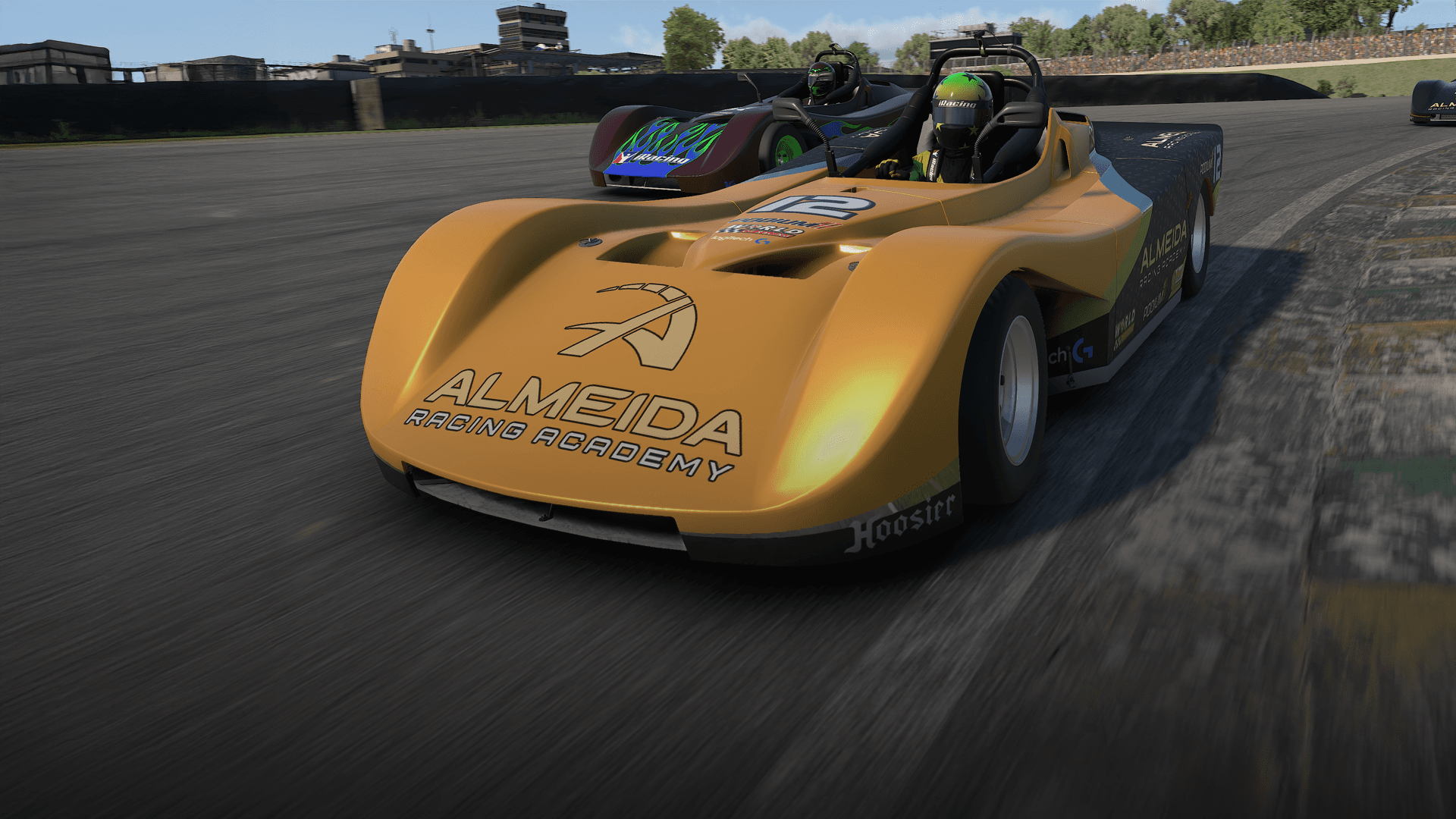
Battle Dynamics Examples
Lesson
6
of
21

Lesson by
Suellio Almeida
Lesson by
Suellio Almeida
Mark as Finished
In this lesson we're going to analyze a few replays and we will try to keep them simple. I'm going to try to use the examples of a single corner with a straight right before it so that we can analyze these examples according to the previous lesson. That still is simplified. We're going to get more advanced examples in the next few lessons.
The idea here is to analyze the battles from both perspectives. So we're going to see what each car involved in the battle is doing right or wrong and what each car can do better. Try to put yourself in the attackers' skin but also in the defenders' skin so that you can learn as much as possible from each example.
Example 1: Inside Attack with Overlap
In the first example, as the attacker, we've done the right thing. There's a little bit of defending here but a little bit too early. And then the defender goes back to the outside. So at this point the defender kind of changed direction, let's say, but it's a long straight and he didn't do any big change in direction. He decided at this point that he was going to use the outside.
So the attacker decides to go to the inside. There's still no breaking involved. There's still no breaking involved. Now there is some breaking involved and then the attacker on the inside breaks later. And at this point here, there is overlap. So now the attacker has legally the right to the apex.
As soon as they start to turn in though, you can see that the attacker is painting the track. That's the left front tire locking up and the car is not capable of turning. So it kind of goes a little bit straight. Then he manages to unlock and get the car to turn. He's not all the way to the apex because of the lock up. But then at this point, there is contact right here. The defender is hitting the rear of the attacker.
So there is a little bit of contact. No one spins and then the pass is not done because the defender is now the attacker. He gets a run and maybe he can attack back on the next corner. But then now the car ahead decides to fully defend, wait, wait, wait until they go to the outside again. And then he opens up a little bit diagonally and doesn't give that much space for the car behind to tuck in on the inside. Which would still be possible, but it would be a very aggressive move. And then at this point here, the pass is pretty much done.
Analysis of the First Example
This was a legit move, first of all. One mistake that the attacker has done here is to go that much to the inside. It's a little bit too much. You don't have to go that much to the inside here because now you're compromising your line way too much.
The attacker only succeeded in making this move because the defender didn't wait a little bit more to do a switch back and to go on the inside like that. He didn't wait for the overlap to be done. There was contact right here. But look at how much overlap there is here. It's not that much.
What the driver on the outside could have done is waited a little bit so that he could do the switch back. He could cut on the inside here. Remember the example when I said if the driver on the inside overshoots the corner, you can get a much better exit and pass them back easily. So that was the opportunity that this guy here had.
But he didn't use that opportunity right because he carried a little bit too much track position here. He tried to probably still pass on the outside which was a wrong decision. As soon as you're here, probably even here, a little bit before that, you already know that that's not going to work. You already know that this guy is sending it. He is not going to stop the car on time. And you either let him go fully and switch back on the inside or you. I mean, that's your only choice really.
So because he tried to go on the outside like that, the contact happened. And at this point here, no one would ever blame the driver on the inside, because look at how early he got the track position, how early he already had the overlap, a big overlap. So at this point, it's the responsibility of the driver on the outside to not cause any contact.
Key Learning Points
Examples like this show you that in 98% of the fights for position, both drivers will be doing some kind of mistake. For example, right here, the mistake on the driver on the outside is to not wait for the switch back to happen and end up turning into the driver who was already going wide, who was doing a dive bomb and missing the apex a little bit.
And then right here, the mistake on the inside is giving way too much space. So right now, you're here, you decide to attack. You don't have to go that much. You don't have to point to that direction like this. You can just go a little bit and point more or less to this direction, almost diagonally to the outside, so you can maximize your line.
He didn't do that. He ended up breaking a little bit late, which was possibly necessary, because by the time he starts breaking, there's no overlap at all. So he definitely needed to break super late to get the track position and get the right to the apex, but he could have done that without being so much in the inside.
Understanding Half Defending
This kind of move when you're going to the inside that early before the breaking is what we can kind of call that half defending. He's not leaving any space, but he's bringing the car back to the inside way before the breaking zone. So because of that, just this move, think psychologically. You see a car going right and you're faster. You automatically think about going left.
So in a way, the mistake of the driver ahead defending is to bring the car so early and so fast to the outside, because that invites the driver behind to do the opposite. So be careful when you're defending, because you can induce the driver to attack you by accident. Of course, you don't want that, but the way you position your car might affect their decisions on the last second.
There's a lot of draft. The driver is carrying a lot more speed here. You just need to stay here, stay here a little bit more, and then as you start breaking, you could go diagonally to the outside. If you really want the driver behind to not attack, you have to position your car to disengage their moves and this fast move to the right here. You see, as soon as they do this, as soon as they go to the right, the driver behind goes to the left. So it's an invitation. Hey, attack me and you have to be careful with that.
This takes a lot of practice, the psychological effect that your car positioning has on the attacker's decision. It's something that requires a lot of battling for position, and you can start thinking about these things doing more fight parties.
Example 2: Proper Switchback with Patience (Verstappen vs Leclerc)
Now, here's an example of a proper switchback with patience. This is Verstappen versus Leclerc, and Verstappen does a dive bomb. He starts breaking. Leclerc, at this point, realizes that if he just turns into the corner, he's going to hit him. So what he does, he waits, he waits, he waits. He's turning way later than he expects to do normally without fighting for position.
He's waiting for the Verstappen to go by, and then he does a switchback. Of course, the cars are much further away than the first example, but here you can show how patience in this case is necessary if you want to pass back easily after the driver on the inside just goes by the apex and gets a terrible exit.
And this is what you're going to see a lot when both drivers have a lot of experience fighting for position. First of all, you see Leclerc is in the middle here. He's half defending. He's trying to disengage the best driver of all time from going to the inside. Of course, it's not going to work. He's going all the way to the inside. There is so much more top speed because of the DRS, but then right now you can see that Leclerc is even forcing him to go even more to the inside.
And then he is going to the outside to have a better line. But Verstappen knows that Verstappen will also diagonally go to the outside to improve his own line on the inside. And that's why you see both drivers opening up at the very last second of breaking. You will always see this inside outside. See, this is a very common thing. Get ready to notice this in every high level race or get ready to do that when you get fights with more experienced drivers.
You will try to disengage them. You try to choose the line as soon as the line is defined, both drivers go diagonally to the outside to try to get the best line possible for them.
Example 3: Common Mistake - Too Much Space and Panic
Now here's one more very common mistake, especially in race starts when people get a little bit scared of the cold tires and everything and they end up closing down their vision, their idea of arc, of big radius, of carrying more speed. They forget that and they get protective, they get afraid.
Look at that. Here, this driver is giving way too much space to the driver on the outside. That's the first thing. Right now, he diagonally goes a little bit to the outside, which is good. But not enough, there's still 70% of a car space right here. And then as soon as he starts to turn in, here's where the big problem shows up. He gets very close to the car ahead and now he panics.
And here's how the panic is going to be expressed. Instead of trying to carry a little bit more speed and try to give less space on the inside here, he ends up being so afraid of this car, so afraid of contact that he's going to overthink going to the left here. And how this shows is like this. See, he continues going left, left, left, left, left. Why is that? Because he's afraid of the contact.
And because of that, he compromises his line so much. He's building such a small arc that he's not able to carry any speed and by the time he changes direction, there's even no overlap anymore because he already lost the position and he might be even losing one more right after that.
Correct Approach Without Panicking
Here's an example of a driver that's not panicking. He still gives a little bit too much space, but it's a little bit less. And then here, as soon as he turns in, now he's going to be thinking forward, not left. He's not overthinking going to the left at this point. He gets back on power earlier and now he's already changing direction. He's already going forward a lot more. He's thinking of track position. He's not afraid of the contact.
Of course, the guy on the outside gave him an easier job because he's not as much to the inside, squeezing the driver on the inside like the previous example. But this guy here is thinking forwards. He's accelerating. He's thinking of track position. He changes direction and he stays ahead of the other driver.
Example 4: Half Defending to Optimize Outside Line
It's possible to, even when you choose to use the outside, you do a half defending to destabilize the attacking driver and have a better line on entry. So here you can see Caine half defending, forcing the driver to go a lot to the inside, and then going to the outside all the way on the last second, which does not give enough time for the driver attacking to also go to the outside to use all the track.
And then right now, the arc that Caine can build is much wider, so he can carry more speed. And that is just enough for him to carry that extra speed and end up winning the race in a photo finish. So look at this. Here, if Caine stayed all the way to the left, then the driver on the inside would have a lot of free room to optimize their own line and get a better run on the entry of this corner here.
But Caine stayed half defended and he preferred to use the outside to get a better run on this corner here, and use all the track on the exit. So the function of half defending here is solely to destabilize the line of the attacking driver so that you can go all the way to the outside and have the best line possible.
Example 5: Tiny Mistake Costs the Battle
And here's a very good example of how even when everything goes right, if the defender is doing the right thing, all it takes on the outside is a tiny mistake for you to lose the battle. Watch this. What was it? All is good. Fully defend. Get the draft into the last second. Squeeze. Squeeze. Open up at the very last second under braking. I mean, before braking. Then you break. You start turning in.
And this is the moment where the driver on the outside hesitated. Instead of building a nice arc and leaving just this amount of space on the inside, he turned then and then he kind of stopped turning for a while and then he turned again. But that was it. He lost his line. Look at this. You see? He turns. Stops. Turns again.
And by the time he turns again, he already lost his line. And there is this much space on the inside that he's not using. And the driver on the inside is a very good driver. He just gets back on power. He gains his track position again. And then after this, he also has the inside for the next corner. And he stays ahead.
So you see? Just because there was a little bit of hesitation right here. Right now. Right now he's going straight. A tiny fraction of a second. He lost the battle.
Moving Forward
You see, I tried to focus on mostly single corner battles, corners in between straights so that we could simplify and exemplify everything that we discussed in the last lesson. In the next few lessons throughout the course, we're going to add more and more layers of complexity. We're going to add chaining corners. We're going to add corners where it's better to be on the outside. And we're going to add more and more cars to the battle.
Before we move on through the course, make sure you understand everything that we talked about. Make sure you can apply it. Make sure you can watch replays and say, no, this guy did this. That's the problem. That's why he lost the battle. Or that's why I lost the battle. Watch your own replays and try to analyze these things.
Developing Spatial Awareness
One very important thing is that everything that we analyzed here was on Chase Camera. In the cockpit view, it's going to be different. In the cockpit view, we have a different spatial awareness. So we have to see how it feels, how it looks from the cockpit. Then watch your replay. Compare. Compare how it felt. Oh wow, I thought there was less space. But then you look at the replay and there is like half a car of space.
This is something that you have to develop. Develop your spatial awareness thinking about those tiny spaces that you're going to give in battle for positions.
In this lesson we're going to analyze a few replays and we will try to keep them simple. I'm going to try to use the examples of a single corner with a straight right before it so that we can analyze these examples according to the previous lesson. That still is simplified. We're going to get more advanced examples in the next few lessons.
The idea here is to analyze the battles from both perspectives. So we're going to see what each car involved in the battle is doing right or wrong and what each car can do better. Try to put yourself in the attackers' skin but also in the defenders' skin so that you can learn as much as possible from each example.
Example 1: Inside Attack with Overlap
In the first example, as the attacker, we've done the right thing. There's a little bit of defending here but a little bit too early. And then the defender goes back to the outside. So at this point the defender kind of changed direction, let's say, but it's a long straight and he didn't do any big change in direction. He decided at this point that he was going to use the outside.
So the attacker decides to go to the inside. There's still no breaking involved. There's still no breaking involved. Now there is some breaking involved and then the attacker on the inside breaks later. And at this point here, there is overlap. So now the attacker has legally the right to the apex.
As soon as they start to turn in though, you can see that the attacker is painting the track. That's the left front tire locking up and the car is not capable of turning. So it kind of goes a little bit straight. Then he manages to unlock and get the car to turn. He's not all the way to the apex because of the lock up. But then at this point, there is contact right here. The defender is hitting the rear of the attacker.
So there is a little bit of contact. No one spins and then the pass is not done because the defender is now the attacker. He gets a run and maybe he can attack back on the next corner. But then now the car ahead decides to fully defend, wait, wait, wait until they go to the outside again. And then he opens up a little bit diagonally and doesn't give that much space for the car behind to tuck in on the inside. Which would still be possible, but it would be a very aggressive move. And then at this point here, the pass is pretty much done.
Analysis of the First Example
This was a legit move, first of all. One mistake that the attacker has done here is to go that much to the inside. It's a little bit too much. You don't have to go that much to the inside here because now you're compromising your line way too much.
The attacker only succeeded in making this move because the defender didn't wait a little bit more to do a switch back and to go on the inside like that. He didn't wait for the overlap to be done. There was contact right here. But look at how much overlap there is here. It's not that much.
What the driver on the outside could have done is waited a little bit so that he could do the switch back. He could cut on the inside here. Remember the example when I said if the driver on the inside overshoots the corner, you can get a much better exit and pass them back easily. So that was the opportunity that this guy here had.
But he didn't use that opportunity right because he carried a little bit too much track position here. He tried to probably still pass on the outside which was a wrong decision. As soon as you're here, probably even here, a little bit before that, you already know that that's not going to work. You already know that this guy is sending it. He is not going to stop the car on time. And you either let him go fully and switch back on the inside or you. I mean, that's your only choice really.
So because he tried to go on the outside like that, the contact happened. And at this point here, no one would ever blame the driver on the inside, because look at how early he got the track position, how early he already had the overlap, a big overlap. So at this point, it's the responsibility of the driver on the outside to not cause any contact.
Key Learning Points
Examples like this show you that in 98% of the fights for position, both drivers will be doing some kind of mistake. For example, right here, the mistake on the driver on the outside is to not wait for the switch back to happen and end up turning into the driver who was already going wide, who was doing a dive bomb and missing the apex a little bit.
And then right here, the mistake on the inside is giving way too much space. So right now, you're here, you decide to attack. You don't have to go that much. You don't have to point to that direction like this. You can just go a little bit and point more or less to this direction, almost diagonally to the outside, so you can maximize your line.
He didn't do that. He ended up breaking a little bit late, which was possibly necessary, because by the time he starts breaking, there's no overlap at all. So he definitely needed to break super late to get the track position and get the right to the apex, but he could have done that without being so much in the inside.
Understanding Half Defending
This kind of move when you're going to the inside that early before the breaking is what we can kind of call that half defending. He's not leaving any space, but he's bringing the car back to the inside way before the breaking zone. So because of that, just this move, think psychologically. You see a car going right and you're faster. You automatically think about going left.
So in a way, the mistake of the driver ahead defending is to bring the car so early and so fast to the outside, because that invites the driver behind to do the opposite. So be careful when you're defending, because you can induce the driver to attack you by accident. Of course, you don't want that, but the way you position your car might affect their decisions on the last second.
There's a lot of draft. The driver is carrying a lot more speed here. You just need to stay here, stay here a little bit more, and then as you start breaking, you could go diagonally to the outside. If you really want the driver behind to not attack, you have to position your car to disengage their moves and this fast move to the right here. You see, as soon as they do this, as soon as they go to the right, the driver behind goes to the left. So it's an invitation. Hey, attack me and you have to be careful with that.
This takes a lot of practice, the psychological effect that your car positioning has on the attacker's decision. It's something that requires a lot of battling for position, and you can start thinking about these things doing more fight parties.
Example 2: Proper Switchback with Patience (Verstappen vs Leclerc)
Now, here's an example of a proper switchback with patience. This is Verstappen versus Leclerc, and Verstappen does a dive bomb. He starts breaking. Leclerc, at this point, realizes that if he just turns into the corner, he's going to hit him. So what he does, he waits, he waits, he waits. He's turning way later than he expects to do normally without fighting for position.
He's waiting for the Verstappen to go by, and then he does a switchback. Of course, the cars are much further away than the first example, but here you can show how patience in this case is necessary if you want to pass back easily after the driver on the inside just goes by the apex and gets a terrible exit.
And this is what you're going to see a lot when both drivers have a lot of experience fighting for position. First of all, you see Leclerc is in the middle here. He's half defending. He's trying to disengage the best driver of all time from going to the inside. Of course, it's not going to work. He's going all the way to the inside. There is so much more top speed because of the DRS, but then right now you can see that Leclerc is even forcing him to go even more to the inside.
And then he is going to the outside to have a better line. But Verstappen knows that Verstappen will also diagonally go to the outside to improve his own line on the inside. And that's why you see both drivers opening up at the very last second of breaking. You will always see this inside outside. See, this is a very common thing. Get ready to notice this in every high level race or get ready to do that when you get fights with more experienced drivers.
You will try to disengage them. You try to choose the line as soon as the line is defined, both drivers go diagonally to the outside to try to get the best line possible for them.
Example 3: Common Mistake - Too Much Space and Panic
Now here's one more very common mistake, especially in race starts when people get a little bit scared of the cold tires and everything and they end up closing down their vision, their idea of arc, of big radius, of carrying more speed. They forget that and they get protective, they get afraid.
Look at that. Here, this driver is giving way too much space to the driver on the outside. That's the first thing. Right now, he diagonally goes a little bit to the outside, which is good. But not enough, there's still 70% of a car space right here. And then as soon as he starts to turn in, here's where the big problem shows up. He gets very close to the car ahead and now he panics.
And here's how the panic is going to be expressed. Instead of trying to carry a little bit more speed and try to give less space on the inside here, he ends up being so afraid of this car, so afraid of contact that he's going to overthink going to the left here. And how this shows is like this. See, he continues going left, left, left, left, left. Why is that? Because he's afraid of the contact.
And because of that, he compromises his line so much. He's building such a small arc that he's not able to carry any speed and by the time he changes direction, there's even no overlap anymore because he already lost the position and he might be even losing one more right after that.
Correct Approach Without Panicking
Here's an example of a driver that's not panicking. He still gives a little bit too much space, but it's a little bit less. And then here, as soon as he turns in, now he's going to be thinking forward, not left. He's not overthinking going to the left at this point. He gets back on power earlier and now he's already changing direction. He's already going forward a lot more. He's thinking of track position. He's not afraid of the contact.
Of course, the guy on the outside gave him an easier job because he's not as much to the inside, squeezing the driver on the inside like the previous example. But this guy here is thinking forwards. He's accelerating. He's thinking of track position. He changes direction and he stays ahead of the other driver.
Example 4: Half Defending to Optimize Outside Line
It's possible to, even when you choose to use the outside, you do a half defending to destabilize the attacking driver and have a better line on entry. So here you can see Caine half defending, forcing the driver to go a lot to the inside, and then going to the outside all the way on the last second, which does not give enough time for the driver attacking to also go to the outside to use all the track.
And then right now, the arc that Caine can build is much wider, so he can carry more speed. And that is just enough for him to carry that extra speed and end up winning the race in a photo finish. So look at this. Here, if Caine stayed all the way to the left, then the driver on the inside would have a lot of free room to optimize their own line and get a better run on the entry of this corner here.
But Caine stayed half defended and he preferred to use the outside to get a better run on this corner here, and use all the track on the exit. So the function of half defending here is solely to destabilize the line of the attacking driver so that you can go all the way to the outside and have the best line possible.
Example 5: Tiny Mistake Costs the Battle
And here's a very good example of how even when everything goes right, if the defender is doing the right thing, all it takes on the outside is a tiny mistake for you to lose the battle. Watch this. What was it? All is good. Fully defend. Get the draft into the last second. Squeeze. Squeeze. Open up at the very last second under braking. I mean, before braking. Then you break. You start turning in.
And this is the moment where the driver on the outside hesitated. Instead of building a nice arc and leaving just this amount of space on the inside, he turned then and then he kind of stopped turning for a while and then he turned again. But that was it. He lost his line. Look at this. You see? He turns. Stops. Turns again.
And by the time he turns again, he already lost his line. And there is this much space on the inside that he's not using. And the driver on the inside is a very good driver. He just gets back on power. He gains his track position again. And then after this, he also has the inside for the next corner. And he stays ahead.
So you see? Just because there was a little bit of hesitation right here. Right now. Right now he's going straight. A tiny fraction of a second. He lost the battle.
Moving Forward
You see, I tried to focus on mostly single corner battles, corners in between straights so that we could simplify and exemplify everything that we discussed in the last lesson. In the next few lessons throughout the course, we're going to add more and more layers of complexity. We're going to add chaining corners. We're going to add corners where it's better to be on the outside. And we're going to add more and more cars to the battle.
Before we move on through the course, make sure you understand everything that we talked about. Make sure you can apply it. Make sure you can watch replays and say, no, this guy did this. That's the problem. That's why he lost the battle. Or that's why I lost the battle. Watch your own replays and try to analyze these things.
Developing Spatial Awareness
One very important thing is that everything that we analyzed here was on Chase Camera. In the cockpit view, it's going to be different. In the cockpit view, we have a different spatial awareness. So we have to see how it feels, how it looks from the cockpit. Then watch your replay. Compare. Compare how it felt. Oh wow, I thought there was less space. But then you look at the replay and there is like half a car of space.
This is something that you have to develop. Develop your spatial awareness thinking about those tiny spaces that you're going to give in battle for positions.
In this lesson we're going to analyze a few replays and we will try to keep them simple. I'm going to try to use the examples of a single corner with a straight right before it so that we can analyze these examples according to the previous lesson. That still is simplified. We're going to get more advanced examples in the next few lessons.
The idea here is to analyze the battles from both perspectives. So we're going to see what each car involved in the battle is doing right or wrong and what each car can do better. Try to put yourself in the attackers' skin but also in the defenders' skin so that you can learn as much as possible from each example.
Example 1: Inside Attack with Overlap
In the first example, as the attacker, we've done the right thing. There's a little bit of defending here but a little bit too early. And then the defender goes back to the outside. So at this point the defender kind of changed direction, let's say, but it's a long straight and he didn't do any big change in direction. He decided at this point that he was going to use the outside.
So the attacker decides to go to the inside. There's still no breaking involved. There's still no breaking involved. Now there is some breaking involved and then the attacker on the inside breaks later. And at this point here, there is overlap. So now the attacker has legally the right to the apex.
As soon as they start to turn in though, you can see that the attacker is painting the track. That's the left front tire locking up and the car is not capable of turning. So it kind of goes a little bit straight. Then he manages to unlock and get the car to turn. He's not all the way to the apex because of the lock up. But then at this point, there is contact right here. The defender is hitting the rear of the attacker.
So there is a little bit of contact. No one spins and then the pass is not done because the defender is now the attacker. He gets a run and maybe he can attack back on the next corner. But then now the car ahead decides to fully defend, wait, wait, wait until they go to the outside again. And then he opens up a little bit diagonally and doesn't give that much space for the car behind to tuck in on the inside. Which would still be possible, but it would be a very aggressive move. And then at this point here, the pass is pretty much done.
Analysis of the First Example
This was a legit move, first of all. One mistake that the attacker has done here is to go that much to the inside. It's a little bit too much. You don't have to go that much to the inside here because now you're compromising your line way too much.
The attacker only succeeded in making this move because the defender didn't wait a little bit more to do a switch back and to go on the inside like that. He didn't wait for the overlap to be done. There was contact right here. But look at how much overlap there is here. It's not that much.
What the driver on the outside could have done is waited a little bit so that he could do the switch back. He could cut on the inside here. Remember the example when I said if the driver on the inside overshoots the corner, you can get a much better exit and pass them back easily. So that was the opportunity that this guy here had.
But he didn't use that opportunity right because he carried a little bit too much track position here. He tried to probably still pass on the outside which was a wrong decision. As soon as you're here, probably even here, a little bit before that, you already know that that's not going to work. You already know that this guy is sending it. He is not going to stop the car on time. And you either let him go fully and switch back on the inside or you. I mean, that's your only choice really.
So because he tried to go on the outside like that, the contact happened. And at this point here, no one would ever blame the driver on the inside, because look at how early he got the track position, how early he already had the overlap, a big overlap. So at this point, it's the responsibility of the driver on the outside to not cause any contact.
Key Learning Points
Examples like this show you that in 98% of the fights for position, both drivers will be doing some kind of mistake. For example, right here, the mistake on the driver on the outside is to not wait for the switch back to happen and end up turning into the driver who was already going wide, who was doing a dive bomb and missing the apex a little bit.
And then right here, the mistake on the inside is giving way too much space. So right now, you're here, you decide to attack. You don't have to go that much. You don't have to point to that direction like this. You can just go a little bit and point more or less to this direction, almost diagonally to the outside, so you can maximize your line.
He didn't do that. He ended up breaking a little bit late, which was possibly necessary, because by the time he starts breaking, there's no overlap at all. So he definitely needed to break super late to get the track position and get the right to the apex, but he could have done that without being so much in the inside.
Understanding Half Defending
This kind of move when you're going to the inside that early before the breaking is what we can kind of call that half defending. He's not leaving any space, but he's bringing the car back to the inside way before the breaking zone. So because of that, just this move, think psychologically. You see a car going right and you're faster. You automatically think about going left.
So in a way, the mistake of the driver ahead defending is to bring the car so early and so fast to the outside, because that invites the driver behind to do the opposite. So be careful when you're defending, because you can induce the driver to attack you by accident. Of course, you don't want that, but the way you position your car might affect their decisions on the last second.
There's a lot of draft. The driver is carrying a lot more speed here. You just need to stay here, stay here a little bit more, and then as you start breaking, you could go diagonally to the outside. If you really want the driver behind to not attack, you have to position your car to disengage their moves and this fast move to the right here. You see, as soon as they do this, as soon as they go to the right, the driver behind goes to the left. So it's an invitation. Hey, attack me and you have to be careful with that.
This takes a lot of practice, the psychological effect that your car positioning has on the attacker's decision. It's something that requires a lot of battling for position, and you can start thinking about these things doing more fight parties.
Example 2: Proper Switchback with Patience (Verstappen vs Leclerc)
Now, here's an example of a proper switchback with patience. This is Verstappen versus Leclerc, and Verstappen does a dive bomb. He starts breaking. Leclerc, at this point, realizes that if he just turns into the corner, he's going to hit him. So what he does, he waits, he waits, he waits. He's turning way later than he expects to do normally without fighting for position.
He's waiting for the Verstappen to go by, and then he does a switchback. Of course, the cars are much further away than the first example, but here you can show how patience in this case is necessary if you want to pass back easily after the driver on the inside just goes by the apex and gets a terrible exit.
And this is what you're going to see a lot when both drivers have a lot of experience fighting for position. First of all, you see Leclerc is in the middle here. He's half defending. He's trying to disengage the best driver of all time from going to the inside. Of course, it's not going to work. He's going all the way to the inside. There is so much more top speed because of the DRS, but then right now you can see that Leclerc is even forcing him to go even more to the inside.
And then he is going to the outside to have a better line. But Verstappen knows that Verstappen will also diagonally go to the outside to improve his own line on the inside. And that's why you see both drivers opening up at the very last second of breaking. You will always see this inside outside. See, this is a very common thing. Get ready to notice this in every high level race or get ready to do that when you get fights with more experienced drivers.
You will try to disengage them. You try to choose the line as soon as the line is defined, both drivers go diagonally to the outside to try to get the best line possible for them.
Example 3: Common Mistake - Too Much Space and Panic
Now here's one more very common mistake, especially in race starts when people get a little bit scared of the cold tires and everything and they end up closing down their vision, their idea of arc, of big radius, of carrying more speed. They forget that and they get protective, they get afraid.
Look at that. Here, this driver is giving way too much space to the driver on the outside. That's the first thing. Right now, he diagonally goes a little bit to the outside, which is good. But not enough, there's still 70% of a car space right here. And then as soon as he starts to turn in, here's where the big problem shows up. He gets very close to the car ahead and now he panics.
And here's how the panic is going to be expressed. Instead of trying to carry a little bit more speed and try to give less space on the inside here, he ends up being so afraid of this car, so afraid of contact that he's going to overthink going to the left here. And how this shows is like this. See, he continues going left, left, left, left, left. Why is that? Because he's afraid of the contact.
And because of that, he compromises his line so much. He's building such a small arc that he's not able to carry any speed and by the time he changes direction, there's even no overlap anymore because he already lost the position and he might be even losing one more right after that.
Correct Approach Without Panicking
Here's an example of a driver that's not panicking. He still gives a little bit too much space, but it's a little bit less. And then here, as soon as he turns in, now he's going to be thinking forward, not left. He's not overthinking going to the left at this point. He gets back on power earlier and now he's already changing direction. He's already going forward a lot more. He's thinking of track position. He's not afraid of the contact.
Of course, the guy on the outside gave him an easier job because he's not as much to the inside, squeezing the driver on the inside like the previous example. But this guy here is thinking forwards. He's accelerating. He's thinking of track position. He changes direction and he stays ahead of the other driver.
Example 4: Half Defending to Optimize Outside Line
It's possible to, even when you choose to use the outside, you do a half defending to destabilize the attacking driver and have a better line on entry. So here you can see Caine half defending, forcing the driver to go a lot to the inside, and then going to the outside all the way on the last second, which does not give enough time for the driver attacking to also go to the outside to use all the track.
And then right now, the arc that Caine can build is much wider, so he can carry more speed. And that is just enough for him to carry that extra speed and end up winning the race in a photo finish. So look at this. Here, if Caine stayed all the way to the left, then the driver on the inside would have a lot of free room to optimize their own line and get a better run on the entry of this corner here.
But Caine stayed half defended and he preferred to use the outside to get a better run on this corner here, and use all the track on the exit. So the function of half defending here is solely to destabilize the line of the attacking driver so that you can go all the way to the outside and have the best line possible.
Example 5: Tiny Mistake Costs the Battle
And here's a very good example of how even when everything goes right, if the defender is doing the right thing, all it takes on the outside is a tiny mistake for you to lose the battle. Watch this. What was it? All is good. Fully defend. Get the draft into the last second. Squeeze. Squeeze. Open up at the very last second under braking. I mean, before braking. Then you break. You start turning in.
And this is the moment where the driver on the outside hesitated. Instead of building a nice arc and leaving just this amount of space on the inside, he turned then and then he kind of stopped turning for a while and then he turned again. But that was it. He lost his line. Look at this. You see? He turns. Stops. Turns again.
And by the time he turns again, he already lost his line. And there is this much space on the inside that he's not using. And the driver on the inside is a very good driver. He just gets back on power. He gains his track position again. And then after this, he also has the inside for the next corner. And he stays ahead.
So you see? Just because there was a little bit of hesitation right here. Right now. Right now he's going straight. A tiny fraction of a second. He lost the battle.
Moving Forward
You see, I tried to focus on mostly single corner battles, corners in between straights so that we could simplify and exemplify everything that we discussed in the last lesson. In the next few lessons throughout the course, we're going to add more and more layers of complexity. We're going to add chaining corners. We're going to add corners where it's better to be on the outside. And we're going to add more and more cars to the battle.
Before we move on through the course, make sure you understand everything that we talked about. Make sure you can apply it. Make sure you can watch replays and say, no, this guy did this. That's the problem. That's why he lost the battle. Or that's why I lost the battle. Watch your own replays and try to analyze these things.
Developing Spatial Awareness
One very important thing is that everything that we analyzed here was on Chase Camera. In the cockpit view, it's going to be different. In the cockpit view, we have a different spatial awareness. So we have to see how it feels, how it looks from the cockpit. Then watch your replay. Compare. Compare how it felt. Oh wow, I thought there was less space. But then you look at the replay and there is like half a car of space.
This is something that you have to develop. Develop your spatial awareness thinking about those tiny spaces that you're going to give in battle for positions.
Racecraft Foundations
Racing Strategies
Psychology of Racing
Other Lessons