
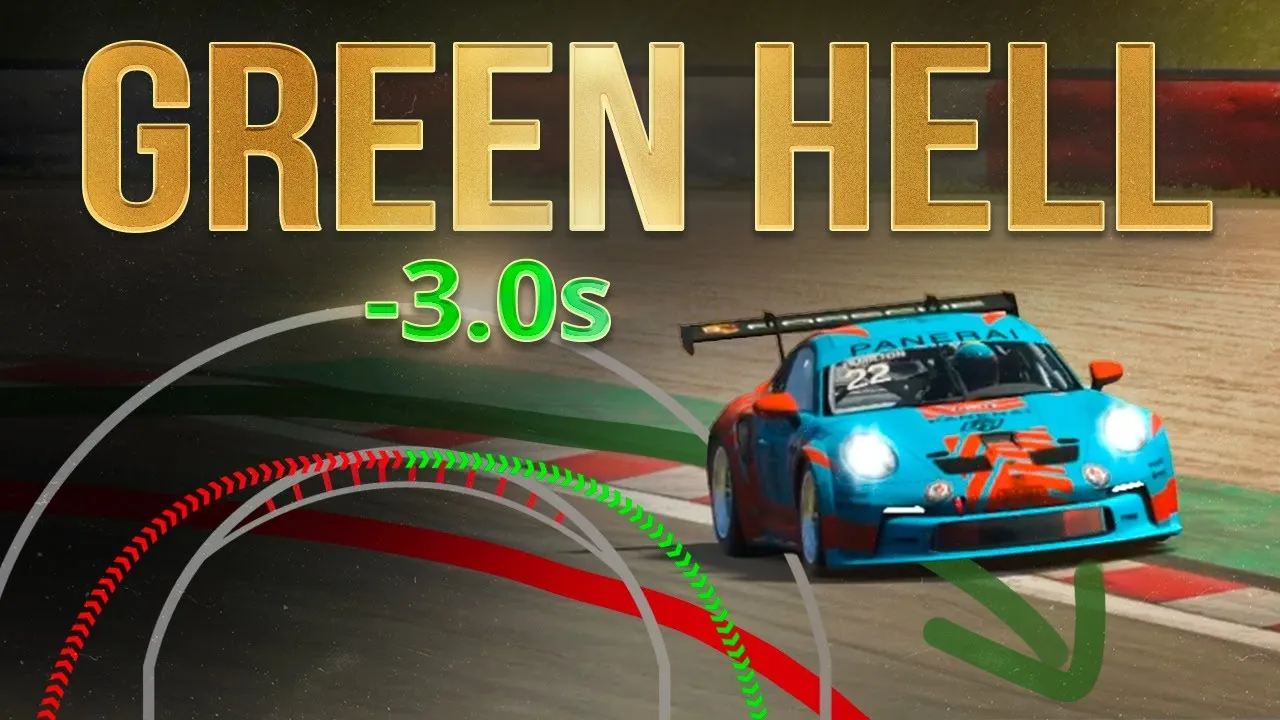
Why You're Slow at Nürburgring Nordschleife: The Real Problem Nobody Talks About
Suellio Almeida
•
Monday, April 8, 2024
You're Treating the Nordschleife Like a Normal Track (That's Your First Mistake)
Here's the thing most drivers don't understand about the Nordschleife: it's not a racetrack.
It's a 13-mile public road that happens to have racing lines painted on it. The elevation changes are violent. The surface is inconsistent. The corners don't follow normal racing geometry.
And yet, you're trying to apply the same techniques you use at Spa or Monza.
That's why you're slow.
The Nordschleife doesn't reward perfect racing lines. It rewards adaptability, risk management, and deep track knowledge. If you're approaching it like a traditional circuit, you're fighting the track instead of flowing with it.
The Memorization Trap: Why Cramming Doesn't Work
Most drivers think the solution to the Nordschleife is memorization.
Learn all 154 corners. Study track guides. Watch alien laps frame-by-frame.
But here's what actually happens: you memorize Turn 1 through Turn 10, feel confident, then completely forget what comes next when you're doing 150 mph through Schwedenkreuz.
Your brain can't process that much information under pressure.
The Nordschleife isn't a memory test. It's a pattern recognition challenge. You need to train your visual system to read the track in real-time, not rely on rote memorization.
Think about it: when you're driving on a highway, you don't memorize every curve. You read the road geometry, adjust your inputs, and flow through it naturally.
That's the skill you need to build for the Nordschleife.
Your Reference Points Are Wrong (And It's Killing Your Lap Times)
Let me guess: you're using the same reference points you saw in a YouTube tutorial.
Braking at the 100m board. Turn-in at the tree. Apex at the curbing.
Here's the problem: those reference points aren't yours.
Every driver has different brake pressure, different confidence levels, different car setups. What works for an alien in a GT3 car might be completely wrong for you in a Radical or a Mazda MX-5.
You need to build your own reference system based on how your car actually behaves.
Start with conservative references. Brake early. Learn where the car settles. Feel the weight transfer. Then — and only then — start pushing the references forward.
The Nordschleife punishes drivers who copy references blindly. One missed braking point at Bergwerk and you're in the wall, session over, repair bill mounting.
The Vision Problem: You're Looking at the Wrong Things
Watch an experienced Nordschleife driver's eye movements compared to a beginner.
The beginner stares at the apex. At the curbing. At the track directly in front of them.
The experienced driver's eyes are already three corners ahead.
You cannot drive the Nordschleife fast if your vision is reactive instead of predictive.
Here's a specific example: Adenauer Forst. Most drivers focus on the immediate left-hander. But the real challenge is setting up for Metzgesfeld right after — a blind, off-camber right that punishes bad positioning.
If you're not looking ahead to Metzgesfeld while you're still in Adenauer Forst, you're already too late.
Train yourself to scan forward constantly. Your peripheral vision handles the immediate corner. Your focal vision should be hunting for the next reference point, the next apex, the next challenge.
You're Overdriving the Dangerous Sections (And Underdriving the Fast Ones)
Here's where most drivers lose time at the Nordschleife: they're conservative in the wrong places.
They tiptoe through Flugplatz and Schwedenkreuz — massive time loss — then overdrive Bergwerk or Adenauer Forst and bin it into the wall.
The fast sections of the Nordschleife — the compressions, the crests, the long sweepers — are where confidence separates fast drivers from slow ones.
Flugplatz isn't scary. It's a commitment exercise. The car compresses, you stay in the throttle, it flies, you land, you keep going. The only thing that makes it dangerous is hesitation.
But Bergwerk? That downhill, off-camber left with massive runoff that looks safe? That's where people crash. Because they think they can brake deeper than physics allows.
Learn which sections reward bravery and which sections demand respect.
The Track Knowledge Fallacy: Knowing Isn't Doing
You can know every corner name. You can recite the layout perfectly. You can ace a Nordschleife quiz.
And still be slow.
Because track knowledge and track execution are completely different skills.
Knowledge is cognitive. Execution is muscle memory, timing, feel, instinct.
You build execution through deliberate practice: run the same section 50 times in a row. Not the full lap — one section. Fuchsröhre entry to exit. Over and over. Different lines, different speeds, different brake points.
Then move to the next section.
This is how you turn knowledge into instinct. This is how you stop thinking and start driving.
The Car Setup Mistake: You're Driving Someone Else's Setup
The Nordschleife has massive elevation changes and wildly different corner types — high-speed sweepers, tight hairpins, blind crests, off-camber disasters.
No single setup is perfect for the entire lap.
But here's what most drivers do: they download a setup from the forums, assume it's optimal, and blame themselves when they struggle.
Listen: that setup might be designed for a completely different driving style.
Maybe it's built for someone who trail brakes aggressively. Maybe it's tuned for a driver who prefers stability over rotation. Maybe it's optimized for a specific weather condition or tire compound.
Learn to tune the car to your strengths instead of forcing yourself to adapt to the setup.
Start with a baseline. Adjust one thing at a time. Feel the difference. Build your understanding.
The Nordschleife demands a setup that balances stability and responsiveness. Too stiff and you're fighting the surface. Too soft and you're unpredictable through compressions.
Why Most Nordschleife Practice Is Wasted
Most drivers practice the Nordschleife wrong.
They run full laps, make mistakes, restart, repeat.
That's not practice. That's just driving.
Practice requires focused repetition of specific skills.
If you're slow through Fuchsröhre, running full laps won't fix it. You'll hit that section once every 8 minutes, make the same mistake, and move on.
Instead: isolate the problem. Use practice mode or AI mode to reset at that section. Run it 20 times consecutively. Experiment with different approaches. Measure the results.
This is how real improvement happens.
Full lap practice is for integration — putting the pieces together after you've mastered the individual sections.
The Consistency Equation: Fast Laps vs. Safe Laps
Here's the truth about the Nordschleife: one fast lap means nothing.
You need to put together consistent, repeatable pace without crashing.
In a race, the driver who finishes wins. Doesn't matter if you set a purple sector through Hatzenbach if you stuff it into the barriers at Brünnchen.
Speed at the Nordschleife comes from building confidence in layers:
1. Drive at 70% until every section feels comfortable
2. Push to 80% and refine your references
3. Incrementally increase pace in the sections where you have margin
4. Identify your personal risk tolerance and respect it
The aliens aren't faster because they take more risks. They're faster because they've eliminated uncertainty through repetition.
They know exactly where the limit is because they've found it a thousand times.
What Would Change If You Stopped Guessing?
You've been throwing laps at the Nordschleife hoping something clicks.
Maybe you watch another track guide. Maybe you copy another setup. Maybe you just keep grinding.
But here's the question: how much faster would you be if you trained with a structured system instead of guesswork?
What if you could isolate your weak sections, fix them methodically, and build real track mastery instead of surface-level familiarity?
The Nordschleife doesn't reward blind repetition. It rewards deliberate skill development.
That's exactly what we built Almeida Racing Academy for — drivers who are tired of random YouTube advice and want a proven training system that actually works.
Inside Gold Membership, you get 80 lessons covering advanced racecraft, vision techniques, trail braking, weight transfer, and the exact practice methods that turn knowledge into execution. Coach-led workshops. Weekly challenges. Access to Garage 61 Pro for setup analysis.
Right now it's $25/month with code WINTER.
If you're serious about mastering the Nordschleife — or any track — stop guessing and start training.
Sim Racing Academy Membership
Everything you need to stop guessing and start getting faster.
Starting at
$25
/mo
Car Handling Online Course
4 levels, full curriculum. Aimed to get you to top 1% in driving pace.
Racecraft Online Course
Overtaking, Defending, Race Strategy
Live coaching + on-track practice
Bi-weekly pro-coach workshops (recorded — never miss one) plus on-track Pit Parties to practice racecraft with a coach.
Plus These Bonuses
13,000+ Member Community
League Racing
Advanced MX-5 Mini Course
Racing Technique Development Guide
The Motor Racing Book (260 pages)
Think & Behave Like a Pro Driver — Mini eBook
Why You're Slow at Nürburgring Nordschleife: The Real Problem Nobody Talks About
Suellio Almeida
•
Monday, April 8, 2024
You're Treating the Nordschleife Like a Normal Track (That's Your First Mistake)
Here's the thing most drivers don't understand about the Nordschleife: it's not a racetrack.
It's a 13-mile public road that happens to have racing lines painted on it. The elevation changes are violent. The surface is inconsistent. The corners don't follow normal racing geometry.
And yet, you're trying to apply the same techniques you use at Spa or Monza.
That's why you're slow.
The Nordschleife doesn't reward perfect racing lines. It rewards adaptability, risk management, and deep track knowledge. If you're approaching it like a traditional circuit, you're fighting the track instead of flowing with it.
The Memorization Trap: Why Cramming Doesn't Work
Most drivers think the solution to the Nordschleife is memorization.
Learn all 154 corners. Study track guides. Watch alien laps frame-by-frame.
But here's what actually happens: you memorize Turn 1 through Turn 10, feel confident, then completely forget what comes next when you're doing 150 mph through Schwedenkreuz.
Your brain can't process that much information under pressure.
The Nordschleife isn't a memory test. It's a pattern recognition challenge. You need to train your visual system to read the track in real-time, not rely on rote memorization.
Think about it: when you're driving on a highway, you don't memorize every curve. You read the road geometry, adjust your inputs, and flow through it naturally.
That's the skill you need to build for the Nordschleife.
Your Reference Points Are Wrong (And It's Killing Your Lap Times)
Let me guess: you're using the same reference points you saw in a YouTube tutorial.
Braking at the 100m board. Turn-in at the tree. Apex at the curbing.
Here's the problem: those reference points aren't yours.
Every driver has different brake pressure, different confidence levels, different car setups. What works for an alien in a GT3 car might be completely wrong for you in a Radical or a Mazda MX-5.
You need to build your own reference system based on how your car actually behaves.
Start with conservative references. Brake early. Learn where the car settles. Feel the weight transfer. Then — and only then — start pushing the references forward.
The Nordschleife punishes drivers who copy references blindly. One missed braking point at Bergwerk and you're in the wall, session over, repair bill mounting.
The Vision Problem: You're Looking at the Wrong Things
Watch an experienced Nordschleife driver's eye movements compared to a beginner.
The beginner stares at the apex. At the curbing. At the track directly in front of them.
The experienced driver's eyes are already three corners ahead.
You cannot drive the Nordschleife fast if your vision is reactive instead of predictive.
Here's a specific example: Adenauer Forst. Most drivers focus on the immediate left-hander. But the real challenge is setting up for Metzgesfeld right after — a blind, off-camber right that punishes bad positioning.
If you're not looking ahead to Metzgesfeld while you're still in Adenauer Forst, you're already too late.
Train yourself to scan forward constantly. Your peripheral vision handles the immediate corner. Your focal vision should be hunting for the next reference point, the next apex, the next challenge.
You're Overdriving the Dangerous Sections (And Underdriving the Fast Ones)
Here's where most drivers lose time at the Nordschleife: they're conservative in the wrong places.
They tiptoe through Flugplatz and Schwedenkreuz — massive time loss — then overdrive Bergwerk or Adenauer Forst and bin it into the wall.
The fast sections of the Nordschleife — the compressions, the crests, the long sweepers — are where confidence separates fast drivers from slow ones.
Flugplatz isn't scary. It's a commitment exercise. The car compresses, you stay in the throttle, it flies, you land, you keep going. The only thing that makes it dangerous is hesitation.
But Bergwerk? That downhill, off-camber left with massive runoff that looks safe? That's where people crash. Because they think they can brake deeper than physics allows.
Learn which sections reward bravery and which sections demand respect.
The Track Knowledge Fallacy: Knowing Isn't Doing
You can know every corner name. You can recite the layout perfectly. You can ace a Nordschleife quiz.
And still be slow.
Because track knowledge and track execution are completely different skills.
Knowledge is cognitive. Execution is muscle memory, timing, feel, instinct.
You build execution through deliberate practice: run the same section 50 times in a row. Not the full lap — one section. Fuchsröhre entry to exit. Over and over. Different lines, different speeds, different brake points.
Then move to the next section.
This is how you turn knowledge into instinct. This is how you stop thinking and start driving.
The Car Setup Mistake: You're Driving Someone Else's Setup
The Nordschleife has massive elevation changes and wildly different corner types — high-speed sweepers, tight hairpins, blind crests, off-camber disasters.
No single setup is perfect for the entire lap.
But here's what most drivers do: they download a setup from the forums, assume it's optimal, and blame themselves when they struggle.
Listen: that setup might be designed for a completely different driving style.
Maybe it's built for someone who trail brakes aggressively. Maybe it's tuned for a driver who prefers stability over rotation. Maybe it's optimized for a specific weather condition or tire compound.
Learn to tune the car to your strengths instead of forcing yourself to adapt to the setup.
Start with a baseline. Adjust one thing at a time. Feel the difference. Build your understanding.
The Nordschleife demands a setup that balances stability and responsiveness. Too stiff and you're fighting the surface. Too soft and you're unpredictable through compressions.
Why Most Nordschleife Practice Is Wasted
Most drivers practice the Nordschleife wrong.
They run full laps, make mistakes, restart, repeat.
That's not practice. That's just driving.
Practice requires focused repetition of specific skills.
If you're slow through Fuchsröhre, running full laps won't fix it. You'll hit that section once every 8 minutes, make the same mistake, and move on.
Instead: isolate the problem. Use practice mode or AI mode to reset at that section. Run it 20 times consecutively. Experiment with different approaches. Measure the results.
This is how real improvement happens.
Full lap practice is for integration — putting the pieces together after you've mastered the individual sections.
The Consistency Equation: Fast Laps vs. Safe Laps
Here's the truth about the Nordschleife: one fast lap means nothing.
You need to put together consistent, repeatable pace without crashing.
In a race, the driver who finishes wins. Doesn't matter if you set a purple sector through Hatzenbach if you stuff it into the barriers at Brünnchen.
Speed at the Nordschleife comes from building confidence in layers:
1. Drive at 70% until every section feels comfortable
2. Push to 80% and refine your references
3. Incrementally increase pace in the sections where you have margin
4. Identify your personal risk tolerance and respect it
The aliens aren't faster because they take more risks. They're faster because they've eliminated uncertainty through repetition.
They know exactly where the limit is because they've found it a thousand times.
What Would Change If You Stopped Guessing?
You've been throwing laps at the Nordschleife hoping something clicks.
Maybe you watch another track guide. Maybe you copy another setup. Maybe you just keep grinding.
But here's the question: how much faster would you be if you trained with a structured system instead of guesswork?
What if you could isolate your weak sections, fix them methodically, and build real track mastery instead of surface-level familiarity?
The Nordschleife doesn't reward blind repetition. It rewards deliberate skill development.
That's exactly what we built Almeida Racing Academy for — drivers who are tired of random YouTube advice and want a proven training system that actually works.
Inside Gold Membership, you get 80 lessons covering advanced racecraft, vision techniques, trail braking, weight transfer, and the exact practice methods that turn knowledge into execution. Coach-led workshops. Weekly challenges. Access to Garage 61 Pro for setup analysis.
Right now it's $25/month with code WINTER.
If you're serious about mastering the Nordschleife — or any track — stop guessing and start training.
Sim Racing Academy Membership
Everything you need to stop guessing and start getting faster.
Starting at
$25
/mo
Car Handling Online Course
4 levels, full curriculum. Aimed to get you to top 1% in driving pace.
Racecraft Online Course
Overtaking, Defending, Race Strategy
Live coaching + on-track practice
Bi-weekly pro-coach workshops (recorded — never miss one) plus on-track Pit Parties to practice racecraft with a coach.
Plus These Bonuses
13,000+ Member Community
League Racing
Advanced MX-5 Mini Course
Racing Technique Development Guide
The Motor Racing Book (260 pages)
Think & Behave Like a Pro Driver — Mini eBook
Why You're Slow at Nürburgring Nordschleife: The Real Problem Nobody Talks About
Suellio Almeida
•
Monday, April 8, 2024
You're Treating the Nordschleife Like a Normal Track (That's Your First Mistake)
Here's the thing most drivers don't understand about the Nordschleife: it's not a racetrack.
It's a 13-mile public road that happens to have racing lines painted on it. The elevation changes are violent. The surface is inconsistent. The corners don't follow normal racing geometry.
And yet, you're trying to apply the same techniques you use at Spa or Monza.
That's why you're slow.
The Nordschleife doesn't reward perfect racing lines. It rewards adaptability, risk management, and deep track knowledge. If you're approaching it like a traditional circuit, you're fighting the track instead of flowing with it.
The Memorization Trap: Why Cramming Doesn't Work
Most drivers think the solution to the Nordschleife is memorization.
Learn all 154 corners. Study track guides. Watch alien laps frame-by-frame.
But here's what actually happens: you memorize Turn 1 through Turn 10, feel confident, then completely forget what comes next when you're doing 150 mph through Schwedenkreuz.
Your brain can't process that much information under pressure.
The Nordschleife isn't a memory test. It's a pattern recognition challenge. You need to train your visual system to read the track in real-time, not rely on rote memorization.
Think about it: when you're driving on a highway, you don't memorize every curve. You read the road geometry, adjust your inputs, and flow through it naturally.
That's the skill you need to build for the Nordschleife.
Your Reference Points Are Wrong (And It's Killing Your Lap Times)
Let me guess: you're using the same reference points you saw in a YouTube tutorial.
Braking at the 100m board. Turn-in at the tree. Apex at the curbing.
Here's the problem: those reference points aren't yours.
Every driver has different brake pressure, different confidence levels, different car setups. What works for an alien in a GT3 car might be completely wrong for you in a Radical or a Mazda MX-5.
You need to build your own reference system based on how your car actually behaves.
Start with conservative references. Brake early. Learn where the car settles. Feel the weight transfer. Then — and only then — start pushing the references forward.
The Nordschleife punishes drivers who copy references blindly. One missed braking point at Bergwerk and you're in the wall, session over, repair bill mounting.
The Vision Problem: You're Looking at the Wrong Things
Watch an experienced Nordschleife driver's eye movements compared to a beginner.
The beginner stares at the apex. At the curbing. At the track directly in front of them.
The experienced driver's eyes are already three corners ahead.
You cannot drive the Nordschleife fast if your vision is reactive instead of predictive.
Here's a specific example: Adenauer Forst. Most drivers focus on the immediate left-hander. But the real challenge is setting up for Metzgesfeld right after — a blind, off-camber right that punishes bad positioning.
If you're not looking ahead to Metzgesfeld while you're still in Adenauer Forst, you're already too late.
Train yourself to scan forward constantly. Your peripheral vision handles the immediate corner. Your focal vision should be hunting for the next reference point, the next apex, the next challenge.
You're Overdriving the Dangerous Sections (And Underdriving the Fast Ones)
Here's where most drivers lose time at the Nordschleife: they're conservative in the wrong places.
They tiptoe through Flugplatz and Schwedenkreuz — massive time loss — then overdrive Bergwerk or Adenauer Forst and bin it into the wall.
The fast sections of the Nordschleife — the compressions, the crests, the long sweepers — are where confidence separates fast drivers from slow ones.
Flugplatz isn't scary. It's a commitment exercise. The car compresses, you stay in the throttle, it flies, you land, you keep going. The only thing that makes it dangerous is hesitation.
But Bergwerk? That downhill, off-camber left with massive runoff that looks safe? That's where people crash. Because they think they can brake deeper than physics allows.
Learn which sections reward bravery and which sections demand respect.
The Track Knowledge Fallacy: Knowing Isn't Doing
You can know every corner name. You can recite the layout perfectly. You can ace a Nordschleife quiz.
And still be slow.
Because track knowledge and track execution are completely different skills.
Knowledge is cognitive. Execution is muscle memory, timing, feel, instinct.
You build execution through deliberate practice: run the same section 50 times in a row. Not the full lap — one section. Fuchsröhre entry to exit. Over and over. Different lines, different speeds, different brake points.
Then move to the next section.
This is how you turn knowledge into instinct. This is how you stop thinking and start driving.
The Car Setup Mistake: You're Driving Someone Else's Setup
The Nordschleife has massive elevation changes and wildly different corner types — high-speed sweepers, tight hairpins, blind crests, off-camber disasters.
No single setup is perfect for the entire lap.
But here's what most drivers do: they download a setup from the forums, assume it's optimal, and blame themselves when they struggle.
Listen: that setup might be designed for a completely different driving style.
Maybe it's built for someone who trail brakes aggressively. Maybe it's tuned for a driver who prefers stability over rotation. Maybe it's optimized for a specific weather condition or tire compound.
Learn to tune the car to your strengths instead of forcing yourself to adapt to the setup.
Start with a baseline. Adjust one thing at a time. Feel the difference. Build your understanding.
The Nordschleife demands a setup that balances stability and responsiveness. Too stiff and you're fighting the surface. Too soft and you're unpredictable through compressions.
Why Most Nordschleife Practice Is Wasted
Most drivers practice the Nordschleife wrong.
They run full laps, make mistakes, restart, repeat.
That's not practice. That's just driving.
Practice requires focused repetition of specific skills.
If you're slow through Fuchsröhre, running full laps won't fix it. You'll hit that section once every 8 minutes, make the same mistake, and move on.
Instead: isolate the problem. Use practice mode or AI mode to reset at that section. Run it 20 times consecutively. Experiment with different approaches. Measure the results.
This is how real improvement happens.
Full lap practice is for integration — putting the pieces together after you've mastered the individual sections.
The Consistency Equation: Fast Laps vs. Safe Laps
Here's the truth about the Nordschleife: one fast lap means nothing.
You need to put together consistent, repeatable pace without crashing.
In a race, the driver who finishes wins. Doesn't matter if you set a purple sector through Hatzenbach if you stuff it into the barriers at Brünnchen.
Speed at the Nordschleife comes from building confidence in layers:
1. Drive at 70% until every section feels comfortable
2. Push to 80% and refine your references
3. Incrementally increase pace in the sections where you have margin
4. Identify your personal risk tolerance and respect it
The aliens aren't faster because they take more risks. They're faster because they've eliminated uncertainty through repetition.
They know exactly where the limit is because they've found it a thousand times.
What Would Change If You Stopped Guessing?
You've been throwing laps at the Nordschleife hoping something clicks.
Maybe you watch another track guide. Maybe you copy another setup. Maybe you just keep grinding.
But here's the question: how much faster would you be if you trained with a structured system instead of guesswork?
What if you could isolate your weak sections, fix them methodically, and build real track mastery instead of surface-level familiarity?
The Nordschleife doesn't reward blind repetition. It rewards deliberate skill development.
That's exactly what we built Almeida Racing Academy for — drivers who are tired of random YouTube advice and want a proven training system that actually works.
Inside Gold Membership, you get 80 lessons covering advanced racecraft, vision techniques, trail braking, weight transfer, and the exact practice methods that turn knowledge into execution. Coach-led workshops. Weekly challenges. Access to Garage 61 Pro for setup analysis.
Right now it's $25/month with code WINTER.
If you're serious about mastering the Nordschleife — or any track — stop guessing and start training.
Sim Racing Academy Membership
Everything you need to stop guessing and start getting faster.
Starting at
$25
/mo
Car Handling Online Course
4 levels, full curriculum. Aimed to get you to top 1% in driving pace.
Racecraft Online Course
Overtaking, Defending, Race Strategy
Live coaching + on-track practice
Bi-weekly pro-coach workshops (recorded — never miss one) plus on-track Pit Parties to practice racecraft with a coach.
Plus These Bonuses
13,000+ Member Community
League Racing
Advanced MX-5 Mini Course
Racing Technique Development Guide
The Motor Racing Book (260 pages)
Think & Behave Like a Pro Driver — Mini eBook