
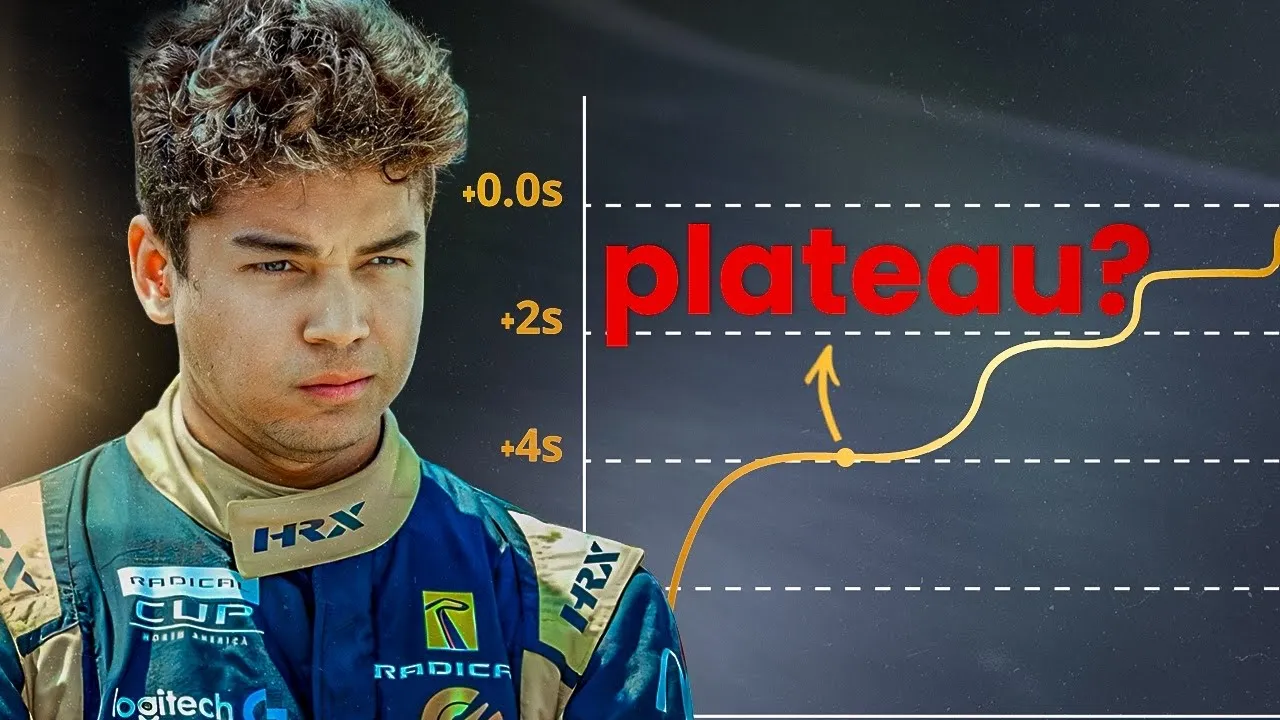
Why You Stopped Improving Your Racing Skills — And How to Break Through
Suellio Almeida
•
Wednesday, October 9, 2024
You're Not Slow Because You Lack Talent
Let's get this out of the way first.
When drivers stop improving, they blame talent. They tell themselves they've hit their ceiling. That faster drivers just have "it" and they don't.
That's not what's happening.
The truth? You stopped improving because your training method stopped working. What got you from beginner to intermediate won't get you from intermediate to fast. The skills are different. The approach is different. The level of awareness required is completely different.
And if you keep doing what you've always done, you'll keep getting what you've always gotten.
The Three Plateaus Every Sim Racer Faces
There are three major skill walls in sim racing. Most drivers get stuck at one of them and never move past it.
Plateau 1: The Beginner Wall (1000-2000 iRating)
You've learned the basics. You can complete laps. You're not spinning every corner. But you're slow, and you don't know why.
The issue here is lack of technique foundation. You're driving by feel, not by method. You don't understand weight transfer. You're not trail braking properly. Your vision is reactive instead of proactive.
You need structured training. Not more laps. Not watching replays of alien drivers. You need someone to teach you the fundamentals with proper progression.
Plateau 2: The Intermediate Trap (2500-3500 iRating)
This is where most drivers get stuck permanently.
You're decent. You can hang with quick drivers for a few laps. You understand the concepts. You know what trail braking is. You've watched the tutorials.
But you can't execute consistently. You're fast one lap, slow the next. You make mistakes under pressure. You lose time in places you can't identify.
The problem? You never trained precision. You learned techniques as concepts, not as repeatable skills. You can trail brake when you're thinking about it, but not automatically. You can hit the apex when the car is perfect, but not when it's sliding.
You need deliberate practice. You need feedback loops. You need to train specific scenarios until they become automatic.
Plateau 3: The Advanced Ceiling (4000+ iRating)
You're fast. Top split. You can run clean laps. You understand car behavior at a deep level.
But the aliens are still faster, and you can't figure out why. You analyze data. You copy setups. You study telemetry. The gap is small — two tenths, three tenths — but it's consistent.
The issue here is optimization and racecraft. The difference between 4000 and 6000 iRating isn't one big thing. It's fifty small things. Brake release timing. Steering precision. Risk management. Mental game. Vision techniques. Energy management over a stint.
You need coaching. You need someone who can see what you can't see. You need targeted feedback on the micro-details that separate good from elite.
The Real Reason You're Stuck
Here's what actually stops improvement:
1. You're practicing, not training.
Practice is doing laps. Training is working on specific skills with specific intent. Most drivers just run laps and hope they get faster. That's not training. That's spinning your wheels.
If you can't name the exact skill you're working on in a session, you're not training.
2. You have no feedback loop.
You're making mistakes and you don't even know it. You think you're trail braking correctly because the car turned. But you're late on brake release. Your steering input is rough. Your vision is two corners behind.
Without feedback — from coaching, from data, from structured drills — you're just reinforcing bad habits.
3. You're training the wrong things.
Drivers spend hours on hotlaps. But hotlapping doesn't teach you racecraft. It doesn't teach you tire management. It doesn't teach you how to defend a position or execute an overtake.
You need to train what you actually want to improve.
4. You're not progressive.
You try to learn everything at once. Trail braking, weight transfer, vision, racecraft, setup changes — all at the same time. That's not how skill development works.
You need layered progression. Master one thing, then add the next.
What Actually Works
Step 1: Identify your plateau.
Be honest. Where are you stuck? What specific skill is limiting you? Not "I'm just slow." Specific. "I'm losing time on corner entry." "I'm inconsistent under braking." "I can't maintain pace over a stint."
Step 2: Train that skill in isolation.
Don't just run laps. Design drills. If your issue is trail braking, run a circuit with three corners and focus ONLY on brake release timing. Repeat. Repeat. Repeat. Until it's automatic.
Step 3: Get feedback.
You can't see your own mistakes. You need external input. Coaching. Data analysis. Video review. Something that shows you the gap between what you think you're doing and what you're actually doing.
Step 4: Build progression.
Once you've mastered a skill in isolation, layer it into full-pace driving. Then add the next skill. Build complexity gradually. Don't skip steps.
The Path Forward
Here's the reality.
Most drivers will stay stuck. They'll keep doing the same thing and expecting different results. They'll blame the car, the setup, the competition.
But the drivers who break through? They train with structure. They get feedback. They commit to the process.
The method works. I've seen it work on 36,000+ students. Beginners who couldn't finish a lap, now running top splits. Intermediate drivers stuck at 2500 iRating, now breaking 4000. Advanced drivers closing the gap to aliens.
The difference isn't talent. It's method.
What Would Change If You Actually Trained With Purpose?
Think about where you are right now.
Same lap times. Same mistakes. Same frustration. How long are you going to keep running laps and hoping something clicks?
What if you had a structured path — lesson by lesson, skill by skill — designed to take you from where you are to where you want to be?
What if you had coaches who've actually done this — won championships, raced IMSA, trained thousands of drivers — giving you feedback on exactly what's holding you back?
That's what Almeida Racing Academy is. Not YouTube tutorials. Not generic advice. A complete training system with 80 lessons, 8 courses, weekly workshops, and a community of drivers who are actually improving.
You can start with a free account. Full access to the Car Handling course. 11 lessons that teach you the fundamentals most drivers never learn properly. Zero risk. Just see if the method works for you.
and start training like you mean it.
Sim Racing Academy Membership
Everything you need to stop guessing and start getting faster.
Starting at
$25
/mo
Car Handling Online Course
4 levels, full curriculum. Aimed to get you to top 1% in driving pace.
Racecraft Online Course
Overtaking, Defending, Race Strategy
Live coaching + on-track practice
Bi-weekly pro-coach workshops (recorded — never miss one) plus on-track Pit Parties to practice racecraft with a coach.
Plus These Bonuses
13,000+ Member Community
League Racing
Advanced MX-5 Mini Course
Racing Technique Development Guide
The Motor Racing Book (260 pages)
Think & Behave Like a Pro Driver — Mini eBook
Why You Stopped Improving Your Racing Skills — And How to Break Through
Suellio Almeida
•
Wednesday, October 9, 2024
You're Not Slow Because You Lack Talent
Let's get this out of the way first.
When drivers stop improving, they blame talent. They tell themselves they've hit their ceiling. That faster drivers just have "it" and they don't.
That's not what's happening.
The truth? You stopped improving because your training method stopped working. What got you from beginner to intermediate won't get you from intermediate to fast. The skills are different. The approach is different. The level of awareness required is completely different.
And if you keep doing what you've always done, you'll keep getting what you've always gotten.
The Three Plateaus Every Sim Racer Faces
There are three major skill walls in sim racing. Most drivers get stuck at one of them and never move past it.
Plateau 1: The Beginner Wall (1000-2000 iRating)
You've learned the basics. You can complete laps. You're not spinning every corner. But you're slow, and you don't know why.
The issue here is lack of technique foundation. You're driving by feel, not by method. You don't understand weight transfer. You're not trail braking properly. Your vision is reactive instead of proactive.
You need structured training. Not more laps. Not watching replays of alien drivers. You need someone to teach you the fundamentals with proper progression.
Plateau 2: The Intermediate Trap (2500-3500 iRating)
This is where most drivers get stuck permanently.
You're decent. You can hang with quick drivers for a few laps. You understand the concepts. You know what trail braking is. You've watched the tutorials.
But you can't execute consistently. You're fast one lap, slow the next. You make mistakes under pressure. You lose time in places you can't identify.
The problem? You never trained precision. You learned techniques as concepts, not as repeatable skills. You can trail brake when you're thinking about it, but not automatically. You can hit the apex when the car is perfect, but not when it's sliding.
You need deliberate practice. You need feedback loops. You need to train specific scenarios until they become automatic.
Plateau 3: The Advanced Ceiling (4000+ iRating)
You're fast. Top split. You can run clean laps. You understand car behavior at a deep level.
But the aliens are still faster, and you can't figure out why. You analyze data. You copy setups. You study telemetry. The gap is small — two tenths, three tenths — but it's consistent.
The issue here is optimization and racecraft. The difference between 4000 and 6000 iRating isn't one big thing. It's fifty small things. Brake release timing. Steering precision. Risk management. Mental game. Vision techniques. Energy management over a stint.
You need coaching. You need someone who can see what you can't see. You need targeted feedback on the micro-details that separate good from elite.
The Real Reason You're Stuck
Here's what actually stops improvement:
1. You're practicing, not training.
Practice is doing laps. Training is working on specific skills with specific intent. Most drivers just run laps and hope they get faster. That's not training. That's spinning your wheels.
If you can't name the exact skill you're working on in a session, you're not training.
2. You have no feedback loop.
You're making mistakes and you don't even know it. You think you're trail braking correctly because the car turned. But you're late on brake release. Your steering input is rough. Your vision is two corners behind.
Without feedback — from coaching, from data, from structured drills — you're just reinforcing bad habits.
3. You're training the wrong things.
Drivers spend hours on hotlaps. But hotlapping doesn't teach you racecraft. It doesn't teach you tire management. It doesn't teach you how to defend a position or execute an overtake.
You need to train what you actually want to improve.
4. You're not progressive.
You try to learn everything at once. Trail braking, weight transfer, vision, racecraft, setup changes — all at the same time. That's not how skill development works.
You need layered progression. Master one thing, then add the next.
What Actually Works
Step 1: Identify your plateau.
Be honest. Where are you stuck? What specific skill is limiting you? Not "I'm just slow." Specific. "I'm losing time on corner entry." "I'm inconsistent under braking." "I can't maintain pace over a stint."
Step 2: Train that skill in isolation.
Don't just run laps. Design drills. If your issue is trail braking, run a circuit with three corners and focus ONLY on brake release timing. Repeat. Repeat. Repeat. Until it's automatic.
Step 3: Get feedback.
You can't see your own mistakes. You need external input. Coaching. Data analysis. Video review. Something that shows you the gap between what you think you're doing and what you're actually doing.
Step 4: Build progression.
Once you've mastered a skill in isolation, layer it into full-pace driving. Then add the next skill. Build complexity gradually. Don't skip steps.
The Path Forward
Here's the reality.
Most drivers will stay stuck. They'll keep doing the same thing and expecting different results. They'll blame the car, the setup, the competition.
But the drivers who break through? They train with structure. They get feedback. They commit to the process.
The method works. I've seen it work on 36,000+ students. Beginners who couldn't finish a lap, now running top splits. Intermediate drivers stuck at 2500 iRating, now breaking 4000. Advanced drivers closing the gap to aliens.
The difference isn't talent. It's method.
What Would Change If You Actually Trained With Purpose?
Think about where you are right now.
Same lap times. Same mistakes. Same frustration. How long are you going to keep running laps and hoping something clicks?
What if you had a structured path — lesson by lesson, skill by skill — designed to take you from where you are to where you want to be?
What if you had coaches who've actually done this — won championships, raced IMSA, trained thousands of drivers — giving you feedback on exactly what's holding you back?
That's what Almeida Racing Academy is. Not YouTube tutorials. Not generic advice. A complete training system with 80 lessons, 8 courses, weekly workshops, and a community of drivers who are actually improving.
You can start with a free account. Full access to the Car Handling course. 11 lessons that teach you the fundamentals most drivers never learn properly. Zero risk. Just see if the method works for you.
and start training like you mean it.
Sim Racing Academy Membership
Everything you need to stop guessing and start getting faster.
Starting at
$25
/mo
Car Handling Online Course
4 levels, full curriculum. Aimed to get you to top 1% in driving pace.
Racecraft Online Course
Overtaking, Defending, Race Strategy
Live coaching + on-track practice
Bi-weekly pro-coach workshops (recorded — never miss one) plus on-track Pit Parties to practice racecraft with a coach.
Plus These Bonuses
13,000+ Member Community
League Racing
Advanced MX-5 Mini Course
Racing Technique Development Guide
The Motor Racing Book (260 pages)
Think & Behave Like a Pro Driver — Mini eBook
Why You Stopped Improving Your Racing Skills — And How to Break Through
Suellio Almeida
•
Wednesday, October 9, 2024
You're Not Slow Because You Lack Talent
Let's get this out of the way first.
When drivers stop improving, they blame talent. They tell themselves they've hit their ceiling. That faster drivers just have "it" and they don't.
That's not what's happening.
The truth? You stopped improving because your training method stopped working. What got you from beginner to intermediate won't get you from intermediate to fast. The skills are different. The approach is different. The level of awareness required is completely different.
And if you keep doing what you've always done, you'll keep getting what you've always gotten.
The Three Plateaus Every Sim Racer Faces
There are three major skill walls in sim racing. Most drivers get stuck at one of them and never move past it.
Plateau 1: The Beginner Wall (1000-2000 iRating)
You've learned the basics. You can complete laps. You're not spinning every corner. But you're slow, and you don't know why.
The issue here is lack of technique foundation. You're driving by feel, not by method. You don't understand weight transfer. You're not trail braking properly. Your vision is reactive instead of proactive.
You need structured training. Not more laps. Not watching replays of alien drivers. You need someone to teach you the fundamentals with proper progression.
Plateau 2: The Intermediate Trap (2500-3500 iRating)
This is where most drivers get stuck permanently.
You're decent. You can hang with quick drivers for a few laps. You understand the concepts. You know what trail braking is. You've watched the tutorials.
But you can't execute consistently. You're fast one lap, slow the next. You make mistakes under pressure. You lose time in places you can't identify.
The problem? You never trained precision. You learned techniques as concepts, not as repeatable skills. You can trail brake when you're thinking about it, but not automatically. You can hit the apex when the car is perfect, but not when it's sliding.
You need deliberate practice. You need feedback loops. You need to train specific scenarios until they become automatic.
Plateau 3: The Advanced Ceiling (4000+ iRating)
You're fast. Top split. You can run clean laps. You understand car behavior at a deep level.
But the aliens are still faster, and you can't figure out why. You analyze data. You copy setups. You study telemetry. The gap is small — two tenths, three tenths — but it's consistent.
The issue here is optimization and racecraft. The difference between 4000 and 6000 iRating isn't one big thing. It's fifty small things. Brake release timing. Steering precision. Risk management. Mental game. Vision techniques. Energy management over a stint.
You need coaching. You need someone who can see what you can't see. You need targeted feedback on the micro-details that separate good from elite.
The Real Reason You're Stuck
Here's what actually stops improvement:
1. You're practicing, not training.
Practice is doing laps. Training is working on specific skills with specific intent. Most drivers just run laps and hope they get faster. That's not training. That's spinning your wheels.
If you can't name the exact skill you're working on in a session, you're not training.
2. You have no feedback loop.
You're making mistakes and you don't even know it. You think you're trail braking correctly because the car turned. But you're late on brake release. Your steering input is rough. Your vision is two corners behind.
Without feedback — from coaching, from data, from structured drills — you're just reinforcing bad habits.
3. You're training the wrong things.
Drivers spend hours on hotlaps. But hotlapping doesn't teach you racecraft. It doesn't teach you tire management. It doesn't teach you how to defend a position or execute an overtake.
You need to train what you actually want to improve.
4. You're not progressive.
You try to learn everything at once. Trail braking, weight transfer, vision, racecraft, setup changes — all at the same time. That's not how skill development works.
You need layered progression. Master one thing, then add the next.
What Actually Works
Step 1: Identify your plateau.
Be honest. Where are you stuck? What specific skill is limiting you? Not "I'm just slow." Specific. "I'm losing time on corner entry." "I'm inconsistent under braking." "I can't maintain pace over a stint."
Step 2: Train that skill in isolation.
Don't just run laps. Design drills. If your issue is trail braking, run a circuit with three corners and focus ONLY on brake release timing. Repeat. Repeat. Repeat. Until it's automatic.
Step 3: Get feedback.
You can't see your own mistakes. You need external input. Coaching. Data analysis. Video review. Something that shows you the gap between what you think you're doing and what you're actually doing.
Step 4: Build progression.
Once you've mastered a skill in isolation, layer it into full-pace driving. Then add the next skill. Build complexity gradually. Don't skip steps.
The Path Forward
Here's the reality.
Most drivers will stay stuck. They'll keep doing the same thing and expecting different results. They'll blame the car, the setup, the competition.
But the drivers who break through? They train with structure. They get feedback. They commit to the process.
The method works. I've seen it work on 36,000+ students. Beginners who couldn't finish a lap, now running top splits. Intermediate drivers stuck at 2500 iRating, now breaking 4000. Advanced drivers closing the gap to aliens.
The difference isn't talent. It's method.
What Would Change If You Actually Trained With Purpose?
Think about where you are right now.
Same lap times. Same mistakes. Same frustration. How long are you going to keep running laps and hoping something clicks?
What if you had a structured path — lesson by lesson, skill by skill — designed to take you from where you are to where you want to be?
What if you had coaches who've actually done this — won championships, raced IMSA, trained thousands of drivers — giving you feedback on exactly what's holding you back?
That's what Almeida Racing Academy is. Not YouTube tutorials. Not generic advice. A complete training system with 80 lessons, 8 courses, weekly workshops, and a community of drivers who are actually improving.
You can start with a free account. Full access to the Car Handling course. 11 lessons that teach you the fundamentals most drivers never learn properly. Zero risk. Just see if the method works for you.
and start training like you mean it.
Sim Racing Academy Membership
Everything you need to stop guessing and start getting faster.
Starting at
$25
/mo
Car Handling Online Course
4 levels, full curriculum. Aimed to get you to top 1% in driving pace.
Racecraft Online Course
Overtaking, Defending, Race Strategy
Live coaching + on-track practice
Bi-weekly pro-coach workshops (recorded — never miss one) plus on-track Pit Parties to practice racecraft with a coach.
Plus These Bonuses
13,000+ Member Community
League Racing
Advanced MX-5 Mini Course
Racing Technique Development Guide
The Motor Racing Book (260 pages)
Think & Behave Like a Pro Driver — Mini eBook