
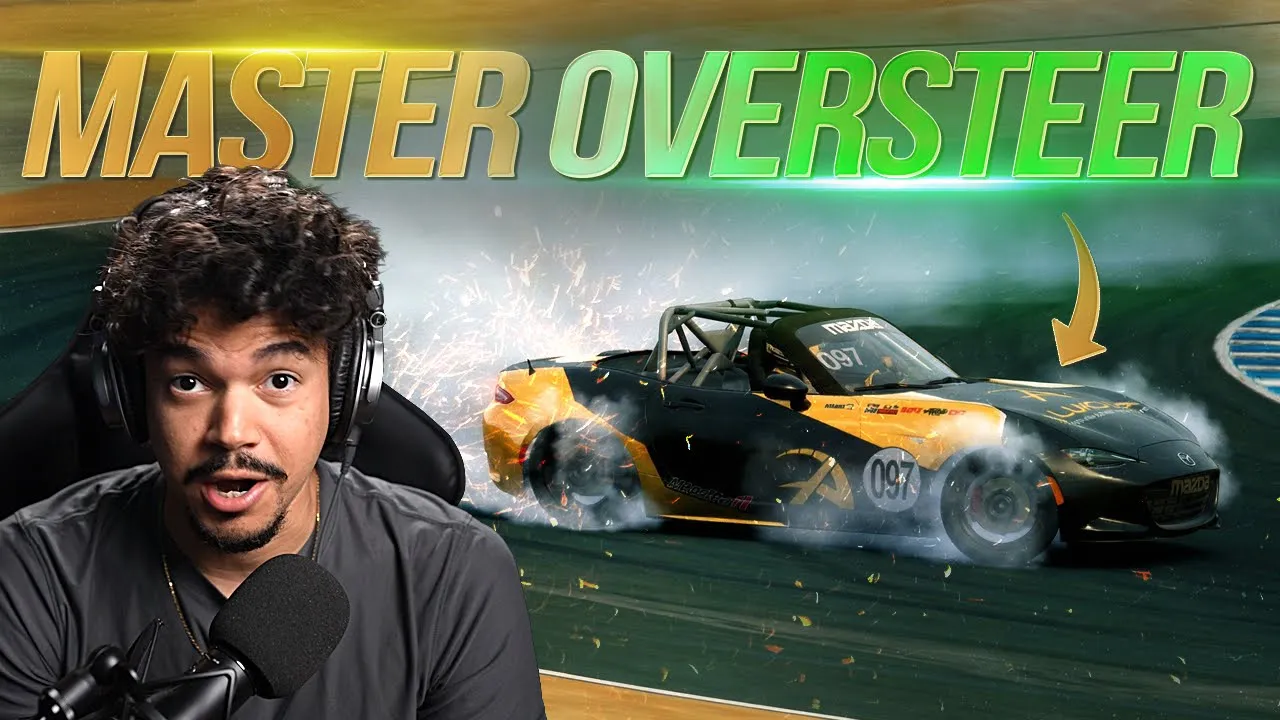
This Will Stop Your Fear of Spins in Racing — How to Build Confidence Behind the Wheel
Suellio Almeida
•
Thursday, January 29, 2026
Why You're Actually Afraid of Spins
You're not afraid of the spin itself.
You're afraid of what happens next — the loss of control, the SR hit, the embarrassment, the wrecked race. Your brain logs that moment as "danger" and starts protecting you the only way it knows how: by making you slow down.
This is normal. It's also fixable.
The fear isn't the problem. The problem is you haven't given your brain a better response pattern. You're driving scared because you don't have a plan for what to do when the car starts to let go.
The Real Reason You Keep Spinning
Most spins happen because you're reacting instead of managing.
You feel the rear step out. You panic. You overcorrect. The car snaps back the other way. Now you're a passenger.
Here's what actually causes spins:
Aggressive inputs mid-corner. You're either on the throttle too hard too early, or you're still trail braking too deep into the apex. The car is already at the limit — you're asking it to do two things at once.
Weight transfer ignorance. Every input you make moves weight. Brake hard? Weight goes forward. Turn in? Weight shifts laterally. Throttle? Weight goes to the rear. If you don't understand this, you're gambling every corner.
No rotation plan. You're trying to point the car through pure steering angle. That's not how fast corners work. You need rotation — getting the car to pivot naturally using weight transfer and subtle inputs.
How to Stop Spinning (The Actual Fix)
Step 1: Learn What a Slide Feels Like
You can't catch something you don't recognize.
Go into a practice session. Find a slow corner. Deliberately upset the car — too much throttle, too aggressive turn-in. Feel the rear go light. Don't panic. Just hold the wheel steady and let it slide.
Do this ten times. Then twenty. You need to desensitize your panic response and replace it with data.
What does the car feel like right before it lets go? That's your warning signal. Start listening for it.
Step 2: Trail Braking is Your Safety Net
Trail braking isn't just about going faster. It's about control.
When you release the brakes gradually through turn-in, you're managing weight transfer. You're keeping load on the front tires, which gives you more grip, more steering authority, more rotation.
Most spins happen because you dump the brakes too early. Now the car is coasting mid-corner with no weight on the nose. The front tires have nothing to work with. You turn the wheel harder. The rear steps out.
Instead: brake deeper, release slower, carry that front grip all the way to the apex. The car will rotate naturally. You won't need to force it.
Step 3: Smooth on the Throttle
This is where most people lose it.
You nail the apex. You think you're clear. You hammer the throttle. The rear unloads. Spin.
Here's the rule: The sharper the corner, the gentler the throttle application.
You're not trying to get on full throttle instantly. You're progressively loading the rear tires as the car unwinds and the steering straightens out.
Think of it like a ramp, not a switch. Squeeze the throttle in proportion to how much steering angle you're carrying. Less steering = more throttle. More steering = less throttle.
If you're still spinning on exit, you're going full throttle too early. Simple.
Step 4: Catch It Early or Don't Catch It at All
Once the car is fully sideways, you're not saving it. You're just along for the ride.
The key is recognizing the slide before it becomes a spin. You'll feel a lightness in the rear, a slight drift. That's when you act.
Small corrections: ease off the throttle slightly, unwind a bit of steering, let the car settle. Don't overcorrect. Don't yank the wheel. Smooth inputs.
If you wait until the car is at 45 degrees? It's over. Accept it, both hands on the wheel, clutch in, straighten the wheel, minimize the damage.
Building Confidence Through Repetition
You don't build confidence by avoiding spins. You build it by knowing you can handle them.
Every fast driver has spun hundreds of times. The difference is they learned from it instead of letting it slow them down.
Start practicing at the limit. Not in races — in practice sessions, time trials, solo laps. Push the car until you feel the edge. Learn where that edge is. Learn how the car talks to you right before it lets go.
The more you practice at the limit, the more normal it becomes. The fear fades because you've been there before. You know what to expect. You know what to do.
The Fastest Drivers Aren't Fearless — They're Prepared
You think the guys at the front never spin? They do. They just don't let it control them.
They've trained the feeling out of the car. They've practiced the save. They know exactly how much grip they have because they've tested the limit over and over.
You can do the same thing. It just takes intentional practice.
Stop driving scared. Start driving informed.
What If You Could Practice This with a Real Coach Watching?
You've read the technique. You understand the theory.
But how do you know if you're actually doing it right? How do you know if you're releasing the brakes correctly, managing weight transfer properly, catching slides early enough?
What if you're reinforcing the wrong habits every session — and you don't even realize it?
This is exactly what Gold Membership at Almeida Racing Academy solves. You get access to 8 full courses, including advanced trail braking, rotation control, and weight transfer mastery. You get 80+ lessons breaking down every input, every phase of the corner, every mistake that causes spins.
And you get coach-led workshops where we watch your driving, analyze your mistakes, and show you exactly what to fix.
No more guessing. No more reinforcing bad habits. Just clear, structured training from a team that includes an IMSA driver, a 9k iRating coach, and a NASCAR driver.
Right now, Gold is $25/month with code WINTER. That's less than a single tank of gas — for unlimited access to the same training that's taken drivers from rookies to podiums.
Sim Racing Academy Membership
Everything you need to stop guessing and start getting faster.
Starting at
$25
/mo
Car Handling Online Course
4 levels, full curriculum. Aimed to get you to top 1% in driving pace.
Racecraft Online Course
Overtaking, Defending, Race Strategy
Live coaching + on-track practice
Bi-weekly pro-coach workshops (recorded — never miss one) plus on-track Pit Parties to practice racecraft with a coach.
Plus These Bonuses
13,000+ Member Community
League Racing
Advanced MX-5 Mini Course
Racing Technique Development Guide
The Motor Racing Book (260 pages)
Think & Behave Like a Pro Driver — Mini eBook
This Will Stop Your Fear of Spins in Racing — How to Build Confidence Behind the Wheel
Suellio Almeida
•
Thursday, January 29, 2026
Why You're Actually Afraid of Spins
You're not afraid of the spin itself.
You're afraid of what happens next — the loss of control, the SR hit, the embarrassment, the wrecked race. Your brain logs that moment as "danger" and starts protecting you the only way it knows how: by making you slow down.
This is normal. It's also fixable.
The fear isn't the problem. The problem is you haven't given your brain a better response pattern. You're driving scared because you don't have a plan for what to do when the car starts to let go.
The Real Reason You Keep Spinning
Most spins happen because you're reacting instead of managing.
You feel the rear step out. You panic. You overcorrect. The car snaps back the other way. Now you're a passenger.
Here's what actually causes spins:
Aggressive inputs mid-corner. You're either on the throttle too hard too early, or you're still trail braking too deep into the apex. The car is already at the limit — you're asking it to do two things at once.
Weight transfer ignorance. Every input you make moves weight. Brake hard? Weight goes forward. Turn in? Weight shifts laterally. Throttle? Weight goes to the rear. If you don't understand this, you're gambling every corner.
No rotation plan. You're trying to point the car through pure steering angle. That's not how fast corners work. You need rotation — getting the car to pivot naturally using weight transfer and subtle inputs.
How to Stop Spinning (The Actual Fix)
Step 1: Learn What a Slide Feels Like
You can't catch something you don't recognize.
Go into a practice session. Find a slow corner. Deliberately upset the car — too much throttle, too aggressive turn-in. Feel the rear go light. Don't panic. Just hold the wheel steady and let it slide.
Do this ten times. Then twenty. You need to desensitize your panic response and replace it with data.
What does the car feel like right before it lets go? That's your warning signal. Start listening for it.
Step 2: Trail Braking is Your Safety Net
Trail braking isn't just about going faster. It's about control.
When you release the brakes gradually through turn-in, you're managing weight transfer. You're keeping load on the front tires, which gives you more grip, more steering authority, more rotation.
Most spins happen because you dump the brakes too early. Now the car is coasting mid-corner with no weight on the nose. The front tires have nothing to work with. You turn the wheel harder. The rear steps out.
Instead: brake deeper, release slower, carry that front grip all the way to the apex. The car will rotate naturally. You won't need to force it.
Step 3: Smooth on the Throttle
This is where most people lose it.
You nail the apex. You think you're clear. You hammer the throttle. The rear unloads. Spin.
Here's the rule: The sharper the corner, the gentler the throttle application.
You're not trying to get on full throttle instantly. You're progressively loading the rear tires as the car unwinds and the steering straightens out.
Think of it like a ramp, not a switch. Squeeze the throttle in proportion to how much steering angle you're carrying. Less steering = more throttle. More steering = less throttle.
If you're still spinning on exit, you're going full throttle too early. Simple.
Step 4: Catch It Early or Don't Catch It at All
Once the car is fully sideways, you're not saving it. You're just along for the ride.
The key is recognizing the slide before it becomes a spin. You'll feel a lightness in the rear, a slight drift. That's when you act.
Small corrections: ease off the throttle slightly, unwind a bit of steering, let the car settle. Don't overcorrect. Don't yank the wheel. Smooth inputs.
If you wait until the car is at 45 degrees? It's over. Accept it, both hands on the wheel, clutch in, straighten the wheel, minimize the damage.
Building Confidence Through Repetition
You don't build confidence by avoiding spins. You build it by knowing you can handle them.
Every fast driver has spun hundreds of times. The difference is they learned from it instead of letting it slow them down.
Start practicing at the limit. Not in races — in practice sessions, time trials, solo laps. Push the car until you feel the edge. Learn where that edge is. Learn how the car talks to you right before it lets go.
The more you practice at the limit, the more normal it becomes. The fear fades because you've been there before. You know what to expect. You know what to do.
The Fastest Drivers Aren't Fearless — They're Prepared
You think the guys at the front never spin? They do. They just don't let it control them.
They've trained the feeling out of the car. They've practiced the save. They know exactly how much grip they have because they've tested the limit over and over.
You can do the same thing. It just takes intentional practice.
Stop driving scared. Start driving informed.
What If You Could Practice This with a Real Coach Watching?
You've read the technique. You understand the theory.
But how do you know if you're actually doing it right? How do you know if you're releasing the brakes correctly, managing weight transfer properly, catching slides early enough?
What if you're reinforcing the wrong habits every session — and you don't even realize it?
This is exactly what Gold Membership at Almeida Racing Academy solves. You get access to 8 full courses, including advanced trail braking, rotation control, and weight transfer mastery. You get 80+ lessons breaking down every input, every phase of the corner, every mistake that causes spins.
And you get coach-led workshops where we watch your driving, analyze your mistakes, and show you exactly what to fix.
No more guessing. No more reinforcing bad habits. Just clear, structured training from a team that includes an IMSA driver, a 9k iRating coach, and a NASCAR driver.
Right now, Gold is $25/month with code WINTER. That's less than a single tank of gas — for unlimited access to the same training that's taken drivers from rookies to podiums.
Sim Racing Academy Membership
Everything you need to stop guessing and start getting faster.
Starting at
$25
/mo
Car Handling Online Course
4 levels, full curriculum. Aimed to get you to top 1% in driving pace.
Racecraft Online Course
Overtaking, Defending, Race Strategy
Live coaching + on-track practice
Bi-weekly pro-coach workshops (recorded — never miss one) plus on-track Pit Parties to practice racecraft with a coach.
Plus These Bonuses
13,000+ Member Community
League Racing
Advanced MX-5 Mini Course
Racing Technique Development Guide
The Motor Racing Book (260 pages)
Think & Behave Like a Pro Driver — Mini eBook
This Will Stop Your Fear of Spins in Racing — How to Build Confidence Behind the Wheel
Suellio Almeida
•
Thursday, January 29, 2026
Why You're Actually Afraid of Spins
You're not afraid of the spin itself.
You're afraid of what happens next — the loss of control, the SR hit, the embarrassment, the wrecked race. Your brain logs that moment as "danger" and starts protecting you the only way it knows how: by making you slow down.
This is normal. It's also fixable.
The fear isn't the problem. The problem is you haven't given your brain a better response pattern. You're driving scared because you don't have a plan for what to do when the car starts to let go.
The Real Reason You Keep Spinning
Most spins happen because you're reacting instead of managing.
You feel the rear step out. You panic. You overcorrect. The car snaps back the other way. Now you're a passenger.
Here's what actually causes spins:
Aggressive inputs mid-corner. You're either on the throttle too hard too early, or you're still trail braking too deep into the apex. The car is already at the limit — you're asking it to do two things at once.
Weight transfer ignorance. Every input you make moves weight. Brake hard? Weight goes forward. Turn in? Weight shifts laterally. Throttle? Weight goes to the rear. If you don't understand this, you're gambling every corner.
No rotation plan. You're trying to point the car through pure steering angle. That's not how fast corners work. You need rotation — getting the car to pivot naturally using weight transfer and subtle inputs.
How to Stop Spinning (The Actual Fix)
Step 1: Learn What a Slide Feels Like
You can't catch something you don't recognize.
Go into a practice session. Find a slow corner. Deliberately upset the car — too much throttle, too aggressive turn-in. Feel the rear go light. Don't panic. Just hold the wheel steady and let it slide.
Do this ten times. Then twenty. You need to desensitize your panic response and replace it with data.
What does the car feel like right before it lets go? That's your warning signal. Start listening for it.
Step 2: Trail Braking is Your Safety Net
Trail braking isn't just about going faster. It's about control.
When you release the brakes gradually through turn-in, you're managing weight transfer. You're keeping load on the front tires, which gives you more grip, more steering authority, more rotation.
Most spins happen because you dump the brakes too early. Now the car is coasting mid-corner with no weight on the nose. The front tires have nothing to work with. You turn the wheel harder. The rear steps out.
Instead: brake deeper, release slower, carry that front grip all the way to the apex. The car will rotate naturally. You won't need to force it.
Step 3: Smooth on the Throttle
This is where most people lose it.
You nail the apex. You think you're clear. You hammer the throttle. The rear unloads. Spin.
Here's the rule: The sharper the corner, the gentler the throttle application.
You're not trying to get on full throttle instantly. You're progressively loading the rear tires as the car unwinds and the steering straightens out.
Think of it like a ramp, not a switch. Squeeze the throttle in proportion to how much steering angle you're carrying. Less steering = more throttle. More steering = less throttle.
If you're still spinning on exit, you're going full throttle too early. Simple.
Step 4: Catch It Early or Don't Catch It at All
Once the car is fully sideways, you're not saving it. You're just along for the ride.
The key is recognizing the slide before it becomes a spin. You'll feel a lightness in the rear, a slight drift. That's when you act.
Small corrections: ease off the throttle slightly, unwind a bit of steering, let the car settle. Don't overcorrect. Don't yank the wheel. Smooth inputs.
If you wait until the car is at 45 degrees? It's over. Accept it, both hands on the wheel, clutch in, straighten the wheel, minimize the damage.
Building Confidence Through Repetition
You don't build confidence by avoiding spins. You build it by knowing you can handle them.
Every fast driver has spun hundreds of times. The difference is they learned from it instead of letting it slow them down.
Start practicing at the limit. Not in races — in practice sessions, time trials, solo laps. Push the car until you feel the edge. Learn where that edge is. Learn how the car talks to you right before it lets go.
The more you practice at the limit, the more normal it becomes. The fear fades because you've been there before. You know what to expect. You know what to do.
The Fastest Drivers Aren't Fearless — They're Prepared
You think the guys at the front never spin? They do. They just don't let it control them.
They've trained the feeling out of the car. They've practiced the save. They know exactly how much grip they have because they've tested the limit over and over.
You can do the same thing. It just takes intentional practice.
Stop driving scared. Start driving informed.
What If You Could Practice This with a Real Coach Watching?
You've read the technique. You understand the theory.
But how do you know if you're actually doing it right? How do you know if you're releasing the brakes correctly, managing weight transfer properly, catching slides early enough?
What if you're reinforcing the wrong habits every session — and you don't even realize it?
This is exactly what Gold Membership at Almeida Racing Academy solves. You get access to 8 full courses, including advanced trail braking, rotation control, and weight transfer mastery. You get 80+ lessons breaking down every input, every phase of the corner, every mistake that causes spins.
And you get coach-led workshops where we watch your driving, analyze your mistakes, and show you exactly what to fix.
No more guessing. No more reinforcing bad habits. Just clear, structured training from a team that includes an IMSA driver, a 9k iRating coach, and a NASCAR driver.
Right now, Gold is $25/month with code WINTER. That's less than a single tank of gas — for unlimited access to the same training that's taken drivers from rookies to podiums.
Sim Racing Academy Membership
Everything you need to stop guessing and start getting faster.
Starting at
$25
/mo
Car Handling Online Course
4 levels, full curriculum. Aimed to get you to top 1% in driving pace.
Racecraft Online Course
Overtaking, Defending, Race Strategy
Live coaching + on-track practice
Bi-weekly pro-coach workshops (recorded — never miss one) plus on-track Pit Parties to practice racecraft with a coach.
Plus These Bonuses
13,000+ Member Community
League Racing
Advanced MX-5 Mini Course
Racing Technique Development Guide
The Motor Racing Book (260 pages)
Think & Behave Like a Pro Driver — Mini eBook