
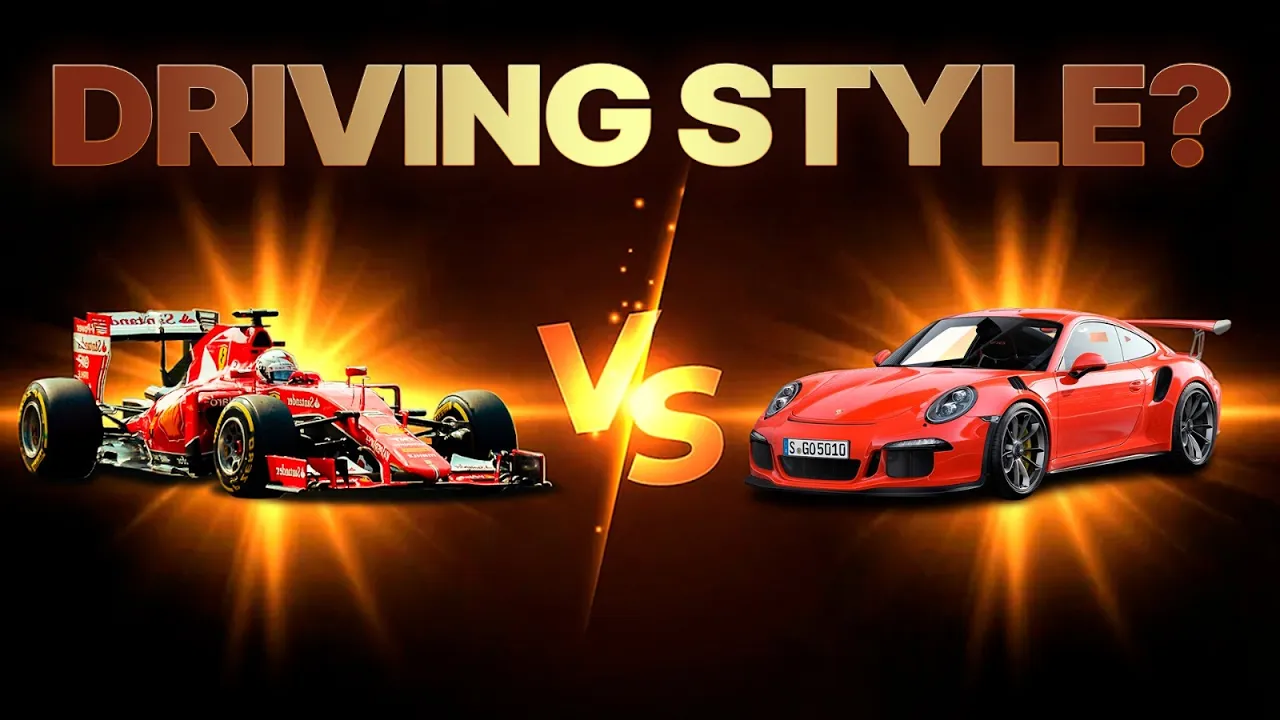
What's Your Driving Style? How Physics, Not Preference, Defines Fast Sim Racing
Suellio Almeida
•
Monday, April 17, 2023
You Don't Choose Your Driving Style — The Car Does
Here's what 99% of sim racers get wrong about driving style: they think it's personal preference.
You hear drivers say "I'm smooth" or "I'm aggressive" like it's an identity. That's not how this works.
Your driving style isn't about you. It's about the car's balance, the corner's geometry, and the physics of weight transfer. The car tells you how to drive it. Your job is to listen.
The Two Fundamental Approaches: Early Rotation vs. Late Rotation
Every corner entry breaks down into two categories: early rotation or late rotation.
Early rotation: You get the car turned in quickly, pointed at the apex early in the braking zone. This works when the car is rear-limited — when the rear has more grip than the front.
Late rotation: You carry more speed deeper into the corner, keep the car straighter longer, and rotate it later. This works when the car is front-limited — when the front tires are doing the heavy lifting.
What determines which one you use?
The car's balance. The corner's radius. The track surface.
Not your mood.
Front-Limited Cars Demand Late Rotation
Front-limited cars — think modern GT3s, especially mid-engine platforms — punish early rotation.
Why? The front tires are already maxed out. If you try to rotate the car early, you're asking the front to turn and brake at the same time. You'll understeer straight off track or scrub so much speed you're slow to the apex.
The solution: carry more speed, brake later, keep the car straighter.
You're managing front tire load. You brake hard in a straight line, then gradually release pressure as you turn in. The car rotates as you're finishing the braking phase, not before.
This looks "smooth" and "late apex" to an outside observer. But it's not style. It's physics.
Rear-Limited Cars Need Early Rotation
Rear-limited cars — older GT cars, some formula cars, front-engine platforms — have the opposite problem.
The rear tires are the limiting factor. If you carry too much speed into the corner, the rear breaks loose. You spin.
So what do you do? You rotate the car early.
You get it pointed at the apex sooner, while you still have brake pressure managing the weight transfer forward. This loads the front tires, helps the car turn, and prevents the rear from stepping out.
You're essentially using the brakes to control rotation, not delay it.
This looks "aggressive" and "early apex" to observers. Again: not style. Physics.
The Same Driver, Two Different Cars, Two Different "Styles"
Put the same driver in a Ferrari 296 GT3 (front-limited) and a Porsche 911 GT3 R (rear-biased). Watch them drive.
In the Ferrari, they're braking later, carrying more speed, rotating late. Smooth, patient, methodical.
In the Porsche, they're rotating earlier, more aggressive on initial turn-in, sharper inputs.
Did their personality change? No.
They adapted to what the car demanded.
This is what separates fast drivers from stuck drivers. Fast drivers diagnose the car's behavior and adjust. Stuck drivers force their style onto every car and wonder why it doesn't work.
How Corner Geometry Changes Everything
Car balance isn't the only factor. Corner shape dictates driving style too.
Tight, low-speed corners (hairpins, 90-degree turns): You need early rotation. If you don't get the car pointed early, you'll understeer wide or lose time on exit because you're still turning mid-corner.
Fast, sweeping corners (high-speed esses, long radius turns): Late rotation wins. Carrying more speed through the entry is worth more than an early apex. You're managing momentum, not rotation.
Decreasing radius corners: These punish late rotation. The corner tightens up on you. If you're not rotated early, you run out of front grip halfway through and push wide.
Again: the corner tells you how to drive it. Not your preference.
What About "Smooth" vs. "Aggressive" Drivers?
You've heard commentators say a driver is "smooth" or "aggressive."
What they're really describing is input rate — how quickly the driver changes steering angle, brake pressure, throttle position.
Smooth drivers: Gradual inputs. Works for cars with narrow operating windows or low mechanical grip.
Aggressive drivers: Sharper inputs. Works for cars with high downforce or strong mechanical platforms that can handle it.
But here's the key: the best drivers aren't locked into one mode. They're smooth when the car needs it, aggressive when the car can take it.
Adaptability is speed.
The Real Skill: Reading What the Car Needs
Here's the hierarchy of driver development:
Beginner: Forces their preferred style onto every car. Wonders why some cars "feel wrong."
Intermediate: Recognizes that different cars need different approaches. Adjusts consciously but slowly.
Advanced: Feels the car's balance within the first few corners. Adapts instinctively. The "style" is invisible because it's just... correct.
How do you get there?
Practice in different cars. Don't just drive one GT3 all year. Drive front-engine, mid-engine, rear-engine. Drive formula cars. Drive touring cars.
*Pay attention to where the car is limited. Is it pushing (front-limited) or loose (rear-limited)? Does it respond better to early rotation or late braking?
Stop saying "this car doesn't suit my style." That's a red flag. The car doesn't care about your style. Learn what it needs.
Why This Matters for Consistency
Drivers who force a fixed style onto every car are inconsistent.
They have good tracks and bad tracks. Good cars and bad cars. They blame the setup, the tires, the game physics.
Drivers who adapt to what the car demands are consistent.
They might not be the fastest in every car, but they're competitive in any car. They don't have mysterious off-weekends.
Consistency is adaptability.
So What Is Your Driving Style?
Your driving style is this:
The set of inputs that extract maximum performance from the specific car you're driving, in the specific corner you're in, under the current conditions.
That's it.
No personality. No identity. No "I'm a late braker" or "I'm a smooth driver."
Just physics. Just adaptation. Just speed.
The drivers who win championships aren't the ones with the most "style." They're the ones who have no style — because they become whatever the car needs them to be.
Are You Adapting or Just Hoping?
Here's the question: when you jump into a new car, do you diagnose its behavior and adjust your approach?
Or do you drive it the same way you drive everything else, then blame the car when it doesn't work?
Because that's the difference between drivers who plateau at 2k iRating and drivers who push 5k+.
One group treats every car like a puzzle to solve. The other group keeps using the same piece in every slot.
The physics don't care how you want to drive. They only reward what works.
If you want to break through your current plateau — if you're tired of being fast in one car and slow in another — you need a system that teaches you to read car balance, adapt your inputs, and extract speed from any* platform.
That's exactly what we built Gold Membership for. Eight courses. 80 lessons. Fundamentals, car control, racecraft, data analysis. Every lesson designed to make you adaptable, not rigid.
No personality-driven "tips." Just physics-based technique that works in any sim, any car, any track.
Sim Racing Academy Membership
Everything you need to stop guessing and start getting faster.
Starting at
$25
/mo
Car Handling Online Course
4 levels, full curriculum. Aimed to get you to top 1% in driving pace.
Racecraft Online Course
Overtaking, Defending, Race Strategy
Live coaching + on-track practice
Bi-weekly pro-coach workshops (recorded — never miss one) plus on-track Pit Parties to practice racecraft with a coach.
Plus These Bonuses
13,000+ Member Community
League Racing
Advanced MX-5 Mini Course
Racing Technique Development Guide
The Motor Racing Book (260 pages)
Think & Behave Like a Pro Driver — Mini eBook
What's Your Driving Style? How Physics, Not Preference, Defines Fast Sim Racing
Suellio Almeida
•
Monday, April 17, 2023
You Don't Choose Your Driving Style — The Car Does
Here's what 99% of sim racers get wrong about driving style: they think it's personal preference.
You hear drivers say "I'm smooth" or "I'm aggressive" like it's an identity. That's not how this works.
Your driving style isn't about you. It's about the car's balance, the corner's geometry, and the physics of weight transfer. The car tells you how to drive it. Your job is to listen.
The Two Fundamental Approaches: Early Rotation vs. Late Rotation
Every corner entry breaks down into two categories: early rotation or late rotation.
Early rotation: You get the car turned in quickly, pointed at the apex early in the braking zone. This works when the car is rear-limited — when the rear has more grip than the front.
Late rotation: You carry more speed deeper into the corner, keep the car straighter longer, and rotate it later. This works when the car is front-limited — when the front tires are doing the heavy lifting.
What determines which one you use?
The car's balance. The corner's radius. The track surface.
Not your mood.
Front-Limited Cars Demand Late Rotation
Front-limited cars — think modern GT3s, especially mid-engine platforms — punish early rotation.
Why? The front tires are already maxed out. If you try to rotate the car early, you're asking the front to turn and brake at the same time. You'll understeer straight off track or scrub so much speed you're slow to the apex.
The solution: carry more speed, brake later, keep the car straighter.
You're managing front tire load. You brake hard in a straight line, then gradually release pressure as you turn in. The car rotates as you're finishing the braking phase, not before.
This looks "smooth" and "late apex" to an outside observer. But it's not style. It's physics.
Rear-Limited Cars Need Early Rotation
Rear-limited cars — older GT cars, some formula cars, front-engine platforms — have the opposite problem.
The rear tires are the limiting factor. If you carry too much speed into the corner, the rear breaks loose. You spin.
So what do you do? You rotate the car early.
You get it pointed at the apex sooner, while you still have brake pressure managing the weight transfer forward. This loads the front tires, helps the car turn, and prevents the rear from stepping out.
You're essentially using the brakes to control rotation, not delay it.
This looks "aggressive" and "early apex" to observers. Again: not style. Physics.
The Same Driver, Two Different Cars, Two Different "Styles"
Put the same driver in a Ferrari 296 GT3 (front-limited) and a Porsche 911 GT3 R (rear-biased). Watch them drive.
In the Ferrari, they're braking later, carrying more speed, rotating late. Smooth, patient, methodical.
In the Porsche, they're rotating earlier, more aggressive on initial turn-in, sharper inputs.
Did their personality change? No.
They adapted to what the car demanded.
This is what separates fast drivers from stuck drivers. Fast drivers diagnose the car's behavior and adjust. Stuck drivers force their style onto every car and wonder why it doesn't work.
How Corner Geometry Changes Everything
Car balance isn't the only factor. Corner shape dictates driving style too.
Tight, low-speed corners (hairpins, 90-degree turns): You need early rotation. If you don't get the car pointed early, you'll understeer wide or lose time on exit because you're still turning mid-corner.
Fast, sweeping corners (high-speed esses, long radius turns): Late rotation wins. Carrying more speed through the entry is worth more than an early apex. You're managing momentum, not rotation.
Decreasing radius corners: These punish late rotation. The corner tightens up on you. If you're not rotated early, you run out of front grip halfway through and push wide.
Again: the corner tells you how to drive it. Not your preference.
What About "Smooth" vs. "Aggressive" Drivers?
You've heard commentators say a driver is "smooth" or "aggressive."
What they're really describing is input rate — how quickly the driver changes steering angle, brake pressure, throttle position.
Smooth drivers: Gradual inputs. Works for cars with narrow operating windows or low mechanical grip.
Aggressive drivers: Sharper inputs. Works for cars with high downforce or strong mechanical platforms that can handle it.
But here's the key: the best drivers aren't locked into one mode. They're smooth when the car needs it, aggressive when the car can take it.
Adaptability is speed.
The Real Skill: Reading What the Car Needs
Here's the hierarchy of driver development:
Beginner: Forces their preferred style onto every car. Wonders why some cars "feel wrong."
Intermediate: Recognizes that different cars need different approaches. Adjusts consciously but slowly.
Advanced: Feels the car's balance within the first few corners. Adapts instinctively. The "style" is invisible because it's just... correct.
How do you get there?
Practice in different cars. Don't just drive one GT3 all year. Drive front-engine, mid-engine, rear-engine. Drive formula cars. Drive touring cars.
*Pay attention to where the car is limited. Is it pushing (front-limited) or loose (rear-limited)? Does it respond better to early rotation or late braking?
Stop saying "this car doesn't suit my style." That's a red flag. The car doesn't care about your style. Learn what it needs.
Why This Matters for Consistency
Drivers who force a fixed style onto every car are inconsistent.
They have good tracks and bad tracks. Good cars and bad cars. They blame the setup, the tires, the game physics.
Drivers who adapt to what the car demands are consistent.
They might not be the fastest in every car, but they're competitive in any car. They don't have mysterious off-weekends.
Consistency is adaptability.
So What Is Your Driving Style?
Your driving style is this:
The set of inputs that extract maximum performance from the specific car you're driving, in the specific corner you're in, under the current conditions.
That's it.
No personality. No identity. No "I'm a late braker" or "I'm a smooth driver."
Just physics. Just adaptation. Just speed.
The drivers who win championships aren't the ones with the most "style." They're the ones who have no style — because they become whatever the car needs them to be.
Are You Adapting or Just Hoping?
Here's the question: when you jump into a new car, do you diagnose its behavior and adjust your approach?
Or do you drive it the same way you drive everything else, then blame the car when it doesn't work?
Because that's the difference between drivers who plateau at 2k iRating and drivers who push 5k+.
One group treats every car like a puzzle to solve. The other group keeps using the same piece in every slot.
The physics don't care how you want to drive. They only reward what works.
If you want to break through your current plateau — if you're tired of being fast in one car and slow in another — you need a system that teaches you to read car balance, adapt your inputs, and extract speed from any* platform.
That's exactly what we built Gold Membership for. Eight courses. 80 lessons. Fundamentals, car control, racecraft, data analysis. Every lesson designed to make you adaptable, not rigid.
No personality-driven "tips." Just physics-based technique that works in any sim, any car, any track.
Sim Racing Academy Membership
Everything you need to stop guessing and start getting faster.
Starting at
$25
/mo
Car Handling Online Course
4 levels, full curriculum. Aimed to get you to top 1% in driving pace.
Racecraft Online Course
Overtaking, Defending, Race Strategy
Live coaching + on-track practice
Bi-weekly pro-coach workshops (recorded — never miss one) plus on-track Pit Parties to practice racecraft with a coach.
Plus These Bonuses
13,000+ Member Community
League Racing
Advanced MX-5 Mini Course
Racing Technique Development Guide
The Motor Racing Book (260 pages)
Think & Behave Like a Pro Driver — Mini eBook
What's Your Driving Style? How Physics, Not Preference, Defines Fast Sim Racing
Suellio Almeida
•
Monday, April 17, 2023
You Don't Choose Your Driving Style — The Car Does
Here's what 99% of sim racers get wrong about driving style: they think it's personal preference.
You hear drivers say "I'm smooth" or "I'm aggressive" like it's an identity. That's not how this works.
Your driving style isn't about you. It's about the car's balance, the corner's geometry, and the physics of weight transfer. The car tells you how to drive it. Your job is to listen.
The Two Fundamental Approaches: Early Rotation vs. Late Rotation
Every corner entry breaks down into two categories: early rotation or late rotation.
Early rotation: You get the car turned in quickly, pointed at the apex early in the braking zone. This works when the car is rear-limited — when the rear has more grip than the front.
Late rotation: You carry more speed deeper into the corner, keep the car straighter longer, and rotate it later. This works when the car is front-limited — when the front tires are doing the heavy lifting.
What determines which one you use?
The car's balance. The corner's radius. The track surface.
Not your mood.
Front-Limited Cars Demand Late Rotation
Front-limited cars — think modern GT3s, especially mid-engine platforms — punish early rotation.
Why? The front tires are already maxed out. If you try to rotate the car early, you're asking the front to turn and brake at the same time. You'll understeer straight off track or scrub so much speed you're slow to the apex.
The solution: carry more speed, brake later, keep the car straighter.
You're managing front tire load. You brake hard in a straight line, then gradually release pressure as you turn in. The car rotates as you're finishing the braking phase, not before.
This looks "smooth" and "late apex" to an outside observer. But it's not style. It's physics.
Rear-Limited Cars Need Early Rotation
Rear-limited cars — older GT cars, some formula cars, front-engine platforms — have the opposite problem.
The rear tires are the limiting factor. If you carry too much speed into the corner, the rear breaks loose. You spin.
So what do you do? You rotate the car early.
You get it pointed at the apex sooner, while you still have brake pressure managing the weight transfer forward. This loads the front tires, helps the car turn, and prevents the rear from stepping out.
You're essentially using the brakes to control rotation, not delay it.
This looks "aggressive" and "early apex" to observers. Again: not style. Physics.
The Same Driver, Two Different Cars, Two Different "Styles"
Put the same driver in a Ferrari 296 GT3 (front-limited) and a Porsche 911 GT3 R (rear-biased). Watch them drive.
In the Ferrari, they're braking later, carrying more speed, rotating late. Smooth, patient, methodical.
In the Porsche, they're rotating earlier, more aggressive on initial turn-in, sharper inputs.
Did their personality change? No.
They adapted to what the car demanded.
This is what separates fast drivers from stuck drivers. Fast drivers diagnose the car's behavior and adjust. Stuck drivers force their style onto every car and wonder why it doesn't work.
How Corner Geometry Changes Everything
Car balance isn't the only factor. Corner shape dictates driving style too.
Tight, low-speed corners (hairpins, 90-degree turns): You need early rotation. If you don't get the car pointed early, you'll understeer wide or lose time on exit because you're still turning mid-corner.
Fast, sweeping corners (high-speed esses, long radius turns): Late rotation wins. Carrying more speed through the entry is worth more than an early apex. You're managing momentum, not rotation.
Decreasing radius corners: These punish late rotation. The corner tightens up on you. If you're not rotated early, you run out of front grip halfway through and push wide.
Again: the corner tells you how to drive it. Not your preference.
What About "Smooth" vs. "Aggressive" Drivers?
You've heard commentators say a driver is "smooth" or "aggressive."
What they're really describing is input rate — how quickly the driver changes steering angle, brake pressure, throttle position.
Smooth drivers: Gradual inputs. Works for cars with narrow operating windows or low mechanical grip.
Aggressive drivers: Sharper inputs. Works for cars with high downforce or strong mechanical platforms that can handle it.
But here's the key: the best drivers aren't locked into one mode. They're smooth when the car needs it, aggressive when the car can take it.
Adaptability is speed.
The Real Skill: Reading What the Car Needs
Here's the hierarchy of driver development:
Beginner: Forces their preferred style onto every car. Wonders why some cars "feel wrong."
Intermediate: Recognizes that different cars need different approaches. Adjusts consciously but slowly.
Advanced: Feels the car's balance within the first few corners. Adapts instinctively. The "style" is invisible because it's just... correct.
How do you get there?
Practice in different cars. Don't just drive one GT3 all year. Drive front-engine, mid-engine, rear-engine. Drive formula cars. Drive touring cars.
*Pay attention to where the car is limited. Is it pushing (front-limited) or loose (rear-limited)? Does it respond better to early rotation or late braking?
Stop saying "this car doesn't suit my style." That's a red flag. The car doesn't care about your style. Learn what it needs.
Why This Matters for Consistency
Drivers who force a fixed style onto every car are inconsistent.
They have good tracks and bad tracks. Good cars and bad cars. They blame the setup, the tires, the game physics.
Drivers who adapt to what the car demands are consistent.
They might not be the fastest in every car, but they're competitive in any car. They don't have mysterious off-weekends.
Consistency is adaptability.
So What Is Your Driving Style?
Your driving style is this:
The set of inputs that extract maximum performance from the specific car you're driving, in the specific corner you're in, under the current conditions.
That's it.
No personality. No identity. No "I'm a late braker" or "I'm a smooth driver."
Just physics. Just adaptation. Just speed.
The drivers who win championships aren't the ones with the most "style." They're the ones who have no style — because they become whatever the car needs them to be.
Are You Adapting or Just Hoping?
Here's the question: when you jump into a new car, do you diagnose its behavior and adjust your approach?
Or do you drive it the same way you drive everything else, then blame the car when it doesn't work?
Because that's the difference between drivers who plateau at 2k iRating and drivers who push 5k+.
One group treats every car like a puzzle to solve. The other group keeps using the same piece in every slot.
The physics don't care how you want to drive. They only reward what works.
If you want to break through your current plateau — if you're tired of being fast in one car and slow in another — you need a system that teaches you to read car balance, adapt your inputs, and extract speed from any* platform.
That's exactly what we built Gold Membership for. Eight courses. 80 lessons. Fundamentals, car control, racecraft, data analysis. Every lesson designed to make you adaptable, not rigid.
No personality-driven "tips." Just physics-based technique that works in any sim, any car, any track.
Sim Racing Academy Membership
Everything you need to stop guessing and start getting faster.
Starting at
$25
/mo
Car Handling Online Course
4 levels, full curriculum. Aimed to get you to top 1% in driving pace.
Racecraft Online Course
Overtaking, Defending, Race Strategy
Live coaching + on-track practice
Bi-weekly pro-coach workshops (recorded — never miss one) plus on-track Pit Parties to practice racecraft with a coach.
Plus These Bonuses
13,000+ Member Community
League Racing
Advanced MX-5 Mini Course
Racing Technique Development Guide
The Motor Racing Book (260 pages)
Think & Behave Like a Pro Driver — Mini eBook