
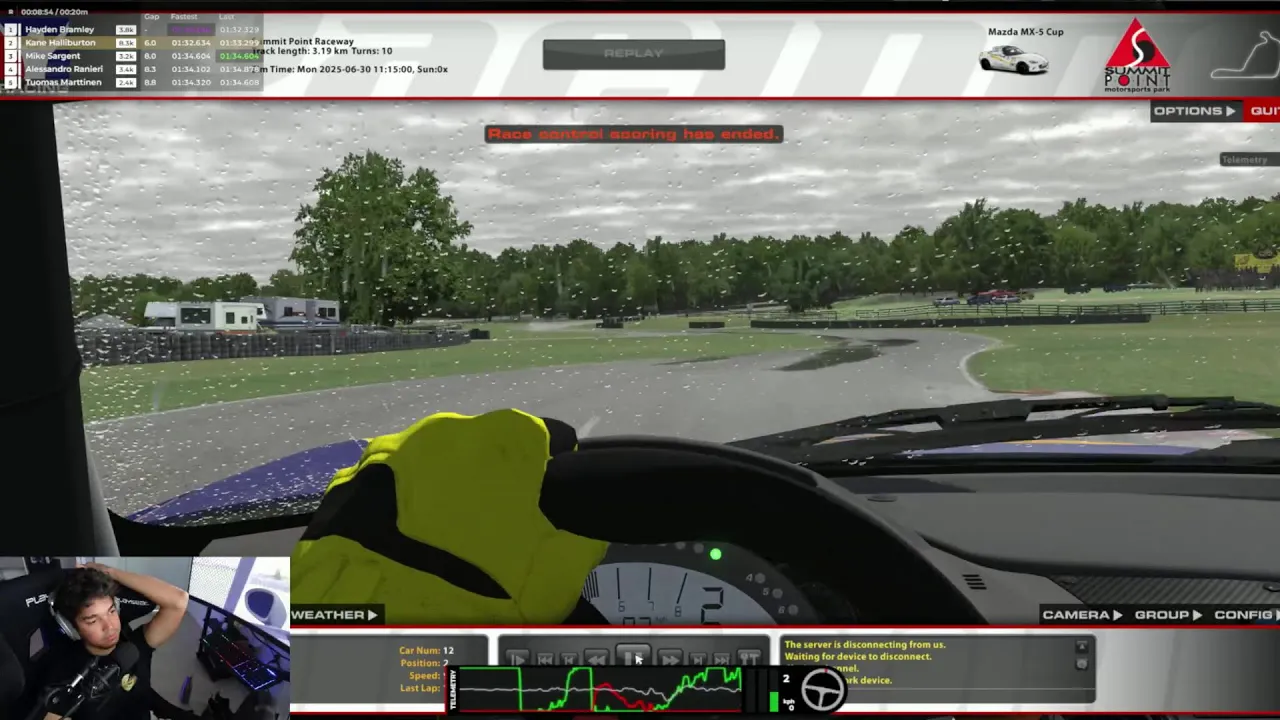
Wet Weather Racing: How to Master Rain Conditions Like a Pro Driver
Suellio Almeida
•
Sunday, September 1, 2024
Rain Isn't Random — It's Physics You Can Learn
Wet weather racing feels unpredictable because nobody teaches you the actual principles. You're guessing at braking points, tiptoeing through corners, watching faster drivers pull away in conditions that seem identical to yours.
The truth? Rain racing is MORE predictable than dry racing once you understand three core concepts: grip migration, weight transfer sensitivity, and visual adaptation.
Let's break down exactly what changes and how to exploit it.
Where the Grip Actually Goes in the Rain
Here's what most drivers get wrong: they assume grip disappears everywhere equally. It doesn't.
The racing line — that dark, rubbered-in strip you chase in dry conditions — becomes the WORST place to be when it's wet. All that rubber laid down by thousands of laps? It turns into an ice rink. The oil, rubber particles, and debris that build up on the ideal line create a slick surface that water sits on top of.
The grip migrates OFF-LINE. The concrete or asphalt that's been scrubbed clean by rain actually offers MORE grip than the racing line.
What does this mean for you?
You need to completely rethink your line. Entry points change. Apex points move. Exit curbs that were sketchy in the dry might be your best friend in the wet. The drivers who adapt their lines win. The drivers who stick to muscle memory from dry running get destroyed.
Start looking at corners differently. Where's the cleanest pavement? Where does water pool versus drain? These aren't minor details — they're the difference between podium and P15.
Your Inputs Need to Be 10x Smoother
Everything you do with your hands and feet gets amplified in the rain.
Weight transfer still happens. Load still shifts from rear to front under braking, side to side through corners. But the grip threshold is SO much lower that aggressive inputs instantly exceed it.
Think about it: in dry conditions, you might have 1.2-1.5G of grip to work with. In the rain, that drops to 0.6-0.8G. You just cut your margin for error in HALF.
What actually works:
Progressive brake application. Don't stab the pedal. Squeeze it like you're trying not to wake someone up. Build pressure gradually, feel the car settle, THEN apply maximum force. Release pressure the same way — progressive, controlled.
Gentle steering inputs. Big, sudden steering corrections are death. The car slides, you panic-correct, the slide gets worse, you're off. Instead: small corrections, early recognition of problems, smoothness over speed.
Throttle modulation becomes critical. In the dry, you can get away with aggressive throttle application. The rear tires might squirm but they'll grip. In the wet, that same input breaks traction and you're facing the wrong direction. Apply throttle like you're controlling a dimmer switch, not flipping a light on.
The fastest wet-weather drivers look BORING from the outside. No drama. No slides. Just smooth, controlled inputs that keep the car balanced.
Vision Techniques That Actually Matter in Rain
You can't see shit in the rain. Spray from the car ahead blocks everything. Your windscreen is a waterfall. Track markers disappear.
So you need alternative reference points.
Look THROUGH the spray. Don't stare at the wall of water coming off the car ahead — your brain will fixate on it. Force your eyes to look beyond it, tracking the car's position through the mist rather than the mist itself.
Use the EDGE of the track. When center-track visibility is gone, use peripheral vision to track the white line, curbing, grass edge — anything that defines track position. Your brain can process that edge awareness even when central vision is compromised.
Adjust braking markers. Your usual 100m board might be invisible. Find new markers: trackside objects, changes in pavement color, anything visible through rain. Test them in practice. Lock them in.
Trust your memory more than your eyes. If you've driven this track 1,000 times, your spatial awareness knows where you are even if you can't see. Let that muscle memory guide you when vision fails.
The drivers who panic in rain are the ones who rely ONLY on visual input. The ones who dominate have multiple sensory systems working together.
Setup Changes That Actually Work
You don't need to become a setup engineer to be fast in the rain. But you need to understand three basic adjustments:
Softer suspension. The car needs to absorb bumps and surface irregularities without unsettling. Stiffer springs that worked in the dry will bounce the car around in the wet, breaking traction. Soften them.
Less aggressive differential. A locked or aggressive diff that helped put power down in dry conditions will now just spin both rear wheels instead of one. Back it off. Let the inside wheel slip a bit. You want mechanical sympathy, not aggression.
Aero balance towards understeer. Oversteer in the rain is terrifying and slow. You want the car to push slightly so you can control it with throttle. Shift wing balance, adjust rake, whatever your car allows — bias towards front grip.
These aren't magic bullets. But they give you a platform to work with instead of fighting the car.
The Mental Game: Patience Beats Aggression
Here's the part nobody wants to hear: you have to be OKAY with being slower.
Not slower than your competition. Slower than your dry pace.
Drivers who try to maintain dry lap times in wet conditions bin it. Every single time. The grip isn't there. The physics don't allow it. Accept that your lap times will be 5-10 seconds slower and focus on consistency instead.
Consistency wins wet races. The guy who does 50 laps at 2:10.5 beats the guy who does three laps at 2:08 and then crashes. Every time.
Patience creates opportunities. Half the field will crash in the first five laps. Let them. You just need to be there when they don't.
Trust your technique. When someone passes you with what looks like impossible speed, don't chase them. They're either about to crash or they're truly aliens. Either way, your job is to execute YOUR race, not theirs.
Rain racing rewards the methodical driver who executes fundamentals perfectly. Be that driver.
Practice Structure for Wet Conditions
You can't just show up to a wet race and hope for the best. You need deliberate practice.
Session 1: Line discovery. Spend the first 10 laps NOT chasing lap times. Just explore different lines. Where's the grip? Where does the car feel stable? Map the track's wet-weather personality.
Session 2: Braking calibration. Find your braking points for every corner. Test them. Adjust. Lock them in. This is your foundation.
Session 3: Race pace consistency. Pick a target lap time 2-3 seconds off your theoretical best. Hit it for 20 consecutive laps. No mistakes. No offs. Build the mental muscle of repeatable execution.
Session 4: Traffic management. Practice following other cars through spray. Practice overtaking off-line. Practice defending without getting rear-ended by someone who can't see.
Most drivers skip straight to session 4 and wonder why they suck. Do the work.
What Separates Wet Weather Specialists From Everyone Else
The drivers who consistently win in the rain aren't just lucky. They've internalized principles you're still treating as conscious thoughts.
They don't think "smooth throttle application" — their right foot just does it automatically. They don't think "off-line grip" — their brain already mapped three alternate lines through every corner during the warmup lap.
You get there through repetition. Through deliberately practicing the fundamentals until they're automatic. Through making rain your specialty instead of your nightmare.
Because here's the reality: most of the grid HATES rain. They show up hoping it stops. Praying for a red flag. Looking for any excuse to not have to race in conditions that scare them.
You can be the driver who WANTS the rain. Who sees the weather forecast and smiles because you know half the competition just mentally checked out.
That's a massive competitive advantage. And it's completely trainable.
Ready to Turn Rain From Your Weakness Into Your Weapon?
How many race wins have you given up because wet weather showed up and you didn't have a systematic approach to handle it?
What would change if rain conditions became your opportunity instead of your excuse?
The difference between the drivers who struggle in the wet and the ones who dominate isn't talent. It's method. It's having a structured approach to learning the physics, adapting the technique, and building the mental game that makes you fast when conditions get ugly.
Almeida Racing Academy's Gold Membership gives you the complete system. Eight courses. Eighty lessons. Coach-led workshops on racecraft, car control, and mental game. Everything you need to turn wet weather racing from guesswork into calculated execution.
For $25/month with code WINTER, you get the exact training structure that's helped 36,000+ drivers break through their plateaus.
Sim Racing Academy Membership
Everything you need to stop guessing and start getting faster.
Starting at
$25
/mo
Car Handling Online Course
4 levels, full curriculum. Aimed to get you to top 1% in driving pace.
Racecraft Online Course
Overtaking, Defending, Race Strategy
Live coaching + on-track practice
Bi-weekly pro-coach workshops (recorded — never miss one) plus on-track Pit Parties to practice racecraft with a coach.
Plus These Bonuses
13,000+ Member Community
League Racing
Advanced MX-5 Mini Course
Racing Technique Development Guide
The Motor Racing Book (260 pages)
Think & Behave Like a Pro Driver — Mini eBook
Wet Weather Racing: How to Master Rain Conditions Like a Pro Driver
Suellio Almeida
•
Sunday, September 1, 2024
Rain Isn't Random — It's Physics You Can Learn
Wet weather racing feels unpredictable because nobody teaches you the actual principles. You're guessing at braking points, tiptoeing through corners, watching faster drivers pull away in conditions that seem identical to yours.
The truth? Rain racing is MORE predictable than dry racing once you understand three core concepts: grip migration, weight transfer sensitivity, and visual adaptation.
Let's break down exactly what changes and how to exploit it.
Where the Grip Actually Goes in the Rain
Here's what most drivers get wrong: they assume grip disappears everywhere equally. It doesn't.
The racing line — that dark, rubbered-in strip you chase in dry conditions — becomes the WORST place to be when it's wet. All that rubber laid down by thousands of laps? It turns into an ice rink. The oil, rubber particles, and debris that build up on the ideal line create a slick surface that water sits on top of.
The grip migrates OFF-LINE. The concrete or asphalt that's been scrubbed clean by rain actually offers MORE grip than the racing line.
What does this mean for you?
You need to completely rethink your line. Entry points change. Apex points move. Exit curbs that were sketchy in the dry might be your best friend in the wet. The drivers who adapt their lines win. The drivers who stick to muscle memory from dry running get destroyed.
Start looking at corners differently. Where's the cleanest pavement? Where does water pool versus drain? These aren't minor details — they're the difference between podium and P15.
Your Inputs Need to Be 10x Smoother
Everything you do with your hands and feet gets amplified in the rain.
Weight transfer still happens. Load still shifts from rear to front under braking, side to side through corners. But the grip threshold is SO much lower that aggressive inputs instantly exceed it.
Think about it: in dry conditions, you might have 1.2-1.5G of grip to work with. In the rain, that drops to 0.6-0.8G. You just cut your margin for error in HALF.
What actually works:
Progressive brake application. Don't stab the pedal. Squeeze it like you're trying not to wake someone up. Build pressure gradually, feel the car settle, THEN apply maximum force. Release pressure the same way — progressive, controlled.
Gentle steering inputs. Big, sudden steering corrections are death. The car slides, you panic-correct, the slide gets worse, you're off. Instead: small corrections, early recognition of problems, smoothness over speed.
Throttle modulation becomes critical. In the dry, you can get away with aggressive throttle application. The rear tires might squirm but they'll grip. In the wet, that same input breaks traction and you're facing the wrong direction. Apply throttle like you're controlling a dimmer switch, not flipping a light on.
The fastest wet-weather drivers look BORING from the outside. No drama. No slides. Just smooth, controlled inputs that keep the car balanced.
Vision Techniques That Actually Matter in Rain
You can't see shit in the rain. Spray from the car ahead blocks everything. Your windscreen is a waterfall. Track markers disappear.
So you need alternative reference points.
Look THROUGH the spray. Don't stare at the wall of water coming off the car ahead — your brain will fixate on it. Force your eyes to look beyond it, tracking the car's position through the mist rather than the mist itself.
Use the EDGE of the track. When center-track visibility is gone, use peripheral vision to track the white line, curbing, grass edge — anything that defines track position. Your brain can process that edge awareness even when central vision is compromised.
Adjust braking markers. Your usual 100m board might be invisible. Find new markers: trackside objects, changes in pavement color, anything visible through rain. Test them in practice. Lock them in.
Trust your memory more than your eyes. If you've driven this track 1,000 times, your spatial awareness knows where you are even if you can't see. Let that muscle memory guide you when vision fails.
The drivers who panic in rain are the ones who rely ONLY on visual input. The ones who dominate have multiple sensory systems working together.
Setup Changes That Actually Work
You don't need to become a setup engineer to be fast in the rain. But you need to understand three basic adjustments:
Softer suspension. The car needs to absorb bumps and surface irregularities without unsettling. Stiffer springs that worked in the dry will bounce the car around in the wet, breaking traction. Soften them.
Less aggressive differential. A locked or aggressive diff that helped put power down in dry conditions will now just spin both rear wheels instead of one. Back it off. Let the inside wheel slip a bit. You want mechanical sympathy, not aggression.
Aero balance towards understeer. Oversteer in the rain is terrifying and slow. You want the car to push slightly so you can control it with throttle. Shift wing balance, adjust rake, whatever your car allows — bias towards front grip.
These aren't magic bullets. But they give you a platform to work with instead of fighting the car.
The Mental Game: Patience Beats Aggression
Here's the part nobody wants to hear: you have to be OKAY with being slower.
Not slower than your competition. Slower than your dry pace.
Drivers who try to maintain dry lap times in wet conditions bin it. Every single time. The grip isn't there. The physics don't allow it. Accept that your lap times will be 5-10 seconds slower and focus on consistency instead.
Consistency wins wet races. The guy who does 50 laps at 2:10.5 beats the guy who does three laps at 2:08 and then crashes. Every time.
Patience creates opportunities. Half the field will crash in the first five laps. Let them. You just need to be there when they don't.
Trust your technique. When someone passes you with what looks like impossible speed, don't chase them. They're either about to crash or they're truly aliens. Either way, your job is to execute YOUR race, not theirs.
Rain racing rewards the methodical driver who executes fundamentals perfectly. Be that driver.
Practice Structure for Wet Conditions
You can't just show up to a wet race and hope for the best. You need deliberate practice.
Session 1: Line discovery. Spend the first 10 laps NOT chasing lap times. Just explore different lines. Where's the grip? Where does the car feel stable? Map the track's wet-weather personality.
Session 2: Braking calibration. Find your braking points for every corner. Test them. Adjust. Lock them in. This is your foundation.
Session 3: Race pace consistency. Pick a target lap time 2-3 seconds off your theoretical best. Hit it for 20 consecutive laps. No mistakes. No offs. Build the mental muscle of repeatable execution.
Session 4: Traffic management. Practice following other cars through spray. Practice overtaking off-line. Practice defending without getting rear-ended by someone who can't see.
Most drivers skip straight to session 4 and wonder why they suck. Do the work.
What Separates Wet Weather Specialists From Everyone Else
The drivers who consistently win in the rain aren't just lucky. They've internalized principles you're still treating as conscious thoughts.
They don't think "smooth throttle application" — their right foot just does it automatically. They don't think "off-line grip" — their brain already mapped three alternate lines through every corner during the warmup lap.
You get there through repetition. Through deliberately practicing the fundamentals until they're automatic. Through making rain your specialty instead of your nightmare.
Because here's the reality: most of the grid HATES rain. They show up hoping it stops. Praying for a red flag. Looking for any excuse to not have to race in conditions that scare them.
You can be the driver who WANTS the rain. Who sees the weather forecast and smiles because you know half the competition just mentally checked out.
That's a massive competitive advantage. And it's completely trainable.
Ready to Turn Rain From Your Weakness Into Your Weapon?
How many race wins have you given up because wet weather showed up and you didn't have a systematic approach to handle it?
What would change if rain conditions became your opportunity instead of your excuse?
The difference between the drivers who struggle in the wet and the ones who dominate isn't talent. It's method. It's having a structured approach to learning the physics, adapting the technique, and building the mental game that makes you fast when conditions get ugly.
Almeida Racing Academy's Gold Membership gives you the complete system. Eight courses. Eighty lessons. Coach-led workshops on racecraft, car control, and mental game. Everything you need to turn wet weather racing from guesswork into calculated execution.
For $25/month with code WINTER, you get the exact training structure that's helped 36,000+ drivers break through their plateaus.
Sim Racing Academy Membership
Everything you need to stop guessing and start getting faster.
Starting at
$25
/mo
Car Handling Online Course
4 levels, full curriculum. Aimed to get you to top 1% in driving pace.
Racecraft Online Course
Overtaking, Defending, Race Strategy
Live coaching + on-track practice
Bi-weekly pro-coach workshops (recorded — never miss one) plus on-track Pit Parties to practice racecraft with a coach.
Plus These Bonuses
13,000+ Member Community
League Racing
Advanced MX-5 Mini Course
Racing Technique Development Guide
The Motor Racing Book (260 pages)
Think & Behave Like a Pro Driver — Mini eBook
Wet Weather Racing: How to Master Rain Conditions Like a Pro Driver
Suellio Almeida
•
Sunday, September 1, 2024
Rain Isn't Random — It's Physics You Can Learn
Wet weather racing feels unpredictable because nobody teaches you the actual principles. You're guessing at braking points, tiptoeing through corners, watching faster drivers pull away in conditions that seem identical to yours.
The truth? Rain racing is MORE predictable than dry racing once you understand three core concepts: grip migration, weight transfer sensitivity, and visual adaptation.
Let's break down exactly what changes and how to exploit it.
Where the Grip Actually Goes in the Rain
Here's what most drivers get wrong: they assume grip disappears everywhere equally. It doesn't.
The racing line — that dark, rubbered-in strip you chase in dry conditions — becomes the WORST place to be when it's wet. All that rubber laid down by thousands of laps? It turns into an ice rink. The oil, rubber particles, and debris that build up on the ideal line create a slick surface that water sits on top of.
The grip migrates OFF-LINE. The concrete or asphalt that's been scrubbed clean by rain actually offers MORE grip than the racing line.
What does this mean for you?
You need to completely rethink your line. Entry points change. Apex points move. Exit curbs that were sketchy in the dry might be your best friend in the wet. The drivers who adapt their lines win. The drivers who stick to muscle memory from dry running get destroyed.
Start looking at corners differently. Where's the cleanest pavement? Where does water pool versus drain? These aren't minor details — they're the difference between podium and P15.
Your Inputs Need to Be 10x Smoother
Everything you do with your hands and feet gets amplified in the rain.
Weight transfer still happens. Load still shifts from rear to front under braking, side to side through corners. But the grip threshold is SO much lower that aggressive inputs instantly exceed it.
Think about it: in dry conditions, you might have 1.2-1.5G of grip to work with. In the rain, that drops to 0.6-0.8G. You just cut your margin for error in HALF.
What actually works:
Progressive brake application. Don't stab the pedal. Squeeze it like you're trying not to wake someone up. Build pressure gradually, feel the car settle, THEN apply maximum force. Release pressure the same way — progressive, controlled.
Gentle steering inputs. Big, sudden steering corrections are death. The car slides, you panic-correct, the slide gets worse, you're off. Instead: small corrections, early recognition of problems, smoothness over speed.
Throttle modulation becomes critical. In the dry, you can get away with aggressive throttle application. The rear tires might squirm but they'll grip. In the wet, that same input breaks traction and you're facing the wrong direction. Apply throttle like you're controlling a dimmer switch, not flipping a light on.
The fastest wet-weather drivers look BORING from the outside. No drama. No slides. Just smooth, controlled inputs that keep the car balanced.
Vision Techniques That Actually Matter in Rain
You can't see shit in the rain. Spray from the car ahead blocks everything. Your windscreen is a waterfall. Track markers disappear.
So you need alternative reference points.
Look THROUGH the spray. Don't stare at the wall of water coming off the car ahead — your brain will fixate on it. Force your eyes to look beyond it, tracking the car's position through the mist rather than the mist itself.
Use the EDGE of the track. When center-track visibility is gone, use peripheral vision to track the white line, curbing, grass edge — anything that defines track position. Your brain can process that edge awareness even when central vision is compromised.
Adjust braking markers. Your usual 100m board might be invisible. Find new markers: trackside objects, changes in pavement color, anything visible through rain. Test them in practice. Lock them in.
Trust your memory more than your eyes. If you've driven this track 1,000 times, your spatial awareness knows where you are even if you can't see. Let that muscle memory guide you when vision fails.
The drivers who panic in rain are the ones who rely ONLY on visual input. The ones who dominate have multiple sensory systems working together.
Setup Changes That Actually Work
You don't need to become a setup engineer to be fast in the rain. But you need to understand three basic adjustments:
Softer suspension. The car needs to absorb bumps and surface irregularities without unsettling. Stiffer springs that worked in the dry will bounce the car around in the wet, breaking traction. Soften them.
Less aggressive differential. A locked or aggressive diff that helped put power down in dry conditions will now just spin both rear wheels instead of one. Back it off. Let the inside wheel slip a bit. You want mechanical sympathy, not aggression.
Aero balance towards understeer. Oversteer in the rain is terrifying and slow. You want the car to push slightly so you can control it with throttle. Shift wing balance, adjust rake, whatever your car allows — bias towards front grip.
These aren't magic bullets. But they give you a platform to work with instead of fighting the car.
The Mental Game: Patience Beats Aggression
Here's the part nobody wants to hear: you have to be OKAY with being slower.
Not slower than your competition. Slower than your dry pace.
Drivers who try to maintain dry lap times in wet conditions bin it. Every single time. The grip isn't there. The physics don't allow it. Accept that your lap times will be 5-10 seconds slower and focus on consistency instead.
Consistency wins wet races. The guy who does 50 laps at 2:10.5 beats the guy who does three laps at 2:08 and then crashes. Every time.
Patience creates opportunities. Half the field will crash in the first five laps. Let them. You just need to be there when they don't.
Trust your technique. When someone passes you with what looks like impossible speed, don't chase them. They're either about to crash or they're truly aliens. Either way, your job is to execute YOUR race, not theirs.
Rain racing rewards the methodical driver who executes fundamentals perfectly. Be that driver.
Practice Structure for Wet Conditions
You can't just show up to a wet race and hope for the best. You need deliberate practice.
Session 1: Line discovery. Spend the first 10 laps NOT chasing lap times. Just explore different lines. Where's the grip? Where does the car feel stable? Map the track's wet-weather personality.
Session 2: Braking calibration. Find your braking points for every corner. Test them. Adjust. Lock them in. This is your foundation.
Session 3: Race pace consistency. Pick a target lap time 2-3 seconds off your theoretical best. Hit it for 20 consecutive laps. No mistakes. No offs. Build the mental muscle of repeatable execution.
Session 4: Traffic management. Practice following other cars through spray. Practice overtaking off-line. Practice defending without getting rear-ended by someone who can't see.
Most drivers skip straight to session 4 and wonder why they suck. Do the work.
What Separates Wet Weather Specialists From Everyone Else
The drivers who consistently win in the rain aren't just lucky. They've internalized principles you're still treating as conscious thoughts.
They don't think "smooth throttle application" — their right foot just does it automatically. They don't think "off-line grip" — their brain already mapped three alternate lines through every corner during the warmup lap.
You get there through repetition. Through deliberately practicing the fundamentals until they're automatic. Through making rain your specialty instead of your nightmare.
Because here's the reality: most of the grid HATES rain. They show up hoping it stops. Praying for a red flag. Looking for any excuse to not have to race in conditions that scare them.
You can be the driver who WANTS the rain. Who sees the weather forecast and smiles because you know half the competition just mentally checked out.
That's a massive competitive advantage. And it's completely trainable.
Ready to Turn Rain From Your Weakness Into Your Weapon?
How many race wins have you given up because wet weather showed up and you didn't have a systematic approach to handle it?
What would change if rain conditions became your opportunity instead of your excuse?
The difference between the drivers who struggle in the wet and the ones who dominate isn't talent. It's method. It's having a structured approach to learning the physics, adapting the technique, and building the mental game that makes you fast when conditions get ugly.
Almeida Racing Academy's Gold Membership gives you the complete system. Eight courses. Eighty lessons. Coach-led workshops on racecraft, car control, and mental game. Everything you need to turn wet weather racing from guesswork into calculated execution.
For $25/month with code WINTER, you get the exact training structure that's helped 36,000+ drivers break through their plateaus.
Sim Racing Academy Membership
Everything you need to stop guessing and start getting faster.
Starting at
$25
/mo
Car Handling Online Course
4 levels, full curriculum. Aimed to get you to top 1% in driving pace.
Racecraft Online Course
Overtaking, Defending, Race Strategy
Live coaching + on-track practice
Bi-weekly pro-coach workshops (recorded — never miss one) plus on-track Pit Parties to practice racecraft with a coach.
Plus These Bonuses
13,000+ Member Community
League Racing
Advanced MX-5 Mini Course
Racing Technique Development Guide
The Motor Racing Book (260 pages)
Think & Behave Like a Pro Driver — Mini eBook