
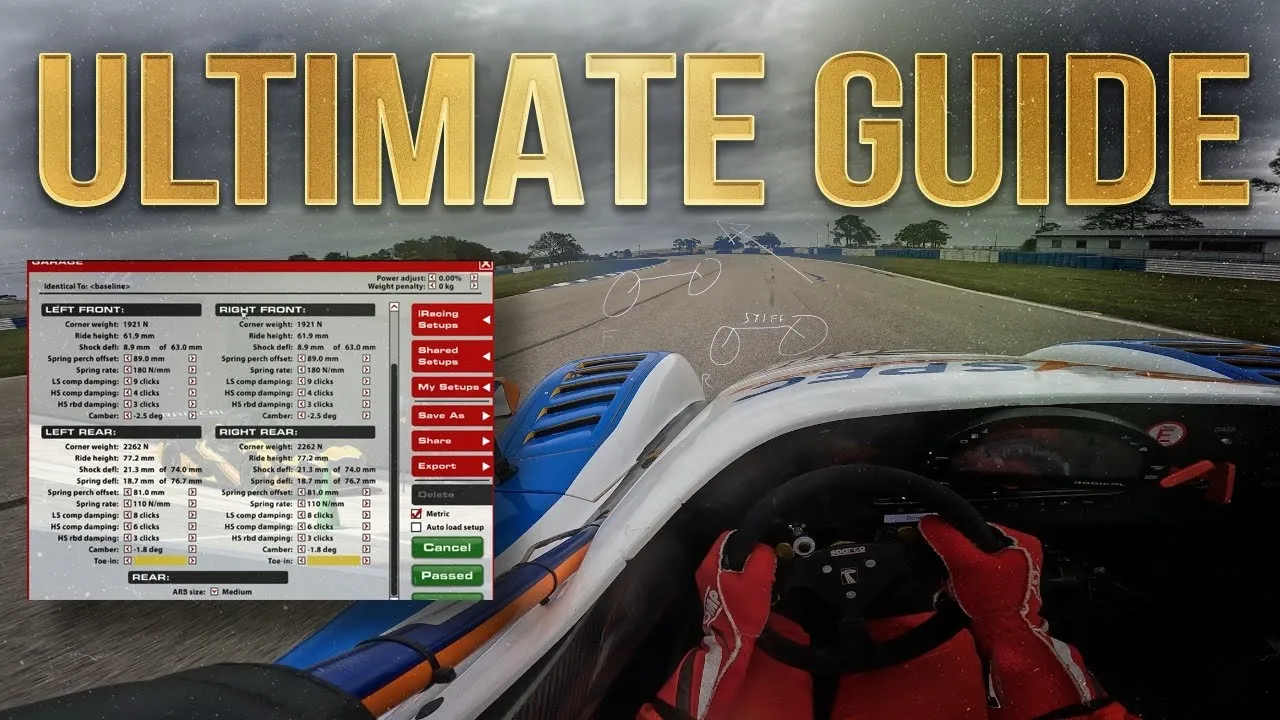
The Ultimate Sim Racing Car Setup Guide for Beginners – Stop Blaming the Setup
Suellio Almeida
•
Sunday, January 28, 2024
The Setup Trap That's Killing Your Lap Times
Let's get one thing straight: your setup isn't the problem.
You are.
I know that's harsh. But I've coached over 36,000 students, and the pattern is always the same. Driver gets stuck. Driver blames setup. Driver spends hours tweaking dampers. Lap times don't improve.
Why? Because you can't setup your way around bad driving technique.
The car setup is the last 2%. Your driving is the first 98%. Until you nail braking points, trail braking, throttle application, and consistency, setup changes are just noise. You're adjusting variables you don't understand to fix problems you can't diagnose.
So before we talk about what to adjust, let's talk about what you need to fix first.
What Actually Makes You Slow (It's Not Spring Rates)
Here's the brutal truth: most beginners are seconds off the pace because of five fundamental mistakes.
Mistake 1: Inconsistent braking points. You brake at different spots every lap. The car feels different because you're loading it differently. That's not setup — that's you.
Mistake 2: No trail braking. You brake in a straight line, release, turn in. The car understeers. You blame the setup. Reality? You're not using weight transfer to load the front tires. Learn to trail brake first. Then we talk setup.
Mistake 3: Jerky throttle application. You hammer the throttle at corner exit. The car snaps loose or pushes wide. Again, not setup. That's mechanical grip management.
Mistake 4: Vision problems. You're looking at the apex, not where you're going. Your brain can't process fast enough. The car feels unstable. Guess what? Setup won't fix where you're looking.
Mistake 5: No reference points. Every lap is a new experiment. No brake markers. No turn-in points. No data. How are you supposed to know if a setup change works when your driving changes lap to lap?
Fix these first. Get consistent within 0.2 seconds per lap. Then — and only then — setup adjustments will actually mean something.
The Only Three Setup Changes Beginners Should Touch
Okay. You've done the work. You're consistent. You understand weight transfer. You can trail brake. Your lap times are respectable.
Now we can talk setup.
But here's the rule: beginners should only adjust three things.
Why three? Because the rest requires data analysis, tire temperature readings, and an understanding of suspension geometry that takes years to develop. Mess with the wrong thing, and you'll make the car undrivable.
So what are the three?
1. Tire Pressure
This is your biggest lever. Tire pressure affects contact patch, tire temperature, and mechanical grip.
Start with the optimal range for your car. Most GT3s run 27.0–27.5 psi hot. Prototype cars are lower. Check the sim's garage recommendations or community setups.
Here's how to adjust:
Car feels vague, understeers mid-corner? Drop front pressure by 0.2–0.3 psi.
Car snaps at corner exit, rear feels loose? Drop rear pressure by 0.2–0.3 psi.
Car feels planted but lap times are slow? You might be over-pressured. Try dropping both ends slightly.
Make one change at a time. Run five clean laps. Compare telemetry. If you don't improve, revert.
2. Anti-Roll Bars (ARBs)
ARBs control how much the car rolls in corners. Stiffer ARB = less roll = faster weight transfer.
Front ARB: Stiffer front reduces understeer on turn-in but can make the car nervous. If you're fighting understeer at initial turn-in, stiffen the front by 1–2 clicks.
Rear ARB: Stiffer rear reduces oversteer on throttle but can make the car snappy. If you're spinning under power at corner exit, soften the rear by 1–2 clicks.
Again: one end at a time. You're trying to balance front vs. rear grip. If you change both, you won't know what worked.
3. Brake Bias
This one's simple but critical. Brake bias controls how much braking force goes to the front vs. rear.
Most cars start around 56–58% front. Adjust by 0.5–1.0% increments.
Locking fronts under braking? Move bias rearward (lower the number).
Rear steps out under braking? Move bias forward (raise the number).
Brake bias should feel different corner to corner. Heavy braking zones? You might need more rear. Slow corners? Front-biased is fine. Adjust based on the track, not just the car.
Why You Should Ignore Everything Else (For Now)
You're going to be tempted. Springs. Dampers. Ride height. Differential. Toe. Camber.
Don't.
Here's why: these adjustments interact with each other in ways you can't predict without data.
Soften the front springs? You change dive under braking, which affects aero balance, which changes rear grip. You just created three new problems trying to fix one.
Stiffen the front dampers? You alter how fast weight transfers, which changes front tire load, which shifts your braking points. Now your lap times are worse and you don't know why.
This isn't gatekeeping. This is physics. Advanced setup requires understanding how 15+ variables interact. You're not there yet.
Stick to the three. Master them. Get faster. When you plateau again, then we talk dampers.
The Real Setup Secret: Drive the Car You Have
Here's the thing nobody tells you: the best sim racers in the world can drive alien laps on baseline setups.
Max Verstappen doesn't need a perfect car to win. He adapts. He finds the limit of what he has and extracts it.
You should too.
Stop chasing the mythical "perfect setup." It doesn't exist. Every setup is a compromise. You gain something, you lose something. The goal isn't perfection — it's understanding what the car needs from you.
Understeer mid-corner? Don't soften the front. Learn to carry more speed with earlier rotation. Oversteer on exit? Don't stiffen the rear. Learn smoother throttle application.
The setup should complement your driving, not replace it.
And when you do make a change — one variable, five laps, compare data. No guessing. No feel. Data doesn't lie.
What If You've Already Done All This?
Maybe you're reading this thinking: "Suellio, I've already fixed my fundamentals. I'm consistent. I understand trail braking. I've optimized tire pressure and ARBs. I'm still stuck."
Good.
That means you're ready for the next level.
But here's the reality: you can't learn advanced setup from an article. You need someone who can read your telemetry, analyze your driving, and diagnose what the car actually needs.
You need a coach.
Not just any coach. Someone who's done this 5,000+ hours. Someone who's driven IMSA, won national championships, coached F1 engineers. Someone who knows the difference between a setup problem and a driving problem.
Because the truth is, most "setup issues" are still driving issues. But the ones that aren't? Those require precision. Data. Experience.
That's what we do at Almeida Racing Academy.
How Much Longer Are You Going to Guess?
Let me ask you something.
How many hours have you spent tweaking setups? Downloading community files? Adjusting springs and dampers based on Reddit advice?
And how much faster are you?
Here's the thing: you can't shortcut experience. But you can borrow it.
That's what coaching is. It's not hand-holding. It's not motivational speeches. It's someone with 36,000 students and decades of racing experience looking at your data and saying: "Here. This. Fix this and you'll find three-tenths."
No guessing. No trial-and-error. No wasted hours.
At Almeida Racing Academy, we offer 1:1 coaching sessions starting at $55. You work directly with me (IMSA TCR driver, top 0.03% iRacing), Kane (9000 iRating), or Connor (NASCAR driver). We analyze your telemetry, watch your replays, and give you the exact changes you need — driving and setup.
One session. Tangible improvements. Or we keep working until you get there.
This is how you break through plateaus. Not by guessing. By learning from someone who's already figured it out.
Sim Racing Academy Membership
Everything you need to stop guessing and start getting faster.
Starting at
$25
/mo
Car Handling Online Course
4 levels, full curriculum. Aimed to get you to top 1% in driving pace.
Racecraft Online Course
Overtaking, Defending, Race Strategy
Live coaching + on-track practice
Bi-weekly pro-coach workshops (recorded — never miss one) plus on-track Pit Parties to practice racecraft with a coach.
Plus These Bonuses
13,000+ Member Community
League Racing
Advanced MX-5 Mini Course
Racing Technique Development Guide
The Motor Racing Book (260 pages)
Think & Behave Like a Pro Driver — Mini eBook
The Ultimate Sim Racing Car Setup Guide for Beginners – Stop Blaming the Setup
Suellio Almeida
•
Sunday, January 28, 2024
The Setup Trap That's Killing Your Lap Times
Let's get one thing straight: your setup isn't the problem.
You are.
I know that's harsh. But I've coached over 36,000 students, and the pattern is always the same. Driver gets stuck. Driver blames setup. Driver spends hours tweaking dampers. Lap times don't improve.
Why? Because you can't setup your way around bad driving technique.
The car setup is the last 2%. Your driving is the first 98%. Until you nail braking points, trail braking, throttle application, and consistency, setup changes are just noise. You're adjusting variables you don't understand to fix problems you can't diagnose.
So before we talk about what to adjust, let's talk about what you need to fix first.
What Actually Makes You Slow (It's Not Spring Rates)
Here's the brutal truth: most beginners are seconds off the pace because of five fundamental mistakes.
Mistake 1: Inconsistent braking points. You brake at different spots every lap. The car feels different because you're loading it differently. That's not setup — that's you.
Mistake 2: No trail braking. You brake in a straight line, release, turn in. The car understeers. You blame the setup. Reality? You're not using weight transfer to load the front tires. Learn to trail brake first. Then we talk setup.
Mistake 3: Jerky throttle application. You hammer the throttle at corner exit. The car snaps loose or pushes wide. Again, not setup. That's mechanical grip management.
Mistake 4: Vision problems. You're looking at the apex, not where you're going. Your brain can't process fast enough. The car feels unstable. Guess what? Setup won't fix where you're looking.
Mistake 5: No reference points. Every lap is a new experiment. No brake markers. No turn-in points. No data. How are you supposed to know if a setup change works when your driving changes lap to lap?
Fix these first. Get consistent within 0.2 seconds per lap. Then — and only then — setup adjustments will actually mean something.
The Only Three Setup Changes Beginners Should Touch
Okay. You've done the work. You're consistent. You understand weight transfer. You can trail brake. Your lap times are respectable.
Now we can talk setup.
But here's the rule: beginners should only adjust three things.
Why three? Because the rest requires data analysis, tire temperature readings, and an understanding of suspension geometry that takes years to develop. Mess with the wrong thing, and you'll make the car undrivable.
So what are the three?
1. Tire Pressure
This is your biggest lever. Tire pressure affects contact patch, tire temperature, and mechanical grip.
Start with the optimal range for your car. Most GT3s run 27.0–27.5 psi hot. Prototype cars are lower. Check the sim's garage recommendations or community setups.
Here's how to adjust:
Car feels vague, understeers mid-corner? Drop front pressure by 0.2–0.3 psi.
Car snaps at corner exit, rear feels loose? Drop rear pressure by 0.2–0.3 psi.
Car feels planted but lap times are slow? You might be over-pressured. Try dropping both ends slightly.
Make one change at a time. Run five clean laps. Compare telemetry. If you don't improve, revert.
2. Anti-Roll Bars (ARBs)
ARBs control how much the car rolls in corners. Stiffer ARB = less roll = faster weight transfer.
Front ARB: Stiffer front reduces understeer on turn-in but can make the car nervous. If you're fighting understeer at initial turn-in, stiffen the front by 1–2 clicks.
Rear ARB: Stiffer rear reduces oversteer on throttle but can make the car snappy. If you're spinning under power at corner exit, soften the rear by 1–2 clicks.
Again: one end at a time. You're trying to balance front vs. rear grip. If you change both, you won't know what worked.
3. Brake Bias
This one's simple but critical. Brake bias controls how much braking force goes to the front vs. rear.
Most cars start around 56–58% front. Adjust by 0.5–1.0% increments.
Locking fronts under braking? Move bias rearward (lower the number).
Rear steps out under braking? Move bias forward (raise the number).
Brake bias should feel different corner to corner. Heavy braking zones? You might need more rear. Slow corners? Front-biased is fine. Adjust based on the track, not just the car.
Why You Should Ignore Everything Else (For Now)
You're going to be tempted. Springs. Dampers. Ride height. Differential. Toe. Camber.
Don't.
Here's why: these adjustments interact with each other in ways you can't predict without data.
Soften the front springs? You change dive under braking, which affects aero balance, which changes rear grip. You just created three new problems trying to fix one.
Stiffen the front dampers? You alter how fast weight transfers, which changes front tire load, which shifts your braking points. Now your lap times are worse and you don't know why.
This isn't gatekeeping. This is physics. Advanced setup requires understanding how 15+ variables interact. You're not there yet.
Stick to the three. Master them. Get faster. When you plateau again, then we talk dampers.
The Real Setup Secret: Drive the Car You Have
Here's the thing nobody tells you: the best sim racers in the world can drive alien laps on baseline setups.
Max Verstappen doesn't need a perfect car to win. He adapts. He finds the limit of what he has and extracts it.
You should too.
Stop chasing the mythical "perfect setup." It doesn't exist. Every setup is a compromise. You gain something, you lose something. The goal isn't perfection — it's understanding what the car needs from you.
Understeer mid-corner? Don't soften the front. Learn to carry more speed with earlier rotation. Oversteer on exit? Don't stiffen the rear. Learn smoother throttle application.
The setup should complement your driving, not replace it.
And when you do make a change — one variable, five laps, compare data. No guessing. No feel. Data doesn't lie.
What If You've Already Done All This?
Maybe you're reading this thinking: "Suellio, I've already fixed my fundamentals. I'm consistent. I understand trail braking. I've optimized tire pressure and ARBs. I'm still stuck."
Good.
That means you're ready for the next level.
But here's the reality: you can't learn advanced setup from an article. You need someone who can read your telemetry, analyze your driving, and diagnose what the car actually needs.
You need a coach.
Not just any coach. Someone who's done this 5,000+ hours. Someone who's driven IMSA, won national championships, coached F1 engineers. Someone who knows the difference between a setup problem and a driving problem.
Because the truth is, most "setup issues" are still driving issues. But the ones that aren't? Those require precision. Data. Experience.
That's what we do at Almeida Racing Academy.
How Much Longer Are You Going to Guess?
Let me ask you something.
How many hours have you spent tweaking setups? Downloading community files? Adjusting springs and dampers based on Reddit advice?
And how much faster are you?
Here's the thing: you can't shortcut experience. But you can borrow it.
That's what coaching is. It's not hand-holding. It's not motivational speeches. It's someone with 36,000 students and decades of racing experience looking at your data and saying: "Here. This. Fix this and you'll find three-tenths."
No guessing. No trial-and-error. No wasted hours.
At Almeida Racing Academy, we offer 1:1 coaching sessions starting at $55. You work directly with me (IMSA TCR driver, top 0.03% iRacing), Kane (9000 iRating), or Connor (NASCAR driver). We analyze your telemetry, watch your replays, and give you the exact changes you need — driving and setup.
One session. Tangible improvements. Or we keep working until you get there.
This is how you break through plateaus. Not by guessing. By learning from someone who's already figured it out.
Sim Racing Academy Membership
Everything you need to stop guessing and start getting faster.
Starting at
$25
/mo
Car Handling Online Course
4 levels, full curriculum. Aimed to get you to top 1% in driving pace.
Racecraft Online Course
Overtaking, Defending, Race Strategy
Live coaching + on-track practice
Bi-weekly pro-coach workshops (recorded — never miss one) plus on-track Pit Parties to practice racecraft with a coach.
Plus These Bonuses
13,000+ Member Community
League Racing
Advanced MX-5 Mini Course
Racing Technique Development Guide
The Motor Racing Book (260 pages)
Think & Behave Like a Pro Driver — Mini eBook
The Ultimate Sim Racing Car Setup Guide for Beginners – Stop Blaming the Setup
Suellio Almeida
•
Sunday, January 28, 2024
The Setup Trap That's Killing Your Lap Times
Let's get one thing straight: your setup isn't the problem.
You are.
I know that's harsh. But I've coached over 36,000 students, and the pattern is always the same. Driver gets stuck. Driver blames setup. Driver spends hours tweaking dampers. Lap times don't improve.
Why? Because you can't setup your way around bad driving technique.
The car setup is the last 2%. Your driving is the first 98%. Until you nail braking points, trail braking, throttle application, and consistency, setup changes are just noise. You're adjusting variables you don't understand to fix problems you can't diagnose.
So before we talk about what to adjust, let's talk about what you need to fix first.
What Actually Makes You Slow (It's Not Spring Rates)
Here's the brutal truth: most beginners are seconds off the pace because of five fundamental mistakes.
Mistake 1: Inconsistent braking points. You brake at different spots every lap. The car feels different because you're loading it differently. That's not setup — that's you.
Mistake 2: No trail braking. You brake in a straight line, release, turn in. The car understeers. You blame the setup. Reality? You're not using weight transfer to load the front tires. Learn to trail brake first. Then we talk setup.
Mistake 3: Jerky throttle application. You hammer the throttle at corner exit. The car snaps loose or pushes wide. Again, not setup. That's mechanical grip management.
Mistake 4: Vision problems. You're looking at the apex, not where you're going. Your brain can't process fast enough. The car feels unstable. Guess what? Setup won't fix where you're looking.
Mistake 5: No reference points. Every lap is a new experiment. No brake markers. No turn-in points. No data. How are you supposed to know if a setup change works when your driving changes lap to lap?
Fix these first. Get consistent within 0.2 seconds per lap. Then — and only then — setup adjustments will actually mean something.
The Only Three Setup Changes Beginners Should Touch
Okay. You've done the work. You're consistent. You understand weight transfer. You can trail brake. Your lap times are respectable.
Now we can talk setup.
But here's the rule: beginners should only adjust three things.
Why three? Because the rest requires data analysis, tire temperature readings, and an understanding of suspension geometry that takes years to develop. Mess with the wrong thing, and you'll make the car undrivable.
So what are the three?
1. Tire Pressure
This is your biggest lever. Tire pressure affects contact patch, tire temperature, and mechanical grip.
Start with the optimal range for your car. Most GT3s run 27.0–27.5 psi hot. Prototype cars are lower. Check the sim's garage recommendations or community setups.
Here's how to adjust:
Car feels vague, understeers mid-corner? Drop front pressure by 0.2–0.3 psi.
Car snaps at corner exit, rear feels loose? Drop rear pressure by 0.2–0.3 psi.
Car feels planted but lap times are slow? You might be over-pressured. Try dropping both ends slightly.
Make one change at a time. Run five clean laps. Compare telemetry. If you don't improve, revert.
2. Anti-Roll Bars (ARBs)
ARBs control how much the car rolls in corners. Stiffer ARB = less roll = faster weight transfer.
Front ARB: Stiffer front reduces understeer on turn-in but can make the car nervous. If you're fighting understeer at initial turn-in, stiffen the front by 1–2 clicks.
Rear ARB: Stiffer rear reduces oversteer on throttle but can make the car snappy. If you're spinning under power at corner exit, soften the rear by 1–2 clicks.
Again: one end at a time. You're trying to balance front vs. rear grip. If you change both, you won't know what worked.
3. Brake Bias
This one's simple but critical. Brake bias controls how much braking force goes to the front vs. rear.
Most cars start around 56–58% front. Adjust by 0.5–1.0% increments.
Locking fronts under braking? Move bias rearward (lower the number).
Rear steps out under braking? Move bias forward (raise the number).
Brake bias should feel different corner to corner. Heavy braking zones? You might need more rear. Slow corners? Front-biased is fine. Adjust based on the track, not just the car.
Why You Should Ignore Everything Else (For Now)
You're going to be tempted. Springs. Dampers. Ride height. Differential. Toe. Camber.
Don't.
Here's why: these adjustments interact with each other in ways you can't predict without data.
Soften the front springs? You change dive under braking, which affects aero balance, which changes rear grip. You just created three new problems trying to fix one.
Stiffen the front dampers? You alter how fast weight transfers, which changes front tire load, which shifts your braking points. Now your lap times are worse and you don't know why.
This isn't gatekeeping. This is physics. Advanced setup requires understanding how 15+ variables interact. You're not there yet.
Stick to the three. Master them. Get faster. When you plateau again, then we talk dampers.
The Real Setup Secret: Drive the Car You Have
Here's the thing nobody tells you: the best sim racers in the world can drive alien laps on baseline setups.
Max Verstappen doesn't need a perfect car to win. He adapts. He finds the limit of what he has and extracts it.
You should too.
Stop chasing the mythical "perfect setup." It doesn't exist. Every setup is a compromise. You gain something, you lose something. The goal isn't perfection — it's understanding what the car needs from you.
Understeer mid-corner? Don't soften the front. Learn to carry more speed with earlier rotation. Oversteer on exit? Don't stiffen the rear. Learn smoother throttle application.
The setup should complement your driving, not replace it.
And when you do make a change — one variable, five laps, compare data. No guessing. No feel. Data doesn't lie.
What If You've Already Done All This?
Maybe you're reading this thinking: "Suellio, I've already fixed my fundamentals. I'm consistent. I understand trail braking. I've optimized tire pressure and ARBs. I'm still stuck."
Good.
That means you're ready for the next level.
But here's the reality: you can't learn advanced setup from an article. You need someone who can read your telemetry, analyze your driving, and diagnose what the car actually needs.
You need a coach.
Not just any coach. Someone who's done this 5,000+ hours. Someone who's driven IMSA, won national championships, coached F1 engineers. Someone who knows the difference between a setup problem and a driving problem.
Because the truth is, most "setup issues" are still driving issues. But the ones that aren't? Those require precision. Data. Experience.
That's what we do at Almeida Racing Academy.
How Much Longer Are You Going to Guess?
Let me ask you something.
How many hours have you spent tweaking setups? Downloading community files? Adjusting springs and dampers based on Reddit advice?
And how much faster are you?
Here's the thing: you can't shortcut experience. But you can borrow it.
That's what coaching is. It's not hand-holding. It's not motivational speeches. It's someone with 36,000 students and decades of racing experience looking at your data and saying: "Here. This. Fix this and you'll find three-tenths."
No guessing. No trial-and-error. No wasted hours.
At Almeida Racing Academy, we offer 1:1 coaching sessions starting at $55. You work directly with me (IMSA TCR driver, top 0.03% iRacing), Kane (9000 iRating), or Connor (NASCAR driver). We analyze your telemetry, watch your replays, and give you the exact changes you need — driving and setup.
One session. Tangible improvements. Or we keep working until you get there.
This is how you break through plateaus. Not by guessing. By learning from someone who's already figured it out.
Sim Racing Academy Membership
Everything you need to stop guessing and start getting faster.
Starting at
$25
/mo
Car Handling Online Course
4 levels, full curriculum. Aimed to get you to top 1% in driving pace.
Racecraft Online Course
Overtaking, Defending, Race Strategy
Live coaching + on-track practice
Bi-weekly pro-coach workshops (recorded — never miss one) plus on-track Pit Parties to practice racecraft with a coach.
Plus These Bonuses
13,000+ Member Community
League Racing
Advanced MX-5 Mini Course
Racing Technique Development Guide
The Motor Racing Book (260 pages)
Think & Behave Like a Pro Driver — Mini eBook