
The True Limit in Motorsports: Slip Angle Explained for Sim Racers
Suellio Almeida
•
Saturday, November 30, 2024
What Actually Defines the Limit?
The limit isn't about bravery. It isn't about car control wizardry.
The limit is slip angle.
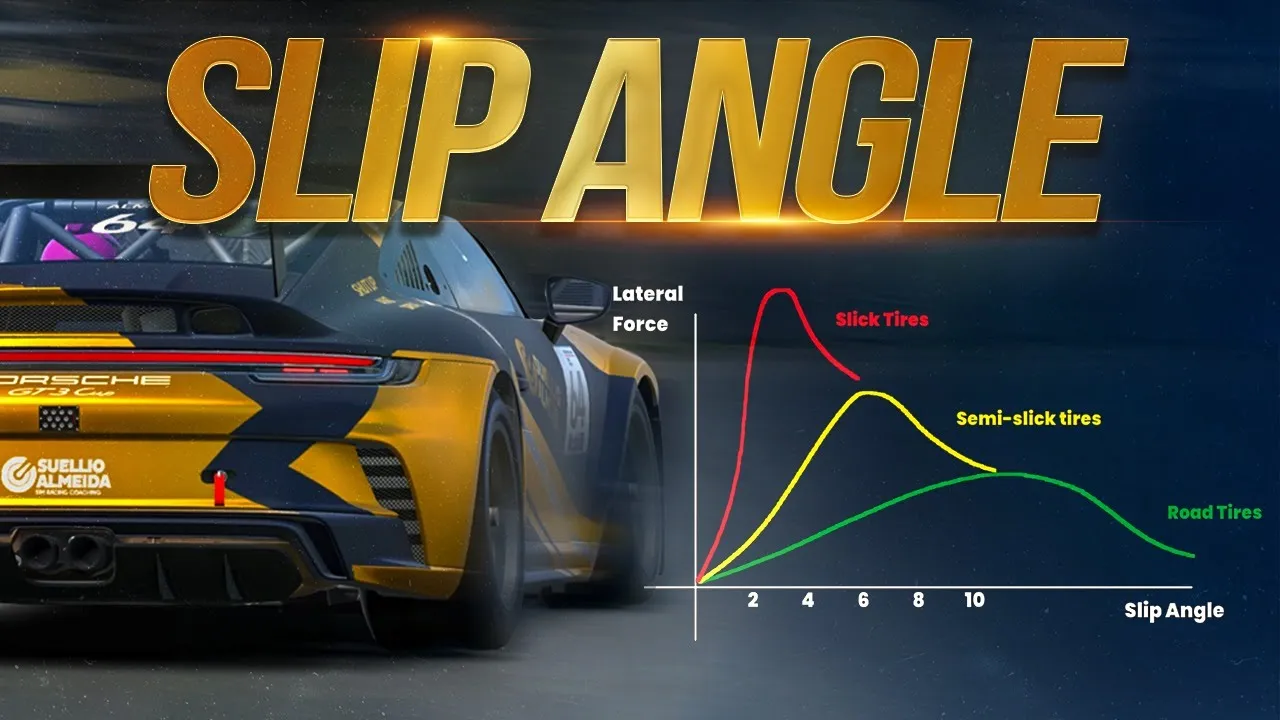
Every tire has a maximum slip angle where it produces peak grip. Push beyond that angle, and grip falls off. Stay below it, and you're leaving time on the table.
Most drivers never learn this. They chase lap times through trial and error, guessing at what "on the limit" feels like. Meanwhile, the fast guys? They understand the physics. They know exactly what the tire is doing at every moment.
Let me show you why slip angle is the single most important concept in racing — and how you can use it to find speed you didn't know existed.
Slip Angle 101: The Physics You Need to Know
Slip angle is the difference between where your tire is pointed and where it's actually traveling.
When you turn the wheel, the tire deforms. It doesn't immediately change direction — it bends, creating a slip angle. That deformation generates grip through the contact patch.
Up to a point, more slip angle = more grip.
But here's the catch: every tire has a peak. Push past that peak slip angle, and the tire starts sliding. Grip drops. Lap time suffers.
The limit isn't when the car feels unstable. The limit is when your tire reaches its maximum slip angle.
Most drivers never get there. They're either under-driving (too little slip angle, not enough grip) or over-driving (too much slip angle, sliding and scrubbing speed).
The fast drivers? They live right at the peak.
Front-Limited vs. Rear-Limited: Why Balance Matters
Here's where it gets tactical.
Your car doesn't have one limit — it has two. Front tires and rear tires each have their own slip angle peaks. And they rarely match.
Front-limited: The front tires reach their slip angle limit first. You get understeer. Turn the wheel more, and nothing happens — the fronts are maxed out.
Rear-limited: The rear tires reach their limit first. You get oversteer. The back end wants to come around.
The best drivers know which end of the car is limiting them in every corner. Then they adjust their technique to maximize the tires that still have grip available.
If you're front-limited and you keep adding steering input, you're just asking the fronts for grip they don't have. You're wasting time.
Instead? Reduce the demand on the fronts. Brake a little less. Carry a little less entry speed. Let the fronts do what they need to do — turn the car — without overloading them.
If you're rear-limited, the opposite applies. You need to manage rear slip angle through throttle application, weight transfer, and corner exit timing.
How to Feel Slip Angle in the Sim
Okay, so you understand the theory. Now what?
You need to develop tire feel. You need to sense when your tires are approaching their slip angle peak, at the peak, or over it.
In a sim, this comes through force feedback, audio cues, and visual feedback.
Understeer feels like this: You turn the wheel, but the car doesn't respond. The front end pushes wide. The FFB goes light — the front tires are saturated.
Oversteer feels like this: The rear end steps out. You feel a sudden snap or slide. The car rotates more than you asked for.
But here's the key: you want to feel the tire loading up BEFORE it breaks loose.
The best drivers sense the transition. They feel the tire building grip as slip angle increases. Then, right before the peak, they hold it there. They don't push past it.
This is what "being on the limit" actually means. You're holding the tire at its peak slip angle, extracting maximum grip, lap after lap.
The Mistake Everyone Makes: Overcorrecting
You feel the car starting to slide. Your instinct? Add more input.
More steering. More brake. More throttle.
But if your tire is already at or past its slip angle peak, adding more input just makes it worse.
When you're front-limited and understeering: Adding more steering doesn't help. The fronts are maxed out. You need to REDUCE the demand. Ease off the brake. Reduce entry speed slightly. Give the fronts a chance to recover slip angle.
When you're rear-limited and oversteering: Hammering the throttle won't save you. You need to modulate. Let the rears build grip gradually as weight transfers back onto them.
The limit isn't about doing MORE. It's about doing EXACTLY ENOUGH.
How Slip Angle Changes Your Driving
Once you understand slip angle, your entire approach shifts.
You stop chasing the car. You stop reacting.
You start managing tire load. You start thinking about which end of the car is the limiting factor. You start making micro-adjustments to keep your tires at their peak slip angle through the entire corner.
This is what separates good drivers from great ones.
Good drivers can follow a racing line and hit apexes. Great drivers maximize tire slip angle at every phase of the corner.
Entry: Managing front slip angle with trail braking and steering input.
Mid-corner: Balancing front and rear slip angles to rotate the car without sliding.
Exit: Unwinding steering while progressively loading the rears with throttle, keeping rear slip angle just below the breakaway point.
Every input you make is about slip angle management.
Real-World Application: Watching the Fast Guys
Go watch an onboard of a top-level driver. Watch how smooth they are.
They're not smooth because they're being gentle. They're smooth because they're managing slip angle.
Every steering correction, every throttle modulation — it's about keeping the tires at their peak. No wasted motion. No overdriving.
That smoothness? It's slip angle control.
Now go watch your own replays. Look for moments where you're asking the tires for more than they can give. Look for understeer you tried to steer out of. Look for oversteer you tried to throttle out of.
Those are the moments you're costing yourself time.
What Happens When You Get This Right?
You stop fighting the car.
You start extracting pace you didn't know was there.
Your lap times drop — not because you're taking more risks, but because you're using the tires properly.
You become consistent. Because you're not guessing anymore. You're working within the physics.
This is the foundation of fast driving. Everything else — racecraft, setup work, data analysis — builds on top of slip angle management.
Get this right, and racing stops being a mystery. It becomes a skill you can refine, session after session.
Ready to Master the Fundamentals That Actually Matter?
How much time have you spent chasing setups, memorizing lines, grinding laps — without understanding what the tires are actually doing?
What if you could strip away the guesswork and learn the physics that separate fast drivers from the rest?
That's exactly what we built the Almeida Racing Academy for. Our Car Handling course breaks down slip angle, weight transfer, and tire management in a way that clicks. Eleven lessons that rewire how you think about driving.
And it's free.
Create your free account and start the Car Handling course here
Sim Racing Academy Membership
Everything you need to stop guessing and start getting faster.
Starting at
$25
/mo
Car Handling Online Course
4 levels, full curriculum. Aimed to get you to top 1% in driving pace.
Racecraft Online Course
Overtaking, Defending, Race Strategy
Live coaching + on-track practice
Bi-weekly pro-coach workshops (recorded — never miss one) plus on-track Pit Parties to practice racecraft with a coach.
Plus These Bonuses
13,000+ Member Community
League Racing
Advanced MX-5 Mini Course
Racing Technique Development Guide
The Motor Racing Book (260 pages)
Think & Behave Like a Pro Driver — Mini eBook
The True Limit in Motorsports: Slip Angle Explained for Sim Racers
Suellio Almeida
•
Saturday, November 30, 2024
What Actually Defines the Limit?
The limit isn't about bravery. It isn't about car control wizardry.
The limit is slip angle.
Every tire has a maximum slip angle where it produces peak grip. Push beyond that angle, and grip falls off. Stay below it, and you're leaving time on the table.
Most drivers never learn this. They chase lap times through trial and error, guessing at what "on the limit" feels like. Meanwhile, the fast guys? They understand the physics. They know exactly what the tire is doing at every moment.
Let me show you why slip angle is the single most important concept in racing — and how you can use it to find speed you didn't know existed.
Slip Angle 101: The Physics You Need to Know
Slip angle is the difference between where your tire is pointed and where it's actually traveling.
When you turn the wheel, the tire deforms. It doesn't immediately change direction — it bends, creating a slip angle. That deformation generates grip through the contact patch.
Up to a point, more slip angle = more grip.
But here's the catch: every tire has a peak. Push past that peak slip angle, and the tire starts sliding. Grip drops. Lap time suffers.
The limit isn't when the car feels unstable. The limit is when your tire reaches its maximum slip angle.
Most drivers never get there. They're either under-driving (too little slip angle, not enough grip) or over-driving (too much slip angle, sliding and scrubbing speed).
The fast drivers? They live right at the peak.
Front-Limited vs. Rear-Limited: Why Balance Matters
Here's where it gets tactical.
Your car doesn't have one limit — it has two. Front tires and rear tires each have their own slip angle peaks. And they rarely match.
Front-limited: The front tires reach their slip angle limit first. You get understeer. Turn the wheel more, and nothing happens — the fronts are maxed out.
Rear-limited: The rear tires reach their limit first. You get oversteer. The back end wants to come around.
The best drivers know which end of the car is limiting them in every corner. Then they adjust their technique to maximize the tires that still have grip available.
If you're front-limited and you keep adding steering input, you're just asking the fronts for grip they don't have. You're wasting time.
Instead? Reduce the demand on the fronts. Brake a little less. Carry a little less entry speed. Let the fronts do what they need to do — turn the car — without overloading them.
If you're rear-limited, the opposite applies. You need to manage rear slip angle through throttle application, weight transfer, and corner exit timing.
How to Feel Slip Angle in the Sim
Okay, so you understand the theory. Now what?
You need to develop tire feel. You need to sense when your tires are approaching their slip angle peak, at the peak, or over it.
In a sim, this comes through force feedback, audio cues, and visual feedback.
Understeer feels like this: You turn the wheel, but the car doesn't respond. The front end pushes wide. The FFB goes light — the front tires are saturated.
Oversteer feels like this: The rear end steps out. You feel a sudden snap or slide. The car rotates more than you asked for.
But here's the key: you want to feel the tire loading up BEFORE it breaks loose.
The best drivers sense the transition. They feel the tire building grip as slip angle increases. Then, right before the peak, they hold it there. They don't push past it.
This is what "being on the limit" actually means. You're holding the tire at its peak slip angle, extracting maximum grip, lap after lap.
The Mistake Everyone Makes: Overcorrecting
You feel the car starting to slide. Your instinct? Add more input.
More steering. More brake. More throttle.
But if your tire is already at or past its slip angle peak, adding more input just makes it worse.
When you're front-limited and understeering: Adding more steering doesn't help. The fronts are maxed out. You need to REDUCE the demand. Ease off the brake. Reduce entry speed slightly. Give the fronts a chance to recover slip angle.
When you're rear-limited and oversteering: Hammering the throttle won't save you. You need to modulate. Let the rears build grip gradually as weight transfers back onto them.
The limit isn't about doing MORE. It's about doing EXACTLY ENOUGH.
How Slip Angle Changes Your Driving
Once you understand slip angle, your entire approach shifts.
You stop chasing the car. You stop reacting.
You start managing tire load. You start thinking about which end of the car is the limiting factor. You start making micro-adjustments to keep your tires at their peak slip angle through the entire corner.
This is what separates good drivers from great ones.
Good drivers can follow a racing line and hit apexes. Great drivers maximize tire slip angle at every phase of the corner.
Entry: Managing front slip angle with trail braking and steering input.
Mid-corner: Balancing front and rear slip angles to rotate the car without sliding.
Exit: Unwinding steering while progressively loading the rears with throttle, keeping rear slip angle just below the breakaway point.
Every input you make is about slip angle management.
Real-World Application: Watching the Fast Guys
Go watch an onboard of a top-level driver. Watch how smooth they are.
They're not smooth because they're being gentle. They're smooth because they're managing slip angle.
Every steering correction, every throttle modulation — it's about keeping the tires at their peak. No wasted motion. No overdriving.
That smoothness? It's slip angle control.
Now go watch your own replays. Look for moments where you're asking the tires for more than they can give. Look for understeer you tried to steer out of. Look for oversteer you tried to throttle out of.
Those are the moments you're costing yourself time.
What Happens When You Get This Right?
You stop fighting the car.
You start extracting pace you didn't know was there.
Your lap times drop — not because you're taking more risks, but because you're using the tires properly.
You become consistent. Because you're not guessing anymore. You're working within the physics.
This is the foundation of fast driving. Everything else — racecraft, setup work, data analysis — builds on top of slip angle management.
Get this right, and racing stops being a mystery. It becomes a skill you can refine, session after session.
Ready to Master the Fundamentals That Actually Matter?
How much time have you spent chasing setups, memorizing lines, grinding laps — without understanding what the tires are actually doing?
What if you could strip away the guesswork and learn the physics that separate fast drivers from the rest?
That's exactly what we built the Almeida Racing Academy for. Our Car Handling course breaks down slip angle, weight transfer, and tire management in a way that clicks. Eleven lessons that rewire how you think about driving.
And it's free.
Create your free account and start the Car Handling course here
Sim Racing Academy Membership
Everything you need to stop guessing and start getting faster.
Starting at
$25
/mo
Car Handling Online Course
4 levels, full curriculum. Aimed to get you to top 1% in driving pace.
Racecraft Online Course
Overtaking, Defending, Race Strategy
Live coaching + on-track practice
Bi-weekly pro-coach workshops (recorded — never miss one) plus on-track Pit Parties to practice racecraft with a coach.
Plus These Bonuses
13,000+ Member Community
League Racing
Advanced MX-5 Mini Course
Racing Technique Development Guide
The Motor Racing Book (260 pages)
Think & Behave Like a Pro Driver — Mini eBook
The True Limit in Motorsports: Slip Angle Explained for Sim Racers
Suellio Almeida
•
Saturday, November 30, 2024
What Actually Defines the Limit?
The limit isn't about bravery. It isn't about car control wizardry.
The limit is slip angle.
Every tire has a maximum slip angle where it produces peak grip. Push beyond that angle, and grip falls off. Stay below it, and you're leaving time on the table.
Most drivers never learn this. They chase lap times through trial and error, guessing at what "on the limit" feels like. Meanwhile, the fast guys? They understand the physics. They know exactly what the tire is doing at every moment.
Let me show you why slip angle is the single most important concept in racing — and how you can use it to find speed you didn't know existed.
Slip Angle 101: The Physics You Need to Know
Slip angle is the difference between where your tire is pointed and where it's actually traveling.
When you turn the wheel, the tire deforms. It doesn't immediately change direction — it bends, creating a slip angle. That deformation generates grip through the contact patch.
Up to a point, more slip angle = more grip.
But here's the catch: every tire has a peak. Push past that peak slip angle, and the tire starts sliding. Grip drops. Lap time suffers.
The limit isn't when the car feels unstable. The limit is when your tire reaches its maximum slip angle.
Most drivers never get there. They're either under-driving (too little slip angle, not enough grip) or over-driving (too much slip angle, sliding and scrubbing speed).
The fast drivers? They live right at the peak.
Front-Limited vs. Rear-Limited: Why Balance Matters
Here's where it gets tactical.
Your car doesn't have one limit — it has two. Front tires and rear tires each have their own slip angle peaks. And they rarely match.
Front-limited: The front tires reach their slip angle limit first. You get understeer. Turn the wheel more, and nothing happens — the fronts are maxed out.
Rear-limited: The rear tires reach their limit first. You get oversteer. The back end wants to come around.
The best drivers know which end of the car is limiting them in every corner. Then they adjust their technique to maximize the tires that still have grip available.
If you're front-limited and you keep adding steering input, you're just asking the fronts for grip they don't have. You're wasting time.
Instead? Reduce the demand on the fronts. Brake a little less. Carry a little less entry speed. Let the fronts do what they need to do — turn the car — without overloading them.
If you're rear-limited, the opposite applies. You need to manage rear slip angle through throttle application, weight transfer, and corner exit timing.
How to Feel Slip Angle in the Sim
Okay, so you understand the theory. Now what?
You need to develop tire feel. You need to sense when your tires are approaching their slip angle peak, at the peak, or over it.
In a sim, this comes through force feedback, audio cues, and visual feedback.
Understeer feels like this: You turn the wheel, but the car doesn't respond. The front end pushes wide. The FFB goes light — the front tires are saturated.
Oversteer feels like this: The rear end steps out. You feel a sudden snap or slide. The car rotates more than you asked for.
But here's the key: you want to feel the tire loading up BEFORE it breaks loose.
The best drivers sense the transition. They feel the tire building grip as slip angle increases. Then, right before the peak, they hold it there. They don't push past it.
This is what "being on the limit" actually means. You're holding the tire at its peak slip angle, extracting maximum grip, lap after lap.
The Mistake Everyone Makes: Overcorrecting
You feel the car starting to slide. Your instinct? Add more input.
More steering. More brake. More throttle.
But if your tire is already at or past its slip angle peak, adding more input just makes it worse.
When you're front-limited and understeering: Adding more steering doesn't help. The fronts are maxed out. You need to REDUCE the demand. Ease off the brake. Reduce entry speed slightly. Give the fronts a chance to recover slip angle.
When you're rear-limited and oversteering: Hammering the throttle won't save you. You need to modulate. Let the rears build grip gradually as weight transfers back onto them.
The limit isn't about doing MORE. It's about doing EXACTLY ENOUGH.
How Slip Angle Changes Your Driving
Once you understand slip angle, your entire approach shifts.
You stop chasing the car. You stop reacting.
You start managing tire load. You start thinking about which end of the car is the limiting factor. You start making micro-adjustments to keep your tires at their peak slip angle through the entire corner.
This is what separates good drivers from great ones.
Good drivers can follow a racing line and hit apexes. Great drivers maximize tire slip angle at every phase of the corner.
Entry: Managing front slip angle with trail braking and steering input.
Mid-corner: Balancing front and rear slip angles to rotate the car without sliding.
Exit: Unwinding steering while progressively loading the rears with throttle, keeping rear slip angle just below the breakaway point.
Every input you make is about slip angle management.
Real-World Application: Watching the Fast Guys
Go watch an onboard of a top-level driver. Watch how smooth they are.
They're not smooth because they're being gentle. They're smooth because they're managing slip angle.
Every steering correction, every throttle modulation — it's about keeping the tires at their peak. No wasted motion. No overdriving.
That smoothness? It's slip angle control.
Now go watch your own replays. Look for moments where you're asking the tires for more than they can give. Look for understeer you tried to steer out of. Look for oversteer you tried to throttle out of.
Those are the moments you're costing yourself time.
What Happens When You Get This Right?
You stop fighting the car.
You start extracting pace you didn't know was there.
Your lap times drop — not because you're taking more risks, but because you're using the tires properly.
You become consistent. Because you're not guessing anymore. You're working within the physics.
This is the foundation of fast driving. Everything else — racecraft, setup work, data analysis — builds on top of slip angle management.
Get this right, and racing stops being a mystery. It becomes a skill you can refine, session after session.
Ready to Master the Fundamentals That Actually Matter?
How much time have you spent chasing setups, memorizing lines, grinding laps — without understanding what the tires are actually doing?
What if you could strip away the guesswork and learn the physics that separate fast drivers from the rest?
That's exactly what we built the Almeida Racing Academy for. Our Car Handling course breaks down slip angle, weight transfer, and tire management in a way that clicks. Eleven lessons that rewire how you think about driving.
And it's free.
Create your free account and start the Car Handling course here
Sim Racing Academy Membership
Everything you need to stop guessing and start getting faster.
Starting at
$25
/mo
Car Handling Online Course
4 levels, full curriculum. Aimed to get you to top 1% in driving pace.
Racecraft Online Course
Overtaking, Defending, Race Strategy
Live coaching + on-track practice
Bi-weekly pro-coach workshops (recorded — never miss one) plus on-track Pit Parties to practice racecraft with a coach.
Plus These Bonuses
13,000+ Member Community
League Racing
Advanced MX-5 Mini Course
Racing Technique Development Guide
The Motor Racing Book (260 pages)
Think & Behave Like a Pro Driver — Mini eBook