
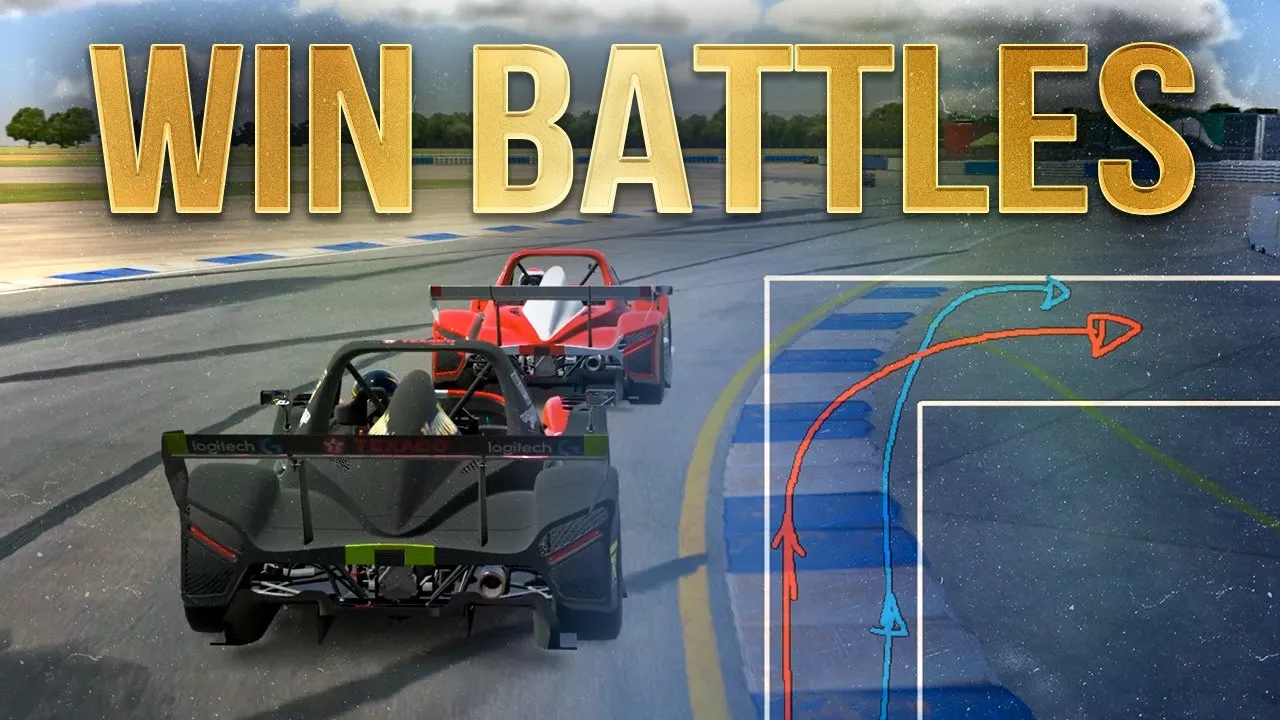
Top 5 Racecraft Skills Every Sim Racer Needs to Win Wheel-to-Wheel Battles
Suellio Almeida
•
Tuesday, January 9, 2024
You're Fast Alone — Why Do You Lose in Traffic?
Let's be real. You've spent hours perfecting your racing line. You know your braking points. You can put in clean laps when the track is empty.
But racing isn't hotlapping.
The moment someone dives up the inside, or you're three-wide into a corner, or you need to defend position without losing time — that's when most drivers fall apart. Because racecraft isn't about being fast. It's about being fast around other people.
And here's the thing: racecraft is a distinct skill set. You don't absorb it by running time trials. You build it through deliberate practice of specific techniques. Let's break down the five core skills that turn fast drivers into race winners.
1. Positioning: Control the Corner Before You Enter It
Most drivers think racecraft starts when you're side-by-side. Wrong. It starts 200 meters before the corner.
Your track position dictates what happens next. If you're defending, you need to claim the inside line early — not at the braking zone, but on corner entry while you're still on throttle. If you wait until you're braking, the attacker already has momentum.
If you're attacking, you need to bait the defender. Stay slightly off-line on the straight. Make them think you're not coming. Then commit late. The goal isn't to force a move — it's to make them second-guess their line choice.
Here's what changes when you master positioning: you stop getting surprised. You stop reacting. You start controlling the pace of the battle because you've already decided what's happening next.
2. Vision: See the Gap Before It Exists
This is the skill nobody teaches. Everyone talks about vision for hitting apexes. But in traffic, your vision discipline determines whether you survive lap one or end up in the wall.
You need to train yourself to process three things simultaneously:
The car directly in front of you
The car one position ahead (their brake lights, their line)
The gap that's about to open
Why? Because the mistake happens when you fixate on the car you're chasing. You mirror their line. You brake when they brake. You never create an opportunity — you just follow.
The drivers who win wheel-to-wheel battles? They're watching the second car ahead. They see the defender get nervous and run wide. They see the slight hesitation on braking. They anticipate the gap 0.5 seconds before it exists.
That's not instinct. That's trained vision.
3. Awareness: Know What's Beside You Without Looking
You're mid-corner. Someone's on your quarter panel. Do you hold your line? Do you give space? Do you even know they're there?
This is where most incidents happen. Not because drivers are reckless, but because they're spatially blind. They commit to a line without knowing what's around them.
Here's the fix: you need to build a mental map of nearby cars before you enter the corner. Use mirrors on the straight. Use spotter callouts. Glance at the relative once. Then trust that information.
Because once you're mid-corner, you can't look. You need to feel the space. You need to know — without checking — whether you can track out or whether you need to leave a car's width.
The best racers have this figured out. They're never surprised by contact because they already knew someone was there. They planned for it three corners ago.
4. Adaptability: Your Perfect Line Doesn't Exist in Traffic
This is the skill that breaks qualifying heroes.
You have a perfect line. You've practiced it a thousand times. You know exactly where to brake, where to apex, where to get back on throttle. That line gives you your best lap time.
Forget it.
In traffic, the optimal line changes every lap based on who's around you. If you're defending, you take the inside line even if it's slower. If you're attacking, you take the outside line and carry more speed through the exit even if you lose the corner.
The drivers who can't adapt? They try to force their ideal line in traffic. They brake at their normal point even though someone's alongside them. They apex where they always apex even though it leaves them vulnerable on exit.
Adaptability means accepting a slower corner right now to set up a better position for the next three corners. It means compromising your line to protect your race. It means thinking in sequences, not single turns.
5. Patience: The Fastest Move Is the One You Don't Force
Here's the uncomfortable truth: most overtakes fail because drivers get impatient.
You're close. You have pace. You think you see a gap. You go for it. Then you're either in the gravel or you've lost three positions defending a bad move.
The drivers who win races? They spend three laps setting up one clean pass. They pressure. They force mistakes. They wait for the defender to run wide, to get on the brakes too early, to make the error.
Because here's what patience actually is in racing: it's sustained pressure. You're not backing off. You're not giving up. You're staying close enough that the driver ahead has to look in their mirrors. You're making them think about you instead of their own pace.
And then — when they finally make the mistake — you're already positioned to capitalize. No lunging. No divebombs. Just a clean, inevitable overtake.
That's how you gain three positions in a race without a single risky move.
What If You Could Practice Racecraft Like You Practice Pace?
Here's the problem most sim racers face: you can practice pace alone. Load up a server, run laps, study your inputs.
But racecraft? You need opponents. You need structured battles. You need coached scenarios where you practice positioning, vision, awareness, adaptability, and patience — not by accident in public lobbies, but with purpose.
You need to drill these skills the same way you drilled trail braking. With feedback. With repetition. With someone who can tell you why your move failed before you even knew you made a mistake.
What would change if you had access to that kind of training environment?
What if you could practice racecraft in a structured setting — with other committed drivers, with coach oversight, with actual progression instead of hoping you learn through chaos?
How much faster would you improve if racecraft wasn't something you stumbled into, but something you deliberately built?
The Almeida Racing Academy Gold Membership gives you exactly that. Coach-led workshops where we set up specific racecraft scenarios. Challenges that force you to apply these five skills under pressure. Private leagues where you race against drivers who are also training with purpose — not randoms who punt you lap one.
You get 8 complete courses, 80 lessons, and a community of 36,000+ drivers who take this seriously. Right now, Gold is $25/month with code WINTER. That's less than one tank of gas.
If you're serious about winning wheel-to-wheel battles, this is where you train for it:
Sim Racing Academy Membership
Everything you need to stop guessing and start getting faster.
Starting at
$25
/mo
Car Handling Online Course
4 levels, full curriculum. Aimed to get you to top 1% in driving pace.
Racecraft Online Course
Overtaking, Defending, Race Strategy
Live coaching + on-track practice
Bi-weekly pro-coach workshops (recorded — never miss one) plus on-track Pit Parties to practice racecraft with a coach.
Plus These Bonuses
13,000+ Member Community
League Racing
Advanced MX-5 Mini Course
Racing Technique Development Guide
The Motor Racing Book (260 pages)
Think & Behave Like a Pro Driver — Mini eBook
Top 5 Racecraft Skills Every Sim Racer Needs to Win Wheel-to-Wheel Battles
Suellio Almeida
•
Tuesday, January 9, 2024
You're Fast Alone — Why Do You Lose in Traffic?
Let's be real. You've spent hours perfecting your racing line. You know your braking points. You can put in clean laps when the track is empty.
But racing isn't hotlapping.
The moment someone dives up the inside, or you're three-wide into a corner, or you need to defend position without losing time — that's when most drivers fall apart. Because racecraft isn't about being fast. It's about being fast around other people.
And here's the thing: racecraft is a distinct skill set. You don't absorb it by running time trials. You build it through deliberate practice of specific techniques. Let's break down the five core skills that turn fast drivers into race winners.
1. Positioning: Control the Corner Before You Enter It
Most drivers think racecraft starts when you're side-by-side. Wrong. It starts 200 meters before the corner.
Your track position dictates what happens next. If you're defending, you need to claim the inside line early — not at the braking zone, but on corner entry while you're still on throttle. If you wait until you're braking, the attacker already has momentum.
If you're attacking, you need to bait the defender. Stay slightly off-line on the straight. Make them think you're not coming. Then commit late. The goal isn't to force a move — it's to make them second-guess their line choice.
Here's what changes when you master positioning: you stop getting surprised. You stop reacting. You start controlling the pace of the battle because you've already decided what's happening next.
2. Vision: See the Gap Before It Exists
This is the skill nobody teaches. Everyone talks about vision for hitting apexes. But in traffic, your vision discipline determines whether you survive lap one or end up in the wall.
You need to train yourself to process three things simultaneously:
The car directly in front of you
The car one position ahead (their brake lights, their line)
The gap that's about to open
Why? Because the mistake happens when you fixate on the car you're chasing. You mirror their line. You brake when they brake. You never create an opportunity — you just follow.
The drivers who win wheel-to-wheel battles? They're watching the second car ahead. They see the defender get nervous and run wide. They see the slight hesitation on braking. They anticipate the gap 0.5 seconds before it exists.
That's not instinct. That's trained vision.
3. Awareness: Know What's Beside You Without Looking
You're mid-corner. Someone's on your quarter panel. Do you hold your line? Do you give space? Do you even know they're there?
This is where most incidents happen. Not because drivers are reckless, but because they're spatially blind. They commit to a line without knowing what's around them.
Here's the fix: you need to build a mental map of nearby cars before you enter the corner. Use mirrors on the straight. Use spotter callouts. Glance at the relative once. Then trust that information.
Because once you're mid-corner, you can't look. You need to feel the space. You need to know — without checking — whether you can track out or whether you need to leave a car's width.
The best racers have this figured out. They're never surprised by contact because they already knew someone was there. They planned for it three corners ago.
4. Adaptability: Your Perfect Line Doesn't Exist in Traffic
This is the skill that breaks qualifying heroes.
You have a perfect line. You've practiced it a thousand times. You know exactly where to brake, where to apex, where to get back on throttle. That line gives you your best lap time.
Forget it.
In traffic, the optimal line changes every lap based on who's around you. If you're defending, you take the inside line even if it's slower. If you're attacking, you take the outside line and carry more speed through the exit even if you lose the corner.
The drivers who can't adapt? They try to force their ideal line in traffic. They brake at their normal point even though someone's alongside them. They apex where they always apex even though it leaves them vulnerable on exit.
Adaptability means accepting a slower corner right now to set up a better position for the next three corners. It means compromising your line to protect your race. It means thinking in sequences, not single turns.
5. Patience: The Fastest Move Is the One You Don't Force
Here's the uncomfortable truth: most overtakes fail because drivers get impatient.
You're close. You have pace. You think you see a gap. You go for it. Then you're either in the gravel or you've lost three positions defending a bad move.
The drivers who win races? They spend three laps setting up one clean pass. They pressure. They force mistakes. They wait for the defender to run wide, to get on the brakes too early, to make the error.
Because here's what patience actually is in racing: it's sustained pressure. You're not backing off. You're not giving up. You're staying close enough that the driver ahead has to look in their mirrors. You're making them think about you instead of their own pace.
And then — when they finally make the mistake — you're already positioned to capitalize. No lunging. No divebombs. Just a clean, inevitable overtake.
That's how you gain three positions in a race without a single risky move.
What If You Could Practice Racecraft Like You Practice Pace?
Here's the problem most sim racers face: you can practice pace alone. Load up a server, run laps, study your inputs.
But racecraft? You need opponents. You need structured battles. You need coached scenarios where you practice positioning, vision, awareness, adaptability, and patience — not by accident in public lobbies, but with purpose.
You need to drill these skills the same way you drilled trail braking. With feedback. With repetition. With someone who can tell you why your move failed before you even knew you made a mistake.
What would change if you had access to that kind of training environment?
What if you could practice racecraft in a structured setting — with other committed drivers, with coach oversight, with actual progression instead of hoping you learn through chaos?
How much faster would you improve if racecraft wasn't something you stumbled into, but something you deliberately built?
The Almeida Racing Academy Gold Membership gives you exactly that. Coach-led workshops where we set up specific racecraft scenarios. Challenges that force you to apply these five skills under pressure. Private leagues where you race against drivers who are also training with purpose — not randoms who punt you lap one.
You get 8 complete courses, 80 lessons, and a community of 36,000+ drivers who take this seriously. Right now, Gold is $25/month with code WINTER. That's less than one tank of gas.
If you're serious about winning wheel-to-wheel battles, this is where you train for it:
Sim Racing Academy Membership
Everything you need to stop guessing and start getting faster.
Starting at
$25
/mo
Car Handling Online Course
4 levels, full curriculum. Aimed to get you to top 1% in driving pace.
Racecraft Online Course
Overtaking, Defending, Race Strategy
Live coaching + on-track practice
Bi-weekly pro-coach workshops (recorded — never miss one) plus on-track Pit Parties to practice racecraft with a coach.
Plus These Bonuses
13,000+ Member Community
League Racing
Advanced MX-5 Mini Course
Racing Technique Development Guide
The Motor Racing Book (260 pages)
Think & Behave Like a Pro Driver — Mini eBook
Top 5 Racecraft Skills Every Sim Racer Needs to Win Wheel-to-Wheel Battles
Suellio Almeida
•
Tuesday, January 9, 2024
You're Fast Alone — Why Do You Lose in Traffic?
Let's be real. You've spent hours perfecting your racing line. You know your braking points. You can put in clean laps when the track is empty.
But racing isn't hotlapping.
The moment someone dives up the inside, or you're three-wide into a corner, or you need to defend position without losing time — that's when most drivers fall apart. Because racecraft isn't about being fast. It's about being fast around other people.
And here's the thing: racecraft is a distinct skill set. You don't absorb it by running time trials. You build it through deliberate practice of specific techniques. Let's break down the five core skills that turn fast drivers into race winners.
1. Positioning: Control the Corner Before You Enter It
Most drivers think racecraft starts when you're side-by-side. Wrong. It starts 200 meters before the corner.
Your track position dictates what happens next. If you're defending, you need to claim the inside line early — not at the braking zone, but on corner entry while you're still on throttle. If you wait until you're braking, the attacker already has momentum.
If you're attacking, you need to bait the defender. Stay slightly off-line on the straight. Make them think you're not coming. Then commit late. The goal isn't to force a move — it's to make them second-guess their line choice.
Here's what changes when you master positioning: you stop getting surprised. You stop reacting. You start controlling the pace of the battle because you've already decided what's happening next.
2. Vision: See the Gap Before It Exists
This is the skill nobody teaches. Everyone talks about vision for hitting apexes. But in traffic, your vision discipline determines whether you survive lap one or end up in the wall.
You need to train yourself to process three things simultaneously:
The car directly in front of you
The car one position ahead (their brake lights, their line)
The gap that's about to open
Why? Because the mistake happens when you fixate on the car you're chasing. You mirror their line. You brake when they brake. You never create an opportunity — you just follow.
The drivers who win wheel-to-wheel battles? They're watching the second car ahead. They see the defender get nervous and run wide. They see the slight hesitation on braking. They anticipate the gap 0.5 seconds before it exists.
That's not instinct. That's trained vision.
3. Awareness: Know What's Beside You Without Looking
You're mid-corner. Someone's on your quarter panel. Do you hold your line? Do you give space? Do you even know they're there?
This is where most incidents happen. Not because drivers are reckless, but because they're spatially blind. They commit to a line without knowing what's around them.
Here's the fix: you need to build a mental map of nearby cars before you enter the corner. Use mirrors on the straight. Use spotter callouts. Glance at the relative once. Then trust that information.
Because once you're mid-corner, you can't look. You need to feel the space. You need to know — without checking — whether you can track out or whether you need to leave a car's width.
The best racers have this figured out. They're never surprised by contact because they already knew someone was there. They planned for it three corners ago.
4. Adaptability: Your Perfect Line Doesn't Exist in Traffic
This is the skill that breaks qualifying heroes.
You have a perfect line. You've practiced it a thousand times. You know exactly where to brake, where to apex, where to get back on throttle. That line gives you your best lap time.
Forget it.
In traffic, the optimal line changes every lap based on who's around you. If you're defending, you take the inside line even if it's slower. If you're attacking, you take the outside line and carry more speed through the exit even if you lose the corner.
The drivers who can't adapt? They try to force their ideal line in traffic. They brake at their normal point even though someone's alongside them. They apex where they always apex even though it leaves them vulnerable on exit.
Adaptability means accepting a slower corner right now to set up a better position for the next three corners. It means compromising your line to protect your race. It means thinking in sequences, not single turns.
5. Patience: The Fastest Move Is the One You Don't Force
Here's the uncomfortable truth: most overtakes fail because drivers get impatient.
You're close. You have pace. You think you see a gap. You go for it. Then you're either in the gravel or you've lost three positions defending a bad move.
The drivers who win races? They spend three laps setting up one clean pass. They pressure. They force mistakes. They wait for the defender to run wide, to get on the brakes too early, to make the error.
Because here's what patience actually is in racing: it's sustained pressure. You're not backing off. You're not giving up. You're staying close enough that the driver ahead has to look in their mirrors. You're making them think about you instead of their own pace.
And then — when they finally make the mistake — you're already positioned to capitalize. No lunging. No divebombs. Just a clean, inevitable overtake.
That's how you gain three positions in a race without a single risky move.
What If You Could Practice Racecraft Like You Practice Pace?
Here's the problem most sim racers face: you can practice pace alone. Load up a server, run laps, study your inputs.
But racecraft? You need opponents. You need structured battles. You need coached scenarios where you practice positioning, vision, awareness, adaptability, and patience — not by accident in public lobbies, but with purpose.
You need to drill these skills the same way you drilled trail braking. With feedback. With repetition. With someone who can tell you why your move failed before you even knew you made a mistake.
What would change if you had access to that kind of training environment?
What if you could practice racecraft in a structured setting — with other committed drivers, with coach oversight, with actual progression instead of hoping you learn through chaos?
How much faster would you improve if racecraft wasn't something you stumbled into, but something you deliberately built?
The Almeida Racing Academy Gold Membership gives you exactly that. Coach-led workshops where we set up specific racecraft scenarios. Challenges that force you to apply these five skills under pressure. Private leagues where you race against drivers who are also training with purpose — not randoms who punt you lap one.
You get 8 complete courses, 80 lessons, and a community of 36,000+ drivers who take this seriously. Right now, Gold is $25/month with code WINTER. That's less than one tank of gas.
If you're serious about winning wheel-to-wheel battles, this is where you train for it:
Sim Racing Academy Membership
Everything you need to stop guessing and start getting faster.
Starting at
$25
/mo
Car Handling Online Course
4 levels, full curriculum. Aimed to get you to top 1% in driving pace.
Racecraft Online Course
Overtaking, Defending, Race Strategy
Live coaching + on-track practice
Bi-weekly pro-coach workshops (recorded — never miss one) plus on-track Pit Parties to practice racecraft with a coach.
Plus These Bonuses
13,000+ Member Community
League Racing
Advanced MX-5 Mini Course
Racing Technique Development Guide
The Motor Racing Book (260 pages)
Think & Behave Like a Pro Driver — Mini eBook