
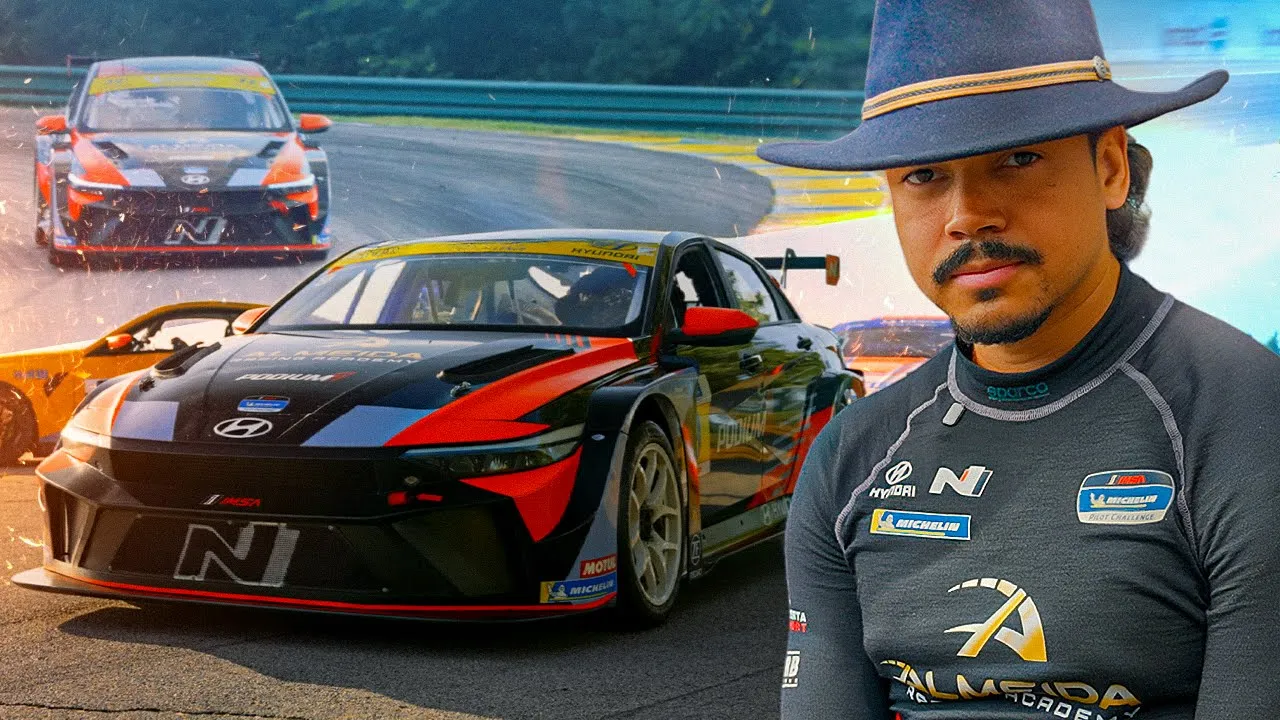
From Sim Racing to Real Life IMSA: What VIRginity International Raceway Actually Teaches You
Suellio Almeida
•
Wednesday, October 29, 2025
Why VIR Breaks Sim Racers (And What It Taught Me About Real Racing)
Virginia International Raceway isn't just fast. It's committed fast.
Blind crests. Elevation drops that load the suspension mid-corner. Corners where you're either all-in or you're slow. There's no middle ground.
I just competed there in IMSA TCR. Real car. Real speed. Real consequences if you get it wrong.
And here's what surprised me: the techniques that make you fast in sim racing are the exact same techniques that keep you alive — and competitive — in real life.
But the sensations? The fear? The way your body processes information at 120mph with G-forces compressing your chest? That's where the gap lives.
Let me walk you through what VIR taught me about the sim-to-real transition — and why your sim training matters more than you think.
The Corners That Separate Pretenders From Drivers
VIR has a few corners that expose you immediately.
Turn 1 — Oak Tree. You're coming off a long straight, heavy braking zone, turning in while still slowing down. Trail braking is non-negotiable. If you're not managing weight transfer through that initial rotation, you're either understeering wide or locking up.
In the sim? You feel understeer through the wheel. You adjust.
In real life? You feel understeer through your entire body. The car pushes. Your inner ear screams. You're fighting instinct to lift because lifting mid-corner kills your lap.
Turn 10 — South Bend. This is where VIR gets scary.
You're carrying massive speed. The corner tightens. And right at the apex, there's a compression — the elevation drops and the suspension loads violently. If your line isn't perfect, if your weight transfer isn't smooth, the car snaps.
I've done this corner thousands of times in iRacing. I know the visual markers. I know the brake point. I know the throttle application timing.
But in real life? The compression hits your chest. Your vision tunnels for a split second. The car feels like it's trying to swap ends.
That's the difference. The technique is identical. The physics are identical. But the sensory overload? That's new.
And here's what I realized: If you can't execute clean technique in the sim under pressure, you will NOT magically unlock it in real life.
Real racing doesn't fix bad habits. It amplifies them.
What Sim Racing Actually Prepares You For (And What It Doesn't)
Let's be honest about what transfers and what doesn't.
What transfers 100%:
Racing lines. If you know the optimal line in the sim, you know it in real life. VIR's Turn 1, Turn 10, the Roller Coaster section — my lines were identical to my iRacing laps.
Braking points. Visual markers work the same. That cone, that paint stripe, that shadow on the track — they're your references in both worlds.
Trail braking technique. Managing brake pressure through corner entry, rotating the car with weight transfer, unwinding the wheel as you release the pedal — this is physics. It doesn't change.
Throttle application. Progressive throttle squeeze through the apex, timing it with steering unwind — same principle, same execution.
Vision discipline. Where you look dictates where you go. In the sim and in real life, looking through the corner to the exit is how you commit to fast entries.
What DOESN'T fully transfer:
Physical feedback intensity. In iRacing, I get force feedback through a wheel. In real life, I'm getting feedback through my hands, feet, butt, inner ear, chest — simultaneously. It's information overload at first.
Fear response. In the sim, there's no consequence for a mistake beyond iRating. In real life, crashing is expensive, painful, and potentially dangerous. Your brain knows this. It tries to protect you by making you slow down. You have to override that.
G-force sensation. Lateral G's compress your body in corners. Braking G's slam you forward in the harness. Your body gets fatigued faster than you expect.
Equipment unknowns. The sim setup is dialed in. The real car? You're dealing with tire wear, fuel load changes, brake fade, track temperature shifts, mechanical grip variations.
So here's the truth: Sim racing gives you 80-90% of the technique foundation you need. The last 10-20%? That's adapting to the physical and mental load.
And that's HUGE. Most people think sim racing is irrelevant for real motorsports. They're dead wrong.
I showed up to VIR as a rookie in IMSA. But I didn't drive like a rookie. Why? Because I'd already practiced the technique 10,000 times in iRacing.
The One Thing That Scared Me More Than The Track
Here's what nobody tells you about transitioning to real racing: the fear isn't about speed. It's about commitment.
In Turn 10 at VIR, you need to trust your line. You need to trust the car. You need to commit to the throttle through the compression even when every instinct screams to lift.
If you lift? You lose time. If you lift mid-corner? You destabilize the platform and risk a snap oversteer moment.
But holding throttle through a blind, compressing, tightening corner at 100mph+ requires a level of belief that sim racing can't fully replicate.
Because in the sim, you've crashed that corner 50 times. You know what it feels like. You respawn and try again.
In real life? You get one shot. And the part of your brain responsible for self-preservation is very loud.
So what's the bridge?
Repetition builds belief. The more you execute clean, committed technique in the sim under pressure, the more your brain learns that the technique works. That confidence transfers.
If you're hesitant in iRacing, you'll be hesitant in real life. If you're aggressive but sloppy in iRacing, you'll be aggressive and sloppy in real life.
Your sim driving IS your real driving. The habit transfers directly.
That's why training with purpose matters. That's why drilling trail braking until it's automatic matters. That's why running consistent laps without mistakes matters.
You're not just building iRating. You're building neural patterns that will activate when the stakes are real.
What I Wish I Knew Before I Made The Jump
If you're serious about going from sim to real racing, here's what I'd tell you:
1. Master weight transfer BEFORE you ever sit in a real car.
You need to understand how braking loads the front, how throttle loads the rear, how trail braking rotates the car. This is the foundation of car control. If you don't have this locked in, you'll be dangerous on track.
2. Train vision discipline religiously.
Where you look under pressure determines everything. In real life, the speeds are higher, the consequences are real, and your natural instinct is to fixate on the danger (the wall, the car ahead, the edge of the track). You need to train your eyes to look through the corner to the exit BEFORE the pressure is real.
3. Build consistency over hero laps.
One fast lap means nothing. Can you run 20 consecutive laps within 0.3 seconds of each other? That's the skill. Real racing is about consistency under fatigue, under pressure, under changing conditions. Practice that in the sim.
4. Accept that the first session will be sensory overload.
Your first time in a real car at speed will feel like chaos. That's normal. Your brain is processing 10x the information it gets from the sim. Give yourself grace. The adaptation happens fast if your technique foundation is solid.
5. Your sim training is not a substitute for real seat time — it's preparation.
Sim racing gets you 90% ready. But you still need real laps to calibrate the sensory differences, build G-force tolerance, and adapt to real car behavior. Think of sim as the gym. Real racing is the game.
The Truth About Sim Racing And Real Motorsports
Here's the bottom line: Sim racing is the most effective driver training tool that has ever existed.
Ten years ago, if you wanted to practice VIR, you had to fly to Virginia, rent a car, burn through tires and fuel, and hope you didn't bin it.
Now? I can practice VIR from my house. I can drill Turn 10 a hundred times in an hour. I can experiment with lines, braking points, throttle timing — all without consequence.
And when I show up to the real track? I already know it. I already have the muscle memory. I'm just adapting to the sensory load.
That's a superpower.
But only if you train with intention. Only if you focus on clean technique. Only if you treat sim racing like real practice, not just a game.
Because the gap between sim and real? It's smaller than you think.
But the gap between mediocre sim training and purposeful sim training? That's MASSIVE.
And that gap determines whether you show up to your first real race as a prepared driver or a liability.
Are You Training Like You Actually Want To Go Real?
Here's the question: If you got a call tomorrow for a real race seat, would you be ready?
Not
Sim Racing Academy Membership
Everything you need to stop guessing and start getting faster.
Starting at
$25
/mo
Car Handling Online Course
4 levels, full curriculum. Aimed to get you to top 1% in driving pace.
Racecraft Online Course
Overtaking, Defending, Race Strategy
Live coaching + on-track practice
Bi-weekly pro-coach workshops (recorded — never miss one) plus on-track Pit Parties to practice racecraft with a coach.
Plus These Bonuses
13,000+ Member Community
League Racing
Advanced MX-5 Mini Course
Racing Technique Development Guide
The Motor Racing Book (260 pages)
Think & Behave Like a Pro Driver — Mini eBook
From Sim Racing to Real Life IMSA: What VIRginity International Raceway Actually Teaches You
Suellio Almeida
•
Wednesday, October 29, 2025
Why VIR Breaks Sim Racers (And What It Taught Me About Real Racing)
Virginia International Raceway isn't just fast. It's committed fast.
Blind crests. Elevation drops that load the suspension mid-corner. Corners where you're either all-in or you're slow. There's no middle ground.
I just competed there in IMSA TCR. Real car. Real speed. Real consequences if you get it wrong.
And here's what surprised me: the techniques that make you fast in sim racing are the exact same techniques that keep you alive — and competitive — in real life.
But the sensations? The fear? The way your body processes information at 120mph with G-forces compressing your chest? That's where the gap lives.
Let me walk you through what VIR taught me about the sim-to-real transition — and why your sim training matters more than you think.
The Corners That Separate Pretenders From Drivers
VIR has a few corners that expose you immediately.
Turn 1 — Oak Tree. You're coming off a long straight, heavy braking zone, turning in while still slowing down. Trail braking is non-negotiable. If you're not managing weight transfer through that initial rotation, you're either understeering wide or locking up.
In the sim? You feel understeer through the wheel. You adjust.
In real life? You feel understeer through your entire body. The car pushes. Your inner ear screams. You're fighting instinct to lift because lifting mid-corner kills your lap.
Turn 10 — South Bend. This is where VIR gets scary.
You're carrying massive speed. The corner tightens. And right at the apex, there's a compression — the elevation drops and the suspension loads violently. If your line isn't perfect, if your weight transfer isn't smooth, the car snaps.
I've done this corner thousands of times in iRacing. I know the visual markers. I know the brake point. I know the throttle application timing.
But in real life? The compression hits your chest. Your vision tunnels for a split second. The car feels like it's trying to swap ends.
That's the difference. The technique is identical. The physics are identical. But the sensory overload? That's new.
And here's what I realized: If you can't execute clean technique in the sim under pressure, you will NOT magically unlock it in real life.
Real racing doesn't fix bad habits. It amplifies them.
What Sim Racing Actually Prepares You For (And What It Doesn't)
Let's be honest about what transfers and what doesn't.
What transfers 100%:
Racing lines. If you know the optimal line in the sim, you know it in real life. VIR's Turn 1, Turn 10, the Roller Coaster section — my lines were identical to my iRacing laps.
Braking points. Visual markers work the same. That cone, that paint stripe, that shadow on the track — they're your references in both worlds.
Trail braking technique. Managing brake pressure through corner entry, rotating the car with weight transfer, unwinding the wheel as you release the pedal — this is physics. It doesn't change.
Throttle application. Progressive throttle squeeze through the apex, timing it with steering unwind — same principle, same execution.
Vision discipline. Where you look dictates where you go. In the sim and in real life, looking through the corner to the exit is how you commit to fast entries.
What DOESN'T fully transfer:
Physical feedback intensity. In iRacing, I get force feedback through a wheel. In real life, I'm getting feedback through my hands, feet, butt, inner ear, chest — simultaneously. It's information overload at first.
Fear response. In the sim, there's no consequence for a mistake beyond iRating. In real life, crashing is expensive, painful, and potentially dangerous. Your brain knows this. It tries to protect you by making you slow down. You have to override that.
G-force sensation. Lateral G's compress your body in corners. Braking G's slam you forward in the harness. Your body gets fatigued faster than you expect.
Equipment unknowns. The sim setup is dialed in. The real car? You're dealing with tire wear, fuel load changes, brake fade, track temperature shifts, mechanical grip variations.
So here's the truth: Sim racing gives you 80-90% of the technique foundation you need. The last 10-20%? That's adapting to the physical and mental load.
And that's HUGE. Most people think sim racing is irrelevant for real motorsports. They're dead wrong.
I showed up to VIR as a rookie in IMSA. But I didn't drive like a rookie. Why? Because I'd already practiced the technique 10,000 times in iRacing.
The One Thing That Scared Me More Than The Track
Here's what nobody tells you about transitioning to real racing: the fear isn't about speed. It's about commitment.
In Turn 10 at VIR, you need to trust your line. You need to trust the car. You need to commit to the throttle through the compression even when every instinct screams to lift.
If you lift? You lose time. If you lift mid-corner? You destabilize the platform and risk a snap oversteer moment.
But holding throttle through a blind, compressing, tightening corner at 100mph+ requires a level of belief that sim racing can't fully replicate.
Because in the sim, you've crashed that corner 50 times. You know what it feels like. You respawn and try again.
In real life? You get one shot. And the part of your brain responsible for self-preservation is very loud.
So what's the bridge?
Repetition builds belief. The more you execute clean, committed technique in the sim under pressure, the more your brain learns that the technique works. That confidence transfers.
If you're hesitant in iRacing, you'll be hesitant in real life. If you're aggressive but sloppy in iRacing, you'll be aggressive and sloppy in real life.
Your sim driving IS your real driving. The habit transfers directly.
That's why training with purpose matters. That's why drilling trail braking until it's automatic matters. That's why running consistent laps without mistakes matters.
You're not just building iRating. You're building neural patterns that will activate when the stakes are real.
What I Wish I Knew Before I Made The Jump
If you're serious about going from sim to real racing, here's what I'd tell you:
1. Master weight transfer BEFORE you ever sit in a real car.
You need to understand how braking loads the front, how throttle loads the rear, how trail braking rotates the car. This is the foundation of car control. If you don't have this locked in, you'll be dangerous on track.
2. Train vision discipline religiously.
Where you look under pressure determines everything. In real life, the speeds are higher, the consequences are real, and your natural instinct is to fixate on the danger (the wall, the car ahead, the edge of the track). You need to train your eyes to look through the corner to the exit BEFORE the pressure is real.
3. Build consistency over hero laps.
One fast lap means nothing. Can you run 20 consecutive laps within 0.3 seconds of each other? That's the skill. Real racing is about consistency under fatigue, under pressure, under changing conditions. Practice that in the sim.
4. Accept that the first session will be sensory overload.
Your first time in a real car at speed will feel like chaos. That's normal. Your brain is processing 10x the information it gets from the sim. Give yourself grace. The adaptation happens fast if your technique foundation is solid.
5. Your sim training is not a substitute for real seat time — it's preparation.
Sim racing gets you 90% ready. But you still need real laps to calibrate the sensory differences, build G-force tolerance, and adapt to real car behavior. Think of sim as the gym. Real racing is the game.
The Truth About Sim Racing And Real Motorsports
Here's the bottom line: Sim racing is the most effective driver training tool that has ever existed.
Ten years ago, if you wanted to practice VIR, you had to fly to Virginia, rent a car, burn through tires and fuel, and hope you didn't bin it.
Now? I can practice VIR from my house. I can drill Turn 10 a hundred times in an hour. I can experiment with lines, braking points, throttle timing — all without consequence.
And when I show up to the real track? I already know it. I already have the muscle memory. I'm just adapting to the sensory load.
That's a superpower.
But only if you train with intention. Only if you focus on clean technique. Only if you treat sim racing like real practice, not just a game.
Because the gap between sim and real? It's smaller than you think.
But the gap between mediocre sim training and purposeful sim training? That's MASSIVE.
And that gap determines whether you show up to your first real race as a prepared driver or a liability.
Are You Training Like You Actually Want To Go Real?
Here's the question: If you got a call tomorrow for a real race seat, would you be ready?
Not
Sim Racing Academy Membership
Everything you need to stop guessing and start getting faster.
Starting at
$25
/mo
Car Handling Online Course
4 levels, full curriculum. Aimed to get you to top 1% in driving pace.
Racecraft Online Course
Overtaking, Defending, Race Strategy
Live coaching + on-track practice
Bi-weekly pro-coach workshops (recorded — never miss one) plus on-track Pit Parties to practice racecraft with a coach.
Plus These Bonuses
13,000+ Member Community
League Racing
Advanced MX-5 Mini Course
Racing Technique Development Guide
The Motor Racing Book (260 pages)
Think & Behave Like a Pro Driver — Mini eBook
From Sim Racing to Real Life IMSA: What VIRginity International Raceway Actually Teaches You
Suellio Almeida
•
Wednesday, October 29, 2025
Why VIR Breaks Sim Racers (And What It Taught Me About Real Racing)
Virginia International Raceway isn't just fast. It's committed fast.
Blind crests. Elevation drops that load the suspension mid-corner. Corners where you're either all-in or you're slow. There's no middle ground.
I just competed there in IMSA TCR. Real car. Real speed. Real consequences if you get it wrong.
And here's what surprised me: the techniques that make you fast in sim racing are the exact same techniques that keep you alive — and competitive — in real life.
But the sensations? The fear? The way your body processes information at 120mph with G-forces compressing your chest? That's where the gap lives.
Let me walk you through what VIR taught me about the sim-to-real transition — and why your sim training matters more than you think.
The Corners That Separate Pretenders From Drivers
VIR has a few corners that expose you immediately.
Turn 1 — Oak Tree. You're coming off a long straight, heavy braking zone, turning in while still slowing down. Trail braking is non-negotiable. If you're not managing weight transfer through that initial rotation, you're either understeering wide or locking up.
In the sim? You feel understeer through the wheel. You adjust.
In real life? You feel understeer through your entire body. The car pushes. Your inner ear screams. You're fighting instinct to lift because lifting mid-corner kills your lap.
Turn 10 — South Bend. This is where VIR gets scary.
You're carrying massive speed. The corner tightens. And right at the apex, there's a compression — the elevation drops and the suspension loads violently. If your line isn't perfect, if your weight transfer isn't smooth, the car snaps.
I've done this corner thousands of times in iRacing. I know the visual markers. I know the brake point. I know the throttle application timing.
But in real life? The compression hits your chest. Your vision tunnels for a split second. The car feels like it's trying to swap ends.
That's the difference. The technique is identical. The physics are identical. But the sensory overload? That's new.
And here's what I realized: If you can't execute clean technique in the sim under pressure, you will NOT magically unlock it in real life.
Real racing doesn't fix bad habits. It amplifies them.
What Sim Racing Actually Prepares You For (And What It Doesn't)
Let's be honest about what transfers and what doesn't.
What transfers 100%:
Racing lines. If you know the optimal line in the sim, you know it in real life. VIR's Turn 1, Turn 10, the Roller Coaster section — my lines were identical to my iRacing laps.
Braking points. Visual markers work the same. That cone, that paint stripe, that shadow on the track — they're your references in both worlds.
Trail braking technique. Managing brake pressure through corner entry, rotating the car with weight transfer, unwinding the wheel as you release the pedal — this is physics. It doesn't change.
Throttle application. Progressive throttle squeeze through the apex, timing it with steering unwind — same principle, same execution.
Vision discipline. Where you look dictates where you go. In the sim and in real life, looking through the corner to the exit is how you commit to fast entries.
What DOESN'T fully transfer:
Physical feedback intensity. In iRacing, I get force feedback through a wheel. In real life, I'm getting feedback through my hands, feet, butt, inner ear, chest — simultaneously. It's information overload at first.
Fear response. In the sim, there's no consequence for a mistake beyond iRating. In real life, crashing is expensive, painful, and potentially dangerous. Your brain knows this. It tries to protect you by making you slow down. You have to override that.
G-force sensation. Lateral G's compress your body in corners. Braking G's slam you forward in the harness. Your body gets fatigued faster than you expect.
Equipment unknowns. The sim setup is dialed in. The real car? You're dealing with tire wear, fuel load changes, brake fade, track temperature shifts, mechanical grip variations.
So here's the truth: Sim racing gives you 80-90% of the technique foundation you need. The last 10-20%? That's adapting to the physical and mental load.
And that's HUGE. Most people think sim racing is irrelevant for real motorsports. They're dead wrong.
I showed up to VIR as a rookie in IMSA. But I didn't drive like a rookie. Why? Because I'd already practiced the technique 10,000 times in iRacing.
The One Thing That Scared Me More Than The Track
Here's what nobody tells you about transitioning to real racing: the fear isn't about speed. It's about commitment.
In Turn 10 at VIR, you need to trust your line. You need to trust the car. You need to commit to the throttle through the compression even when every instinct screams to lift.
If you lift? You lose time. If you lift mid-corner? You destabilize the platform and risk a snap oversteer moment.
But holding throttle through a blind, compressing, tightening corner at 100mph+ requires a level of belief that sim racing can't fully replicate.
Because in the sim, you've crashed that corner 50 times. You know what it feels like. You respawn and try again.
In real life? You get one shot. And the part of your brain responsible for self-preservation is very loud.
So what's the bridge?
Repetition builds belief. The more you execute clean, committed technique in the sim under pressure, the more your brain learns that the technique works. That confidence transfers.
If you're hesitant in iRacing, you'll be hesitant in real life. If you're aggressive but sloppy in iRacing, you'll be aggressive and sloppy in real life.
Your sim driving IS your real driving. The habit transfers directly.
That's why training with purpose matters. That's why drilling trail braking until it's automatic matters. That's why running consistent laps without mistakes matters.
You're not just building iRating. You're building neural patterns that will activate when the stakes are real.
What I Wish I Knew Before I Made The Jump
If you're serious about going from sim to real racing, here's what I'd tell you:
1. Master weight transfer BEFORE you ever sit in a real car.
You need to understand how braking loads the front, how throttle loads the rear, how trail braking rotates the car. This is the foundation of car control. If you don't have this locked in, you'll be dangerous on track.
2. Train vision discipline religiously.
Where you look under pressure determines everything. In real life, the speeds are higher, the consequences are real, and your natural instinct is to fixate on the danger (the wall, the car ahead, the edge of the track). You need to train your eyes to look through the corner to the exit BEFORE the pressure is real.
3. Build consistency over hero laps.
One fast lap means nothing. Can you run 20 consecutive laps within 0.3 seconds of each other? That's the skill. Real racing is about consistency under fatigue, under pressure, under changing conditions. Practice that in the sim.
4. Accept that the first session will be sensory overload.
Your first time in a real car at speed will feel like chaos. That's normal. Your brain is processing 10x the information it gets from the sim. Give yourself grace. The adaptation happens fast if your technique foundation is solid.
5. Your sim training is not a substitute for real seat time — it's preparation.
Sim racing gets you 90% ready. But you still need real laps to calibrate the sensory differences, build G-force tolerance, and adapt to real car behavior. Think of sim as the gym. Real racing is the game.
The Truth About Sim Racing And Real Motorsports
Here's the bottom line: Sim racing is the most effective driver training tool that has ever existed.
Ten years ago, if you wanted to practice VIR, you had to fly to Virginia, rent a car, burn through tires and fuel, and hope you didn't bin it.
Now? I can practice VIR from my house. I can drill Turn 10 a hundred times in an hour. I can experiment with lines, braking points, throttle timing — all without consequence.
And when I show up to the real track? I already know it. I already have the muscle memory. I'm just adapting to the sensory load.
That's a superpower.
But only if you train with intention. Only if you focus on clean technique. Only if you treat sim racing like real practice, not just a game.
Because the gap between sim and real? It's smaller than you think.
But the gap between mediocre sim training and purposeful sim training? That's MASSIVE.
And that gap determines whether you show up to your first real race as a prepared driver or a liability.
Are You Training Like You Actually Want To Go Real?
Here's the question: If you got a call tomorrow for a real race seat, would you be ready?
Not
Sim Racing Academy Membership
Everything you need to stop guessing and start getting faster.
Starting at
$25
/mo
Car Handling Online Course
4 levels, full curriculum. Aimed to get you to top 1% in driving pace.
Racecraft Online Course
Overtaking, Defending, Race Strategy
Live coaching + on-track practice
Bi-weekly pro-coach workshops (recorded — never miss one) plus on-track Pit Parties to practice racecraft with a coach.
Plus These Bonuses
13,000+ Member Community
League Racing
Advanced MX-5 Mini Course
Racing Technique Development Guide
The Motor Racing Book (260 pages)
Think & Behave Like a Pro Driver — Mini eBook