
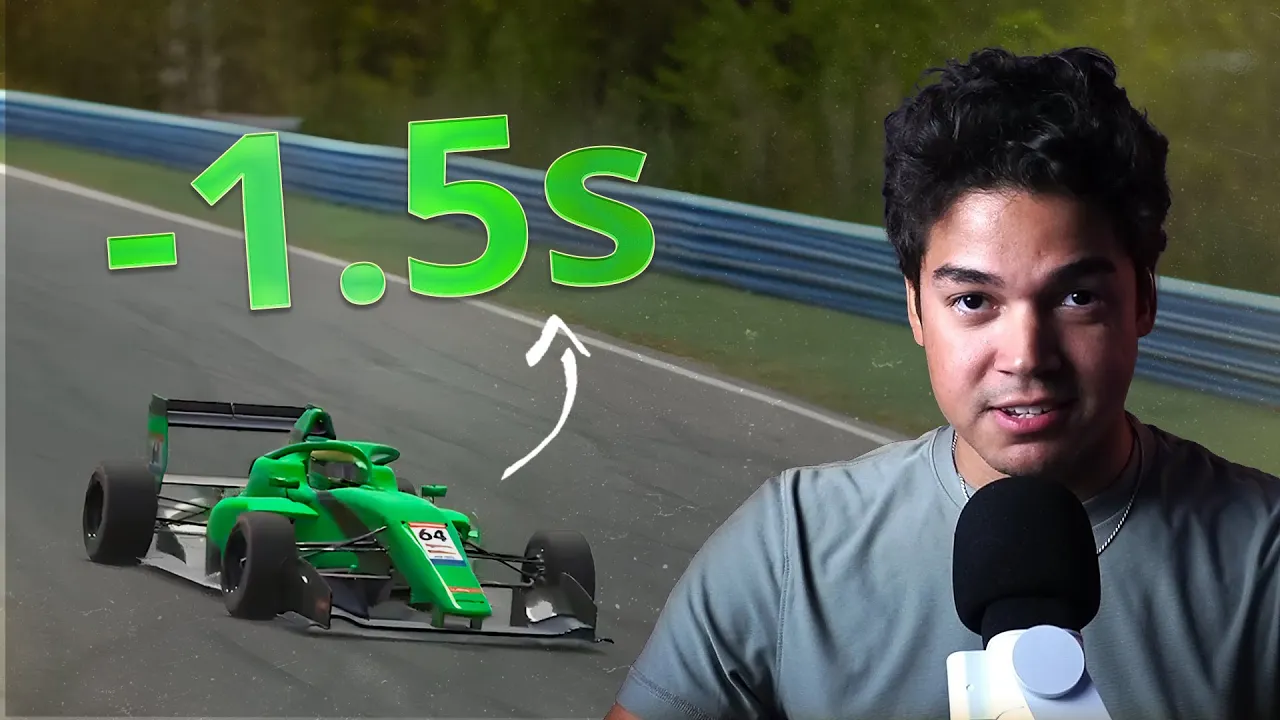
How a Sim Racer Found 1.5 Seconds on His First Try - Trail Braking Breakthrough at Spa
Suellio Almeida
•
Thursday, May 30, 2024
The Problem: Fast Everywhere Except Turn 1
The student's issue was classic. He'd done the YouTube tutorials. He understood racing lines in theory. His mid-corner speed was decent. But Turn 1 at Spa — that fast, sweeping right-hander after Eau Rouge — was costing him massive time.
When I pulled up his telemetry against the VRS baseline, the gap was obvious. He was losing half a second in a single corner. Not because he was slow on entry. Not because he missed the apex. Because he wasn't using his brakes correctly.
He thought he was trail braking. He wasn't.
What Trail Braking Actually Means
Most drivers think trail braking is just "braking into the corner." That's not it.
Trail braking is about transferring weight to the front axle to generate rotation while simultaneously managing grip. You're asking the front tires to do two jobs at once: turn the car AND slow it down. Done right, the car rotates naturally toward the apex. Done wrong, you either understeer off track or lock the fronts.
The key is braking pressure management. You don't just hold the brake pedal steady as you turn in. You release it progressively — smoothly bleeding off pressure as steering angle increases. The release rate has to match the corner's geometry. Too slow, you understeer. Too fast, you lose rotation and have to add steering mid-corner.
This student was doing neither. He was releasing the brake too early — before turn-in — then coasting through the entry phase. No weight on the front. No rotation. Just understeer and lost time.
The Fix: Hold the Brake 15 Meters Longer
I told him: "Brake to 130 kph. Hold it. Don't release until you're turning in."
That's it. One change.
Instead of releasing at the 100m board, hold until you're actually committing to the corner. Then — and this is critical — release slowly. Match the release to your steering input. As you add more steering angle approaching the apex, your brake pressure drops proportionally.
The telemetry showed the difference immediately. His minimum speed in Turn 1 jumped from 128 kph to 135 kph. Same racing line. Same throttle application point. Just better brake management.
The result? 1.5 seconds faster. On his first attempt.
Why This Works: Physics, Not Magic
When you brake late into the corner, weight transfers forward. The front tires compress. They gain grip. The rear lightens. The car wants to rotate.
If you release the brake too early — like this student was doing — that weight transfer disappears before you turn in. You're asking the front tires to change direction with no extra grip. They can't. You understeer. You have to slow down more mid-corner to make the apex. You lose speed.
Holding the brake longer keeps that weight forward through turn-in. The car rotates naturally. You can carry more speed. You're faster to the apex, faster on exit, faster down the next straight.
This is why trail braking isn't optional at high levels. It's mandatory. Every fast driver does it. The difference is most of them learned it through thousands of laps of trial and error. You don't have to.
The Bigger Lesson: Technique Beats Talent
This student didn't suddenly gain racecraft or talent. He applied one specific technique correctly. That's the difference between a 2:19 and a 2:17.5.
How many corners are you leaving time on the table because you're not managing your brakes correctly? How much faster would you be if someone just showed you exactly where you're losing time and what to change?
Most sim racers spend months — years — grinding laps, hoping to "figure it out." They watch tutorials. They copy aliens' setups. They blame the car. But they never get the one thing that actually moves the needle: specific feedback on their specific driving.
You don't need another YouTube video. You need someone to look at your telemetry and tell you: "Brake here. Release here. This is why."
What If You Could Drop 1.5 Seconds This Week?
How long have you been stuck at your current pace? How many races have you lost because you're giving away half a second in one corner?
What would change if someone who's coached 36,000+ students — someone who's driven IMSA, won championships, trained F1 engineers — looked at your data and told you exactly what to fix?
You could keep guessing. Keep hoping the next setup or the next practice session magically clicks. Or you could get the same clarity this student got.
That's what 1:1 coaching is. I watch your replay. I analyze your telemetry. I show you — corner by corner, brake zone by brake zone — where you're losing time and what specific change to make. No fluff. No theory. Just results.
Sim Racing Academy Membership
Everything you need to stop guessing and start getting faster.
Starting at
$25
/mo
Car Handling Online Course
4 levels, full curriculum. Aimed to get you to top 1% in driving pace.
Racecraft Online Course
Overtaking, Defending, Race Strategy
Live coaching + on-track practice
Bi-weekly pro-coach workshops (recorded — never miss one) plus on-track Pit Parties to practice racecraft with a coach.
Plus These Bonuses
13,000+ Member Community
League Racing
Advanced MX-5 Mini Course
Racing Technique Development Guide
The Motor Racing Book (260 pages)
Think & Behave Like a Pro Driver — Mini eBook
How a Sim Racer Found 1.5 Seconds on His First Try - Trail Braking Breakthrough at Spa
Suellio Almeida
•
Thursday, May 30, 2024
The Problem: Fast Everywhere Except Turn 1
The student's issue was classic. He'd done the YouTube tutorials. He understood racing lines in theory. His mid-corner speed was decent. But Turn 1 at Spa — that fast, sweeping right-hander after Eau Rouge — was costing him massive time.
When I pulled up his telemetry against the VRS baseline, the gap was obvious. He was losing half a second in a single corner. Not because he was slow on entry. Not because he missed the apex. Because he wasn't using his brakes correctly.
He thought he was trail braking. He wasn't.
What Trail Braking Actually Means
Most drivers think trail braking is just "braking into the corner." That's not it.
Trail braking is about transferring weight to the front axle to generate rotation while simultaneously managing grip. You're asking the front tires to do two jobs at once: turn the car AND slow it down. Done right, the car rotates naturally toward the apex. Done wrong, you either understeer off track or lock the fronts.
The key is braking pressure management. You don't just hold the brake pedal steady as you turn in. You release it progressively — smoothly bleeding off pressure as steering angle increases. The release rate has to match the corner's geometry. Too slow, you understeer. Too fast, you lose rotation and have to add steering mid-corner.
This student was doing neither. He was releasing the brake too early — before turn-in — then coasting through the entry phase. No weight on the front. No rotation. Just understeer and lost time.
The Fix: Hold the Brake 15 Meters Longer
I told him: "Brake to 130 kph. Hold it. Don't release until you're turning in."
That's it. One change.
Instead of releasing at the 100m board, hold until you're actually committing to the corner. Then — and this is critical — release slowly. Match the release to your steering input. As you add more steering angle approaching the apex, your brake pressure drops proportionally.
The telemetry showed the difference immediately. His minimum speed in Turn 1 jumped from 128 kph to 135 kph. Same racing line. Same throttle application point. Just better brake management.
The result? 1.5 seconds faster. On his first attempt.
Why This Works: Physics, Not Magic
When you brake late into the corner, weight transfers forward. The front tires compress. They gain grip. The rear lightens. The car wants to rotate.
If you release the brake too early — like this student was doing — that weight transfer disappears before you turn in. You're asking the front tires to change direction with no extra grip. They can't. You understeer. You have to slow down more mid-corner to make the apex. You lose speed.
Holding the brake longer keeps that weight forward through turn-in. The car rotates naturally. You can carry more speed. You're faster to the apex, faster on exit, faster down the next straight.
This is why trail braking isn't optional at high levels. It's mandatory. Every fast driver does it. The difference is most of them learned it through thousands of laps of trial and error. You don't have to.
The Bigger Lesson: Technique Beats Talent
This student didn't suddenly gain racecraft or talent. He applied one specific technique correctly. That's the difference between a 2:19 and a 2:17.5.
How many corners are you leaving time on the table because you're not managing your brakes correctly? How much faster would you be if someone just showed you exactly where you're losing time and what to change?
Most sim racers spend months — years — grinding laps, hoping to "figure it out." They watch tutorials. They copy aliens' setups. They blame the car. But they never get the one thing that actually moves the needle: specific feedback on their specific driving.
You don't need another YouTube video. You need someone to look at your telemetry and tell you: "Brake here. Release here. This is why."
What If You Could Drop 1.5 Seconds This Week?
How long have you been stuck at your current pace? How many races have you lost because you're giving away half a second in one corner?
What would change if someone who's coached 36,000+ students — someone who's driven IMSA, won championships, trained F1 engineers — looked at your data and told you exactly what to fix?
You could keep guessing. Keep hoping the next setup or the next practice session magically clicks. Or you could get the same clarity this student got.
That's what 1:1 coaching is. I watch your replay. I analyze your telemetry. I show you — corner by corner, brake zone by brake zone — where you're losing time and what specific change to make. No fluff. No theory. Just results.
Sim Racing Academy Membership
Everything you need to stop guessing and start getting faster.
Starting at
$25
/mo
Car Handling Online Course
4 levels, full curriculum. Aimed to get you to top 1% in driving pace.
Racecraft Online Course
Overtaking, Defending, Race Strategy
Live coaching + on-track practice
Bi-weekly pro-coach workshops (recorded — never miss one) plus on-track Pit Parties to practice racecraft with a coach.
Plus These Bonuses
13,000+ Member Community
League Racing
Advanced MX-5 Mini Course
Racing Technique Development Guide
The Motor Racing Book (260 pages)
Think & Behave Like a Pro Driver — Mini eBook
How a Sim Racer Found 1.5 Seconds on His First Try - Trail Braking Breakthrough at Spa
Suellio Almeida
•
Thursday, May 30, 2024
The Problem: Fast Everywhere Except Turn 1
The student's issue was classic. He'd done the YouTube tutorials. He understood racing lines in theory. His mid-corner speed was decent. But Turn 1 at Spa — that fast, sweeping right-hander after Eau Rouge — was costing him massive time.
When I pulled up his telemetry against the VRS baseline, the gap was obvious. He was losing half a second in a single corner. Not because he was slow on entry. Not because he missed the apex. Because he wasn't using his brakes correctly.
He thought he was trail braking. He wasn't.
What Trail Braking Actually Means
Most drivers think trail braking is just "braking into the corner." That's not it.
Trail braking is about transferring weight to the front axle to generate rotation while simultaneously managing grip. You're asking the front tires to do two jobs at once: turn the car AND slow it down. Done right, the car rotates naturally toward the apex. Done wrong, you either understeer off track or lock the fronts.
The key is braking pressure management. You don't just hold the brake pedal steady as you turn in. You release it progressively — smoothly bleeding off pressure as steering angle increases. The release rate has to match the corner's geometry. Too slow, you understeer. Too fast, you lose rotation and have to add steering mid-corner.
This student was doing neither. He was releasing the brake too early — before turn-in — then coasting through the entry phase. No weight on the front. No rotation. Just understeer and lost time.
The Fix: Hold the Brake 15 Meters Longer
I told him: "Brake to 130 kph. Hold it. Don't release until you're turning in."
That's it. One change.
Instead of releasing at the 100m board, hold until you're actually committing to the corner. Then — and this is critical — release slowly. Match the release to your steering input. As you add more steering angle approaching the apex, your brake pressure drops proportionally.
The telemetry showed the difference immediately. His minimum speed in Turn 1 jumped from 128 kph to 135 kph. Same racing line. Same throttle application point. Just better brake management.
The result? 1.5 seconds faster. On his first attempt.
Why This Works: Physics, Not Magic
When you brake late into the corner, weight transfers forward. The front tires compress. They gain grip. The rear lightens. The car wants to rotate.
If you release the brake too early — like this student was doing — that weight transfer disappears before you turn in. You're asking the front tires to change direction with no extra grip. They can't. You understeer. You have to slow down more mid-corner to make the apex. You lose speed.
Holding the brake longer keeps that weight forward through turn-in. The car rotates naturally. You can carry more speed. You're faster to the apex, faster on exit, faster down the next straight.
This is why trail braking isn't optional at high levels. It's mandatory. Every fast driver does it. The difference is most of them learned it through thousands of laps of trial and error. You don't have to.
The Bigger Lesson: Technique Beats Talent
This student didn't suddenly gain racecraft or talent. He applied one specific technique correctly. That's the difference between a 2:19 and a 2:17.5.
How many corners are you leaving time on the table because you're not managing your brakes correctly? How much faster would you be if someone just showed you exactly where you're losing time and what to change?
Most sim racers spend months — years — grinding laps, hoping to "figure it out." They watch tutorials. They copy aliens' setups. They blame the car. But they never get the one thing that actually moves the needle: specific feedback on their specific driving.
You don't need another YouTube video. You need someone to look at your telemetry and tell you: "Brake here. Release here. This is why."
What If You Could Drop 1.5 Seconds This Week?
How long have you been stuck at your current pace? How many races have you lost because you're giving away half a second in one corner?
What would change if someone who's coached 36,000+ students — someone who's driven IMSA, won championships, trained F1 engineers — looked at your data and told you exactly what to fix?
You could keep guessing. Keep hoping the next setup or the next practice session magically clicks. Or you could get the same clarity this student got.
That's what 1:1 coaching is. I watch your replay. I analyze your telemetry. I show you — corner by corner, brake zone by brake zone — where you're losing time and what specific change to make. No fluff. No theory. Just results.
Sim Racing Academy Membership
Everything you need to stop guessing and start getting faster.
Starting at
$25
/mo
Car Handling Online Course
4 levels, full curriculum. Aimed to get you to top 1% in driving pace.
Racecraft Online Course
Overtaking, Defending, Race Strategy
Live coaching + on-track practice
Bi-weekly pro-coach workshops (recorded — never miss one) plus on-track Pit Parties to practice racecraft with a coach.
Plus These Bonuses
13,000+ Member Community
League Racing
Advanced MX-5 Mini Course
Racing Technique Development Guide
The Motor Racing Book (260 pages)
Think & Behave Like a Pro Driver — Mini eBook