
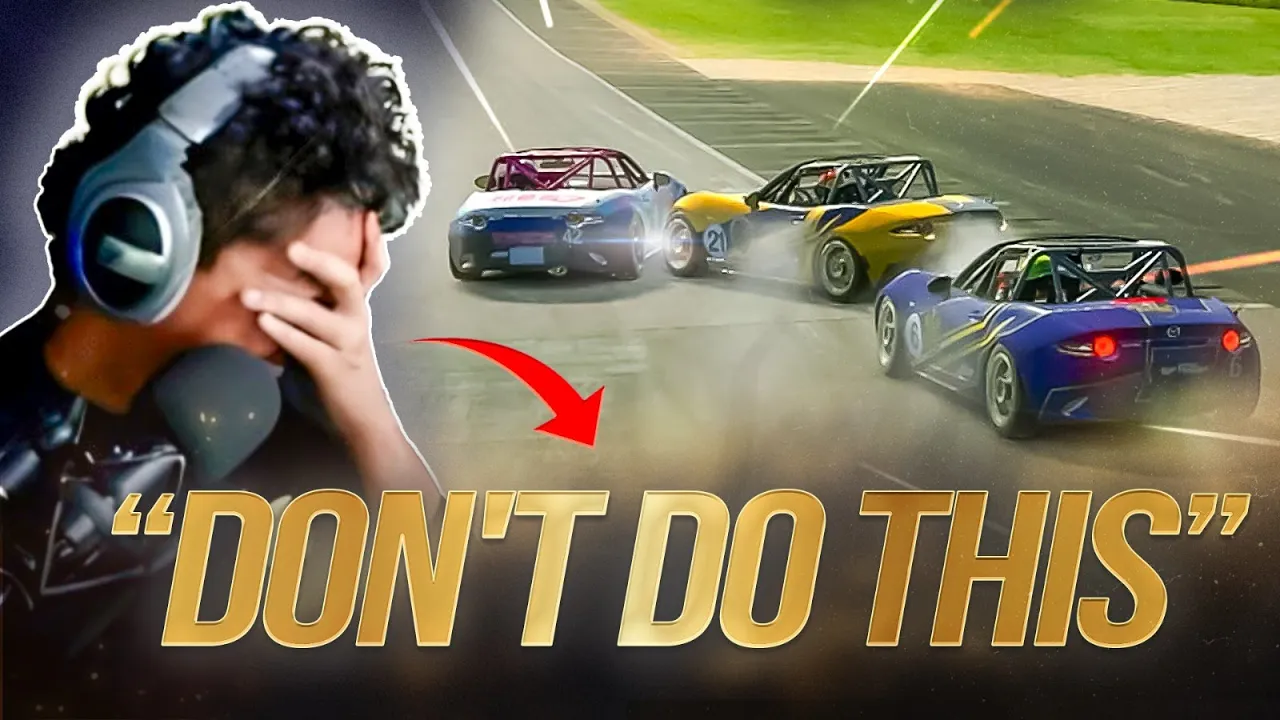
Racecraft Analysis: What Separates Fast Drivers from Race Winners
Suellio Almeida
•
Friday, September 13, 2024
Your Lap Time Means Nothing If You Can't Race
Let me be direct: you can turn the fastest lap of the session and still finish mid-pack.
Why? Because lap time and racecraft are two different skills.
I see this constantly with students who dominate time trials but crumble in wheel-to-wheel racing. They understand speed. They don't understand racing.
Racecraft is decision-making under pressure. It's knowing when to attack, when to defend, when to be patient. It's managing tire life while battling for position. It's adapting to chaos instead of hoping for clean air.
And here's the truth: most sim racers never properly train it.
The Dive Bomb That Wasn't a Dive Bomb
Let's start with a common scenario my students face: getting accused of dive bombing when they made a legitimate overtake.
One of my students sent me footage after getting protested in iRacing. The other driver claimed he dive bombed into Turn 1.
Here's what actually happened:
My student was within 0.3 seconds at the braking zone. He had overlap before turn-in. He hit his apex. He didn't push the other car wide. Textbook overtake.
The other driver just wasn't paying attention to his mirrors.
This is critical: a dive bomb is not any pass where you brake later than expected. A dive bomb is when you're too far back, brake too late, miss the apex, and force the other car off track to avoid contact.
If you're close enough to make the corner properly while alongside, that's racing.
But here's the issue — if you don't understand this distinction, you'll either be too timid (missing opportunities) or too aggressive (causing incidents).
The Defense That Actually Worked
Another student was defending position at Road Atlanta. Car behind was faster. Pressure for three laps.
Most drivers in this situation make one of two mistakes:
1. They defend too early and create a worse exit, losing the position anyway.
2. They defend too late and get outbraked.
My student did neither.
He focused on exit speed instead of blocking. He took the ideal line through Turn 10A and 10B, maximizing momentum onto the back straight. The car behind kept trying different lines — late apex, early apex, switching up braking points — but couldn't get enough of a run.
Why? Because you can't beat good exit speed with a desperate lunge.
Eventually the pressure forced the other driver into a mistake. He overcooked Turn 1, went wide, lost 0.4 seconds. My student extended the gap and controlled the race from there.
This is defensive racecraft: making your car as fast as possible, not as wide as possible.
When You Should Back Out (And When You Shouldn't)
Here's a situation that frustrates everyone: you're on the inside, alongside, and the other driver turns in like you don't exist.
Contact. You both lose.
Your instinct is to blame them. And maybe they're at fault. But ask yourself: did winning that corner help you finish the race?
One of my students had this exact scenario at Spa. Inside line into La Source, full overlap, and the outside car turned in anyway. Collision. Both cars damaged. My student dropped from P3 to P8.
"I had the right to that space," he told me.
And he did. But that doesn't matter when you're in the pits with damage.
The correct move? Recognize the other driver wasn't yielding and back out early. Live to fight the next corner.
This isn't about being soft. It's about being smart.
Now, when SHOULD you hold your ground?
When backing out costs you more than the risk of contact. Late-race battle for the win? Hold your line. Early-lap midfield scrap? Choose your battles.
Racecraft is knowing the difference.
The Mistake Every Rookie Makes at the Start
Starts are chaos. That's expected.
But there's one mistake I see in every single rookie race: trying to gain five positions in Turn 1.
You can't.
What actually happens: you brake too late trying to capitalize on the chaos, lock up, and lose three positions instead of gaining one.
One of my students sent me footage from a GT3 race at Monza. He was P7 on the grid, saw a gap into the first chicane, and lunged. Locked the fronts. Hit the car ahead. Dropped to P12.
"I thought I could make it," he said.
Here's what he should have done:
Brake earlier than usual. The pack is unpredictable. Cars will slow down more than expected. The slipstream effect is stronger. You need more margin.
Focus on surviving the first lap, not winning it.
The drivers who finish P1 aren't the ones who made the hero move into Turn 1. They're the ones who avoided the carnage, maintained clean pace, and capitalized on others' mistakes over 20 laps.
Patience wins races.
How to Actually Train Racecraft (Not Just Speed)
Most drivers train for speed only: hotlapping, time trials, chasing optimal laps.
That's important. But it's not racecraft.
Here's how to develop racecraft intentionally:
1. Race in traffic on purpose. Join a practice session and stay in a pack. Don't pull away. Practice defending, overtaking, managing dirty air. Make it uncomfortable.
2. Study your replays from other perspectives. Watch the car behind you. What did they see? Where were they looking to pass? Where did you leave the door open?
3. Analyze incidents objectively. Strip out emotion. Was it a legitimate move? Could you have avoided it? What would you do differently?
4. Run race simulations, not just quali pace. Do full-length stints. Manage tire deg. Practice consistency under fatigue. That's where races are actually won.
5. Enter split races. Don't only race at your iRating level. Jump into a higher split and survive. Jump into a lower split and practice clean overtakes without relying on the other driver being perfect.
Racecraft is a skill. Like any skill, it improves with deliberate practice.
You wouldn't expect to master trail braking by only doing straights. So why expect to master racecraft by only hotlapping?
The Real Difference Between Aliens and Everyone Else
You know what separates aliens from fast drivers?
It's not raw pace. Plenty of drivers can run within a few tenths of the front.
It's consistency under pressure.
Aliens don't make mistakes when it matters. They don't panic when a faster car closes in. They don't throw it away trying to defend a position that's already lost.
They manage the race, not just the lap.
One of my Platinum students made the jump from 4k to 7k iRating this season. You know what changed? Not his pace. He was already fast.
He stopped making stupid mistakes. He stopped racing emotionally. He started thinking two corners ahead instead of reacting to the one he's in.
That's racecraft.
And that's trainable.
What's Actually Holding You Back from Winning Races?
Be honest: how many races have you lost because of your decisions, not your pace?
How many times did you brake too late trying to force a pass that wasn't there?
How many times did you defend too hard and ruin your exit, losing the position anyway?
How many times did you focus on the gap to the car ahead instead of managing your tires and consistency?
You can keep making the same mistakes, hoping experience will eventually fix them. Or you can train racecraft the same way you train speed — deliberately, with feedback, with structure.
That's what we do at Almeida Racing Academy. Our Gold Membership includes racecraft workshops, coach-led race reviews, and structured leagues where you practice wheel-to-wheel skills in a controlled environment. You don't just get faster — you get smarter.
For $25/month (use code WINTER), you get access to 8 courses, 80 lessons, weekly workshops, and a community of drivers who actually care about improving, not just talking about it.
Stop losing races you should win.
Sim Racing Academy Membership
Everything you need to stop guessing and start getting faster.
Starting at
$25
/mo
Car Handling Online Course
4 levels, full curriculum. Aimed to get you to top 1% in driving pace.
Racecraft Online Course
Overtaking, Defending, Race Strategy
Live coaching + on-track practice
Bi-weekly pro-coach workshops (recorded — never miss one) plus on-track Pit Parties to practice racecraft with a coach.
Plus These Bonuses
13,000+ Member Community
League Racing
Advanced MX-5 Mini Course
Racing Technique Development Guide
The Motor Racing Book (260 pages)
Think & Behave Like a Pro Driver — Mini eBook
Racecraft Analysis: What Separates Fast Drivers from Race Winners
Suellio Almeida
•
Friday, September 13, 2024
Your Lap Time Means Nothing If You Can't Race
Let me be direct: you can turn the fastest lap of the session and still finish mid-pack.
Why? Because lap time and racecraft are two different skills.
I see this constantly with students who dominate time trials but crumble in wheel-to-wheel racing. They understand speed. They don't understand racing.
Racecraft is decision-making under pressure. It's knowing when to attack, when to defend, when to be patient. It's managing tire life while battling for position. It's adapting to chaos instead of hoping for clean air.
And here's the truth: most sim racers never properly train it.
The Dive Bomb That Wasn't a Dive Bomb
Let's start with a common scenario my students face: getting accused of dive bombing when they made a legitimate overtake.
One of my students sent me footage after getting protested in iRacing. The other driver claimed he dive bombed into Turn 1.
Here's what actually happened:
My student was within 0.3 seconds at the braking zone. He had overlap before turn-in. He hit his apex. He didn't push the other car wide. Textbook overtake.
The other driver just wasn't paying attention to his mirrors.
This is critical: a dive bomb is not any pass where you brake later than expected. A dive bomb is when you're too far back, brake too late, miss the apex, and force the other car off track to avoid contact.
If you're close enough to make the corner properly while alongside, that's racing.
But here's the issue — if you don't understand this distinction, you'll either be too timid (missing opportunities) or too aggressive (causing incidents).
The Defense That Actually Worked
Another student was defending position at Road Atlanta. Car behind was faster. Pressure for three laps.
Most drivers in this situation make one of two mistakes:
1. They defend too early and create a worse exit, losing the position anyway.
2. They defend too late and get outbraked.
My student did neither.
He focused on exit speed instead of blocking. He took the ideal line through Turn 10A and 10B, maximizing momentum onto the back straight. The car behind kept trying different lines — late apex, early apex, switching up braking points — but couldn't get enough of a run.
Why? Because you can't beat good exit speed with a desperate lunge.
Eventually the pressure forced the other driver into a mistake. He overcooked Turn 1, went wide, lost 0.4 seconds. My student extended the gap and controlled the race from there.
This is defensive racecraft: making your car as fast as possible, not as wide as possible.
When You Should Back Out (And When You Shouldn't)
Here's a situation that frustrates everyone: you're on the inside, alongside, and the other driver turns in like you don't exist.
Contact. You both lose.
Your instinct is to blame them. And maybe they're at fault. But ask yourself: did winning that corner help you finish the race?
One of my students had this exact scenario at Spa. Inside line into La Source, full overlap, and the outside car turned in anyway. Collision. Both cars damaged. My student dropped from P3 to P8.
"I had the right to that space," he told me.
And he did. But that doesn't matter when you're in the pits with damage.
The correct move? Recognize the other driver wasn't yielding and back out early. Live to fight the next corner.
This isn't about being soft. It's about being smart.
Now, when SHOULD you hold your ground?
When backing out costs you more than the risk of contact. Late-race battle for the win? Hold your line. Early-lap midfield scrap? Choose your battles.
Racecraft is knowing the difference.
The Mistake Every Rookie Makes at the Start
Starts are chaos. That's expected.
But there's one mistake I see in every single rookie race: trying to gain five positions in Turn 1.
You can't.
What actually happens: you brake too late trying to capitalize on the chaos, lock up, and lose three positions instead of gaining one.
One of my students sent me footage from a GT3 race at Monza. He was P7 on the grid, saw a gap into the first chicane, and lunged. Locked the fronts. Hit the car ahead. Dropped to P12.
"I thought I could make it," he said.
Here's what he should have done:
Brake earlier than usual. The pack is unpredictable. Cars will slow down more than expected. The slipstream effect is stronger. You need more margin.
Focus on surviving the first lap, not winning it.
The drivers who finish P1 aren't the ones who made the hero move into Turn 1. They're the ones who avoided the carnage, maintained clean pace, and capitalized on others' mistakes over 20 laps.
Patience wins races.
How to Actually Train Racecraft (Not Just Speed)
Most drivers train for speed only: hotlapping, time trials, chasing optimal laps.
That's important. But it's not racecraft.
Here's how to develop racecraft intentionally:
1. Race in traffic on purpose. Join a practice session and stay in a pack. Don't pull away. Practice defending, overtaking, managing dirty air. Make it uncomfortable.
2. Study your replays from other perspectives. Watch the car behind you. What did they see? Where were they looking to pass? Where did you leave the door open?
3. Analyze incidents objectively. Strip out emotion. Was it a legitimate move? Could you have avoided it? What would you do differently?
4. Run race simulations, not just quali pace. Do full-length stints. Manage tire deg. Practice consistency under fatigue. That's where races are actually won.
5. Enter split races. Don't only race at your iRating level. Jump into a higher split and survive. Jump into a lower split and practice clean overtakes without relying on the other driver being perfect.
Racecraft is a skill. Like any skill, it improves with deliberate practice.
You wouldn't expect to master trail braking by only doing straights. So why expect to master racecraft by only hotlapping?
The Real Difference Between Aliens and Everyone Else
You know what separates aliens from fast drivers?
It's not raw pace. Plenty of drivers can run within a few tenths of the front.
It's consistency under pressure.
Aliens don't make mistakes when it matters. They don't panic when a faster car closes in. They don't throw it away trying to defend a position that's already lost.
They manage the race, not just the lap.
One of my Platinum students made the jump from 4k to 7k iRating this season. You know what changed? Not his pace. He was already fast.
He stopped making stupid mistakes. He stopped racing emotionally. He started thinking two corners ahead instead of reacting to the one he's in.
That's racecraft.
And that's trainable.
What's Actually Holding You Back from Winning Races?
Be honest: how many races have you lost because of your decisions, not your pace?
How many times did you brake too late trying to force a pass that wasn't there?
How many times did you defend too hard and ruin your exit, losing the position anyway?
How many times did you focus on the gap to the car ahead instead of managing your tires and consistency?
You can keep making the same mistakes, hoping experience will eventually fix them. Or you can train racecraft the same way you train speed — deliberately, with feedback, with structure.
That's what we do at Almeida Racing Academy. Our Gold Membership includes racecraft workshops, coach-led race reviews, and structured leagues where you practice wheel-to-wheel skills in a controlled environment. You don't just get faster — you get smarter.
For $25/month (use code WINTER), you get access to 8 courses, 80 lessons, weekly workshops, and a community of drivers who actually care about improving, not just talking about it.
Stop losing races you should win.
Sim Racing Academy Membership
Everything you need to stop guessing and start getting faster.
Starting at
$25
/mo
Car Handling Online Course
4 levels, full curriculum. Aimed to get you to top 1% in driving pace.
Racecraft Online Course
Overtaking, Defending, Race Strategy
Live coaching + on-track practice
Bi-weekly pro-coach workshops (recorded — never miss one) plus on-track Pit Parties to practice racecraft with a coach.
Plus These Bonuses
13,000+ Member Community
League Racing
Advanced MX-5 Mini Course
Racing Technique Development Guide
The Motor Racing Book (260 pages)
Think & Behave Like a Pro Driver — Mini eBook
Racecraft Analysis: What Separates Fast Drivers from Race Winners
Suellio Almeida
•
Friday, September 13, 2024
Your Lap Time Means Nothing If You Can't Race
Let me be direct: you can turn the fastest lap of the session and still finish mid-pack.
Why? Because lap time and racecraft are two different skills.
I see this constantly with students who dominate time trials but crumble in wheel-to-wheel racing. They understand speed. They don't understand racing.
Racecraft is decision-making under pressure. It's knowing when to attack, when to defend, when to be patient. It's managing tire life while battling for position. It's adapting to chaos instead of hoping for clean air.
And here's the truth: most sim racers never properly train it.
The Dive Bomb That Wasn't a Dive Bomb
Let's start with a common scenario my students face: getting accused of dive bombing when they made a legitimate overtake.
One of my students sent me footage after getting protested in iRacing. The other driver claimed he dive bombed into Turn 1.
Here's what actually happened:
My student was within 0.3 seconds at the braking zone. He had overlap before turn-in. He hit his apex. He didn't push the other car wide. Textbook overtake.
The other driver just wasn't paying attention to his mirrors.
This is critical: a dive bomb is not any pass where you brake later than expected. A dive bomb is when you're too far back, brake too late, miss the apex, and force the other car off track to avoid contact.
If you're close enough to make the corner properly while alongside, that's racing.
But here's the issue — if you don't understand this distinction, you'll either be too timid (missing opportunities) or too aggressive (causing incidents).
The Defense That Actually Worked
Another student was defending position at Road Atlanta. Car behind was faster. Pressure for three laps.
Most drivers in this situation make one of two mistakes:
1. They defend too early and create a worse exit, losing the position anyway.
2. They defend too late and get outbraked.
My student did neither.
He focused on exit speed instead of blocking. He took the ideal line through Turn 10A and 10B, maximizing momentum onto the back straight. The car behind kept trying different lines — late apex, early apex, switching up braking points — but couldn't get enough of a run.
Why? Because you can't beat good exit speed with a desperate lunge.
Eventually the pressure forced the other driver into a mistake. He overcooked Turn 1, went wide, lost 0.4 seconds. My student extended the gap and controlled the race from there.
This is defensive racecraft: making your car as fast as possible, not as wide as possible.
When You Should Back Out (And When You Shouldn't)
Here's a situation that frustrates everyone: you're on the inside, alongside, and the other driver turns in like you don't exist.
Contact. You both lose.
Your instinct is to blame them. And maybe they're at fault. But ask yourself: did winning that corner help you finish the race?
One of my students had this exact scenario at Spa. Inside line into La Source, full overlap, and the outside car turned in anyway. Collision. Both cars damaged. My student dropped from P3 to P8.
"I had the right to that space," he told me.
And he did. But that doesn't matter when you're in the pits with damage.
The correct move? Recognize the other driver wasn't yielding and back out early. Live to fight the next corner.
This isn't about being soft. It's about being smart.
Now, when SHOULD you hold your ground?
When backing out costs you more than the risk of contact. Late-race battle for the win? Hold your line. Early-lap midfield scrap? Choose your battles.
Racecraft is knowing the difference.
The Mistake Every Rookie Makes at the Start
Starts are chaos. That's expected.
But there's one mistake I see in every single rookie race: trying to gain five positions in Turn 1.
You can't.
What actually happens: you brake too late trying to capitalize on the chaos, lock up, and lose three positions instead of gaining one.
One of my students sent me footage from a GT3 race at Monza. He was P7 on the grid, saw a gap into the first chicane, and lunged. Locked the fronts. Hit the car ahead. Dropped to P12.
"I thought I could make it," he said.
Here's what he should have done:
Brake earlier than usual. The pack is unpredictable. Cars will slow down more than expected. The slipstream effect is stronger. You need more margin.
Focus on surviving the first lap, not winning it.
The drivers who finish P1 aren't the ones who made the hero move into Turn 1. They're the ones who avoided the carnage, maintained clean pace, and capitalized on others' mistakes over 20 laps.
Patience wins races.
How to Actually Train Racecraft (Not Just Speed)
Most drivers train for speed only: hotlapping, time trials, chasing optimal laps.
That's important. But it's not racecraft.
Here's how to develop racecraft intentionally:
1. Race in traffic on purpose. Join a practice session and stay in a pack. Don't pull away. Practice defending, overtaking, managing dirty air. Make it uncomfortable.
2. Study your replays from other perspectives. Watch the car behind you. What did they see? Where were they looking to pass? Where did you leave the door open?
3. Analyze incidents objectively. Strip out emotion. Was it a legitimate move? Could you have avoided it? What would you do differently?
4. Run race simulations, not just quali pace. Do full-length stints. Manage tire deg. Practice consistency under fatigue. That's where races are actually won.
5. Enter split races. Don't only race at your iRating level. Jump into a higher split and survive. Jump into a lower split and practice clean overtakes without relying on the other driver being perfect.
Racecraft is a skill. Like any skill, it improves with deliberate practice.
You wouldn't expect to master trail braking by only doing straights. So why expect to master racecraft by only hotlapping?
The Real Difference Between Aliens and Everyone Else
You know what separates aliens from fast drivers?
It's not raw pace. Plenty of drivers can run within a few tenths of the front.
It's consistency under pressure.
Aliens don't make mistakes when it matters. They don't panic when a faster car closes in. They don't throw it away trying to defend a position that's already lost.
They manage the race, not just the lap.
One of my Platinum students made the jump from 4k to 7k iRating this season. You know what changed? Not his pace. He was already fast.
He stopped making stupid mistakes. He stopped racing emotionally. He started thinking two corners ahead instead of reacting to the one he's in.
That's racecraft.
And that's trainable.
What's Actually Holding You Back from Winning Races?
Be honest: how many races have you lost because of your decisions, not your pace?
How many times did you brake too late trying to force a pass that wasn't there?
How many times did you defend too hard and ruin your exit, losing the position anyway?
How many times did you focus on the gap to the car ahead instead of managing your tires and consistency?
You can keep making the same mistakes, hoping experience will eventually fix them. Or you can train racecraft the same way you train speed — deliberately, with feedback, with structure.
That's what we do at Almeida Racing Academy. Our Gold Membership includes racecraft workshops, coach-led race reviews, and structured leagues where you practice wheel-to-wheel skills in a controlled environment. You don't just get faster — you get smarter.
For $25/month (use code WINTER), you get access to 8 courses, 80 lessons, weekly workshops, and a community of drivers who actually care about improving, not just talking about it.
Stop losing races you should win.
Sim Racing Academy Membership
Everything you need to stop guessing and start getting faster.
Starting at
$25
/mo
Car Handling Online Course
4 levels, full curriculum. Aimed to get you to top 1% in driving pace.
Racecraft Online Course
Overtaking, Defending, Race Strategy
Live coaching + on-track practice
Bi-weekly pro-coach workshops (recorded — never miss one) plus on-track Pit Parties to practice racecraft with a coach.
Plus These Bonuses
13,000+ Member Community
League Racing
Advanced MX-5 Mini Course
Racing Technique Development Guide
The Motor Racing Book (260 pages)
Think & Behave Like a Pro Driver — Mini eBook