
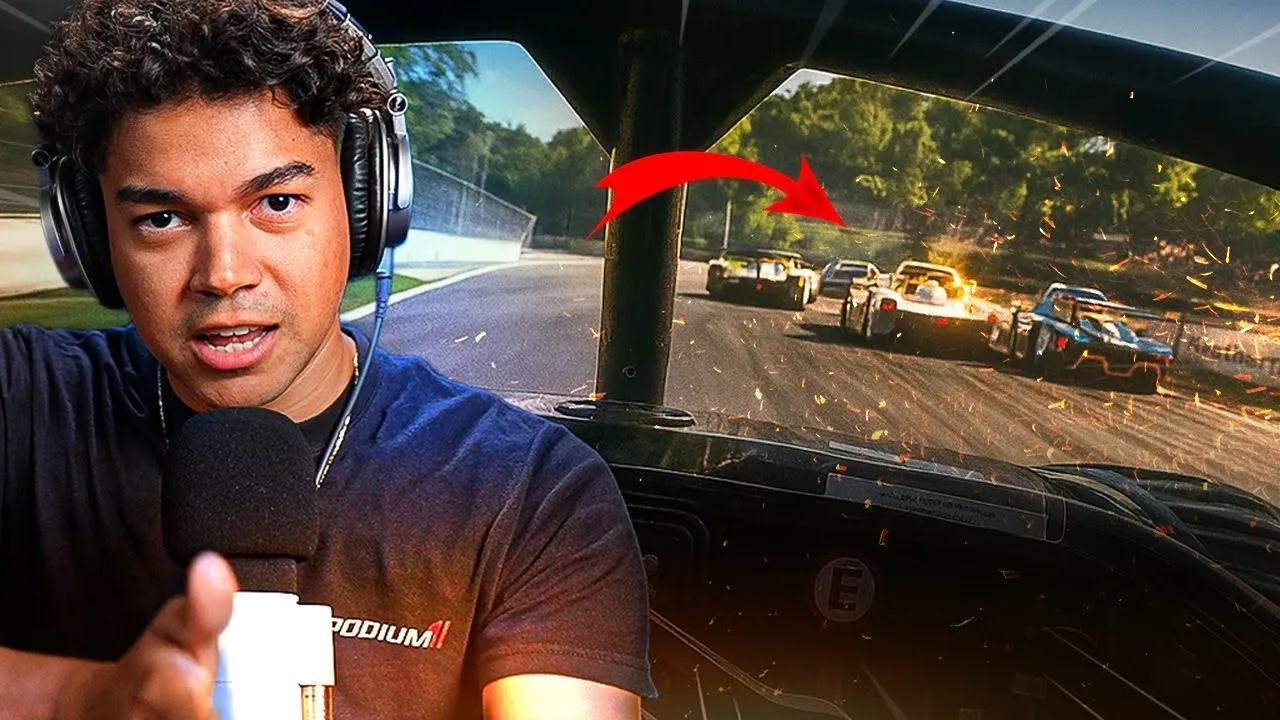
Race Moves That Made Me Champion: Onboard Analysis of Winning Racecraft
Suellio Almeida
•
Saturday, June 14, 2025
The Gap Between Fast and Championship-Winning
You can be fast in qualifying. You can nail the perfect lap in practice.
But can you execute under pressure? Can you position your car to make an overtake inevitable? Can you defend without losing time?
That's the gap. That's what separates drivers who look fast on their own from drivers who win championships.
I'm going to show you the exact race moves that won me the Canadian Sim Racing Championship. Not theory. Not "here's what you should do." Actual onboard footage with analysis of what I was thinking, what I was seeing, and why each move worked.
This is racecraft in action.
Move 1: Creating Pressure Through Consistent Proximity
Lap 3. I'm P2, sitting 0.4 seconds behind the leader.
I'm not trying to overtake yet. I'm not dive-bombing into Turn 1. I'm doing something more effective: I'm making him think about me.
Every corner exit, I'm there in his mirrors. Every braking zone, he sees my nose. I'm not close enough to be a threat, but I'm close enough that he has to drive defensively.
Watch his line through Turn 4. He's taking a tighter entry than he needs to. Why? Because he's protecting the inside. That tighter line costs him exit speed. That exit speed compounds over the next three corners.
By lap 5, that 0.4-second gap is 0.2 seconds.
I didn't gain time by being faster. I gained time by making him slower.
The principle: Pressure is a tool. Proximity forces defensive driving. Defensive driving is slower than confident driving. Stay close, stay patient, let them beat themselves.
Move 2: The Inside Line Isn't Always the Overtaking Line
Lap 7. Turn 6, a medium-speed right-hander leading onto a long straight.
I have the inside. Classic overtaking position, right?
Wrong.
The inside line at this corner is garbage. Tight radius, poor exit, you're on the outside curb at the exit and that kills your straight-line speed. Everyone tries to pass here on the inside and everyone loses the position back before the next braking zone.
So I don't take it.
I stay outside, maintain my speed, and I position my car so he can't take the ideal line through the corner. He either has to brake early or run wide. Either way, I get a better exit.
He brakes early.
I carry more speed through the corner, I get a better run onto the straight, and I complete the pass into Turn 7 with DRS advantage. He doesn't have an answer.
The principle: The overtaking opportunity isn't always in the corner you're thinking about. Sometimes you sacrifice position in one corner to create the overtake in the next. You need to think two moves ahead.
Move 3: Forcing the Mistake Through Exit Speed
Lap 12. I'm defending P1 now. Guy behind me is fast, he's been gaining a tenth per lap, and he's right on my gearbox.
Turn 9 is the danger zone. Fast left-hander, long straight after. If he gets beside me here, he'll pass me on the straight.
So I don't defend the inside.
I take the ideal line. I focus on exit speed. I position my car so that even if he does get alongside me in the braking zone, I'll have more speed at the exit and I'll re-pass him before the straight.
Watch the entry. He's committed to the inside. He's got overlap. This looks like a successful overtake.
But I'm patient. I don't panic. I don't squeeze him. I let him have the corner.
And then I focus on the Maximum Rotation Point.
I rotate the car early, I get on throttle early, and I carry more speed through the second half of the corner. By the time we're both accelerating, I'm ahead.
He tries again two laps later. Same result. By lap 15, he stops trying.
The principle: Defense isn't always about blocking. Sometimes the best defense is making the overtake unprofitable. Let them have the corner if it means you keep the race.
Move 4: The Kamikaze Dive That Actually Worked
Lap 18. Final stint. I'm P3, and I need P1 to win the championship.
Two laps left. Leader and P2 are battling each other, both running defensive lines, both losing time. They're 1.2 seconds ahead.
Turn 1 is a heavy braking zone. I know from practice that if you brake late and turn in sharp, you can make the apex. It's not the fast line, but it's a valid line.
I send it.
I brake 10 meters later than either of them expects. I turn in sharper. I make the apex. I'm three-wide on the exit.
The leader goes wide because he wasn't expecting anyone on the inside. P2 has to lift because there's no space. I thread the needle between both of them.
P1, one corner.
Risky? Yes. But calculated. I knew they were both focused on each other, not on me. I knew the gap was there if I committed. And I knew that if I didn't make the move, I'd lose the championship.
Sometimes you have to take the risk.
The principle: There's a difference between reckless and decisive. Reckless is hope. Decisive is calculated risk. Know the line, know the gap, commit fully. Hesitation is what causes crashes, not aggression.
Move 5: Managing the Final Lap When Everything Is On the Line
Lap 20. Final lap. I'm P1. Championship is mine if I don't mess this up.
P2 is 0.3 seconds behind. He's faster in Sector 2. If I drive scared, I'll lose.
So I don't drive scared.
I drive the same lap I've been driving for the last 19 laps. Same braking points, same throttle application, same vision sequence. No changes.
Turn 4, he gets close. Turn 6, he gets alongside on the inside. I let him have the corner, I focus on exit, I re-pass him before the straight.
Turn 9, same thing. He tries the inside, I get the better exit, I stay ahead.
Final corner. I nail the exit. He's 0.4 seconds back at the line.
Championship won.
The principle: Pressure makes drivers change what they're doing. Changing what you're doing under pressure makes you slower. The best mental game is no mental game—just execute the process you've already proven works.
What Actually Wins Championships
It's not one hero move. It's not raw speed.
It's racecraft. It's positioning. It's understanding what the other driver is thinking, what they're seeing, what they're afraid of.
It's making them defend when they want to attack. It's taking the line they're not expecting. It's staying calm when everything is on the line.
You want to win races? You need to train this. You need to practice wheel-to-wheel scenarios, not just hotlapping. You need to understand race strategy, not just lap time.
Speed gets you to the front. Racecraft keeps you there.
What Would Change If You Trained Racecraft Like a Skill?
You've watched the moves. You've seen the thought process. You understand the principles.
But understanding doesn't translate to execution without practice. How many races have you lost because you didn't know how to position your car for the overtake? How many times have you been fast in practice and then fallen apart in wheel-to-wheel combat?
Racecraft isn't something you're born with. It's trained. It's pattern recognition. It's scenarios you've practiced so many times that the right move becomes instinctive.
That's what we build at Almeida Racing Academy. Our Racecraft Masterclass breaks down positioning, overtaking, defending, and race strategy into repeatable techniques. You practice them in our coach-led workshops and leagues. You analyze your races with tools that show you exactly where you're losing positions.
No more guessing. No more "I'll figure it out in the race." You train the moves until they're automatic.
Gold members get full access—8 courses, 80 lessons, weekly workshops, competitive leagues, and the Garage 61 Pro app for data analysis. Right now, it's $25/month with code WINTER.
Sim Racing Academy Membership
Everything you need to stop guessing and start getting faster.
Starting at
$25
/mo
Car Handling Online Course
4 levels, full curriculum. Aimed to get you to top 1% in driving pace.
Racecraft Online Course
Overtaking, Defending, Race Strategy
Live coaching + on-track practice
Bi-weekly pro-coach workshops (recorded — never miss one) plus on-track Pit Parties to practice racecraft with a coach.
Plus These Bonuses
13,000+ Member Community
League Racing
Advanced MX-5 Mini Course
Racing Technique Development Guide
The Motor Racing Book (260 pages)
Think & Behave Like a Pro Driver — Mini eBook
Race Moves That Made Me Champion: Onboard Analysis of Winning Racecraft
Suellio Almeida
•
Saturday, June 14, 2025
The Gap Between Fast and Championship-Winning
You can be fast in qualifying. You can nail the perfect lap in practice.
But can you execute under pressure? Can you position your car to make an overtake inevitable? Can you defend without losing time?
That's the gap. That's what separates drivers who look fast on their own from drivers who win championships.
I'm going to show you the exact race moves that won me the Canadian Sim Racing Championship. Not theory. Not "here's what you should do." Actual onboard footage with analysis of what I was thinking, what I was seeing, and why each move worked.
This is racecraft in action.
Move 1: Creating Pressure Through Consistent Proximity
Lap 3. I'm P2, sitting 0.4 seconds behind the leader.
I'm not trying to overtake yet. I'm not dive-bombing into Turn 1. I'm doing something more effective: I'm making him think about me.
Every corner exit, I'm there in his mirrors. Every braking zone, he sees my nose. I'm not close enough to be a threat, but I'm close enough that he has to drive defensively.
Watch his line through Turn 4. He's taking a tighter entry than he needs to. Why? Because he's protecting the inside. That tighter line costs him exit speed. That exit speed compounds over the next three corners.
By lap 5, that 0.4-second gap is 0.2 seconds.
I didn't gain time by being faster. I gained time by making him slower.
The principle: Pressure is a tool. Proximity forces defensive driving. Defensive driving is slower than confident driving. Stay close, stay patient, let them beat themselves.
Move 2: The Inside Line Isn't Always the Overtaking Line
Lap 7. Turn 6, a medium-speed right-hander leading onto a long straight.
I have the inside. Classic overtaking position, right?
Wrong.
The inside line at this corner is garbage. Tight radius, poor exit, you're on the outside curb at the exit and that kills your straight-line speed. Everyone tries to pass here on the inside and everyone loses the position back before the next braking zone.
So I don't take it.
I stay outside, maintain my speed, and I position my car so he can't take the ideal line through the corner. He either has to brake early or run wide. Either way, I get a better exit.
He brakes early.
I carry more speed through the corner, I get a better run onto the straight, and I complete the pass into Turn 7 with DRS advantage. He doesn't have an answer.
The principle: The overtaking opportunity isn't always in the corner you're thinking about. Sometimes you sacrifice position in one corner to create the overtake in the next. You need to think two moves ahead.
Move 3: Forcing the Mistake Through Exit Speed
Lap 12. I'm defending P1 now. Guy behind me is fast, he's been gaining a tenth per lap, and he's right on my gearbox.
Turn 9 is the danger zone. Fast left-hander, long straight after. If he gets beside me here, he'll pass me on the straight.
So I don't defend the inside.
I take the ideal line. I focus on exit speed. I position my car so that even if he does get alongside me in the braking zone, I'll have more speed at the exit and I'll re-pass him before the straight.
Watch the entry. He's committed to the inside. He's got overlap. This looks like a successful overtake.
But I'm patient. I don't panic. I don't squeeze him. I let him have the corner.
And then I focus on the Maximum Rotation Point.
I rotate the car early, I get on throttle early, and I carry more speed through the second half of the corner. By the time we're both accelerating, I'm ahead.
He tries again two laps later. Same result. By lap 15, he stops trying.
The principle: Defense isn't always about blocking. Sometimes the best defense is making the overtake unprofitable. Let them have the corner if it means you keep the race.
Move 4: The Kamikaze Dive That Actually Worked
Lap 18. Final stint. I'm P3, and I need P1 to win the championship.
Two laps left. Leader and P2 are battling each other, both running defensive lines, both losing time. They're 1.2 seconds ahead.
Turn 1 is a heavy braking zone. I know from practice that if you brake late and turn in sharp, you can make the apex. It's not the fast line, but it's a valid line.
I send it.
I brake 10 meters later than either of them expects. I turn in sharper. I make the apex. I'm three-wide on the exit.
The leader goes wide because he wasn't expecting anyone on the inside. P2 has to lift because there's no space. I thread the needle between both of them.
P1, one corner.
Risky? Yes. But calculated. I knew they were both focused on each other, not on me. I knew the gap was there if I committed. And I knew that if I didn't make the move, I'd lose the championship.
Sometimes you have to take the risk.
The principle: There's a difference between reckless and decisive. Reckless is hope. Decisive is calculated risk. Know the line, know the gap, commit fully. Hesitation is what causes crashes, not aggression.
Move 5: Managing the Final Lap When Everything Is On the Line
Lap 20. Final lap. I'm P1. Championship is mine if I don't mess this up.
P2 is 0.3 seconds behind. He's faster in Sector 2. If I drive scared, I'll lose.
So I don't drive scared.
I drive the same lap I've been driving for the last 19 laps. Same braking points, same throttle application, same vision sequence. No changes.
Turn 4, he gets close. Turn 6, he gets alongside on the inside. I let him have the corner, I focus on exit, I re-pass him before the straight.
Turn 9, same thing. He tries the inside, I get the better exit, I stay ahead.
Final corner. I nail the exit. He's 0.4 seconds back at the line.
Championship won.
The principle: Pressure makes drivers change what they're doing. Changing what you're doing under pressure makes you slower. The best mental game is no mental game—just execute the process you've already proven works.
What Actually Wins Championships
It's not one hero move. It's not raw speed.
It's racecraft. It's positioning. It's understanding what the other driver is thinking, what they're seeing, what they're afraid of.
It's making them defend when they want to attack. It's taking the line they're not expecting. It's staying calm when everything is on the line.
You want to win races? You need to train this. You need to practice wheel-to-wheel scenarios, not just hotlapping. You need to understand race strategy, not just lap time.
Speed gets you to the front. Racecraft keeps you there.
What Would Change If You Trained Racecraft Like a Skill?
You've watched the moves. You've seen the thought process. You understand the principles.
But understanding doesn't translate to execution without practice. How many races have you lost because you didn't know how to position your car for the overtake? How many times have you been fast in practice and then fallen apart in wheel-to-wheel combat?
Racecraft isn't something you're born with. It's trained. It's pattern recognition. It's scenarios you've practiced so many times that the right move becomes instinctive.
That's what we build at Almeida Racing Academy. Our Racecraft Masterclass breaks down positioning, overtaking, defending, and race strategy into repeatable techniques. You practice them in our coach-led workshops and leagues. You analyze your races with tools that show you exactly where you're losing positions.
No more guessing. No more "I'll figure it out in the race." You train the moves until they're automatic.
Gold members get full access—8 courses, 80 lessons, weekly workshops, competitive leagues, and the Garage 61 Pro app for data analysis. Right now, it's $25/month with code WINTER.
Sim Racing Academy Membership
Everything you need to stop guessing and start getting faster.
Starting at
$25
/mo
Car Handling Online Course
4 levels, full curriculum. Aimed to get you to top 1% in driving pace.
Racecraft Online Course
Overtaking, Defending, Race Strategy
Live coaching + on-track practice
Bi-weekly pro-coach workshops (recorded — never miss one) plus on-track Pit Parties to practice racecraft with a coach.
Plus These Bonuses
13,000+ Member Community
League Racing
Advanced MX-5 Mini Course
Racing Technique Development Guide
The Motor Racing Book (260 pages)
Think & Behave Like a Pro Driver — Mini eBook
Race Moves That Made Me Champion: Onboard Analysis of Winning Racecraft
Suellio Almeida
•
Saturday, June 14, 2025
The Gap Between Fast and Championship-Winning
You can be fast in qualifying. You can nail the perfect lap in practice.
But can you execute under pressure? Can you position your car to make an overtake inevitable? Can you defend without losing time?
That's the gap. That's what separates drivers who look fast on their own from drivers who win championships.
I'm going to show you the exact race moves that won me the Canadian Sim Racing Championship. Not theory. Not "here's what you should do." Actual onboard footage with analysis of what I was thinking, what I was seeing, and why each move worked.
This is racecraft in action.
Move 1: Creating Pressure Through Consistent Proximity
Lap 3. I'm P2, sitting 0.4 seconds behind the leader.
I'm not trying to overtake yet. I'm not dive-bombing into Turn 1. I'm doing something more effective: I'm making him think about me.
Every corner exit, I'm there in his mirrors. Every braking zone, he sees my nose. I'm not close enough to be a threat, but I'm close enough that he has to drive defensively.
Watch his line through Turn 4. He's taking a tighter entry than he needs to. Why? Because he's protecting the inside. That tighter line costs him exit speed. That exit speed compounds over the next three corners.
By lap 5, that 0.4-second gap is 0.2 seconds.
I didn't gain time by being faster. I gained time by making him slower.
The principle: Pressure is a tool. Proximity forces defensive driving. Defensive driving is slower than confident driving. Stay close, stay patient, let them beat themselves.
Move 2: The Inside Line Isn't Always the Overtaking Line
Lap 7. Turn 6, a medium-speed right-hander leading onto a long straight.
I have the inside. Classic overtaking position, right?
Wrong.
The inside line at this corner is garbage. Tight radius, poor exit, you're on the outside curb at the exit and that kills your straight-line speed. Everyone tries to pass here on the inside and everyone loses the position back before the next braking zone.
So I don't take it.
I stay outside, maintain my speed, and I position my car so he can't take the ideal line through the corner. He either has to brake early or run wide. Either way, I get a better exit.
He brakes early.
I carry more speed through the corner, I get a better run onto the straight, and I complete the pass into Turn 7 with DRS advantage. He doesn't have an answer.
The principle: The overtaking opportunity isn't always in the corner you're thinking about. Sometimes you sacrifice position in one corner to create the overtake in the next. You need to think two moves ahead.
Move 3: Forcing the Mistake Through Exit Speed
Lap 12. I'm defending P1 now. Guy behind me is fast, he's been gaining a tenth per lap, and he's right on my gearbox.
Turn 9 is the danger zone. Fast left-hander, long straight after. If he gets beside me here, he'll pass me on the straight.
So I don't defend the inside.
I take the ideal line. I focus on exit speed. I position my car so that even if he does get alongside me in the braking zone, I'll have more speed at the exit and I'll re-pass him before the straight.
Watch the entry. He's committed to the inside. He's got overlap. This looks like a successful overtake.
But I'm patient. I don't panic. I don't squeeze him. I let him have the corner.
And then I focus on the Maximum Rotation Point.
I rotate the car early, I get on throttle early, and I carry more speed through the second half of the corner. By the time we're both accelerating, I'm ahead.
He tries again two laps later. Same result. By lap 15, he stops trying.
The principle: Defense isn't always about blocking. Sometimes the best defense is making the overtake unprofitable. Let them have the corner if it means you keep the race.
Move 4: The Kamikaze Dive That Actually Worked
Lap 18. Final stint. I'm P3, and I need P1 to win the championship.
Two laps left. Leader and P2 are battling each other, both running defensive lines, both losing time. They're 1.2 seconds ahead.
Turn 1 is a heavy braking zone. I know from practice that if you brake late and turn in sharp, you can make the apex. It's not the fast line, but it's a valid line.
I send it.
I brake 10 meters later than either of them expects. I turn in sharper. I make the apex. I'm three-wide on the exit.
The leader goes wide because he wasn't expecting anyone on the inside. P2 has to lift because there's no space. I thread the needle between both of them.
P1, one corner.
Risky? Yes. But calculated. I knew they were both focused on each other, not on me. I knew the gap was there if I committed. And I knew that if I didn't make the move, I'd lose the championship.
Sometimes you have to take the risk.
The principle: There's a difference between reckless and decisive. Reckless is hope. Decisive is calculated risk. Know the line, know the gap, commit fully. Hesitation is what causes crashes, not aggression.
Move 5: Managing the Final Lap When Everything Is On the Line
Lap 20. Final lap. I'm P1. Championship is mine if I don't mess this up.
P2 is 0.3 seconds behind. He's faster in Sector 2. If I drive scared, I'll lose.
So I don't drive scared.
I drive the same lap I've been driving for the last 19 laps. Same braking points, same throttle application, same vision sequence. No changes.
Turn 4, he gets close. Turn 6, he gets alongside on the inside. I let him have the corner, I focus on exit, I re-pass him before the straight.
Turn 9, same thing. He tries the inside, I get the better exit, I stay ahead.
Final corner. I nail the exit. He's 0.4 seconds back at the line.
Championship won.
The principle: Pressure makes drivers change what they're doing. Changing what you're doing under pressure makes you slower. The best mental game is no mental game—just execute the process you've already proven works.
What Actually Wins Championships
It's not one hero move. It's not raw speed.
It's racecraft. It's positioning. It's understanding what the other driver is thinking, what they're seeing, what they're afraid of.
It's making them defend when they want to attack. It's taking the line they're not expecting. It's staying calm when everything is on the line.
You want to win races? You need to train this. You need to practice wheel-to-wheel scenarios, not just hotlapping. You need to understand race strategy, not just lap time.
Speed gets you to the front. Racecraft keeps you there.
What Would Change If You Trained Racecraft Like a Skill?
You've watched the moves. You've seen the thought process. You understand the principles.
But understanding doesn't translate to execution without practice. How many races have you lost because you didn't know how to position your car for the overtake? How many times have you been fast in practice and then fallen apart in wheel-to-wheel combat?
Racecraft isn't something you're born with. It's trained. It's pattern recognition. It's scenarios you've practiced so many times that the right move becomes instinctive.
That's what we build at Almeida Racing Academy. Our Racecraft Masterclass breaks down positioning, overtaking, defending, and race strategy into repeatable techniques. You practice them in our coach-led workshops and leagues. You analyze your races with tools that show you exactly where you're losing positions.
No more guessing. No more "I'll figure it out in the race." You train the moves until they're automatic.
Gold members get full access—8 courses, 80 lessons, weekly workshops, competitive leagues, and the Garage 61 Pro app for data analysis. Right now, it's $25/month with code WINTER.
Sim Racing Academy Membership
Everything you need to stop guessing and start getting faster.
Starting at
$25
/mo
Car Handling Online Course
4 levels, full curriculum. Aimed to get you to top 1% in driving pace.
Racecraft Online Course
Overtaking, Defending, Race Strategy
Live coaching + on-track practice
Bi-weekly pro-coach workshops (recorded — never miss one) plus on-track Pit Parties to practice racecraft with a coach.
Plus These Bonuses
13,000+ Member Community
League Racing
Advanced MX-5 Mini Course
Racing Technique Development Guide
The Motor Racing Book (260 pages)
Think & Behave Like a Pro Driver — Mini eBook