
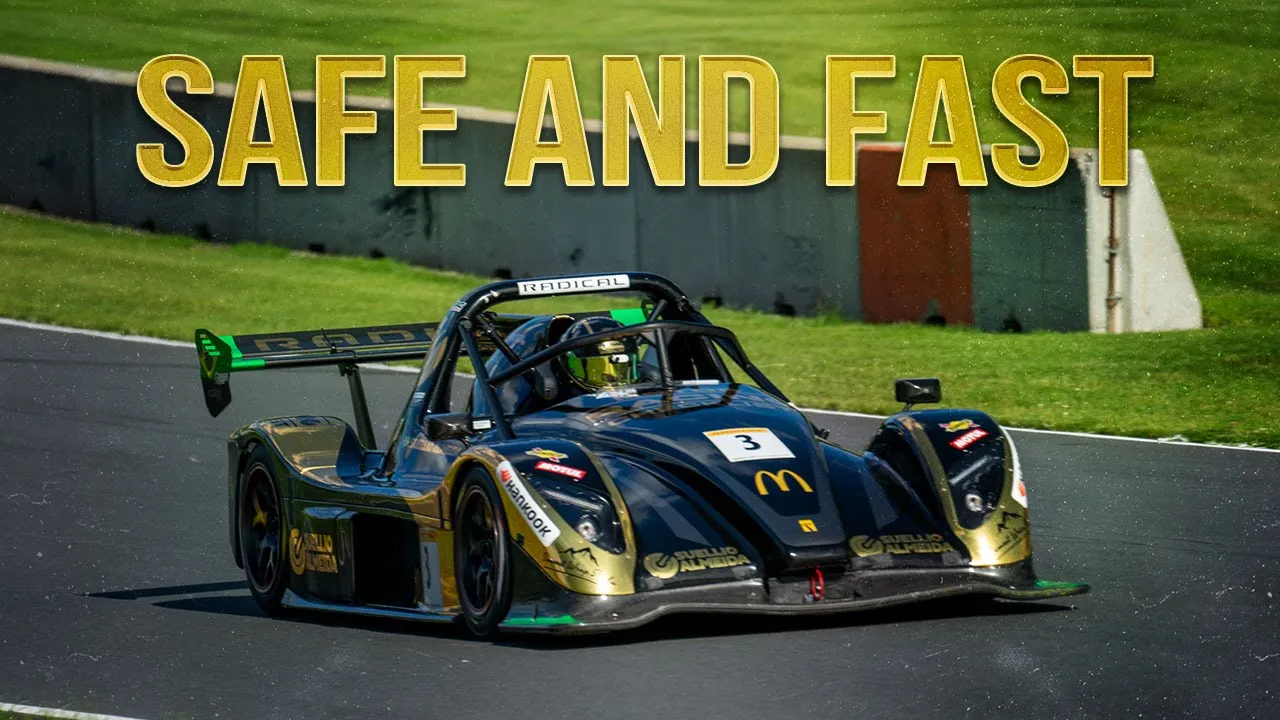
How Professional Racing Drivers Learn New Tracks in 24 Hours (Proven Method)
Suellio Almeida
•
Thursday, August 29, 2024
The Track Learning Problem Most Drivers Never Solve
You show up to a new circuit. You run lap after lap, gradually getting faster. By session three, you're comfortable. By session five, you're pretty quick.
But you're still leaving time on the table.
Why? Because you're learning passively. You're waiting for the track to reveal itself to you instead of actively extracting information from it.
Professional racing drivers don't have that luxury. When you're competing in IMSA, Radical Cup, or any real-world championship, track time costs money. You might get one practice session before qualifying. Maybe two if you're lucky.
You need a method.
The Three-Phase System: How Pros Master Circuits Fast
Every professional driver I've worked with — from IMSA competitors to F1 engineers — uses some version of this approach. The details vary, but the framework is universal.
Phase One: Information Gathering (Before You Touch the Car)
This is where most people fail. They jump straight into driving.
Pros don't.
Before your first lap, you need to build a mental model of the circuit. Here's the checklist:
Circuit map study — Not just glancing at it. Actually study the layout. Which corners are connected? Where are the heavy braking zones? Where does elevation change?
Onboard footage — Watch fast laps from multiple drivers. Not for entertainment. Watch their inputs. Where do they position the car? When does the wheel go straight? Where's the throttle application point?
Reference points — Start identifying visual markers. Brake boards, kerbs, track furniture, elevation changes. You're building a mental database before you've turned a wheel.
Racing line theory — Before you know the actual fast line, predict it. Based on corner radius, banking, and runoff, where should the ideal line be? This gives you a starting hypothesis.
Right?
This phase isn't glamorous. But it compresses your learning curve by hours. You're arriving at the track with context, not a blank slate.
Phase Two: Systematic Building (First Sessions)
Now you're in the car. This is where discipline matters.
Most drivers immediately try to be fast. They're chasing lap times from lap one. That's a mistake.
Pros build in stages:
Stage 1: Safety and Awareness (Laps 1-3)
You're not pushing. You're confirming what you studied. Does the track match your mental model? Where are the grip changes? Surface transitions? Bumps that unsettle the car?
You're driving at 70-75% commitment. Smooth inputs. No drama.
Stage 2: Reference Point Calibration (Laps 4-8)
Now you start testing your braking points. You picked reference points from video study — test them. Too early? Move them closer. Too late? Back them up.
This is methodical. Corner by corner. You're not trying to nail every corner at once. Pick three key corners per session. Master those. Then add more.
Stage 3: Commitment Increase (Laps 9-15)
You've got solid reference points. Now you start applying pressure. Later braking. More aggressive rotation. Pushing track limits.
But here's the critical part: you're still building, not attacking.
You're incrementally increasing commitment while maintaining margin. If you're spinning, you're going too fast too soon. The track hasn't given you permission yet.
Phase Three: Refinement and Repeatability (Competition Mode)
By now, you're fast. The question is: can you repeat it?
This is where amateurs plateau and pros pull away.
Consistency mapping — You need to know which corners you're nailing and which you're still fumbling. Pros mentally rate every corner after every lap. Corner 3? Solid. Corner 7? Still inconsistent. That's where focus goes next session.
Sector analysis — Don't just look at lap times. Where are you gaining or losing? If your Sector 1 is weak but Sector 3 is strong, your issue is probably early-corner grip or braking technique, not power application.
Traffic management — Learning a track isn't just solo pace. It's knowing where you can overtake, where you're vulnerable, where you can defend. That only comes from laps in traffic.
Adaptability — Conditions change. Temperature drops. Track rubbers in. Setup changes. Can you adjust your reference points and driving style in real-time? That's the final layer.
The Mistake That Costs You Hours: Passive Repetition
Let's be direct: most sim racers don't learn tracks — they just drive them until they stop crashing.
That's not a method. That's hope.
You run 50 laps and wonder why you're still two seconds off the aliens. It's because you're practicing without purpose. You're reinforcing inconsistency instead of building competence.
Here's what changes:
Stop chasing lap times early — Your goal in the first 20 laps is understanding, not speed.
One focus per lap — If you're working on braking points, don't also try to nail throttle application. Master one thing, then add the next.
Immediate feedback — After every session, review what worked and what didn't. Motec, iRacing telemetry, even mental notes. What's improving? What's still inconsistent?
Pros don't practice more. They practice smarter.
Real-World Application: How I Learned New Tracks in Competition
When I transitioned from sim racing to real motorsports, I had zero margin for error. I was competing in Radical Cup and IMSA TCR against drivers who'd been racing those circuits for years.
I didn't have time to slowly "figure it out."
So I applied this exact method:
Before arriving: I studied onboards, walked the track on Google Earth (yes, really), and mentally rehearsed every corner. I knew my brake points before I'd seen the circuit in person.
First session: I drove at 70% and calibrated my mental model. Adjusted reference points. Confirmed grip levels. No heroics.
Second session: I started pushing specific corners. Braking zones first, then mid-corner rotation, then exit application. Incremental pressure.
Third session: I was competitive. Not perfect, but within a second of the leaders. By qualifying, I was on pace.
That didn't happen by accident. It happened because I had a process.
The Mental Shift That Accelerates Learning
Here's the thing about track learning: it's not just physical skill.
It's mental bandwidth.
When you're learning a new track, your brain is processing massive amounts of information. Braking points, turn-in spots, apex placement, track limits, bumps, grip changes, throttle application, traffic, sector times — it's cognitive overload.
Pros manage this by chunking information. They don't think about 15 corners. They think about three sequences. They group corners into connected elements.
Example: Turn 4 into Turn 5 isn't two separate corners — it's one flow. Your exit from 4 dictates your entry to 5. Master the sequence, not the individual corners.
This reduces cognitive load. You're processing three sequences instead of fifteen corners. Your brain has bandwidth to focus on execution, not just survival.
Basically, you're compressing complexity.
The Tools That Actually Matter
Let's talk resources.
You don't need expensive equipment to learn tracks fast. But you do need the right inputs:
Circuit maps — Study them. Print them. Annotate them. Where's the heavy braking? Where's the car unstable? Where can you take risks?
Onboard footage — Watch aliens. Watch pros. Watch multiple drivers. Look for patterns. Where do they all do the same thing? That's probably optimal.
Telemetry — Compare your inputs to fast laps. Where's your braking point different? Where's your minimum speed higher or lower? Data doesn't lie.
Mental rehearsal — Before you sleep, visualize the lap. Corner by corner. Inputs, reference points, car behavior. This isn't woo-woo — it's actual skill acquisition.
Coaching — Someone who can watch your driving and say, "Your issue is corner entry overspeed in Turn 6, and it's killing your lap" — that compresses learning by weeks.
The fastest learners aren't the ones with the most natural talent. They're the ones with the best feedback loops.
Why This Works in Sim Racing Better Than Real Life
Here's the advantage you have as a sim racer: unlimited track time.
In real motorsports, every lap costs money. Tires, fuel, brake pads, risk of damage. You can't afford to waste sessions.
In sim racing, you can run 100 laps in a day. Zero cost. Zero risk.
But most people use that advantage to practice bad habits 100 times.
Instead, use it to practice this method 100 times. Learn tracks systematically. Build the skill of learning itself.
Because here's the truth: if you're serious about improving, you're going to learn dozens of tracks. Maybe hundreds. The skill isn't learning Spa or Monza or Laguna Seca — it's learning how to learn any track efficiently.
That's what separates the top 1% from everyone else.
What Fast Track Learning Actually Gives You
Let's get specific about outcomes.
When you master this method, you:
Cut learning time in half — What took you 50 laps now takes 25.
Reach competitive pace faster — You're racing for wins by session three, not practice five.
Build transferable skills — Every new track becomes easier because you've honed the learning process.
Reduce mistakes — You're not driving on hope. You're driving on information.
Increase confidence — You trust your reference points. You trust your process. That shows in your racecraft.
And if you're eyeing real-world motorsports? This isn't just helpful — it's mandatory. Real racing doesn't give you unlimited practice. You need to be fast, immediately.
This method makes that possible.
How Long Are You Going to Keep Guessing?
You've been running the same tracks for months. Maybe years.
You're fast enough to be competitive. But you're not learning anymore. You're just repeating what you already know.
Now imagine this: a new season drops. New tracks in the rotation. Everyone's on equal footing.
Who has the advantage? The driver who fumbles through 40 laps hoping to get comfortable? Or the driver who shows up with a systematic method, hits their marks by lap 10, and is racing for podiums by session two?
The skill gap isn't talent. It's method.
What would change if you stopped guessing and started building? If every new track became an opportunity to apply a proven system instead of starting from scratch?
That's exactly why we built the Almeida Racing Academy curriculum the way we did. The Car Handling course — free with signup — walks you through the exact fundamentals that make systematic learning possible. Weight transfer, rotation mechanics, reference point theory, vision techniques. The building blocks pros use to master circuits fast.
You're not stuck relearning the basics every time you load a new track. You're applying a framework. And when you're ready to go deeper — advanced racecraft, telemetry analysis, coach-led workshops — Gold Membership gives you everything. 8 courses. 80 lessons. $25/month with code WINTER.
The question isn't whether this works. It's whether you're ready to stop wasting time on inefficient practice.
Start building your track learning system — free account here
Sim Racing Academy Membership
Everything you need to stop guessing and start getting faster.
Starting at
$25
/mo
Car Handling Online Course
4 levels, full curriculum. Aimed to get you to top 1% in driving pace.
Racecraft Online Course
Overtaking, Defending, Race Strategy
Live coaching + on-track practice
Bi-weekly pro-coach workshops (recorded — never miss one) plus on-track Pit Parties to practice racecraft with a coach.
Plus These Bonuses
13,000+ Member Community
League Racing
Advanced MX-5 Mini Course
Racing Technique Development Guide
The Motor Racing Book (260 pages)
Think & Behave Like a Pro Driver — Mini eBook
How Professional Racing Drivers Learn New Tracks in 24 Hours (Proven Method)
Suellio Almeida
•
Thursday, August 29, 2024
The Track Learning Problem Most Drivers Never Solve
You show up to a new circuit. You run lap after lap, gradually getting faster. By session three, you're comfortable. By session five, you're pretty quick.
But you're still leaving time on the table.
Why? Because you're learning passively. You're waiting for the track to reveal itself to you instead of actively extracting information from it.
Professional racing drivers don't have that luxury. When you're competing in IMSA, Radical Cup, or any real-world championship, track time costs money. You might get one practice session before qualifying. Maybe two if you're lucky.
You need a method.
The Three-Phase System: How Pros Master Circuits Fast
Every professional driver I've worked with — from IMSA competitors to F1 engineers — uses some version of this approach. The details vary, but the framework is universal.
Phase One: Information Gathering (Before You Touch the Car)
This is where most people fail. They jump straight into driving.
Pros don't.
Before your first lap, you need to build a mental model of the circuit. Here's the checklist:
Circuit map study — Not just glancing at it. Actually study the layout. Which corners are connected? Where are the heavy braking zones? Where does elevation change?
Onboard footage — Watch fast laps from multiple drivers. Not for entertainment. Watch their inputs. Where do they position the car? When does the wheel go straight? Where's the throttle application point?
Reference points — Start identifying visual markers. Brake boards, kerbs, track furniture, elevation changes. You're building a mental database before you've turned a wheel.
Racing line theory — Before you know the actual fast line, predict it. Based on corner radius, banking, and runoff, where should the ideal line be? This gives you a starting hypothesis.
Right?
This phase isn't glamorous. But it compresses your learning curve by hours. You're arriving at the track with context, not a blank slate.
Phase Two: Systematic Building (First Sessions)
Now you're in the car. This is where discipline matters.
Most drivers immediately try to be fast. They're chasing lap times from lap one. That's a mistake.
Pros build in stages:
Stage 1: Safety and Awareness (Laps 1-3)
You're not pushing. You're confirming what you studied. Does the track match your mental model? Where are the grip changes? Surface transitions? Bumps that unsettle the car?
You're driving at 70-75% commitment. Smooth inputs. No drama.
Stage 2: Reference Point Calibration (Laps 4-8)
Now you start testing your braking points. You picked reference points from video study — test them. Too early? Move them closer. Too late? Back them up.
This is methodical. Corner by corner. You're not trying to nail every corner at once. Pick three key corners per session. Master those. Then add more.
Stage 3: Commitment Increase (Laps 9-15)
You've got solid reference points. Now you start applying pressure. Later braking. More aggressive rotation. Pushing track limits.
But here's the critical part: you're still building, not attacking.
You're incrementally increasing commitment while maintaining margin. If you're spinning, you're going too fast too soon. The track hasn't given you permission yet.
Phase Three: Refinement and Repeatability (Competition Mode)
By now, you're fast. The question is: can you repeat it?
This is where amateurs plateau and pros pull away.
Consistency mapping — You need to know which corners you're nailing and which you're still fumbling. Pros mentally rate every corner after every lap. Corner 3? Solid. Corner 7? Still inconsistent. That's where focus goes next session.
Sector analysis — Don't just look at lap times. Where are you gaining or losing? If your Sector 1 is weak but Sector 3 is strong, your issue is probably early-corner grip or braking technique, not power application.
Traffic management — Learning a track isn't just solo pace. It's knowing where you can overtake, where you're vulnerable, where you can defend. That only comes from laps in traffic.
Adaptability — Conditions change. Temperature drops. Track rubbers in. Setup changes. Can you adjust your reference points and driving style in real-time? That's the final layer.
The Mistake That Costs You Hours: Passive Repetition
Let's be direct: most sim racers don't learn tracks — they just drive them until they stop crashing.
That's not a method. That's hope.
You run 50 laps and wonder why you're still two seconds off the aliens. It's because you're practicing without purpose. You're reinforcing inconsistency instead of building competence.
Here's what changes:
Stop chasing lap times early — Your goal in the first 20 laps is understanding, not speed.
One focus per lap — If you're working on braking points, don't also try to nail throttle application. Master one thing, then add the next.
Immediate feedback — After every session, review what worked and what didn't. Motec, iRacing telemetry, even mental notes. What's improving? What's still inconsistent?
Pros don't practice more. They practice smarter.
Real-World Application: How I Learned New Tracks in Competition
When I transitioned from sim racing to real motorsports, I had zero margin for error. I was competing in Radical Cup and IMSA TCR against drivers who'd been racing those circuits for years.
I didn't have time to slowly "figure it out."
So I applied this exact method:
Before arriving: I studied onboards, walked the track on Google Earth (yes, really), and mentally rehearsed every corner. I knew my brake points before I'd seen the circuit in person.
First session: I drove at 70% and calibrated my mental model. Adjusted reference points. Confirmed grip levels. No heroics.
Second session: I started pushing specific corners. Braking zones first, then mid-corner rotation, then exit application. Incremental pressure.
Third session: I was competitive. Not perfect, but within a second of the leaders. By qualifying, I was on pace.
That didn't happen by accident. It happened because I had a process.
The Mental Shift That Accelerates Learning
Here's the thing about track learning: it's not just physical skill.
It's mental bandwidth.
When you're learning a new track, your brain is processing massive amounts of information. Braking points, turn-in spots, apex placement, track limits, bumps, grip changes, throttle application, traffic, sector times — it's cognitive overload.
Pros manage this by chunking information. They don't think about 15 corners. They think about three sequences. They group corners into connected elements.
Example: Turn 4 into Turn 5 isn't two separate corners — it's one flow. Your exit from 4 dictates your entry to 5. Master the sequence, not the individual corners.
This reduces cognitive load. You're processing three sequences instead of fifteen corners. Your brain has bandwidth to focus on execution, not just survival.
Basically, you're compressing complexity.
The Tools That Actually Matter
Let's talk resources.
You don't need expensive equipment to learn tracks fast. But you do need the right inputs:
Circuit maps — Study them. Print them. Annotate them. Where's the heavy braking? Where's the car unstable? Where can you take risks?
Onboard footage — Watch aliens. Watch pros. Watch multiple drivers. Look for patterns. Where do they all do the same thing? That's probably optimal.
Telemetry — Compare your inputs to fast laps. Where's your braking point different? Where's your minimum speed higher or lower? Data doesn't lie.
Mental rehearsal — Before you sleep, visualize the lap. Corner by corner. Inputs, reference points, car behavior. This isn't woo-woo — it's actual skill acquisition.
Coaching — Someone who can watch your driving and say, "Your issue is corner entry overspeed in Turn 6, and it's killing your lap" — that compresses learning by weeks.
The fastest learners aren't the ones with the most natural talent. They're the ones with the best feedback loops.
Why This Works in Sim Racing Better Than Real Life
Here's the advantage you have as a sim racer: unlimited track time.
In real motorsports, every lap costs money. Tires, fuel, brake pads, risk of damage. You can't afford to waste sessions.
In sim racing, you can run 100 laps in a day. Zero cost. Zero risk.
But most people use that advantage to practice bad habits 100 times.
Instead, use it to practice this method 100 times. Learn tracks systematically. Build the skill of learning itself.
Because here's the truth: if you're serious about improving, you're going to learn dozens of tracks. Maybe hundreds. The skill isn't learning Spa or Monza or Laguna Seca — it's learning how to learn any track efficiently.
That's what separates the top 1% from everyone else.
What Fast Track Learning Actually Gives You
Let's get specific about outcomes.
When you master this method, you:
Cut learning time in half — What took you 50 laps now takes 25.
Reach competitive pace faster — You're racing for wins by session three, not practice five.
Build transferable skills — Every new track becomes easier because you've honed the learning process.
Reduce mistakes — You're not driving on hope. You're driving on information.
Increase confidence — You trust your reference points. You trust your process. That shows in your racecraft.
And if you're eyeing real-world motorsports? This isn't just helpful — it's mandatory. Real racing doesn't give you unlimited practice. You need to be fast, immediately.
This method makes that possible.
How Long Are You Going to Keep Guessing?
You've been running the same tracks for months. Maybe years.
You're fast enough to be competitive. But you're not learning anymore. You're just repeating what you already know.
Now imagine this: a new season drops. New tracks in the rotation. Everyone's on equal footing.
Who has the advantage? The driver who fumbles through 40 laps hoping to get comfortable? Or the driver who shows up with a systematic method, hits their marks by lap 10, and is racing for podiums by session two?
The skill gap isn't talent. It's method.
What would change if you stopped guessing and started building? If every new track became an opportunity to apply a proven system instead of starting from scratch?
That's exactly why we built the Almeida Racing Academy curriculum the way we did. The Car Handling course — free with signup — walks you through the exact fundamentals that make systematic learning possible. Weight transfer, rotation mechanics, reference point theory, vision techniques. The building blocks pros use to master circuits fast.
You're not stuck relearning the basics every time you load a new track. You're applying a framework. And when you're ready to go deeper — advanced racecraft, telemetry analysis, coach-led workshops — Gold Membership gives you everything. 8 courses. 80 lessons. $25/month with code WINTER.
The question isn't whether this works. It's whether you're ready to stop wasting time on inefficient practice.
Start building your track learning system — free account here
Sim Racing Academy Membership
Everything you need to stop guessing and start getting faster.
Starting at
$25
/mo
Car Handling Online Course
4 levels, full curriculum. Aimed to get you to top 1% in driving pace.
Racecraft Online Course
Overtaking, Defending, Race Strategy
Live coaching + on-track practice
Bi-weekly pro-coach workshops (recorded — never miss one) plus on-track Pit Parties to practice racecraft with a coach.
Plus These Bonuses
13,000+ Member Community
League Racing
Advanced MX-5 Mini Course
Racing Technique Development Guide
The Motor Racing Book (260 pages)
Think & Behave Like a Pro Driver — Mini eBook
How Professional Racing Drivers Learn New Tracks in 24 Hours (Proven Method)
Suellio Almeida
•
Thursday, August 29, 2024
The Track Learning Problem Most Drivers Never Solve
You show up to a new circuit. You run lap after lap, gradually getting faster. By session three, you're comfortable. By session five, you're pretty quick.
But you're still leaving time on the table.
Why? Because you're learning passively. You're waiting for the track to reveal itself to you instead of actively extracting information from it.
Professional racing drivers don't have that luxury. When you're competing in IMSA, Radical Cup, or any real-world championship, track time costs money. You might get one practice session before qualifying. Maybe two if you're lucky.
You need a method.
The Three-Phase System: How Pros Master Circuits Fast
Every professional driver I've worked with — from IMSA competitors to F1 engineers — uses some version of this approach. The details vary, but the framework is universal.
Phase One: Information Gathering (Before You Touch the Car)
This is where most people fail. They jump straight into driving.
Pros don't.
Before your first lap, you need to build a mental model of the circuit. Here's the checklist:
Circuit map study — Not just glancing at it. Actually study the layout. Which corners are connected? Where are the heavy braking zones? Where does elevation change?
Onboard footage — Watch fast laps from multiple drivers. Not for entertainment. Watch their inputs. Where do they position the car? When does the wheel go straight? Where's the throttle application point?
Reference points — Start identifying visual markers. Brake boards, kerbs, track furniture, elevation changes. You're building a mental database before you've turned a wheel.
Racing line theory — Before you know the actual fast line, predict it. Based on corner radius, banking, and runoff, where should the ideal line be? This gives you a starting hypothesis.
Right?
This phase isn't glamorous. But it compresses your learning curve by hours. You're arriving at the track with context, not a blank slate.
Phase Two: Systematic Building (First Sessions)
Now you're in the car. This is where discipline matters.
Most drivers immediately try to be fast. They're chasing lap times from lap one. That's a mistake.
Pros build in stages:
Stage 1: Safety and Awareness (Laps 1-3)
You're not pushing. You're confirming what you studied. Does the track match your mental model? Where are the grip changes? Surface transitions? Bumps that unsettle the car?
You're driving at 70-75% commitment. Smooth inputs. No drama.
Stage 2: Reference Point Calibration (Laps 4-8)
Now you start testing your braking points. You picked reference points from video study — test them. Too early? Move them closer. Too late? Back them up.
This is methodical. Corner by corner. You're not trying to nail every corner at once. Pick three key corners per session. Master those. Then add more.
Stage 3: Commitment Increase (Laps 9-15)
You've got solid reference points. Now you start applying pressure. Later braking. More aggressive rotation. Pushing track limits.
But here's the critical part: you're still building, not attacking.
You're incrementally increasing commitment while maintaining margin. If you're spinning, you're going too fast too soon. The track hasn't given you permission yet.
Phase Three: Refinement and Repeatability (Competition Mode)
By now, you're fast. The question is: can you repeat it?
This is where amateurs plateau and pros pull away.
Consistency mapping — You need to know which corners you're nailing and which you're still fumbling. Pros mentally rate every corner after every lap. Corner 3? Solid. Corner 7? Still inconsistent. That's where focus goes next session.
Sector analysis — Don't just look at lap times. Where are you gaining or losing? If your Sector 1 is weak but Sector 3 is strong, your issue is probably early-corner grip or braking technique, not power application.
Traffic management — Learning a track isn't just solo pace. It's knowing where you can overtake, where you're vulnerable, where you can defend. That only comes from laps in traffic.
Adaptability — Conditions change. Temperature drops. Track rubbers in. Setup changes. Can you adjust your reference points and driving style in real-time? That's the final layer.
The Mistake That Costs You Hours: Passive Repetition
Let's be direct: most sim racers don't learn tracks — they just drive them until they stop crashing.
That's not a method. That's hope.
You run 50 laps and wonder why you're still two seconds off the aliens. It's because you're practicing without purpose. You're reinforcing inconsistency instead of building competence.
Here's what changes:
Stop chasing lap times early — Your goal in the first 20 laps is understanding, not speed.
One focus per lap — If you're working on braking points, don't also try to nail throttle application. Master one thing, then add the next.
Immediate feedback — After every session, review what worked and what didn't. Motec, iRacing telemetry, even mental notes. What's improving? What's still inconsistent?
Pros don't practice more. They practice smarter.
Real-World Application: How I Learned New Tracks in Competition
When I transitioned from sim racing to real motorsports, I had zero margin for error. I was competing in Radical Cup and IMSA TCR against drivers who'd been racing those circuits for years.
I didn't have time to slowly "figure it out."
So I applied this exact method:
Before arriving: I studied onboards, walked the track on Google Earth (yes, really), and mentally rehearsed every corner. I knew my brake points before I'd seen the circuit in person.
First session: I drove at 70% and calibrated my mental model. Adjusted reference points. Confirmed grip levels. No heroics.
Second session: I started pushing specific corners. Braking zones first, then mid-corner rotation, then exit application. Incremental pressure.
Third session: I was competitive. Not perfect, but within a second of the leaders. By qualifying, I was on pace.
That didn't happen by accident. It happened because I had a process.
The Mental Shift That Accelerates Learning
Here's the thing about track learning: it's not just physical skill.
It's mental bandwidth.
When you're learning a new track, your brain is processing massive amounts of information. Braking points, turn-in spots, apex placement, track limits, bumps, grip changes, throttle application, traffic, sector times — it's cognitive overload.
Pros manage this by chunking information. They don't think about 15 corners. They think about three sequences. They group corners into connected elements.
Example: Turn 4 into Turn 5 isn't two separate corners — it's one flow. Your exit from 4 dictates your entry to 5. Master the sequence, not the individual corners.
This reduces cognitive load. You're processing three sequences instead of fifteen corners. Your brain has bandwidth to focus on execution, not just survival.
Basically, you're compressing complexity.
The Tools That Actually Matter
Let's talk resources.
You don't need expensive equipment to learn tracks fast. But you do need the right inputs:
Circuit maps — Study them. Print them. Annotate them. Where's the heavy braking? Where's the car unstable? Where can you take risks?
Onboard footage — Watch aliens. Watch pros. Watch multiple drivers. Look for patterns. Where do they all do the same thing? That's probably optimal.
Telemetry — Compare your inputs to fast laps. Where's your braking point different? Where's your minimum speed higher or lower? Data doesn't lie.
Mental rehearsal — Before you sleep, visualize the lap. Corner by corner. Inputs, reference points, car behavior. This isn't woo-woo — it's actual skill acquisition.
Coaching — Someone who can watch your driving and say, "Your issue is corner entry overspeed in Turn 6, and it's killing your lap" — that compresses learning by weeks.
The fastest learners aren't the ones with the most natural talent. They're the ones with the best feedback loops.
Why This Works in Sim Racing Better Than Real Life
Here's the advantage you have as a sim racer: unlimited track time.
In real motorsports, every lap costs money. Tires, fuel, brake pads, risk of damage. You can't afford to waste sessions.
In sim racing, you can run 100 laps in a day. Zero cost. Zero risk.
But most people use that advantage to practice bad habits 100 times.
Instead, use it to practice this method 100 times. Learn tracks systematically. Build the skill of learning itself.
Because here's the truth: if you're serious about improving, you're going to learn dozens of tracks. Maybe hundreds. The skill isn't learning Spa or Monza or Laguna Seca — it's learning how to learn any track efficiently.
That's what separates the top 1% from everyone else.
What Fast Track Learning Actually Gives You
Let's get specific about outcomes.
When you master this method, you:
Cut learning time in half — What took you 50 laps now takes 25.
Reach competitive pace faster — You're racing for wins by session three, not practice five.
Build transferable skills — Every new track becomes easier because you've honed the learning process.
Reduce mistakes — You're not driving on hope. You're driving on information.
Increase confidence — You trust your reference points. You trust your process. That shows in your racecraft.
And if you're eyeing real-world motorsports? This isn't just helpful — it's mandatory. Real racing doesn't give you unlimited practice. You need to be fast, immediately.
This method makes that possible.
How Long Are You Going to Keep Guessing?
You've been running the same tracks for months. Maybe years.
You're fast enough to be competitive. But you're not learning anymore. You're just repeating what you already know.
Now imagine this: a new season drops. New tracks in the rotation. Everyone's on equal footing.
Who has the advantage? The driver who fumbles through 40 laps hoping to get comfortable? Or the driver who shows up with a systematic method, hits their marks by lap 10, and is racing for podiums by session two?
The skill gap isn't talent. It's method.
What would change if you stopped guessing and started building? If every new track became an opportunity to apply a proven system instead of starting from scratch?
That's exactly why we built the Almeida Racing Academy curriculum the way we did. The Car Handling course — free with signup — walks you through the exact fundamentals that make systematic learning possible. Weight transfer, rotation mechanics, reference point theory, vision techniques. The building blocks pros use to master circuits fast.
You're not stuck relearning the basics every time you load a new track. You're applying a framework. And when you're ready to go deeper — advanced racecraft, telemetry analysis, coach-led workshops — Gold Membership gives you everything. 8 courses. 80 lessons. $25/month with code WINTER.
The question isn't whether this works. It's whether you're ready to stop wasting time on inefficient practice.
Start building your track learning system — free account here
Sim Racing Academy Membership
Everything you need to stop guessing and start getting faster.
Starting at
$25
/mo
Car Handling Online Course
4 levels, full curriculum. Aimed to get you to top 1% in driving pace.
Racecraft Online Course
Overtaking, Defending, Race Strategy
Live coaching + on-track practice
Bi-weekly pro-coach workshops (recorded — never miss one) plus on-track Pit Parties to practice racecraft with a coach.
Plus These Bonuses
13,000+ Member Community
League Racing
Advanced MX-5 Mini Course
Racing Technique Development Guide
The Motor Racing Book (260 pages)
Think & Behave Like a Pro Driver — Mini eBook