
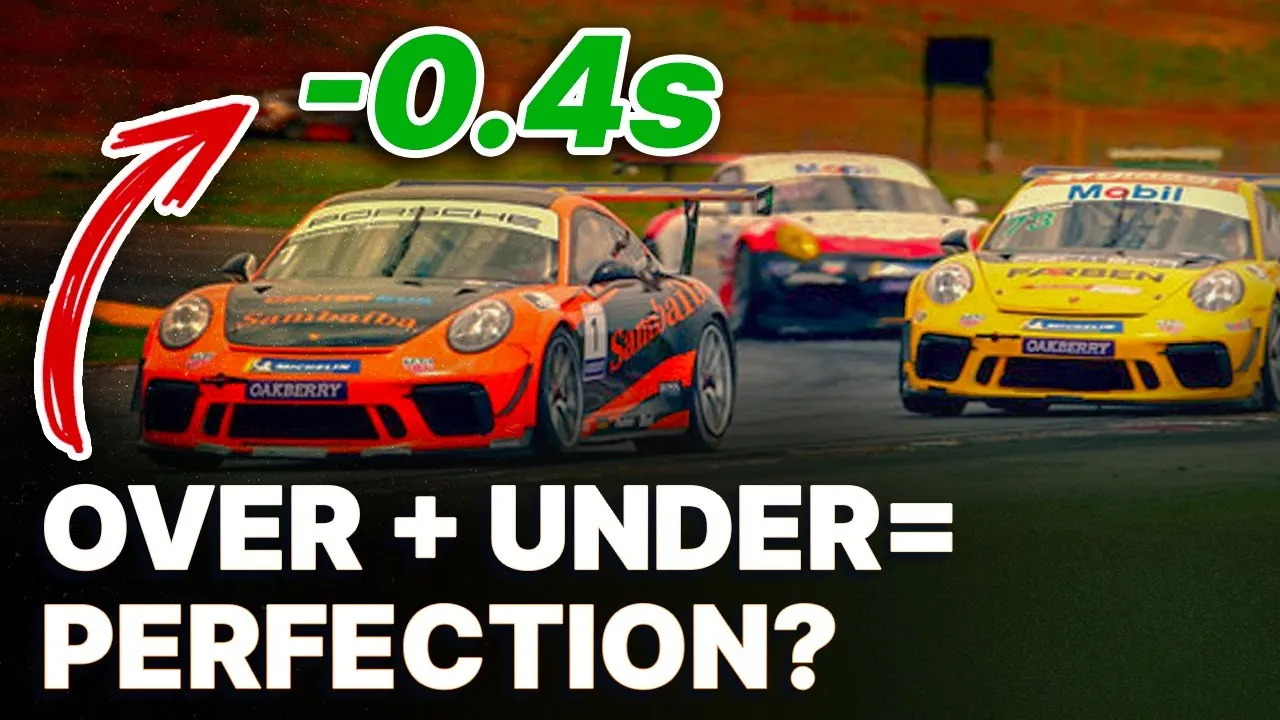
Oversteer vs Understeer in Sim Racing: Why Your Setup Might Be Wrong
Suellio Almeida
•
Thursday, February 23, 2023
The Setup Paradox: Why Oversteer Doesn't Always Feel Like Oversteer
You dial in more rear wing. The back end stabilizes. The car feels planted.
But you just got slower.
This is the setup trap that catches even experienced sim racers. You chase a feeling instead of understanding the physics underneath. The car "feels" better, but the stopwatch doesn't lie.
Here's what's actually happening: You're confusing driver-induced rotation with mechanical oversteer.
And until you learn the difference, you'll keep making the wrong setup changes.
What Oversteer and Understeer Actually Mean (Not What You Think)
Let's get the physics straight first.
Understeer means the front tires are sliding more than the rears. The car wants to go straight when you want to turn. You're fighting the wheel, waiting for grip.
Oversteer means the rear tires are sliding more than the fronts. The back wants to come around. You're catching slides, correcting constantly.
Simple enough, right?
Now here's where it gets complicated: The car can be in oversteer even if you never spin.
Most drivers think oversteer only happens when they're sideways. Wrong. If your rear is slightly loose on corner entry — even if you're controlling it perfectly — that's oversteer. You're just managing it well.
The question isn't "Am I oversteering?" The question is "How much oversteer am I managing, and is it costing me time?"
The Trail Braking Truth: You're Creating Rotation, Not Fixing It
Here's where most coaching gets it backwards.
You're told: "Trail brake to rotate the car."
So you do. You keep brake pressure deep into the corner. The car rotates beautifully. You nail the apex.
Then you add rear wing because the car "feels nervous."
What just happened?
You added mechanical oversteer through trail braking, then added downforce to mask it.
Now you're carrying less speed through the corner because the extra drag is killing your exit. But it "feels" better, so you think it's right.
This is the fundamental mistake: confusing driver technique with car balance.
Trail braking transfers weight forward. That loads the front tires and unloads the rears. Physics 101. You're deliberately creating rotation through weight transfer.
But if your car is already mechanically oversteery, you're compounding it. You're rotating more than you need to. And then you're fighting that rotation with steering corrections and throttle modulation all the way through the corner.
Fast drivers don't do this.
The Platform Concept: Why Stability Actually Makes You Faster
Let me introduce you to the most misunderstood concept in sim racing: the platform.
A stable platform means the car isn't sliding. Not the front, not the rear. It's gripping, rotating on its tires, not sliding through the corner.
You might think: "But I need rotation to make the apex!"
No. You need controlled rotation, not slide-induced rotation.
When your rear is slightly loose, you're getting rotation through slip angle. The tire is sliding a bit, and that helps you point toward the apex. Feels great. Looks cool.
But it's slow.
Why? Because once you're past the apex and try to apply throttle, that rear has nothing left to give. It's already at the edge of grip. You can't put power down without spinning or understeering wide.
Now imagine a car with a stable rear. You trail brake, rotate onto your line, and the instant you hit the apex, you can hammer the throttle. The rear bites. You rocket out.
That's the platform.
The faster the corner, the more this matters. In high-speed sections, even 1% of rear slip costs you massive time on exit. You're bleeding speed through sliding friction instead of converting it into forward acceleration.
How to Actually Diagnose What Your Car Is Doing
Stop driving by feel. Start driving by data.
Here's the test:
1. Record a lap in your sim. Use the replay system or telemetry.
2. Watch your steering inputs. Are you constantly making small corrections mid-corner? That's oversteer. You're catching slides you don't even realize are happening.
3. Check your throttle trace. Are you hesitating on throttle application at apex? Are you modulating (lifting slightly) mid-exit? That's oversteer management. The car doesn't have the rear grip to handle full throttle.
4. Compare to a faster driver. Look at their steering and throttle. I guarantee their inputs are smoother because their car is more stable.
Most sim racers never do this. They drive by sensation, which is exactly why they plateau.
Your brain adapts to oversteer. What feels "normal" to you might be 2-3 degrees of slip angle that's costing you half a second per corner.
The Setup Decision: When to Add Rear Stability (And When Not To)
So when should you actually add rear wing or stiffen the rear?
Add rear stability when:
Your telemetry shows constant steering corrections
You're slow on corner exit because you can't apply throttle
You're consistent but slow — meaning your technique is good but the car lacks platform
Don't add rear stability when:
You're not trail braking properly yet (fix technique first)
You're understeering on entry (adding rear will make it worse)
The issue is front-end related (you're just misdiagnosing it)
Here's the harsh truth: Most intermediate sim racers need MORE rear stability, not less.
You think you need rotation because that's what YouTube tells you. But what you actually need is a car that lets you attack the throttle earlier.
The fastest drivers aren't the ones sliding around looking spectacular. They're the ones with boring, stable, efficient corners that string together into blistering lap times.
The Technique-Setup Balance: Why Your 6k iRating Friend Is Faster
Let's talk about the gap between you and that 6k driver in your split.
It's not just skill. It's understanding this:
Technique and setup are a matched pair.
If you have elite trail braking control, you can run a more oversteery setup. You're creating rotation on demand through brake pressure. You don't need the car to do it for you.
But if your trail braking is inconsistent — if you're releasing too early or too aggressively — then you need more mechanical stability to compensate.
The 6k driver knows this. They tune their car to their driving style, not to some theoretical "fast setup" they found on a forum.
You're trying to drive someone else's setup with your technique. That's why it feels wrong.
Start here: Build stability first. Add rotation through technique.
Get a car that's predictable. Boring, even. Then learn to make it dance through precise trail braking and throttle control.
Once you've mastered that, then you can start experimenting with more aggressive setups.
But until then? Stop chasing oversteer. Chase consistency.
What Actually Happens When You Fix This
I've watched this transformation hundreds of times.
Driver comes to me. Plateau at 3k iRating. "I can't get faster. I've tried everything."
I look at their telemetry. Steering trace looks like a seismograph. Throttle application is tentative.
"Add rear wing," I say.
They resist. "But won't that make me slower?"
I make them try it anyway.
First lap: "This feels terrible. The car is so planted, I'm not rotating enough."
Second lap: 0.2 seconds faster.
Third lap: 0.5 seconds faster. They're on throttle 15 meters earlier out of every corner.
Fourth lap: "Oh."
That's the moment. The realization that feeling fast and being fast are not the same thing.
The car feels boring now. But the lap times don't lie. And suddenly they're racing people they used to watch disappear into the distance.
This is what proper car balance does. It frees up your mental bandwidth. You stop micro-managing slides and start focusing on racecraft, consistency, and racelines.
That's when you actually get fast.
So What Are You Actually Chasing?
Here's the question you need to ask yourself:
Are you trying to drive a car that feels exciting, or a car that's fast?
Because those aren't the same thing. Not even close.
The most confidence-inspiring, lap-time-destroying cars feel almost boring. They do what you ask. They don't surprise you. They don't make you fight them.
But they're 2 seconds faster over a stint because you're not bleeding time through slides you don't even realize are happening.
Most sim racers never learn this. They spend years chasing "rotation" and "feel" while the drivers who understand platform and stability keep beating them.
Which one are you going to be?
Ready to Stop Guessing and Start Actually Improving?
How much time have you wasted making setup changes based on feel?
How many races have you lost because you couldn't figure out why the car felt "off"?
What would change if you actually understood what your car was doing — not what it felt like, but what it was really doing?
This is exactly what we break down inside Almeida Racing Academy. Not just oversteer and understeer. The entire chain: how weight transfer works, how to read telemetry, how to match your setup to your driving style, how to build a platform that lets you actually attack.
We've coached over 36,000 students through this exact process. From first-time sim racers to drivers competing in IMSA and NASCAR. The physics don't change. The method works.
Gold Membership gets you 8 full courses, 80 lessons, coach-led workshops, and a community of drivers who actually understand this stuff. Right now, use code WINTER for $25/month.
Sim Racing Academy Membership
Everything you need to stop guessing and start getting faster.
Starting at
$25
/mo
Car Handling Online Course
4 levels, full curriculum. Aimed to get you to top 1% in driving pace.
Racecraft Online Course
Overtaking, Defending, Race Strategy
Live coaching + on-track practice
Bi-weekly pro-coach workshops (recorded — never miss one) plus on-track Pit Parties to practice racecraft with a coach.
Plus These Bonuses
13,000+ Member Community
League Racing
Advanced MX-5 Mini Course
Racing Technique Development Guide
The Motor Racing Book (260 pages)
Think & Behave Like a Pro Driver — Mini eBook
Oversteer vs Understeer in Sim Racing: Why Your Setup Might Be Wrong
Suellio Almeida
•
Thursday, February 23, 2023
The Setup Paradox: Why Oversteer Doesn't Always Feel Like Oversteer
You dial in more rear wing. The back end stabilizes. The car feels planted.
But you just got slower.
This is the setup trap that catches even experienced sim racers. You chase a feeling instead of understanding the physics underneath. The car "feels" better, but the stopwatch doesn't lie.
Here's what's actually happening: You're confusing driver-induced rotation with mechanical oversteer.
And until you learn the difference, you'll keep making the wrong setup changes.
What Oversteer and Understeer Actually Mean (Not What You Think)
Let's get the physics straight first.
Understeer means the front tires are sliding more than the rears. The car wants to go straight when you want to turn. You're fighting the wheel, waiting for grip.
Oversteer means the rear tires are sliding more than the fronts. The back wants to come around. You're catching slides, correcting constantly.
Simple enough, right?
Now here's where it gets complicated: The car can be in oversteer even if you never spin.
Most drivers think oversteer only happens when they're sideways. Wrong. If your rear is slightly loose on corner entry — even if you're controlling it perfectly — that's oversteer. You're just managing it well.
The question isn't "Am I oversteering?" The question is "How much oversteer am I managing, and is it costing me time?"
The Trail Braking Truth: You're Creating Rotation, Not Fixing It
Here's where most coaching gets it backwards.
You're told: "Trail brake to rotate the car."
So you do. You keep brake pressure deep into the corner. The car rotates beautifully. You nail the apex.
Then you add rear wing because the car "feels nervous."
What just happened?
You added mechanical oversteer through trail braking, then added downforce to mask it.
Now you're carrying less speed through the corner because the extra drag is killing your exit. But it "feels" better, so you think it's right.
This is the fundamental mistake: confusing driver technique with car balance.
Trail braking transfers weight forward. That loads the front tires and unloads the rears. Physics 101. You're deliberately creating rotation through weight transfer.
But if your car is already mechanically oversteery, you're compounding it. You're rotating more than you need to. And then you're fighting that rotation with steering corrections and throttle modulation all the way through the corner.
Fast drivers don't do this.
The Platform Concept: Why Stability Actually Makes You Faster
Let me introduce you to the most misunderstood concept in sim racing: the platform.
A stable platform means the car isn't sliding. Not the front, not the rear. It's gripping, rotating on its tires, not sliding through the corner.
You might think: "But I need rotation to make the apex!"
No. You need controlled rotation, not slide-induced rotation.
When your rear is slightly loose, you're getting rotation through slip angle. The tire is sliding a bit, and that helps you point toward the apex. Feels great. Looks cool.
But it's slow.
Why? Because once you're past the apex and try to apply throttle, that rear has nothing left to give. It's already at the edge of grip. You can't put power down without spinning or understeering wide.
Now imagine a car with a stable rear. You trail brake, rotate onto your line, and the instant you hit the apex, you can hammer the throttle. The rear bites. You rocket out.
That's the platform.
The faster the corner, the more this matters. In high-speed sections, even 1% of rear slip costs you massive time on exit. You're bleeding speed through sliding friction instead of converting it into forward acceleration.
How to Actually Diagnose What Your Car Is Doing
Stop driving by feel. Start driving by data.
Here's the test:
1. Record a lap in your sim. Use the replay system or telemetry.
2. Watch your steering inputs. Are you constantly making small corrections mid-corner? That's oversteer. You're catching slides you don't even realize are happening.
3. Check your throttle trace. Are you hesitating on throttle application at apex? Are you modulating (lifting slightly) mid-exit? That's oversteer management. The car doesn't have the rear grip to handle full throttle.
4. Compare to a faster driver. Look at their steering and throttle. I guarantee their inputs are smoother because their car is more stable.
Most sim racers never do this. They drive by sensation, which is exactly why they plateau.
Your brain adapts to oversteer. What feels "normal" to you might be 2-3 degrees of slip angle that's costing you half a second per corner.
The Setup Decision: When to Add Rear Stability (And When Not To)
So when should you actually add rear wing or stiffen the rear?
Add rear stability when:
Your telemetry shows constant steering corrections
You're slow on corner exit because you can't apply throttle
You're consistent but slow — meaning your technique is good but the car lacks platform
Don't add rear stability when:
You're not trail braking properly yet (fix technique first)
You're understeering on entry (adding rear will make it worse)
The issue is front-end related (you're just misdiagnosing it)
Here's the harsh truth: Most intermediate sim racers need MORE rear stability, not less.
You think you need rotation because that's what YouTube tells you. But what you actually need is a car that lets you attack the throttle earlier.
The fastest drivers aren't the ones sliding around looking spectacular. They're the ones with boring, stable, efficient corners that string together into blistering lap times.
The Technique-Setup Balance: Why Your 6k iRating Friend Is Faster
Let's talk about the gap between you and that 6k driver in your split.
It's not just skill. It's understanding this:
Technique and setup are a matched pair.
If you have elite trail braking control, you can run a more oversteery setup. You're creating rotation on demand through brake pressure. You don't need the car to do it for you.
But if your trail braking is inconsistent — if you're releasing too early or too aggressively — then you need more mechanical stability to compensate.
The 6k driver knows this. They tune their car to their driving style, not to some theoretical "fast setup" they found on a forum.
You're trying to drive someone else's setup with your technique. That's why it feels wrong.
Start here: Build stability first. Add rotation through technique.
Get a car that's predictable. Boring, even. Then learn to make it dance through precise trail braking and throttle control.
Once you've mastered that, then you can start experimenting with more aggressive setups.
But until then? Stop chasing oversteer. Chase consistency.
What Actually Happens When You Fix This
I've watched this transformation hundreds of times.
Driver comes to me. Plateau at 3k iRating. "I can't get faster. I've tried everything."
I look at their telemetry. Steering trace looks like a seismograph. Throttle application is tentative.
"Add rear wing," I say.
They resist. "But won't that make me slower?"
I make them try it anyway.
First lap: "This feels terrible. The car is so planted, I'm not rotating enough."
Second lap: 0.2 seconds faster.
Third lap: 0.5 seconds faster. They're on throttle 15 meters earlier out of every corner.
Fourth lap: "Oh."
That's the moment. The realization that feeling fast and being fast are not the same thing.
The car feels boring now. But the lap times don't lie. And suddenly they're racing people they used to watch disappear into the distance.
This is what proper car balance does. It frees up your mental bandwidth. You stop micro-managing slides and start focusing on racecraft, consistency, and racelines.
That's when you actually get fast.
So What Are You Actually Chasing?
Here's the question you need to ask yourself:
Are you trying to drive a car that feels exciting, or a car that's fast?
Because those aren't the same thing. Not even close.
The most confidence-inspiring, lap-time-destroying cars feel almost boring. They do what you ask. They don't surprise you. They don't make you fight them.
But they're 2 seconds faster over a stint because you're not bleeding time through slides you don't even realize are happening.
Most sim racers never learn this. They spend years chasing "rotation" and "feel" while the drivers who understand platform and stability keep beating them.
Which one are you going to be?
Ready to Stop Guessing and Start Actually Improving?
How much time have you wasted making setup changes based on feel?
How many races have you lost because you couldn't figure out why the car felt "off"?
What would change if you actually understood what your car was doing — not what it felt like, but what it was really doing?
This is exactly what we break down inside Almeida Racing Academy. Not just oversteer and understeer. The entire chain: how weight transfer works, how to read telemetry, how to match your setup to your driving style, how to build a platform that lets you actually attack.
We've coached over 36,000 students through this exact process. From first-time sim racers to drivers competing in IMSA and NASCAR. The physics don't change. The method works.
Gold Membership gets you 8 full courses, 80 lessons, coach-led workshops, and a community of drivers who actually understand this stuff. Right now, use code WINTER for $25/month.
Sim Racing Academy Membership
Everything you need to stop guessing and start getting faster.
Starting at
$25
/mo
Car Handling Online Course
4 levels, full curriculum. Aimed to get you to top 1% in driving pace.
Racecraft Online Course
Overtaking, Defending, Race Strategy
Live coaching + on-track practice
Bi-weekly pro-coach workshops (recorded — never miss one) plus on-track Pit Parties to practice racecraft with a coach.
Plus These Bonuses
13,000+ Member Community
League Racing
Advanced MX-5 Mini Course
Racing Technique Development Guide
The Motor Racing Book (260 pages)
Think & Behave Like a Pro Driver — Mini eBook
Oversteer vs Understeer in Sim Racing: Why Your Setup Might Be Wrong
Suellio Almeida
•
Thursday, February 23, 2023
The Setup Paradox: Why Oversteer Doesn't Always Feel Like Oversteer
You dial in more rear wing. The back end stabilizes. The car feels planted.
But you just got slower.
This is the setup trap that catches even experienced sim racers. You chase a feeling instead of understanding the physics underneath. The car "feels" better, but the stopwatch doesn't lie.
Here's what's actually happening: You're confusing driver-induced rotation with mechanical oversteer.
And until you learn the difference, you'll keep making the wrong setup changes.
What Oversteer and Understeer Actually Mean (Not What You Think)
Let's get the physics straight first.
Understeer means the front tires are sliding more than the rears. The car wants to go straight when you want to turn. You're fighting the wheel, waiting for grip.
Oversteer means the rear tires are sliding more than the fronts. The back wants to come around. You're catching slides, correcting constantly.
Simple enough, right?
Now here's where it gets complicated: The car can be in oversteer even if you never spin.
Most drivers think oversteer only happens when they're sideways. Wrong. If your rear is slightly loose on corner entry — even if you're controlling it perfectly — that's oversteer. You're just managing it well.
The question isn't "Am I oversteering?" The question is "How much oversteer am I managing, and is it costing me time?"
The Trail Braking Truth: You're Creating Rotation, Not Fixing It
Here's where most coaching gets it backwards.
You're told: "Trail brake to rotate the car."
So you do. You keep brake pressure deep into the corner. The car rotates beautifully. You nail the apex.
Then you add rear wing because the car "feels nervous."
What just happened?
You added mechanical oversteer through trail braking, then added downforce to mask it.
Now you're carrying less speed through the corner because the extra drag is killing your exit. But it "feels" better, so you think it's right.
This is the fundamental mistake: confusing driver technique with car balance.
Trail braking transfers weight forward. That loads the front tires and unloads the rears. Physics 101. You're deliberately creating rotation through weight transfer.
But if your car is already mechanically oversteery, you're compounding it. You're rotating more than you need to. And then you're fighting that rotation with steering corrections and throttle modulation all the way through the corner.
Fast drivers don't do this.
The Platform Concept: Why Stability Actually Makes You Faster
Let me introduce you to the most misunderstood concept in sim racing: the platform.
A stable platform means the car isn't sliding. Not the front, not the rear. It's gripping, rotating on its tires, not sliding through the corner.
You might think: "But I need rotation to make the apex!"
No. You need controlled rotation, not slide-induced rotation.
When your rear is slightly loose, you're getting rotation through slip angle. The tire is sliding a bit, and that helps you point toward the apex. Feels great. Looks cool.
But it's slow.
Why? Because once you're past the apex and try to apply throttle, that rear has nothing left to give. It's already at the edge of grip. You can't put power down without spinning or understeering wide.
Now imagine a car with a stable rear. You trail brake, rotate onto your line, and the instant you hit the apex, you can hammer the throttle. The rear bites. You rocket out.
That's the platform.
The faster the corner, the more this matters. In high-speed sections, even 1% of rear slip costs you massive time on exit. You're bleeding speed through sliding friction instead of converting it into forward acceleration.
How to Actually Diagnose What Your Car Is Doing
Stop driving by feel. Start driving by data.
Here's the test:
1. Record a lap in your sim. Use the replay system or telemetry.
2. Watch your steering inputs. Are you constantly making small corrections mid-corner? That's oversteer. You're catching slides you don't even realize are happening.
3. Check your throttle trace. Are you hesitating on throttle application at apex? Are you modulating (lifting slightly) mid-exit? That's oversteer management. The car doesn't have the rear grip to handle full throttle.
4. Compare to a faster driver. Look at their steering and throttle. I guarantee their inputs are smoother because their car is more stable.
Most sim racers never do this. They drive by sensation, which is exactly why they plateau.
Your brain adapts to oversteer. What feels "normal" to you might be 2-3 degrees of slip angle that's costing you half a second per corner.
The Setup Decision: When to Add Rear Stability (And When Not To)
So when should you actually add rear wing or stiffen the rear?
Add rear stability when:
Your telemetry shows constant steering corrections
You're slow on corner exit because you can't apply throttle
You're consistent but slow — meaning your technique is good but the car lacks platform
Don't add rear stability when:
You're not trail braking properly yet (fix technique first)
You're understeering on entry (adding rear will make it worse)
The issue is front-end related (you're just misdiagnosing it)
Here's the harsh truth: Most intermediate sim racers need MORE rear stability, not less.
You think you need rotation because that's what YouTube tells you. But what you actually need is a car that lets you attack the throttle earlier.
The fastest drivers aren't the ones sliding around looking spectacular. They're the ones with boring, stable, efficient corners that string together into blistering lap times.
The Technique-Setup Balance: Why Your 6k iRating Friend Is Faster
Let's talk about the gap between you and that 6k driver in your split.
It's not just skill. It's understanding this:
Technique and setup are a matched pair.
If you have elite trail braking control, you can run a more oversteery setup. You're creating rotation on demand through brake pressure. You don't need the car to do it for you.
But if your trail braking is inconsistent — if you're releasing too early or too aggressively — then you need more mechanical stability to compensate.
The 6k driver knows this. They tune their car to their driving style, not to some theoretical "fast setup" they found on a forum.
You're trying to drive someone else's setup with your technique. That's why it feels wrong.
Start here: Build stability first. Add rotation through technique.
Get a car that's predictable. Boring, even. Then learn to make it dance through precise trail braking and throttle control.
Once you've mastered that, then you can start experimenting with more aggressive setups.
But until then? Stop chasing oversteer. Chase consistency.
What Actually Happens When You Fix This
I've watched this transformation hundreds of times.
Driver comes to me. Plateau at 3k iRating. "I can't get faster. I've tried everything."
I look at their telemetry. Steering trace looks like a seismograph. Throttle application is tentative.
"Add rear wing," I say.
They resist. "But won't that make me slower?"
I make them try it anyway.
First lap: "This feels terrible. The car is so planted, I'm not rotating enough."
Second lap: 0.2 seconds faster.
Third lap: 0.5 seconds faster. They're on throttle 15 meters earlier out of every corner.
Fourth lap: "Oh."
That's the moment. The realization that feeling fast and being fast are not the same thing.
The car feels boring now. But the lap times don't lie. And suddenly they're racing people they used to watch disappear into the distance.
This is what proper car balance does. It frees up your mental bandwidth. You stop micro-managing slides and start focusing on racecraft, consistency, and racelines.
That's when you actually get fast.
So What Are You Actually Chasing?
Here's the question you need to ask yourself:
Are you trying to drive a car that feels exciting, or a car that's fast?
Because those aren't the same thing. Not even close.
The most confidence-inspiring, lap-time-destroying cars feel almost boring. They do what you ask. They don't surprise you. They don't make you fight them.
But they're 2 seconds faster over a stint because you're not bleeding time through slides you don't even realize are happening.
Most sim racers never learn this. They spend years chasing "rotation" and "feel" while the drivers who understand platform and stability keep beating them.
Which one are you going to be?
Ready to Stop Guessing and Start Actually Improving?
How much time have you wasted making setup changes based on feel?
How many races have you lost because you couldn't figure out why the car felt "off"?
What would change if you actually understood what your car was doing — not what it felt like, but what it was really doing?
This is exactly what we break down inside Almeida Racing Academy. Not just oversteer and understeer. The entire chain: how weight transfer works, how to read telemetry, how to match your setup to your driving style, how to build a platform that lets you actually attack.
We've coached over 36,000 students through this exact process. From first-time sim racers to drivers competing in IMSA and NASCAR. The physics don't change. The method works.
Gold Membership gets you 8 full courses, 80 lessons, coach-led workshops, and a community of drivers who actually understand this stuff. Right now, use code WINTER for $25/month.
Sim Racing Academy Membership
Everything you need to stop guessing and start getting faster.
Starting at
$25
/mo
Car Handling Online Course
4 levels, full curriculum. Aimed to get you to top 1% in driving pace.
Racecraft Online Course
Overtaking, Defending, Race Strategy
Live coaching + on-track practice
Bi-weekly pro-coach workshops (recorded — never miss one) plus on-track Pit Parties to practice racecraft with a coach.
Plus These Bonuses
13,000+ Member Community
League Racing
Advanced MX-5 Mini Course
Racing Technique Development Guide
The Motor Racing Book (260 pages)
Think & Behave Like a Pro Driver — Mini eBook