
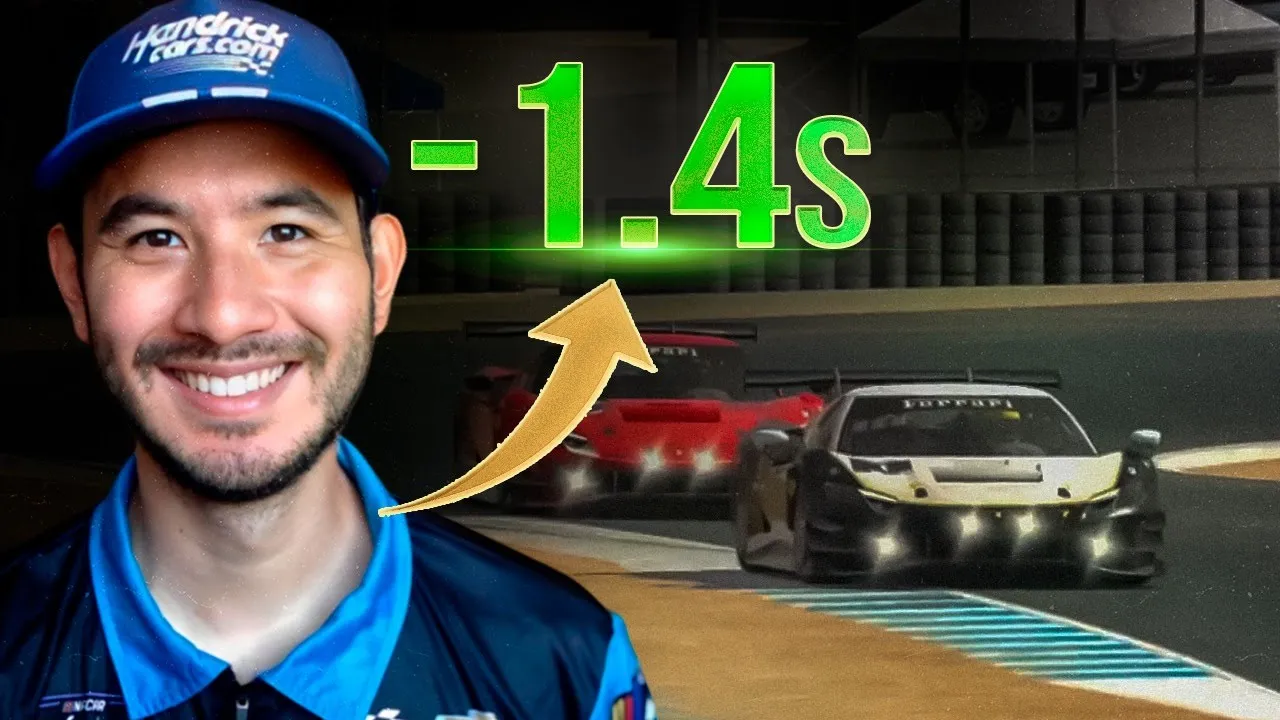
From Oval Ace to Road Racer: Coaching DJ YeeJay's First Road Racing Session
Suellio Almeida
•
Tuesday, July 9, 2024
What Happens When an Oval Champion Goes Road Racing?
DJ came to me with a straightforward goal: figure out road racing. He's not starting from zero — the guy understands racecraft, consistency, and car control at speed. But the Nürburgring GP circuit in a BMW M4 GT3? That's a completely different language.
I pulled up his telemetry next to a reference lap. The gap was immediate.
He was losing 1.2 seconds in the first sector alone. Not from lack of talent. From technique gaps that oval racing never forces you to address.
The Trail Braking Blind Spot
First corner, first problem: braking points.
DJ was hitting the brakes hard — good instinct from oval racing where you need to scrub speed fast. But he was releasing too early, coasting into the corner, then trying to get back on throttle.
That's not how you attack a road course apex.
"You're braking here," I told him, pointing at the telemetry. "But watch what happens when you hold pressure longer."
The concept: trail braking. You don't brake in a straight line and then turn. You brake INTO the turn, progressively releasing as you rotate the car. The front tires stay loaded. The rear stays light. You point the car exactly where you need it.
In oval racing, you're managing momentum through long, sweeping arcs. You're not asking the front end to do precision work under heavy braking.
Road racing demands it.
I had him brake 10 meters later — not earlier like most beginners think they need. Then hold brake pressure deeper into the corner, releasing as the wheel turns.
First attempt: He gained 0.4 seconds in Turn 1 alone.
The Vision Problem No One Talks About
Second major issue: where he was looking.
Oval racing trains you to focus on the car ahead, the wall clearance, the gap to the inside. Your vision is mostly lateral — scanning threats, managing traffic.
Road racing flips that. You need to look where the track is going, not where you are right now.
DJ was looking at the apex as he hit it. By the time he saw the exit, he was already there — no time to adjust the line, position the car, or maximize exit speed.
"Look at the exit curbing before you even turn in," I said. "Your hands follow your eyes. If you're looking at the apex, you're stuck at the apex."
He made the shift. Turn 6, a fast right-hander where he'd been running wide every lap — suddenly he's carrying more speed, hitting the apex cleaner, and getting on throttle earlier.
Vision change alone: Another 0.3 seconds found.
Understeer Is Not a Setup Problem (Yet)
Mid-session, DJ mentioned the car felt like it was pushing — classic understeer complaint.
"Before we touch the setup," I told him, "let's see where you're asking the car to turn."
I pulled up the steering input trace. He was cranking in full lock early, holding it, waiting for the car to respond. That's the oval instinct — load the car early, commit to the arc.
But on a road course with heavy braking zones? You're overloading the front tires. They can't grip AND turn at max capacity simultaneously.
The fix: progressive turn-in. Start with less steering angle. Let the brake release and weight transfer do the rotation work. Add steering as the car settles.
He tried it in Turn 1 — the same corner where we fixed braking. Now the inputs were working together: trail braking rotating the car, progressive steering guiding it, throttle application once the nose is pointed.
The understeer vanished. No setup change. Just technique.
The Mental Shift: Precision Over Flow
Here's what DJ said halfway through the session that stuck with me:
"In oval, I'm thinking three corners ahead. Here, I'm barely thinking past the next apex."
That's the gap.
Oval racing is rhythm. You're managing a flow state across long runs, reacting to traffic, making micro-adjustments to maintain momentum.
Road racing is precision execution. Every corner is a separate problem with a distinct solution. Brake point. Turn-in. Apex. Exit. Repeat.
You're not flowing — you're executing a sequence. Over and over. Until the sequence becomes automatic and THEN you start flowing.
DJ needed to give himself permission to slow down mentally. To focus on one corner at a time. To nail the fundamentals before trying to link the lap together.
Once he made that shift? The lap times started dropping consistently.
The Numbers: From Struggles to Confidence
When we started the session, DJ was running 1:57.8s on Nürburgring GP.
By the end — after addressing trail braking, vision, progressive inputs, and mental approach — he dropped to 1:56.1.
That's 1.7 seconds in under an hour. No setup changes. No magic. Just addressing the technique gaps that oval racing never exposed.
And he left the session with a clear development path:
1. Master trail braking — hold pressure deeper, release progressively
2. Fix vision habits — look ahead, not at where you are
3. Smooth the inputs — progressive steering, not all-or-nothing
4. Embrace the precision mindset — one corner at a time
He's got the car control. He's got the racecraft. Now he's got the road racing foundations.
What's Your Technique Blind Spot Costing You?
You might not be coming from oval racing, but you've got blind spots. Every driver does.
Maybe it's trail braking. Maybe it's vision. Maybe you're fast in some corners and bleeding time in others, and you don't know why.
Here's the reality: You can't see your own telemetry gaps. You can't coach yourself out of habits you don't know you have.
DJ gained 1.7 seconds in one session because someone with 5,000+ coaching hours looked at his data and said, "Here's exactly what's costing you time."
How much time are you leaving on the table right now? What would change if you had a coach — an IMSA driver, a top 0.03% iRacing competitor — analyzing your laps and showing you the exact fixes?
This is what 1:1 coaching does. We don't guess. We don't generalize. We pull your telemetry, compare it to reference laps, and give you a specific, personalized action plan to get faster.
Sessions start at $55. You work directly with me, Kane (9k iRating), or Connor (NASCAR driver). We've coached over 36,000 students — from rookies to F1 engineers.
Sim Racing Academy Membership
Everything you need to stop guessing and start getting faster.
Starting at
$25
/mo
Car Handling Online Course
4 levels, full curriculum. Aimed to get you to top 1% in driving pace.
Racecraft Online Course
Overtaking, Defending, Race Strategy
Live coaching + on-track practice
Bi-weekly pro-coach workshops (recorded — never miss one) plus on-track Pit Parties to practice racecraft with a coach.
Plus These Bonuses
13,000+ Member Community
League Racing
Advanced MX-5 Mini Course
Racing Technique Development Guide
The Motor Racing Book (260 pages)
Think & Behave Like a Pro Driver — Mini eBook
From Oval Ace to Road Racer: Coaching DJ YeeJay's First Road Racing Session
Suellio Almeida
•
Tuesday, July 9, 2024
What Happens When an Oval Champion Goes Road Racing?
DJ came to me with a straightforward goal: figure out road racing. He's not starting from zero — the guy understands racecraft, consistency, and car control at speed. But the Nürburgring GP circuit in a BMW M4 GT3? That's a completely different language.
I pulled up his telemetry next to a reference lap. The gap was immediate.
He was losing 1.2 seconds in the first sector alone. Not from lack of talent. From technique gaps that oval racing never forces you to address.
The Trail Braking Blind Spot
First corner, first problem: braking points.
DJ was hitting the brakes hard — good instinct from oval racing where you need to scrub speed fast. But he was releasing too early, coasting into the corner, then trying to get back on throttle.
That's not how you attack a road course apex.
"You're braking here," I told him, pointing at the telemetry. "But watch what happens when you hold pressure longer."
The concept: trail braking. You don't brake in a straight line and then turn. You brake INTO the turn, progressively releasing as you rotate the car. The front tires stay loaded. The rear stays light. You point the car exactly where you need it.
In oval racing, you're managing momentum through long, sweeping arcs. You're not asking the front end to do precision work under heavy braking.
Road racing demands it.
I had him brake 10 meters later — not earlier like most beginners think they need. Then hold brake pressure deeper into the corner, releasing as the wheel turns.
First attempt: He gained 0.4 seconds in Turn 1 alone.
The Vision Problem No One Talks About
Second major issue: where he was looking.
Oval racing trains you to focus on the car ahead, the wall clearance, the gap to the inside. Your vision is mostly lateral — scanning threats, managing traffic.
Road racing flips that. You need to look where the track is going, not where you are right now.
DJ was looking at the apex as he hit it. By the time he saw the exit, he was already there — no time to adjust the line, position the car, or maximize exit speed.
"Look at the exit curbing before you even turn in," I said. "Your hands follow your eyes. If you're looking at the apex, you're stuck at the apex."
He made the shift. Turn 6, a fast right-hander where he'd been running wide every lap — suddenly he's carrying more speed, hitting the apex cleaner, and getting on throttle earlier.
Vision change alone: Another 0.3 seconds found.
Understeer Is Not a Setup Problem (Yet)
Mid-session, DJ mentioned the car felt like it was pushing — classic understeer complaint.
"Before we touch the setup," I told him, "let's see where you're asking the car to turn."
I pulled up the steering input trace. He was cranking in full lock early, holding it, waiting for the car to respond. That's the oval instinct — load the car early, commit to the arc.
But on a road course with heavy braking zones? You're overloading the front tires. They can't grip AND turn at max capacity simultaneously.
The fix: progressive turn-in. Start with less steering angle. Let the brake release and weight transfer do the rotation work. Add steering as the car settles.
He tried it in Turn 1 — the same corner where we fixed braking. Now the inputs were working together: trail braking rotating the car, progressive steering guiding it, throttle application once the nose is pointed.
The understeer vanished. No setup change. Just technique.
The Mental Shift: Precision Over Flow
Here's what DJ said halfway through the session that stuck with me:
"In oval, I'm thinking three corners ahead. Here, I'm barely thinking past the next apex."
That's the gap.
Oval racing is rhythm. You're managing a flow state across long runs, reacting to traffic, making micro-adjustments to maintain momentum.
Road racing is precision execution. Every corner is a separate problem with a distinct solution. Brake point. Turn-in. Apex. Exit. Repeat.
You're not flowing — you're executing a sequence. Over and over. Until the sequence becomes automatic and THEN you start flowing.
DJ needed to give himself permission to slow down mentally. To focus on one corner at a time. To nail the fundamentals before trying to link the lap together.
Once he made that shift? The lap times started dropping consistently.
The Numbers: From Struggles to Confidence
When we started the session, DJ was running 1:57.8s on Nürburgring GP.
By the end — after addressing trail braking, vision, progressive inputs, and mental approach — he dropped to 1:56.1.
That's 1.7 seconds in under an hour. No setup changes. No magic. Just addressing the technique gaps that oval racing never exposed.
And he left the session with a clear development path:
1. Master trail braking — hold pressure deeper, release progressively
2. Fix vision habits — look ahead, not at where you are
3. Smooth the inputs — progressive steering, not all-or-nothing
4. Embrace the precision mindset — one corner at a time
He's got the car control. He's got the racecraft. Now he's got the road racing foundations.
What's Your Technique Blind Spot Costing You?
You might not be coming from oval racing, but you've got blind spots. Every driver does.
Maybe it's trail braking. Maybe it's vision. Maybe you're fast in some corners and bleeding time in others, and you don't know why.
Here's the reality: You can't see your own telemetry gaps. You can't coach yourself out of habits you don't know you have.
DJ gained 1.7 seconds in one session because someone with 5,000+ coaching hours looked at his data and said, "Here's exactly what's costing you time."
How much time are you leaving on the table right now? What would change if you had a coach — an IMSA driver, a top 0.03% iRacing competitor — analyzing your laps and showing you the exact fixes?
This is what 1:1 coaching does. We don't guess. We don't generalize. We pull your telemetry, compare it to reference laps, and give you a specific, personalized action plan to get faster.
Sessions start at $55. You work directly with me, Kane (9k iRating), or Connor (NASCAR driver). We've coached over 36,000 students — from rookies to F1 engineers.
Sim Racing Academy Membership
Everything you need to stop guessing and start getting faster.
Starting at
$25
/mo
Car Handling Online Course
4 levels, full curriculum. Aimed to get you to top 1% in driving pace.
Racecraft Online Course
Overtaking, Defending, Race Strategy
Live coaching + on-track practice
Bi-weekly pro-coach workshops (recorded — never miss one) plus on-track Pit Parties to practice racecraft with a coach.
Plus These Bonuses
13,000+ Member Community
League Racing
Advanced MX-5 Mini Course
Racing Technique Development Guide
The Motor Racing Book (260 pages)
Think & Behave Like a Pro Driver — Mini eBook
From Oval Ace to Road Racer: Coaching DJ YeeJay's First Road Racing Session
Suellio Almeida
•
Tuesday, July 9, 2024
What Happens When an Oval Champion Goes Road Racing?
DJ came to me with a straightforward goal: figure out road racing. He's not starting from zero — the guy understands racecraft, consistency, and car control at speed. But the Nürburgring GP circuit in a BMW M4 GT3? That's a completely different language.
I pulled up his telemetry next to a reference lap. The gap was immediate.
He was losing 1.2 seconds in the first sector alone. Not from lack of talent. From technique gaps that oval racing never forces you to address.
The Trail Braking Blind Spot
First corner, first problem: braking points.
DJ was hitting the brakes hard — good instinct from oval racing where you need to scrub speed fast. But he was releasing too early, coasting into the corner, then trying to get back on throttle.
That's not how you attack a road course apex.
"You're braking here," I told him, pointing at the telemetry. "But watch what happens when you hold pressure longer."
The concept: trail braking. You don't brake in a straight line and then turn. You brake INTO the turn, progressively releasing as you rotate the car. The front tires stay loaded. The rear stays light. You point the car exactly where you need it.
In oval racing, you're managing momentum through long, sweeping arcs. You're not asking the front end to do precision work under heavy braking.
Road racing demands it.
I had him brake 10 meters later — not earlier like most beginners think they need. Then hold brake pressure deeper into the corner, releasing as the wheel turns.
First attempt: He gained 0.4 seconds in Turn 1 alone.
The Vision Problem No One Talks About
Second major issue: where he was looking.
Oval racing trains you to focus on the car ahead, the wall clearance, the gap to the inside. Your vision is mostly lateral — scanning threats, managing traffic.
Road racing flips that. You need to look where the track is going, not where you are right now.
DJ was looking at the apex as he hit it. By the time he saw the exit, he was already there — no time to adjust the line, position the car, or maximize exit speed.
"Look at the exit curbing before you even turn in," I said. "Your hands follow your eyes. If you're looking at the apex, you're stuck at the apex."
He made the shift. Turn 6, a fast right-hander where he'd been running wide every lap — suddenly he's carrying more speed, hitting the apex cleaner, and getting on throttle earlier.
Vision change alone: Another 0.3 seconds found.
Understeer Is Not a Setup Problem (Yet)
Mid-session, DJ mentioned the car felt like it was pushing — classic understeer complaint.
"Before we touch the setup," I told him, "let's see where you're asking the car to turn."
I pulled up the steering input trace. He was cranking in full lock early, holding it, waiting for the car to respond. That's the oval instinct — load the car early, commit to the arc.
But on a road course with heavy braking zones? You're overloading the front tires. They can't grip AND turn at max capacity simultaneously.
The fix: progressive turn-in. Start with less steering angle. Let the brake release and weight transfer do the rotation work. Add steering as the car settles.
He tried it in Turn 1 — the same corner where we fixed braking. Now the inputs were working together: trail braking rotating the car, progressive steering guiding it, throttle application once the nose is pointed.
The understeer vanished. No setup change. Just technique.
The Mental Shift: Precision Over Flow
Here's what DJ said halfway through the session that stuck with me:
"In oval, I'm thinking three corners ahead. Here, I'm barely thinking past the next apex."
That's the gap.
Oval racing is rhythm. You're managing a flow state across long runs, reacting to traffic, making micro-adjustments to maintain momentum.
Road racing is precision execution. Every corner is a separate problem with a distinct solution. Brake point. Turn-in. Apex. Exit. Repeat.
You're not flowing — you're executing a sequence. Over and over. Until the sequence becomes automatic and THEN you start flowing.
DJ needed to give himself permission to slow down mentally. To focus on one corner at a time. To nail the fundamentals before trying to link the lap together.
Once he made that shift? The lap times started dropping consistently.
The Numbers: From Struggles to Confidence
When we started the session, DJ was running 1:57.8s on Nürburgring GP.
By the end — after addressing trail braking, vision, progressive inputs, and mental approach — he dropped to 1:56.1.
That's 1.7 seconds in under an hour. No setup changes. No magic. Just addressing the technique gaps that oval racing never exposed.
And he left the session with a clear development path:
1. Master trail braking — hold pressure deeper, release progressively
2. Fix vision habits — look ahead, not at where you are
3. Smooth the inputs — progressive steering, not all-or-nothing
4. Embrace the precision mindset — one corner at a time
He's got the car control. He's got the racecraft. Now he's got the road racing foundations.
What's Your Technique Blind Spot Costing You?
You might not be coming from oval racing, but you've got blind spots. Every driver does.
Maybe it's trail braking. Maybe it's vision. Maybe you're fast in some corners and bleeding time in others, and you don't know why.
Here's the reality: You can't see your own telemetry gaps. You can't coach yourself out of habits you don't know you have.
DJ gained 1.7 seconds in one session because someone with 5,000+ coaching hours looked at his data and said, "Here's exactly what's costing you time."
How much time are you leaving on the table right now? What would change if you had a coach — an IMSA driver, a top 0.03% iRacing competitor — analyzing your laps and showing you the exact fixes?
This is what 1:1 coaching does. We don't guess. We don't generalize. We pull your telemetry, compare it to reference laps, and give you a specific, personalized action plan to get faster.
Sessions start at $55. You work directly with me, Kane (9k iRating), or Connor (NASCAR driver). We've coached over 36,000 students — from rookies to F1 engineers.
Sim Racing Academy Membership
Everything you need to stop guessing and start getting faster.
Starting at
$25
/mo
Car Handling Online Course
4 levels, full curriculum. Aimed to get you to top 1% in driving pace.
Racecraft Online Course
Overtaking, Defending, Race Strategy
Live coaching + on-track practice
Bi-weekly pro-coach workshops (recorded — never miss one) plus on-track Pit Parties to practice racecraft with a coach.
Plus These Bonuses
13,000+ Member Community
League Racing
Advanced MX-5 Mini Course
Racing Technique Development Guide
The Motor Racing Book (260 pages)
Think & Behave Like a Pro Driver — Mini eBook