
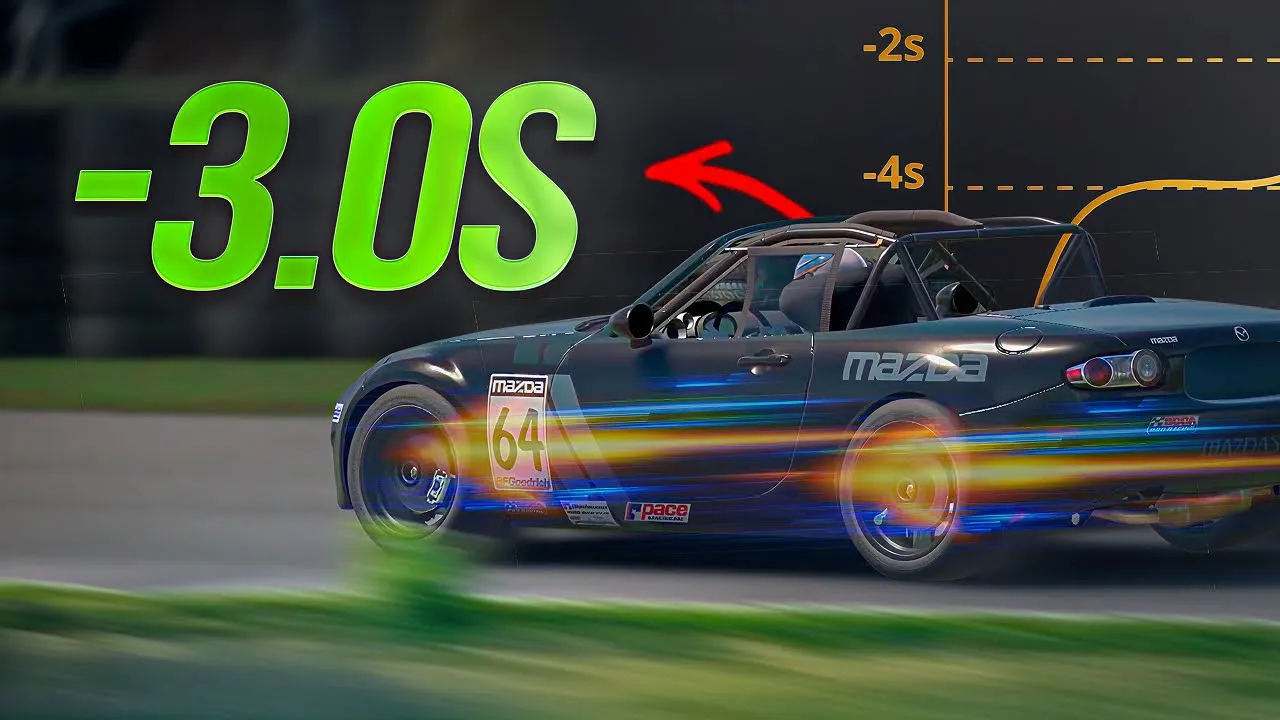
How One Student Found 3 Seconds Per Lap in 1 Hour — What Most Sim Racers Miss About Speed
Suellio Almeida
•
Sunday, May 25, 2025
The Problem: Fast Doesn't Feel Fast When You're Making the Wrong Mistakes
Most drivers think they need to be smoother. More aggressive. Brake later. Turn in sharper.
And they're wrong.
The student in this session wasn't slow because of effort. He was slow because he was making high-level mistakes — the kind that feel right but cost you seconds you can't even see.
Here's what actually happened: one hour of coaching, three specific corrections, and a three-second improvement.
No magic. No shortcuts. Just precision.
Mistake #1: Braking Too Early and Killing Your Rotation
The first issue showed up immediately in Turn 1.
He was braking early. Reasonable, right? Be safe, build confidence, nail the apex.
Except early braking doesn't just cost you entry speed — it destroys your rotation.
Here's the physics: when you brake, weight transfers forward. The front tires load up, the rear gets light, and the car wants to rotate. That's free rotation — the car turning itself because of load transfer.
But if you brake too early, you finish braking in a straight line. You coast into the corner. The weight settles back. The car goes neutral.
Now you have to physically wrestle the car through the apex with steering input. You're scrubbing speed. You're inducing understeer. You're working harder and going slower.
The fix: Brake later and trail brake deeper into the corner. Keep that weight on the front through turn-in. Let the car rotate naturally.
One correction. Half a second gained.
Mistake #2: Fighting Weight Transfer Instead of Using It
The second mistake was subtler — and way more expensive.
He was trying to be smooth. Gradual inputs. Steady hands. Textbook stuff.
But smooth isn't always fast.
In a momentum car, you need aggressive weight transfer at the right moments. You need to load the front hard, let the rear come around, then catch it with throttle and steering.
He was doing the opposite: gentle brake release, cautious turn-in, tentative throttle. The car stayed flat. The tires stayed neutral. He was leaving grip on the table.
The thing is, weight transfer isn't something you avoid — it's something you manipulate.
When you nail trail braking, you're not just slowing down. You're actively rotating the car with brake pressure. The rear gets light, the nose tucks in, and you hit the apex carrying more speed with less steering angle.
Then you transition: ease off the brakes, the weight shifts back, the rear plants, and you hammer the throttle.
That's the platform. That's how you get on the power early without spinning.
The correction: Stop being polite with the car. Attack the brake zone. Trail brake aggressively. Use the weight.
Another second gone.
Mistake #3: Looking at the Apex Instead of the Exit
The third mistake is the one most drivers never notice.
Vision.
You go where you look. That's not a metaphor — it's physiology. Your hands follow your eyes. Your brain processes information faster when you're looking ahead.
He was fixated on hitting the apex. Eyes locked on the inside curbing. Classic target fixation.
The problem? By the time he looked at the exit, he was already there. No time to adjust. No time to optimize the line. Just reactive steering, late throttle, compromised exit speed.
And exit speed is everything. A bad exit costs you speed down the entire straight. One mph at corner exit is worth three mph at the braking zone.
The fix: Look at the exit before you even turn in. Your peripheral vision handles the apex. Your primary focus should already be scanning the track-out point.
Do this right, and your line improves automatically. Your hands know where to go because your brain is already there.
Half a second. Maybe more.
The Real Lesson: You Can't Fix What You Can't See
Three mistakes. Three corrections. Three seconds.
But here's the part that matters: he didn't know any of this was wrong.
To him, braking early felt safe. Smooth inputs felt fast. Looking at the apex felt correct.
And that's the trap. You can't improve what you can't identify. You'll keep grinding laps, chasing tenths, wondering why the alien times feel impossible.
This is why coaching works. Not because a coach drives for you. Not because they give you a magic setup.
Because they see what you're blind to.
They watch your inputs. They analyze your data. They spot the pattern you've been repeating for months without realizing it costs you two seconds a lap.
And then they fix it. In one session.
What Separates Fast Drivers from Everyone Else
Fast drivers don't have better reflexes. They don't have more talent.
They have better information.
They know what to fix. They know what to practice. They don't waste time on the wrong skills.
They understand that speed isn't about pushing harder — it's about eliminating the mistakes that feel invisible.
Braking early feels safe until you learn rotation.
Smooth inputs feel fast until you learn weight transfer.
Looking at the apex feels right until you learn vision technique.
Every plateau you hit is just a mistake you haven't identified yet.
The Technique Stack That Actually Works
Let's break down the exact process that led to this three-second gain:
1. Trail braking fundamentals — Understanding that braking isn't just about slowing down. It's a rotation tool. You're manipulating front-to-rear load to make the car turn.
2. Maximum Rotation Point — The moment in the corner where the car rotates the most. This is where you transition from trail braking to throttle. Miss this window and you either understeer wide or oversteer and scrub speed.
3. Weight transfer manipulation — Stop treating the car like it's fragile. Attack the brake zone. Load the front. Use the platform. Get aggressive with load transfer at the right moments.
4. Vision technique — Look where you want to be, not where you are. Eyes to exit before turn-in. Your hands will follow.
5. Throttle application timing — The moment you pick up throttle changes everything. Too early and you push wide. Too late and you lose exit speed. It's dictated by the Maximum Rotation Point and rear grip availability.
This isn't theory. This is the exact sequence we used in the session.
And it works because it's physics, not opinion.
Why Most Sim Racers Never Get Here
You know what the real problem is?
Most drivers are guessing.
They try something. Maybe it works. Maybe it doesn't. They change five things at once and can't isolate what actually helped.
They watch a YouTube video about trail braking, go try it, spin twice, give up, and decide they "just need more practice."
But practice doesn't fix bad technique. It reinforces bad technique.
You'll get really good at braking too early. You'll master slow, safe inputs. You'll perfect your ability to hit the apex while leaving a second on the table.
And you'll blame talent. Or equipment. Or the meta.
Meanwhile, someone with the right information — someone who knows exactly what to fix and how to fix it — finds three seconds in an hour.
That's not talent. That's precision.
The Data Doesn't Lie — But You Have to Know How to Read It
One of the most powerful moments in this session came from the data.
We pulled up his telemetry. Looked at brake pressure, throttle trace, speed through corners.
And the mistakes were obvious.
Brake pressure dropping too early. Coasting phase before turn-in. Throttle application late and tentative.
But here's the thing: he couldn't see it until someone showed him what to look for.
Data analysis isn't about having the tool. It's about knowing what the lines mean. What good technique looks like on a graph. What your inputs should be doing and when.
Most drivers look at telemetry and see squiggly lines. Fast drivers see a story — where time is lost, where grip is wasted, where technique breaks down.
That's the gap. And it's fixable.
This Works for Every Car, Every Track, Every Sim
Here's what makes this even better: these principles transfer.
It doesn't matter if you're driving a GT3 in iRacing, a Formula car in ACC, or a TCR in real life.
Trail braking works the same. Weight transfer works the same. Vision technique works the same.
The specifics change — brake points, rotation windows, throttle timing — but the method is universal.
Learn it once, apply it everywhere.
That's why students who commit to the process don't just get faster in one car. They get faster in everything.
Because they're not memorizing track guides. They're learning to drive.
The Real Question: How Long Are You Going to Keep Guessing?
You've been stuck at the same pace for how long now?
Six months? A year? Longer?
You've tried YouTube tutorials. You've watched replays. You've adjusted your setup seventeen times.
And you're still three seconds off the pace.
What if the problem isn't effort? What if it's information?
What if you're practicing the wrong things, reinforcing the wrong habits, and optimizing the wrong inputs?
This student found three seconds in one hour because someone showed him exactly what was broken and exactly how to fix it.
No guesswork. No trial and error. Just precision.
How much faster would you be if you stopped guessing?
What If You Actually Knew What to Fix?
You've been grinding. Putting in the hours. Chasing those tenths.
But are you fixing the right things? Or are you just practicing the same mistakes at higher speed?
Most drivers never break through because they don't know what's holding them back. They feel slow but can't see why. They watch aliens and think it's magic.
It's not magic. It's method.
The Almeida Racing Academy exists because sim racers deserved better than guesswork. Better than YouTube tutorials that contradict each other. Better than hoping you'll stumble into speed.
Inside the Gold Membership, you get the full technique stack: trail braking, weight transfer, Maximum Rotation Point, vision systems, racecraft, consistency training. Eight courses. Eighty lessons. Coach-led workshops where we break down exactly what's costing you time.
Not theory. Not motivational fluff. Just the physics, the technique, and the reps that actually work.
Right now, you can get Gold for $25/month with code WINTER. That's less than one tank of gas for a system that's put 36,000+ students on the pace.
Start your Gold Membership here — code WINTER unlocks $25/mo
Sim Racing Academy Membership
Everything you need to stop guessing and start getting faster.
Starting at
$25
/mo
Car Handling Online Course
4 levels, full curriculum. Aimed to get you to top 1% in driving pace.
Racecraft Online Course
Overtaking, Defending, Race Strategy
Live coaching + on-track practice
Bi-weekly pro-coach workshops (recorded — never miss one) plus on-track Pit Parties to practice racecraft with a coach.
Plus These Bonuses
13,000+ Member Community
League Racing
Advanced MX-5 Mini Course
Racing Technique Development Guide
The Motor Racing Book (260 pages)
Think & Behave Like a Pro Driver — Mini eBook
How One Student Found 3 Seconds Per Lap in 1 Hour — What Most Sim Racers Miss About Speed
Suellio Almeida
•
Sunday, May 25, 2025
The Problem: Fast Doesn't Feel Fast When You're Making the Wrong Mistakes
Most drivers think they need to be smoother. More aggressive. Brake later. Turn in sharper.
And they're wrong.
The student in this session wasn't slow because of effort. He was slow because he was making high-level mistakes — the kind that feel right but cost you seconds you can't even see.
Here's what actually happened: one hour of coaching, three specific corrections, and a three-second improvement.
No magic. No shortcuts. Just precision.
Mistake #1: Braking Too Early and Killing Your Rotation
The first issue showed up immediately in Turn 1.
He was braking early. Reasonable, right? Be safe, build confidence, nail the apex.
Except early braking doesn't just cost you entry speed — it destroys your rotation.
Here's the physics: when you brake, weight transfers forward. The front tires load up, the rear gets light, and the car wants to rotate. That's free rotation — the car turning itself because of load transfer.
But if you brake too early, you finish braking in a straight line. You coast into the corner. The weight settles back. The car goes neutral.
Now you have to physically wrestle the car through the apex with steering input. You're scrubbing speed. You're inducing understeer. You're working harder and going slower.
The fix: Brake later and trail brake deeper into the corner. Keep that weight on the front through turn-in. Let the car rotate naturally.
One correction. Half a second gained.
Mistake #2: Fighting Weight Transfer Instead of Using It
The second mistake was subtler — and way more expensive.
He was trying to be smooth. Gradual inputs. Steady hands. Textbook stuff.
But smooth isn't always fast.
In a momentum car, you need aggressive weight transfer at the right moments. You need to load the front hard, let the rear come around, then catch it with throttle and steering.
He was doing the opposite: gentle brake release, cautious turn-in, tentative throttle. The car stayed flat. The tires stayed neutral. He was leaving grip on the table.
The thing is, weight transfer isn't something you avoid — it's something you manipulate.
When you nail trail braking, you're not just slowing down. You're actively rotating the car with brake pressure. The rear gets light, the nose tucks in, and you hit the apex carrying more speed with less steering angle.
Then you transition: ease off the brakes, the weight shifts back, the rear plants, and you hammer the throttle.
That's the platform. That's how you get on the power early without spinning.
The correction: Stop being polite with the car. Attack the brake zone. Trail brake aggressively. Use the weight.
Another second gone.
Mistake #3: Looking at the Apex Instead of the Exit
The third mistake is the one most drivers never notice.
Vision.
You go where you look. That's not a metaphor — it's physiology. Your hands follow your eyes. Your brain processes information faster when you're looking ahead.
He was fixated on hitting the apex. Eyes locked on the inside curbing. Classic target fixation.
The problem? By the time he looked at the exit, he was already there. No time to adjust. No time to optimize the line. Just reactive steering, late throttle, compromised exit speed.
And exit speed is everything. A bad exit costs you speed down the entire straight. One mph at corner exit is worth three mph at the braking zone.
The fix: Look at the exit before you even turn in. Your peripheral vision handles the apex. Your primary focus should already be scanning the track-out point.
Do this right, and your line improves automatically. Your hands know where to go because your brain is already there.
Half a second. Maybe more.
The Real Lesson: You Can't Fix What You Can't See
Three mistakes. Three corrections. Three seconds.
But here's the part that matters: he didn't know any of this was wrong.
To him, braking early felt safe. Smooth inputs felt fast. Looking at the apex felt correct.
And that's the trap. You can't improve what you can't identify. You'll keep grinding laps, chasing tenths, wondering why the alien times feel impossible.
This is why coaching works. Not because a coach drives for you. Not because they give you a magic setup.
Because they see what you're blind to.
They watch your inputs. They analyze your data. They spot the pattern you've been repeating for months without realizing it costs you two seconds a lap.
And then they fix it. In one session.
What Separates Fast Drivers from Everyone Else
Fast drivers don't have better reflexes. They don't have more talent.
They have better information.
They know what to fix. They know what to practice. They don't waste time on the wrong skills.
They understand that speed isn't about pushing harder — it's about eliminating the mistakes that feel invisible.
Braking early feels safe until you learn rotation.
Smooth inputs feel fast until you learn weight transfer.
Looking at the apex feels right until you learn vision technique.
Every plateau you hit is just a mistake you haven't identified yet.
The Technique Stack That Actually Works
Let's break down the exact process that led to this three-second gain:
1. Trail braking fundamentals — Understanding that braking isn't just about slowing down. It's a rotation tool. You're manipulating front-to-rear load to make the car turn.
2. Maximum Rotation Point — The moment in the corner where the car rotates the most. This is where you transition from trail braking to throttle. Miss this window and you either understeer wide or oversteer and scrub speed.
3. Weight transfer manipulation — Stop treating the car like it's fragile. Attack the brake zone. Load the front. Use the platform. Get aggressive with load transfer at the right moments.
4. Vision technique — Look where you want to be, not where you are. Eyes to exit before turn-in. Your hands will follow.
5. Throttle application timing — The moment you pick up throttle changes everything. Too early and you push wide. Too late and you lose exit speed. It's dictated by the Maximum Rotation Point and rear grip availability.
This isn't theory. This is the exact sequence we used in the session.
And it works because it's physics, not opinion.
Why Most Sim Racers Never Get Here
You know what the real problem is?
Most drivers are guessing.
They try something. Maybe it works. Maybe it doesn't. They change five things at once and can't isolate what actually helped.
They watch a YouTube video about trail braking, go try it, spin twice, give up, and decide they "just need more practice."
But practice doesn't fix bad technique. It reinforces bad technique.
You'll get really good at braking too early. You'll master slow, safe inputs. You'll perfect your ability to hit the apex while leaving a second on the table.
And you'll blame talent. Or equipment. Or the meta.
Meanwhile, someone with the right information — someone who knows exactly what to fix and how to fix it — finds three seconds in an hour.
That's not talent. That's precision.
The Data Doesn't Lie — But You Have to Know How to Read It
One of the most powerful moments in this session came from the data.
We pulled up his telemetry. Looked at brake pressure, throttle trace, speed through corners.
And the mistakes were obvious.
Brake pressure dropping too early. Coasting phase before turn-in. Throttle application late and tentative.
But here's the thing: he couldn't see it until someone showed him what to look for.
Data analysis isn't about having the tool. It's about knowing what the lines mean. What good technique looks like on a graph. What your inputs should be doing and when.
Most drivers look at telemetry and see squiggly lines. Fast drivers see a story — where time is lost, where grip is wasted, where technique breaks down.
That's the gap. And it's fixable.
This Works for Every Car, Every Track, Every Sim
Here's what makes this even better: these principles transfer.
It doesn't matter if you're driving a GT3 in iRacing, a Formula car in ACC, or a TCR in real life.
Trail braking works the same. Weight transfer works the same. Vision technique works the same.
The specifics change — brake points, rotation windows, throttle timing — but the method is universal.
Learn it once, apply it everywhere.
That's why students who commit to the process don't just get faster in one car. They get faster in everything.
Because they're not memorizing track guides. They're learning to drive.
The Real Question: How Long Are You Going to Keep Guessing?
You've been stuck at the same pace for how long now?
Six months? A year? Longer?
You've tried YouTube tutorials. You've watched replays. You've adjusted your setup seventeen times.
And you're still three seconds off the pace.
What if the problem isn't effort? What if it's information?
What if you're practicing the wrong things, reinforcing the wrong habits, and optimizing the wrong inputs?
This student found three seconds in one hour because someone showed him exactly what was broken and exactly how to fix it.
No guesswork. No trial and error. Just precision.
How much faster would you be if you stopped guessing?
What If You Actually Knew What to Fix?
You've been grinding. Putting in the hours. Chasing those tenths.
But are you fixing the right things? Or are you just practicing the same mistakes at higher speed?
Most drivers never break through because they don't know what's holding them back. They feel slow but can't see why. They watch aliens and think it's magic.
It's not magic. It's method.
The Almeida Racing Academy exists because sim racers deserved better than guesswork. Better than YouTube tutorials that contradict each other. Better than hoping you'll stumble into speed.
Inside the Gold Membership, you get the full technique stack: trail braking, weight transfer, Maximum Rotation Point, vision systems, racecraft, consistency training. Eight courses. Eighty lessons. Coach-led workshops where we break down exactly what's costing you time.
Not theory. Not motivational fluff. Just the physics, the technique, and the reps that actually work.
Right now, you can get Gold for $25/month with code WINTER. That's less than one tank of gas for a system that's put 36,000+ students on the pace.
Start your Gold Membership here — code WINTER unlocks $25/mo
Sim Racing Academy Membership
Everything you need to stop guessing and start getting faster.
Starting at
$25
/mo
Car Handling Online Course
4 levels, full curriculum. Aimed to get you to top 1% in driving pace.
Racecraft Online Course
Overtaking, Defending, Race Strategy
Live coaching + on-track practice
Bi-weekly pro-coach workshops (recorded — never miss one) plus on-track Pit Parties to practice racecraft with a coach.
Plus These Bonuses
13,000+ Member Community
League Racing
Advanced MX-5 Mini Course
Racing Technique Development Guide
The Motor Racing Book (260 pages)
Think & Behave Like a Pro Driver — Mini eBook
How One Student Found 3 Seconds Per Lap in 1 Hour — What Most Sim Racers Miss About Speed
Suellio Almeida
•
Sunday, May 25, 2025
The Problem: Fast Doesn't Feel Fast When You're Making the Wrong Mistakes
Most drivers think they need to be smoother. More aggressive. Brake later. Turn in sharper.
And they're wrong.
The student in this session wasn't slow because of effort. He was slow because he was making high-level mistakes — the kind that feel right but cost you seconds you can't even see.
Here's what actually happened: one hour of coaching, three specific corrections, and a three-second improvement.
No magic. No shortcuts. Just precision.
Mistake #1: Braking Too Early and Killing Your Rotation
The first issue showed up immediately in Turn 1.
He was braking early. Reasonable, right? Be safe, build confidence, nail the apex.
Except early braking doesn't just cost you entry speed — it destroys your rotation.
Here's the physics: when you brake, weight transfers forward. The front tires load up, the rear gets light, and the car wants to rotate. That's free rotation — the car turning itself because of load transfer.
But if you brake too early, you finish braking in a straight line. You coast into the corner. The weight settles back. The car goes neutral.
Now you have to physically wrestle the car through the apex with steering input. You're scrubbing speed. You're inducing understeer. You're working harder and going slower.
The fix: Brake later and trail brake deeper into the corner. Keep that weight on the front through turn-in. Let the car rotate naturally.
One correction. Half a second gained.
Mistake #2: Fighting Weight Transfer Instead of Using It
The second mistake was subtler — and way more expensive.
He was trying to be smooth. Gradual inputs. Steady hands. Textbook stuff.
But smooth isn't always fast.
In a momentum car, you need aggressive weight transfer at the right moments. You need to load the front hard, let the rear come around, then catch it with throttle and steering.
He was doing the opposite: gentle brake release, cautious turn-in, tentative throttle. The car stayed flat. The tires stayed neutral. He was leaving grip on the table.
The thing is, weight transfer isn't something you avoid — it's something you manipulate.
When you nail trail braking, you're not just slowing down. You're actively rotating the car with brake pressure. The rear gets light, the nose tucks in, and you hit the apex carrying more speed with less steering angle.
Then you transition: ease off the brakes, the weight shifts back, the rear plants, and you hammer the throttle.
That's the platform. That's how you get on the power early without spinning.
The correction: Stop being polite with the car. Attack the brake zone. Trail brake aggressively. Use the weight.
Another second gone.
Mistake #3: Looking at the Apex Instead of the Exit
The third mistake is the one most drivers never notice.
Vision.
You go where you look. That's not a metaphor — it's physiology. Your hands follow your eyes. Your brain processes information faster when you're looking ahead.
He was fixated on hitting the apex. Eyes locked on the inside curbing. Classic target fixation.
The problem? By the time he looked at the exit, he was already there. No time to adjust. No time to optimize the line. Just reactive steering, late throttle, compromised exit speed.
And exit speed is everything. A bad exit costs you speed down the entire straight. One mph at corner exit is worth three mph at the braking zone.
The fix: Look at the exit before you even turn in. Your peripheral vision handles the apex. Your primary focus should already be scanning the track-out point.
Do this right, and your line improves automatically. Your hands know where to go because your brain is already there.
Half a second. Maybe more.
The Real Lesson: You Can't Fix What You Can't See
Three mistakes. Three corrections. Three seconds.
But here's the part that matters: he didn't know any of this was wrong.
To him, braking early felt safe. Smooth inputs felt fast. Looking at the apex felt correct.
And that's the trap. You can't improve what you can't identify. You'll keep grinding laps, chasing tenths, wondering why the alien times feel impossible.
This is why coaching works. Not because a coach drives for you. Not because they give you a magic setup.
Because they see what you're blind to.
They watch your inputs. They analyze your data. They spot the pattern you've been repeating for months without realizing it costs you two seconds a lap.
And then they fix it. In one session.
What Separates Fast Drivers from Everyone Else
Fast drivers don't have better reflexes. They don't have more talent.
They have better information.
They know what to fix. They know what to practice. They don't waste time on the wrong skills.
They understand that speed isn't about pushing harder — it's about eliminating the mistakes that feel invisible.
Braking early feels safe until you learn rotation.
Smooth inputs feel fast until you learn weight transfer.
Looking at the apex feels right until you learn vision technique.
Every plateau you hit is just a mistake you haven't identified yet.
The Technique Stack That Actually Works
Let's break down the exact process that led to this three-second gain:
1. Trail braking fundamentals — Understanding that braking isn't just about slowing down. It's a rotation tool. You're manipulating front-to-rear load to make the car turn.
2. Maximum Rotation Point — The moment in the corner where the car rotates the most. This is where you transition from trail braking to throttle. Miss this window and you either understeer wide or oversteer and scrub speed.
3. Weight transfer manipulation — Stop treating the car like it's fragile. Attack the brake zone. Load the front. Use the platform. Get aggressive with load transfer at the right moments.
4. Vision technique — Look where you want to be, not where you are. Eyes to exit before turn-in. Your hands will follow.
5. Throttle application timing — The moment you pick up throttle changes everything. Too early and you push wide. Too late and you lose exit speed. It's dictated by the Maximum Rotation Point and rear grip availability.
This isn't theory. This is the exact sequence we used in the session.
And it works because it's physics, not opinion.
Why Most Sim Racers Never Get Here
You know what the real problem is?
Most drivers are guessing.
They try something. Maybe it works. Maybe it doesn't. They change five things at once and can't isolate what actually helped.
They watch a YouTube video about trail braking, go try it, spin twice, give up, and decide they "just need more practice."
But practice doesn't fix bad technique. It reinforces bad technique.
You'll get really good at braking too early. You'll master slow, safe inputs. You'll perfect your ability to hit the apex while leaving a second on the table.
And you'll blame talent. Or equipment. Or the meta.
Meanwhile, someone with the right information — someone who knows exactly what to fix and how to fix it — finds three seconds in an hour.
That's not talent. That's precision.
The Data Doesn't Lie — But You Have to Know How to Read It
One of the most powerful moments in this session came from the data.
We pulled up his telemetry. Looked at brake pressure, throttle trace, speed through corners.
And the mistakes were obvious.
Brake pressure dropping too early. Coasting phase before turn-in. Throttle application late and tentative.
But here's the thing: he couldn't see it until someone showed him what to look for.
Data analysis isn't about having the tool. It's about knowing what the lines mean. What good technique looks like on a graph. What your inputs should be doing and when.
Most drivers look at telemetry and see squiggly lines. Fast drivers see a story — where time is lost, where grip is wasted, where technique breaks down.
That's the gap. And it's fixable.
This Works for Every Car, Every Track, Every Sim
Here's what makes this even better: these principles transfer.
It doesn't matter if you're driving a GT3 in iRacing, a Formula car in ACC, or a TCR in real life.
Trail braking works the same. Weight transfer works the same. Vision technique works the same.
The specifics change — brake points, rotation windows, throttle timing — but the method is universal.
Learn it once, apply it everywhere.
That's why students who commit to the process don't just get faster in one car. They get faster in everything.
Because they're not memorizing track guides. They're learning to drive.
The Real Question: How Long Are You Going to Keep Guessing?
You've been stuck at the same pace for how long now?
Six months? A year? Longer?
You've tried YouTube tutorials. You've watched replays. You've adjusted your setup seventeen times.
And you're still three seconds off the pace.
What if the problem isn't effort? What if it's information?
What if you're practicing the wrong things, reinforcing the wrong habits, and optimizing the wrong inputs?
This student found three seconds in one hour because someone showed him exactly what was broken and exactly how to fix it.
No guesswork. No trial and error. Just precision.
How much faster would you be if you stopped guessing?
What If You Actually Knew What to Fix?
You've been grinding. Putting in the hours. Chasing those tenths.
But are you fixing the right things? Or are you just practicing the same mistakes at higher speed?
Most drivers never break through because they don't know what's holding them back. They feel slow but can't see why. They watch aliens and think it's magic.
It's not magic. It's method.
The Almeida Racing Academy exists because sim racers deserved better than guesswork. Better than YouTube tutorials that contradict each other. Better than hoping you'll stumble into speed.
Inside the Gold Membership, you get the full technique stack: trail braking, weight transfer, Maximum Rotation Point, vision systems, racecraft, consistency training. Eight courses. Eighty lessons. Coach-led workshops where we break down exactly what's costing you time.
Not theory. Not motivational fluff. Just the physics, the technique, and the reps that actually work.
Right now, you can get Gold for $25/month with code WINTER. That's less than one tank of gas for a system that's put 36,000+ students on the pace.
Start your Gold Membership here — code WINTER unlocks $25/mo
Sim Racing Academy Membership
Everything you need to stop guessing and start getting faster.
Starting at
$25
/mo
Car Handling Online Course
4 levels, full curriculum. Aimed to get you to top 1% in driving pace.
Racecraft Online Course
Overtaking, Defending, Race Strategy
Live coaching + on-track practice
Bi-weekly pro-coach workshops (recorded — never miss one) plus on-track Pit Parties to practice racecraft with a coach.
Plus These Bonuses
13,000+ Member Community
League Racing
Advanced MX-5 Mini Course
Racing Technique Development Guide
The Motor Racing Book (260 pages)
Think & Behave Like a Pro Driver — Mini eBook