
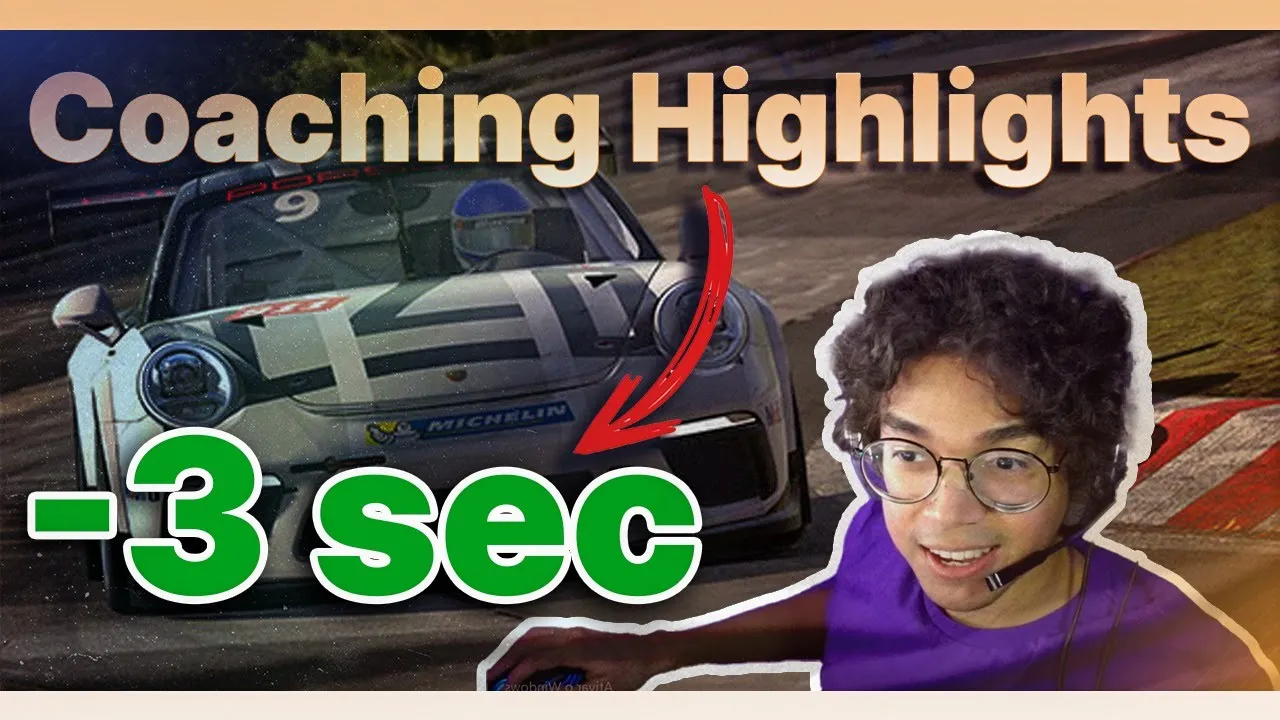
How One Sim Racer Found 3 Seconds Per Lap (And Why Most Drivers Never Will)
Suellio Almeida
•
Sunday, February 20, 2022
The Problem Isn't Your Setup. It's Your Approach.
You've spent hours chasing tenths. New setups. YouTube tutorials. Data overlays. And you're still slow.
Here's why: you're treating symptoms, not the disease. You adjust brake bias when you should be fixing your entry. You blame understeer when the real issue is your hands. You chase other drivers' lines instead of understanding the physics.
This student was doing all of that. Decent pace. Consistent enough. But stuck. And the breakthrough didn't come from a magical setup tweak or a secret braking point.
It came from fixing fundamentals most drivers never actually learn.
Where Speed Actually Lives (And Why You're Looking in the Wrong Place)
Let's talk about where lap time comes from. Not the sexy stuff — aero balance and spring rates. The unglamorous physics that actually matter.
Weight transfer. When you brake, load moves forward. When you turn, load shifts laterally. When you accelerate, it goes to the rear. Every input you make is a negotiation with those forces.
Most drivers think they understand this. They don't. They brake in a straight line, turn the wheel, then wonder why the car won't rotate. Or they trail brake but do it wrong — releasing pressure too early, too late, or in a panic when the car starts moving.
This student was releasing brake pressure the moment he turned in. Why? Because it felt safer. The problem? You kill rotation before it even starts. The car stays heavy on the front, you understeer, you compensate with more steering angle, and now you're scrubbing speed through the entire corner.
The fix? Extend your braking zone into the corner. Not deeper — longer. Hold pressure as you turn. Feel the front tires load. Let the rear get light. That's rotation. That's the car doing what it's designed to do.
Three seconds came from this alone. Not all at once. But corner after corner, the gains stacked.
The Vision Problem No One Talks About
You know what else kills lap time? Where you're looking.
Most drivers look at the apex. Some look at the exit. Almost none look far enough ahead to actually drive fast.
Here's what happens when your vision is short: you react instead of anticipate. You brake late because you didn't see the corner coming. You turn in abruptly because you're already at the apex. You get on throttle hesitantly because you're not sure where the track goes next.
Speed lives in predictability. And predictability comes from seeing what's next before you get there.
This student was scanning the track properly — eyes up, looking through the corner. But he wasn't trusting what he saw. He'd look at the exit curbing, then his hands would hesitate. His brain knew where to go. His body didn't believe it yet.
The drill? Verbalize it. Out loud. "Apex... exit curbing... throttle point." Say it before you get there. Your brain starts building the map. Your hands start following your eyes instead of reacting to the steering wheel.
Sounds simple. Works like magic.
Maximum Rotation Point: The Concept That Changes Everything
Let me introduce you to a term that will rewire how you drive: Maximum Rotation Point (MRP).
Every corner has a moment where the car rotates the most. It's the instant where the rear is lightest, the front is loaded, and the car pivots on its axis. Miss that moment and you're fighting understeer for the rest of the corner. Nail it and you're carrying momentum through exit like the car's on rails.
Most drivers never find MRP because they release brake pressure too early or turn in too slowly. The car never actually rotates — it just... turns. Slowly. Scrubbing speed the whole way.
This student was close. He had the general idea of trail braking. But he was treating it like a checkbox: "Okay, I'm braking into the corner, good." The problem? He wasn't feeling for the moment. He was guessing.
Here's how you find MRP:
1. Brake in a straight line. Get most of your deceleration done before turn-in. Don't hero-brake into corners.
2. Turn in smoothly. Not aggressive. Not timid. Progressive.
3. Extend brake pressure as you turn. This is the magic. You're not braking harder — you're holding pressure longer.
4. Feel for the pivot. The car gets light at the rear. The nose tucks in. That's MRP. Right there.
5. Release the brakes progressively. Not a dump. A flow. As rotation happens, you're already unwinding the wheel and transitioning to throttle.
When you get this sequence right, the car feels alive. It's not a fight. It's a dance.
The Understeer Trap (And How to Escape It)
Understeer. The universal sim racing complaint. "My car won't turn." "I have to wait forever to get on throttle." "Setup issue, right?"
Wrong.
Ninety percent of understeer is driver-induced. You're creating it with your inputs. And until you fix those inputs, no setup will save you.
Here's what causes it:
Too much steering angle. You ask for rotation the car can't give. The front tires exceed their slip angle. They stop gripping. You turn more. It gets worse.
Releasing brakes too early. The car never rotates. You try to steer it through the corner. See above.
Getting on throttle too early. The rear squats, weight comes off the front, and now you're plowing.
This student was doing all three. Classic pattern. He'd feel the initial understeer, panic, add more steering, get frustrated, then try to muscle the car through with throttle.
The fix isn't intuitive. It's counterintuitive.
Less steering angle. More patience. Better rotation.
Trust the front tires. They know what to do. If you set up the corner right — proper braking, smooth turn-in, MRP — the car will rotate. You don't need to force it.
And when you're on throttle? If the car understeers, don't add steering. Lift slightly. Just a breath. The weight shifts forward, the front bites again, and the car rotates back under you. Then you reapply throttle.
It's a micro-adjustment. It costs you nothing. And it transforms corner exit.
The Mental Game: Why Consistency Beats Hero Laps
Let's talk about the part no one wants to hear. You're inconsistent because you're not training consistency.
You go into practice sessions hunting for your personal best. You throw away lap after lap trying to find that one perfect combination of inputs. And when you finally hit it? You can't repeat it. Because you didn't build the foundation.
This student had flashes of speed. One lap at 1:32. Next lap 1:35. Why? Because he was guessing. He'd execute one corner perfectly, miss the next three, then wonder why his race pace was garbage.
Here's the truth: consistency is a skill. It's not something that happens when you "get good." It's something you practice deliberately.
The method:
1. Pick a target lap time that's 0.5-1 second off your PB. Not your hero lap. Your repeatable lap.
2. Run 10 consecutive laps within 0.2 seconds of that target. No outliers. No "I'll just send it this lap."
3. Only after you hit that consistency do you lower the target.
This trains your brain to execute the same inputs lap after lap. It builds muscle memory. It removes the guesswork. And it makes you fast when it matters — in races, under pressure, when someone's on your bumper.
Speed without consistency is useless. Consistency without speed is just being slow reliably. You need both. And you build both the same way: repetition with purpose.
The Three-Second Breakdown: What Actually Changed
So where did the three seconds come from? Let's be specific.
1 second from braking zones. Extending trail braking into corners instead of releasing early. Carrying more entry speed without overslowing.
1 second from corner exits. Finding MRP, rotating the car properly, getting on throttle earlier and harder because the car was already pointed where it needed to go.
1 second from consistency. Eliminating mistakes. No more blown corners. No more over-corrections. Just clean, repeatable laps.
Three seconds. Not from a setup. Not from a new rig. From fixing fundamentals.
And here's the part that matters: this isn't special. This student isn't a prodigy. He's just a sim racer who was willing to do the work. To challenge his assumptions. To practice boring drills until they became instinct.
You can do this too. The question is whether you're willing to.
What If You Could Stop Guessing and Start Improving?
How many more sessions are you going to waste hoping the next YouTube video has the answer?
How many races are you going to lose because you can't execute under pressure?
What would change if someone showed you exactly what's wrong — and exactly how to fix it?
The difference between stuck and progressing isn't talent. It's method. It's having someone who can see what you're doing wrong before you waste another month building bad habits.
That's what
does. You drive. We watch. We break down every input — braking, steering, throttle, vision — and give you a clear, step-by-step plan to improve. Starting at $55, you work with coaches who've been exactly where you are and know how to get you where you want to go.
No fluff. No generic advice. Just real coaching from real drivers who've helped thousands find the speed they didn't know they had.
Sim Racing Academy Membership
Everything you need to stop guessing and start getting faster.
Starting at
$25
/mo
Car Handling Online Course
4 levels, full curriculum. Aimed to get you to top 1% in driving pace.
Racecraft Online Course
Overtaking, Defending, Race Strategy
Live coaching + on-track practice
Bi-weekly pro-coach workshops (recorded — never miss one) plus on-track Pit Parties to practice racecraft with a coach.
Plus These Bonuses
13,000+ Member Community
League Racing
Advanced MX-5 Mini Course
Racing Technique Development Guide
The Motor Racing Book (260 pages)
Think & Behave Like a Pro Driver — Mini eBook
How One Sim Racer Found 3 Seconds Per Lap (And Why Most Drivers Never Will)
Suellio Almeida
•
Sunday, February 20, 2022
The Problem Isn't Your Setup. It's Your Approach.
You've spent hours chasing tenths. New setups. YouTube tutorials. Data overlays. And you're still slow.
Here's why: you're treating symptoms, not the disease. You adjust brake bias when you should be fixing your entry. You blame understeer when the real issue is your hands. You chase other drivers' lines instead of understanding the physics.
This student was doing all of that. Decent pace. Consistent enough. But stuck. And the breakthrough didn't come from a magical setup tweak or a secret braking point.
It came from fixing fundamentals most drivers never actually learn.
Where Speed Actually Lives (And Why You're Looking in the Wrong Place)
Let's talk about where lap time comes from. Not the sexy stuff — aero balance and spring rates. The unglamorous physics that actually matter.
Weight transfer. When you brake, load moves forward. When you turn, load shifts laterally. When you accelerate, it goes to the rear. Every input you make is a negotiation with those forces.
Most drivers think they understand this. They don't. They brake in a straight line, turn the wheel, then wonder why the car won't rotate. Or they trail brake but do it wrong — releasing pressure too early, too late, or in a panic when the car starts moving.
This student was releasing brake pressure the moment he turned in. Why? Because it felt safer. The problem? You kill rotation before it even starts. The car stays heavy on the front, you understeer, you compensate with more steering angle, and now you're scrubbing speed through the entire corner.
The fix? Extend your braking zone into the corner. Not deeper — longer. Hold pressure as you turn. Feel the front tires load. Let the rear get light. That's rotation. That's the car doing what it's designed to do.
Three seconds came from this alone. Not all at once. But corner after corner, the gains stacked.
The Vision Problem No One Talks About
You know what else kills lap time? Where you're looking.
Most drivers look at the apex. Some look at the exit. Almost none look far enough ahead to actually drive fast.
Here's what happens when your vision is short: you react instead of anticipate. You brake late because you didn't see the corner coming. You turn in abruptly because you're already at the apex. You get on throttle hesitantly because you're not sure where the track goes next.
Speed lives in predictability. And predictability comes from seeing what's next before you get there.
This student was scanning the track properly — eyes up, looking through the corner. But he wasn't trusting what he saw. He'd look at the exit curbing, then his hands would hesitate. His brain knew where to go. His body didn't believe it yet.
The drill? Verbalize it. Out loud. "Apex... exit curbing... throttle point." Say it before you get there. Your brain starts building the map. Your hands start following your eyes instead of reacting to the steering wheel.
Sounds simple. Works like magic.
Maximum Rotation Point: The Concept That Changes Everything
Let me introduce you to a term that will rewire how you drive: Maximum Rotation Point (MRP).
Every corner has a moment where the car rotates the most. It's the instant where the rear is lightest, the front is loaded, and the car pivots on its axis. Miss that moment and you're fighting understeer for the rest of the corner. Nail it and you're carrying momentum through exit like the car's on rails.
Most drivers never find MRP because they release brake pressure too early or turn in too slowly. The car never actually rotates — it just... turns. Slowly. Scrubbing speed the whole way.
This student was close. He had the general idea of trail braking. But he was treating it like a checkbox: "Okay, I'm braking into the corner, good." The problem? He wasn't feeling for the moment. He was guessing.
Here's how you find MRP:
1. Brake in a straight line. Get most of your deceleration done before turn-in. Don't hero-brake into corners.
2. Turn in smoothly. Not aggressive. Not timid. Progressive.
3. Extend brake pressure as you turn. This is the magic. You're not braking harder — you're holding pressure longer.
4. Feel for the pivot. The car gets light at the rear. The nose tucks in. That's MRP. Right there.
5. Release the brakes progressively. Not a dump. A flow. As rotation happens, you're already unwinding the wheel and transitioning to throttle.
When you get this sequence right, the car feels alive. It's not a fight. It's a dance.
The Understeer Trap (And How to Escape It)
Understeer. The universal sim racing complaint. "My car won't turn." "I have to wait forever to get on throttle." "Setup issue, right?"
Wrong.
Ninety percent of understeer is driver-induced. You're creating it with your inputs. And until you fix those inputs, no setup will save you.
Here's what causes it:
Too much steering angle. You ask for rotation the car can't give. The front tires exceed their slip angle. They stop gripping. You turn more. It gets worse.
Releasing brakes too early. The car never rotates. You try to steer it through the corner. See above.
Getting on throttle too early. The rear squats, weight comes off the front, and now you're plowing.
This student was doing all three. Classic pattern. He'd feel the initial understeer, panic, add more steering, get frustrated, then try to muscle the car through with throttle.
The fix isn't intuitive. It's counterintuitive.
Less steering angle. More patience. Better rotation.
Trust the front tires. They know what to do. If you set up the corner right — proper braking, smooth turn-in, MRP — the car will rotate. You don't need to force it.
And when you're on throttle? If the car understeers, don't add steering. Lift slightly. Just a breath. The weight shifts forward, the front bites again, and the car rotates back under you. Then you reapply throttle.
It's a micro-adjustment. It costs you nothing. And it transforms corner exit.
The Mental Game: Why Consistency Beats Hero Laps
Let's talk about the part no one wants to hear. You're inconsistent because you're not training consistency.
You go into practice sessions hunting for your personal best. You throw away lap after lap trying to find that one perfect combination of inputs. And when you finally hit it? You can't repeat it. Because you didn't build the foundation.
This student had flashes of speed. One lap at 1:32. Next lap 1:35. Why? Because he was guessing. He'd execute one corner perfectly, miss the next three, then wonder why his race pace was garbage.
Here's the truth: consistency is a skill. It's not something that happens when you "get good." It's something you practice deliberately.
The method:
1. Pick a target lap time that's 0.5-1 second off your PB. Not your hero lap. Your repeatable lap.
2. Run 10 consecutive laps within 0.2 seconds of that target. No outliers. No "I'll just send it this lap."
3. Only after you hit that consistency do you lower the target.
This trains your brain to execute the same inputs lap after lap. It builds muscle memory. It removes the guesswork. And it makes you fast when it matters — in races, under pressure, when someone's on your bumper.
Speed without consistency is useless. Consistency without speed is just being slow reliably. You need both. And you build both the same way: repetition with purpose.
The Three-Second Breakdown: What Actually Changed
So where did the three seconds come from? Let's be specific.
1 second from braking zones. Extending trail braking into corners instead of releasing early. Carrying more entry speed without overslowing.
1 second from corner exits. Finding MRP, rotating the car properly, getting on throttle earlier and harder because the car was already pointed where it needed to go.
1 second from consistency. Eliminating mistakes. No more blown corners. No more over-corrections. Just clean, repeatable laps.
Three seconds. Not from a setup. Not from a new rig. From fixing fundamentals.
And here's the part that matters: this isn't special. This student isn't a prodigy. He's just a sim racer who was willing to do the work. To challenge his assumptions. To practice boring drills until they became instinct.
You can do this too. The question is whether you're willing to.
What If You Could Stop Guessing and Start Improving?
How many more sessions are you going to waste hoping the next YouTube video has the answer?
How many races are you going to lose because you can't execute under pressure?
What would change if someone showed you exactly what's wrong — and exactly how to fix it?
The difference between stuck and progressing isn't talent. It's method. It's having someone who can see what you're doing wrong before you waste another month building bad habits.
That's what
does. You drive. We watch. We break down every input — braking, steering, throttle, vision — and give you a clear, step-by-step plan to improve. Starting at $55, you work with coaches who've been exactly where you are and know how to get you where you want to go.
No fluff. No generic advice. Just real coaching from real drivers who've helped thousands find the speed they didn't know they had.
Sim Racing Academy Membership
Everything you need to stop guessing and start getting faster.
Starting at
$25
/mo
Car Handling Online Course
4 levels, full curriculum. Aimed to get you to top 1% in driving pace.
Racecraft Online Course
Overtaking, Defending, Race Strategy
Live coaching + on-track practice
Bi-weekly pro-coach workshops (recorded — never miss one) plus on-track Pit Parties to practice racecraft with a coach.
Plus These Bonuses
13,000+ Member Community
League Racing
Advanced MX-5 Mini Course
Racing Technique Development Guide
The Motor Racing Book (260 pages)
Think & Behave Like a Pro Driver — Mini eBook
How One Sim Racer Found 3 Seconds Per Lap (And Why Most Drivers Never Will)
Suellio Almeida
•
Sunday, February 20, 2022
The Problem Isn't Your Setup. It's Your Approach.
You've spent hours chasing tenths. New setups. YouTube tutorials. Data overlays. And you're still slow.
Here's why: you're treating symptoms, not the disease. You adjust brake bias when you should be fixing your entry. You blame understeer when the real issue is your hands. You chase other drivers' lines instead of understanding the physics.
This student was doing all of that. Decent pace. Consistent enough. But stuck. And the breakthrough didn't come from a magical setup tweak or a secret braking point.
It came from fixing fundamentals most drivers never actually learn.
Where Speed Actually Lives (And Why You're Looking in the Wrong Place)
Let's talk about where lap time comes from. Not the sexy stuff — aero balance and spring rates. The unglamorous physics that actually matter.
Weight transfer. When you brake, load moves forward. When you turn, load shifts laterally. When you accelerate, it goes to the rear. Every input you make is a negotiation with those forces.
Most drivers think they understand this. They don't. They brake in a straight line, turn the wheel, then wonder why the car won't rotate. Or they trail brake but do it wrong — releasing pressure too early, too late, or in a panic when the car starts moving.
This student was releasing brake pressure the moment he turned in. Why? Because it felt safer. The problem? You kill rotation before it even starts. The car stays heavy on the front, you understeer, you compensate with more steering angle, and now you're scrubbing speed through the entire corner.
The fix? Extend your braking zone into the corner. Not deeper — longer. Hold pressure as you turn. Feel the front tires load. Let the rear get light. That's rotation. That's the car doing what it's designed to do.
Three seconds came from this alone. Not all at once. But corner after corner, the gains stacked.
The Vision Problem No One Talks About
You know what else kills lap time? Where you're looking.
Most drivers look at the apex. Some look at the exit. Almost none look far enough ahead to actually drive fast.
Here's what happens when your vision is short: you react instead of anticipate. You brake late because you didn't see the corner coming. You turn in abruptly because you're already at the apex. You get on throttle hesitantly because you're not sure where the track goes next.
Speed lives in predictability. And predictability comes from seeing what's next before you get there.
This student was scanning the track properly — eyes up, looking through the corner. But he wasn't trusting what he saw. He'd look at the exit curbing, then his hands would hesitate. His brain knew where to go. His body didn't believe it yet.
The drill? Verbalize it. Out loud. "Apex... exit curbing... throttle point." Say it before you get there. Your brain starts building the map. Your hands start following your eyes instead of reacting to the steering wheel.
Sounds simple. Works like magic.
Maximum Rotation Point: The Concept That Changes Everything
Let me introduce you to a term that will rewire how you drive: Maximum Rotation Point (MRP).
Every corner has a moment where the car rotates the most. It's the instant where the rear is lightest, the front is loaded, and the car pivots on its axis. Miss that moment and you're fighting understeer for the rest of the corner. Nail it and you're carrying momentum through exit like the car's on rails.
Most drivers never find MRP because they release brake pressure too early or turn in too slowly. The car never actually rotates — it just... turns. Slowly. Scrubbing speed the whole way.
This student was close. He had the general idea of trail braking. But he was treating it like a checkbox: "Okay, I'm braking into the corner, good." The problem? He wasn't feeling for the moment. He was guessing.
Here's how you find MRP:
1. Brake in a straight line. Get most of your deceleration done before turn-in. Don't hero-brake into corners.
2. Turn in smoothly. Not aggressive. Not timid. Progressive.
3. Extend brake pressure as you turn. This is the magic. You're not braking harder — you're holding pressure longer.
4. Feel for the pivot. The car gets light at the rear. The nose tucks in. That's MRP. Right there.
5. Release the brakes progressively. Not a dump. A flow. As rotation happens, you're already unwinding the wheel and transitioning to throttle.
When you get this sequence right, the car feels alive. It's not a fight. It's a dance.
The Understeer Trap (And How to Escape It)
Understeer. The universal sim racing complaint. "My car won't turn." "I have to wait forever to get on throttle." "Setup issue, right?"
Wrong.
Ninety percent of understeer is driver-induced. You're creating it with your inputs. And until you fix those inputs, no setup will save you.
Here's what causes it:
Too much steering angle. You ask for rotation the car can't give. The front tires exceed their slip angle. They stop gripping. You turn more. It gets worse.
Releasing brakes too early. The car never rotates. You try to steer it through the corner. See above.
Getting on throttle too early. The rear squats, weight comes off the front, and now you're plowing.
This student was doing all three. Classic pattern. He'd feel the initial understeer, panic, add more steering, get frustrated, then try to muscle the car through with throttle.
The fix isn't intuitive. It's counterintuitive.
Less steering angle. More patience. Better rotation.
Trust the front tires. They know what to do. If you set up the corner right — proper braking, smooth turn-in, MRP — the car will rotate. You don't need to force it.
And when you're on throttle? If the car understeers, don't add steering. Lift slightly. Just a breath. The weight shifts forward, the front bites again, and the car rotates back under you. Then you reapply throttle.
It's a micro-adjustment. It costs you nothing. And it transforms corner exit.
The Mental Game: Why Consistency Beats Hero Laps
Let's talk about the part no one wants to hear. You're inconsistent because you're not training consistency.
You go into practice sessions hunting for your personal best. You throw away lap after lap trying to find that one perfect combination of inputs. And when you finally hit it? You can't repeat it. Because you didn't build the foundation.
This student had flashes of speed. One lap at 1:32. Next lap 1:35. Why? Because he was guessing. He'd execute one corner perfectly, miss the next three, then wonder why his race pace was garbage.
Here's the truth: consistency is a skill. It's not something that happens when you "get good." It's something you practice deliberately.
The method:
1. Pick a target lap time that's 0.5-1 second off your PB. Not your hero lap. Your repeatable lap.
2. Run 10 consecutive laps within 0.2 seconds of that target. No outliers. No "I'll just send it this lap."
3. Only after you hit that consistency do you lower the target.
This trains your brain to execute the same inputs lap after lap. It builds muscle memory. It removes the guesswork. And it makes you fast when it matters — in races, under pressure, when someone's on your bumper.
Speed without consistency is useless. Consistency without speed is just being slow reliably. You need both. And you build both the same way: repetition with purpose.
The Three-Second Breakdown: What Actually Changed
So where did the three seconds come from? Let's be specific.
1 second from braking zones. Extending trail braking into corners instead of releasing early. Carrying more entry speed without overslowing.
1 second from corner exits. Finding MRP, rotating the car properly, getting on throttle earlier and harder because the car was already pointed where it needed to go.
1 second from consistency. Eliminating mistakes. No more blown corners. No more over-corrections. Just clean, repeatable laps.
Three seconds. Not from a setup. Not from a new rig. From fixing fundamentals.
And here's the part that matters: this isn't special. This student isn't a prodigy. He's just a sim racer who was willing to do the work. To challenge his assumptions. To practice boring drills until they became instinct.
You can do this too. The question is whether you're willing to.
What If You Could Stop Guessing and Start Improving?
How many more sessions are you going to waste hoping the next YouTube video has the answer?
How many races are you going to lose because you can't execute under pressure?
What would change if someone showed you exactly what's wrong — and exactly how to fix it?
The difference between stuck and progressing isn't talent. It's method. It's having someone who can see what you're doing wrong before you waste another month building bad habits.
That's what
does. You drive. We watch. We break down every input — braking, steering, throttle, vision — and give you a clear, step-by-step plan to improve. Starting at $55, you work with coaches who've been exactly where you are and know how to get you where you want to go.
No fluff. No generic advice. Just real coaching from real drivers who've helped thousands find the speed they didn't know they had.
Sim Racing Academy Membership
Everything you need to stop guessing and start getting faster.
Starting at
$25
/mo
Car Handling Online Course
4 levels, full curriculum. Aimed to get you to top 1% in driving pace.
Racecraft Online Course
Overtaking, Defending, Race Strategy
Live coaching + on-track practice
Bi-weekly pro-coach workshops (recorded — never miss one) plus on-track Pit Parties to practice racecraft with a coach.
Plus These Bonuses
13,000+ Member Community
League Racing
Advanced MX-5 Mini Course
Racing Technique Development Guide
The Motor Racing Book (260 pages)
Think & Behave Like a Pro Driver — Mini eBook