
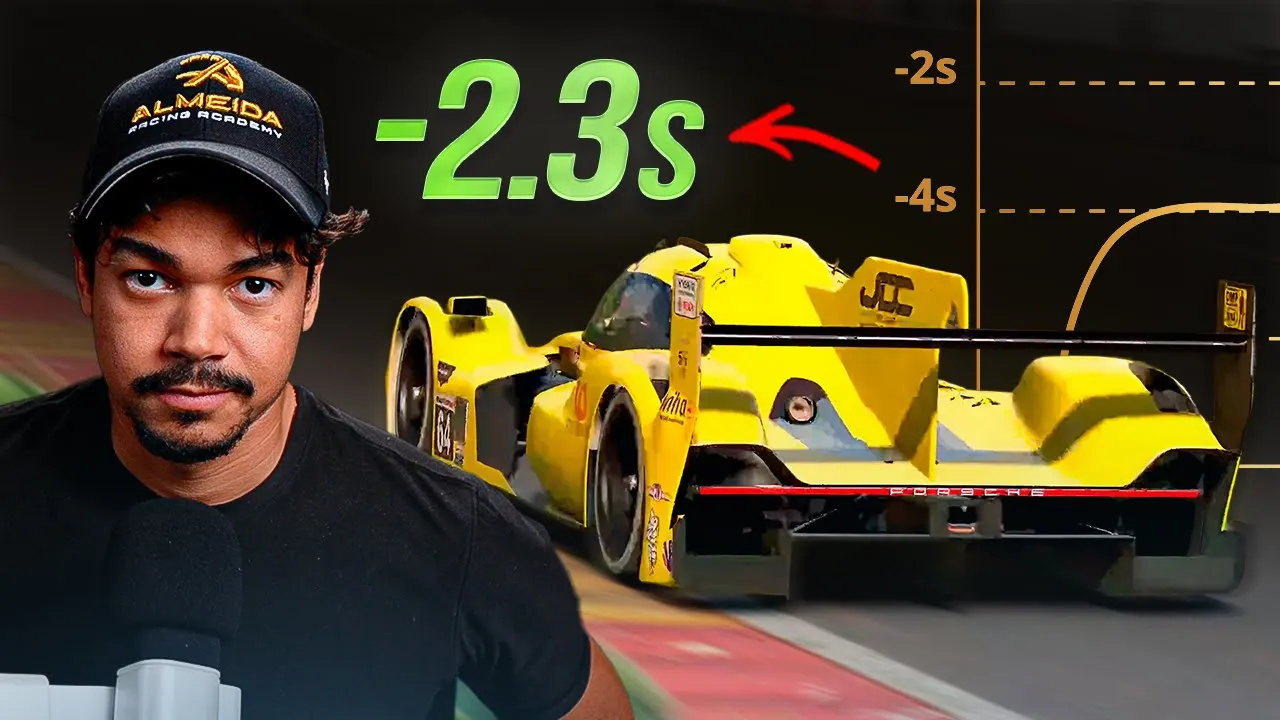
How One Driver Found 2.3 Seconds in One Hour (And Why Most Sim Racers Never Will)
Suellio Almeida
•
Tuesday, November 18, 2025
The Problem: You're Fast Enough to Be Frustrated
You've been sim racing for a while now. You know the basics. You can keep it on track. You're not slow.
But you're stuck.
Every session feels the same. You're hitting the same lap times, making the same mistakes in the same corners. You watch aliens on YouTube and think "I'm doing that... aren't I?"
You're not. And the gap between what you THINK you're doing and what you're ACTUALLY doing? That's where seconds hide.
What This Student Was Doing Wrong (And You Probably Are Too)
This driver came to me running 1:28s at Watkins Glen in the Dallara IR18. Respectable times. He knew the track. He had pace.
But watch his inputs and you'd see the same pattern 90% of intermediate sim racers fall into:
He was braking in a straight line.
Not because he didn't know about trail braking. He did. He'd watched the videos. He "understood" the concept.
The issue? He was treating trail braking like an ON/OFF switch. Brake hard. Turn. Release brake. Accelerate.
That's not trail braking. That's sequential inputs. And it's costing you MASSIVE time.
The Single Concept That Changed Everything
Trail braking isn't about WHEN you release the brake. It's about HOW you transfer load through the corner.
Here's what actually needs to happen:
You brake hard initially — yes, in a mostly straight line. But as you begin turning in, you DON'T just come off the brake. You BLEND brake release with steering input.
The brake keeps load on the front tires while you're asking them to turn. As the car rotates and you unwind the wheel, you're simultaneously rolling out of the brake. It's a GRADIENT, not a step.
This does two things:
1. Keeps the front tires loaded — More grip exactly when you need it most.
2. Controls the rotation platform — You're not asking the rear to suddenly take all the load while the car is still turning. That's how you get snaps and instability.
Most drivers release the brake too early because they're scared of understeer. But what they don't realize? That early release CAUSES the understeer by unloading the front.
What We Actually Changed in That One Hour
I didn't give this driver a setup. I didn't teach him some magic racing line.
I changed ONE input: Keep brake pressure longer, but reduce it progressively as you add steering.
We worked on three corners at Watkins Glen:
Turn 1 — He was releasing brake pressure completely before apex. I had him maintain 20-30% brake all the way to apex while unwinding the wheel. Rotation improved. Time dropped.
The Bus Stop chicane — He was braking, turning, braking, turning like two separate events. I made him overlap the inputs. Brake release matched steering unwind. The car flowed. Rear stayed stable.
Turn 5 (the 90-degree right) — This was the biggest gain. He was coasting mid-corner because he thought trail braking meant "brake less." Wrong. Trail braking means brake LONGER but lighter. We kept pressure deep into the corner. Front stayed loaded. He could carry more speed AND get on throttle earlier.
One adjustment. Three corners. 2.3 seconds.
Why Most Drivers Never Figure This Out
Because nobody tells you what trail braking FEELS like.
You watch a video. You see the concept. You try it once. It feels weird. You understeer. You think "this doesn't work for me" and go back to your old habits.
But here's the truth: Trail braking feels wrong at first because you've trained your brain to separate braking from turning.
Your muscle memory expects: brake → coast → turn → throttle.
Trail braking removes that coast phase. It BLENDS the phases. That's uncomfortable. It requires you to trust the front tires when every instinct says "you're going to understeer."
You won't. Not if you're managing load transfer correctly.
The Mistake Within the Mistake
Here's where it gets deeper.
Even drivers who KNOW about trail braking make this error: They keep the same brake pressure too long.
You can't brake at 100%, turn the wheel, and expect the front tires to handle both. Physics doesn't work that way.
The correct sequence:
1. Maximum brake pressure — Straight line or very early turn-in.
2. Progressive release — As steering input increases, brake pressure decreases. NOT a cliff drop. A slope.
3. Final phase — You're at 10-20% brake, maximum steering angle, approaching apex.
4. Transition — As you start unwinding the wheel, you're rolling off the last bit of brake and transitioning to throttle.
It's a DANCE. Brake and steering are inversely related. One goes up, the other comes down. But the OVERLAP is where the magic happens.
This student wasn't doing that. He was trying to trail brake, but he was keeping 60% pressure while adding full steering. Result? Understeer. Frustration. Slower lap times.
We adjusted the GRADIENT of brake release. Immediate improvement.
What You Can Do Right Now
You don't need a coach to start fixing this (though it helps — we'll get to that).
Here's your homework:
Pick ONE corner. Something medium-to-slow speed. Not a hairpin, not a flat-out kink. A proper braking corner.
Run 10 laps focusing ONLY on this:
Turn in slightly earlier than you normally would.
As you add steering, KEEP some brake pressure. Start with 20-30%.
Feel what happens to the front end. Does it bite? Does it push?
If it pushes, you're either keeping too much brake OR you need to release faster.
If it snaps, you're releasing too quickly and the rear is unloading.
Adjust the RATE of brake release. That's the skill. Not binary on/off. A smooth blend.
Record your inputs. Watch the brake trace. Does it look like a staircase or a slope? You want a slope.
This ONE change — done correctly — is worth seconds. Not tenths. Seconds.
The Bigger Picture: Why Technique Beats Talent
This student didn't suddenly become a better driver in one hour. He had the same reflexes, the same car control, the same spatial awareness.
What changed? He stopped guessing and started applying physics.
That's the difference between drivers who plateau and drivers who progress. Plateaued drivers rely on feel and repetition. Progressing drivers understand the MECHANISM.
You can feel your way to a 1:28. You can't feel your way to a 1:25. Not without understanding load transfer, tire slip angles, rotation dynamics, and brake modulation.
That's why YouTube tutorials don't work for most people. They show you WHAT to do. They don't teach you WHY it works or HOW to self-correct when it doesn't.
You need structured learning. You need feedback. You need someone who can watch your inputs and say "Here. This exact moment. This is where you're losing time."
That's coaching. That's what we do at Almeida Racing Academy.
What If You Could Find Your 2.3 Seconds?
How long have you been stuck at your current pace?
A month? Six months? A year?
What would change if you had a structured path — not just random YouTube videos, but a proven system that takes you from where you are now to consistently fast?
And what if you had someone in your corner who could actually SHOW you where the time is hiding — not in some generic way, but specific to YOUR driving, YOUR mistakes, YOUR track?
That's what happened for this student in one hour. One session. One focused correction.
Imagine what happens over eight weeks. Or six months.
If you're serious about getting faster — actually faster, not just spinning your wheels — you need more than motivation. You need METHOD.
Almeida Racing Academy Gold Membership gives you exactly that. Eight full courses. 80+ lessons covering everything from trail braking to racecraft to mental performance. Weekly coach-led workshops. Challenges that push you. A community of drivers actually improving, not just talking about it.
Right now, it's $25/month with code WINTER. That's less than one tank of gas. Less than one night out. Less than the cost of staying stuck.
Sim Racing Academy Membership
Everything you need to stop guessing and start getting faster.
Starting at
$25
/mo
Car Handling Online Course
4 levels, full curriculum. Aimed to get you to top 1% in driving pace.
Racecraft Online Course
Overtaking, Defending, Race Strategy
Live coaching + on-track practice
Bi-weekly pro-coach workshops (recorded — never miss one) plus on-track Pit Parties to practice racecraft with a coach.
Plus These Bonuses
13,000+ Member Community
League Racing
Advanced MX-5 Mini Course
Racing Technique Development Guide
The Motor Racing Book (260 pages)
Think & Behave Like a Pro Driver — Mini eBook
How One Driver Found 2.3 Seconds in One Hour (And Why Most Sim Racers Never Will)
Suellio Almeida
•
Tuesday, November 18, 2025
The Problem: You're Fast Enough to Be Frustrated
You've been sim racing for a while now. You know the basics. You can keep it on track. You're not slow.
But you're stuck.
Every session feels the same. You're hitting the same lap times, making the same mistakes in the same corners. You watch aliens on YouTube and think "I'm doing that... aren't I?"
You're not. And the gap between what you THINK you're doing and what you're ACTUALLY doing? That's where seconds hide.
What This Student Was Doing Wrong (And You Probably Are Too)
This driver came to me running 1:28s at Watkins Glen in the Dallara IR18. Respectable times. He knew the track. He had pace.
But watch his inputs and you'd see the same pattern 90% of intermediate sim racers fall into:
He was braking in a straight line.
Not because he didn't know about trail braking. He did. He'd watched the videos. He "understood" the concept.
The issue? He was treating trail braking like an ON/OFF switch. Brake hard. Turn. Release brake. Accelerate.
That's not trail braking. That's sequential inputs. And it's costing you MASSIVE time.
The Single Concept That Changed Everything
Trail braking isn't about WHEN you release the brake. It's about HOW you transfer load through the corner.
Here's what actually needs to happen:
You brake hard initially — yes, in a mostly straight line. But as you begin turning in, you DON'T just come off the brake. You BLEND brake release with steering input.
The brake keeps load on the front tires while you're asking them to turn. As the car rotates and you unwind the wheel, you're simultaneously rolling out of the brake. It's a GRADIENT, not a step.
This does two things:
1. Keeps the front tires loaded — More grip exactly when you need it most.
2. Controls the rotation platform — You're not asking the rear to suddenly take all the load while the car is still turning. That's how you get snaps and instability.
Most drivers release the brake too early because they're scared of understeer. But what they don't realize? That early release CAUSES the understeer by unloading the front.
What We Actually Changed in That One Hour
I didn't give this driver a setup. I didn't teach him some magic racing line.
I changed ONE input: Keep brake pressure longer, but reduce it progressively as you add steering.
We worked on three corners at Watkins Glen:
Turn 1 — He was releasing brake pressure completely before apex. I had him maintain 20-30% brake all the way to apex while unwinding the wheel. Rotation improved. Time dropped.
The Bus Stop chicane — He was braking, turning, braking, turning like two separate events. I made him overlap the inputs. Brake release matched steering unwind. The car flowed. Rear stayed stable.
Turn 5 (the 90-degree right) — This was the biggest gain. He was coasting mid-corner because he thought trail braking meant "brake less." Wrong. Trail braking means brake LONGER but lighter. We kept pressure deep into the corner. Front stayed loaded. He could carry more speed AND get on throttle earlier.
One adjustment. Three corners. 2.3 seconds.
Why Most Drivers Never Figure This Out
Because nobody tells you what trail braking FEELS like.
You watch a video. You see the concept. You try it once. It feels weird. You understeer. You think "this doesn't work for me" and go back to your old habits.
But here's the truth: Trail braking feels wrong at first because you've trained your brain to separate braking from turning.
Your muscle memory expects: brake → coast → turn → throttle.
Trail braking removes that coast phase. It BLENDS the phases. That's uncomfortable. It requires you to trust the front tires when every instinct says "you're going to understeer."
You won't. Not if you're managing load transfer correctly.
The Mistake Within the Mistake
Here's where it gets deeper.
Even drivers who KNOW about trail braking make this error: They keep the same brake pressure too long.
You can't brake at 100%, turn the wheel, and expect the front tires to handle both. Physics doesn't work that way.
The correct sequence:
1. Maximum brake pressure — Straight line or very early turn-in.
2. Progressive release — As steering input increases, brake pressure decreases. NOT a cliff drop. A slope.
3. Final phase — You're at 10-20% brake, maximum steering angle, approaching apex.
4. Transition — As you start unwinding the wheel, you're rolling off the last bit of brake and transitioning to throttle.
It's a DANCE. Brake and steering are inversely related. One goes up, the other comes down. But the OVERLAP is where the magic happens.
This student wasn't doing that. He was trying to trail brake, but he was keeping 60% pressure while adding full steering. Result? Understeer. Frustration. Slower lap times.
We adjusted the GRADIENT of brake release. Immediate improvement.
What You Can Do Right Now
You don't need a coach to start fixing this (though it helps — we'll get to that).
Here's your homework:
Pick ONE corner. Something medium-to-slow speed. Not a hairpin, not a flat-out kink. A proper braking corner.
Run 10 laps focusing ONLY on this:
Turn in slightly earlier than you normally would.
As you add steering, KEEP some brake pressure. Start with 20-30%.
Feel what happens to the front end. Does it bite? Does it push?
If it pushes, you're either keeping too much brake OR you need to release faster.
If it snaps, you're releasing too quickly and the rear is unloading.
Adjust the RATE of brake release. That's the skill. Not binary on/off. A smooth blend.
Record your inputs. Watch the brake trace. Does it look like a staircase or a slope? You want a slope.
This ONE change — done correctly — is worth seconds. Not tenths. Seconds.
The Bigger Picture: Why Technique Beats Talent
This student didn't suddenly become a better driver in one hour. He had the same reflexes, the same car control, the same spatial awareness.
What changed? He stopped guessing and started applying physics.
That's the difference between drivers who plateau and drivers who progress. Plateaued drivers rely on feel and repetition. Progressing drivers understand the MECHANISM.
You can feel your way to a 1:28. You can't feel your way to a 1:25. Not without understanding load transfer, tire slip angles, rotation dynamics, and brake modulation.
That's why YouTube tutorials don't work for most people. They show you WHAT to do. They don't teach you WHY it works or HOW to self-correct when it doesn't.
You need structured learning. You need feedback. You need someone who can watch your inputs and say "Here. This exact moment. This is where you're losing time."
That's coaching. That's what we do at Almeida Racing Academy.
What If You Could Find Your 2.3 Seconds?
How long have you been stuck at your current pace?
A month? Six months? A year?
What would change if you had a structured path — not just random YouTube videos, but a proven system that takes you from where you are now to consistently fast?
And what if you had someone in your corner who could actually SHOW you where the time is hiding — not in some generic way, but specific to YOUR driving, YOUR mistakes, YOUR track?
That's what happened for this student in one hour. One session. One focused correction.
Imagine what happens over eight weeks. Or six months.
If you're serious about getting faster — actually faster, not just spinning your wheels — you need more than motivation. You need METHOD.
Almeida Racing Academy Gold Membership gives you exactly that. Eight full courses. 80+ lessons covering everything from trail braking to racecraft to mental performance. Weekly coach-led workshops. Challenges that push you. A community of drivers actually improving, not just talking about it.
Right now, it's $25/month with code WINTER. That's less than one tank of gas. Less than one night out. Less than the cost of staying stuck.
Sim Racing Academy Membership
Everything you need to stop guessing and start getting faster.
Starting at
$25
/mo
Car Handling Online Course
4 levels, full curriculum. Aimed to get you to top 1% in driving pace.
Racecraft Online Course
Overtaking, Defending, Race Strategy
Live coaching + on-track practice
Bi-weekly pro-coach workshops (recorded — never miss one) plus on-track Pit Parties to practice racecraft with a coach.
Plus These Bonuses
13,000+ Member Community
League Racing
Advanced MX-5 Mini Course
Racing Technique Development Guide
The Motor Racing Book (260 pages)
Think & Behave Like a Pro Driver — Mini eBook
How One Driver Found 2.3 Seconds in One Hour (And Why Most Sim Racers Never Will)
Suellio Almeida
•
Tuesday, November 18, 2025
The Problem: You're Fast Enough to Be Frustrated
You've been sim racing for a while now. You know the basics. You can keep it on track. You're not slow.
But you're stuck.
Every session feels the same. You're hitting the same lap times, making the same mistakes in the same corners. You watch aliens on YouTube and think "I'm doing that... aren't I?"
You're not. And the gap between what you THINK you're doing and what you're ACTUALLY doing? That's where seconds hide.
What This Student Was Doing Wrong (And You Probably Are Too)
This driver came to me running 1:28s at Watkins Glen in the Dallara IR18. Respectable times. He knew the track. He had pace.
But watch his inputs and you'd see the same pattern 90% of intermediate sim racers fall into:
He was braking in a straight line.
Not because he didn't know about trail braking. He did. He'd watched the videos. He "understood" the concept.
The issue? He was treating trail braking like an ON/OFF switch. Brake hard. Turn. Release brake. Accelerate.
That's not trail braking. That's sequential inputs. And it's costing you MASSIVE time.
The Single Concept That Changed Everything
Trail braking isn't about WHEN you release the brake. It's about HOW you transfer load through the corner.
Here's what actually needs to happen:
You brake hard initially — yes, in a mostly straight line. But as you begin turning in, you DON'T just come off the brake. You BLEND brake release with steering input.
The brake keeps load on the front tires while you're asking them to turn. As the car rotates and you unwind the wheel, you're simultaneously rolling out of the brake. It's a GRADIENT, not a step.
This does two things:
1. Keeps the front tires loaded — More grip exactly when you need it most.
2. Controls the rotation platform — You're not asking the rear to suddenly take all the load while the car is still turning. That's how you get snaps and instability.
Most drivers release the brake too early because they're scared of understeer. But what they don't realize? That early release CAUSES the understeer by unloading the front.
What We Actually Changed in That One Hour
I didn't give this driver a setup. I didn't teach him some magic racing line.
I changed ONE input: Keep brake pressure longer, but reduce it progressively as you add steering.
We worked on three corners at Watkins Glen:
Turn 1 — He was releasing brake pressure completely before apex. I had him maintain 20-30% brake all the way to apex while unwinding the wheel. Rotation improved. Time dropped.
The Bus Stop chicane — He was braking, turning, braking, turning like two separate events. I made him overlap the inputs. Brake release matched steering unwind. The car flowed. Rear stayed stable.
Turn 5 (the 90-degree right) — This was the biggest gain. He was coasting mid-corner because he thought trail braking meant "brake less." Wrong. Trail braking means brake LONGER but lighter. We kept pressure deep into the corner. Front stayed loaded. He could carry more speed AND get on throttle earlier.
One adjustment. Three corners. 2.3 seconds.
Why Most Drivers Never Figure This Out
Because nobody tells you what trail braking FEELS like.
You watch a video. You see the concept. You try it once. It feels weird. You understeer. You think "this doesn't work for me" and go back to your old habits.
But here's the truth: Trail braking feels wrong at first because you've trained your brain to separate braking from turning.
Your muscle memory expects: brake → coast → turn → throttle.
Trail braking removes that coast phase. It BLENDS the phases. That's uncomfortable. It requires you to trust the front tires when every instinct says "you're going to understeer."
You won't. Not if you're managing load transfer correctly.
The Mistake Within the Mistake
Here's where it gets deeper.
Even drivers who KNOW about trail braking make this error: They keep the same brake pressure too long.
You can't brake at 100%, turn the wheel, and expect the front tires to handle both. Physics doesn't work that way.
The correct sequence:
1. Maximum brake pressure — Straight line or very early turn-in.
2. Progressive release — As steering input increases, brake pressure decreases. NOT a cliff drop. A slope.
3. Final phase — You're at 10-20% brake, maximum steering angle, approaching apex.
4. Transition — As you start unwinding the wheel, you're rolling off the last bit of brake and transitioning to throttle.
It's a DANCE. Brake and steering are inversely related. One goes up, the other comes down. But the OVERLAP is where the magic happens.
This student wasn't doing that. He was trying to trail brake, but he was keeping 60% pressure while adding full steering. Result? Understeer. Frustration. Slower lap times.
We adjusted the GRADIENT of brake release. Immediate improvement.
What You Can Do Right Now
You don't need a coach to start fixing this (though it helps — we'll get to that).
Here's your homework:
Pick ONE corner. Something medium-to-slow speed. Not a hairpin, not a flat-out kink. A proper braking corner.
Run 10 laps focusing ONLY on this:
Turn in slightly earlier than you normally would.
As you add steering, KEEP some brake pressure. Start with 20-30%.
Feel what happens to the front end. Does it bite? Does it push?
If it pushes, you're either keeping too much brake OR you need to release faster.
If it snaps, you're releasing too quickly and the rear is unloading.
Adjust the RATE of brake release. That's the skill. Not binary on/off. A smooth blend.
Record your inputs. Watch the brake trace. Does it look like a staircase or a slope? You want a slope.
This ONE change — done correctly — is worth seconds. Not tenths. Seconds.
The Bigger Picture: Why Technique Beats Talent
This student didn't suddenly become a better driver in one hour. He had the same reflexes, the same car control, the same spatial awareness.
What changed? He stopped guessing and started applying physics.
That's the difference between drivers who plateau and drivers who progress. Plateaued drivers rely on feel and repetition. Progressing drivers understand the MECHANISM.
You can feel your way to a 1:28. You can't feel your way to a 1:25. Not without understanding load transfer, tire slip angles, rotation dynamics, and brake modulation.
That's why YouTube tutorials don't work for most people. They show you WHAT to do. They don't teach you WHY it works or HOW to self-correct when it doesn't.
You need structured learning. You need feedback. You need someone who can watch your inputs and say "Here. This exact moment. This is where you're losing time."
That's coaching. That's what we do at Almeida Racing Academy.
What If You Could Find Your 2.3 Seconds?
How long have you been stuck at your current pace?
A month? Six months? A year?
What would change if you had a structured path — not just random YouTube videos, but a proven system that takes you from where you are now to consistently fast?
And what if you had someone in your corner who could actually SHOW you where the time is hiding — not in some generic way, but specific to YOUR driving, YOUR mistakes, YOUR track?
That's what happened for this student in one hour. One session. One focused correction.
Imagine what happens over eight weeks. Or six months.
If you're serious about getting faster — actually faster, not just spinning your wheels — you need more than motivation. You need METHOD.
Almeida Racing Academy Gold Membership gives you exactly that. Eight full courses. 80+ lessons covering everything from trail braking to racecraft to mental performance. Weekly coach-led workshops. Challenges that push you. A community of drivers actually improving, not just talking about it.
Right now, it's $25/month with code WINTER. That's less than one tank of gas. Less than one night out. Less than the cost of staying stuck.
Sim Racing Academy Membership
Everything you need to stop guessing and start getting faster.
Starting at
$25
/mo
Car Handling Online Course
4 levels, full curriculum. Aimed to get you to top 1% in driving pace.
Racecraft Online Course
Overtaking, Defending, Race Strategy
Live coaching + on-track practice
Bi-weekly pro-coach workshops (recorded — never miss one) plus on-track Pit Parties to practice racecraft with a coach.
Plus These Bonuses
13,000+ Member Community
League Racing
Advanced MX-5 Mini Course
Racing Technique Development Guide
The Motor Racing Book (260 pages)
Think & Behave Like a Pro Driver — Mini eBook