
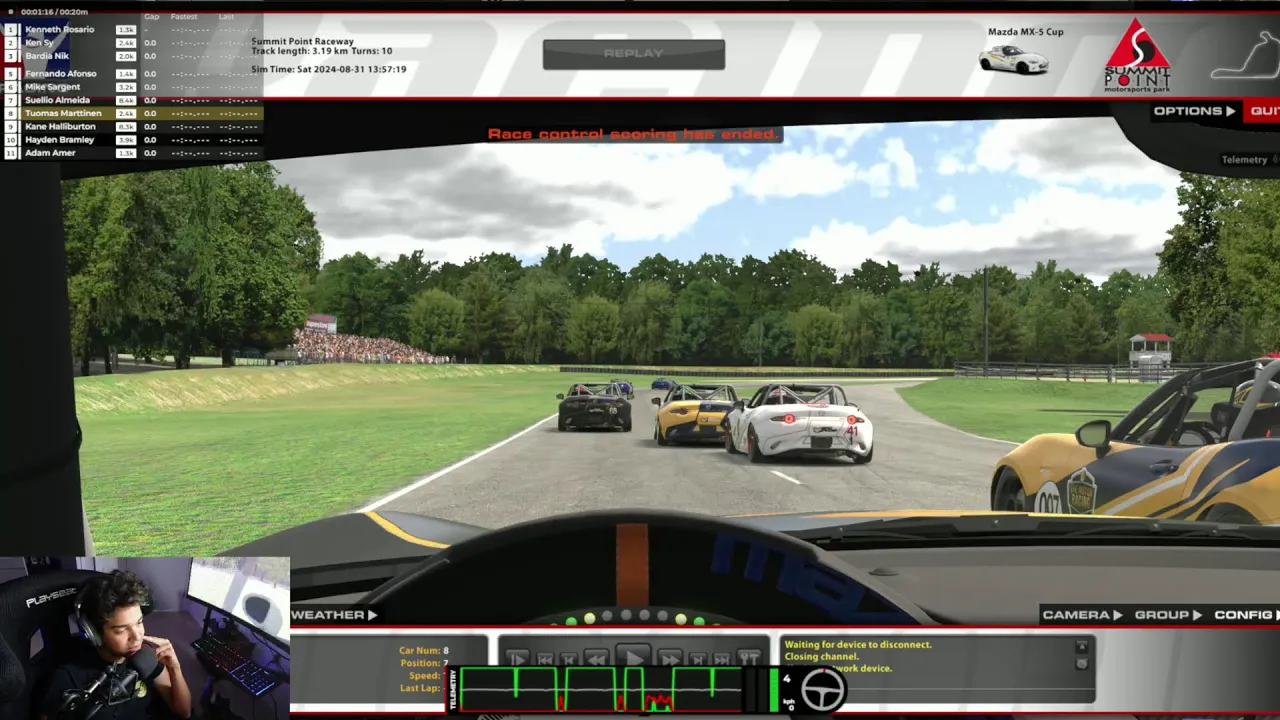
The Motor Racing League Season 1 Begins: MX-5 Racing at Summit Point
Suellio Almeida
•
Saturday, August 31, 2024
The Format: Real Racing, Real Pressure
The Motor Racing League isn't about casual driving. It's structured competition. Qualifying matters. Race craft matters. Consistency under pressure matters.
Season 1, Round 1 dropped us into MX-5s at Summit Point — a combination that rewards precision and punishes mistakes. Low power means you can't fix errors with straight-line speed. You live and die by your corner exits.
The grid formed after qualifying. Drivers who nailed their laps started up front. Everyone else had work to do.
Lap 1: Where Championships Are Won or Lost
The green flag dropped and immediately the field compressed into Turn 1. This is where most races get decided — not by the fastest car, but by the driver who keeps their head.
You see it every time: someone dives too deep, locks up, ruins their momentum. Or they play it safe, lose three positions, spend the entire race trying to recover.
The leaders held position through the opening corners. Clean. No drama. That's how you win races — survive the chaos, then execute.
But mid-pack? Different story. Contact. Lock-ups. Drivers getting squeezed. This is where you learn what racing actually is. It's not hotlapping. It's managing traffic, defending position, choosing your battles.
The Battle for Position: Trading Paint and Patience
By lap three, the race settled into clusters. Lead pack pulling away. Mid-field nose-to-tail. Back markers fighting to stay on the lead lap.
Watch how the front runners approach traffic. They don't panic. They set up the pass two corners in advance. They use slipstream down the straight, position themselves on the inside, brake later but not stupid-late.
Then you see the mistakes. A driver gets impatient, lunges into a gap that's closing, makes contact, both cars lose time. Or they sit on someone's bumper for five laps waiting for a mistake instead of creating an opportunity.
Here's what most drivers don't understand: you don't wait for the pass to come to you. You construct it. Pressure them into Turn 1, they defend, you switch sides for Turn 3. Make them think about you. Force the error.
One battle mid-pack showed exactly this. Two drivers trading positions for four laps straight. No contact. Just clean, aggressive racing. That's the standard.
The Physics of MX-5 Racing: Why This Car Teaches You Everything
The MX-5 is slow. That's the point.
You can't muscle it through mistakes. You can't make up for a bad corner exit with horsepower. Every input matters. Every tenth counts.
Watch the fast drivers. Their steering inputs are tiny. They're not sawing at the wheel. They rotate the car on entry with weight transfer, hold the rotation through the apex with throttle modulation, then unwind smoothly on exit.
The slow drivers? Huge steering corrections. Fighting the car. Scrubbing speed.
Summit Point punishes this. Turn 1 is all about brake application — too much pressure and you're in the grass. Not enough and you apex too early, compromise your exit, lose speed down the back straight.
Turn 5 (the long sweeping right) exposes vision problems. If you're staring at the apex, you're late everywhere. Eyes up, look where you're going three seconds ahead, and suddenly the car flows.
The Leaders Pull Away: What Separation Actually Means
By half distance, the lead battle was over. P1 and P2 had clean air. P3 was three seconds back.
Here's what that gap tells you: the leaders made zero mistakes. Not one lock-up. Not one moment of oversteer that cost momentum. Just perfect execution, lap after lap.
That's the difference between fast and consistent-fast. Anyone can do one quick lap. String together 15 identical laps under pressure? That's a different skill.
P3 was faster than P4 and P5 behind them, but they couldn't close the gap to P2. Why? Because when you're in clean air, every corner is perfect. When you're chasing, you're managing dirty air, changing lines to find grip, adjusting brake points.
The leaders controlled the pace. Managed their tires. Saved energy for the final laps.
Final Laps: When Mental Fatigue Becomes Physical
Lap 12. Lap 13. This is where races get decided.
Your hands are tired. Your focus is slipping. You start missing apexes by inches. Those inches become tenths. Those tenths become positions lost.
Watch what happens to lap times in the final three laps. The leaders stay consistent. Everyone else drops off. P6 loses four tenths a lap. P8 makes a mistake, runs wide, loses two positions.
Why? Because they didn't train for this. They practiced hotlaps, not race pace. They didn't build the mental endurance to execute under fatigue.
The winner crossed the line with a three-second gap. Clean race. No mistakes. That's how it's done.
The Checkered Flag: What We Learned
Round 1 is complete. Points are awarded. Some drivers exceeded expectations. Others learned hard lessons.
Here's what the data shows:
Consistency wins. The podium finishers had lap time standard deviations under 0.3 seconds. Everyone else was over 0.5.
Qualifying matters. P1 and P2 started up front and stayed there. Clean air is everything.
Racecraft is a skill. The battles mid-pack showed who knew how to overtake and who just knew how to go fast alone.
Season 1 continues. Next round, different track, different car. The competition gets tighter. The stakes get higher.
What If You Could Race Like This Every Week?
You just watched drivers from our community compete in structured, competitive racing. Clean battles. Real pressure. Actual improvement happening lap by lap.
How long have you been practicing alone? Hotlapping the same track, chasing the same ghosts, wondering why your race results don't match your qualifying pace?
What would change if you had a community pushing you? Regular competition? Structured events where your racecraft actually gets tested?
The Motor Racing League is part of Almeida Racing Academy's Gold Membership. Along with access to 8 complete courses (80+ lessons on technique, racecraft, and mental game), you get weekly challenges, league racing, coach-led workshops, and the Discord community where this all happens.
$25/month with code WINTER. No contract. Cancel anytime.
Sim Racing Academy Membership
Everything you need to stop guessing and start getting faster.
Starting at
$25
/mo
Car Handling Online Course
4 levels, full curriculum. Aimed to get you to top 1% in driving pace.
Racecraft Online Course
Overtaking, Defending, Race Strategy
Live coaching + on-track practice
Bi-weekly pro-coach workshops (recorded — never miss one) plus on-track Pit Parties to practice racecraft with a coach.
Plus These Bonuses
13,000+ Member Community
League Racing
Advanced MX-5 Mini Course
Racing Technique Development Guide
The Motor Racing Book (260 pages)
Think & Behave Like a Pro Driver — Mini eBook
The Motor Racing League Season 1 Begins: MX-5 Racing at Summit Point
Suellio Almeida
•
Saturday, August 31, 2024
The Format: Real Racing, Real Pressure
The Motor Racing League isn't about casual driving. It's structured competition. Qualifying matters. Race craft matters. Consistency under pressure matters.
Season 1, Round 1 dropped us into MX-5s at Summit Point — a combination that rewards precision and punishes mistakes. Low power means you can't fix errors with straight-line speed. You live and die by your corner exits.
The grid formed after qualifying. Drivers who nailed their laps started up front. Everyone else had work to do.
Lap 1: Where Championships Are Won or Lost
The green flag dropped and immediately the field compressed into Turn 1. This is where most races get decided — not by the fastest car, but by the driver who keeps their head.
You see it every time: someone dives too deep, locks up, ruins their momentum. Or they play it safe, lose three positions, spend the entire race trying to recover.
The leaders held position through the opening corners. Clean. No drama. That's how you win races — survive the chaos, then execute.
But mid-pack? Different story. Contact. Lock-ups. Drivers getting squeezed. This is where you learn what racing actually is. It's not hotlapping. It's managing traffic, defending position, choosing your battles.
The Battle for Position: Trading Paint and Patience
By lap three, the race settled into clusters. Lead pack pulling away. Mid-field nose-to-tail. Back markers fighting to stay on the lead lap.
Watch how the front runners approach traffic. They don't panic. They set up the pass two corners in advance. They use slipstream down the straight, position themselves on the inside, brake later but not stupid-late.
Then you see the mistakes. A driver gets impatient, lunges into a gap that's closing, makes contact, both cars lose time. Or they sit on someone's bumper for five laps waiting for a mistake instead of creating an opportunity.
Here's what most drivers don't understand: you don't wait for the pass to come to you. You construct it. Pressure them into Turn 1, they defend, you switch sides for Turn 3. Make them think about you. Force the error.
One battle mid-pack showed exactly this. Two drivers trading positions for four laps straight. No contact. Just clean, aggressive racing. That's the standard.
The Physics of MX-5 Racing: Why This Car Teaches You Everything
The MX-5 is slow. That's the point.
You can't muscle it through mistakes. You can't make up for a bad corner exit with horsepower. Every input matters. Every tenth counts.
Watch the fast drivers. Their steering inputs are tiny. They're not sawing at the wheel. They rotate the car on entry with weight transfer, hold the rotation through the apex with throttle modulation, then unwind smoothly on exit.
The slow drivers? Huge steering corrections. Fighting the car. Scrubbing speed.
Summit Point punishes this. Turn 1 is all about brake application — too much pressure and you're in the grass. Not enough and you apex too early, compromise your exit, lose speed down the back straight.
Turn 5 (the long sweeping right) exposes vision problems. If you're staring at the apex, you're late everywhere. Eyes up, look where you're going three seconds ahead, and suddenly the car flows.
The Leaders Pull Away: What Separation Actually Means
By half distance, the lead battle was over. P1 and P2 had clean air. P3 was three seconds back.
Here's what that gap tells you: the leaders made zero mistakes. Not one lock-up. Not one moment of oversteer that cost momentum. Just perfect execution, lap after lap.
That's the difference between fast and consistent-fast. Anyone can do one quick lap. String together 15 identical laps under pressure? That's a different skill.
P3 was faster than P4 and P5 behind them, but they couldn't close the gap to P2. Why? Because when you're in clean air, every corner is perfect. When you're chasing, you're managing dirty air, changing lines to find grip, adjusting brake points.
The leaders controlled the pace. Managed their tires. Saved energy for the final laps.
Final Laps: When Mental Fatigue Becomes Physical
Lap 12. Lap 13. This is where races get decided.
Your hands are tired. Your focus is slipping. You start missing apexes by inches. Those inches become tenths. Those tenths become positions lost.
Watch what happens to lap times in the final three laps. The leaders stay consistent. Everyone else drops off. P6 loses four tenths a lap. P8 makes a mistake, runs wide, loses two positions.
Why? Because they didn't train for this. They practiced hotlaps, not race pace. They didn't build the mental endurance to execute under fatigue.
The winner crossed the line with a three-second gap. Clean race. No mistakes. That's how it's done.
The Checkered Flag: What We Learned
Round 1 is complete. Points are awarded. Some drivers exceeded expectations. Others learned hard lessons.
Here's what the data shows:
Consistency wins. The podium finishers had lap time standard deviations under 0.3 seconds. Everyone else was over 0.5.
Qualifying matters. P1 and P2 started up front and stayed there. Clean air is everything.
Racecraft is a skill. The battles mid-pack showed who knew how to overtake and who just knew how to go fast alone.
Season 1 continues. Next round, different track, different car. The competition gets tighter. The stakes get higher.
What If You Could Race Like This Every Week?
You just watched drivers from our community compete in structured, competitive racing. Clean battles. Real pressure. Actual improvement happening lap by lap.
How long have you been practicing alone? Hotlapping the same track, chasing the same ghosts, wondering why your race results don't match your qualifying pace?
What would change if you had a community pushing you? Regular competition? Structured events where your racecraft actually gets tested?
The Motor Racing League is part of Almeida Racing Academy's Gold Membership. Along with access to 8 complete courses (80+ lessons on technique, racecraft, and mental game), you get weekly challenges, league racing, coach-led workshops, and the Discord community where this all happens.
$25/month with code WINTER. No contract. Cancel anytime.
Sim Racing Academy Membership
Everything you need to stop guessing and start getting faster.
Starting at
$25
/mo
Car Handling Online Course
4 levels, full curriculum. Aimed to get you to top 1% in driving pace.
Racecraft Online Course
Overtaking, Defending, Race Strategy
Live coaching + on-track practice
Bi-weekly pro-coach workshops (recorded — never miss one) plus on-track Pit Parties to practice racecraft with a coach.
Plus These Bonuses
13,000+ Member Community
League Racing
Advanced MX-5 Mini Course
Racing Technique Development Guide
The Motor Racing Book (260 pages)
Think & Behave Like a Pro Driver — Mini eBook
The Motor Racing League Season 1 Begins: MX-5 Racing at Summit Point
Suellio Almeida
•
Saturday, August 31, 2024
The Format: Real Racing, Real Pressure
The Motor Racing League isn't about casual driving. It's structured competition. Qualifying matters. Race craft matters. Consistency under pressure matters.
Season 1, Round 1 dropped us into MX-5s at Summit Point — a combination that rewards precision and punishes mistakes. Low power means you can't fix errors with straight-line speed. You live and die by your corner exits.
The grid formed after qualifying. Drivers who nailed their laps started up front. Everyone else had work to do.
Lap 1: Where Championships Are Won or Lost
The green flag dropped and immediately the field compressed into Turn 1. This is where most races get decided — not by the fastest car, but by the driver who keeps their head.
You see it every time: someone dives too deep, locks up, ruins their momentum. Or they play it safe, lose three positions, spend the entire race trying to recover.
The leaders held position through the opening corners. Clean. No drama. That's how you win races — survive the chaos, then execute.
But mid-pack? Different story. Contact. Lock-ups. Drivers getting squeezed. This is where you learn what racing actually is. It's not hotlapping. It's managing traffic, defending position, choosing your battles.
The Battle for Position: Trading Paint and Patience
By lap three, the race settled into clusters. Lead pack pulling away. Mid-field nose-to-tail. Back markers fighting to stay on the lead lap.
Watch how the front runners approach traffic. They don't panic. They set up the pass two corners in advance. They use slipstream down the straight, position themselves on the inside, brake later but not stupid-late.
Then you see the mistakes. A driver gets impatient, lunges into a gap that's closing, makes contact, both cars lose time. Or they sit on someone's bumper for five laps waiting for a mistake instead of creating an opportunity.
Here's what most drivers don't understand: you don't wait for the pass to come to you. You construct it. Pressure them into Turn 1, they defend, you switch sides for Turn 3. Make them think about you. Force the error.
One battle mid-pack showed exactly this. Two drivers trading positions for four laps straight. No contact. Just clean, aggressive racing. That's the standard.
The Physics of MX-5 Racing: Why This Car Teaches You Everything
The MX-5 is slow. That's the point.
You can't muscle it through mistakes. You can't make up for a bad corner exit with horsepower. Every input matters. Every tenth counts.
Watch the fast drivers. Their steering inputs are tiny. They're not sawing at the wheel. They rotate the car on entry with weight transfer, hold the rotation through the apex with throttle modulation, then unwind smoothly on exit.
The slow drivers? Huge steering corrections. Fighting the car. Scrubbing speed.
Summit Point punishes this. Turn 1 is all about brake application — too much pressure and you're in the grass. Not enough and you apex too early, compromise your exit, lose speed down the back straight.
Turn 5 (the long sweeping right) exposes vision problems. If you're staring at the apex, you're late everywhere. Eyes up, look where you're going three seconds ahead, and suddenly the car flows.
The Leaders Pull Away: What Separation Actually Means
By half distance, the lead battle was over. P1 and P2 had clean air. P3 was three seconds back.
Here's what that gap tells you: the leaders made zero mistakes. Not one lock-up. Not one moment of oversteer that cost momentum. Just perfect execution, lap after lap.
That's the difference between fast and consistent-fast. Anyone can do one quick lap. String together 15 identical laps under pressure? That's a different skill.
P3 was faster than P4 and P5 behind them, but they couldn't close the gap to P2. Why? Because when you're in clean air, every corner is perfect. When you're chasing, you're managing dirty air, changing lines to find grip, adjusting brake points.
The leaders controlled the pace. Managed their tires. Saved energy for the final laps.
Final Laps: When Mental Fatigue Becomes Physical
Lap 12. Lap 13. This is where races get decided.
Your hands are tired. Your focus is slipping. You start missing apexes by inches. Those inches become tenths. Those tenths become positions lost.
Watch what happens to lap times in the final three laps. The leaders stay consistent. Everyone else drops off. P6 loses four tenths a lap. P8 makes a mistake, runs wide, loses two positions.
Why? Because they didn't train for this. They practiced hotlaps, not race pace. They didn't build the mental endurance to execute under fatigue.
The winner crossed the line with a three-second gap. Clean race. No mistakes. That's how it's done.
The Checkered Flag: What We Learned
Round 1 is complete. Points are awarded. Some drivers exceeded expectations. Others learned hard lessons.
Here's what the data shows:
Consistency wins. The podium finishers had lap time standard deviations under 0.3 seconds. Everyone else was over 0.5.
Qualifying matters. P1 and P2 started up front and stayed there. Clean air is everything.
Racecraft is a skill. The battles mid-pack showed who knew how to overtake and who just knew how to go fast alone.
Season 1 continues. Next round, different track, different car. The competition gets tighter. The stakes get higher.
What If You Could Race Like This Every Week?
You just watched drivers from our community compete in structured, competitive racing. Clean battles. Real pressure. Actual improvement happening lap by lap.
How long have you been practicing alone? Hotlapping the same track, chasing the same ghosts, wondering why your race results don't match your qualifying pace?
What would change if you had a community pushing you? Regular competition? Structured events where your racecraft actually gets tested?
The Motor Racing League is part of Almeida Racing Academy's Gold Membership. Along with access to 8 complete courses (80+ lessons on technique, racecraft, and mental game), you get weekly challenges, league racing, coach-led workshops, and the Discord community where this all happens.
$25/month with code WINTER. No contract. Cancel anytime.
Sim Racing Academy Membership
Everything you need to stop guessing and start getting faster.
Starting at
$25
/mo
Car Handling Online Course
4 levels, full curriculum. Aimed to get you to top 1% in driving pace.
Racecraft Online Course
Overtaking, Defending, Race Strategy
Live coaching + on-track practice
Bi-weekly pro-coach workshops (recorded — never miss one) plus on-track Pit Parties to practice racecraft with a coach.
Plus These Bonuses
13,000+ Member Community
League Racing
Advanced MX-5 Mini Course
Racing Technique Development Guide
The Motor Racing Book (260 pages)
Think & Behave Like a Pro Driver — Mini eBook