
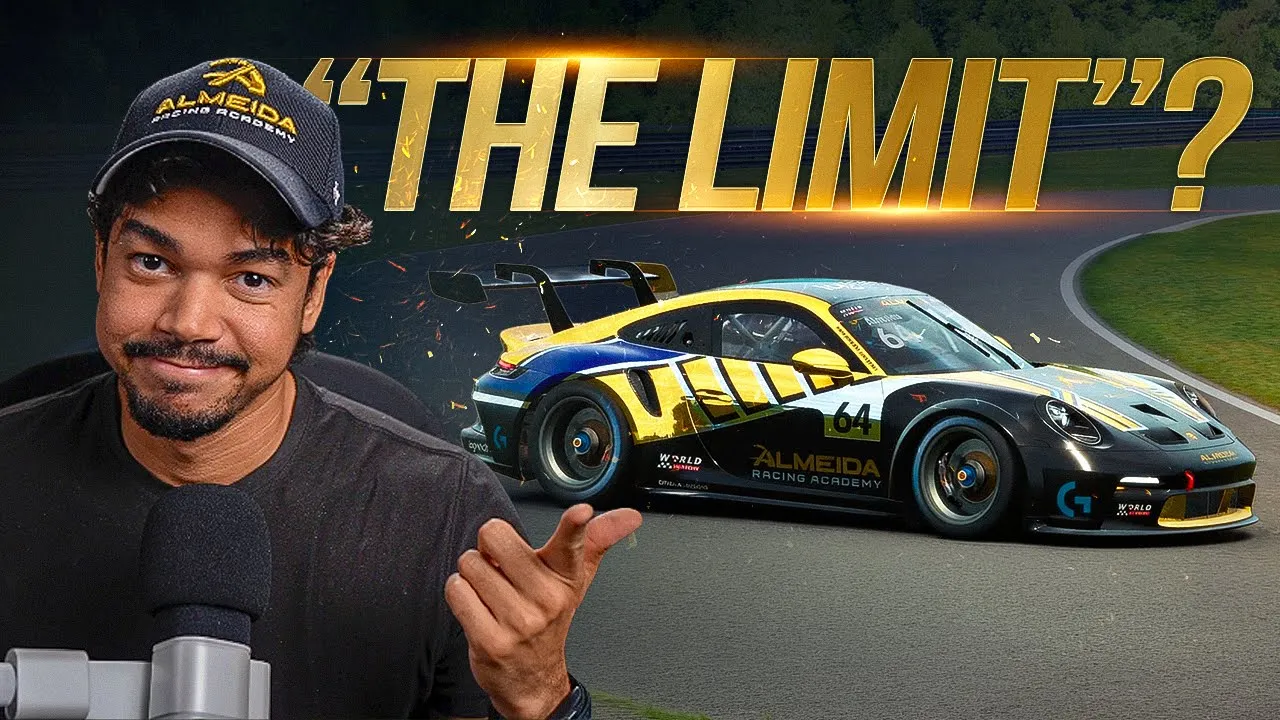
What is The Limit? Understanding Racing Dynamics and Car Control
Suellio Almeida
•
Thursday, December 4, 2025
The Limit Isn't What You Think It Is
Most drivers believe the limit is the moment before the car breaks loose. Wrong.
The limit is the maximum amount of grip your tires can generate at any given moment. It's physics. It's measurable. And it changes constantly based on speed, load, temperature, surface — everything.
You're not trying to find one magical edge and stay there. You're managing a dynamic relationship between your inputs and the car's response.
Here's the problem: if you think the limit is binary — on or off, grip or slide — you'll never learn to dance with it. You'll either drive too cautiously or overcook corners trying to "push harder."
The Traction Circle: Your New Mental Model
Every tire has a finite amount of grip. Think of it as a circle.
That circle represents the maximum combined forces your tire can handle: braking, acceleration, and cornering. Use all your grip for braking? You have nothing left for turning. Use it all for turning? You can't accelerate or brake.
This is why drivers who brake in a straight line and then try to turn end up slow. They're not blending forces. They're using grip in sequence instead of combination.
The fastest drivers? They're constantly working at the edge of that circle, transitioning smoothly between braking, turning, and accelerating. No wasted grip. No sudden inputs that exceed the circle's edge.
If you've ever wondered why your trail braking isn't working — this is why. You're releasing the brakes too early or too late, not blending brake pressure with steering input to keep the car balanced at the edge of available grip.
Load Transfer: Why Your Car Handles Different in Every Corner
The limit isn't static because load transfer isn't static.
When you brake, weight shifts forward. Front tires gain grip. Rears lose it. When you accelerate, weight shifts back. Rears gain grip. Fronts lose it. Mid-corner? Weight shifts laterally to the outside tires.
This is why you can't drive every corner the same way. A slow hairpin needs different weight management than a fast sweeper. The limit changes with the corner.
If you're fighting understeer mid-corner, you've probably asked the front tires to do too much — either you're carrying too much speed, or you turned in too aggressively, or you're still on the brakes when the fronts need grip for turning.
If you're getting snap oversteer on corner exit, you've unloaded the rears too quickly. Sudden throttle application shifts weight back before the rears are ready. The tires exceed their traction circle. You spin.
Understanding load transfer means you stop reacting to the car and start anticipating it. You know what's coming because you know what you're asking the tires to do.
Platform: The Forgotten Foundation of Speed
Here's what separates good drivers from great ones: platform management.
Platform is the car's settled state. It's when the suspension isn't compressing or rebounding dramatically. It's when weight distribution is predictable. It's when the car is stable enough to receive your next input.
You can't push to the limit if the car isn't on platform. You'll just upset it.
Watch an alien lap. Notice how smooth their inputs are? They're not being gentle for the sake of it. They're managing platform. Every input — brake, turn, throttle — is timed so the car stays balanced. No sudden weight shifts. No oscillations.
This is why aggressive drivers who "attack" corners often end up slower. They're constantly unsettling the car. The suspension is bouncing. The weight is shifting unpredictably. The limit becomes impossible to find because it's moving all over the place.
Smooth doesn't mean slow. Smooth means you're giving the car what it needs to stay at the edge of grip without crossing it.
Finding the Limit Without Crashing (Much)
So how do you actually learn where the limit is?
You push past it. Deliberately. Controlled. Not in a race — in practice.
Pick one corner. Brake later and later each lap until you lock up or miss the apex. That's too far. Back it off 5%. Now you know.
Carry more speed mid-corner until you get understeer. That's too much. Back it off. Now you know.
Get on throttle earlier each lap until the rear steps out. That's the edge. Now you know where it is.
The limit isn't some mystical thing. It's a repeatable, learnable threshold. You just have to be willing to cross it enough times to recognize what it feels like right before you do.
This is why data is powerful. Brake pressure traces, throttle application points, steering angle — they show you exactly where you crossed the limit and what you did differently when you didn't.
But data without understanding is just numbers. You need to feel it first. Then the data confirms what you already know.
Consistency Comes from Staying Just Below the Limit
Here's the truth nobody tells you: the fastest race pace isn't at 100% of the limit. It's at 95%.
Why? Because at 100%, you're one tiny mistake away from exceeding it. One bump, one lockup, one degree too much steering angle, and you're off.
At 95%, you have margin. You can react. You can adjust. You stay consistent.
This is why aliens don't look like they're trying. They're not driving at the ragged edge. They've learned the limit so well that they can sit just below it, lap after lap, without drama.
You want to be fast in a race? Learn the limit in practice. Then race at 95% of it. You'll be faster than the guy who's trying to squeeze every millisecond out of every corner and bins it on lap 3.
What Would Change If You Actually Understood Your Car?
You've been chasing lap time the hard way.
You're watching aliens. Copying lines. Trying different setups. Hoping something clicks.
But you're missing the foundation: understanding the physics of what the car is actually doing. Why it understeers. Why it snaps. Why you can't get on throttle as early as the fast guys.
The limit isn't a mystery. It's physics. And physics can be learned.
What if you stopped guessing and started training with the same structure that took Suellio from pianist to IMSA driver? What if you had a system that taught you car control, weight transfer, and racecraft — not through random YouTube videos, but through a proven coaching method used by 36,000+ students?
Almeida Racing Academy's Gold Membership gives you 8 full courses, 80+ lessons, coach-led workshops, and a community of drivers who've already made the jump from inconsistent to competitive. Right now, it's $25/mo with code WINTER.
You can keep struggling alone. Or you can learn the right way.
Sim Racing Academy Membership
Everything you need to stop guessing and start getting faster.
Starting at
$25
/mo
Car Handling Online Course
4 levels, full curriculum. Aimed to get you to top 1% in driving pace.
Racecraft Online Course
Overtaking, Defending, Race Strategy
Live coaching + on-track practice
Bi-weekly pro-coach workshops (recorded — never miss one) plus on-track Pit Parties to practice racecraft with a coach.
Plus These Bonuses
13,000+ Member Community
League Racing
Advanced MX-5 Mini Course
Racing Technique Development Guide
The Motor Racing Book (260 pages)
Think & Behave Like a Pro Driver — Mini eBook
What is The Limit? Understanding Racing Dynamics and Car Control
Suellio Almeida
•
Thursday, December 4, 2025
The Limit Isn't What You Think It Is
Most drivers believe the limit is the moment before the car breaks loose. Wrong.
The limit is the maximum amount of grip your tires can generate at any given moment. It's physics. It's measurable. And it changes constantly based on speed, load, temperature, surface — everything.
You're not trying to find one magical edge and stay there. You're managing a dynamic relationship between your inputs and the car's response.
Here's the problem: if you think the limit is binary — on or off, grip or slide — you'll never learn to dance with it. You'll either drive too cautiously or overcook corners trying to "push harder."
The Traction Circle: Your New Mental Model
Every tire has a finite amount of grip. Think of it as a circle.
That circle represents the maximum combined forces your tire can handle: braking, acceleration, and cornering. Use all your grip for braking? You have nothing left for turning. Use it all for turning? You can't accelerate or brake.
This is why drivers who brake in a straight line and then try to turn end up slow. They're not blending forces. They're using grip in sequence instead of combination.
The fastest drivers? They're constantly working at the edge of that circle, transitioning smoothly between braking, turning, and accelerating. No wasted grip. No sudden inputs that exceed the circle's edge.
If you've ever wondered why your trail braking isn't working — this is why. You're releasing the brakes too early or too late, not blending brake pressure with steering input to keep the car balanced at the edge of available grip.
Load Transfer: Why Your Car Handles Different in Every Corner
The limit isn't static because load transfer isn't static.
When you brake, weight shifts forward. Front tires gain grip. Rears lose it. When you accelerate, weight shifts back. Rears gain grip. Fronts lose it. Mid-corner? Weight shifts laterally to the outside tires.
This is why you can't drive every corner the same way. A slow hairpin needs different weight management than a fast sweeper. The limit changes with the corner.
If you're fighting understeer mid-corner, you've probably asked the front tires to do too much — either you're carrying too much speed, or you turned in too aggressively, or you're still on the brakes when the fronts need grip for turning.
If you're getting snap oversteer on corner exit, you've unloaded the rears too quickly. Sudden throttle application shifts weight back before the rears are ready. The tires exceed their traction circle. You spin.
Understanding load transfer means you stop reacting to the car and start anticipating it. You know what's coming because you know what you're asking the tires to do.
Platform: The Forgotten Foundation of Speed
Here's what separates good drivers from great ones: platform management.
Platform is the car's settled state. It's when the suspension isn't compressing or rebounding dramatically. It's when weight distribution is predictable. It's when the car is stable enough to receive your next input.
You can't push to the limit if the car isn't on platform. You'll just upset it.
Watch an alien lap. Notice how smooth their inputs are? They're not being gentle for the sake of it. They're managing platform. Every input — brake, turn, throttle — is timed so the car stays balanced. No sudden weight shifts. No oscillations.
This is why aggressive drivers who "attack" corners often end up slower. They're constantly unsettling the car. The suspension is bouncing. The weight is shifting unpredictably. The limit becomes impossible to find because it's moving all over the place.
Smooth doesn't mean slow. Smooth means you're giving the car what it needs to stay at the edge of grip without crossing it.
Finding the Limit Without Crashing (Much)
So how do you actually learn where the limit is?
You push past it. Deliberately. Controlled. Not in a race — in practice.
Pick one corner. Brake later and later each lap until you lock up or miss the apex. That's too far. Back it off 5%. Now you know.
Carry more speed mid-corner until you get understeer. That's too much. Back it off. Now you know.
Get on throttle earlier each lap until the rear steps out. That's the edge. Now you know where it is.
The limit isn't some mystical thing. It's a repeatable, learnable threshold. You just have to be willing to cross it enough times to recognize what it feels like right before you do.
This is why data is powerful. Brake pressure traces, throttle application points, steering angle — they show you exactly where you crossed the limit and what you did differently when you didn't.
But data without understanding is just numbers. You need to feel it first. Then the data confirms what you already know.
Consistency Comes from Staying Just Below the Limit
Here's the truth nobody tells you: the fastest race pace isn't at 100% of the limit. It's at 95%.
Why? Because at 100%, you're one tiny mistake away from exceeding it. One bump, one lockup, one degree too much steering angle, and you're off.
At 95%, you have margin. You can react. You can adjust. You stay consistent.
This is why aliens don't look like they're trying. They're not driving at the ragged edge. They've learned the limit so well that they can sit just below it, lap after lap, without drama.
You want to be fast in a race? Learn the limit in practice. Then race at 95% of it. You'll be faster than the guy who's trying to squeeze every millisecond out of every corner and bins it on lap 3.
What Would Change If You Actually Understood Your Car?
You've been chasing lap time the hard way.
You're watching aliens. Copying lines. Trying different setups. Hoping something clicks.
But you're missing the foundation: understanding the physics of what the car is actually doing. Why it understeers. Why it snaps. Why you can't get on throttle as early as the fast guys.
The limit isn't a mystery. It's physics. And physics can be learned.
What if you stopped guessing and started training with the same structure that took Suellio from pianist to IMSA driver? What if you had a system that taught you car control, weight transfer, and racecraft — not through random YouTube videos, but through a proven coaching method used by 36,000+ students?
Almeida Racing Academy's Gold Membership gives you 8 full courses, 80+ lessons, coach-led workshops, and a community of drivers who've already made the jump from inconsistent to competitive. Right now, it's $25/mo with code WINTER.
You can keep struggling alone. Or you can learn the right way.
Sim Racing Academy Membership
Everything you need to stop guessing and start getting faster.
Starting at
$25
/mo
Car Handling Online Course
4 levels, full curriculum. Aimed to get you to top 1% in driving pace.
Racecraft Online Course
Overtaking, Defending, Race Strategy
Live coaching + on-track practice
Bi-weekly pro-coach workshops (recorded — never miss one) plus on-track Pit Parties to practice racecraft with a coach.
Plus These Bonuses
13,000+ Member Community
League Racing
Advanced MX-5 Mini Course
Racing Technique Development Guide
The Motor Racing Book (260 pages)
Think & Behave Like a Pro Driver — Mini eBook
What is The Limit? Understanding Racing Dynamics and Car Control
Suellio Almeida
•
Thursday, December 4, 2025
The Limit Isn't What You Think It Is
Most drivers believe the limit is the moment before the car breaks loose. Wrong.
The limit is the maximum amount of grip your tires can generate at any given moment. It's physics. It's measurable. And it changes constantly based on speed, load, temperature, surface — everything.
You're not trying to find one magical edge and stay there. You're managing a dynamic relationship between your inputs and the car's response.
Here's the problem: if you think the limit is binary — on or off, grip or slide — you'll never learn to dance with it. You'll either drive too cautiously or overcook corners trying to "push harder."
The Traction Circle: Your New Mental Model
Every tire has a finite amount of grip. Think of it as a circle.
That circle represents the maximum combined forces your tire can handle: braking, acceleration, and cornering. Use all your grip for braking? You have nothing left for turning. Use it all for turning? You can't accelerate or brake.
This is why drivers who brake in a straight line and then try to turn end up slow. They're not blending forces. They're using grip in sequence instead of combination.
The fastest drivers? They're constantly working at the edge of that circle, transitioning smoothly between braking, turning, and accelerating. No wasted grip. No sudden inputs that exceed the circle's edge.
If you've ever wondered why your trail braking isn't working — this is why. You're releasing the brakes too early or too late, not blending brake pressure with steering input to keep the car balanced at the edge of available grip.
Load Transfer: Why Your Car Handles Different in Every Corner
The limit isn't static because load transfer isn't static.
When you brake, weight shifts forward. Front tires gain grip. Rears lose it. When you accelerate, weight shifts back. Rears gain grip. Fronts lose it. Mid-corner? Weight shifts laterally to the outside tires.
This is why you can't drive every corner the same way. A slow hairpin needs different weight management than a fast sweeper. The limit changes with the corner.
If you're fighting understeer mid-corner, you've probably asked the front tires to do too much — either you're carrying too much speed, or you turned in too aggressively, or you're still on the brakes when the fronts need grip for turning.
If you're getting snap oversteer on corner exit, you've unloaded the rears too quickly. Sudden throttle application shifts weight back before the rears are ready. The tires exceed their traction circle. You spin.
Understanding load transfer means you stop reacting to the car and start anticipating it. You know what's coming because you know what you're asking the tires to do.
Platform: The Forgotten Foundation of Speed
Here's what separates good drivers from great ones: platform management.
Platform is the car's settled state. It's when the suspension isn't compressing or rebounding dramatically. It's when weight distribution is predictable. It's when the car is stable enough to receive your next input.
You can't push to the limit if the car isn't on platform. You'll just upset it.
Watch an alien lap. Notice how smooth their inputs are? They're not being gentle for the sake of it. They're managing platform. Every input — brake, turn, throttle — is timed so the car stays balanced. No sudden weight shifts. No oscillations.
This is why aggressive drivers who "attack" corners often end up slower. They're constantly unsettling the car. The suspension is bouncing. The weight is shifting unpredictably. The limit becomes impossible to find because it's moving all over the place.
Smooth doesn't mean slow. Smooth means you're giving the car what it needs to stay at the edge of grip without crossing it.
Finding the Limit Without Crashing (Much)
So how do you actually learn where the limit is?
You push past it. Deliberately. Controlled. Not in a race — in practice.
Pick one corner. Brake later and later each lap until you lock up or miss the apex. That's too far. Back it off 5%. Now you know.
Carry more speed mid-corner until you get understeer. That's too much. Back it off. Now you know.
Get on throttle earlier each lap until the rear steps out. That's the edge. Now you know where it is.
The limit isn't some mystical thing. It's a repeatable, learnable threshold. You just have to be willing to cross it enough times to recognize what it feels like right before you do.
This is why data is powerful. Brake pressure traces, throttle application points, steering angle — they show you exactly where you crossed the limit and what you did differently when you didn't.
But data without understanding is just numbers. You need to feel it first. Then the data confirms what you already know.
Consistency Comes from Staying Just Below the Limit
Here's the truth nobody tells you: the fastest race pace isn't at 100% of the limit. It's at 95%.
Why? Because at 100%, you're one tiny mistake away from exceeding it. One bump, one lockup, one degree too much steering angle, and you're off.
At 95%, you have margin. You can react. You can adjust. You stay consistent.
This is why aliens don't look like they're trying. They're not driving at the ragged edge. They've learned the limit so well that they can sit just below it, lap after lap, without drama.
You want to be fast in a race? Learn the limit in practice. Then race at 95% of it. You'll be faster than the guy who's trying to squeeze every millisecond out of every corner and bins it on lap 3.
What Would Change If You Actually Understood Your Car?
You've been chasing lap time the hard way.
You're watching aliens. Copying lines. Trying different setups. Hoping something clicks.
But you're missing the foundation: understanding the physics of what the car is actually doing. Why it understeers. Why it snaps. Why you can't get on throttle as early as the fast guys.
The limit isn't a mystery. It's physics. And physics can be learned.
What if you stopped guessing and started training with the same structure that took Suellio from pianist to IMSA driver? What if you had a system that taught you car control, weight transfer, and racecraft — not through random YouTube videos, but through a proven coaching method used by 36,000+ students?
Almeida Racing Academy's Gold Membership gives you 8 full courses, 80+ lessons, coach-led workshops, and a community of drivers who've already made the jump from inconsistent to competitive. Right now, it's $25/mo with code WINTER.
You can keep struggling alone. Or you can learn the right way.
Sim Racing Academy Membership
Everything you need to stop guessing and start getting faster.
Starting at
$25
/mo
Car Handling Online Course
4 levels, full curriculum. Aimed to get you to top 1% in driving pace.
Racecraft Online Course
Overtaking, Defending, Race Strategy
Live coaching + on-track practice
Bi-weekly pro-coach workshops (recorded — never miss one) plus on-track Pit Parties to practice racecraft with a coach.
Plus These Bonuses
13,000+ Member Community
League Racing
Advanced MX-5 Mini Course
Racing Technique Development Guide
The Motor Racing Book (260 pages)
Think & Behave Like a Pro Driver — Mini eBook