
Inside the $80,000 Podium1 Racing Simulator — Worth It or Overkill?
Suellio Almeida
•
Thursday, May 29, 2025
What $80,000 Gets You in a Racing Simulator
Let me be blunt: most people don't need an $80,000 simulator.
But if you're a professional racing driver, a team looking to develop car setups, or someone transitioning from sim to real motorsports — this is the kind of equipment that closes the gap between virtual and reality.
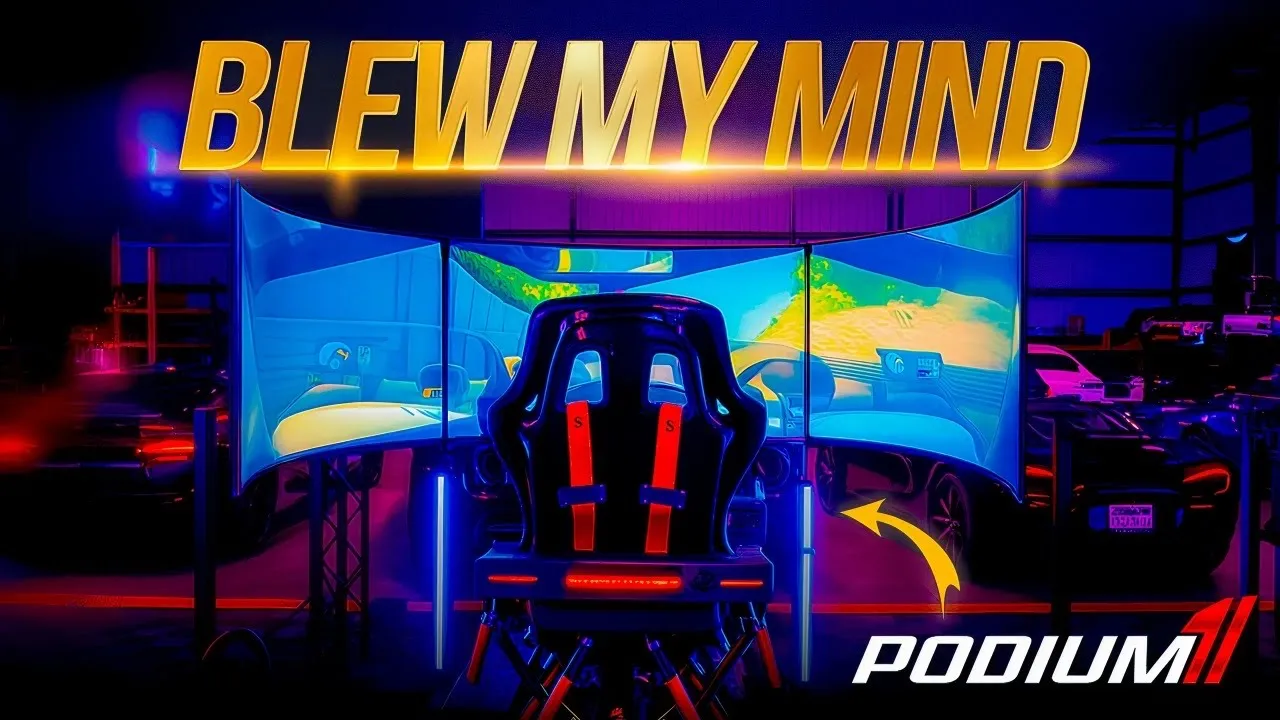
I tested the Podium1 racing simulator at their facility. Full motion platform. Professional-grade force feedback. Wrapped 180-degree screens. The works.
Here's what actually impressed me — and what didn't.
The Motion System — Where Physics Meets Hardware
The Podium1 uses a 6-degree-of-freedom motion platform. That means it moves in every direction a real car does: pitch, roll, yaw, heave, sway, surge.
You feel weight transfer. You feel the car rotate under braking. You feel compression through high-speed corners.
This isn't the vibration motors in a consumer rig. This is actual G-force simulation through motion.
When I trail brake into a corner, the platform pitches forward. The nose dives. Just like in my IMSA TCR car. When I turn in aggressively, the platform rolls to the outside. My body gets loaded.
That feedback loop — the one you spend years developing as a racing driver — it's there.
And that's the whole point.
Force Feedback — The Part That Actually Matters Most
Here's the thing: motion is impressive. But force feedback through the steering wheel is more important for driver development.
The Podium1 runs a direct-drive wheelbase — I believe it's a Simucube setup, maybe 25-30 Nm of torque. That's overkill for most drivers, but at this level, you want headroom.
What matters is the detail. You feel the front tires start to push in understeer. You feel the rear begin to step out before your eyes register it. You feel curb impacts, track surface changes, weight shift under braking.
That tactile information is what separates a simulator from a video game.
If you're training muscle memory — the subconscious corrections a racing driver makes a hundred times per lap — you need that fidelity. Without it, you're just playing.
The Screen Setup — Immersion vs Practicality
Podium1 uses a triple-screen curved setup, probably around 180 degrees of view. The screens are high-refresh-rate, sharp image quality, minimal bezel.
It's immersive. You have proper peripheral vision. You can judge corner entry angles naturally.
But here's my honest take: for pure lap time improvement, VR is still king.
VR gives you better depth perception. You judge braking points more accurately. You see over crests. You position the car with millimeter precision.
Triple screens look better for external viewers — clients, sponsors, team members watching you drive. VR looks ridiculous from the outside but performs better from the inside.
For a commercial setup like Podium1 — where you're hosting corporate events, driver development sessions, team activities — the screens make sense. People can watch, discuss, point at the track.
For your home rig? I'd still recommend VR if lap time is the goal.
The Pedal Set — Where Feel Becomes Data
The brake pedal is where most sim racers screw up their hardware choices.
Podium1 runs what looks like Heusinkveld Ultimate+ pedals — hydraulic brake, load cell pressure sensor. You're braking by pressure, not travel.
Just like a real race car.
That muscle memory — the exact brake pressure needed for a specific corner — transfers directly to the real world. I've had students move from sim to real racing and their braking consistency is immediately their strongest skill.
Cheap pedals with spring-based brakes? You're training the wrong muscle memory.
If you're serious about driver development, your pedal set matters more than your wheelbase. Spend accordingly.
Software — What They're Actually Running
Podium1 supports multiple platforms. I tested it on iRacing, which makes sense — it's the industry standard for driver development and online competition.
iRacing's physics model, combined with this level of hardware, gives you the most accurate training environment available outside a real car.
They also run Assetto Corsa Competizione for GT3 work, and rFactor 2 for custom vehicle dynamics testing.
Here's what matters: the software you choose depends on your goal.
iRacing — best for racecraft, competition, structured practice. Highest quality online racing.
ACC — best for GT3-specific training. Excellent tire model, weather simulation.
rFactor 2 — best for professional teams doing vehicle dynamics work, custom car development.
The Podium1 setup handles all of them smoothly. Zero lag, high frame rates, instant response.
But you don't need $80,000 to run any of these platforms well. You need smart hardware choices and proper setup.
Who Actually Needs This Level of Simulator
Let's be realistic.
If you're a sim racer working on iRating, lap time consistency, racecraft — you don't need this.
A well-built rig with a solid direct-drive wheelbase ($1,000-2,000), quality load-cell pedals ($500-1,500), and VR or triples ($500-2,000) will get you 95% of the training value.
The Podium1 is for:
Professional racing drivers using sim for track preparation, car setup development, off-season training.
Racing teams testing setups, driver evaluation, sponsor experiences.
Drivers transitioning from sim to real motorsports who need the most accurate physical feedback loop.
Commercial facilities offering professional-grade simulator experiences.
If you're in one of those categories, the investment makes sense. Motion adds a layer of physical training — endurance, G-tolerance, spatial awareness — that you can't get from a static rig.
But if you're not, build a killer static rig for $5,000-10,000 and spend the rest on coaching, data analysis, and seat time.
The Real Question — Motion vs Skills Training
Here's what I tell every driver who asks about motion rigs:
Would you rather spend $80,000 on motion hardware, or $5,000 on a rig and $75,000 on real track time?
If you're a professional driver already competing, the motion sim is a tool. It saves you test days, reduces risk, accelerates car setup work.
If you're still learning fundamentals — trail braking, weight transfer, racecraft, consistency — you'll improve faster with quality coaching and deliberate practice than with motion hardware.
I've coached drivers with $500 rigs who are faster than guys with $20,000 setups. The rig doesn't make you fast. Your technique does.
The Podium1 is an incredible piece of engineering. But it's not a shortcut.
Final Verdict — Podium1 Racing Simulator
Physics accuracy: 10/10. As close to real as you can get outside a car.
Force feedback quality: 9/10. Excellent detail, professional-grade components.
Immersion: 9/10. Motion adds a physical training element you can't replicate.
Value for money: Depends entirely on your use case.
If you're a professional driver, racing team, or commercial facility — this is the benchmark. You're not buying a toy, you're buying a training tool that can save you hundreds of thousands in real-world testing.
If you're a sim racer looking to improve — invest in skills first, hardware second.
The Podium1 impressed me. But what impresses me more is when a driver with basic gear shows up with proper technique, data analysis, and race-winning mindset.
That's what makes you fast.
What If Your Technique Doesn't Match Your Hardware?
You can sit in the best simulator in the world.
But if you're braking at the wrong points, missing apexes, and guessing at car setup — you're just making expensive mistakes.
How much faster would you be if you actually understood trail braking pressure curves, weight transfer timing, and rotation control?
What if you could analyze your data like a professional driver instead of hoping you'll "feel it out"?
That's what we built Almeida Racing Academy for. Not to sell you hardware — to teach you the skills that actually make you fast.
Start with the free Car Handling course. 11 lessons. Zero cost. Real technique. If you can't apply proper fundamentals on your current rig, a motion platform won't save you.
Sim Racing Academy Membership
Everything you need to stop guessing and start getting faster.
Starting at
$25
/mo
Car Handling Online Course
4 levels, full curriculum. Aimed to get you to top 1% in driving pace.
Racecraft Online Course
Overtaking, Defending, Race Strategy
Live coaching + on-track practice
Bi-weekly pro-coach workshops (recorded — never miss one) plus on-track Pit Parties to practice racecraft with a coach.
Plus These Bonuses
13,000+ Member Community
League Racing
Advanced MX-5 Mini Course
Racing Technique Development Guide
The Motor Racing Book (260 pages)
Think & Behave Like a Pro Driver — Mini eBook
Inside the $80,000 Podium1 Racing Simulator — Worth It or Overkill?
Suellio Almeida
•
Thursday, May 29, 2025
What $80,000 Gets You in a Racing Simulator
Let me be blunt: most people don't need an $80,000 simulator.
But if you're a professional racing driver, a team looking to develop car setups, or someone transitioning from sim to real motorsports — this is the kind of equipment that closes the gap between virtual and reality.
I tested the Podium1 racing simulator at their facility. Full motion platform. Professional-grade force feedback. Wrapped 180-degree screens. The works.
Here's what actually impressed me — and what didn't.
The Motion System — Where Physics Meets Hardware
The Podium1 uses a 6-degree-of-freedom motion platform. That means it moves in every direction a real car does: pitch, roll, yaw, heave, sway, surge.
You feel weight transfer. You feel the car rotate under braking. You feel compression through high-speed corners.
This isn't the vibration motors in a consumer rig. This is actual G-force simulation through motion.
When I trail brake into a corner, the platform pitches forward. The nose dives. Just like in my IMSA TCR car. When I turn in aggressively, the platform rolls to the outside. My body gets loaded.
That feedback loop — the one you spend years developing as a racing driver — it's there.
And that's the whole point.
Force Feedback — The Part That Actually Matters Most
Here's the thing: motion is impressive. But force feedback through the steering wheel is more important for driver development.
The Podium1 runs a direct-drive wheelbase — I believe it's a Simucube setup, maybe 25-30 Nm of torque. That's overkill for most drivers, but at this level, you want headroom.
What matters is the detail. You feel the front tires start to push in understeer. You feel the rear begin to step out before your eyes register it. You feel curb impacts, track surface changes, weight shift under braking.
That tactile information is what separates a simulator from a video game.
If you're training muscle memory — the subconscious corrections a racing driver makes a hundred times per lap — you need that fidelity. Without it, you're just playing.
The Screen Setup — Immersion vs Practicality
Podium1 uses a triple-screen curved setup, probably around 180 degrees of view. The screens are high-refresh-rate, sharp image quality, minimal bezel.
It's immersive. You have proper peripheral vision. You can judge corner entry angles naturally.
But here's my honest take: for pure lap time improvement, VR is still king.
VR gives you better depth perception. You judge braking points more accurately. You see over crests. You position the car with millimeter precision.
Triple screens look better for external viewers — clients, sponsors, team members watching you drive. VR looks ridiculous from the outside but performs better from the inside.
For a commercial setup like Podium1 — where you're hosting corporate events, driver development sessions, team activities — the screens make sense. People can watch, discuss, point at the track.
For your home rig? I'd still recommend VR if lap time is the goal.
The Pedal Set — Where Feel Becomes Data
The brake pedal is where most sim racers screw up their hardware choices.
Podium1 runs what looks like Heusinkveld Ultimate+ pedals — hydraulic brake, load cell pressure sensor. You're braking by pressure, not travel.
Just like a real race car.
That muscle memory — the exact brake pressure needed for a specific corner — transfers directly to the real world. I've had students move from sim to real racing and their braking consistency is immediately their strongest skill.
Cheap pedals with spring-based brakes? You're training the wrong muscle memory.
If you're serious about driver development, your pedal set matters more than your wheelbase. Spend accordingly.
Software — What They're Actually Running
Podium1 supports multiple platforms. I tested it on iRacing, which makes sense — it's the industry standard for driver development and online competition.
iRacing's physics model, combined with this level of hardware, gives you the most accurate training environment available outside a real car.
They also run Assetto Corsa Competizione for GT3 work, and rFactor 2 for custom vehicle dynamics testing.
Here's what matters: the software you choose depends on your goal.
iRacing — best for racecraft, competition, structured practice. Highest quality online racing.
ACC — best for GT3-specific training. Excellent tire model, weather simulation.
rFactor 2 — best for professional teams doing vehicle dynamics work, custom car development.
The Podium1 setup handles all of them smoothly. Zero lag, high frame rates, instant response.
But you don't need $80,000 to run any of these platforms well. You need smart hardware choices and proper setup.
Who Actually Needs This Level of Simulator
Let's be realistic.
If you're a sim racer working on iRating, lap time consistency, racecraft — you don't need this.
A well-built rig with a solid direct-drive wheelbase ($1,000-2,000), quality load-cell pedals ($500-1,500), and VR or triples ($500-2,000) will get you 95% of the training value.
The Podium1 is for:
Professional racing drivers using sim for track preparation, car setup development, off-season training.
Racing teams testing setups, driver evaluation, sponsor experiences.
Drivers transitioning from sim to real motorsports who need the most accurate physical feedback loop.
Commercial facilities offering professional-grade simulator experiences.
If you're in one of those categories, the investment makes sense. Motion adds a layer of physical training — endurance, G-tolerance, spatial awareness — that you can't get from a static rig.
But if you're not, build a killer static rig for $5,000-10,000 and spend the rest on coaching, data analysis, and seat time.
The Real Question — Motion vs Skills Training
Here's what I tell every driver who asks about motion rigs:
Would you rather spend $80,000 on motion hardware, or $5,000 on a rig and $75,000 on real track time?
If you're a professional driver already competing, the motion sim is a tool. It saves you test days, reduces risk, accelerates car setup work.
If you're still learning fundamentals — trail braking, weight transfer, racecraft, consistency — you'll improve faster with quality coaching and deliberate practice than with motion hardware.
I've coached drivers with $500 rigs who are faster than guys with $20,000 setups. The rig doesn't make you fast. Your technique does.
The Podium1 is an incredible piece of engineering. But it's not a shortcut.
Final Verdict — Podium1 Racing Simulator
Physics accuracy: 10/10. As close to real as you can get outside a car.
Force feedback quality: 9/10. Excellent detail, professional-grade components.
Immersion: 9/10. Motion adds a physical training element you can't replicate.
Value for money: Depends entirely on your use case.
If you're a professional driver, racing team, or commercial facility — this is the benchmark. You're not buying a toy, you're buying a training tool that can save you hundreds of thousands in real-world testing.
If you're a sim racer looking to improve — invest in skills first, hardware second.
The Podium1 impressed me. But what impresses me more is when a driver with basic gear shows up with proper technique, data analysis, and race-winning mindset.
That's what makes you fast.
What If Your Technique Doesn't Match Your Hardware?
You can sit in the best simulator in the world.
But if you're braking at the wrong points, missing apexes, and guessing at car setup — you're just making expensive mistakes.
How much faster would you be if you actually understood trail braking pressure curves, weight transfer timing, and rotation control?
What if you could analyze your data like a professional driver instead of hoping you'll "feel it out"?
That's what we built Almeida Racing Academy for. Not to sell you hardware — to teach you the skills that actually make you fast.
Start with the free Car Handling course. 11 lessons. Zero cost. Real technique. If you can't apply proper fundamentals on your current rig, a motion platform won't save you.
Sim Racing Academy Membership
Everything you need to stop guessing and start getting faster.
Starting at
$25
/mo
Car Handling Online Course
4 levels, full curriculum. Aimed to get you to top 1% in driving pace.
Racecraft Online Course
Overtaking, Defending, Race Strategy
Live coaching + on-track practice
Bi-weekly pro-coach workshops (recorded — never miss one) plus on-track Pit Parties to practice racecraft with a coach.
Plus These Bonuses
13,000+ Member Community
League Racing
Advanced MX-5 Mini Course
Racing Technique Development Guide
The Motor Racing Book (260 pages)
Think & Behave Like a Pro Driver — Mini eBook
Inside the $80,000 Podium1 Racing Simulator — Worth It or Overkill?
Suellio Almeida
•
Thursday, May 29, 2025
What $80,000 Gets You in a Racing Simulator
Let me be blunt: most people don't need an $80,000 simulator.
But if you're a professional racing driver, a team looking to develop car setups, or someone transitioning from sim to real motorsports — this is the kind of equipment that closes the gap between virtual and reality.
I tested the Podium1 racing simulator at their facility. Full motion platform. Professional-grade force feedback. Wrapped 180-degree screens. The works.
Here's what actually impressed me — and what didn't.
The Motion System — Where Physics Meets Hardware
The Podium1 uses a 6-degree-of-freedom motion platform. That means it moves in every direction a real car does: pitch, roll, yaw, heave, sway, surge.
You feel weight transfer. You feel the car rotate under braking. You feel compression through high-speed corners.
This isn't the vibration motors in a consumer rig. This is actual G-force simulation through motion.
When I trail brake into a corner, the platform pitches forward. The nose dives. Just like in my IMSA TCR car. When I turn in aggressively, the platform rolls to the outside. My body gets loaded.
That feedback loop — the one you spend years developing as a racing driver — it's there.
And that's the whole point.
Force Feedback — The Part That Actually Matters Most
Here's the thing: motion is impressive. But force feedback through the steering wheel is more important for driver development.
The Podium1 runs a direct-drive wheelbase — I believe it's a Simucube setup, maybe 25-30 Nm of torque. That's overkill for most drivers, but at this level, you want headroom.
What matters is the detail. You feel the front tires start to push in understeer. You feel the rear begin to step out before your eyes register it. You feel curb impacts, track surface changes, weight shift under braking.
That tactile information is what separates a simulator from a video game.
If you're training muscle memory — the subconscious corrections a racing driver makes a hundred times per lap — you need that fidelity. Without it, you're just playing.
The Screen Setup — Immersion vs Practicality
Podium1 uses a triple-screen curved setup, probably around 180 degrees of view. The screens are high-refresh-rate, sharp image quality, minimal bezel.
It's immersive. You have proper peripheral vision. You can judge corner entry angles naturally.
But here's my honest take: for pure lap time improvement, VR is still king.
VR gives you better depth perception. You judge braking points more accurately. You see over crests. You position the car with millimeter precision.
Triple screens look better for external viewers — clients, sponsors, team members watching you drive. VR looks ridiculous from the outside but performs better from the inside.
For a commercial setup like Podium1 — where you're hosting corporate events, driver development sessions, team activities — the screens make sense. People can watch, discuss, point at the track.
For your home rig? I'd still recommend VR if lap time is the goal.
The Pedal Set — Where Feel Becomes Data
The brake pedal is where most sim racers screw up their hardware choices.
Podium1 runs what looks like Heusinkveld Ultimate+ pedals — hydraulic brake, load cell pressure sensor. You're braking by pressure, not travel.
Just like a real race car.
That muscle memory — the exact brake pressure needed for a specific corner — transfers directly to the real world. I've had students move from sim to real racing and their braking consistency is immediately their strongest skill.
Cheap pedals with spring-based brakes? You're training the wrong muscle memory.
If you're serious about driver development, your pedal set matters more than your wheelbase. Spend accordingly.
Software — What They're Actually Running
Podium1 supports multiple platforms. I tested it on iRacing, which makes sense — it's the industry standard for driver development and online competition.
iRacing's physics model, combined with this level of hardware, gives you the most accurate training environment available outside a real car.
They also run Assetto Corsa Competizione for GT3 work, and rFactor 2 for custom vehicle dynamics testing.
Here's what matters: the software you choose depends on your goal.
iRacing — best for racecraft, competition, structured practice. Highest quality online racing.
ACC — best for GT3-specific training. Excellent tire model, weather simulation.
rFactor 2 — best for professional teams doing vehicle dynamics work, custom car development.
The Podium1 setup handles all of them smoothly. Zero lag, high frame rates, instant response.
But you don't need $80,000 to run any of these platforms well. You need smart hardware choices and proper setup.
Who Actually Needs This Level of Simulator
Let's be realistic.
If you're a sim racer working on iRating, lap time consistency, racecraft — you don't need this.
A well-built rig with a solid direct-drive wheelbase ($1,000-2,000), quality load-cell pedals ($500-1,500), and VR or triples ($500-2,000) will get you 95% of the training value.
The Podium1 is for:
Professional racing drivers using sim for track preparation, car setup development, off-season training.
Racing teams testing setups, driver evaluation, sponsor experiences.
Drivers transitioning from sim to real motorsports who need the most accurate physical feedback loop.
Commercial facilities offering professional-grade simulator experiences.
If you're in one of those categories, the investment makes sense. Motion adds a layer of physical training — endurance, G-tolerance, spatial awareness — that you can't get from a static rig.
But if you're not, build a killer static rig for $5,000-10,000 and spend the rest on coaching, data analysis, and seat time.
The Real Question — Motion vs Skills Training
Here's what I tell every driver who asks about motion rigs:
Would you rather spend $80,000 on motion hardware, or $5,000 on a rig and $75,000 on real track time?
If you're a professional driver already competing, the motion sim is a tool. It saves you test days, reduces risk, accelerates car setup work.
If you're still learning fundamentals — trail braking, weight transfer, racecraft, consistency — you'll improve faster with quality coaching and deliberate practice than with motion hardware.
I've coached drivers with $500 rigs who are faster than guys with $20,000 setups. The rig doesn't make you fast. Your technique does.
The Podium1 is an incredible piece of engineering. But it's not a shortcut.
Final Verdict — Podium1 Racing Simulator
Physics accuracy: 10/10. As close to real as you can get outside a car.
Force feedback quality: 9/10. Excellent detail, professional-grade components.
Immersion: 9/10. Motion adds a physical training element you can't replicate.
Value for money: Depends entirely on your use case.
If you're a professional driver, racing team, or commercial facility — this is the benchmark. You're not buying a toy, you're buying a training tool that can save you hundreds of thousands in real-world testing.
If you're a sim racer looking to improve — invest in skills first, hardware second.
The Podium1 impressed me. But what impresses me more is when a driver with basic gear shows up with proper technique, data analysis, and race-winning mindset.
That's what makes you fast.
What If Your Technique Doesn't Match Your Hardware?
You can sit in the best simulator in the world.
But if you're braking at the wrong points, missing apexes, and guessing at car setup — you're just making expensive mistakes.
How much faster would you be if you actually understood trail braking pressure curves, weight transfer timing, and rotation control?
What if you could analyze your data like a professional driver instead of hoping you'll "feel it out"?
That's what we built Almeida Racing Academy for. Not to sell you hardware — to teach you the skills that actually make you fast.
Start with the free Car Handling course. 11 lessons. Zero cost. Real technique. If you can't apply proper fundamentals on your current rig, a motion platform won't save you.
Sim Racing Academy Membership
Everything you need to stop guessing and start getting faster.
Starting at
$25
/mo
Car Handling Online Course
4 levels, full curriculum. Aimed to get you to top 1% in driving pace.
Racecraft Online Course
Overtaking, Defending, Race Strategy
Live coaching + on-track practice
Bi-weekly pro-coach workshops (recorded — never miss one) plus on-track Pit Parties to practice racecraft with a coach.
Plus These Bonuses
13,000+ Member Community
League Racing
Advanced MX-5 Mini Course
Racing Technique Development Guide
The Motor Racing Book (260 pages)
Think & Behave Like a Pro Driver — Mini eBook