
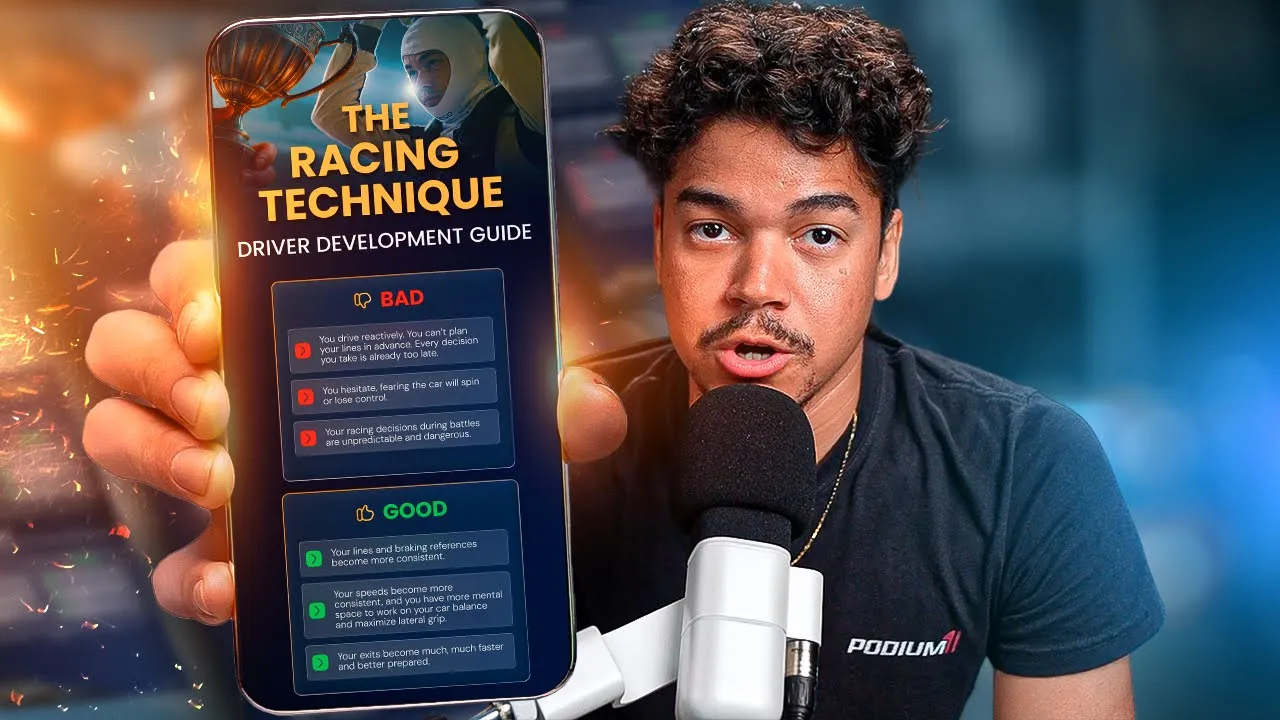
I Mapped Out Every Skill To Become A Pro Racing Driver — The Complete Roadmap
Suellio Almeida
•
Tuesday, July 22, 2025
The Brutal Truth About Racing Skill Development
You can't become a professional racing driver by accident.
You can't YouTube-tutorial your way there either.
I see this constantly — drivers with thousands of hours who never break through. They practice. They grind races. They watch replays. But they're missing the map.
Professional racing requires a specific sequence of skills, built in a specific order. Skip steps, and you plateau. Master them systematically, and doors open.
I've mapped this out based on my own journey from complete beginner to Canadian Sim Racing Champion to IMSA TCR driver, plus five years coaching everyone from first-timers to F1 engineers. This is the actual progression.
The Foundation: Car Control Before Speed
Most drivers start wrong.
They jump into competitive racing immediately, trying to be fast without understanding what fast actually means. They chase lap times before they can control the car.
Here's what you need first:
Vision technique — Where you look determines everything. If you're staring at the apex while you're still braking, you're reacting late to every input. You need to train your eyes to lead the car, looking through corners to the exit while your hands work the entry.
This isn't natural. Your brain wants to look at the danger point. You have to override that instinct.
Basic car physics understanding — Weight transfer, load, platform. When you brake, weight moves forward. When you turn, weight moves laterally. When you accelerate, weight moves rearward.
Every input you make shifts the car's balance. If you don't understand this, you're guessing.
Smooth inputs — Aggressive doesn't mean fast. Fast drivers are smooth. They build brake pressure progressively. They unwind steering gradually. They roll into throttle.
Jerky inputs unsettle the car. Smooth inputs keep it balanced and allow maximum grip.
These three things — vision, physics knowledge, smooth inputs — are the foundation. Without them, nothing else works.
Phase Two: The Racing Line and Consistency
Once you can control the car smoothly, you need to drive the correct path.
The geometric racing line — This is the fundamental line that maximizes speed through corners by minimizing curvature. Wide entry, clip the apex, wide exit.
But here's what most drivers miss: the geometric line changes based on corner types. A single corner uses one line. A corner leading onto a straight uses another. A decreasing radius corner requires yet another approach.
You need to understand why each line works, not just memorize brake markers.
Consistency — This is where most sim racers fail. They can do one fast lap. They can't do ten.
Consistency comes from reference points. Every corner needs a brake point, a turn-in point, an apex target, and a throttle application point. These must be visual references you can hit lap after lap.
No references = guessing. Guessing = inconsistency.
Lap time improvement methodology — You can't improve what you don't measure. You need to understand delta analysis, sector times, and how to identify your weakest corners.
Then you isolate those corners and fix them one at a time.
Random practice makes you randomly better. Targeted practice makes you systematically faster.
Phase Three: Advanced Car Control Techniques
Now you're ready for the techniques that actually make you fast.
Trail braking — This is the skill that separates intermediate from advanced drivers. Trail braking means maintaining brake pressure past turn-in, gradually releasing as you rotate the car.
This does two things: it keeps weight on the front tires for grip, and it helps the car rotate through the apex.
Without trail braking, you're slow. Period.
Weight transfer manipulation — Now you're using physics deliberately. You're not just reacting to weight transfer — you're controlling it.
Need more front grip? Brake deeper into the corner. Need more rear grip? Get to throttle earlier, even if it's just maintenance throttle.
This is where driving becomes active problem-solving instead of passive following.
Maximum Rotation Point (MRP) — This is one of my core teaching concepts. There's a specific moment in every corner where the car reaches peak rotation rate — that's your MRP.
Before that point, you're still adding rotation. After that point, you're managing exit.
Understanding MRP transforms your corner execution. You stop treating corners as vague arcs and start treating them as precise sequences with identifiable transition points.
Throttle application technique — It's not just "go fast when straight." The way you apply throttle determines your exit speed, tire wear, and whether you spin.
You need to understand progressive application, maintenance throttle, and how throttle interacts with steering angle.
Get this wrong, and you either understeer wide or spin.
Phase Four: Car Setup and Mechanical Understanding
You can't drive around bad setup.
Well, you can try. But the fast drivers understand their cars.
Fundamental setup principles — Tire pressure, dampers, anti-roll bars, wing angles. What each adjustment actually does to car behavior.
You don't need to be an engineer. But you need to know: "My car understeers mid-corner" → "I should try softening the front ARB."
Setup testing methodology — Change one thing at a time. Do at least three consistent laps to evaluate. Take notes.
Random setup changes make the car worse. Systematic testing makes it faster.
Understanding tire behavior — Tire temperatures, pressure, compound differences, degradation patterns. Tires are the only thing connecting your car to the track.
If you don't understand them, you're guessing about the most important variable in racing.
Phase Five: Racecraft and Competition
Now you're fast and consistent. Time to race other humans.
Defensive driving — How to position your car to make overtakes difficult without being dangerous. How to defend without losing time.
Bad defensive driving costs you positions. Good defensive driving costs the attacker time.
Overtaking — Where to position for passes, how to use different lines, late braking vs. better exit, slipstream utilization.
Aggressive isn't smart. Patient and calculated wins races.
Race strategy — Tire management, fuel management, when to push and when to conserve, how to race for points vs. racing for wins.
You can be the fastest driver and finish nowhere if you don't understand strategy.
Traffic management — Dealing with blue flags, managing multi-class racing, not losing time to slower cars.
This is huge in endurance racing and becomes critical as you move up the ladder.
Phase Six: Data Analysis and Performance Optimization
Pro drivers live in data.
Telemetry analysis — Speed traces, brake pressure, throttle position, steering angle. Comparing your data to faster drivers and identifying exactly where you lose time.
Motec, VRS, Garage 61 — these tools show you the truth. You might think you're braking hard enough. The data shows you're not.
Video analysis — Reviewing your own footage, comparing lines, spotting mistakes you didn't feel while driving.
Your brain lies to you in the moment. Video doesn't.
Identifying patterns — Are you consistently slow in high-speed corners? Are you losing time on exits? Is your racecraft costing you positions?
Patterns reveal your weaknesses. Once you know your weaknesses, you can fix them.
Phase Seven: Mental Performance and Professional Mindset
This is what separates good drivers from professionals.
Pressure management — Performing under pressure, staying calm when money or reputation is on the line, recovering from mistakes mid-race.
The mental game is real. I've seen incredible sim racers fold in real cars because they couldn't handle the pressure.
Consistency under fatigue — Maintaining performance in long stints, multi-hour races, back-to-back race weekends.
Amateurs are fast when fresh. Pros are fast when exhausted.
Learning speed — Adapting to new cars quickly, learning new tracks efficiently, implementing feedback immediately.
Teams don't want drivers who need twenty laps to get up to speed. They want drivers who are fast by lap three.
Professional communication — Working with engineers, giving useful feedback, understanding what information your team needs.
You're not just a driver. You're part of a technical team. Your job is to translate what the car is doing into information they can use.
Phase Eight: Real-World Transition (If That's Your Goal)
Going from sim to real is possible. I did it. But it requires specific preparation.
Physical fitness — Real racing is physically demanding. G-forces, heat, long stints — your body needs to be ready.
Sim racing doesn't prepare you for this. You have to train.
Real-world testing methodology — Track time is expensive. You need to learn efficiently. That means having a clear plan for every session, taking notes, and being systematic.
Networking and opportunities — Professional racing is who you know as much as how fast you are. You need to build relationships, be visible, and create opportunities.
Speed gets you in the door. Professionalism keeps you in the seat.
Financial planning — Real racing costs money. Even as a semi-pro, you're likely paying to drive. You need a plan for how to fund your career.
This is the least sexy part of racing. It's also unavoidable.
The Progression is Non-Negotiable
You can't skip steps.
I see drivers trying to learn racecraft before they can drive consistent laps. I see drivers trying to tune setups when they don't understand basic weight transfer. I see drivers jumping into real cars without proper physical preparation.
It doesn't work.
The skill tree is sequential. Master each phase before moving to the next. Build the foundation correctly, and everything else becomes easier.
Rush the process, and you plateau permanently.
Where Are You on This Map?
Be honest with yourself.
If you can't drive ten consistent laps within two-tenths, you're not ready for advanced techniques.
If you don't understand trail braking, you're not ready for setup work.
If you can't analyze your own data, you're not ready to race competitively.
Find your current position on this roadmap. Then work on the next skill, not the one that sounds exciting.
That's how you become a professional racing driver.
Not by hoping. By building.
What If You Actually Had a Training System That Matched This Roadmap?
You've just seen the complete skill progression.
Now ask yourself: are you training these skills systematically, or are you just hoping random practice will get you there?
Most drivers know what they should work on. They just don't have a structured way to do it. They're piecing together YouTube videos and forum advice, trying to self-diagnose their weaknesses without proper tools or feedback.
How long are you willing to keep guessing?
Almeida Racing Academy is built around this exact progression. Eight complete courses covering car control, racecraft, data analysis, mental performance — every phase of this roadmap. Eighty lessons, structured in the right order, taught by drivers who've actually made it to professional racing.
Plus coach-led workshops where we work on specific skills in real time. Plus challenges and leagues where you apply what you've learned under competitive pressure.
We built this because sim racers deserved better than random YouTube tutorials.
Code WINTER gets you Gold Membership for $25/month. That's full access to the complete training system.
Sim Racing Academy Membership
Everything you need to stop guessing and start getting faster.
Starting at
$25
/mo
Car Handling Online Course
4 levels, full curriculum. Aimed to get you to top 1% in driving pace.
Racecraft Online Course
Overtaking, Defending, Race Strategy
Live coaching + on-track practice
Bi-weekly pro-coach workshops (recorded — never miss one) plus on-track Pit Parties to practice racecraft with a coach.
Plus These Bonuses
13,000+ Member Community
League Racing
Advanced MX-5 Mini Course
Racing Technique Development Guide
The Motor Racing Book (260 pages)
Think & Behave Like a Pro Driver — Mini eBook
I Mapped Out Every Skill To Become A Pro Racing Driver — The Complete Roadmap
Suellio Almeida
•
Tuesday, July 22, 2025
The Brutal Truth About Racing Skill Development
You can't become a professional racing driver by accident.
You can't YouTube-tutorial your way there either.
I see this constantly — drivers with thousands of hours who never break through. They practice. They grind races. They watch replays. But they're missing the map.
Professional racing requires a specific sequence of skills, built in a specific order. Skip steps, and you plateau. Master them systematically, and doors open.
I've mapped this out based on my own journey from complete beginner to Canadian Sim Racing Champion to IMSA TCR driver, plus five years coaching everyone from first-timers to F1 engineers. This is the actual progression.
The Foundation: Car Control Before Speed
Most drivers start wrong.
They jump into competitive racing immediately, trying to be fast without understanding what fast actually means. They chase lap times before they can control the car.
Here's what you need first:
Vision technique — Where you look determines everything. If you're staring at the apex while you're still braking, you're reacting late to every input. You need to train your eyes to lead the car, looking through corners to the exit while your hands work the entry.
This isn't natural. Your brain wants to look at the danger point. You have to override that instinct.
Basic car physics understanding — Weight transfer, load, platform. When you brake, weight moves forward. When you turn, weight moves laterally. When you accelerate, weight moves rearward.
Every input you make shifts the car's balance. If you don't understand this, you're guessing.
Smooth inputs — Aggressive doesn't mean fast. Fast drivers are smooth. They build brake pressure progressively. They unwind steering gradually. They roll into throttle.
Jerky inputs unsettle the car. Smooth inputs keep it balanced and allow maximum grip.
These three things — vision, physics knowledge, smooth inputs — are the foundation. Without them, nothing else works.
Phase Two: The Racing Line and Consistency
Once you can control the car smoothly, you need to drive the correct path.
The geometric racing line — This is the fundamental line that maximizes speed through corners by minimizing curvature. Wide entry, clip the apex, wide exit.
But here's what most drivers miss: the geometric line changes based on corner types. A single corner uses one line. A corner leading onto a straight uses another. A decreasing radius corner requires yet another approach.
You need to understand why each line works, not just memorize brake markers.
Consistency — This is where most sim racers fail. They can do one fast lap. They can't do ten.
Consistency comes from reference points. Every corner needs a brake point, a turn-in point, an apex target, and a throttle application point. These must be visual references you can hit lap after lap.
No references = guessing. Guessing = inconsistency.
Lap time improvement methodology — You can't improve what you don't measure. You need to understand delta analysis, sector times, and how to identify your weakest corners.
Then you isolate those corners and fix them one at a time.
Random practice makes you randomly better. Targeted practice makes you systematically faster.
Phase Three: Advanced Car Control Techniques
Now you're ready for the techniques that actually make you fast.
Trail braking — This is the skill that separates intermediate from advanced drivers. Trail braking means maintaining brake pressure past turn-in, gradually releasing as you rotate the car.
This does two things: it keeps weight on the front tires for grip, and it helps the car rotate through the apex.
Without trail braking, you're slow. Period.
Weight transfer manipulation — Now you're using physics deliberately. You're not just reacting to weight transfer — you're controlling it.
Need more front grip? Brake deeper into the corner. Need more rear grip? Get to throttle earlier, even if it's just maintenance throttle.
This is where driving becomes active problem-solving instead of passive following.
Maximum Rotation Point (MRP) — This is one of my core teaching concepts. There's a specific moment in every corner where the car reaches peak rotation rate — that's your MRP.
Before that point, you're still adding rotation. After that point, you're managing exit.
Understanding MRP transforms your corner execution. You stop treating corners as vague arcs and start treating them as precise sequences with identifiable transition points.
Throttle application technique — It's not just "go fast when straight." The way you apply throttle determines your exit speed, tire wear, and whether you spin.
You need to understand progressive application, maintenance throttle, and how throttle interacts with steering angle.
Get this wrong, and you either understeer wide or spin.
Phase Four: Car Setup and Mechanical Understanding
You can't drive around bad setup.
Well, you can try. But the fast drivers understand their cars.
Fundamental setup principles — Tire pressure, dampers, anti-roll bars, wing angles. What each adjustment actually does to car behavior.
You don't need to be an engineer. But you need to know: "My car understeers mid-corner" → "I should try softening the front ARB."
Setup testing methodology — Change one thing at a time. Do at least three consistent laps to evaluate. Take notes.
Random setup changes make the car worse. Systematic testing makes it faster.
Understanding tire behavior — Tire temperatures, pressure, compound differences, degradation patterns. Tires are the only thing connecting your car to the track.
If you don't understand them, you're guessing about the most important variable in racing.
Phase Five: Racecraft and Competition
Now you're fast and consistent. Time to race other humans.
Defensive driving — How to position your car to make overtakes difficult without being dangerous. How to defend without losing time.
Bad defensive driving costs you positions. Good defensive driving costs the attacker time.
Overtaking — Where to position for passes, how to use different lines, late braking vs. better exit, slipstream utilization.
Aggressive isn't smart. Patient and calculated wins races.
Race strategy — Tire management, fuel management, when to push and when to conserve, how to race for points vs. racing for wins.
You can be the fastest driver and finish nowhere if you don't understand strategy.
Traffic management — Dealing with blue flags, managing multi-class racing, not losing time to slower cars.
This is huge in endurance racing and becomes critical as you move up the ladder.
Phase Six: Data Analysis and Performance Optimization
Pro drivers live in data.
Telemetry analysis — Speed traces, brake pressure, throttle position, steering angle. Comparing your data to faster drivers and identifying exactly where you lose time.
Motec, VRS, Garage 61 — these tools show you the truth. You might think you're braking hard enough. The data shows you're not.
Video analysis — Reviewing your own footage, comparing lines, spotting mistakes you didn't feel while driving.
Your brain lies to you in the moment. Video doesn't.
Identifying patterns — Are you consistently slow in high-speed corners? Are you losing time on exits? Is your racecraft costing you positions?
Patterns reveal your weaknesses. Once you know your weaknesses, you can fix them.
Phase Seven: Mental Performance and Professional Mindset
This is what separates good drivers from professionals.
Pressure management — Performing under pressure, staying calm when money or reputation is on the line, recovering from mistakes mid-race.
The mental game is real. I've seen incredible sim racers fold in real cars because they couldn't handle the pressure.
Consistency under fatigue — Maintaining performance in long stints, multi-hour races, back-to-back race weekends.
Amateurs are fast when fresh. Pros are fast when exhausted.
Learning speed — Adapting to new cars quickly, learning new tracks efficiently, implementing feedback immediately.
Teams don't want drivers who need twenty laps to get up to speed. They want drivers who are fast by lap three.
Professional communication — Working with engineers, giving useful feedback, understanding what information your team needs.
You're not just a driver. You're part of a technical team. Your job is to translate what the car is doing into information they can use.
Phase Eight: Real-World Transition (If That's Your Goal)
Going from sim to real is possible. I did it. But it requires specific preparation.
Physical fitness — Real racing is physically demanding. G-forces, heat, long stints — your body needs to be ready.
Sim racing doesn't prepare you for this. You have to train.
Real-world testing methodology — Track time is expensive. You need to learn efficiently. That means having a clear plan for every session, taking notes, and being systematic.
Networking and opportunities — Professional racing is who you know as much as how fast you are. You need to build relationships, be visible, and create opportunities.
Speed gets you in the door. Professionalism keeps you in the seat.
Financial planning — Real racing costs money. Even as a semi-pro, you're likely paying to drive. You need a plan for how to fund your career.
This is the least sexy part of racing. It's also unavoidable.
The Progression is Non-Negotiable
You can't skip steps.
I see drivers trying to learn racecraft before they can drive consistent laps. I see drivers trying to tune setups when they don't understand basic weight transfer. I see drivers jumping into real cars without proper physical preparation.
It doesn't work.
The skill tree is sequential. Master each phase before moving to the next. Build the foundation correctly, and everything else becomes easier.
Rush the process, and you plateau permanently.
Where Are You on This Map?
Be honest with yourself.
If you can't drive ten consistent laps within two-tenths, you're not ready for advanced techniques.
If you don't understand trail braking, you're not ready for setup work.
If you can't analyze your own data, you're not ready to race competitively.
Find your current position on this roadmap. Then work on the next skill, not the one that sounds exciting.
That's how you become a professional racing driver.
Not by hoping. By building.
What If You Actually Had a Training System That Matched This Roadmap?
You've just seen the complete skill progression.
Now ask yourself: are you training these skills systematically, or are you just hoping random practice will get you there?
Most drivers know what they should work on. They just don't have a structured way to do it. They're piecing together YouTube videos and forum advice, trying to self-diagnose their weaknesses without proper tools or feedback.
How long are you willing to keep guessing?
Almeida Racing Academy is built around this exact progression. Eight complete courses covering car control, racecraft, data analysis, mental performance — every phase of this roadmap. Eighty lessons, structured in the right order, taught by drivers who've actually made it to professional racing.
Plus coach-led workshops where we work on specific skills in real time. Plus challenges and leagues where you apply what you've learned under competitive pressure.
We built this because sim racers deserved better than random YouTube tutorials.
Code WINTER gets you Gold Membership for $25/month. That's full access to the complete training system.
Sim Racing Academy Membership
Everything you need to stop guessing and start getting faster.
Starting at
$25
/mo
Car Handling Online Course
4 levels, full curriculum. Aimed to get you to top 1% in driving pace.
Racecraft Online Course
Overtaking, Defending, Race Strategy
Live coaching + on-track practice
Bi-weekly pro-coach workshops (recorded — never miss one) plus on-track Pit Parties to practice racecraft with a coach.
Plus These Bonuses
13,000+ Member Community
League Racing
Advanced MX-5 Mini Course
Racing Technique Development Guide
The Motor Racing Book (260 pages)
Think & Behave Like a Pro Driver — Mini eBook
I Mapped Out Every Skill To Become A Pro Racing Driver — The Complete Roadmap
Suellio Almeida
•
Tuesday, July 22, 2025
The Brutal Truth About Racing Skill Development
You can't become a professional racing driver by accident.
You can't YouTube-tutorial your way there either.
I see this constantly — drivers with thousands of hours who never break through. They practice. They grind races. They watch replays. But they're missing the map.
Professional racing requires a specific sequence of skills, built in a specific order. Skip steps, and you plateau. Master them systematically, and doors open.
I've mapped this out based on my own journey from complete beginner to Canadian Sim Racing Champion to IMSA TCR driver, plus five years coaching everyone from first-timers to F1 engineers. This is the actual progression.
The Foundation: Car Control Before Speed
Most drivers start wrong.
They jump into competitive racing immediately, trying to be fast without understanding what fast actually means. They chase lap times before they can control the car.
Here's what you need first:
Vision technique — Where you look determines everything. If you're staring at the apex while you're still braking, you're reacting late to every input. You need to train your eyes to lead the car, looking through corners to the exit while your hands work the entry.
This isn't natural. Your brain wants to look at the danger point. You have to override that instinct.
Basic car physics understanding — Weight transfer, load, platform. When you brake, weight moves forward. When you turn, weight moves laterally. When you accelerate, weight moves rearward.
Every input you make shifts the car's balance. If you don't understand this, you're guessing.
Smooth inputs — Aggressive doesn't mean fast. Fast drivers are smooth. They build brake pressure progressively. They unwind steering gradually. They roll into throttle.
Jerky inputs unsettle the car. Smooth inputs keep it balanced and allow maximum grip.
These three things — vision, physics knowledge, smooth inputs — are the foundation. Without them, nothing else works.
Phase Two: The Racing Line and Consistency
Once you can control the car smoothly, you need to drive the correct path.
The geometric racing line — This is the fundamental line that maximizes speed through corners by minimizing curvature. Wide entry, clip the apex, wide exit.
But here's what most drivers miss: the geometric line changes based on corner types. A single corner uses one line. A corner leading onto a straight uses another. A decreasing radius corner requires yet another approach.
You need to understand why each line works, not just memorize brake markers.
Consistency — This is where most sim racers fail. They can do one fast lap. They can't do ten.
Consistency comes from reference points. Every corner needs a brake point, a turn-in point, an apex target, and a throttle application point. These must be visual references you can hit lap after lap.
No references = guessing. Guessing = inconsistency.
Lap time improvement methodology — You can't improve what you don't measure. You need to understand delta analysis, sector times, and how to identify your weakest corners.
Then you isolate those corners and fix them one at a time.
Random practice makes you randomly better. Targeted practice makes you systematically faster.
Phase Three: Advanced Car Control Techniques
Now you're ready for the techniques that actually make you fast.
Trail braking — This is the skill that separates intermediate from advanced drivers. Trail braking means maintaining brake pressure past turn-in, gradually releasing as you rotate the car.
This does two things: it keeps weight on the front tires for grip, and it helps the car rotate through the apex.
Without trail braking, you're slow. Period.
Weight transfer manipulation — Now you're using physics deliberately. You're not just reacting to weight transfer — you're controlling it.
Need more front grip? Brake deeper into the corner. Need more rear grip? Get to throttle earlier, even if it's just maintenance throttle.
This is where driving becomes active problem-solving instead of passive following.
Maximum Rotation Point (MRP) — This is one of my core teaching concepts. There's a specific moment in every corner where the car reaches peak rotation rate — that's your MRP.
Before that point, you're still adding rotation. After that point, you're managing exit.
Understanding MRP transforms your corner execution. You stop treating corners as vague arcs and start treating them as precise sequences with identifiable transition points.
Throttle application technique — It's not just "go fast when straight." The way you apply throttle determines your exit speed, tire wear, and whether you spin.
You need to understand progressive application, maintenance throttle, and how throttle interacts with steering angle.
Get this wrong, and you either understeer wide or spin.
Phase Four: Car Setup and Mechanical Understanding
You can't drive around bad setup.
Well, you can try. But the fast drivers understand their cars.
Fundamental setup principles — Tire pressure, dampers, anti-roll bars, wing angles. What each adjustment actually does to car behavior.
You don't need to be an engineer. But you need to know: "My car understeers mid-corner" → "I should try softening the front ARB."
Setup testing methodology — Change one thing at a time. Do at least three consistent laps to evaluate. Take notes.
Random setup changes make the car worse. Systematic testing makes it faster.
Understanding tire behavior — Tire temperatures, pressure, compound differences, degradation patterns. Tires are the only thing connecting your car to the track.
If you don't understand them, you're guessing about the most important variable in racing.
Phase Five: Racecraft and Competition
Now you're fast and consistent. Time to race other humans.
Defensive driving — How to position your car to make overtakes difficult without being dangerous. How to defend without losing time.
Bad defensive driving costs you positions. Good defensive driving costs the attacker time.
Overtaking — Where to position for passes, how to use different lines, late braking vs. better exit, slipstream utilization.
Aggressive isn't smart. Patient and calculated wins races.
Race strategy — Tire management, fuel management, when to push and when to conserve, how to race for points vs. racing for wins.
You can be the fastest driver and finish nowhere if you don't understand strategy.
Traffic management — Dealing with blue flags, managing multi-class racing, not losing time to slower cars.
This is huge in endurance racing and becomes critical as you move up the ladder.
Phase Six: Data Analysis and Performance Optimization
Pro drivers live in data.
Telemetry analysis — Speed traces, brake pressure, throttle position, steering angle. Comparing your data to faster drivers and identifying exactly where you lose time.
Motec, VRS, Garage 61 — these tools show you the truth. You might think you're braking hard enough. The data shows you're not.
Video analysis — Reviewing your own footage, comparing lines, spotting mistakes you didn't feel while driving.
Your brain lies to you in the moment. Video doesn't.
Identifying patterns — Are you consistently slow in high-speed corners? Are you losing time on exits? Is your racecraft costing you positions?
Patterns reveal your weaknesses. Once you know your weaknesses, you can fix them.
Phase Seven: Mental Performance and Professional Mindset
This is what separates good drivers from professionals.
Pressure management — Performing under pressure, staying calm when money or reputation is on the line, recovering from mistakes mid-race.
The mental game is real. I've seen incredible sim racers fold in real cars because they couldn't handle the pressure.
Consistency under fatigue — Maintaining performance in long stints, multi-hour races, back-to-back race weekends.
Amateurs are fast when fresh. Pros are fast when exhausted.
Learning speed — Adapting to new cars quickly, learning new tracks efficiently, implementing feedback immediately.
Teams don't want drivers who need twenty laps to get up to speed. They want drivers who are fast by lap three.
Professional communication — Working with engineers, giving useful feedback, understanding what information your team needs.
You're not just a driver. You're part of a technical team. Your job is to translate what the car is doing into information they can use.
Phase Eight: Real-World Transition (If That's Your Goal)
Going from sim to real is possible. I did it. But it requires specific preparation.
Physical fitness — Real racing is physically demanding. G-forces, heat, long stints — your body needs to be ready.
Sim racing doesn't prepare you for this. You have to train.
Real-world testing methodology — Track time is expensive. You need to learn efficiently. That means having a clear plan for every session, taking notes, and being systematic.
Networking and opportunities — Professional racing is who you know as much as how fast you are. You need to build relationships, be visible, and create opportunities.
Speed gets you in the door. Professionalism keeps you in the seat.
Financial planning — Real racing costs money. Even as a semi-pro, you're likely paying to drive. You need a plan for how to fund your career.
This is the least sexy part of racing. It's also unavoidable.
The Progression is Non-Negotiable
You can't skip steps.
I see drivers trying to learn racecraft before they can drive consistent laps. I see drivers trying to tune setups when they don't understand basic weight transfer. I see drivers jumping into real cars without proper physical preparation.
It doesn't work.
The skill tree is sequential. Master each phase before moving to the next. Build the foundation correctly, and everything else becomes easier.
Rush the process, and you plateau permanently.
Where Are You on This Map?
Be honest with yourself.
If you can't drive ten consistent laps within two-tenths, you're not ready for advanced techniques.
If you don't understand trail braking, you're not ready for setup work.
If you can't analyze your own data, you're not ready to race competitively.
Find your current position on this roadmap. Then work on the next skill, not the one that sounds exciting.
That's how you become a professional racing driver.
Not by hoping. By building.
What If You Actually Had a Training System That Matched This Roadmap?
You've just seen the complete skill progression.
Now ask yourself: are you training these skills systematically, or are you just hoping random practice will get you there?
Most drivers know what they should work on. They just don't have a structured way to do it. They're piecing together YouTube videos and forum advice, trying to self-diagnose their weaknesses without proper tools or feedback.
How long are you willing to keep guessing?
Almeida Racing Academy is built around this exact progression. Eight complete courses covering car control, racecraft, data analysis, mental performance — every phase of this roadmap. Eighty lessons, structured in the right order, taught by drivers who've actually made it to professional racing.
Plus coach-led workshops where we work on specific skills in real time. Plus challenges and leagues where you apply what you've learned under competitive pressure.
We built this because sim racers deserved better than random YouTube tutorials.
Code WINTER gets you Gold Membership for $25/month. That's full access to the complete training system.
Sim Racing Academy Membership
Everything you need to stop guessing and start getting faster.
Starting at
$25
/mo
Car Handling Online Course
4 levels, full curriculum. Aimed to get you to top 1% in driving pace.
Racecraft Online Course
Overtaking, Defending, Race Strategy
Live coaching + on-track practice
Bi-weekly pro-coach workshops (recorded — never miss one) plus on-track Pit Parties to practice racecraft with a coach.
Plus These Bonuses
13,000+ Member Community
League Racing
Advanced MX-5 Mini Course
Racing Technique Development Guide
The Motor Racing Book (260 pages)
Think & Behave Like a Pro Driver — Mini eBook