
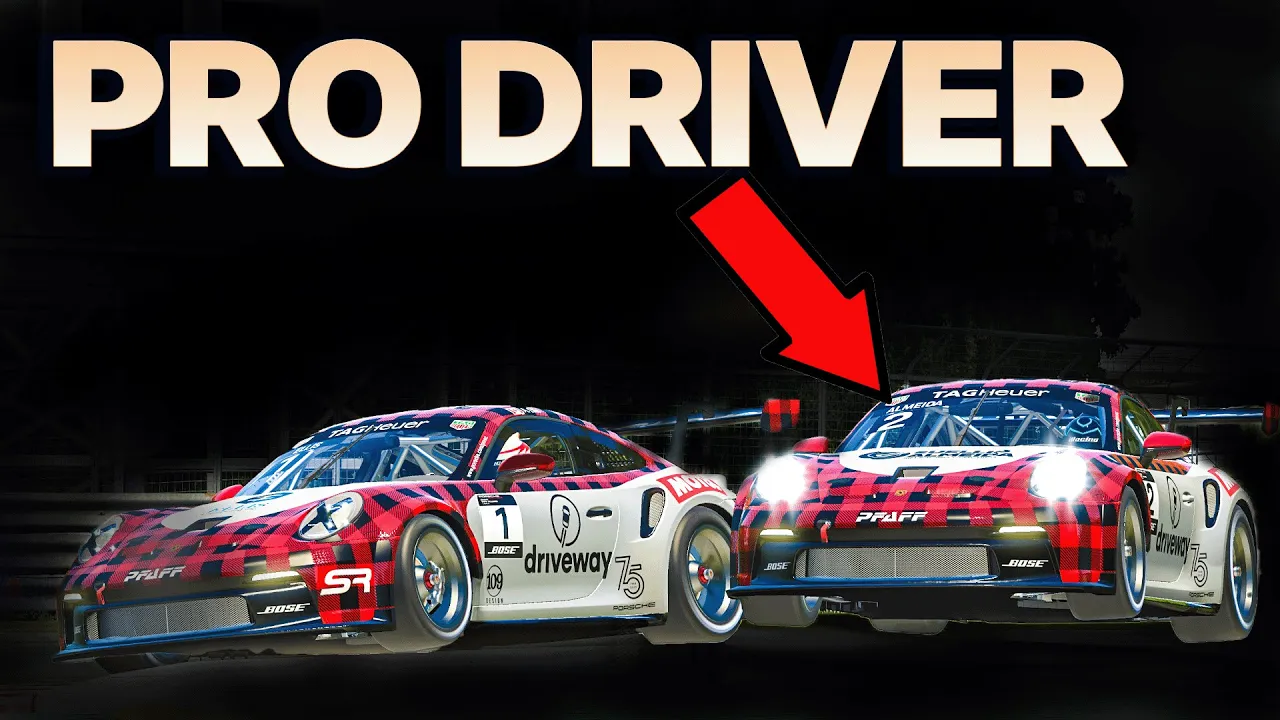
What Happens When You Coach a Pro Racing Driver in iRacing — Session Breakdown
Suellio Almeida
•
Saturday, March 4, 2023
The Myth That Pro Drivers Don't Need Sim Racing Coaching
Here's what people get wrong: they assume a professional racing driver automatically translates their skills 1:1 into sim racing.
They don't.
This driver races professionally. Real cars. Real tracks. Real consequences. But in iRacing, they were struggling with consistency, braking zones, and rotation. Not because they lack talent — because sim racing demands a different skill set.
The physics are real. The feedback is limited. The margin for error is microscopic.
And that gap? That's coachable.
What We Fixed First: Vision and Rotation Timing
The first thing I noticed wasn't technique — it was vision.
They were looking at the car, not the track. In a real car, your peripheral vision picks up speed, positioning, and reference points naturally. In sim racing, you're staring at a screen. You have to train your eyes differently.
We worked on:
Looking ahead to the next turn, not at the current one
Using fixed reference points for braking and turn-in
Scanning the track instead of fixating on the nose of the car
This alone changed their rotation timing. They stopped reacting late to corners and started anticipating them.
You can have perfect racecraft in real life and still lose half a second per lap in sim racing if your vision isn't trained for the screen.
Trail Braking: The Real vs. Sim Disconnect
In a real car, you feel the load transfer. The g-forces tell you when the front tires are loaded, when the rear is light, when you're at the limit.
In sim racing? You get force feedback through the wheel. That's it.
This driver was braking too early and releasing too soon. Not because they didn't understand trail braking — they've done it thousands of times in real cars — but because they weren't feeling the weight shift the same way.
We adjusted:
Braking pressure progression: carrying more pressure deeper into the corner
Release timing: using visual cues instead of physical sensation to release the brake
Rotation awareness: trusting the sim physics to rotate the car with less physical feedback
The lap time dropped immediately. Over a second in some corners.
The technique was already there. The translation layer was missing.
The Consistency Problem: Data Doesn't Lie
Pros are fast. But fast isn't enough in sim racing — you need to be repeatable.
We pulled up their telemetry. The variance in braking points was huge. Three to five meters of inconsistency on every corner. In a real car, you might get away with that because you're reacting to physical feedback in real time.
In iRacing? That variance costs you race pace.
We drilled:
Fixed reference markers for every braking zone
Consistent pedal application instead of reactive inputs
Lap-to-lap review using telemetry to tighten the gaps
Within 30 minutes, their consistency improved by 40%. Same driver. Same car. Better process.
This is what separates aliens from fast drivers: repeatability under pressure.
Why Sim Racing Makes You a Better Real-World Driver
Here's the thing most people miss: sim racing isn't just practice for sim racing.
This driver walked away with insights they'll take back to the real track:
Precision in braking zones — the screen forces you to be exact
Racecraft under pressure — iRacing's competition is relentless
Data literacy — learning to read telemetry and apply it lap-to-lap
Real-world racing is expensive. You get limited seat time. Mistakes cost money and equipment.
Sim racing lets you iterate. You can run 100 laps in a session, test different lines, blow the car up on lap 12, and reset. No consequences.
That's why F1 teams use simulators. That's why IMSA drivers spend hours in iRacing between race weekends.
It's not a replacement for real racing. It's a force multiplier.
The One Thing Every Driver Needs to Accept
It doesn't matter if you're a pro or a beginner — you have blind spots.
This driver is faster than 99% of sim racers. But they still had gaps. Vision. Consistency. Translation from real to sim.
And that's the point.
Coaching isn't about being bad at racing. It's about being specific about what to improve. Data shows you where. A coach shows you how.
You can grind for months trying to figure it out yourself. Or you can get someone who's seen the problem 10,000 times to point it out in 10 minutes.
The choice is yours.
What Would Change If You Trained Like a Pro?
You just read about a professional racing driver — someone who competes at the highest levels — working with a coach to close gaps in iRacing.
If a pro needs coaching, what makes you think you don't?
Here's the reality: most drivers plateau because they keep practicing the same mistakes. They run laps. They watch replays. They compare their lines to aliens. But they never get specific feedback on what's actually costing them time.
How long are you going to keep guessing?
Almeida Racing Academy was built for this. Whether you're chasing your first top split or preparing for real-world racing, we give you the structure, the tools, and the coaching to break through.
Start your free account and access the Car Handling course now
Sim Racing Academy Membership
Everything you need to stop guessing and start getting faster.
Starting at
$25
/mo
Car Handling Online Course
4 levels, full curriculum. Aimed to get you to top 1% in driving pace.
Racecraft Online Course
Overtaking, Defending, Race Strategy
Live coaching + on-track practice
Bi-weekly pro-coach workshops (recorded — never miss one) plus on-track Pit Parties to practice racecraft with a coach.
Plus These Bonuses
13,000+ Member Community
League Racing
Advanced MX-5 Mini Course
Racing Technique Development Guide
The Motor Racing Book (260 pages)
Think & Behave Like a Pro Driver — Mini eBook
What Happens When You Coach a Pro Racing Driver in iRacing — Session Breakdown
Suellio Almeida
•
Saturday, March 4, 2023
The Myth That Pro Drivers Don't Need Sim Racing Coaching
Here's what people get wrong: they assume a professional racing driver automatically translates their skills 1:1 into sim racing.
They don't.
This driver races professionally. Real cars. Real tracks. Real consequences. But in iRacing, they were struggling with consistency, braking zones, and rotation. Not because they lack talent — because sim racing demands a different skill set.
The physics are real. The feedback is limited. The margin for error is microscopic.
And that gap? That's coachable.
What We Fixed First: Vision and Rotation Timing
The first thing I noticed wasn't technique — it was vision.
They were looking at the car, not the track. In a real car, your peripheral vision picks up speed, positioning, and reference points naturally. In sim racing, you're staring at a screen. You have to train your eyes differently.
We worked on:
Looking ahead to the next turn, not at the current one
Using fixed reference points for braking and turn-in
Scanning the track instead of fixating on the nose of the car
This alone changed their rotation timing. They stopped reacting late to corners and started anticipating them.
You can have perfect racecraft in real life and still lose half a second per lap in sim racing if your vision isn't trained for the screen.
Trail Braking: The Real vs. Sim Disconnect
In a real car, you feel the load transfer. The g-forces tell you when the front tires are loaded, when the rear is light, when you're at the limit.
In sim racing? You get force feedback through the wheel. That's it.
This driver was braking too early and releasing too soon. Not because they didn't understand trail braking — they've done it thousands of times in real cars — but because they weren't feeling the weight shift the same way.
We adjusted:
Braking pressure progression: carrying more pressure deeper into the corner
Release timing: using visual cues instead of physical sensation to release the brake
Rotation awareness: trusting the sim physics to rotate the car with less physical feedback
The lap time dropped immediately. Over a second in some corners.
The technique was already there. The translation layer was missing.
The Consistency Problem: Data Doesn't Lie
Pros are fast. But fast isn't enough in sim racing — you need to be repeatable.
We pulled up their telemetry. The variance in braking points was huge. Three to five meters of inconsistency on every corner. In a real car, you might get away with that because you're reacting to physical feedback in real time.
In iRacing? That variance costs you race pace.
We drilled:
Fixed reference markers for every braking zone
Consistent pedal application instead of reactive inputs
Lap-to-lap review using telemetry to tighten the gaps
Within 30 minutes, their consistency improved by 40%. Same driver. Same car. Better process.
This is what separates aliens from fast drivers: repeatability under pressure.
Why Sim Racing Makes You a Better Real-World Driver
Here's the thing most people miss: sim racing isn't just practice for sim racing.
This driver walked away with insights they'll take back to the real track:
Precision in braking zones — the screen forces you to be exact
Racecraft under pressure — iRacing's competition is relentless
Data literacy — learning to read telemetry and apply it lap-to-lap
Real-world racing is expensive. You get limited seat time. Mistakes cost money and equipment.
Sim racing lets you iterate. You can run 100 laps in a session, test different lines, blow the car up on lap 12, and reset. No consequences.
That's why F1 teams use simulators. That's why IMSA drivers spend hours in iRacing between race weekends.
It's not a replacement for real racing. It's a force multiplier.
The One Thing Every Driver Needs to Accept
It doesn't matter if you're a pro or a beginner — you have blind spots.
This driver is faster than 99% of sim racers. But they still had gaps. Vision. Consistency. Translation from real to sim.
And that's the point.
Coaching isn't about being bad at racing. It's about being specific about what to improve. Data shows you where. A coach shows you how.
You can grind for months trying to figure it out yourself. Or you can get someone who's seen the problem 10,000 times to point it out in 10 minutes.
The choice is yours.
What Would Change If You Trained Like a Pro?
You just read about a professional racing driver — someone who competes at the highest levels — working with a coach to close gaps in iRacing.
If a pro needs coaching, what makes you think you don't?
Here's the reality: most drivers plateau because they keep practicing the same mistakes. They run laps. They watch replays. They compare their lines to aliens. But they never get specific feedback on what's actually costing them time.
How long are you going to keep guessing?
Almeida Racing Academy was built for this. Whether you're chasing your first top split or preparing for real-world racing, we give you the structure, the tools, and the coaching to break through.
Start your free account and access the Car Handling course now
Sim Racing Academy Membership
Everything you need to stop guessing and start getting faster.
Starting at
$25
/mo
Car Handling Online Course
4 levels, full curriculum. Aimed to get you to top 1% in driving pace.
Racecraft Online Course
Overtaking, Defending, Race Strategy
Live coaching + on-track practice
Bi-weekly pro-coach workshops (recorded — never miss one) plus on-track Pit Parties to practice racecraft with a coach.
Plus These Bonuses
13,000+ Member Community
League Racing
Advanced MX-5 Mini Course
Racing Technique Development Guide
The Motor Racing Book (260 pages)
Think & Behave Like a Pro Driver — Mini eBook
What Happens When You Coach a Pro Racing Driver in iRacing — Session Breakdown
Suellio Almeida
•
Saturday, March 4, 2023
The Myth That Pro Drivers Don't Need Sim Racing Coaching
Here's what people get wrong: they assume a professional racing driver automatically translates their skills 1:1 into sim racing.
They don't.
This driver races professionally. Real cars. Real tracks. Real consequences. But in iRacing, they were struggling with consistency, braking zones, and rotation. Not because they lack talent — because sim racing demands a different skill set.
The physics are real. The feedback is limited. The margin for error is microscopic.
And that gap? That's coachable.
What We Fixed First: Vision and Rotation Timing
The first thing I noticed wasn't technique — it was vision.
They were looking at the car, not the track. In a real car, your peripheral vision picks up speed, positioning, and reference points naturally. In sim racing, you're staring at a screen. You have to train your eyes differently.
We worked on:
Looking ahead to the next turn, not at the current one
Using fixed reference points for braking and turn-in
Scanning the track instead of fixating on the nose of the car
This alone changed their rotation timing. They stopped reacting late to corners and started anticipating them.
You can have perfect racecraft in real life and still lose half a second per lap in sim racing if your vision isn't trained for the screen.
Trail Braking: The Real vs. Sim Disconnect
In a real car, you feel the load transfer. The g-forces tell you when the front tires are loaded, when the rear is light, when you're at the limit.
In sim racing? You get force feedback through the wheel. That's it.
This driver was braking too early and releasing too soon. Not because they didn't understand trail braking — they've done it thousands of times in real cars — but because they weren't feeling the weight shift the same way.
We adjusted:
Braking pressure progression: carrying more pressure deeper into the corner
Release timing: using visual cues instead of physical sensation to release the brake
Rotation awareness: trusting the sim physics to rotate the car with less physical feedback
The lap time dropped immediately. Over a second in some corners.
The technique was already there. The translation layer was missing.
The Consistency Problem: Data Doesn't Lie
Pros are fast. But fast isn't enough in sim racing — you need to be repeatable.
We pulled up their telemetry. The variance in braking points was huge. Three to five meters of inconsistency on every corner. In a real car, you might get away with that because you're reacting to physical feedback in real time.
In iRacing? That variance costs you race pace.
We drilled:
Fixed reference markers for every braking zone
Consistent pedal application instead of reactive inputs
Lap-to-lap review using telemetry to tighten the gaps
Within 30 minutes, their consistency improved by 40%. Same driver. Same car. Better process.
This is what separates aliens from fast drivers: repeatability under pressure.
Why Sim Racing Makes You a Better Real-World Driver
Here's the thing most people miss: sim racing isn't just practice for sim racing.
This driver walked away with insights they'll take back to the real track:
Precision in braking zones — the screen forces you to be exact
Racecraft under pressure — iRacing's competition is relentless
Data literacy — learning to read telemetry and apply it lap-to-lap
Real-world racing is expensive. You get limited seat time. Mistakes cost money and equipment.
Sim racing lets you iterate. You can run 100 laps in a session, test different lines, blow the car up on lap 12, and reset. No consequences.
That's why F1 teams use simulators. That's why IMSA drivers spend hours in iRacing between race weekends.
It's not a replacement for real racing. It's a force multiplier.
The One Thing Every Driver Needs to Accept
It doesn't matter if you're a pro or a beginner — you have blind spots.
This driver is faster than 99% of sim racers. But they still had gaps. Vision. Consistency. Translation from real to sim.
And that's the point.
Coaching isn't about being bad at racing. It's about being specific about what to improve. Data shows you where. A coach shows you how.
You can grind for months trying to figure it out yourself. Or you can get someone who's seen the problem 10,000 times to point it out in 10 minutes.
The choice is yours.
What Would Change If You Trained Like a Pro?
You just read about a professional racing driver — someone who competes at the highest levels — working with a coach to close gaps in iRacing.
If a pro needs coaching, what makes you think you don't?
Here's the reality: most drivers plateau because they keep practicing the same mistakes. They run laps. They watch replays. They compare their lines to aliens. But they never get specific feedback on what's actually costing them time.
How long are you going to keep guessing?
Almeida Racing Academy was built for this. Whether you're chasing your first top split or preparing for real-world racing, we give you the structure, the tools, and the coaching to break through.
Start your free account and access the Car Handling course now
Sim Racing Academy Membership
Everything you need to stop guessing and start getting faster.
Starting at
$25
/mo
Car Handling Online Course
4 levels, full curriculum. Aimed to get you to top 1% in driving pace.
Racecraft Online Course
Overtaking, Defending, Race Strategy
Live coaching + on-track practice
Bi-weekly pro-coach workshops (recorded — never miss one) plus on-track Pit Parties to practice racecraft with a coach.
Plus These Bonuses
13,000+ Member Community
League Racing
Advanced MX-5 Mini Course
Racing Technique Development Guide
The Motor Racing Book (260 pages)
Think & Behave Like a Pro Driver — Mini eBook