
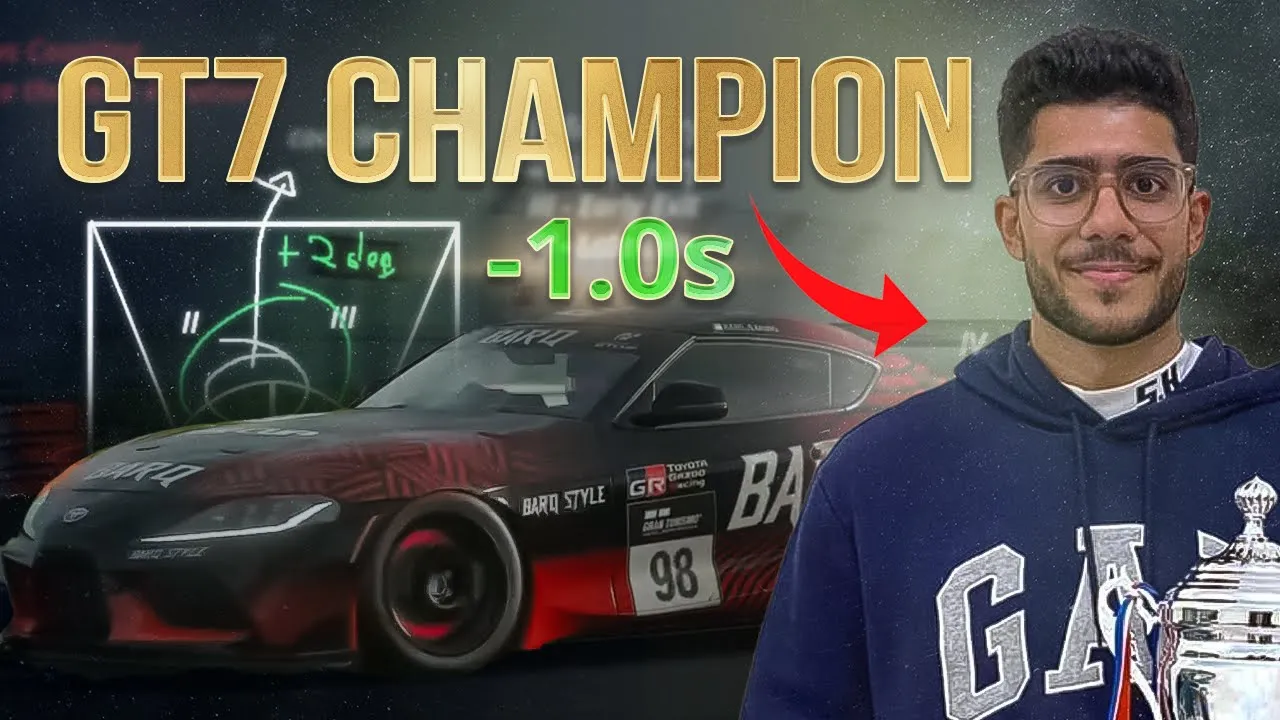
What Happens When You Coach a Gran Turismo 7 Champion — Coaching Session Breakdown
Suellio Almeida
•
Friday, October 6, 2023
The Student: A GT7 Champion Walks In
Okay, so I'm working with a Gran Turismo 7 champion. Not a beginner. Not someone stuck in mid-pack races. A driver who's already proven they can win at the highest level in their sim.
But here's the thing — championship-level driving in one sim doesn't automatically translate to other platforms. Different physics engines reward different techniques. And even at the top, there are micro-adjustments that unlock tenths you didn't know existed.
That's what this session was about. Finding those tenths.
The Problem: Fast, But Inconsistent Entry Speed
Right away, I can see what's happening on the telemetry. The racing line is clean. The exits are strong. But the entry speed into specific corners is costing lap time.
Not by seconds. By tenths. Which at this level is the difference between podium and mid-pack.
The issue? Braking reference points that aren't optimized for the car's actual capabilities. He's braking where it feels safe, not where the car can actually brake. And in high-downforce cars, that gap is massive.
You see this all the time with fast drivers. They develop habits that work for 90% of the lap, then leave time on the table in two or three critical zones because they never questioned those habits.
The Diagnosis: You're Not Trusting the Downforce
I told him: "You're braking 10 meters too early into Turn 3. The car has more grip than you're giving it credit for."
He pushes back — "But I'm already at the limit."
No. You're at your limit. The car's limit is different.
This is where data-driven coaching becomes critical. I overlay his braking trace with a reference lap from a faster driver in the same car. Same track. Same conditions.
The difference is obvious. The faster driver carries 8-10 kph more speed into the braking zone, brakes later, and rotates the car harder on entry. Same car. Same physics. Different technique.
What I want you to do is brake 5 meters later. Not 10 — that's too aggressive and you'll overshoot. Start with 5. Let the downforce work.
The Fix: Incremental Braking Point Adjustments
We make the change in stages. First lap, he brakes 5 meters later. Overshoots slightly, but the entry speed is there.
Second lap, he adjusts the braking pressure curve — less initial bite, more trail braking through the turn-in. Now the rotation is smoother. The car settles.
Third lap, he nails it. Braking point locked in. Entry speed up. Apex hit. Exit clean.
Lap time drops by 0.4 seconds. One corner. Four-tenths.
That's the difference between theory and execution. You can know you need to brake later, but until you've calibrated the exact reference point and pressure profile, you're guessing.
Another Thing: Mid-Corner Throttle Application
Okay, so the entry is fixed. Now let's look at mid-corner.
He's smooth on the throttle — that's good. But he's waiting too long to apply it. The car has already rotated through the Maximum Rotation Point, and he's still coasting.
In high-downforce cars, you want to be back on throttle before the apex. Not full throttle — progressive application. But the moment the car starts to settle from rotation, you should be feeding it in.
What we can see here is he's losing two-tenths in the middle of the corner, not on exit. The exit is fine. The problem is the transition from rotation to acceleration.
I tell him: "The moment you feel the car settle — not when you see the apex, when you feel the grip come back — start feeding throttle."
Next lap, he tries it. The car responds immediately. Less time coasting. Smoother power delivery. Exit speed goes up as a byproduct, but the real gain is in mid-corner stability.
Another two-tenths. Just from throttle timing.
The Result: From Fast to Faster
Total lap time improvement: 0.6 seconds over five laps.
Same car. Same track. Same driver. Different technique.
This is what high-level coaching looks like. It's not about teaching someone how to drive. It's about identifying the 2-3 specific inputs that are costing time and giving them the exact adjustment to fix it.
And here's the thing — this driver is a champion. He already knows how to race. He already knows the fundamentals. But even at that level, there's always something to refine.
That's the gap between good and great. Great drivers never stop questioning their inputs.
What Would Change If You Had This Level of Precision?
You're already fast. You've put in the hours. You know the racing line, you understand weight transfer, you can hold a race pace.
But how many tenths are you leaving on the table in three or four corners? How much faster could you be if someone showed you the exact inputs that are costing you time?
Most drivers plateau because they don't have the data to see their own gaps. They feel fast, so they assume they're optimized. But feeling fast and being fast are two different things.
What if you could see your telemetry overlaid with a reference lap from a top-tier driver? What if someone walked you through the exact braking point, the exact throttle timing, the exact line adjustment that unlocks the time you're missing?
That's what 1:1 coaching does. It removes the guesswork. You get a session with a real racing driver — IMSA, NASCAR, top 0.03% iRacing — who breaks down your driving at the input level and gives you the exact changes to make.
No generic advice. No YouTube theory. Just data, diagnosis, and a clear path forward.
Sim Racing Academy Membership
Everything you need to stop guessing and start getting faster.
Starting at
$25
/mo
Car Handling Online Course
4 levels, full curriculum. Aimed to get you to top 1% in driving pace.
Racecraft Online Course
Overtaking, Defending, Race Strategy
Live coaching + on-track practice
Bi-weekly pro-coach workshops (recorded — never miss one) plus on-track Pit Parties to practice racecraft with a coach.
Plus These Bonuses
13,000+ Member Community
League Racing
Advanced MX-5 Mini Course
Racing Technique Development Guide
The Motor Racing Book (260 pages)
Think & Behave Like a Pro Driver — Mini eBook
What Happens When You Coach a Gran Turismo 7 Champion — Coaching Session Breakdown
Suellio Almeida
•
Friday, October 6, 2023
The Student: A GT7 Champion Walks In
Okay, so I'm working with a Gran Turismo 7 champion. Not a beginner. Not someone stuck in mid-pack races. A driver who's already proven they can win at the highest level in their sim.
But here's the thing — championship-level driving in one sim doesn't automatically translate to other platforms. Different physics engines reward different techniques. And even at the top, there are micro-adjustments that unlock tenths you didn't know existed.
That's what this session was about. Finding those tenths.
The Problem: Fast, But Inconsistent Entry Speed
Right away, I can see what's happening on the telemetry. The racing line is clean. The exits are strong. But the entry speed into specific corners is costing lap time.
Not by seconds. By tenths. Which at this level is the difference between podium and mid-pack.
The issue? Braking reference points that aren't optimized for the car's actual capabilities. He's braking where it feels safe, not where the car can actually brake. And in high-downforce cars, that gap is massive.
You see this all the time with fast drivers. They develop habits that work for 90% of the lap, then leave time on the table in two or three critical zones because they never questioned those habits.
The Diagnosis: You're Not Trusting the Downforce
I told him: "You're braking 10 meters too early into Turn 3. The car has more grip than you're giving it credit for."
He pushes back — "But I'm already at the limit."
No. You're at your limit. The car's limit is different.
This is where data-driven coaching becomes critical. I overlay his braking trace with a reference lap from a faster driver in the same car. Same track. Same conditions.
The difference is obvious. The faster driver carries 8-10 kph more speed into the braking zone, brakes later, and rotates the car harder on entry. Same car. Same physics. Different technique.
What I want you to do is brake 5 meters later. Not 10 — that's too aggressive and you'll overshoot. Start with 5. Let the downforce work.
The Fix: Incremental Braking Point Adjustments
We make the change in stages. First lap, he brakes 5 meters later. Overshoots slightly, but the entry speed is there.
Second lap, he adjusts the braking pressure curve — less initial bite, more trail braking through the turn-in. Now the rotation is smoother. The car settles.
Third lap, he nails it. Braking point locked in. Entry speed up. Apex hit. Exit clean.
Lap time drops by 0.4 seconds. One corner. Four-tenths.
That's the difference between theory and execution. You can know you need to brake later, but until you've calibrated the exact reference point and pressure profile, you're guessing.
Another Thing: Mid-Corner Throttle Application
Okay, so the entry is fixed. Now let's look at mid-corner.
He's smooth on the throttle — that's good. But he's waiting too long to apply it. The car has already rotated through the Maximum Rotation Point, and he's still coasting.
In high-downforce cars, you want to be back on throttle before the apex. Not full throttle — progressive application. But the moment the car starts to settle from rotation, you should be feeding it in.
What we can see here is he's losing two-tenths in the middle of the corner, not on exit. The exit is fine. The problem is the transition from rotation to acceleration.
I tell him: "The moment you feel the car settle — not when you see the apex, when you feel the grip come back — start feeding throttle."
Next lap, he tries it. The car responds immediately. Less time coasting. Smoother power delivery. Exit speed goes up as a byproduct, but the real gain is in mid-corner stability.
Another two-tenths. Just from throttle timing.
The Result: From Fast to Faster
Total lap time improvement: 0.6 seconds over five laps.
Same car. Same track. Same driver. Different technique.
This is what high-level coaching looks like. It's not about teaching someone how to drive. It's about identifying the 2-3 specific inputs that are costing time and giving them the exact adjustment to fix it.
And here's the thing — this driver is a champion. He already knows how to race. He already knows the fundamentals. But even at that level, there's always something to refine.
That's the gap between good and great. Great drivers never stop questioning their inputs.
What Would Change If You Had This Level of Precision?
You're already fast. You've put in the hours. You know the racing line, you understand weight transfer, you can hold a race pace.
But how many tenths are you leaving on the table in three or four corners? How much faster could you be if someone showed you the exact inputs that are costing you time?
Most drivers plateau because they don't have the data to see their own gaps. They feel fast, so they assume they're optimized. But feeling fast and being fast are two different things.
What if you could see your telemetry overlaid with a reference lap from a top-tier driver? What if someone walked you through the exact braking point, the exact throttle timing, the exact line adjustment that unlocks the time you're missing?
That's what 1:1 coaching does. It removes the guesswork. You get a session with a real racing driver — IMSA, NASCAR, top 0.03% iRacing — who breaks down your driving at the input level and gives you the exact changes to make.
No generic advice. No YouTube theory. Just data, diagnosis, and a clear path forward.
Sim Racing Academy Membership
Everything you need to stop guessing and start getting faster.
Starting at
$25
/mo
Car Handling Online Course
4 levels, full curriculum. Aimed to get you to top 1% in driving pace.
Racecraft Online Course
Overtaking, Defending, Race Strategy
Live coaching + on-track practice
Bi-weekly pro-coach workshops (recorded — never miss one) plus on-track Pit Parties to practice racecraft with a coach.
Plus These Bonuses
13,000+ Member Community
League Racing
Advanced MX-5 Mini Course
Racing Technique Development Guide
The Motor Racing Book (260 pages)
Think & Behave Like a Pro Driver — Mini eBook
What Happens When You Coach a Gran Turismo 7 Champion — Coaching Session Breakdown
Suellio Almeida
•
Friday, October 6, 2023
The Student: A GT7 Champion Walks In
Okay, so I'm working with a Gran Turismo 7 champion. Not a beginner. Not someone stuck in mid-pack races. A driver who's already proven they can win at the highest level in their sim.
But here's the thing — championship-level driving in one sim doesn't automatically translate to other platforms. Different physics engines reward different techniques. And even at the top, there are micro-adjustments that unlock tenths you didn't know existed.
That's what this session was about. Finding those tenths.
The Problem: Fast, But Inconsistent Entry Speed
Right away, I can see what's happening on the telemetry. The racing line is clean. The exits are strong. But the entry speed into specific corners is costing lap time.
Not by seconds. By tenths. Which at this level is the difference between podium and mid-pack.
The issue? Braking reference points that aren't optimized for the car's actual capabilities. He's braking where it feels safe, not where the car can actually brake. And in high-downforce cars, that gap is massive.
You see this all the time with fast drivers. They develop habits that work for 90% of the lap, then leave time on the table in two or three critical zones because they never questioned those habits.
The Diagnosis: You're Not Trusting the Downforce
I told him: "You're braking 10 meters too early into Turn 3. The car has more grip than you're giving it credit for."
He pushes back — "But I'm already at the limit."
No. You're at your limit. The car's limit is different.
This is where data-driven coaching becomes critical. I overlay his braking trace with a reference lap from a faster driver in the same car. Same track. Same conditions.
The difference is obvious. The faster driver carries 8-10 kph more speed into the braking zone, brakes later, and rotates the car harder on entry. Same car. Same physics. Different technique.
What I want you to do is brake 5 meters later. Not 10 — that's too aggressive and you'll overshoot. Start with 5. Let the downforce work.
The Fix: Incremental Braking Point Adjustments
We make the change in stages. First lap, he brakes 5 meters later. Overshoots slightly, but the entry speed is there.
Second lap, he adjusts the braking pressure curve — less initial bite, more trail braking through the turn-in. Now the rotation is smoother. The car settles.
Third lap, he nails it. Braking point locked in. Entry speed up. Apex hit. Exit clean.
Lap time drops by 0.4 seconds. One corner. Four-tenths.
That's the difference between theory and execution. You can know you need to brake later, but until you've calibrated the exact reference point and pressure profile, you're guessing.
Another Thing: Mid-Corner Throttle Application
Okay, so the entry is fixed. Now let's look at mid-corner.
He's smooth on the throttle — that's good. But he's waiting too long to apply it. The car has already rotated through the Maximum Rotation Point, and he's still coasting.
In high-downforce cars, you want to be back on throttle before the apex. Not full throttle — progressive application. But the moment the car starts to settle from rotation, you should be feeding it in.
What we can see here is he's losing two-tenths in the middle of the corner, not on exit. The exit is fine. The problem is the transition from rotation to acceleration.
I tell him: "The moment you feel the car settle — not when you see the apex, when you feel the grip come back — start feeding throttle."
Next lap, he tries it. The car responds immediately. Less time coasting. Smoother power delivery. Exit speed goes up as a byproduct, but the real gain is in mid-corner stability.
Another two-tenths. Just from throttle timing.
The Result: From Fast to Faster
Total lap time improvement: 0.6 seconds over five laps.
Same car. Same track. Same driver. Different technique.
This is what high-level coaching looks like. It's not about teaching someone how to drive. It's about identifying the 2-3 specific inputs that are costing time and giving them the exact adjustment to fix it.
And here's the thing — this driver is a champion. He already knows how to race. He already knows the fundamentals. But even at that level, there's always something to refine.
That's the gap between good and great. Great drivers never stop questioning their inputs.
What Would Change If You Had This Level of Precision?
You're already fast. You've put in the hours. You know the racing line, you understand weight transfer, you can hold a race pace.
But how many tenths are you leaving on the table in three or four corners? How much faster could you be if someone showed you the exact inputs that are costing you time?
Most drivers plateau because they don't have the data to see their own gaps. They feel fast, so they assume they're optimized. But feeling fast and being fast are two different things.
What if you could see your telemetry overlaid with a reference lap from a top-tier driver? What if someone walked you through the exact braking point, the exact throttle timing, the exact line adjustment that unlocks the time you're missing?
That's what 1:1 coaching does. It removes the guesswork. You get a session with a real racing driver — IMSA, NASCAR, top 0.03% iRacing — who breaks down your driving at the input level and gives you the exact changes to make.
No generic advice. No YouTube theory. Just data, diagnosis, and a clear path forward.
Sim Racing Academy Membership
Everything you need to stop guessing and start getting faster.
Starting at
$25
/mo
Car Handling Online Course
4 levels, full curriculum. Aimed to get you to top 1% in driving pace.
Racecraft Online Course
Overtaking, Defending, Race Strategy
Live coaching + on-track practice
Bi-weekly pro-coach workshops (recorded — never miss one) plus on-track Pit Parties to practice racecraft with a coach.
Plus These Bonuses
13,000+ Member Community
League Racing
Advanced MX-5 Mini Course
Racing Technique Development Guide
The Motor Racing Book (260 pages)
Think & Behave Like a Pro Driver — Mini eBook