
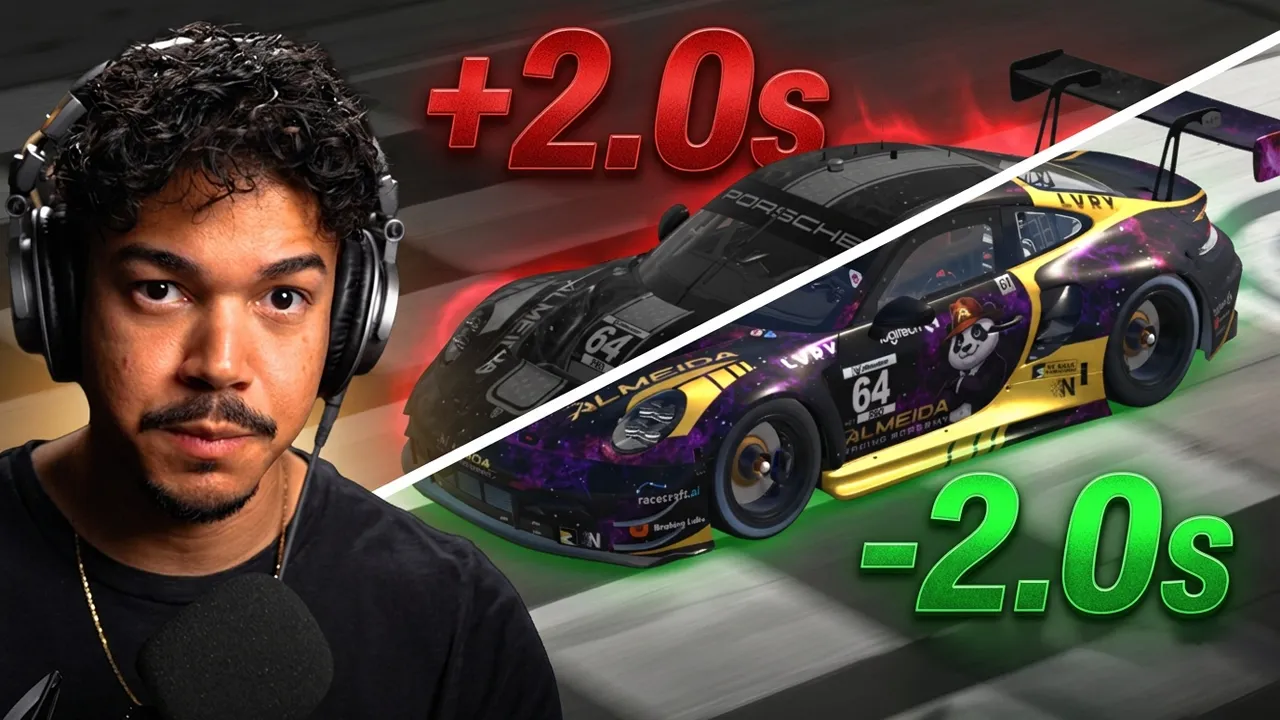
How to Get Better in Racing: The Only Training Method That Actually Works
Suellio Almeida
•
Friday, March 13, 2026
Why Are You Still Making the Same Mistakes?
You've run thousands of laps. You've watched YouTube tutorials. You've tweaked your setup.
But your lap times haven't moved in months.
The problem isn't your talent. It's not your equipment. It's your training method — or lack of one.
Most sim racers confuse seat time with skill development. They think more laps equals faster times. But repeating the same mistakes 10,000 times doesn't make you faster. It makes you consistently mediocre.
The difference between drivers who break through and drivers who plateau? One group trains with purpose. The other just drives.
The Myth of "Natural Talent" in Racing
Let me destroy a comfortable lie right now: "Some people are just naturally fast."
Bullshit.
I've coached over 36,000 students. I've worked with complete beginners who became division champions. I've coached F1 engineers. I've seen 12-year-olds develop racecraft that embarrasses adults with years of experience.
The pattern is clear: Fast drivers aren't born. They're built through specific, focused training.
Every world-class racing driver follows a structured development path. They don't just "drive more." They isolate skills, drill fundamentals, analyze data, and build muscle memory through deliberate practice.
You know what separates a 2,000 iRating driver from a 4,000 iRating driver? It's not reflexes. It's not some mystical "feel."
It's training methodology.
What Actually Makes You Faster
Here's the framework that works. This is how I went from complete beginner to Canadian Sim Racing Champion. This is how I coach drivers who jump 1,000+ iRating in weeks.
1. Fundamentals Come First (No Exceptions)
You cannot build racecraft on broken fundamentals.
Before you worry about setup, before you analyze telemetry, before you study racecraft — you need to master car control.
Weight transfer. How the car loads and unloads through steering, braking, and throttle.
Trail braking. Not just braking into corners — understanding how brake pressure manipulates rotation through the Maximum Rotation Point.
Vision techniques. Where you look determines where the car goes. Most drivers stare 3 feet in front of their bumper and wonder why they can't hit apexes consistently.
Throttle modulation. The difference between gentle application that maintains rear grip and stabbing the pedal that spins you into a wall.
These aren't "basics" you graduate from. These are the foundation every fast lap is built on.
I still drill fundamentals. Every session. Because precision at the limit requires constant calibration.
2. Isolate Skills, Don't Chase Lap Times
Stop doing full race stints when you're trying to improve.
Seriously. Stop it.
You're training your brain to accept mediocre execution because you're focused on the wrong metric. Lap times are an OUTPUT. They're the result of skill execution.
Here's how deliberate practice actually works:
Pick ONE skill. Trail braking. Corner entry speed. Throttle application out of slow corners. One thing.
Run 5-10 laps focusing ONLY on that skill. Ignore lap times. Ignore other parts of the track. Drill that specific technique until your execution is consistent.
Analyze what happened. Did you brake too early? Too late? Did you carry too much speed into the apex? Did you lose the rear on throttle?
Adjust and repeat. Small changes. Iterate. Build the neural pathway.
This is how you develop muscle memory that works under pressure. Not grinding hundreds of laps hoping something clicks.
3. Data Tells You What Feel Cannot
Your butt dyno lies to you.
You FEEL like you're braking later than your previous lap. The data says you braked 5 meters earlier.
You THINK you're smooth on throttle. The trace shows you're stabbing the pedal like you're trying to kill a spider.
This is why telemetry analysis separates serious drivers from hobbyists.
At Almeida Racing Academy, we use Garage 61 Pro — purpose-built software for racing analysis. It shows you exactly where time is being lost. Not guesses. Not feelings. Facts.
Braking points. Minimum speed. Throttle application. Line precision.
Compare your trace to a faster driver's trace. The gaps are obvious. Now you know what to fix.
Without data, you're training blind.
4. Consistency Before Speed
Here's the test: Can you run 10 consecutive laps within 0.2 seconds of each other?
No?
Then you're not ready to chase faster lap times.
Consistency is the foundation of racecraft. You cannot defend position if you don't know where your limit is. You cannot execute an overtake if you can't hit your marks under pressure.
Consistency comes from repeatable technique. Same braking point. Same turn-in. Same throttle application point. Lap after lap.
Once you can deliver consistent laps, THEN you can push the limit. Because now you have a baseline. Now small adjustments show clear results.
Inconsistent drivers are unpredictable. They're dangerous in races. They crash under pressure because they don't actually know their own limits.
Consistency isn't boring. Consistency is speed you can access on demand.
5. Race with Purpose, Not Just for Positions
Every race should have a training objective.
"Win" is not an objective. It's an outcome.
Objectives look like this:
Practice defending the inside line through Turn 3.
Execute clean overtakes using late braking without contact.
Maintain tire temp management for 20 consecutive laps.
Stay calm and precise when racing door-to-door.
When you race with training objectives, you develop racecraft. You learn how to position the car. How to force mistakes. How to capitalize on opportunities.
Positions will come. Championships will come.
But only if you build the skills that create results.
The Training Program That Actually Works
When I founded Almeida Racing Academy in 2021, it was because I was tired of watching talented drivers plateau.
They had the potential. They didn't have the structure.
So I built what I wish existed when I started: A complete driver development program based on real motorsports training methods.
Not random YouTube tips. Not guesswork.
8 courses. 80 lessons. Structured progression from fundamentals to advanced racecraft.
Car handling. Trail braking. Weight transfer. Maximum Rotation Point. Vision techniques. Race starts. Overtaking. Defending. Mental game.
Every lesson is coach-led. Every technique is demonstrated. Every concept is drilled until it becomes instinct.
We run weekly workshops where I personally work with members on specific skills. We analyze telemetry together. We break down race footage. We diagnose exactly why you're losing time.
We have challenges and leagues where you apply what you've learned in competitive environments. With feedback. With coaching. With a community of drivers who are all committed to improvement.
And we give you Garage 61 Pro — the same telemetry software I use to analyze my own driving.
This isn't a course you watch once and forget. This is a training system you engage with every week.
What Happens If You Keep Training the Wrong Way?
Honest question: How long are you willing to stay stuck?
Another year of random practice sessions hoping something clicks?
Another year watching other drivers improve while you plateau?
Another year of frustration because you KNOW you're capable of more but you can't break through?
You don't have a talent problem. You have a training problem.
And training problems have solutions.
The drivers who break through — the ones who jump from mid-pack to podiums, from 2k to 4k iRating, from sim racing to real motorsports — they all made the same decision:
They stopped guessing and started training with structure.
Some join Gold Membership and work through the 80-lesson curriculum. Some book 1:1 coaching sessions with me or my team (Kane at 9k iRating, Connor who drives NASCAR). Some apply for Platinum and get personal mentorship as they transition to real racing.
But they all stopped accepting mediocrity as inevitable.
What about you? How much longer are you going to train without a plan?
Right now, Gold Membership is $25/month with code WINTER. Full access to every course. Every workshop. Every tool. The entire training system.
Sim Racing Academy Membership
Everything you need to stop guessing and start getting faster.
Starting at
$25
/mo
Car Handling Online Course
4 levels, full curriculum. Aimed to get you to top 1% in driving pace.
Racecraft Online Course
Overtaking, Defending, Race Strategy
Live coaching + on-track practice
Bi-weekly pro-coach workshops (recorded — never miss one) plus on-track Pit Parties to practice racecraft with a coach.
Plus These Bonuses
13,000+ Member Community
League Racing
Advanced MX-5 Mini Course
Racing Technique Development Guide
The Motor Racing Book (260 pages)
Think & Behave Like a Pro Driver — Mini eBook
How to Get Better in Racing: The Only Training Method That Actually Works
Suellio Almeida
•
Friday, March 13, 2026
Why Are You Still Making the Same Mistakes?
You've run thousands of laps. You've watched YouTube tutorials. You've tweaked your setup.
But your lap times haven't moved in months.
The problem isn't your talent. It's not your equipment. It's your training method — or lack of one.
Most sim racers confuse seat time with skill development. They think more laps equals faster times. But repeating the same mistakes 10,000 times doesn't make you faster. It makes you consistently mediocre.
The difference between drivers who break through and drivers who plateau? One group trains with purpose. The other just drives.
The Myth of "Natural Talent" in Racing
Let me destroy a comfortable lie right now: "Some people are just naturally fast."
Bullshit.
I've coached over 36,000 students. I've worked with complete beginners who became division champions. I've coached F1 engineers. I've seen 12-year-olds develop racecraft that embarrasses adults with years of experience.
The pattern is clear: Fast drivers aren't born. They're built through specific, focused training.
Every world-class racing driver follows a structured development path. They don't just "drive more." They isolate skills, drill fundamentals, analyze data, and build muscle memory through deliberate practice.
You know what separates a 2,000 iRating driver from a 4,000 iRating driver? It's not reflexes. It's not some mystical "feel."
It's training methodology.
What Actually Makes You Faster
Here's the framework that works. This is how I went from complete beginner to Canadian Sim Racing Champion. This is how I coach drivers who jump 1,000+ iRating in weeks.
1. Fundamentals Come First (No Exceptions)
You cannot build racecraft on broken fundamentals.
Before you worry about setup, before you analyze telemetry, before you study racecraft — you need to master car control.
Weight transfer. How the car loads and unloads through steering, braking, and throttle.
Trail braking. Not just braking into corners — understanding how brake pressure manipulates rotation through the Maximum Rotation Point.
Vision techniques. Where you look determines where the car goes. Most drivers stare 3 feet in front of their bumper and wonder why they can't hit apexes consistently.
Throttle modulation. The difference between gentle application that maintains rear grip and stabbing the pedal that spins you into a wall.
These aren't "basics" you graduate from. These are the foundation every fast lap is built on.
I still drill fundamentals. Every session. Because precision at the limit requires constant calibration.
2. Isolate Skills, Don't Chase Lap Times
Stop doing full race stints when you're trying to improve.
Seriously. Stop it.
You're training your brain to accept mediocre execution because you're focused on the wrong metric. Lap times are an OUTPUT. They're the result of skill execution.
Here's how deliberate practice actually works:
Pick ONE skill. Trail braking. Corner entry speed. Throttle application out of slow corners. One thing.
Run 5-10 laps focusing ONLY on that skill. Ignore lap times. Ignore other parts of the track. Drill that specific technique until your execution is consistent.
Analyze what happened. Did you brake too early? Too late? Did you carry too much speed into the apex? Did you lose the rear on throttle?
Adjust and repeat. Small changes. Iterate. Build the neural pathway.
This is how you develop muscle memory that works under pressure. Not grinding hundreds of laps hoping something clicks.
3. Data Tells You What Feel Cannot
Your butt dyno lies to you.
You FEEL like you're braking later than your previous lap. The data says you braked 5 meters earlier.
You THINK you're smooth on throttle. The trace shows you're stabbing the pedal like you're trying to kill a spider.
This is why telemetry analysis separates serious drivers from hobbyists.
At Almeida Racing Academy, we use Garage 61 Pro — purpose-built software for racing analysis. It shows you exactly where time is being lost. Not guesses. Not feelings. Facts.
Braking points. Minimum speed. Throttle application. Line precision.
Compare your trace to a faster driver's trace. The gaps are obvious. Now you know what to fix.
Without data, you're training blind.
4. Consistency Before Speed
Here's the test: Can you run 10 consecutive laps within 0.2 seconds of each other?
No?
Then you're not ready to chase faster lap times.
Consistency is the foundation of racecraft. You cannot defend position if you don't know where your limit is. You cannot execute an overtake if you can't hit your marks under pressure.
Consistency comes from repeatable technique. Same braking point. Same turn-in. Same throttle application point. Lap after lap.
Once you can deliver consistent laps, THEN you can push the limit. Because now you have a baseline. Now small adjustments show clear results.
Inconsistent drivers are unpredictable. They're dangerous in races. They crash under pressure because they don't actually know their own limits.
Consistency isn't boring. Consistency is speed you can access on demand.
5. Race with Purpose, Not Just for Positions
Every race should have a training objective.
"Win" is not an objective. It's an outcome.
Objectives look like this:
Practice defending the inside line through Turn 3.
Execute clean overtakes using late braking without contact.
Maintain tire temp management for 20 consecutive laps.
Stay calm and precise when racing door-to-door.
When you race with training objectives, you develop racecraft. You learn how to position the car. How to force mistakes. How to capitalize on opportunities.
Positions will come. Championships will come.
But only if you build the skills that create results.
The Training Program That Actually Works
When I founded Almeida Racing Academy in 2021, it was because I was tired of watching talented drivers plateau.
They had the potential. They didn't have the structure.
So I built what I wish existed when I started: A complete driver development program based on real motorsports training methods.
Not random YouTube tips. Not guesswork.
8 courses. 80 lessons. Structured progression from fundamentals to advanced racecraft.
Car handling. Trail braking. Weight transfer. Maximum Rotation Point. Vision techniques. Race starts. Overtaking. Defending. Mental game.
Every lesson is coach-led. Every technique is demonstrated. Every concept is drilled until it becomes instinct.
We run weekly workshops where I personally work with members on specific skills. We analyze telemetry together. We break down race footage. We diagnose exactly why you're losing time.
We have challenges and leagues where you apply what you've learned in competitive environments. With feedback. With coaching. With a community of drivers who are all committed to improvement.
And we give you Garage 61 Pro — the same telemetry software I use to analyze my own driving.
This isn't a course you watch once and forget. This is a training system you engage with every week.
What Happens If You Keep Training the Wrong Way?
Honest question: How long are you willing to stay stuck?
Another year of random practice sessions hoping something clicks?
Another year watching other drivers improve while you plateau?
Another year of frustration because you KNOW you're capable of more but you can't break through?
You don't have a talent problem. You have a training problem.
And training problems have solutions.
The drivers who break through — the ones who jump from mid-pack to podiums, from 2k to 4k iRating, from sim racing to real motorsports — they all made the same decision:
They stopped guessing and started training with structure.
Some join Gold Membership and work through the 80-lesson curriculum. Some book 1:1 coaching sessions with me or my team (Kane at 9k iRating, Connor who drives NASCAR). Some apply for Platinum and get personal mentorship as they transition to real racing.
But they all stopped accepting mediocrity as inevitable.
What about you? How much longer are you going to train without a plan?
Right now, Gold Membership is $25/month with code WINTER. Full access to every course. Every workshop. Every tool. The entire training system.
Sim Racing Academy Membership
Everything you need to stop guessing and start getting faster.
Starting at
$25
/mo
Car Handling Online Course
4 levels, full curriculum. Aimed to get you to top 1% in driving pace.
Racecraft Online Course
Overtaking, Defending, Race Strategy
Live coaching + on-track practice
Bi-weekly pro-coach workshops (recorded — never miss one) plus on-track Pit Parties to practice racecraft with a coach.
Plus These Bonuses
13,000+ Member Community
League Racing
Advanced MX-5 Mini Course
Racing Technique Development Guide
The Motor Racing Book (260 pages)
Think & Behave Like a Pro Driver — Mini eBook
How to Get Better in Racing: The Only Training Method That Actually Works
Suellio Almeida
•
Friday, March 13, 2026
Why Are You Still Making the Same Mistakes?
You've run thousands of laps. You've watched YouTube tutorials. You've tweaked your setup.
But your lap times haven't moved in months.
The problem isn't your talent. It's not your equipment. It's your training method — or lack of one.
Most sim racers confuse seat time with skill development. They think more laps equals faster times. But repeating the same mistakes 10,000 times doesn't make you faster. It makes you consistently mediocre.
The difference between drivers who break through and drivers who plateau? One group trains with purpose. The other just drives.
The Myth of "Natural Talent" in Racing
Let me destroy a comfortable lie right now: "Some people are just naturally fast."
Bullshit.
I've coached over 36,000 students. I've worked with complete beginners who became division champions. I've coached F1 engineers. I've seen 12-year-olds develop racecraft that embarrasses adults with years of experience.
The pattern is clear: Fast drivers aren't born. They're built through specific, focused training.
Every world-class racing driver follows a structured development path. They don't just "drive more." They isolate skills, drill fundamentals, analyze data, and build muscle memory through deliberate practice.
You know what separates a 2,000 iRating driver from a 4,000 iRating driver? It's not reflexes. It's not some mystical "feel."
It's training methodology.
What Actually Makes You Faster
Here's the framework that works. This is how I went from complete beginner to Canadian Sim Racing Champion. This is how I coach drivers who jump 1,000+ iRating in weeks.
1. Fundamentals Come First (No Exceptions)
You cannot build racecraft on broken fundamentals.
Before you worry about setup, before you analyze telemetry, before you study racecraft — you need to master car control.
Weight transfer. How the car loads and unloads through steering, braking, and throttle.
Trail braking. Not just braking into corners — understanding how brake pressure manipulates rotation through the Maximum Rotation Point.
Vision techniques. Where you look determines where the car goes. Most drivers stare 3 feet in front of their bumper and wonder why they can't hit apexes consistently.
Throttle modulation. The difference between gentle application that maintains rear grip and stabbing the pedal that spins you into a wall.
These aren't "basics" you graduate from. These are the foundation every fast lap is built on.
I still drill fundamentals. Every session. Because precision at the limit requires constant calibration.
2. Isolate Skills, Don't Chase Lap Times
Stop doing full race stints when you're trying to improve.
Seriously. Stop it.
You're training your brain to accept mediocre execution because you're focused on the wrong metric. Lap times are an OUTPUT. They're the result of skill execution.
Here's how deliberate practice actually works:
Pick ONE skill. Trail braking. Corner entry speed. Throttle application out of slow corners. One thing.
Run 5-10 laps focusing ONLY on that skill. Ignore lap times. Ignore other parts of the track. Drill that specific technique until your execution is consistent.
Analyze what happened. Did you brake too early? Too late? Did you carry too much speed into the apex? Did you lose the rear on throttle?
Adjust and repeat. Small changes. Iterate. Build the neural pathway.
This is how you develop muscle memory that works under pressure. Not grinding hundreds of laps hoping something clicks.
3. Data Tells You What Feel Cannot
Your butt dyno lies to you.
You FEEL like you're braking later than your previous lap. The data says you braked 5 meters earlier.
You THINK you're smooth on throttle. The trace shows you're stabbing the pedal like you're trying to kill a spider.
This is why telemetry analysis separates serious drivers from hobbyists.
At Almeida Racing Academy, we use Garage 61 Pro — purpose-built software for racing analysis. It shows you exactly where time is being lost. Not guesses. Not feelings. Facts.
Braking points. Minimum speed. Throttle application. Line precision.
Compare your trace to a faster driver's trace. The gaps are obvious. Now you know what to fix.
Without data, you're training blind.
4. Consistency Before Speed
Here's the test: Can you run 10 consecutive laps within 0.2 seconds of each other?
No?
Then you're not ready to chase faster lap times.
Consistency is the foundation of racecraft. You cannot defend position if you don't know where your limit is. You cannot execute an overtake if you can't hit your marks under pressure.
Consistency comes from repeatable technique. Same braking point. Same turn-in. Same throttle application point. Lap after lap.
Once you can deliver consistent laps, THEN you can push the limit. Because now you have a baseline. Now small adjustments show clear results.
Inconsistent drivers are unpredictable. They're dangerous in races. They crash under pressure because they don't actually know their own limits.
Consistency isn't boring. Consistency is speed you can access on demand.
5. Race with Purpose, Not Just for Positions
Every race should have a training objective.
"Win" is not an objective. It's an outcome.
Objectives look like this:
Practice defending the inside line through Turn 3.
Execute clean overtakes using late braking without contact.
Maintain tire temp management for 20 consecutive laps.
Stay calm and precise when racing door-to-door.
When you race with training objectives, you develop racecraft. You learn how to position the car. How to force mistakes. How to capitalize on opportunities.
Positions will come. Championships will come.
But only if you build the skills that create results.
The Training Program That Actually Works
When I founded Almeida Racing Academy in 2021, it was because I was tired of watching talented drivers plateau.
They had the potential. They didn't have the structure.
So I built what I wish existed when I started: A complete driver development program based on real motorsports training methods.
Not random YouTube tips. Not guesswork.
8 courses. 80 lessons. Structured progression from fundamentals to advanced racecraft.
Car handling. Trail braking. Weight transfer. Maximum Rotation Point. Vision techniques. Race starts. Overtaking. Defending. Mental game.
Every lesson is coach-led. Every technique is demonstrated. Every concept is drilled until it becomes instinct.
We run weekly workshops where I personally work with members on specific skills. We analyze telemetry together. We break down race footage. We diagnose exactly why you're losing time.
We have challenges and leagues where you apply what you've learned in competitive environments. With feedback. With coaching. With a community of drivers who are all committed to improvement.
And we give you Garage 61 Pro — the same telemetry software I use to analyze my own driving.
This isn't a course you watch once and forget. This is a training system you engage with every week.
What Happens If You Keep Training the Wrong Way?
Honest question: How long are you willing to stay stuck?
Another year of random practice sessions hoping something clicks?
Another year watching other drivers improve while you plateau?
Another year of frustration because you KNOW you're capable of more but you can't break through?
You don't have a talent problem. You have a training problem.
And training problems have solutions.
The drivers who break through — the ones who jump from mid-pack to podiums, from 2k to 4k iRating, from sim racing to real motorsports — they all made the same decision:
They stopped guessing and started training with structure.
Some join Gold Membership and work through the 80-lesson curriculum. Some book 1:1 coaching sessions with me or my team (Kane at 9k iRating, Connor who drives NASCAR). Some apply for Platinum and get personal mentorship as they transition to real racing.
But they all stopped accepting mediocrity as inevitable.
What about you? How much longer are you going to train without a plan?
Right now, Gold Membership is $25/month with code WINTER. Full access to every course. Every workshop. Every tool. The entire training system.
Sim Racing Academy Membership
Everything you need to stop guessing and start getting faster.
Starting at
$25
/mo
Car Handling Online Course
4 levels, full curriculum. Aimed to get you to top 1% in driving pace.
Racecraft Online Course
Overtaking, Defending, Race Strategy
Live coaching + on-track practice
Bi-weekly pro-coach workshops (recorded — never miss one) plus on-track Pit Parties to practice racecraft with a coach.
Plus These Bonuses
13,000+ Member Community
League Racing
Advanced MX-5 Mini Course
Racing Technique Development Guide
The Motor Racing Book (260 pages)
Think & Behave Like a Pro Driver — Mini eBook