
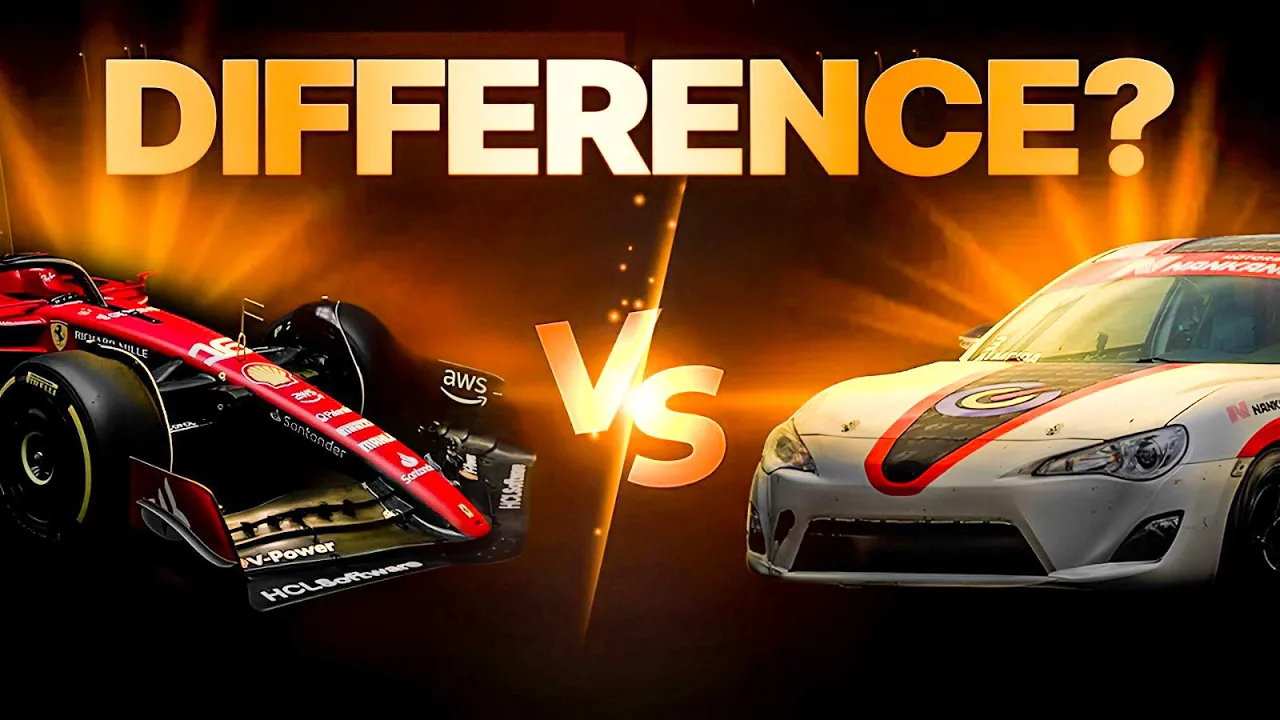
Formula vs GT Racing: Why Your Technique Must Change Between Cars
Suellio Almeida
•
Monday, May 29, 2023
The Physics Don't Lie: Why Formula and GT Cars Handle Nothing Alike
You're mid-corner in a Formula car. Light. Responsive. The front end bites.
Now you're in a GT. Heavy. The car fights you. The front pushes.
Same driver. Same track. Completely different techniques required.
Here's what most sim racers miss: Formula and GT cars demand opposite approaches to weight transfer, braking, and rotation. Drive them the same way, and you'll wonder why one always feels "wrong."
Let me show you exactly what changes.
Weight Distribution: The Core Difference That Rewrites Everything
Formula cars are light and centralized. We're talking 600-700kg with most of the weight between the axles.
GT cars? 1,300kg+ with mass hanging off the ends — engine in the back or front, fuel tanks, the whole chassis structure.
This changes how weight transfers under braking and acceleration.
In a Formula car, weight transfer is immediate and sharp. You brake, the nose dives, front grip appears instantly. Release the brake, the rear plants, you're already on throttle.
In a GT, weight transfer is slow and heavy. The car rolls. It takes time for load to settle on the front tires. If you release the brake too early, the front hasn't loaded yet — you get understeer.
This is why you can't copy your GT technique into a Formula car. The timing is completely different.
Braking Technique: Why Formula Cars Let You Get Away With Murder
Formula cars are forgiving on initial braking pressure.
You can hit the brakes hard, the aero keeps the car stable, and the light weight means you're not fighting massive inertia. The front tires load fast. You get rotation.
GT cars? You need progressive braking pressure.
If you stomp the brakes, you overload the front before the weight has time to settle properly. The car pitches. The rear gets light. You get instability.
In GT, you need to squeeze the brake pedal. Build pressure. Let the weight transfer gradually. Give the suspension time to compress and the tires time to load.
Formula cars reward aggression. GT cars punish it.
That's the fundamental shift.
Trail Braking: Same Concept, Completely Different Execution
Both car types use trail braking. But how you execute it changes everything.
In a Formula car, trail braking is about keeping aero load. You're bleeding off brake pressure to keep the front planted while the car rotates. The rotation happens fast because the car is light and the rear is unstable once you turn in.
You can release the brake relatively early. The car is already rotating. You're managing that rotation, not creating it.
In a GT car, trail braking is about creating rotation. The car is stable — too stable. It wants to understeer. So you trail brake deeper into the corner to keep weight on the front and help the car turn.
You're releasing the brake later than in a Formula car. And you're releasing it slower. If you come off the brake too fast, the weight shifts back, the front unloads, and you push wide.
Same technique name. Opposite application.
Steering Input: Why Formula Cars Punish Overdriving
Formula cars have quick steering racks and immediate response.
You don't need much steering angle. A small input, the front bites, the car changes direction. If you overdo it, you scrub speed. The car gets nervous.
Smooth, precise, minimal input. That's the Formula car game.
GT cars need more steering commitment. The car is heavier. The front doesn't respond as sharply. You need to give it more angle to initiate the turn, then manage the rotation with throttle and brake.
You can also get away with correcting mid-corner in a GT. The car is more stable. You have time to adjust.
In a Formula car, if you're adjusting mid-corner, you've already lost time. The correction itself is slow.
Throttle Application: Where GT Drivers Blow Corners
Formula cars let you apply throttle early and aggressively.
The rear is planted. The weight is centered. The aero is working. You can get on the gas while still unwinding the wheel and the car stays stable.
GT cars — especially rear-engine GT cars — are twitchy on throttle.
The weight is already in the back. Add throttle too early, and you unload the front even more. The car understeers. Or worse, if you're aggressive on a trailing throttle oversteer car, the rear snaps.
You need to wait for the car to settle. Let the weight come back to the rear naturally. Then apply throttle progressively.
Formula cars reward early throttle. GT cars punish it.
Rotation Point: Why Your MRP Needs to Shift
The Maximum Rotation Point — the moment the car is turning the most before you start unwinding — moves between car types.
In a Formula car, MRP happens earlier in the corner. The car rotates fast. You're already managing exit before you hit the apex.
In a GT car, MRP happens at or after the apex. The car is slow to rotate. You're still working to get it turned even as you reach the apex.
If you try to apply a Formula car's early-rotation mindset to a GT, you'll understeer every corner exit. The car hasn't turned yet.
If you try to apply a GT's late-rotation mindset to a Formula car, you'll scrub speed mid-corner. The car has already rotated — you're holding it back.
Your vision and timing need to adjust based on what you're driving.
Aero Dependency: The Invisible Force That Changes Everything
Formula cars are aero-dependent. Slow down too much, you lose downforce, the car becomes unstable.
You need to carry minimum speed through corners. This changes how you approach slow corners — you can't just brake late and pivot. You need to maintain momentum to keep the aero working.
GT cars are mechanically dependent. They rely on suspension, tire grip, weight transfer. Aero helps, but it's not make-or-break.
This is why GT cars feel more "traditional" — the techniques are closer to real-world road car physics. Formula cars exist in their own aero-driven world.
Setup Philosophy: Opposite Baseline Approaches
Formula car setup is about maximizing aero efficiency while keeping the car balanced.
You're chasing downforce without drag. You're adjusting wings, rake, ride height. The suspension is stiff because the aero provides the grip.
GT car setup is about mechanical grip and weight transfer management.
You're tuning springs, dampers, anti-roll bars to get the car to rotate without snapping. You're managing tire temperatures and pressures. Aero is secondary.
If you bring a GT setup mindset into Formula car tuning, you'll end up with a car that's too soft and loses aero platform.
If you bring a Formula setup mindset into GT tuning, you'll end up with a car that's too stiff and won't load the tires properly.
Who Should You Be? The Specialist vs The Complete Driver
Here's the reality: Most top sim racers specialize.
You have GT specialists. You have Formula specialists. They've spent thousands of hours in one discipline and they're fast because they've mastered that specific technique.
But the complete driver understands both.
And here's why that matters: The fundamentals are the same. The execution is different.
Weight transfer. Vision. Trail braking. Throttle management. These concepts exist in both Formula and GT racing.
If you only drive one, you're learning the concept in one context.
If you drive both, you're learning the concept in two contexts — which means you understand it deeper.
I coach drivers across every discipline. The ones who improve fastest? The ones who don't lock themselves into one car type.
They drive Formula. They drive GT. They drive prototypes. They absorb the differences and it makes them sharper everywhere.
What's Your Default Technique?
Here's the test: Which car feels more natural to you?
If GT feels natural, you're probably a smooth, patient driver. You build the corner. You let the car settle. You manage weight transfer gradually.
If Formula feels natural, you're probably a sharp, reactive driver. You respond fast. You trust the car. You're comfortable with instant rotation.
Neither is better. But knowing your default tells you what you need to work on.
If you're a GT driver trying to go fast in Formula, you need to trust the car more and be more aggressive. Stop waiting for the car to settle — it already has.
If you're a Formula driver trying to go fast in GT, you need to slow down your inputs and let weight transfer happen. Stop expecting instant response — it's not coming.
The car will teach you if you listen.
Stop Forcing One Technique Across All Cars
This is the mistake I see constantly: Drivers find one technique that works and try to apply it everywhere.
They get fast in GT3. Then they jump into Formula Renault and wonder why they're slow.
Or they dominate in F3. Then they try GTE and can't figure out why the car won't turn.
The technique that made you fast in one car is the exact technique holding you back in another.
You need to adapt. Not just your inputs — your entire mental approach to the corner.
Formula cars demand anticipation and trust.
GT cars demand patience and precision.
If you're still driving them the same way, you're leaving seconds on the table.
Want to Master Both? You Need Proper Training.
You now understand the differences. But understanding isn't execution.
How do you actually retrain your muscle memory when switching between car types?
How do you know if you're trail braking too early or too late for the car you're in?
How do you adjust your vision and rotation timing when the physics fundamentally change?
You can't figure that out from a YouTube comment section.
You need structured training. You need drills. You need someone analyzing your inputs and telling you where the technique is breaking down.
That's what we do at Almeida Racing Academy. We train drivers across Formula, GT, prototype — every discipline. Because the fastest drivers aren't specialists. They're adaptable.
We have a free Car Handling course that breaks down weight transfer, braking, and rotation in multiple car types. It's 11 lessons. No credit card. Just proper coaching.
If you're serious about becoming a complete driver — someone who can jump into any car and be fast —
.
Sim Racing Academy Membership
Everything you need to stop guessing and start getting faster.
Starting at
$25
/mo
Car Handling Online Course
4 levels, full curriculum. Aimed to get you to top 1% in driving pace.
Racecraft Online Course
Overtaking, Defending, Race Strategy
Live coaching + on-track practice
Bi-weekly pro-coach workshops (recorded — never miss one) plus on-track Pit Parties to practice racecraft with a coach.
Plus These Bonuses
13,000+ Member Community
League Racing
Advanced MX-5 Mini Course
Racing Technique Development Guide
The Motor Racing Book (260 pages)
Think & Behave Like a Pro Driver — Mini eBook
Formula vs GT Racing: Why Your Technique Must Change Between Cars
Suellio Almeida
•
Monday, May 29, 2023
The Physics Don't Lie: Why Formula and GT Cars Handle Nothing Alike
You're mid-corner in a Formula car. Light. Responsive. The front end bites.
Now you're in a GT. Heavy. The car fights you. The front pushes.
Same driver. Same track. Completely different techniques required.
Here's what most sim racers miss: Formula and GT cars demand opposite approaches to weight transfer, braking, and rotation. Drive them the same way, and you'll wonder why one always feels "wrong."
Let me show you exactly what changes.
Weight Distribution: The Core Difference That Rewrites Everything
Formula cars are light and centralized. We're talking 600-700kg with most of the weight between the axles.
GT cars? 1,300kg+ with mass hanging off the ends — engine in the back or front, fuel tanks, the whole chassis structure.
This changes how weight transfers under braking and acceleration.
In a Formula car, weight transfer is immediate and sharp. You brake, the nose dives, front grip appears instantly. Release the brake, the rear plants, you're already on throttle.
In a GT, weight transfer is slow and heavy. The car rolls. It takes time for load to settle on the front tires. If you release the brake too early, the front hasn't loaded yet — you get understeer.
This is why you can't copy your GT technique into a Formula car. The timing is completely different.
Braking Technique: Why Formula Cars Let You Get Away With Murder
Formula cars are forgiving on initial braking pressure.
You can hit the brakes hard, the aero keeps the car stable, and the light weight means you're not fighting massive inertia. The front tires load fast. You get rotation.
GT cars? You need progressive braking pressure.
If you stomp the brakes, you overload the front before the weight has time to settle properly. The car pitches. The rear gets light. You get instability.
In GT, you need to squeeze the brake pedal. Build pressure. Let the weight transfer gradually. Give the suspension time to compress and the tires time to load.
Formula cars reward aggression. GT cars punish it.
That's the fundamental shift.
Trail Braking: Same Concept, Completely Different Execution
Both car types use trail braking. But how you execute it changes everything.
In a Formula car, trail braking is about keeping aero load. You're bleeding off brake pressure to keep the front planted while the car rotates. The rotation happens fast because the car is light and the rear is unstable once you turn in.
You can release the brake relatively early. The car is already rotating. You're managing that rotation, not creating it.
In a GT car, trail braking is about creating rotation. The car is stable — too stable. It wants to understeer. So you trail brake deeper into the corner to keep weight on the front and help the car turn.
You're releasing the brake later than in a Formula car. And you're releasing it slower. If you come off the brake too fast, the weight shifts back, the front unloads, and you push wide.
Same technique name. Opposite application.
Steering Input: Why Formula Cars Punish Overdriving
Formula cars have quick steering racks and immediate response.
You don't need much steering angle. A small input, the front bites, the car changes direction. If you overdo it, you scrub speed. The car gets nervous.
Smooth, precise, minimal input. That's the Formula car game.
GT cars need more steering commitment. The car is heavier. The front doesn't respond as sharply. You need to give it more angle to initiate the turn, then manage the rotation with throttle and brake.
You can also get away with correcting mid-corner in a GT. The car is more stable. You have time to adjust.
In a Formula car, if you're adjusting mid-corner, you've already lost time. The correction itself is slow.
Throttle Application: Where GT Drivers Blow Corners
Formula cars let you apply throttle early and aggressively.
The rear is planted. The weight is centered. The aero is working. You can get on the gas while still unwinding the wheel and the car stays stable.
GT cars — especially rear-engine GT cars — are twitchy on throttle.
The weight is already in the back. Add throttle too early, and you unload the front even more. The car understeers. Or worse, if you're aggressive on a trailing throttle oversteer car, the rear snaps.
You need to wait for the car to settle. Let the weight come back to the rear naturally. Then apply throttle progressively.
Formula cars reward early throttle. GT cars punish it.
Rotation Point: Why Your MRP Needs to Shift
The Maximum Rotation Point — the moment the car is turning the most before you start unwinding — moves between car types.
In a Formula car, MRP happens earlier in the corner. The car rotates fast. You're already managing exit before you hit the apex.
In a GT car, MRP happens at or after the apex. The car is slow to rotate. You're still working to get it turned even as you reach the apex.
If you try to apply a Formula car's early-rotation mindset to a GT, you'll understeer every corner exit. The car hasn't turned yet.
If you try to apply a GT's late-rotation mindset to a Formula car, you'll scrub speed mid-corner. The car has already rotated — you're holding it back.
Your vision and timing need to adjust based on what you're driving.
Aero Dependency: The Invisible Force That Changes Everything
Formula cars are aero-dependent. Slow down too much, you lose downforce, the car becomes unstable.
You need to carry minimum speed through corners. This changes how you approach slow corners — you can't just brake late and pivot. You need to maintain momentum to keep the aero working.
GT cars are mechanically dependent. They rely on suspension, tire grip, weight transfer. Aero helps, but it's not make-or-break.
This is why GT cars feel more "traditional" — the techniques are closer to real-world road car physics. Formula cars exist in their own aero-driven world.
Setup Philosophy: Opposite Baseline Approaches
Formula car setup is about maximizing aero efficiency while keeping the car balanced.
You're chasing downforce without drag. You're adjusting wings, rake, ride height. The suspension is stiff because the aero provides the grip.
GT car setup is about mechanical grip and weight transfer management.
You're tuning springs, dampers, anti-roll bars to get the car to rotate without snapping. You're managing tire temperatures and pressures. Aero is secondary.
If you bring a GT setup mindset into Formula car tuning, you'll end up with a car that's too soft and loses aero platform.
If you bring a Formula setup mindset into GT tuning, you'll end up with a car that's too stiff and won't load the tires properly.
Who Should You Be? The Specialist vs The Complete Driver
Here's the reality: Most top sim racers specialize.
You have GT specialists. You have Formula specialists. They've spent thousands of hours in one discipline and they're fast because they've mastered that specific technique.
But the complete driver understands both.
And here's why that matters: The fundamentals are the same. The execution is different.
Weight transfer. Vision. Trail braking. Throttle management. These concepts exist in both Formula and GT racing.
If you only drive one, you're learning the concept in one context.
If you drive both, you're learning the concept in two contexts — which means you understand it deeper.
I coach drivers across every discipline. The ones who improve fastest? The ones who don't lock themselves into one car type.
They drive Formula. They drive GT. They drive prototypes. They absorb the differences and it makes them sharper everywhere.
What's Your Default Technique?
Here's the test: Which car feels more natural to you?
If GT feels natural, you're probably a smooth, patient driver. You build the corner. You let the car settle. You manage weight transfer gradually.
If Formula feels natural, you're probably a sharp, reactive driver. You respond fast. You trust the car. You're comfortable with instant rotation.
Neither is better. But knowing your default tells you what you need to work on.
If you're a GT driver trying to go fast in Formula, you need to trust the car more and be more aggressive. Stop waiting for the car to settle — it already has.
If you're a Formula driver trying to go fast in GT, you need to slow down your inputs and let weight transfer happen. Stop expecting instant response — it's not coming.
The car will teach you if you listen.
Stop Forcing One Technique Across All Cars
This is the mistake I see constantly: Drivers find one technique that works and try to apply it everywhere.
They get fast in GT3. Then they jump into Formula Renault and wonder why they're slow.
Or they dominate in F3. Then they try GTE and can't figure out why the car won't turn.
The technique that made you fast in one car is the exact technique holding you back in another.
You need to adapt. Not just your inputs — your entire mental approach to the corner.
Formula cars demand anticipation and trust.
GT cars demand patience and precision.
If you're still driving them the same way, you're leaving seconds on the table.
Want to Master Both? You Need Proper Training.
You now understand the differences. But understanding isn't execution.
How do you actually retrain your muscle memory when switching between car types?
How do you know if you're trail braking too early or too late for the car you're in?
How do you adjust your vision and rotation timing when the physics fundamentally change?
You can't figure that out from a YouTube comment section.
You need structured training. You need drills. You need someone analyzing your inputs and telling you where the technique is breaking down.
That's what we do at Almeida Racing Academy. We train drivers across Formula, GT, prototype — every discipline. Because the fastest drivers aren't specialists. They're adaptable.
We have a free Car Handling course that breaks down weight transfer, braking, and rotation in multiple car types. It's 11 lessons. No credit card. Just proper coaching.
If you're serious about becoming a complete driver — someone who can jump into any car and be fast —
.
Sim Racing Academy Membership
Everything you need to stop guessing and start getting faster.
Starting at
$25
/mo
Car Handling Online Course
4 levels, full curriculum. Aimed to get you to top 1% in driving pace.
Racecraft Online Course
Overtaking, Defending, Race Strategy
Live coaching + on-track practice
Bi-weekly pro-coach workshops (recorded — never miss one) plus on-track Pit Parties to practice racecraft with a coach.
Plus These Bonuses
13,000+ Member Community
League Racing
Advanced MX-5 Mini Course
Racing Technique Development Guide
The Motor Racing Book (260 pages)
Think & Behave Like a Pro Driver — Mini eBook
Formula vs GT Racing: Why Your Technique Must Change Between Cars
Suellio Almeida
•
Monday, May 29, 2023
The Physics Don't Lie: Why Formula and GT Cars Handle Nothing Alike
You're mid-corner in a Formula car. Light. Responsive. The front end bites.
Now you're in a GT. Heavy. The car fights you. The front pushes.
Same driver. Same track. Completely different techniques required.
Here's what most sim racers miss: Formula and GT cars demand opposite approaches to weight transfer, braking, and rotation. Drive them the same way, and you'll wonder why one always feels "wrong."
Let me show you exactly what changes.
Weight Distribution: The Core Difference That Rewrites Everything
Formula cars are light and centralized. We're talking 600-700kg with most of the weight between the axles.
GT cars? 1,300kg+ with mass hanging off the ends — engine in the back or front, fuel tanks, the whole chassis structure.
This changes how weight transfers under braking and acceleration.
In a Formula car, weight transfer is immediate and sharp. You brake, the nose dives, front grip appears instantly. Release the brake, the rear plants, you're already on throttle.
In a GT, weight transfer is slow and heavy. The car rolls. It takes time for load to settle on the front tires. If you release the brake too early, the front hasn't loaded yet — you get understeer.
This is why you can't copy your GT technique into a Formula car. The timing is completely different.
Braking Technique: Why Formula Cars Let You Get Away With Murder
Formula cars are forgiving on initial braking pressure.
You can hit the brakes hard, the aero keeps the car stable, and the light weight means you're not fighting massive inertia. The front tires load fast. You get rotation.
GT cars? You need progressive braking pressure.
If you stomp the brakes, you overload the front before the weight has time to settle properly. The car pitches. The rear gets light. You get instability.
In GT, you need to squeeze the brake pedal. Build pressure. Let the weight transfer gradually. Give the suspension time to compress and the tires time to load.
Formula cars reward aggression. GT cars punish it.
That's the fundamental shift.
Trail Braking: Same Concept, Completely Different Execution
Both car types use trail braking. But how you execute it changes everything.
In a Formula car, trail braking is about keeping aero load. You're bleeding off brake pressure to keep the front planted while the car rotates. The rotation happens fast because the car is light and the rear is unstable once you turn in.
You can release the brake relatively early. The car is already rotating. You're managing that rotation, not creating it.
In a GT car, trail braking is about creating rotation. The car is stable — too stable. It wants to understeer. So you trail brake deeper into the corner to keep weight on the front and help the car turn.
You're releasing the brake later than in a Formula car. And you're releasing it slower. If you come off the brake too fast, the weight shifts back, the front unloads, and you push wide.
Same technique name. Opposite application.
Steering Input: Why Formula Cars Punish Overdriving
Formula cars have quick steering racks and immediate response.
You don't need much steering angle. A small input, the front bites, the car changes direction. If you overdo it, you scrub speed. The car gets nervous.
Smooth, precise, minimal input. That's the Formula car game.
GT cars need more steering commitment. The car is heavier. The front doesn't respond as sharply. You need to give it more angle to initiate the turn, then manage the rotation with throttle and brake.
You can also get away with correcting mid-corner in a GT. The car is more stable. You have time to adjust.
In a Formula car, if you're adjusting mid-corner, you've already lost time. The correction itself is slow.
Throttle Application: Where GT Drivers Blow Corners
Formula cars let you apply throttle early and aggressively.
The rear is planted. The weight is centered. The aero is working. You can get on the gas while still unwinding the wheel and the car stays stable.
GT cars — especially rear-engine GT cars — are twitchy on throttle.
The weight is already in the back. Add throttle too early, and you unload the front even more. The car understeers. Or worse, if you're aggressive on a trailing throttle oversteer car, the rear snaps.
You need to wait for the car to settle. Let the weight come back to the rear naturally. Then apply throttle progressively.
Formula cars reward early throttle. GT cars punish it.
Rotation Point: Why Your MRP Needs to Shift
The Maximum Rotation Point — the moment the car is turning the most before you start unwinding — moves between car types.
In a Formula car, MRP happens earlier in the corner. The car rotates fast. You're already managing exit before you hit the apex.
In a GT car, MRP happens at or after the apex. The car is slow to rotate. You're still working to get it turned even as you reach the apex.
If you try to apply a Formula car's early-rotation mindset to a GT, you'll understeer every corner exit. The car hasn't turned yet.
If you try to apply a GT's late-rotation mindset to a Formula car, you'll scrub speed mid-corner. The car has already rotated — you're holding it back.
Your vision and timing need to adjust based on what you're driving.
Aero Dependency: The Invisible Force That Changes Everything
Formula cars are aero-dependent. Slow down too much, you lose downforce, the car becomes unstable.
You need to carry minimum speed through corners. This changes how you approach slow corners — you can't just brake late and pivot. You need to maintain momentum to keep the aero working.
GT cars are mechanically dependent. They rely on suspension, tire grip, weight transfer. Aero helps, but it's not make-or-break.
This is why GT cars feel more "traditional" — the techniques are closer to real-world road car physics. Formula cars exist in their own aero-driven world.
Setup Philosophy: Opposite Baseline Approaches
Formula car setup is about maximizing aero efficiency while keeping the car balanced.
You're chasing downforce without drag. You're adjusting wings, rake, ride height. The suspension is stiff because the aero provides the grip.
GT car setup is about mechanical grip and weight transfer management.
You're tuning springs, dampers, anti-roll bars to get the car to rotate without snapping. You're managing tire temperatures and pressures. Aero is secondary.
If you bring a GT setup mindset into Formula car tuning, you'll end up with a car that's too soft and loses aero platform.
If you bring a Formula setup mindset into GT tuning, you'll end up with a car that's too stiff and won't load the tires properly.
Who Should You Be? The Specialist vs The Complete Driver
Here's the reality: Most top sim racers specialize.
You have GT specialists. You have Formula specialists. They've spent thousands of hours in one discipline and they're fast because they've mastered that specific technique.
But the complete driver understands both.
And here's why that matters: The fundamentals are the same. The execution is different.
Weight transfer. Vision. Trail braking. Throttle management. These concepts exist in both Formula and GT racing.
If you only drive one, you're learning the concept in one context.
If you drive both, you're learning the concept in two contexts — which means you understand it deeper.
I coach drivers across every discipline. The ones who improve fastest? The ones who don't lock themselves into one car type.
They drive Formula. They drive GT. They drive prototypes. They absorb the differences and it makes them sharper everywhere.
What's Your Default Technique?
Here's the test: Which car feels more natural to you?
If GT feels natural, you're probably a smooth, patient driver. You build the corner. You let the car settle. You manage weight transfer gradually.
If Formula feels natural, you're probably a sharp, reactive driver. You respond fast. You trust the car. You're comfortable with instant rotation.
Neither is better. But knowing your default tells you what you need to work on.
If you're a GT driver trying to go fast in Formula, you need to trust the car more and be more aggressive. Stop waiting for the car to settle — it already has.
If you're a Formula driver trying to go fast in GT, you need to slow down your inputs and let weight transfer happen. Stop expecting instant response — it's not coming.
The car will teach you if you listen.
Stop Forcing One Technique Across All Cars
This is the mistake I see constantly: Drivers find one technique that works and try to apply it everywhere.
They get fast in GT3. Then they jump into Formula Renault and wonder why they're slow.
Or they dominate in F3. Then they try GTE and can't figure out why the car won't turn.
The technique that made you fast in one car is the exact technique holding you back in another.
You need to adapt. Not just your inputs — your entire mental approach to the corner.
Formula cars demand anticipation and trust.
GT cars demand patience and precision.
If you're still driving them the same way, you're leaving seconds on the table.
Want to Master Both? You Need Proper Training.
You now understand the differences. But understanding isn't execution.
How do you actually retrain your muscle memory when switching between car types?
How do you know if you're trail braking too early or too late for the car you're in?
How do you adjust your vision and rotation timing when the physics fundamentally change?
You can't figure that out from a YouTube comment section.
You need structured training. You need drills. You need someone analyzing your inputs and telling you where the technique is breaking down.
That's what we do at Almeida Racing Academy. We train drivers across Formula, GT, prototype — every discipline. Because the fastest drivers aren't specialists. They're adaptable.
We have a free Car Handling course that breaks down weight transfer, braking, and rotation in multiple car types. It's 11 lessons. No credit card. Just proper coaching.
If you're serious about becoming a complete driver — someone who can jump into any car and be fast —
.
Sim Racing Academy Membership
Everything you need to stop guessing and start getting faster.
Starting at
$25
/mo
Car Handling Online Course
4 levels, full curriculum. Aimed to get you to top 1% in driving pace.
Racecraft Online Course
Overtaking, Defending, Race Strategy
Live coaching + on-track practice
Bi-weekly pro-coach workshops (recorded — never miss one) plus on-track Pit Parties to practice racecraft with a coach.
Plus These Bonuses
13,000+ Member Community
League Racing
Advanced MX-5 Mini Course
Racing Technique Development Guide
The Motor Racing Book (260 pages)
Think & Behave Like a Pro Driver — Mini eBook